Desuggestopedia
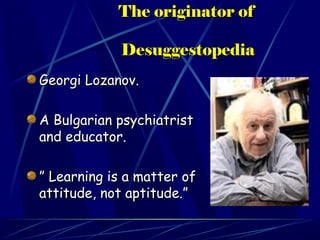
The originator of

            Desuggestopedia
Georgi Lozanov.

A Bulgarian psychiatrist
and educator.

” Learning is a matter of
attitude, not aptitude.”
The meaning of
   desuggestopedia

  suggest => desuggest
This method puts importance
on “desuggesting limitations on
learning.”
We set up psychological barriers to
learning and thus we do not use the
full mental powers we have; in order
to use our reserved capacity, the
limitations we think we have need to
be “desuggested.”
The goal of the teachers

The goal of the teachers using
the teaching method is to help
students eliminate and
overcome the barriers to
learning and increase their
communicative ability.
The teacher speaks confidently;

The teacher should integrate
indirect positive suggestions (there
is no limit to what you can do) into
the learning situation.
Peripheral learning
We perceive much more in our
environment than that to which we
consciously attend.
“When there is a unity between
conscious and subconscious,
learning is enhanced.”
Fine arts
One of the ways the students’
mental reserves are
stimulated is through
integration of the fine arts-
music, drama, or paintings.
Enjoy your learning
The teacher gives the
students the impression that
learning is easy and enjoyable.
Choosing a new identity
This enhances students’
feeling of security and allows
them to be more open.
Active concert
Teacher will introduce a story as related in
the dialog and call the students’ attention
to some particular grammatical points that
arise in it, she reads the dialog in the
target language. Music is played. The
teacher begins a slow, dramatic reading,
synchronized in intonation with the music.
The music is classical and the teacher’s
voice rises and falls with the music.
Passive concert
In the phase, the students are asked
to put their scripts aside. They simply
listen as the teacher reads the dialog
at a normal rate of speed. The
teacher is seated and reads with
musical accompaniment.
Primary activation
The students playfully reread the
target language dialog out loud, as
individuals or in groups. Students are
asked to read the dialog in particular
manner: sadly, angrily, and cheerfully.
Creative adaptation
The students engage in various
activities designed to help them learn
the new material and use it
spontaneously. Activities particularly
recommended for this phase include
singing, dancing, dramatizations, and
games.
~Thank You ~

desuggestopedia

  • 1.
  • 2.
    The originator of Desuggestopedia Georgi Lozanov. A Bulgarian psychiatrist and educator. ” Learning is a matter of attitude, not aptitude.”
  • 3.
    The meaning of desuggestopedia suggest => desuggest This method puts importance on “desuggesting limitations on learning.”
  • 4.
    We set uppsychological barriers to learning and thus we do not use the full mental powers we have; in order to use our reserved capacity, the limitations we think we have need to be “desuggested.”
  • 5.
    The goal ofthe teachers The goal of the teachers using the teaching method is to help students eliminate and overcome the barriers to learning and increase their communicative ability.
  • 6.
    The teacher speaksconfidently; The teacher should integrate indirect positive suggestions (there is no limit to what you can do) into the learning situation.
  • 7.
    Peripheral learning We perceivemuch more in our environment than that to which we consciously attend. “When there is a unity between conscious and subconscious, learning is enhanced.”
  • 8.
    Fine arts One ofthe ways the students’ mental reserves are stimulated is through integration of the fine arts- music, drama, or paintings.
  • 9.
    Enjoy your learning Theteacher gives the students the impression that learning is easy and enjoyable.
  • 10.
    Choosing a newidentity This enhances students’ feeling of security and allows them to be more open.
  • 11.
    Active concert Teacher willintroduce a story as related in the dialog and call the students’ attention to some particular grammatical points that arise in it, she reads the dialog in the target language. Music is played. The teacher begins a slow, dramatic reading, synchronized in intonation with the music. The music is classical and the teacher’s voice rises and falls with the music.
  • 12.
    Passive concert In thephase, the students are asked to put their scripts aside. They simply listen as the teacher reads the dialog at a normal rate of speed. The teacher is seated and reads with musical accompaniment.
  • 13.
    Primary activation The studentsplayfully reread the target language dialog out loud, as individuals or in groups. Students are asked to read the dialog in particular manner: sadly, angrily, and cheerfully.
  • 14.
    Creative adaptation The studentsengage in various activities designed to help them learn the new material and use it spontaneously. Activities particularly recommended for this phase include singing, dancing, dramatizations, and games.
  • 15.