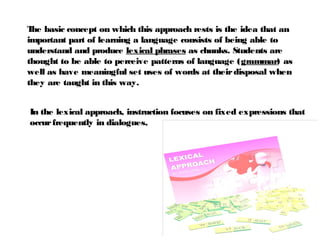
In the lexical approach, instruction focuses on fixed expressions that
occurfrequently in dialogues,
The basic concept on which this approach rests is the idea that an
important part of learning a language consists of being able to
understand and produce lexical phrases as chunks. Students are
thought to be able to perceive patterns of language (grammar) as
well as have meaningful set uses of words at theirdisposal when
they are taught in this way.
Approach Chunks
Collocations
Lexical Units
Minimal Pairs
single Words (pencil, watch)
Polywords (by the way,anyway
Trinomials: cool, calm, upside down
Similes: as old as the hills. Convinced
Connectives: finally, to
Fixed Expressions Social greetings
( Good morning! It’s a lovely morning, isn’t it )
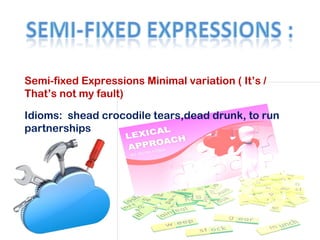
Semi-fixed Expressions Minimal variation ( It’s /
That’s not my fault)
Idioms: shead crocodile tears,dead drunk, to run
partnerships
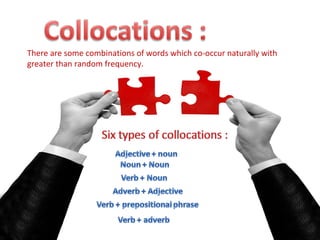
There are some combinations of words which co-occur naturally with
greater than random frequency.
Introduction of chunks – practice of chunks – accumulation of chunks,
use of chunks and coolocations
Teaching individual collocations
Making students aware of collocattions
Extanding what students already know by adding knowledge of
collocation
restrictions to know vocabulary
Storing collocations through encouragin students to keep a lexical
notebook
It lacks full
characterization of an
approach lack of a
detailed learning theory
Deliberately draw attention to chunks, collocations, idioms, etc.. And
invite
learners to do the same
Focus attention on identifying and using chunks
Teach learners to be critically aware
Teach the what good language learners do and how to do it
It is lexically based theory of language
It doesn’t have any certain learning theory
Learning lexis is not an easy task, it is a slow and complex process
which
require a lot of dedication and effort from teachers and learnerS

Lexical approach Presentation

  • 3.
    In the lexicalapproach, instruction focuses on fixed expressions that occurfrequently in dialogues, The basic concept on which this approach rests is the idea that an important part of learning a language consists of being able to understand and produce lexical phrases as chunks. Students are thought to be able to perceive patterns of language (grammar) as well as have meaningful set uses of words at theirdisposal when they are taught in this way.
  • 5.
  • 6.
    single Words (pencil,watch) Polywords (by the way,anyway
  • 7.
    Trinomials: cool, calm,upside down Similes: as old as the hills. Convinced Connectives: finally, to
  • 8.
    Fixed Expressions Socialgreetings ( Good morning! It’s a lovely morning, isn’t it )
  • 9.
    Semi-fixed Expressions Minimalvariation ( It’s / That’s not my fault) Idioms: shead crocodile tears,dead drunk, to run partnerships
  • 10.
    There are somecombinations of words which co-occur naturally with greater than random frequency.
  • 11.
    Introduction of chunks– practice of chunks – accumulation of chunks, use of chunks and coolocations Teaching individual collocations Making students aware of collocattions Extanding what students already know by adding knowledge of collocation restrictions to know vocabulary Storing collocations through encouragin students to keep a lexical notebook
  • 12.
    It lacks full characterizationof an approach lack of a detailed learning theory
  • 13.
    Deliberately draw attentionto chunks, collocations, idioms, etc.. And invite learners to do the same Focus attention on identifying and using chunks Teach learners to be critically aware Teach the what good language learners do and how to do it It is lexically based theory of language It doesn’t have any certain learning theory Learning lexis is not an easy task, it is a slow and complex process which require a lot of dedication and effort from teachers and learnerS