
The Ethical Thinking Cap
Torill Bull, Elisha Riggs, & Sussy Nchogu ISECN Ethics Working Group
Ethics defined
• ’The discipline concerned with what is morally
good and bad, right and wrong…
• …Its subject consists of the fundamental
issues of practical decision making’
Encyclopædia Britannica, http://www.britannica.com/Torill Bull, University of Bergen, March 11
2013
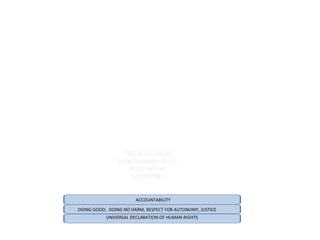
DOING GOOD, DOING NO HARM, RESPECT FOR AUTONOMY, JUSTICE
ACCOUNTABILITY
UNIVERSAL DECLARATION OF HUMAN RIGHTS
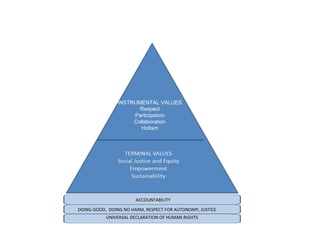
INSTRUMENTAL VALUES
Respect
Participation
Collaboration
Holism
DOING GOOD, DOING NO HARM, RESPECT FOR AUTONOMY, JUSTICE
ACCOUNTABILITY
UNIVERSAL DECLARATION OF HUMAN RIGHTS
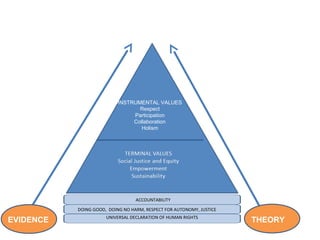
EVIDENCE THEORY
INSTRUMENTAL VALUES
Respect
Participation
Collaboration
Holism
DOING GOOD, DOING NO HARM, RESPECT FOR AUTONOMY, JUSTICE
ACCOUNTABILITY
UNIVERSAL DECLARATION OF HUMAN RIGHTS
EVIDENCE THEORY
INSTRUMENTAL VALUES
Respect
Participation
Collaboration
Holism
DOING GOOD, DOING NO HARM, RESPECT FOR AUTONOMY, JUSTICE
ACCOUNTABILITY
UNIVERSAL DECLARATION OF HUMAN RIGHTS
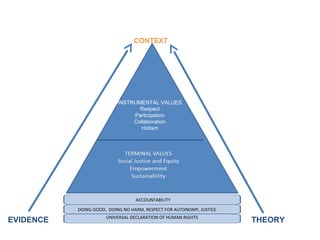
CONTEXT
EVIDENCE THEORY
INSTRUMENTAL VALUES
Respect
Participation
Collaboration
Holism
DOING GOOD, DOING NO HARM, RESPECT FOR AUTONOMY, JUSTICE
ACCOUNTABILITY
UNIVERSAL DECLARATION OF HUMAN RIGHTS
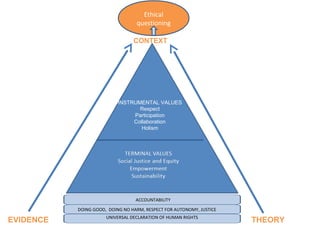
Ethical
questioning
CONTEXT
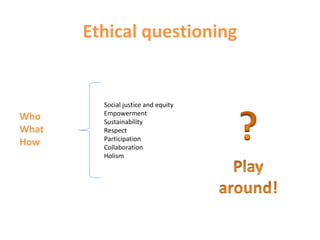
Ethical questioning
Social justice and equity
Empowerment
Sustainability
Respect
Participation
Collaboration
Holism
Who
What
How
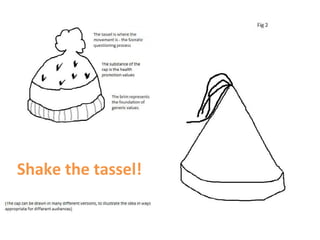
Shake the tassel!
Socratic questioning
“Socrates was one of the greatest educators who taught
by asking questions and thus drawing out answers from
his pupils ('ex duco', means to 'lead out', which is the
root of 'education')...
…The overall purpose of Socratic questioning, is to
challenge accuracy and completeness of thinking in a way
that acts to move people towards their ultimate goal.”
•http://changingminds.org/techniques/questioning/soc
ratic_questions.htm
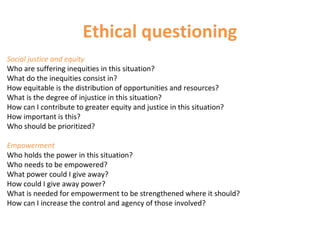
Ethical questioning
Social justice and equity
Who are suffering inequities in this situation?
What do the inequities consist in?
How equitable is the distribution of opportunities and resources?
What is the degree of injustice in this situation?
How can I contribute to greater equity and justice in this situation?
How important is this?
Who should be prioritized?
Empowerment
Who holds the power in this situation?
Who needs to be empowered?
What power could I give away?
How could I give away power?
What is needed for empowerment to be strengthened where it should?
How can I increase the control and agency of those involved?
 
Beauchamp, T. L., & Childress, J. F. (2001). Principles of Biomedical Ethics. Oxford University Press.
 
Bull, T., Riggs, E. & Nchogu, S. (2012).  Does health promotion need a code of ethics? Results from an IUHPE 
mixed method survey. Global Health Promotion 19 (3), pp 8-20.                                                      doi: 
10.1177/1757975912453181
 
Dempsey, C., Battel-Kirk, B. & Barry, MM. (2011). The CompHP Core Competencies Framework for Health 
Promotion Handbook   Retrieved Sept 20 2012 from: http://www.iuhpe.org/index.html?page=614&lang=en
 
DeGeorge, Richard T. Military Ethics: A Code of Ethics for Officers. Washington,National Defense University 
Press, 1987
 
Encyclopaedia Britannica (2012). Ethics. (Main contributor Peter Singer). Retrieved Sept 20 2012 from: 
http://www.britannica.com/EBchecked/topic/194023/ethics
 
Mittelmark, M. B. (2008). Setting an ethical agenda for health promotion. Health Promot. Int., 23(1), 78–85. 
doi:10.1093/heapro/dam035
 
Seedhouse, D. (2002). Commitment to health: a shared ethical bond between professions. Journal of 
Interprofessional Care, 16(3), 249–260. doi:10.1080/13561820220146685
 
References
Torill Bull, University of Bergen, March 11 
2013
Seedhouse, D. (1988). Ethics: the heart of health care. Wiley.
SHEPS Cymru. Framework for Ethical Health Promotion. Retrieved Sept 20 2012 from:  
http://www.rsph.org.uk/en/health-promotion/collaboration-action-plan/index.cfm 
 
Sindall, C. (2002). Does health promotion need a code of ethics? Health Promotion International, 17(3), 201–
203.
 
Society for Public Health Education. Ethics. Code of Ethics for the Health Education Profession, Retrieved Sept 
20 2012 from: http://www.sophe.org/ethics.cfm 
 
Tannahill, A. (2008). Beyond evidence—to ethics: a decision-making framework for health promotion, public 
health and health improvement†. Health Promotion International, 23(4), 380 –390. doi:10.1093/heapro/dan032
 
United Nations (1948). The Universal Declaration of Human Rights, retrieved Sept 20 2012 from: 
http://www.un.org/en/documents/udhr/index.shtml
  
WHO (1986). The Ottawa Charter for Health Promotion. Charter adopted at an international conference on 
health promotion. The move towards a new public health, November 17-21, 1986 Ottawa, Ontario, Canada. 
Retrieved Sept 20 2012 from: 
http://www.who.int/healthpromotion/conferences/previous/ottawa/en/index.html
Socratic questioning:
http://changingminds.org/techniques/questioning/socratic_questions.htm 
Torill Bull, University of Bergen, March 11 
2013

Torill bull NHPRC 2013

  • 1.
    The Ethical ThinkingCap Torill Bull, Elisha Riggs, & Sussy Nchogu ISECN Ethics Working Group
  • 2.
    Ethics defined • ’Thediscipline concerned with what is morally good and bad, right and wrong… • …Its subject consists of the fundamental issues of practical decision making’ Encyclopædia Britannica, http://www.britannica.com/Torill Bull, University of Bergen, March 11 2013
  • 3.
    DOING GOOD, DOINGNO HARM, RESPECT FOR AUTONOMY, JUSTICE ACCOUNTABILITY UNIVERSAL DECLARATION OF HUMAN RIGHTS
  • 4.
    INSTRUMENTAL VALUES Respect Participation Collaboration Holism DOING GOOD,DOING NO HARM, RESPECT FOR AUTONOMY, JUSTICE ACCOUNTABILITY UNIVERSAL DECLARATION OF HUMAN RIGHTS
  • 5.
    EVIDENCE THEORY INSTRUMENTAL VALUES Respect Participation Collaboration Holism DOINGGOOD, DOING NO HARM, RESPECT FOR AUTONOMY, JUSTICE ACCOUNTABILITY UNIVERSAL DECLARATION OF HUMAN RIGHTS
  • 6.
    EVIDENCE THEORY INSTRUMENTAL VALUES Respect Participation Collaboration Holism DOINGGOOD, DOING NO HARM, RESPECT FOR AUTONOMY, JUSTICE ACCOUNTABILITY UNIVERSAL DECLARATION OF HUMAN RIGHTS CONTEXT
  • 7.
    EVIDENCE THEORY INSTRUMENTAL VALUES Respect Participation Collaboration Holism DOINGGOOD, DOING NO HARM, RESPECT FOR AUTONOMY, JUSTICE ACCOUNTABILITY UNIVERSAL DECLARATION OF HUMAN RIGHTS Ethical questioning CONTEXT
  • 8.
    Ethical questioning Social justiceand equity Empowerment Sustainability Respect Participation Collaboration Holism Who What How
  • 10.
  • 11.
    Socratic questioning “Socrates wasone of the greatest educators who taught by asking questions and thus drawing out answers from his pupils ('ex duco', means to 'lead out', which is the root of 'education')... …The overall purpose of Socratic questioning, is to challenge accuracy and completeness of thinking in a way that acts to move people towards their ultimate goal.” •http://changingminds.org/techniques/questioning/soc ratic_questions.htm
  • 12.
    Ethical questioning Social justiceand equity Who are suffering inequities in this situation? What do the inequities consist in? How equitable is the distribution of opportunities and resources? What is the degree of injustice in this situation? How can I contribute to greater equity and justice in this situation? How important is this? Who should be prioritized? Empowerment Who holds the power in this situation? Who needs to be empowered? What power could I give away? How could I give away power? What is needed for empowerment to be strengthened where it should? How can I increase the control and agency of those involved?
  • 13.
      Beauchamp, T. L., & Childress, J. F. (2001). Principles of BiomedicalEthics. Oxford University Press.   Bull, T., Riggs, E. & Nchogu, S. (2012).  Does health promotion need a code of ethics? Results from an IUHPE  mixed method survey. Global Health Promotion 19 (3), pp 8-20.                                                      doi:  10.1177/1757975912453181   Dempsey, C., Battel-Kirk, B. & Barry, MM. (2011). The CompHP Core Competencies Framework for Health  Promotion Handbook   Retrieved Sept 20 2012 from: http://www.iuhpe.org/index.html?page=614&lang=en   DeGeorge, Richard T. Military Ethics: A Code of Ethics for Officers. Washington,National Defense University  Press, 1987   Encyclopaedia Britannica (2012). Ethics. (Main contributor Peter Singer). Retrieved Sept 20 2012 from:  http://www.britannica.com/EBchecked/topic/194023/ethics   Mittelmark, M. B. (2008). Setting an ethical agenda for health promotion. Health Promot. Int., 23(1), 78–85.  doi:10.1093/heapro/dam035   Seedhouse, D. (2002). Commitment to health: a shared ethical bond between professions. Journal of  Interprofessional Care, 16(3), 249–260. doi:10.1080/13561820220146685   References Torill Bull, University of Bergen, March 11  2013
  • 14.
    Seedhouse, D. (1988). Ethics: the heartof health care. Wiley. SHEPS Cymru. Framework for Ethical Health Promotion. Retrieved Sept 20 2012 from:   http://www.rsph.org.uk/en/health-promotion/collaboration-action-plan/index.cfm    Sindall, C. (2002). Does health promotion need a code of ethics? Health Promotion International, 17(3), 201– 203.   Society for Public Health Education. Ethics. Code of Ethics for the Health Education Profession, Retrieved Sept  20 2012 from: http://www.sophe.org/ethics.cfm    Tannahill, A. (2008). Beyond evidence—to ethics: a decision-making framework for health promotion, public  health and health improvement†. Health Promotion International, 23(4), 380 –390. doi:10.1093/heapro/dan032   United Nations (1948). The Universal Declaration of Human Rights, retrieved Sept 20 2012 from:  http://www.un.org/en/documents/udhr/index.shtml    WHO (1986). The Ottawa Charter for Health Promotion. Charter adopted at an international conference on  health promotion. The move towards a new public health, November 17-21, 1986 Ottawa, Ontario, Canada.  Retrieved Sept 20 2012 from:  http://www.who.int/healthpromotion/conferences/previous/ottawa/en/index.html Socratic questioning: http://changingminds.org/techniques/questioning/socratic_questions.htm  Torill Bull, University of Bergen, March 11  2013

Editor's Notes

  • #2 Snakke litt om meg og om opplegg i forelesningen
  • #4 Can you see that this could look like a cap, with a tassel or pompom at the top and a brim at the bottom? The main structure: A foundation of generic ethical principles not specific to hp Adding on top health promotion principles distilled/condensed from the Ottawa Charter, in a conceptual structure from literature: terminal values, next instrumental values. The way the model is supposed to be applied is as follows: In a situation of choice you consider what is important to achieve in hp – the terminal values. You consider how it is appropriate to achieve this – the instrumental values. This process is supported by the sides – evidence AND theory. As HP is a field with a small basis of RTC type of evidence, authors suggest not an evidence BASE but choice supported by evidence and where evidence is not available – theory. The aim is to get to the top of this model, so moving up you have to go through CONTEXT. This was missing in all previous models we have considered, and we wanted it to be explicit in the model. You take all the values, evidence and theory into consideration for a specific context. When you have all these elements, you do the ethical questioning – which is basically asking relevant questions. I will return to that.
  • #5 Empowerment
  • #6 I already mentioned how evidence and theory make part of a sound decision making process in health promotion
  • #7 And then the important context:
  • #8 And then we come to the questioning: Ethical questioning is deep questioning, based on Socratic questioning: The overall purpose of Socratic questioning, is to challenge accuracy and completeness of thinking in a way that acts to move people towards their ultimate goal. Getting deeper into the issues. Like the philosophers ask: What is at stake here?
  • #9 This ethical questioning should not be difficult. Basically, one should remember the 7 values of health promotion and then play around with the simple irrogatives, such as who what how