


ETHICAL LEADERSHIP 
AMBASSADOR TRAININGTM 
www.ethical-leaders.com 
Youssef Gaboune B.Eng., M.Sc. 
Founder, Ethical Leaders 
y.gaboune@gmail.com
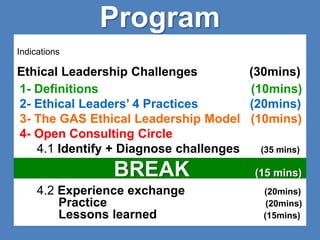
Program 
Indications 
Ethical Leadership Challenges (30mins) 
1- Definitions (10mins) 
2- Ethical Leaders’ 4 Practices (20mins) 
3- The GAS Ethical Leadership Model (10mins) 
4- Open Consulting Circle 
4.1 Identify + Diagnose challenges (35 mins) 
BREAK (15 mins) 
4.2 Experience exchange (20mins) 
Practice (20mins) 
Lessons learned (15mins)
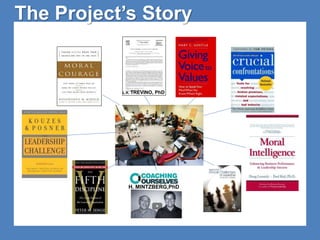
The Project’s Story 
L.K. TREVINO, PhD 
H. MINTZBERG,PhD
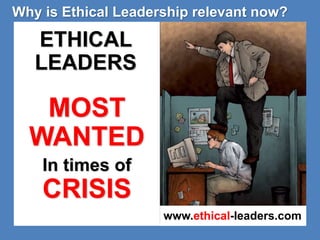
Why is Ethical Leadership relevant now? 
ETHICAL 
LEADERS 
www.ethical-leaders.com 
MOST 
WANTED 
In times of 
CRISIS
Why is Ethical Leadership relevant now? 
VIDEO 
University of Notre-Dame’s 
Ethical Leadership Program 
www.youtube.com/watch?v=OK8Pw4dzbio
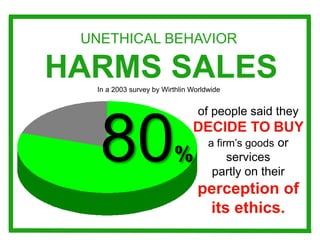
UNETHICAL BEHAVIOR 
HARMS SALES 
In a 2003 survey by Wirthlin Worldwide 
80% 
of people said they 
DECIDE TO BUY 
a firm’s goods or 
services 
partly on their 
perception of 
its ethics.
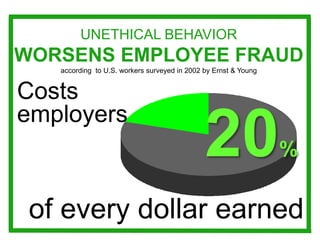
UNETHICAL BEHAVIOR 
WORSENS EMPLOYEE FRAUD 
according to U.S. workers surveyed in 2002 by Ernst & Young 
20% 
Costs 
employers 
of every dollar earned
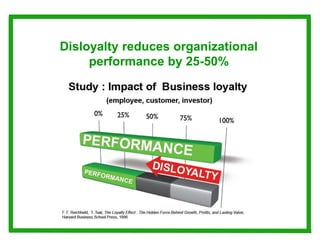
Disloyalty reduces organizational 
performance by 25-50%
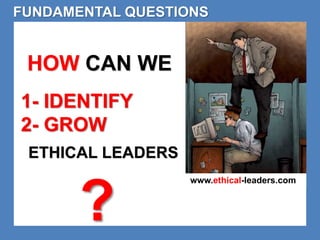
FUNDAMENTAL QUESTIONS 
ETHICAL LEADERS 
www.ethical-leaders.com 
HOW CAN WE 
1- IDENTIFY 
2- GROW 
?
How to identify Ethical Leaders? 
WATCH THEM IN 
TURBULENT TIMES
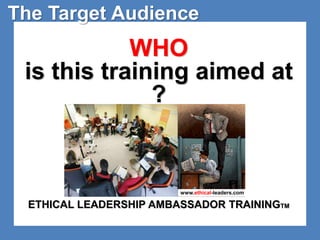
The Target Audience 
WHO 
is this training aimed at 
? 
www.ethical-leaders.com 
ETHICAL LEADERSHIP AMBASSADOR TRAININGTM
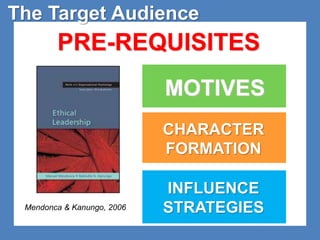
The Target Audience 
PRE-REQUISITES 
MOTIVES 
CHARACTER 
FORMATION 
INFLUENCE 
Mendonca & Kanungo, 2006 STRATEGIES
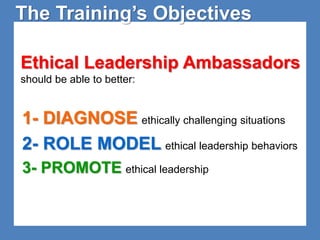
The Training’s Objectives 
Ethical Leadership Ambassadors 
should be able to better: 
1- DIAGNOSE ethically challenging situations 
2- ROLE MODEL ethical leadership behaviors 
3- PROMOTE ethical leadership
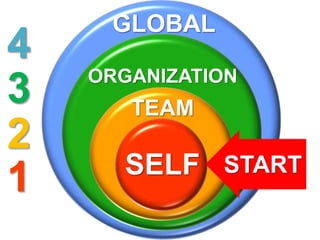
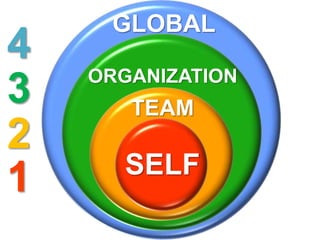
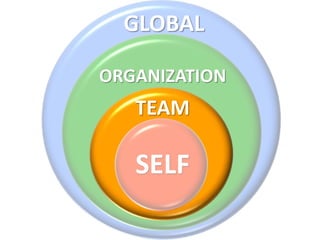
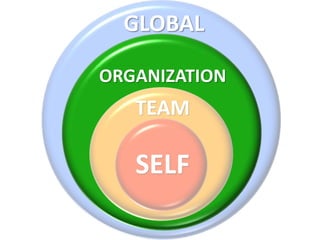
GLOBAL 
ORGANIZATION 
TEAM 
4 
3 
2 
1 SELF 
START
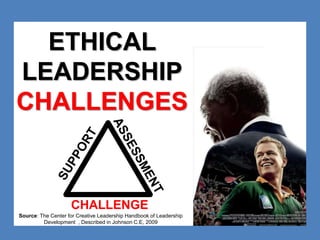
ETHICAL 
LEADERSHIP 
CHALLENGES 
CHALLENGE 
Source: The Center for Creative Leadership Handbook of Leadership 
Development , Described in Johnson C.E, 2009
DEFINITIONS 
WHAT IS 
ETHICAL 
LEADERSHIP 
?
DEFINITIONS 
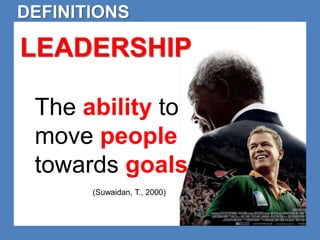
LEADERSHIP 
The ability to 
move people 
towards goals 
(Suwaidan, T., 2000)
DEFINITIONS 
LEADERSHIP 
What’s in it 
for me?
DEFINITIONS 
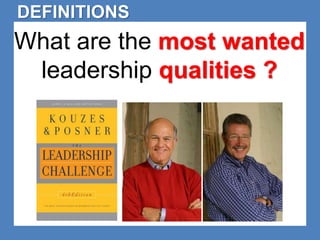
What are the most wanted 
leadership qualities ?
1,5 
MILLION PEOPLE 
SURVEYED 
DEFINITIONS
DEFINITIONS 
CONTINENTS
DEFINITIONS 
QUALITIES 
People Look for in leaders
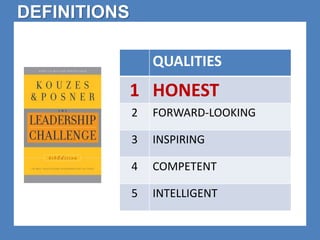
QUALITIES 
1 HONEST 
2 FORWARD-LOOKING 
3 INSPIRING 
4 COMPETENT 
5 INTELLIGENT 
DEFINITIONS
DEFINITIONS 
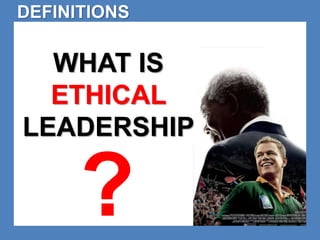
WHAT IS 
ETHICAL 
LEADERSHIP 
?
DEFINITIONS 
Worldwide Survey 
5 
Most widely shared 
ethical principles
DEFINITIONS 
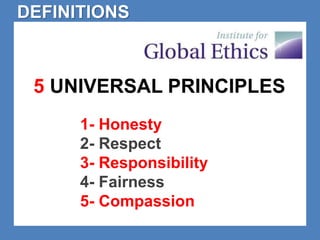
5 UNIVERSAL PRINCIPLES 
1- Honesty 
2- Respect 
3- Responsibility 
4- Fairness 
5- Compassion
DEFINITIONS 
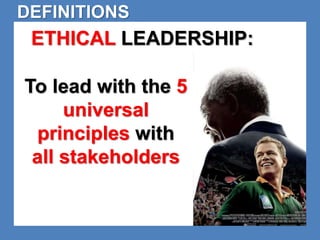
ETHICAL LEADERSHIP: 
To lead with the 5 
universal 
principles with 
all stakeholders
DEFINITIONS 
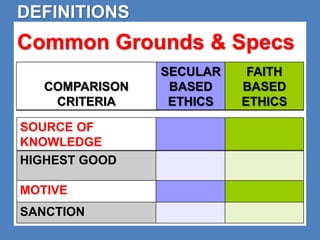
Common Grounds & Specs 
COMPARISON 
CRITERIA 
SOURCE OF 
KNOWLEDGE 
HIGHEST GOOD 
MOTIVE 
SANCTION 
SECULAR 
BASED 
ETHICS 
FAITH 
BASED 
ETHICS
DEFINITIONS 
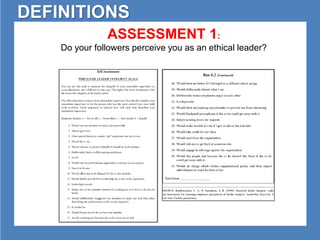
ASSESSMENT 1: 
Do your followers perceive you as an ethical leader?
DEFINITIONS 
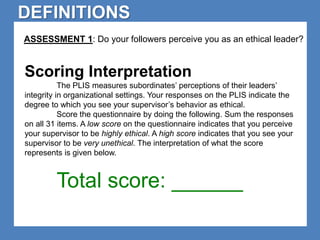
ASSESSMENT 1: Do your followers perceive you as an ethical leader? 
Scoring Interpretation 
The PLIS measures subordinates’ perceptions of their leaders’ 
integrity in organizational settings. Your responses on the PLIS indicate the 
degree to which you see your supervisor’s behavior as ethical. 
Score the questionnaire by doing the following. Sum the responses 
on all 31 items. A low score on the questionnaire indicates that you perceive 
your supervisor to be highly ethical. A high score indicates that you see your 
supervisor to be very unethical. The interpretation of what the score 
represents is given below. 
Total score: ______
DEFINITIONS 
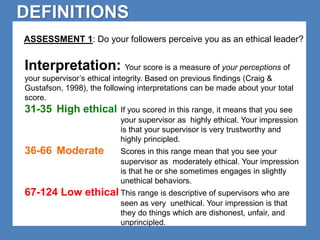
ASSESSMENT 1: Do your followers perceive you as an ethical leader? 
Interpretation: Your score is a measure of your perceptions of 
your supervisor’s ethical integrity. Based on previous findings (Craig & 
Gustafson, 1998), the following interpretations can be made about your total 
score. 
31-35 High ethical If you scored in this range, it means that you see 
your supervisor as highly ethical. Your impression 
is that your supervisor is very trustworthy and 
highly principled. 
36-66 Moderate Scores in this range mean that you see your 
supervisor as moderately ethical. Your impression 
is that he or she sometimes engages in slightly 
unethical behaviors. 
67-124 Low ethical This range is descriptive of supervisors who are 
seen as very unethical. Your impression is that 
they do things which are dishonest, unfair, and 
unprincipled.
BEHAVIORS 
Training Goals 
What essential behaviors must 
ethical leaders master?
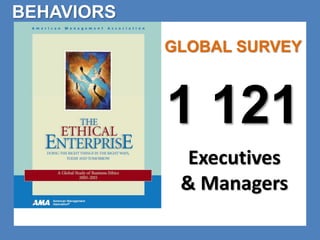
GLOBAL SURVEY 
1 121 
Executives 
& Managers 
BEHAVIORS
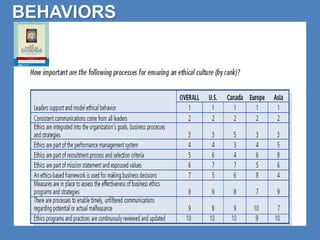
What are the 
BEHAVIORS 
TOP 3 Processes 
for ensuring an 
Ethical Business Culture?
BEHAVIORS
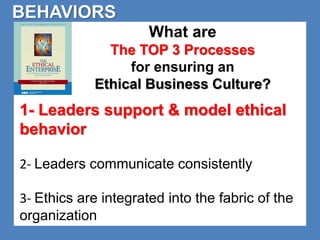
What are 
BEHAVIORS 
The TOP 3 Processes 
for ensuring an 
Ethical Business Culture? 
1- Leaders support & model ethical 
behavior 
2- Leaders communicate consistently 
3- Ethics are integrated into the fabric of the 
organization
BEHAVIORS 
What are the 
Top 5 
Most important 
Ethical Leadership 
Behaviors ?
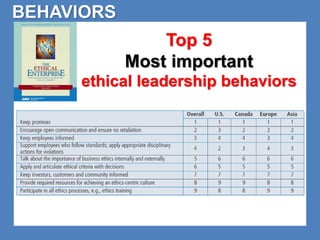
Top 5 
Most important 
BEHAVIORS 
ethical leadership behaviors
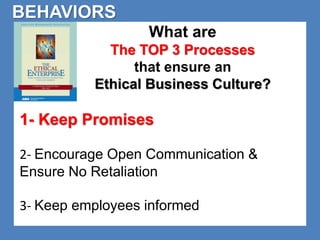
What are 
BEHAVIORS 
The TOP 3 Processes 
that ensure an 
Ethical Business Culture? 
1- Keep Promises 
2- Encourage Open Communication & 
Ensure No Retaliation 
3- Keep employees informed
BEHAVIORS 
Ethical Leaders’ 
4 
BEHAVIORS
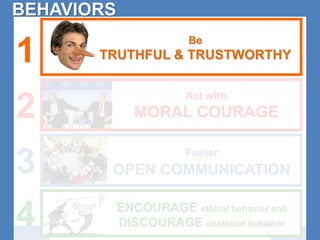
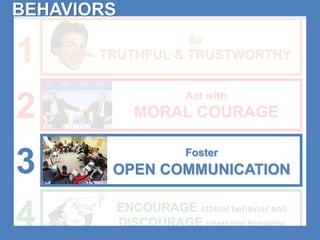
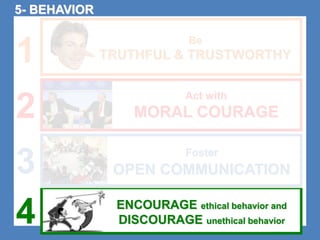
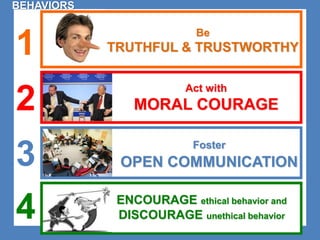
Be 
BEHAVIORS 
TRUTHFUL & TRUSTWORTHY 
Act with 
MORAL COURAGE 
Foster 
OPEN COMMUNICATION 
ENCOURAGE ethical behavior and 
DISCOURAGE unethical behavior 
1 
2 
3 
4
BEHAVIORS / Be Truthful & Trustworthy 
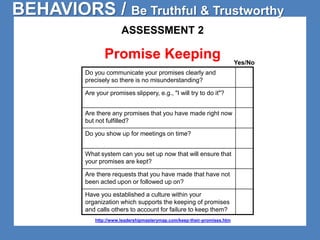
ASSESSMENT 2 
Promise Keeping 
Do you communicate your promises clearly and 
precisely so there is no misunderstanding? 
Are your promises slippery, e.g., "I will try to do it"? 
Are there any promises that you have made right now 
but not fulfilled? 
Do you show up for meetings on time? 
What system can you set up now that will ensure that 
your promises are kept? 
Are there requests that you have made that have not 
been acted upon or followed up on? 
Have you established a culture within your 
organization which supports the keeping of promises 
and calls others to account for failure to keep them? 
http://www.leadershipmasterymap.com/keep-their-promises.htm 
Yes/No
BEHAVIORS / Be Truthful & Trustworthy 
Why do 
leaders 
(or anyone) 
lie ?
BEHAVIORS / Be Truthful & Trustworthy 
1 
To boost appeal and 
likeability
BEHAVIORS / Be Truthful & Trustworthy 
2 
To avoid negative 
consequences
BEHAVIORS / Be Truthful & Trustworthy 
3 
To gain an advantage
BEHAVIORS / Be Truthful & Trustworthy 
4 
To cover up lies
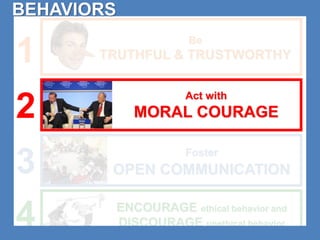
Be 
BEHAVIORS 
TRUTHFUL & TRUSTWORTHY 
Act with 
MORAL COURAGE 
Foster 
OPEN COMMUNICATION 
ENCOURAGE ethical behavior and 
DISCOURAGE unethical behavior 
1 
2 
3 
4
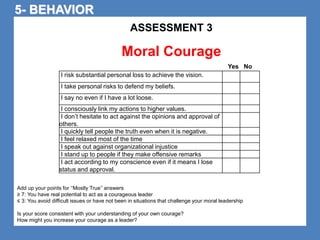
ASSESSMENT 3 
Moral Courage 
5- BEHAVIOR 
I risk substantial personal loss to achieve the vision. 
I take personal risks to defend my beliefs. 
I say no even if I have a lot loose. 
I consciously link my actions to higher values. 
I don’t hesitate to act against the opinions and approval of 
others. 
I quickly tell people the truth even when it is negative. 
I feel relaxed most of the time 
I speak out against organizational injustice 
I stand up to people if they make offensive remarks 
I act according to my conscience even if it means I lose 
status and approval. 
Yes No 
Add up your points for ‘‘Mostly True’’ answers 
≥ 7: You have real potential to act as a courageous leader 
≤ 3: You avoid difficult issues or have not been in situations that challenge your moral leadership 
Is your score consistent with your understanding of your own courage? 
How might you increase your courage as a leader?
BEHAVIORS / Moral Courage 
VIDEO 1 
MORAL COURAGE 
Erdogan at Davos 
http://youtu.be/OrbQsHkVQ_4
Be 
BEHAVIORS 
TRUTHFUL & TRUSTWORTHY 
Act with 
MORAL COURAGE 
Foster 
OPEN COMMUNICATION 
ENCOURAGE ethical behavior and 
DISCOURAGE unethical behavior 
1 
2 
3 
4
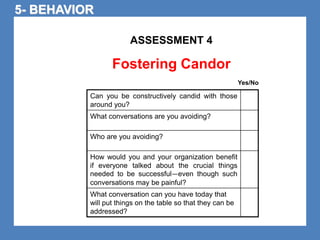
ASSESSMENT 4 
Fostering Candor 
5- BEHAVIOR 
Can you be constructively candid with those 
around you? 
What conversations are you avoiding? 
Who are you avoiding? 
How would you and your organization benefit 
if everyone talked about the crucial things 
needed to be successful—even though such 
conversations may be painful? 
What conversation can you have today that 
will put things on the table so that they can be 
addressed? 
Yes/No
Be 
TRUTHFUL & TRUSTWORTHY 
Act with 
MORAL COURAGE 
Foster 
OPEN COMMUNICATION 
ENCOURAGE ethical behavior and 
DISCOURAGE unethical behavior 
5- BEHAVIOR 
1 
2 
3 
4
BEHAVIORS / Encourage ethical behavior 
VIDEO 2 
Discipline 
No Gossip Zone 
http://youtu.be/OrbQsHkVQ_4
Be 
TRUTHFUL & TRUSTWORTHY 
Act with 
MORAL COURAGE 
Foster 
OPEN COMMUNICATION 
ENCOURAGE ethical behavior and 
DISCOURAGE unethical behavior 
BEHAVIORS 
1 
2 
3 
4
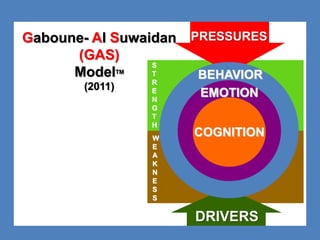
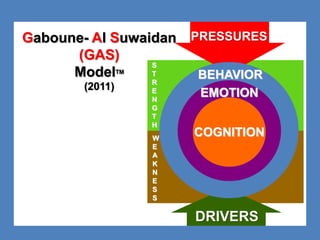
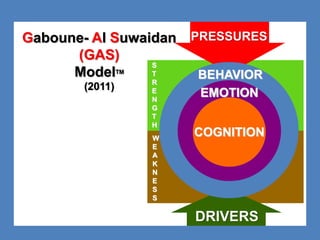
Gaboune- Al Suwaidan PRESSURES 
DRIVERS 
(GAS) 
ModelTM 
(2011) 
BEHAVIOR 
EMOTION 
COGNITION 
S 
T 
R 
E 
N 
G 
T 
H 
W 
E 
A 
K 
N 
E 
S 
S
Be 
BEHAVIORS 
TRUTHFUL & TRUSTWORTHY 
Act with 
MORAL COURAGE 
Foster 
OPEN COMMUNICATION 
ENCOURAGE ethical behavior and 
DISCOURAGE unethical behavior 
1 
2 
3 
4
BEHAVIORS / Foster Open Communication 
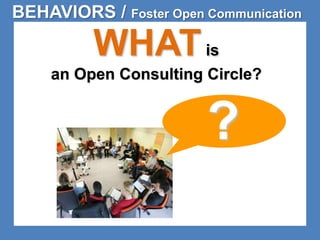
WHATis 
an Open Consulting Circle? 
?
BEHAVIORS / Foster Open Communication 
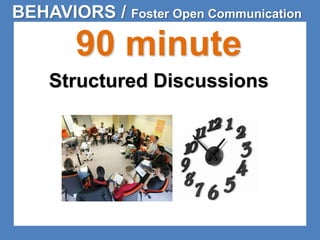
90 minute 
Structured Discussions
BEHAVIORS / Foster Open Communication 
WHY 
Open Consulting Circles?
BEHAVIORS / Foster Open Communication 
To resolve ethical issues 
in a safe environment
BEHAVIORS / Foster Open Communication 
Safe environment : 
Practice voicing your values 
without fear of retaliation
BEHAVIORS / Foster Open Communication 
HOWcan you facilitate 
an Open Consulting Circle?
BEHAVIORS / Foster Open Communication 
5 STEPS
BEHAVIORS / Foster Open Communication 
1- IDENTIFY 
an ethical challenge 
(10 mins)
BEHAVIORS / Foster Open Communication 
2- DIAGNOSE 
the ethical challenge 
(25 mins)
BEHAVIORS / Foster Open Communication 
3- SHARE 
relevant experiences and 
possible solutions 
(20 mins)
BEHAVIORS / Foster Open Communication 
4- PRACTICE 
difficult conversations 
(20 mins)
BEHAVIORS / Foster Open Communication 
5- SYNTHESIZE 
lessons learned 
+ 
commitments 
(15 mins)
BEHAVIORS / Foster Open Communication 
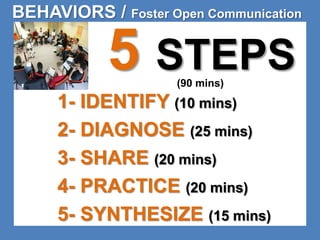
5 STEPS 
(90 mins) 
1- IDENTIFY (10 mins) 
2- DIAGNOSE (25 mins) 
3- SHARE (20 mins) 
4- PRACTICE (20 mins) 
5- SYNTHESIZE (15 mins)
BEHAVIORS / Foster Open Communication 
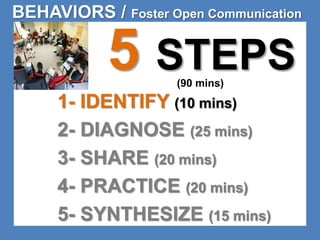
5 STEPS 
(90 mins) 
1- IDENTIFY (10 mins) 
2- DIAGNOSE (25 mins) 
3- SHARE (20 mins) 
4- PRACTICE (20 mins) 
5- SYNTHESIZE (15 mins)
BEHAVIORS / Foster Open Communication 
How can we categorize 
ethical leadership 
challenges 
?
BEHAVIORS / Foster Open Communication 
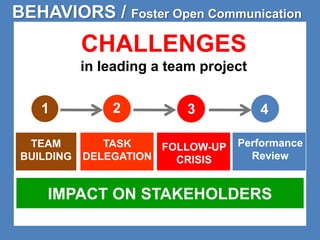
CHALLENGES 
in leading a team project 
1 2 3 4 
TEAM 
BUILDING 
TASK 
DELEGATION 
FOLLOW-UP 
CRISIS 
Performance 
Review 
IMPACT ON STAKEHOLDERS
BEHAVIORS / Foster Open Communication 
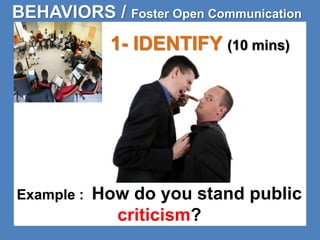
1- IDENTIFY (10 mins) 
Example : How do you stand public 
criticism?
BEHAVIORS / Foster Open Communication 
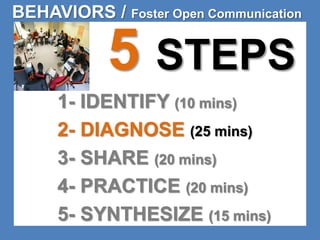
5 STEPS 
1- IDENTIFY (10 mins) 
2- DIAGNOSE (25 mins) 
3- SHARE (20 mins) 
4- PRACTICE (20 mins) 
5- SYNTHESIZE (15 mins)
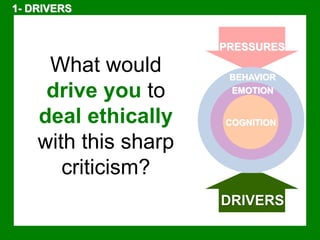
What would 
drive you to 
deal ethically 
with this sharp 
criticism? 
PRESSURES 
BEHAVIOR 
EMOTION 
COGNITION 
DRIVERS 
1- DRIVERS
What are the 
Top 3 Drivers 
To run a business 
ethically 
? 
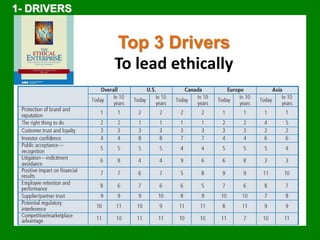
1- DRIVERS
Top 3 Drivers 
To lead ethically 
1- DRIVERS
Top 3 Drivers 
To lead ethically 
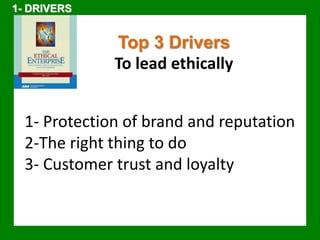
1- DRIVERS 
1- Protection of brand and reputation 
2-The right thing to do 
3- Customer trust and loyalty
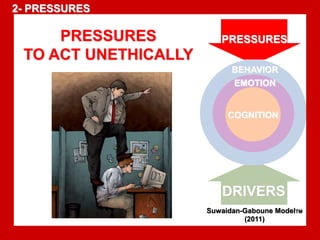
PRESSURES 
TO ACT UNETHICALLY 
PRESSURES 
BEHAVIOR 
EMOTION 
COGNITION 
DRIVERS 
Suwaidan-Gaboune ModelTM 
(2011) 
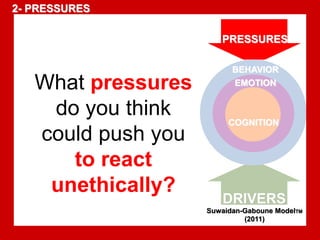
2- PRESSURES
What pressures 
do you think 
could push you 
to react 
unethically? 
PRESSURES 
BEHAVIOR 
EMOTION 
COGNITION 
DRIVERS 
Suwaidan-Gaboune ModelTM 
(2011) 
2- PRESSURES
What are the 
Top 3 Pressures 
To act unethically 
? 
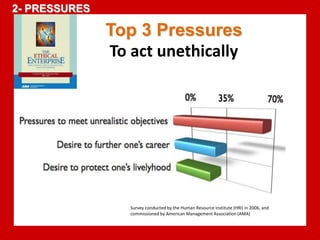
2- PRESSURES
Top 3 Pressures 
To act unethically 
Survey conducted by the Human Resource Institute (HRI) in 2006, and 
commissioned by American Management Association (AMA) 
2- PRESSURES
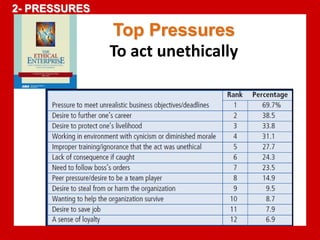
2- PRESSURES 
Top Pressures 
To act unethically
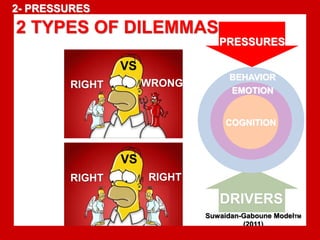
2 TYPES OF DILEMMAS 
VS 
RIGHT WRONG 
VS 
RIGHT RIGHT 
PRESSURES 
BEHAVIOR 
EMOTION 
COGNITION 
DRIVERS 
Suwaidan-Gaboune ModelTM 
(2011) 
2- PRESSURES
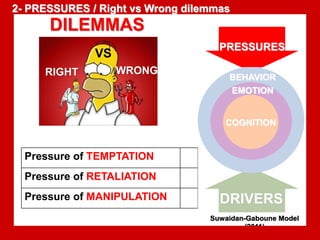
DILEMMAS 
VS 
RIGHT WRONG 
Pressure of TEMPTATION 
Pressure of RETALIATION 
PRESSURES 
BEHAVIOR 
EMOTION 
COGNITION 
Pressure of MANIPULATION DRIVERS 
Suwaidan-Gaboune Model 
(2011) 
2- PRESSURES / Right vs Wrong dilemmas
2- PRESSURES / Right vs Wrong dilemmas / Temptation 
VS 
RIGHT WRONG 
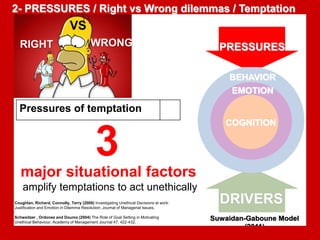
Pressures of temptation 
PRESSURES 
BEHAVIOR 
EMOTION 
COGNITION 
DRIVERS 
Suwaidan-Gaboune Model 
(2011) 
3 
major situational factors 
amplify temptations to act unethically 
Coughlan, Richard, Connolly, Terry (2008) Investigating Unethical Decisions at work: 
Justification and Emotion in Dilemma Resolution; Journal of Managerial Issues, 
Schweitzer , Ordonez and Douma (2004) The Role of Goal Setting in Motivating 
Unethical Behaviour, Academy of Management Journal 47, 422-432.
2- PRESSURES / Right vs Wrong dilemmas / Temptation 
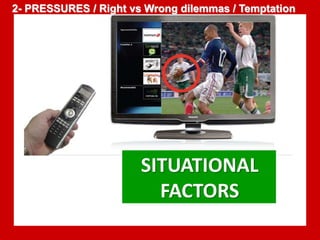
SITUATIONAL 
FACTORS
2- PRESSURES / Right vs Wrong dilemmas / Temptation 
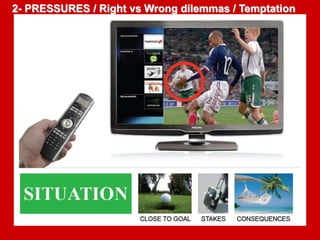
VIDEO 2 
Unethical Qualification to Soccer World Cup 
www.youtube.com/watch?v=jxw1-Id91lQ
2- PRESSURES / Right vs Wrong dilemmas / Temptation 
VS 
RIGHT WRONG 
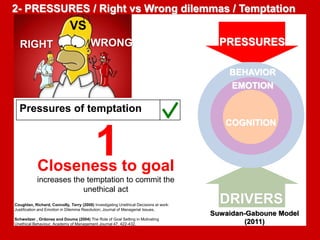
Pressures of temptation 
PRESSURES 
BEHAVIOR 
EMOTION 
COGNITION 
DRIVERS 
Suwaidan-Gaboune Model 
(2011) 
1 
Closeness to goal 
increases the temptation to commit the 
unethical act 
Coughlan, Richard, Connolly, Terry (2008) Investigating Unethical Decisions at work: 
Justification and Emotion in Dilemma Resolution; Journal of Managerial Issues, 
Schweitzer , Ordonez and Douma (2004) The Role of Goal Setting in Motivating 
Unethical Behaviour, Academy of Management Journal 47, 422-432.
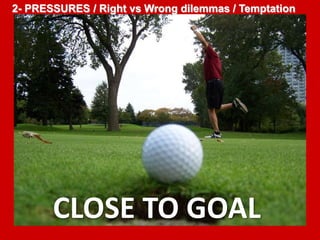
2- PRESSURES / Right vs Wrong dilemmas / Temptation 
CLOSE TO GOAL
2- PRESSURES / Right vs Wrong dilemmas / Temptation 
VS 
RIGHT WRONG 
Pressures of temptation 
PRESSURES 
BEHAVIOR 
EMOTION 
COGNITION 
DRIVERS 
Suwaidan-Gaboune Model 
(2011) 
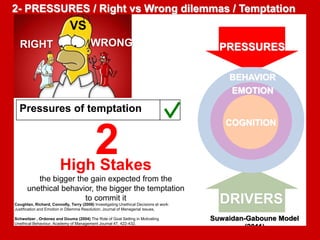
2 
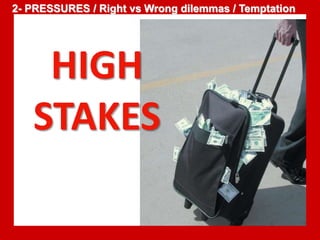
High Stakes 
the bigger the gain expected from the 
unethical behavior, the bigger the temptation 
to commit it 
Coughlan, Richard, Connolly, Terry (2008) Investigating Unethical Decisions at work: 
Justification and Emotion in Dilemma Resolution; Journal of Managerial Issues, 
Schweitzer , Ordonez and Douma (2004) The Role of Goal Setting in Motivating 
Unethical Behaviour, Academy of Management Journal 47, 422-432.
2- PRESSURES / Right vs Wrong dilemmas / Temptation 
HIGH 
STAKES
2- PRESSURES / Right vs Wrong dilemmas / Temptation 
VS 
RIGHT WRONG 
Pressures of temptation 
PRESSURES 
BEHAVIOR 
EMOTION 
COGNITION 
DRIVERS 
Suwaidan-Gaboune Model 
(2011) 
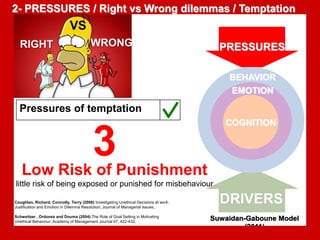
3 
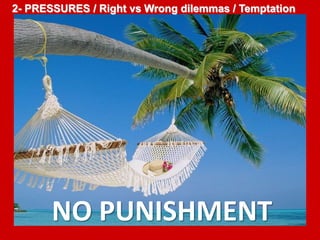
Low Risk of Punishment 
little risk of being exposed or punished for misbehaviour 
Coughlan, Richard, Connolly, Terry (2008) Investigating Unethical Decisions at work: 
Justification and Emotion in Dilemma Resolution; Journal of Managerial Issues, 
Schweitzer , Ordonez and Douma (2004) The Role of Goal Setting in Motivating 
Unethical Behaviour, Academy of Management Journal 47, 422-432.
2- PRESSURES / Right vs Wrong dilemmas / Temptation 
NO PUNISHMENT
2- PRESSURES / Right vs Wrong dilemmas / Temptation
2- PRESSURES / Right vs Wrong dilemmas / Retaliation 
VS 
RIGHT WRONG 
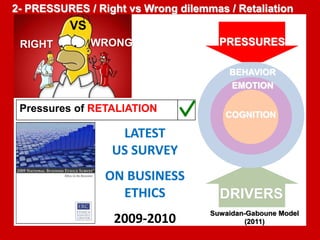
Pressures of RETALIATION 
PRESSURES 
BEHAVIOR 
EMOTION 
COGNITION 
DRIVERS 
Suwaidan-Gaboune Model 
(2011) 
LATEST 
US SURVEY 
ON BUSINESS 
ETHICS 
2009-2010
2- PRESSURES / Right vs Wrong dilemmas / Manipulation 
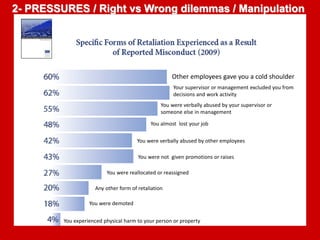
Other employees gave you a cold shoulder 
Your supervisor or management excluded you from 
decisions and work activity 
You were verbally abused by your supervisor or 
someone else in management 
You almost lost your job 
You were verbally abused by other employees 
You were not given promotions or raises 
You were reallocated or reassigned 
Any other form of retaliation 
You were demoted 
You experienced physical harm to your person or property 
Source: 2009 National Business Ethics Survey, Ethics Resource Center, USA
2- PRESSURES / Right vs Wrong dilemmas / Manipulation 
VS 
RIGHT WRONG 
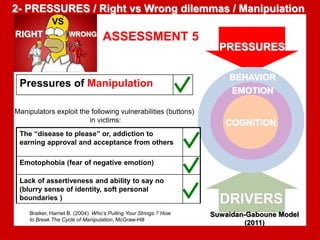
Pressures of Manipulation 
PRESSURES 
BEHAVIOR 
EMOTION 
COGNITION 
DRIVERS 
Manipulators exploit the following vulnerabilities (buttons) 
in victims: 
The “disease to please” or, addiction to 
earning approval and acceptance from others 
Emotophobia (fear of negative emotion) 
Lack of assertiveness and ability to say no 
(blurry sense of identity, soft personal 
boundaries ) 
Braiker, Harriet B. (2004). Who’s Pulling Your Strings ? How 
to Break The Cycle of Manipulation, McGraw-Hill 
Suwaidan-Gaboune Model 
(2011) 
ASSESSMENT 5
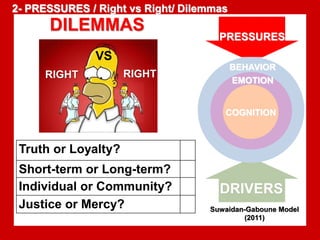
DILEMMAS 
VS 
RIGHT RIGHT 
Truth or Loyalty? 
Short-term or Long-term? 
Individual or Community? 
Justice or Mercy? 
PRESSURES 
BEHAVIOR 
EMOTION 
COGNITION 
DRIVERS 
Suwaidan-Gaboune Model 
(2011) 
2- PRESSURES / Right vs Right/ Dilemmas
PRESSURES 
BEHAVIOR 
EMOTION 
COGNITION 
DRIVERS 
Suwaidan-Gaboune Model 
(2011) 
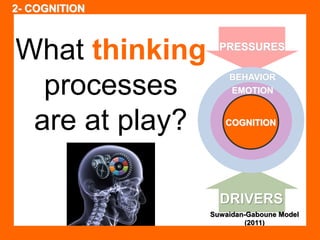
2- COGNITION 
What thinking 
processes 
are at play?
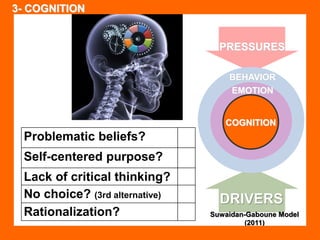
Problematic beliefs? 
Self-centered purpose? 
Lack of critical thinking? 
No choice? (3rd alternative) 
Rationalization? 
PRESSURES 
BEHAVIOR 
EMOTION 
COGNITION 
DRIVERS 
Suwaidan-Gaboune Model 
(2011) 
3- COGNITION
PRESSURES 
BEHAVIOR 
EMOTION 
COGNITION 
DRIVERS 
Suwaidan-Gaboune Model 
(2011) 
2- COGNITION 
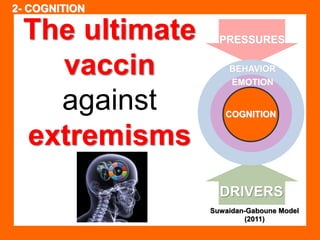
The ultimate 
vaccin 
against 
extremisms
23- COGNITION / Problematic Beliefs 
PROBLEMATIC 
BELIEFS 
Problematic beliefs can disrupt ethical 
reasoning and ethical action
23- COGNITION / Problematic Beliefs 
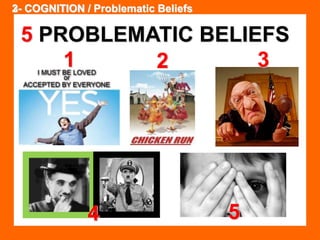
5 PROBLEMATIC BELIEFS 
1 2 3 
4 5
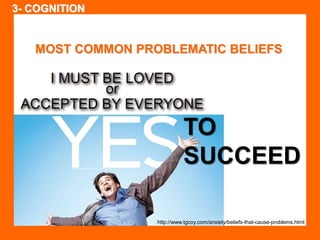
MOST COMMON PROBLEMATIC BELIEFS 
TO 
SUCCEED 
http://www.tgcoy.com/anxiety/beliefs-that-cause-problems.html 
3- COGNITION
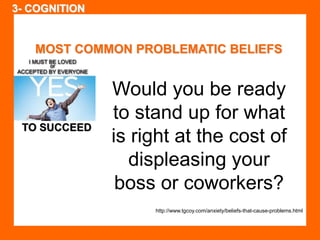
MOST COMMON PROBLEMATIC BELIEFS 
TO SUCCEED 
Would you be ready 
to stand up for what 
is right at the cost of 
displeasing your 
boss or coworkers? 
http://www.tgcoy.com/anxiety/beliefs-that-cause-problems.html 
3- COGNITION
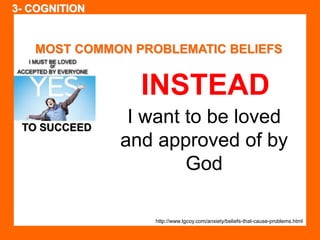
MOST COMMON PROBLEMATIC BELIEFS 
TO SUCCEED 
INSTEAD 
I want to be loved 
and approved of by 
God 
http://www.tgcoy.com/anxiety/beliefs-that-cause-problems.html 
3- COGNITION
MOST COMMON PROBLEMATIC BELIEFS 
http://www.tgcoy.com/anxiety/beliefs-that-cause-problems.html 
3- COGNITION
MOST POPULAR PROBLEMATIC BELIEFS 
Would you confront 
an unethical act you 
witness, or just 
ignore it? 
http://www.tgcoy.com/anxiety/beliefs-that-cause-problems.html 
3- COGNITION
MOST COMMON PROBLEMATIC BELIEFS 
INSTEAD 
FACING A PROBLEM IS 
AN OPPORTUNITY TO 
FIX A PROBLEMATIC 
SITUATION 
3- COGNITION
MOST COMMON PROBLEMATIC BELIEFS 
People who do 
things I don't 
approve of are 
bad people. 
http://www.tgcoy.com/anxiety/beliefs-that-cause-problems.html 
3- COGNITION
MOST COMMON PROBLEMATIC BELIEFS 
INSTEAD 
Judge actions 
not people. 
http://www.tgcoy.com/anxiety/beliefs-that-cause-problems.html 
3- COGNITION
MOST COMMON PROBLEMATIC BELIEFS 
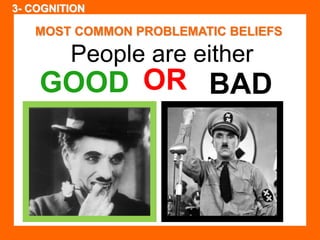
People are either 
GOOD OR BAD 
http://www.tgcoy.com/anxiety/beliefs-that-cause-problems.html 
3- COGNITION
MOST COMMON PROBLEMATIC BELIEFS 
INSTEAD 
Recognize good 
actions and condemn 
bad actions 
http://www.tgcoy.com/anxiety/beliefs-that-cause-problems.html 
3- COGNITION
SELF / 5 STAR PERSONAL MASTERY MODEL / BELIEFS 
MOST COMMON PROBLEMATIC BELIEFS 
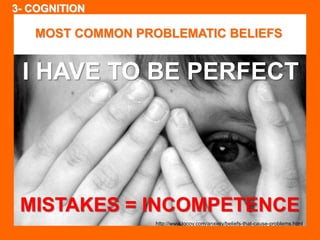
I HAVE TO BE PERFECT 
MISTAKES = INCOMPETENCE 
http://www.tgcoy.com/anxiety/beliefs-that-cause-problems.html 
3- COGNITION
SELF / 5 STAR PERSONAL MASTERY MODEL / BELIEFS 
MOST COMMON PROBLEMATIC BELIEFS 
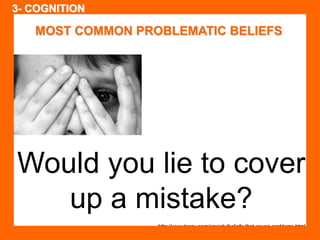
Would you lie to cover 
up a mistake? 
http://www.tgcoy.com/anxiety/beliefs-that-cause-problems.html 
3- COGNITION
SELF / 5 STAR PERSONAL MASTERY MODEL / BELIEFS 
MOST COMMON PROBLEMATIC BELIEFS 
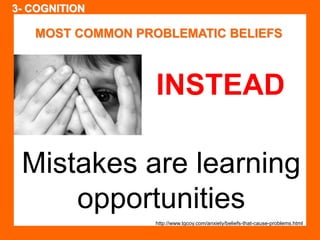
INSTEAD 
Mistakes are learning 
opportunities 
http://www.tgcoy.com/anxiety/beliefs-that-cause-problems.html 
3- COGNITION
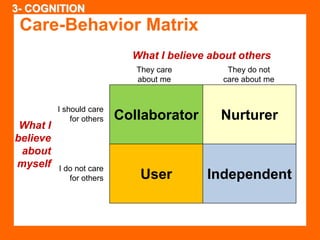
Care-Behavior Matrix 
What I believe about others 
They care 
about me 
They do not 
care about me 
http://www.changingminds.org/explanations/behaviors/care-behavior_matrix.htm 
What I 
believe 
about 
myself 
I should care 
for others 
I do not care 
for others 
Collaborator Nurturer 
User Independent 
3- COGNITION
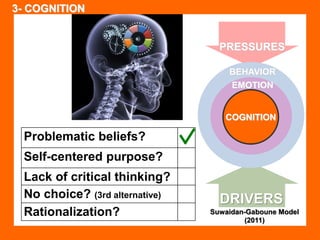
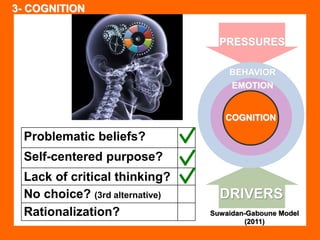
Problematic beliefs? 
Self-centered purpose? 
Lack of critical thinking? 
No choice? (3rd alternative) 
Rationalization? 
PRESSURES 
BEHAVIOR 
EMOTION 
COGNITION 
DRIVERS 
Suwaidan-Gaboune Model 
(2011) 
3- COGNITION
PURPOSE 
3- COGNITION 
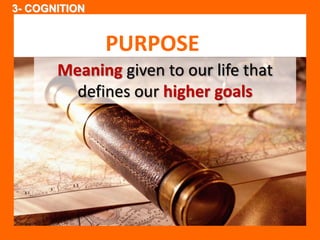
Meaning given to our life that 
defines our higher goals
(personal, family, work, community…) 
3- COGNITION
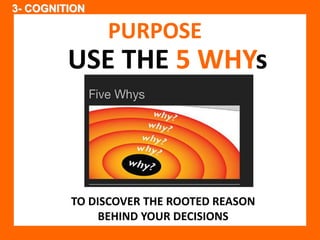
PURPOSE 
USE THE 5 WHYs 
TO DISCOVER THE ROOTED REASON 
BEHIND YOUR DECISIONS 
3- COGNITION
3- COGNITION 
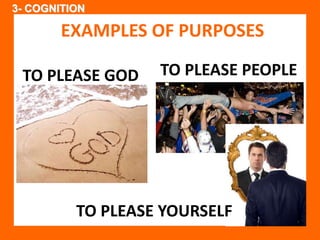
EXAMPLES OF PURPOSES 
TO PLEASE GOD TO PLEASE PEOPLE 
TO PLEASE YOURSELF
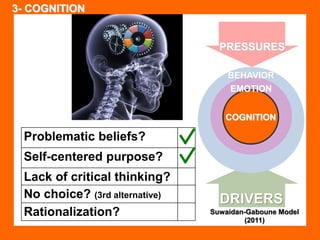
Problematic beliefs? 
Self-centered purpose? 
Lack of critical thinking? 
No choice? (3rd alternative) 
Rationalization? 
PRESSURES 
BEHAVIOR 
EMOTION 
COGNITION 
DRIVERS 
Suwaidan-Gaboune Model 
(2011) 
3- COGNITION
PRESSURES 
BEHAVIOR 
EMOTION 
COGNITION 
DRIVERS 
Suwaidan-Gaboune Model 
(2011) 
3- COGNITION / Critical Thinking 
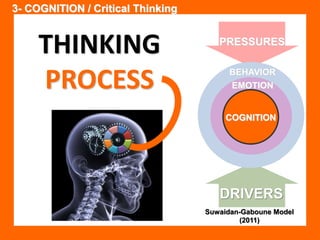
THINKING 
PROCESS
3- COGNITION / Critical Thinking 
VIDEO 3 
CRITICAL THINKING 
Don’t juge too quickly 
http://www.youtube.com/watch?v=v_PKUkWM9zI
3- COGNITION / Critical Thinking 
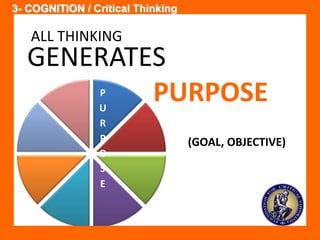
GENERATES 
P PURPOSE 
U 
R 
P 
O 
S 
E 
(GOAL, OBJECTIVE) 
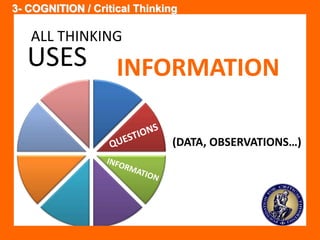
ALL THINKING
3- COGNITION / Critical Thinking 
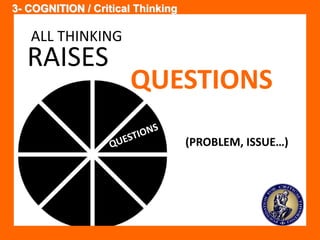
RAISES 
QUESTIONS 
(PROBLEM, ISSUE…) 
ALL THINKING
3- COGNITION / Critical Thinking 
USES INFORMATION 
(DATA, OBSERVATIONS…) 
ALL THINKING
3- COGNITION / Critical Thinking 
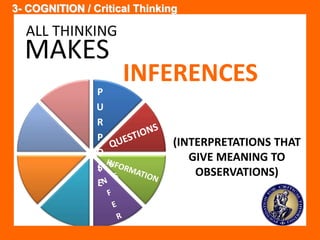
MAKES 
P 
U 
R 
P 
O 
S 
E 
INFERENCES 
(INTERPRETATIONS THAT 
GIVE MEANING TO 
OBSERVATIONS) 
ALL THINKING
3- COGNITION / Critical Thinking 
SELF / 5 STAR PERSONAL MASTERY MODEL / THINKING 
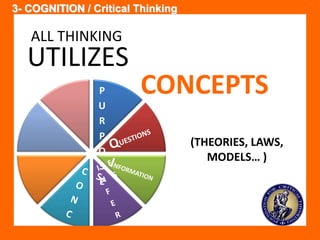
UTILIZES 
P 
U 
R 
P 
O 
S 
E 
CONCEPTS 
(THEORIES, LAWS, 
MODELS… ) 
ALL THINKING
3- COGNITION / Critical Thinking 
SELF / 5 STAR PERSONAL MASTERY MODEL / THINKING 
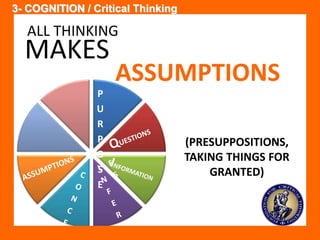
MAKES 
P 
U 
R 
P 
O 
S 
E 
ASSUMPTIONS 
(PRESUPPOSITIONS, 
TAKING THINGS FOR 
GRANTED) 
ALL THINKING
3- COGNITION / Critical Thinking 
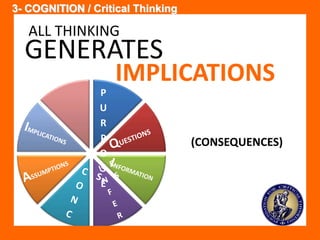
GENERATES 
P 
U 
R 
P 
O 
S 
E 
IMPLICATIONS 
(CONSEQUENCES) 
ALL THINKING
3- COGNITION / Critical Thinking 
SELF / 5 STAR PERSONAL MASTERY MODEL / THINKING 
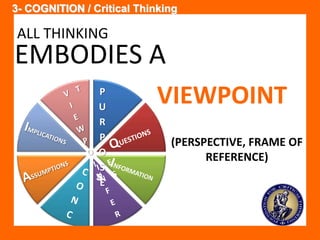
EMBODIES A 
P 
U 
R 
P 
O 
S 
E 
VIEWPOINT 
(PERSPECTIVE, FRAME OF 
REFERENCE) 
ALL THINKING
Problematic beliefs? 
Self-centered purpose? 
Lack of critical thinking? 
No choice? (3rd alternative) 
Rationalization? 
PRESSURES 
BEHAVIOR 
EMOTION 
COGNITION 
DRIVERS 
Suwaidan-Gaboune Model 
(2011) 
3- COGNITION
3- COGNITION 
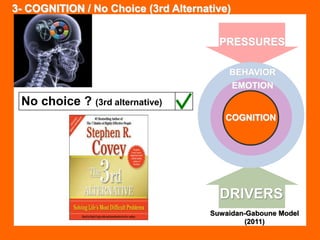
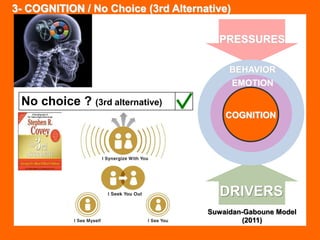
No choice ? (3rd alternative) 
PRESSURES 
BEHAVIOR 
EMOTION 
COGNITION 
DRIVERS 
Suwaidan-Gaboune Model 
(2011) 
/ No Choice (3rd Alternative)
No choice ? (3rd alternative) 
PRESSURES 
BEHAVIOR 
EMOTION 
COGNITION 
DRIVERS 
Suwaidan-Gaboune Model 
(2011) 
3- COGNITION / No Choice (3rd Alternative)
3- COGNITION 
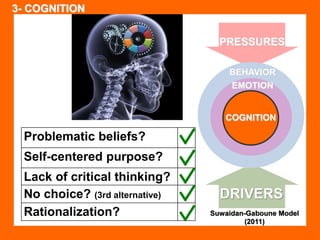
Problematic beliefs? 
Self-centered purpose? 
Lack of critical thinking? 
No choice? (3rd alternative) 
Rationalization? 
PRESSURES 
BEHAVIOR 
EMOTION 
COGNITION 
DRIVERS 
Suwaidan-Gaboune Model 
(2011)
3- COGNITION / Rationalization 
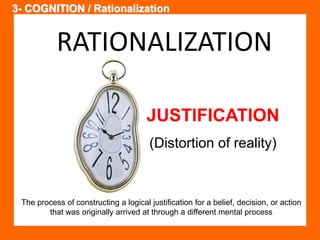
RATIONALIZATION 
JUSTIFICATION 
(Distortion of reality) 
The process of constructing a logical justification for a belief, decision, or action 
that was originally arrived at through a different mental process
3- COGNITION / Rationalization 
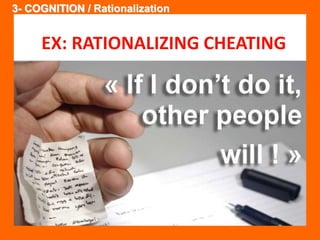
EX: RATIONALIZING CHEATING
3- COGNITION / Rationalization 
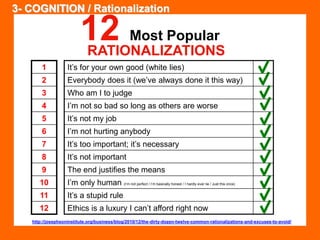
12 Most Popular 
RATIONALIZATIONS 
It’s for your own good (white lies) 
Everybody does it (we’ve always done it this way) 
Who am I to judge 
I’m not so bad so long as others are worse 
It’s not my job 
I’m not hurting anybody 
It’s too important; it’s necessary 
It’s not important 
The end justifies the means 
I’m only human (I’m not perfect / I’m basically honest / I hardly ever lie / Just this once) 
It’s a stupid rule 
Ethics is a luxury I can’t afford right now 
1 
2 
3 
4 
5 
6 
7 
8 
9 
10 
11 
12 
http://josephsoninstitute.org/business/blog/2010/12/the-dirty-dozen-twelve-common-rationalizations-and-excuses-to-avoid/
3- COGNITION / Rationalization 
Do you rationalize? 
Test yourself:
3- COGNITION / Rationalization 
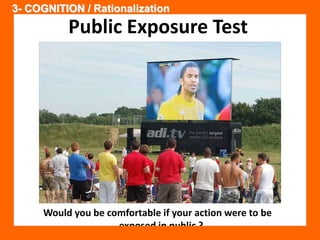
Public Exposure Test 
Would you be comfortable if your action were to be 
exposed in public ?
3- COGNITION / Rationalization 
VIDEO 4 
RATIONALIZATION 
Employee Caught Stealing 
http://www.youtube.com/watch?v=wAOss2-3tok
3- COGNITION 
/ Rationalization 
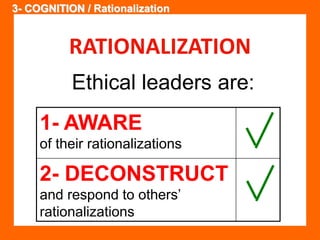
RATIONALIZATION 
Ethical leaders are: 
1- AWARE 
of their rationalizations 
2- DECONSTRUCT 
and respond to others’ 
rationalizations
Gaboune- Al Suwaidan PRESSURES 
DRIVERS 
(GAS) 
ModelTM 
(2011) 
BEHAVIOR 
EMOTION 
COGNITION 
S 
T 
R 
E 
N 
G 
T 
H 
W 
E 
A 
K 
N 
E 
S 
S
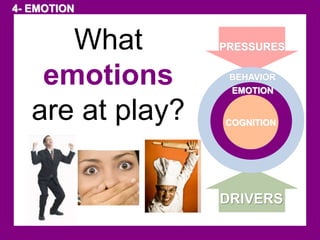
What 
emotions 
are at play? 
PRESSURES 
BEHAVIOR 
EMOTION 
COGNITION 
DRIVERS 
4- EMOTION
PRESSURES 
BEHAVIOR 
EMOTION 
COGNITION 
DRIVERS 
4- EMOTION 
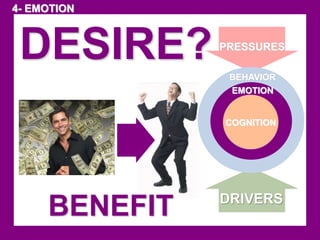
DESIRE? 
BENEFIT
MONEY! 
Just for Laugh Money Temptation 
www.youtube.com/watch?v=0I6lk47QnGQ 
4- EMOTION 
VIDEO 5
PRESSURES 
BEHAVIOR 
EMOTION 
COGNITION 
DRIVERS 
4- EMOTION 
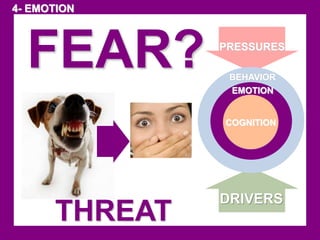
FEAR? 
THREAT
FEAR REACTION #1 
FLEE! 
Just For Laugh: Fear’s fleeing reaction 
www.youtube.com/watch?v=zzzCtQy1jFg 
4- EMOTION 
VIDEO 6
PRESSURES 
BEHAVIOR 
EMOTION 
COGNITION 
DRIVERS 
4- EMOTION 
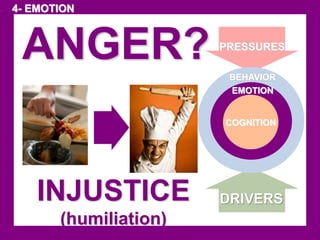
ANGER? 
INJUSTICE 
(humiliation)
PRESSURES 
BEHAVIOR 
EMOTION 
COGNITION 
DRIVERS 
Suwaidan-Gaboune Model 
(2011) 
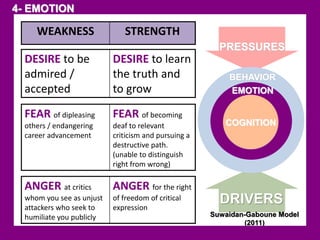
WEAKNESS STRENGTH 
DESIRE to be 
admired / 
accepted 
DESIRE to learn 
the truth and 
to grow 
FEAR of dipleasing 
others / endangering 
career advancement 
FEAR of becoming 
deaf to relevant 
criticism and pursuing a 
destructive path. 
(unable to distinguish 
right from wrong) 
ANGER at critics 
whom you see as unjust 
attackers who seek to 
humiliate you publicly 
ANGER for the right 
of freedom of critical 
expression 
4- EMOTION
Gaboune- Al Suwaidan PRESSURES 
DRIVERS 
(GAS) 
ModelTM 
(2011) 
BEHAVIOR 
EMOTION 
COGNITION 
S 
T 
R 
E 
N 
G 
T 
H 
W 
E 
A 
K 
N 
E 
S 
S
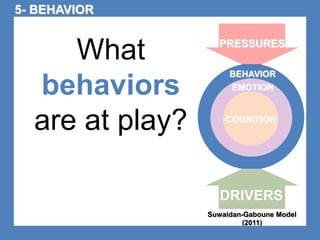
What 
behaviors 
are at play? 
PRESSURES 
BEHAVIOR 
EMOTION 
COGNITION 
DRIVERS 
Suwaidan-Gaboune Model 
(2011) 
5- BEHAVIOR
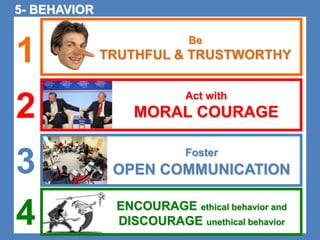
Be 
TRUTHFUL & TRUSTWORTHY 
Act with 
MORAL COURAGE 
Foster 
OPEN COMMUNICATION 
ENCOURAGE ethical behavior and 
DISCOURAGE unethical behavior 
5- BEHAVIOR 
1 
2 
3 
4
PRESSURES 
BEHAVIOR 
EMOTION 
COGNITION 
DRIVERS 
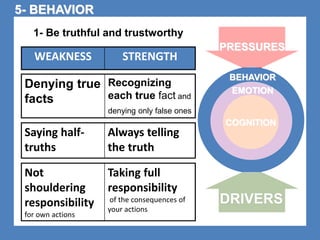
1- Be truthful and trustworthy 
WEAKNESS STRENGTH 
Denying true 
facts 
Recognizing 
each true fact and 
denying only false ones 
Saying half-truths 
Always telling 
the truth 
Not 
shouldering 
responsibility 
for own actions 
Taking full 
responsibility 
of the consequences of 
your actions 
5- BEHAVIOR
PRESSURES 
BEHAVIOR 
EMOTION 
COGNITION 
DRIVERS 
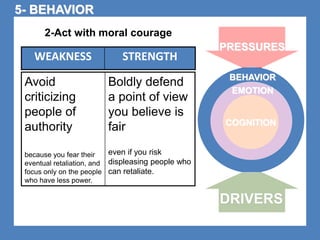
2-Act with moral courage 
WEAKNESS STRENGTH 
Avoid 
criticizing 
people of 
authority 
because you fear their 
eventual retaliation, and 
focus only on the people 
who have less power. 
Boldly defend 
a point of view 
you believe is 
fair 
even if you risk 
displeasing people who 
can retaliate. 
5- BEHAVIOR
PRESSURES 
BEHAVIOR 
EMOTION 
COGNITION 
DRIVERS 
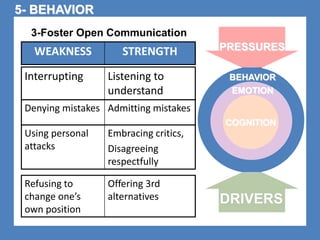
3-Foster Open Communication 
WEAKNESS STRENGTH 
Interrupting Listening to 
understand 
Denying mistakes Admitting mistakes 
Using personal 
attacks 
Embracing critics, 
Disagreeing 
respectfully 
Refusing to 
change one’s 
own position 
Offering 3rd 
alternatives 
5- BEHAVIOR
PRESSURES 
BEHAVIOR 
EMOTION 
COGNITION 
DRIVERS 
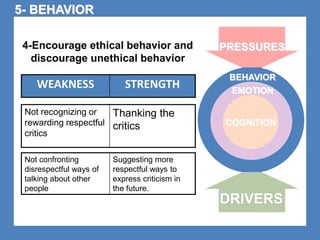
4-Encourage ethical behavior and 
discourage unethical behavior 
WEAKNESS STRENGTH 
Not recognizing or 
rewarding respectful 
critics 
Thanking the 
critics 
Not confronting 
disrespectful ways of 
talking about other 
people 
Suggesting more 
respectful ways to 
express criticism in 
the future. 
5- BEHAVIOR
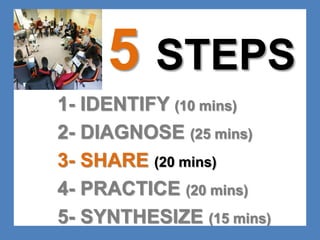
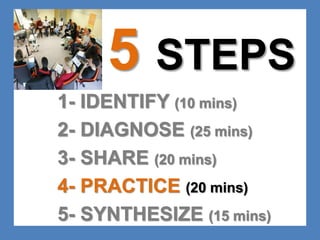
5 STEPS 
1- IDENTIFY (10 mins) 
2- DIAGNOSE (25 mins) 
3- SHARE (20 mins) 
4- PRACTICE (20 mins) 
5- SYNTHESIZE (15 mins)
5 STEPS 
1- IDENTIFY (10 mins) 
2- DIAGNOSE (25 mins) 
3- SHARE (20 mins) 
4- PRACTICE (20 mins) 
5- SYNTHESIZE (15 mins)
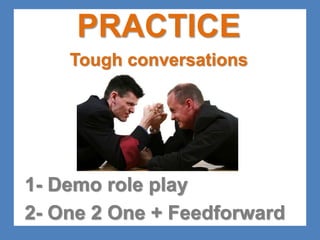
PRACTICE 
Tough conversations 
1- Demo role play 
2- One 2 One + Feedforward
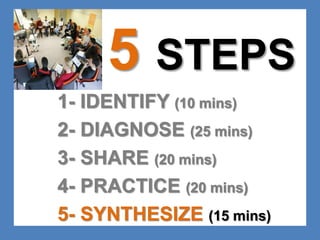
5 STEPS 
1- IDENTIFY (10 mins) 
2- DIAGNOSE (25 mins) 
3- SHARE (20 mins) 
4- PRACTICE (20 mins) 
5- SYNTHESIZE (15 mins)
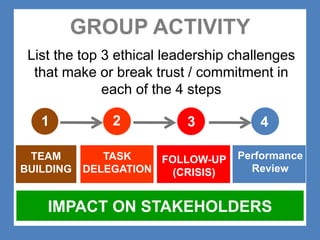
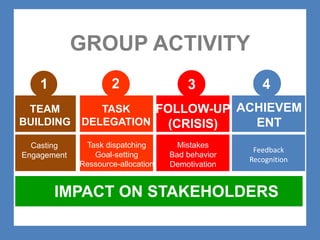
GROUP ACTIVITY 
List the top 3 ethical leadership challenges 
that make or break trust / commitment in 
each of the 4 steps 
1 2 3 4 
TEAM 
BUILDING 
TASK 
DELEGATION 
FOLLOW-UP 
(CRISIS) 
Performance 
Review 
IMPACT ON STAKEHOLDERS
GROUP ACTIVITY 
1 2 3 4 
TEAM 
BUILDING 
TASK 
DELEGATION 
FOLLOW-UP 
(CRISIS) 
ACHIEVEM 
ENT 
Task dispatching 
Goal-setting 
Ressource-allocation 
Mistakes 
Bad behavior 
Demotivation 
Feedback 
Recognition 
Casting 
Engagement 
IMPACT ON STAKEHOLDERS
1 2 3 4 
TEAM 
BUILDING 
TASK 
DELEGATION 
FOLLOW-UP 
CRISIS 
ACHIEVEM 
ENT 
Task dispatching 
Goal-setting 
Ressource allocation 
Mistakes 
Bad behavior 
Demotivation 
Feedback 
Recognition 
Casting 
Engagement 
IMPACT ON STAKEHOLDERS 
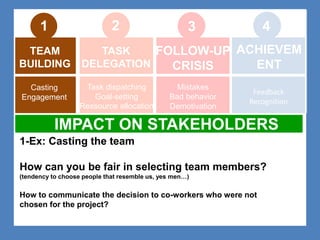
1-Ex: Casting the team 
How can you be fair in selecting team members? 
(tendency to choose people that resemble us, yes men…) 
How to communicate the decision to co-workers who were not 
chosen for the project?
GLOBAL 
ORGANIZATION 
TEAM 
4 
3 
2 
1 SELF
ETHICAL LEADERSHIP 
AMBASSADOR TRAININGTM 
www.ethical-leaders.com 
Youssef Gaboune B.Eng., M.Sc. 
Founder, Ethical Leaders 
y.gaboune@gmail.com
GLOBAL 
ORGANIZATION 
TEAM 
SELF
TEAM/ 
HOW TO BUILD 
ETHICAL TEAMS ?
TEAM/ 
To enable leaders to : 
TO CREATE AND MAINTAIN AN 
ETHICAL TEAM CLIMATE 
GOAL
TEAM/ 
PROBLEM 
Teams may suffer from pressures (ex: 
conformity) that could prevent members 
to act ethically or to raise ethical issues.
TEAM/ 
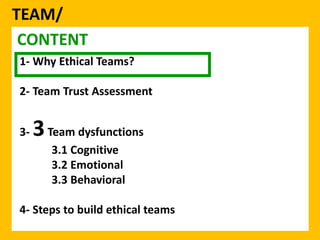
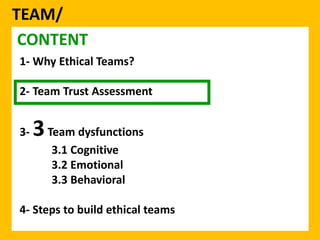
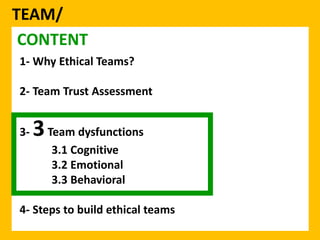
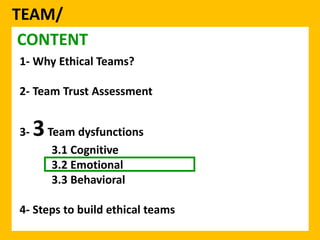
CONTENT 
1- Why Ethical Teams? 
2- Team Trust Assessment 
3-3Team dysfunctions 
3.1 Cognitive 
3.2 Emotional 
3.3 Behavioral 
4- Steps to build ethical teams
TEAM / WHY ETHICAL TEAMS ? 
Teams have the 
potential to make 
better choices than 
individuals
TEAM / WHY ETHICAL TEAMS ? 
Top-level executives 
spend on average 21 
weeks / year in team 
work 
(committees, task forces and other small settings) 
Johnson C.E, Meeting the ethical challenges of leadership, Sage Publications, Inc; 3rd edition (July 23, 2008) p.216 
Rothwell J.D., (1998) In mixed company: Small group communication (3rd ed.) Fort Worth, TX: Harcourt Brace, p.2.
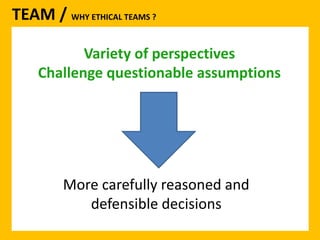
TEAM / WHY ETHICAL TEAMS ? 
Variety of perspectives 
Challenge questionable assumptions 
More carefully reasoned and 
defensible decisions
TEAM / WHY ETHICAL TEAMS ? 
Why Do Leaders 
FAIL 
to Practice Shura/Consulting?
TEAM / WHY ETHICAL TEAMS ? 
4 
MAIN REASONS
TEAM / WHY ETHICAL TEAMS ? 
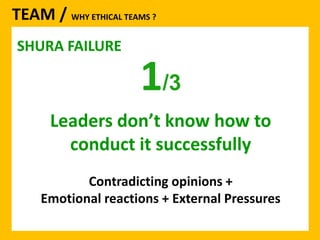
SHURA FAILURE 
1/3 
Leaders don’t know how to 
conduct it successfully 
Contradicting opinions + 
Emotional reactions + External Pressures
TEAM / WHY ETHICAL TEAMS ? 
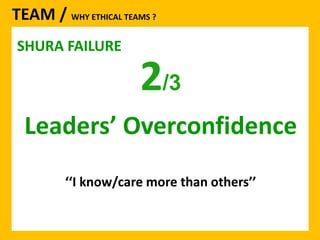
SHURA FAILURE 
2/3 
Leaders’ Overconfidence 
‘‘I know/care more than others’’
TEAM / WHY ETHICAL TEAMS ? 
SHURA FAILURE 
3/3 
Leaders Believe It is 
Not necessary 
‘‘ What’s the value of it?’’
TEAM/ 
CONTENT 
1- Why Ethical Teams? 
2- Team Trust Assessment 
3-3Team dysfunctions 
3.1 Cognitive 
3.2 Emotional 
3.3 Behavioral 
4- Steps to build ethical teams
TEAM / TEAM TRUST ASSESSMENT 
TEAM TRUST 
ASSESSMENT
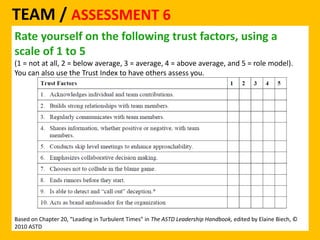
TEAM / ASSESSMENT 6 
Rate yourself on the following trust factors, using a 
scale of 1 to 5 
(1 = not at all, 2 = below average, 3 = average, 4 = above average, and 5 = role model). 
You can also use the Trust Index to have others assess you. 
Based on Chapter 20, “Leading in Turbulent Times” in The ASTD Leadership Handbook, edited by Elaine Biech, © 
2010 ASTD
TEAM / TEAM TRUST ASSESSMENT 
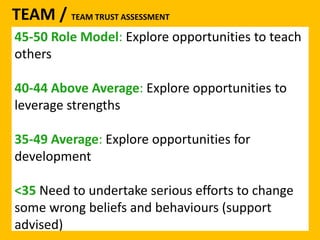
45-50 Role Model: Explore opportunities to teach 
others 
40-44 Above Average: Explore opportunities to 
leverage strengths 
35-49 Average: Explore opportunities for 
development 
<35 Need to undertake serious efforts to change 
some wrong beliefs and behaviours (support 
advised)
TEAM/ 
CONTENT 
1- Why Ethical Teams? 
2- Team Trust Assessment 
3-3Team dysfunctions 
3.1 Cognitive 
3.2 Emotional 
3.3 Behavioral 
4- Steps to build ethical teams
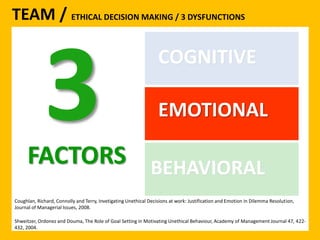
TEAM / ETHICAL DECISION MAKING / 3 DYSFUNCTIONS 
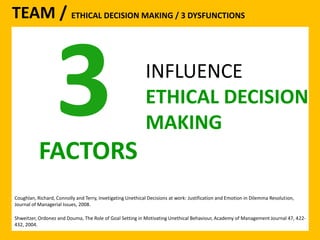
FACTORS 
INFLUENCE 
ETHICAL DECISION 
MAKING 
Coughlan, Richard, Connolly and Terry, Invetigating Unethical Decisions at work: Justification and Emotion in Dilemma Resolution, 
Journal of Managerial Issues, 2008. 
Shweitzer, Ordonez and Douma, The Role of Goal Setting in Motivating Unethical Behaviour, Academy of Management Journal 47, 422- 
432, 2004.
TEAM / ETHICAL DECISION MAKING / 3 DYSFUNCTIONS 
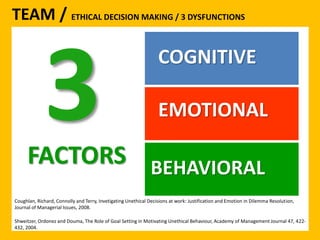
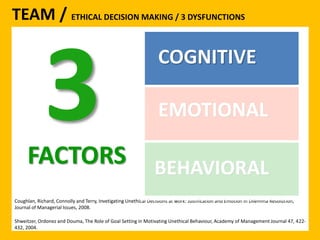
FACTORS 
COGNITIVE 
EMOTIONAL 
BEHAVIORAL 
Coughlan, Richard, Connolly and Terry, Invetigating Unethical Decisions at work: Justification and Emotion in Dilemma Resolution, 
Journal of Managerial Issues, 2008. 
Shweitzer, Ordonez and Douma, The Role of Goal Setting in Motivating Unethical Behaviour, Academy of Management Journal 47, 422- 
432, 2004.
TEAM/ 
CONTENT 
1- Why Ethical Teams? 
2- Team Trust Assessment 
3-3Team dysfunctions 
3.1 Cognitive 
3.2 Emotional 
3.3 Behavioral 
4- Steps to build ethical teams
TEAM / ETHICAL DECISION MAKING / 3 DYSFUNCTIONS 
FACTORS 
COGNITIVE 
EMOTIONAL 
BEHAVIORAL 
Coughlan, Richard, Connolly and Terry, Invetigating Unethical Decisions at work: Justification and Emotion in Dilemma Resolution, 
Journal of Managerial Issues, 2008. 
Shweitzer, Ordonez and Douma, The Role of Goal Setting in Motivating Unethical Behaviour, Academy of Management Journal 47, 422- 
432, 2004.
TEAM / ETHICAL DECISION MAKING / 3 DYSFUNCTIONS /COGNITIVE 
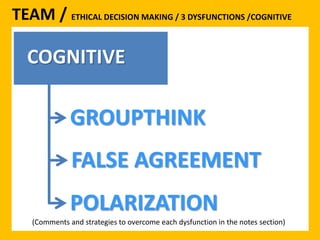
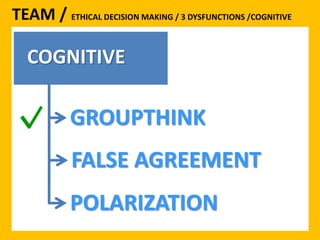
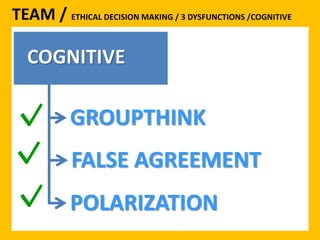
COGNITIVE 
GROUPTHINK 
FALSE AGREEMENT 
POLARIZATION 
(Comments and strategies to overcome each dysfunction in the notes section)
STEELAFM / /W HEYT HPEICRASLO DNEACLI SMIOANST MERAYK I?N /G T /E M3 DPTYASTFIUONNCST IONS /COGNITIVE 
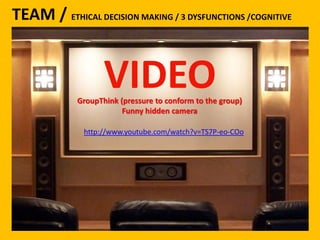
VIDEO 
GroupThink (pressure to conform to the group) 
Funny hidden camera 
http://www.youtube.com/watch?v=TS7P-eo-COo
TEAM / ETHICAL DECISION MAKING / 3 FACTORS /COGNITIVE 
GROUPTHINK 
Putting unanimous agreement 
ahead of 
reasoned problem solving 
Social psychologist Irving Janis
TEAM / ETHICAL DECISION MAKING / 3 FACTORS /COGNITIVE 
GROUPTHINK 
High Risk of 
Ineffective + Unethical 
Decisions 
Janis I. Groupthink: The problems of conformity
TEAM / ETHICAL DECISION MAKING / 3 DYSFUNCTIONS /COGNITIVE 
Groupthink 
3 Symptoms 
A) Overconfidence 
B) Close-Mindedness 
C) Group pressure
STEELAFM / /W HEYT HPEICRASLO DNEACLI SMIOANST MERAYK I?N /G T /E M3 DPTYASTFIUONNCST IONS /COGNITIVE 
VIDEO 
Asch Experiment 
http://www.youtube.com/watch?v=iRh5qy09nNw
TEAM / ETHICAL DECISION MAKING / 3 DYSFUNCTIONS /COGNITIVE 
COGNITIVE 
GROUPTHINK 
FALSE AGREEMENT 
POLARIZATION
TEAM / ETHICAL DECISION MAKING / 3 FACTORS /COGNITIVE 
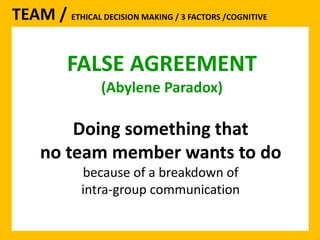
FALSE AGREEMENT 
(Abylene Paradox) 
Doing something that 
no team member wants to do 
because of a breakdown of 
intra-group communication
TEAM / ETHICAL DECISION MAKING / 3 FACTORS /COGNITIVE 
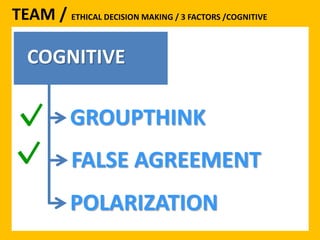
COGNITIVE 
GROUPTHINK 
FALSE AGREEMENT 
POLARIZATION
TEAM / ETHICAL DECISION MAKING / 3 FACTORS /COGNITIVE 
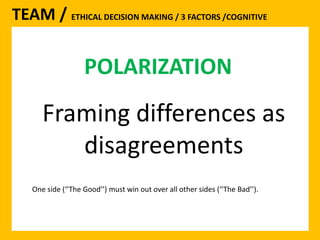
POLARIZATION 
Framing differences as 
disagreements 
One side (‘’The Good’’) must win out over all other sides (‘’The Bad’’).
TEAM / ETHICAL DECISION MAKING / 3 DYSFUNCTIONS /COGNITIVE 
COGNITIVE 
GROUPTHINK 
FALSE AGREEMENT 
POLARIZATION
TEAM /ETHICAL DECISION MAKING / 3 FACTORS / EMOTIONAL 
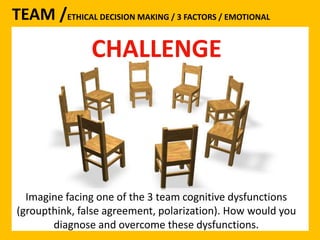
CHALLENGE 
Imagine facing one of the 3 team cognitive dysfunctions 
(groupthink, false agreement, polarization). How would you 
diagnose and overcome these dysfunctions.
TEAM/ 
CONTENT 
1- Why Ethical Teams? 
2- Team Trust Assessment 
3-3Team dysfunctions 
3.1 Cognitive 
3.2 Emotional 
3.3 Behavioral 
4- Steps to build ethical teams
TEAM / ETHICAL DECISION MAKING / 3 DYSFUNCTIONS 
FACTORS 
COGNITIVE 
EMOTIONAL 
BEHAVIORAL 
Coughlan, Richard, Connolly and Terry, Invetigating Unethical Decisions at work: Justification and Emotion in Dilemma Resolution, 
Journal of Managerial Issues, 2008. 
Shweitzer, Ordonez and Douma, The Role of Goal Setting in Motivating Unethical Behaviour, Academy of Management Journal 47, 422- 
432, 2004.
TEAM /ETHICAL DECISION MAKING / 3 DYSFUNCTIONS / EMOTIONAL 
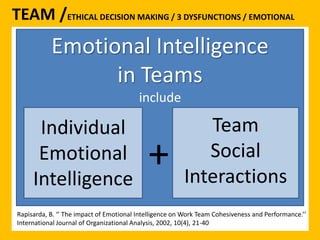
Emotional Intelligence 
in Teams 
include 
Individual 
Emotional 
Intelligence 
Team 
Social 
Interactions 
+ 
Rapisarda, B. ‘’ The impact of Emotional Intelligence on Work Team Cohesiveness and Performance.’’ 
International Journal of Organizational Analysis, 2002, 10(4), 21-40
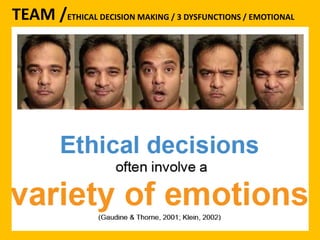
TEAM /ETHICAL DECISION MAKING / 3 DYSFUNCTIONS / EMOTIONAL
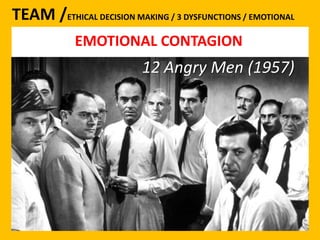
TEAM /ETHICAL DECISION MAKING / 3 DYSFUNCTIONS / EMOTIONAL 
EMOTIONAL CONTAGION 
12 Angry Men (1957)
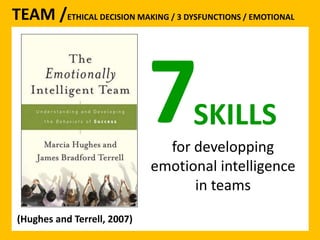
TEAM /ETHICAL DECISION MAKING / 3 DYSFUNCTIONS / EMOTIONAL 
(Hughes and Terrell, 2007) 
SKILLS 
for developping 
emotional intelligence 
in teams
TEAM /ETHICAL DECISION MAKING / 3 DYSFUNCTIONS / EMOTIONAL 
1/ 7 
Developping a Team Identity 
(Common purpose)
TEAM /ETHICAL DECISION MAKING / 3 DYSFUNCTIONS / EMOTIONAL 
2/ 7 
Creating and Harnessing 
Motivation 
(Drive that enable teams to achieve)
TEAM /ETHICAL DECISION MAKING / 3 DYSFUNCTIONS / EMOTIONAL 
3/ 7 
Emotional Awareness 
(Ability to read one another and respond to how others 
feel)
TEAM /ETHICAL DECISION MAKING / 3 DYSFUNCTIONS / EMOTIONAL 
4/ 7 
Communication 
(Ability to listen and talk effectively to one another)
TEAM /ETHICAL DECISION MAKING / 3 DYSFUNCTIONS / EMOTIONAL 
5/ 7 
Stress tolerance 
(Building strong relationships to overcome challenges)
TEAM /ETHICAL DECISION MAKING / 3 DYSFUNCTIONS / EMOTIONAL 
6/ 7 
Conflict resolution 
(Developping capabilities to address the inevitable team 
conflicts)
TEAM /ETHICAL DECISION MAKING / 3 DYSFUNCTIONS / EMOTIONAL 
7/ 7 
Positive Mood 
(Cultivating optimism that encourages a can-do attitude, 
curiosity and hopefulness)
TEAM /ETHICAL DECISION MAKING / 3 DYSFUNCTIONS / EMOTIONAL 
CHALLENGE 
How would you re-motivate a 
demotivated constituent?
TEAM /ETHICAL DECISION MAKING / 3 DYSFUNCTIONS / EMOTIONAL 
CHALLENGE 
What would you do if you were 
pressured to act unethically? 
Your boss pressures you to modify the numbers in a report to be 
submitted to the top management or to overestimate your consulting 
fees to a client…
TEAM /ETHICAL DECISION MAKING / 3 DYSFUNCTIONS / EMOTIONAL 
CHALLENGE 
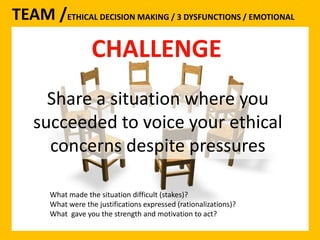
Share a situation where you 
succeeded to voice your ethical 
concerns despite pressures 
What made the situation difficult (stakes)? 
What were the justifications expressed (rationalizations)? 
What gave you the strength and motivation to act?
TEAM/ 
CONTENT 
1- Why Ethical Teams? 
2- Team Trust Assessment 
3-3Team dysfunctions 
3.1 Cognitive 
3.2 Emotional 
3.3 Behavioral 
4- Steps to build ethical teams
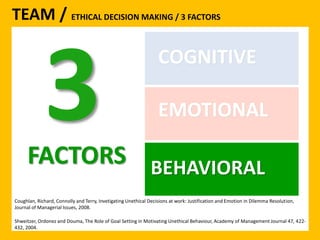
TEAM / ETHICAL DECISION MAKING / 3 FACTORS 
FACTORS 
COGNITIVE 
EMOTIONAL 
BEHAVIORAL 
Coughlan, Richard, Connolly and Terry, Invetigating Unethical Decisions at work: Justification and Emotion in Dilemma Resolution, 
Journal of Managerial Issues, 2008. 
Shweitzer, Ordonez and Douma, The Role of Goal Setting in Motivating Unethical Behaviour, Academy of Management Journal 47, 422- 
432, 2004.
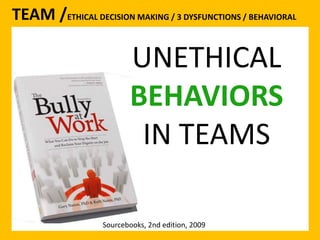
TEAM /ETHICAL DECISION MAKING / 3 DYSFUNCTIONS / BEHAVIORAL 
UNETHICAL 
BEHAVIORS 
IN TEAMS 
Sourcebooks, 2nd edition, 2009
TEAM /ETHICAL DECISION MAKING / 3 DYSFUNCTIONS / BEHAVIORAL 
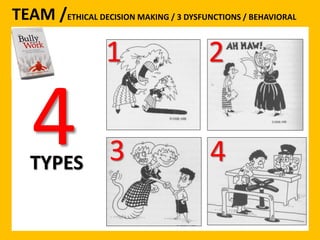
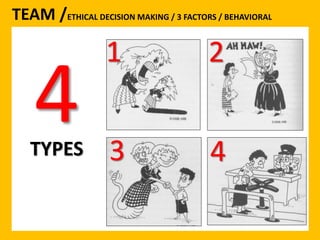
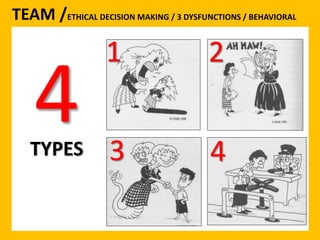
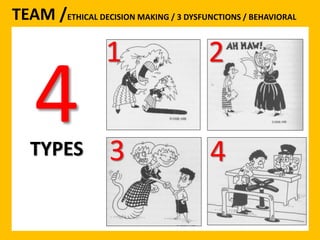
4TYPES 
1 2 
3 4
TEAM /ETHICAL DECISION MAKING / 3 DYSFUNCTIONS / BEHAVIORAL 
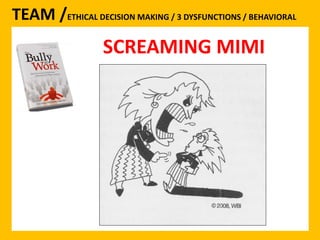
SCREAMING MIMI
SCREAMING MIMI 
TEAM /ETHICAL DECISION MAKING / 3 DYSFUNCTIONS / BEHAVIORAL 
SCREAMING MIMI / TACTICS 
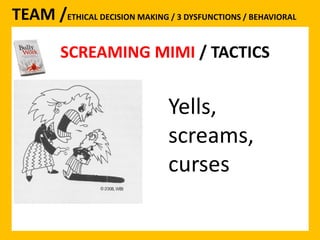
Yells, 
screams, 
curses
SCREAMING MIMI 
TEAM /ETHICAL DECISION MAKING / 3 DYSFUNCTIONS / BEHAVIORAL 
SCREAMING MIMI / TACTICS 
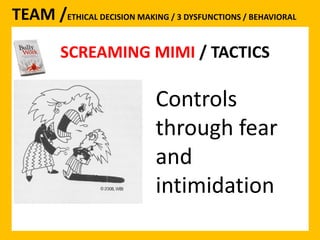
Controls 
through fear 
and 
intimidation
SCREAMING MIMI 
TEAM /ETHICAL DECISION MAKING / 3 DYSFUNCTIONS / BEHAVIORAL 
SCREAMING MIMI / TACTICS 
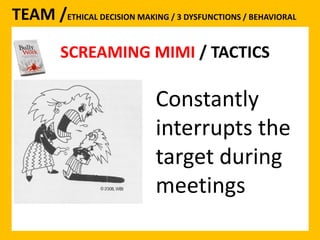
Constantly 
interrupts the 
target during 
meetings
SCREAMING MIMI 
TEAM /ETHICAL DECISION MAKING / 3 DYSFUNCTIONS / BEHAVIORAL 
SCREAMING MIMI / TACTICS 
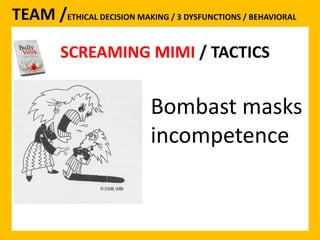
Bombast masks 
incompetence
SCREAMING MIMI 
TEAM /ETHICAL DECISION MAKING / 3 DYSFUNCTIONS / BEHAVIORAL 
SCREAMING MIMI / HANDLING 
SYSTEM 
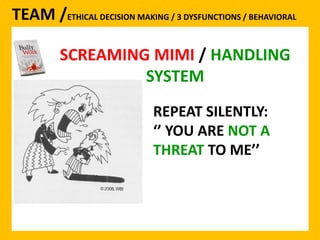
REPEAT SILENTLY: 
‘’ YOU ARE NOT A 
THREAT TO ME’’
SCREAMING MIMI 
TEAM /ETHICAL DECISION MAKING / 3 DYSFUNCTIONS / BEHAVIORAL 
SCREAMING MIMI / HANDLING 
SYSTEM 
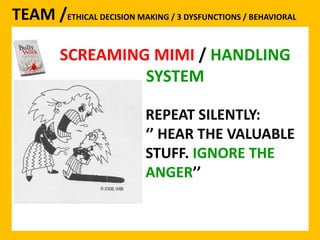
REPEAT SILENTLY: 
‘’ HEAR THE VALUABLE 
STUFF. IGNORE THE 
ANGER’’
SCREAMING MIMI 
TEAM /ETHICAL DECISION MAKING / 3 DYSFUNCTIONS / BEHAVIORAL 
SCREAMING MIMI / HANDLING 
SYSTEM 
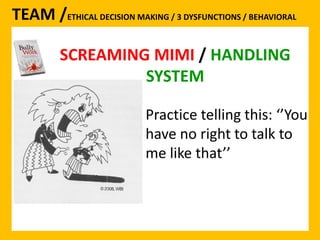
Practice telling this: ‘’You 
have no right to talk to 
me like that’’
SCREAMING MIMI 
TEAM /ETHICAL DECISION MAKING / 3 DYSFUNCTIONS / BEHAVIORAL 
SCREAMING MIMI / HANDLING 
SYSTEM 
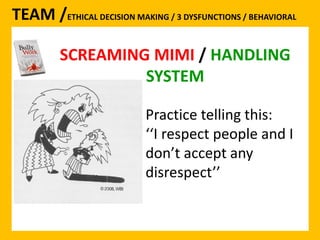
Practice telling this: 
‘‘I respect people and I 
don’t accept any 
disrespect’’
TEAM /ETHICAL DECISION MAKING / 3 DYSFUNCTIONS / BEHAVIORAL 
4 
TYPES 
1 2 
3 4
TEAM /ETHICAL DECISION MAKING / 3 DYSFUNCTIONS / BEHAVIORAL 
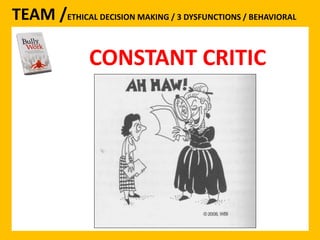
CONSTANT CRITIC 
CONSTANT CRITIC
TEAM /ETHICAL DECISION MAKING / 3 DYSFUNCTIONS / BEHAVIORAL 
CONSTANT CRITIC 
CONSTANT CRITIC / TACTICS 
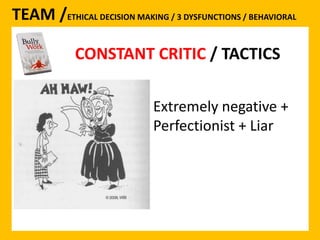
Extremely negative + 
Perfectionist + Liar
TEAM /ETHICAL DECISION MAKING / 3 DYSFUNCTIONS / BEHAVIORAL 
CONSTANT CRITIC 
CONSTANT CRITIC / TACTICS 
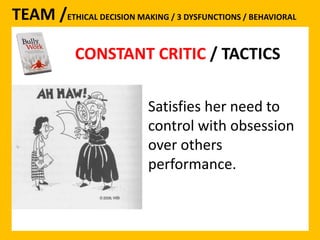
Satisfies her need to 
control with obsession 
over others 
performance.
TEAM /ETHICAL DECISION MAKING / 3 DYSFUNCTIONS / BEHAVIORAL 
CONSTANT CRITIC 
CONSTANT CRITIC / TACTICS 
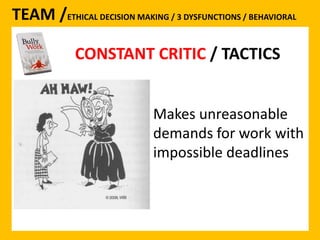
Makes unreasonable 
demands for work with 
impossible deadlines
TEAM /ETHICAL DECISION MAKING / 3 DYSFUNCTIONS / BEHAVIORAL 
CONSTANT CRITIC 
CONSTANT CRITIC / TACTICS 
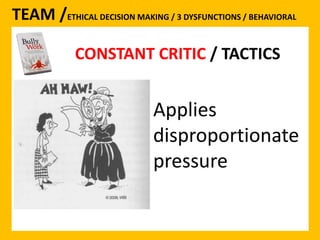
Applies 
disproportionate 
pressure
TEAM /ETHICAL DECISION MAKING / 3 DYSFUNCTIONS / BEHAVIORAL 
CONSTANT CRITIC 
CONSTANT CRITIC / TACTICS 
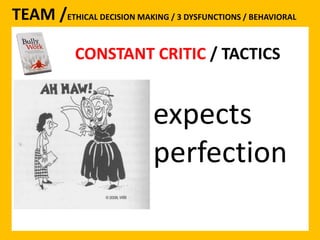
expects 
perfection
TEAM /ETHICAL DECISION MAKING / 3 FACTORS / BEHAVIORAL 
CONSTANT CRITIC 
CONSTANT CRITIC / TACTICS 
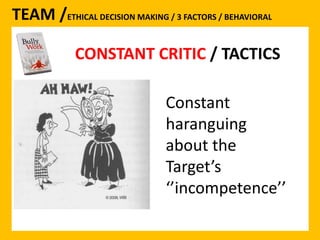
Constant 
haranguing 
about the 
Target’s 
‘’incompetence’’
TEAM /ETHICAL DECISION MAKING / 3 FACTORS / BEHAVIORAL 
CONSTANT CRITIC 
CONSTANT CRITIC / TACTICS 
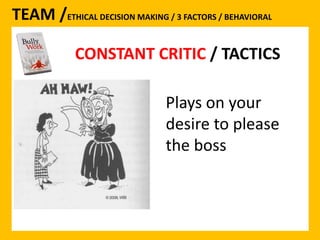
Plays on your 
desire to please 
the boss
TEAM /ETHICAL DECISION MAKING / 3 FACTORS / BEHAVIORAL 
CONSTANT CRITIC 
CONSTANT CRITIC / TACTICS 
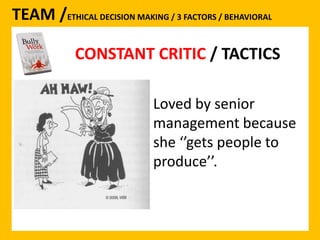
Loved by senior 
management because 
she ‘’gets people to 
produce’’.
TEAM /ETHICAL DECISION MAKING / 3 DYSFUNCTIONS / BEHAVIORAL 
CONSTANT CRITIC 
CONSTANT CRITIC / TACTICS 
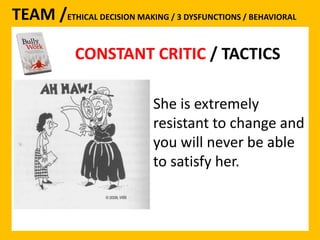
She is extremely 
resistant to change and 
you will never be able 
to satisfy her.
TEAM /ETHICAL DECISION MAKING / 3 FACTORS / BEHAVIORAL 
CONSTANT CRITIC 
CONSTANT CRITIC / TACTICS 
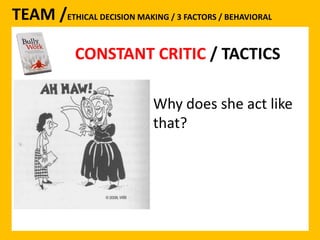
Why does she act like 
that?
TEAM /ETHICAL DECISION MAKING / 3 FACTORS / BEHAVIORAL 
CONSTANT CRITIC 
CONSTANT CRITIC / TACTICS 
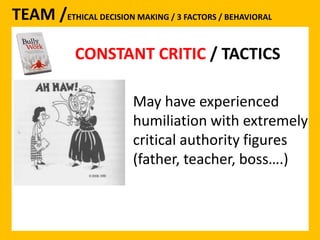
May have experienced 
humiliation with extremely 
critical authority figures 
(father, teacher, boss….)
TEAM /ETHICAL DECISION MAKING / 3 FACTORS / BEHAVIORAL 
CONSTANT CRITIC 
CONSTANT CRITIC / HANDLING 
SYSTEM 
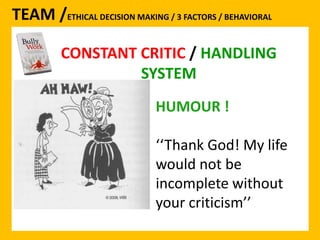
HUMOUR ! 
‘‘Thank God! My life 
would not be 
incomplete without 
your criticism’’
TEAM /ETHICAL DECISION MAKING / 3 DYSFUNCTIONS / BEHAVIORAL 
CONSTANT CRITIC 
CONSTANT CRITIC / HANDLING 
SYSTEM 
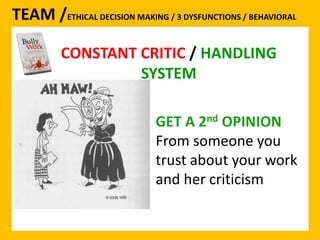
GET A 2nd OPINION 
From someone you 
trust about your work 
and her criticism
TEAM /ETHICAL DECISION MAKING / 3 FACTORS / BEHAVIORAL 
4 
TYPES 
1 2 
3 4
TEAM /ETHICAL DECISION MAKING / 3 FACTORS / BEHAVIORAL 
CONSTANT CRITIC 
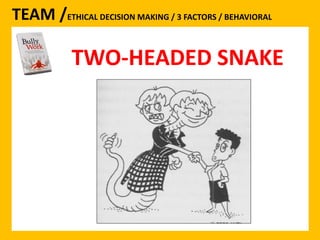
TWO-HEADED SNAKE
TEAM /ETHICAL DECISION MAKING / 3 FACTORS / BEHAVIORAL 
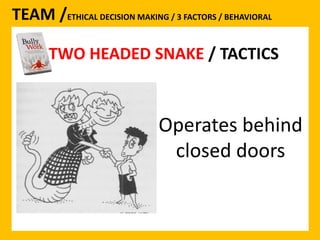
TWO HEADED SNAKE / TACTICS 
Operates behind 
closed doors
TEAM /ETHICAL DECISION MAKING / 3 DYSFUNCTIONS / BEHAVIORAL 
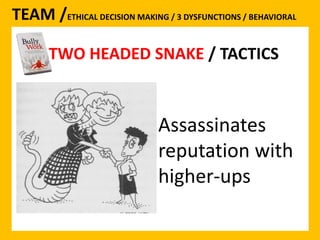
TWO HEADED SNAKE / TACTICS 
Assassinates 
reputation with 
higher-ups
TEAM /ETHICAL DECISION MAKING / 3 FACTORS / BEHAVIORAL 
TWO HEADED SNAKE / TACTICS 
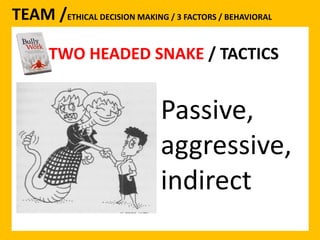
Passive, 
aggressive, 
indirect
TEAM /ETHICAL DECISION MAKING / 3 FACTORS / BEHAVIORAL 
TWO HEADED SNAKE / TACTICS 
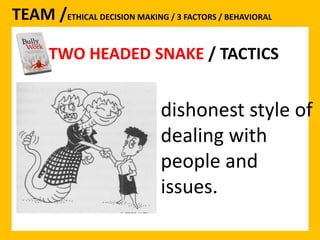
dishonest style of 
dealing with 
people and 
issues.
TEAM /ETHICAL DECISION MAKING / 3 FACTORS / BEHAVIORAL 
TWO HEADED SNAKE / TACTICS 
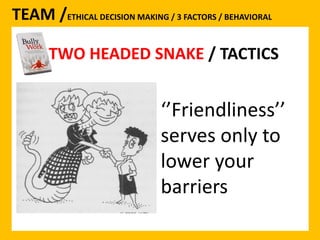
‘’Friendliness’’ 
serves only to 
lower your 
barriers
TEAM /ETHICAL DECISION MAKING / 3 DYSFUNCTIONS / BEHAVIORAL 
TWO HEADED SNAKE / TACTICS 
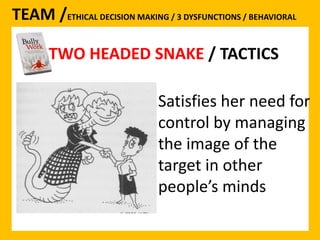
Satisfies her need for 
control by managing 
the image of the 
target in other 
people’s minds
TEAM /ETHICAL DECISION MAKING / 3 DYSFUNCTIONS / BEHAVIORAL 
TWO HEADED SNAKE / HANDLING 
SYSTEM 
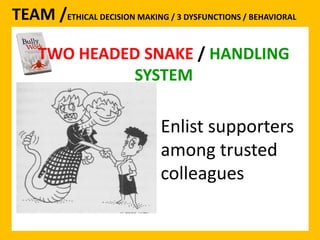
Enlist supporters 
among trusted 
colleagues
TEAM /ETHICAL DECISION MAKING / 3 DYSFUNCTIONS / BEHAVIORAL 
TWO HEADED SNAKE / HANDLING 
SYSTEM 
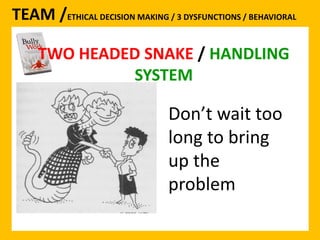
Don’t wait too 
long to bring 
up the 
problem
TEAM /ETHICAL DECISION MAKING / 3 DYSFUNCTIONS / BEHAVIORAL 
TWO HEADED SNAKE / HANDLING 
SYSTEM 
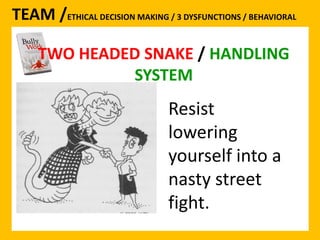
Resist 
lowering 
yourself into a 
nasty street 
fight.
TEAM /ETHICAL DECISION MAKING / 3 DYSFUNCTIONS / BEHAVIORAL 
TWO HEADED SNAKE / HANDLING 
SYSTEM 
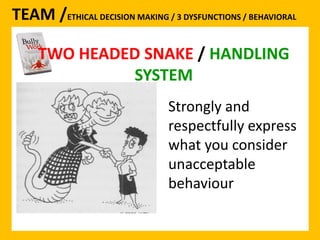
Strongly and 
respectfully express 
what you consider 
unacceptable 
behaviour
TEAM /ETHICAL DECISION MAKING / 3 FACTORS / BEHAVIORAL 
TWO HEADED SNAKE / HANDLING 
SYSTEM 
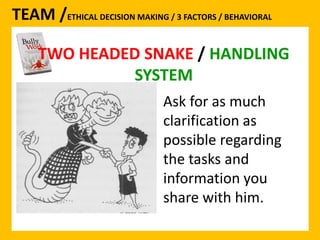
Ask for as much 
clarification as 
possible regarding 
the tasks and 
information you 
share with him.
TEAM /ETHICAL DECISION MAKING / 3 FACTORS / BEHAVIORAL 
TWO HEADED SNAKE / HANDLING 
SYSTEM 
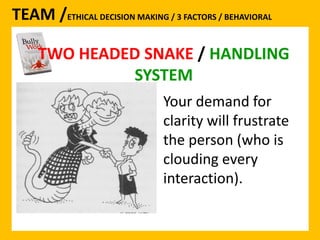
Your demand for 
clarity will frustrate 
the person (who is 
clouding every 
interaction).
TEAM /ETHICAL DECISION MAKING / 3 FACTORS / BEHAVIORAL 
TWO HEADED SNAKE / HANDLING 
SYSTEM 
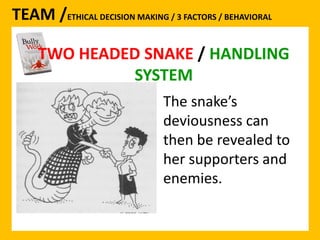
The snake’s 
deviousness can 
then be revealed to 
her supporters and 
enemies.
TEAM /ETHICAL DECISION MAKING / 3 DYSFUNCTIONS / BEHAVIORAL 
4 
TYPES 
1 2 
3 4
TEAM /ETHICAL DECISION MAKING / 3 FACTORS / BEHAVIORAL 
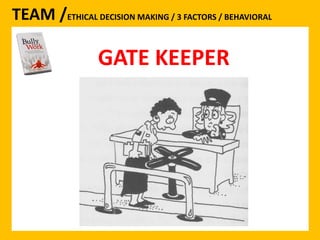
GATE KEEPER
TEAM /ETHICAL DECISION MAKING / 3 DYSFUNCTIONS / BEHAVIORAL 
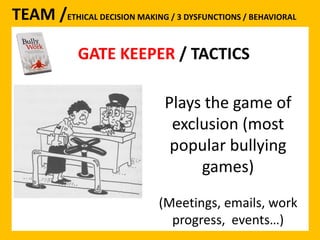
GATE KEEPER / TACTICS 
Plays the game of 
exclusion (most 
popular bullying 
games) 
(Meetings, emails, work 
progress, events…)
TEAM /ETHICAL DECISION MAKING / 3 DYSFUNCTIONS / BEHAVIORAL 
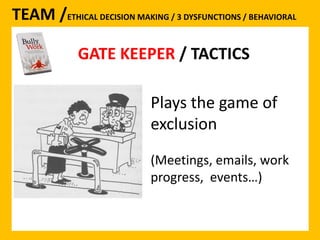
GATE KEEPER / TACTICS 
Plays the game of 
exclusion 
(Meetings, emails, work 
progress, events…)
TEAM /ETHICAL DECISION MAKING / 3 DYSFUNCTIONS / BEHAVIORAL 
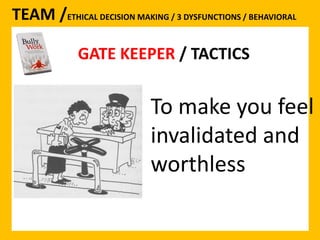
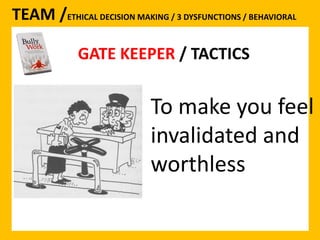
GATE KEEPER / TACTICS 
To make you feel 
invalidated and 
worthless
TEAM /ETHICAL DECISION MAKING / 3 DYSFUNCTIONS / BEHAVIORAL 
GATE KEEPER / TACTICS 
To make you feel 
invalidated and 
worthless
TEAM /ETHICAL DECISION MAKING / 3 DYSFUNCTIONS / BEHAVIORAL 
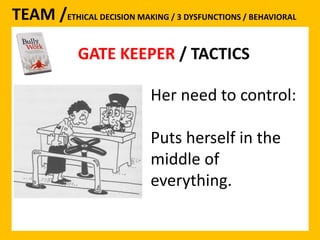
GATE KEEPER / TACTICS 
Her need to control: 
Puts herself in the 
middle of 
everything.
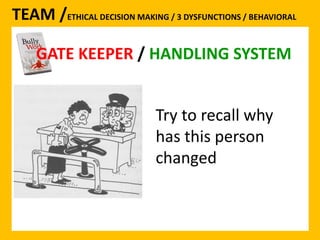
TEAM /ETHICAL DECISION MAKING / 3 DYSFUNCTIONS / BEHAVIORAL 
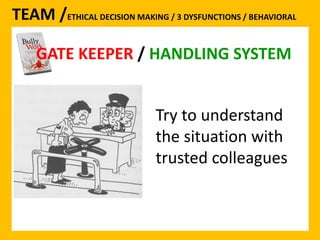
GATE KEEPER / HANDLING SYSTEM 
Try to recall why 
has this person 
changed
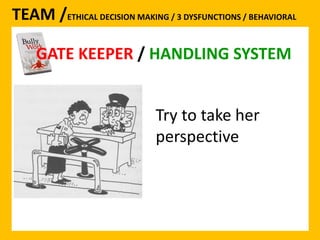
TEAM /ETHICAL DECISION MAKING / 3 DYSFUNCTIONS / BEHAVIORAL 
GATE KEEPER / HANDLING SYSTEM 
Try to take her 
perspective
TEAM /ETHICAL DECISION MAKING / 3 DYSFUNCTIONS / BEHAVIORAL 
GATE KEEPER / HANDLING SYSTEM 
Try to understand 
the situation with 
trusted colleagues
TEAM /ETHICAL DECISION MAKING / 3 DYSFUNCTIONS / BEHAVIORAL 
4 
TYPES 
1 2 
3 4
TEAM / CHALLENGES 
CHALLENGE 
Split the group in teams. Every team can role play a leader 
confronting one of the unethical types of behaviors.
TEAM/ 
CONTENT 
1- Why Ethical Teams? 
2- Team Trust Assessment 
3-3Team dysfunctions 
3.1 Cognitive 
3.2 Emotional 
3.3 Behavioral 
4- Steps to build ethical teams
TEAM / BUILDING STEPS 
STEPS 
TO 
BUILD ETHICAL TEAMS
TEAM / BUILDING STEPS 
1/ 5 
RECRUIT 
Ethical Team Members
TEAM / BUILDING STEPS 
2/ 5 
AGREE 
on ways to deal with conflicts
TEAM / BUILDING STEPS 
3/ 5 
CONSULT 
team members openly and 
honestly
TEAM / BUILDING STEPS 
4/ 5 
REWARD 
(and Discipline) 
(un)ethical behaviors
TEAM / BUILDING STEPS 
5/ 5 
SURVEY 
perceptions of honesty and 
fairness among team members
TEAM / CHALLENGES 
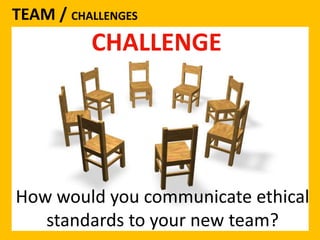
CHALLENGE 
How would you communicate ethical 
standards to your new team?
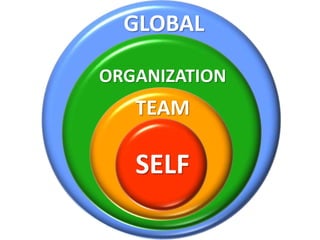
GLOBAL 
ORGANIZATION 
TEAM 
SELF
ETHICAL LEADERSHIP 
AMBASSADOR TRAININGTM 
www.ethical-leaders.com 
Youssef Gaboune B.Eng., M.Sc. 
Founder, Ethical Leaders 
y.gaboune@gmail.com
GLOBAL 
ORGANIZATION 
TEAM 
SELF
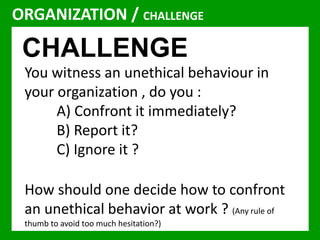
ORGANIZATION / CHALLENGE 
CHALLENGE 
You witness an unethical behaviour in 
your organization , do you : 
A) Confront it immediately? 
B) Report it? 
C) Ignore it ? 
How should one decide how to confront 
an unethical behavior at work ? (Any rule of 
thumb to avoid too much hesitation?)
ORGANIZATION / 
HOW TO BUILD 
ETHICAL 
ORGANIZATIONS 
?
ORGANIZATION / 
GOALS 
-To know the most important factors that 
shape an ethical organizational culture 
-Get an action framework to transform the 
components of organizations to make them 
more ethical.
ORGANIZATION / 
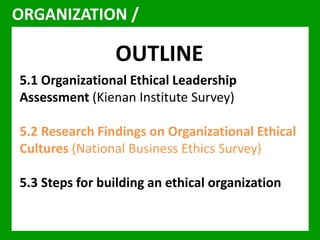
OUTLINE 
5.1 Organizational Ethical Leadership 
Assessment (Kienan Institute Survey) 
5.2 Research Findings on Organizational Ethical 
Cultures (National Business Ethics Survey) 
5.3 Steps for building an ethical organization
ORGANIZATION / 
OUTLINE 
5.1 Organizational Ethical Leadership 
Assessment (Kienan Institute Survey) 
5.2 Research Findings on Organizational Ethical 
Cultures (National Business Ethics Survey) 
5.3 Steps for building an ethical organization
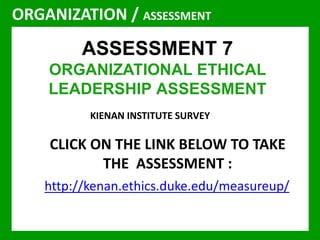
ORGANIZATION / ASSESSMENT 
ASSESSMENT 7 
ORGANIZATIONAL ETHICAL 
LEADERSHIP ASSESSMENT 
KIENAN INSTITUTE SURVEY 
CLICK ON THE LINK BELOW TO TAKE 
THE ASSESSMENT : 
http://kenan.ethics.duke.edu/measureup/
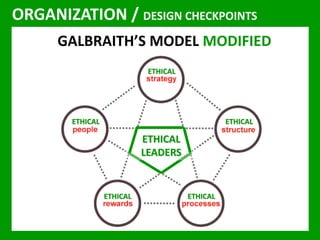
JAY GALBRAITH 
ORGANIZATION / DESIGN CHECKPOINTS 
Dr. Jay GALBRAITH 
Professor Emeritus at the International Institute 
for Management Development(IMD) 
Previously at: 
Wharton School of Business (University of Pennsylvania) 
Sloan School of Management (MIT)
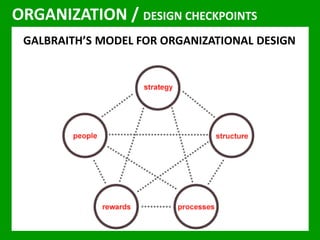
ORGANIZATION / DESIGN CHECKPOINTS 
GALBRAITH’S MODEL FOR ORGANIZATIONAL DESIGN
ORGANIZATION / DESIGN CHECKPOINTS 
GALBRAITH’S MODEL MODIFIED 
ETHICAL 
LEADERS 
ETHICAL 
ETHICAL 
ETHICAL 
ETHICAL ETHICAL
ORGANIZATION / DESIGN CHECKPOINTS 
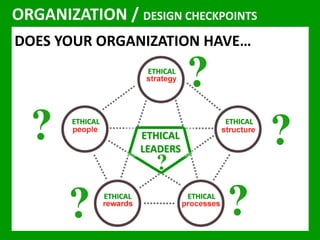
DOES YOUR ORGANIZATION HAVE… 
ETHICAL 
LEADERS 
ETHICAL 
ETHICAL 
ETHICAL 
? 
ETHICAL ETHICAL 
? 
? ? 
? 
?
ORGANIZATION / 
OUTLINE 
5.1 Organizational Ethical Leadership 
Assessment (Kienan Institute Survey) 
5.2 Research Findings on Organizational Ethical 
Cultures (National Business Ethics Survey) 
5.3 Steps for building an ethical organization
ORGANIZATION / ETHICAL CULTURE 
HOW TOASSESS 
the strength of an organization’s 
ETHICAL CULTURE ?
ORGANIZATION / ETHICAL CULTURE 
LATEST 
US SURVEY 
ON BUSINESS 
ETHICS 
2009-2010
ORGANIZATION / ETHICAL CULTURE 
ETHICAL 
CULTURES’ 
COMPONENTS
ORGANIZATION / ETHICAL CULTURE 
1/ 4 
ETHICAL LEADERHIP 
(‘TONE AT THE TOP’)
ORGANIZATION / ETHICAL CULTURE 
2 / 4 
SUPERVISOR 
REINFORCEMENT 
(How supervisors walk the top leadership’s talk)
ORGANIZATION / ETHICAL CULTURE 
3 / 4 
PEER COMMITMENT 
(Finding support in ‘doing the right thing’ 
among coworkers)
ORGANIZATION / ETHICAL CULTURE 
4 / 4 
EMBEDDED ETHICAL 
VALUES 
(‘How we do things around here’ in daily 
activities)
ORGANIZATION / ETHICAL CULTURE 
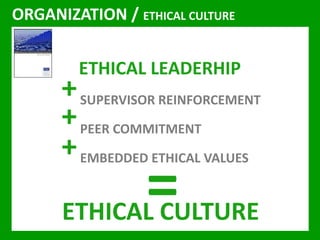
ETHICAL LEADERHIP 
+++ = 
SUPERVISOR REINFORCEMENT 
PEER COMMITMENT 
EMBEDDED ETHICAL VALUES 
ETHICAL CULTURE
ORGANIZATION / ETHICAL CULTURE 
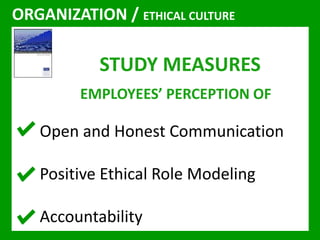
STUDY MEASURES 
EMPLOYEES’ PERCEPTION OF 
Open and Honest Communication 
Positive Ethical Role Modeling 
Accountability
ORGANIZATION / ETHICAL CULTURE 
USING 2 
INDICES 
1- TOP MANAGEMENT CULTURE 
INDEX 
2- SUPERVISOR CULTURE 
INDEX
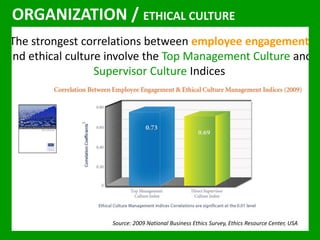
ORGANIZATION / ETHICAL CULTURE 
The strongest correlations between employee engagement 
and ethical culture involve the Top Management Culture and 
Supervisor Culture Indices 
Source: 2009 National Business Ethics Survey, Ethics Resource Center, USA
ORGANIZATION / 
OUTLINE 
5.1 Organizational Ethical Leadership 
Assessment (Kienan Institute Survey) 
5.2 Research Findings on Organizational Ethical 
Cultures (National Business Ethics Survey) 
5.3 Steps for building an ethical organization
ORGANIZATION / BUILDING STEPS 
STEPS TO BUILD ETHICAL 
ORGANIZATIONS
ORGANIZATION / BUILDING STEPS 
/6 
Hire/Appoint 
ethical leaders 
(Fire unethical leaders, even if they are performant)
ORGANIZATION / BUILDING STEPS 
/6 
A Strategic Plan’s 
Objective
ORGANIZATION / BUILDING STEPS 
/6 
Set up ethical processes
ORGANIZATION / BUILDING STEPS 
/6 
Ethical talent management and 
leadership development programs
ORGANIZATION / BUILDING STEPS 
/6 
A culture of rewarding the ethical employees 
and firing the unethical ones
ORGANIZATION / BUILDING STEPS 
/6 
Independant surveys to assess trust and 
ethics levels among employees / customers
ORGANIZATION / BUILDING STEPS 
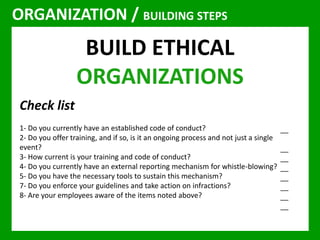
BUILD ETHICAL 
ORGANIZATIONS 
Check list 
1- Do you currently have an established code of conduct? 
2- Do you offer training, and if so, is it an ongoing process and not just a single 
event? 
3- How current is your training and code of conduct? 
4- Do you currently have an external reporting mechanism for whistle-blowing? 
5- Do you have the necessary tools to sustain this mechanism? 
7- Do you enforce your guidelines and take action on infractions? 
8- Are your employees aware of the items noted above? 
__ 
__ 
__ 
__ 
__ 
__ 
__ 
__
GLOBAL / MEDIA 
VIDEO 
ETHICAL LEADERSHIP IS COOL 
(Viral Video) 
http://www.youtube.com/watch?v=uUIlF9TEg2E
ETHICAL LEADERSHIP 
AMBASSADOR TRAININGTM 
www.ethical-leaders.com 
Youssef Gaboune B.Eng., M.Sc. 
Founder, Ethical Leaders 
y.gaboune@gmail.com

Ethical Leadership Ambassadors Training

  • 1.
    ETHICAL LEADERSHIP AMBASSADORTRAININGTM www.ethical-leaders.com www.ethical-leaders.com Youssef Gaboune B.Eng., M.Sc. Founder, Ethical Leaders y.gaboune@gmail.com
  • 2.
    Program Indications EthicalLeadership Challenges (30mins) 1- Definitions (10mins) 2- Ethical Leaders’ 4 Practices (20mins) 3- The GAS Ethical Leadership Model (10mins) 4- Open Consulting Circle 4.1 Identify + Diagnose challenges (35 mins) BREAK (15 mins) 4.2 Experience exchange (20mins) Practice (20mins) Lessons learned (15mins)
  • 3.
    The Project’s Story L.K. TREVINO, PhD H. MINTZBERG,PhD
  • 4.
    Why is EthicalLeadership relevant now? ETHICAL LEADERS www.ethical-leaders.com MOST WANTED In times of CRISIS
  • 5.
    Why is EthicalLeadership relevant now? VIDEO University of Notre-Dame’s Ethical Leadership Program www.youtube.com/watch?v=OK8Pw4dzbio
  • 6.
    UNETHICAL BEHAVIOR HARMSSALES In a 2003 survey by Wirthlin Worldwide 80% of people said they DECIDE TO BUY a firm’s goods or services partly on their perception of its ethics.
  • 7.
    UNETHICAL BEHAVIOR WORSENSEMPLOYEE FRAUD according to U.S. workers surveyed in 2002 by Ernst & Young 20% Costs employers of every dollar earned
  • 8.
    Disloyalty reduces organizational performance by 25-50%
  • 9.
    FUNDAMENTAL QUESTIONS ETHICALLEADERS www.ethical-leaders.com HOW CAN WE 1- IDENTIFY 2- GROW ?
  • 10.
    How to identifyEthical Leaders? WATCH THEM IN TURBULENT TIMES
  • 11.
    The Target Audience WHO is this training aimed at ? www.ethical-leaders.com ETHICAL LEADERSHIP AMBASSADOR TRAININGTM
  • 12.
    The Target Audience PRE-REQUISITES MOTIVES CHARACTER FORMATION INFLUENCE Mendonca & Kanungo, 2006 STRATEGIES
  • 13.
    The Training’s Objectives Ethical Leadership Ambassadors should be able to better: 1- DIAGNOSE ethically challenging situations 2- ROLE MODEL ethical leadership behaviors 3- PROMOTE ethical leadership
  • 14.
    GLOBAL ORGANIZATION TEAM 4 3 2 1 SELF START
  • 15.
    ETHICAL LEADERSHIP CHALLENGES CHALLENGE Source: The Center for Creative Leadership Handbook of Leadership Development , Described in Johnson C.E, 2009
  • 16.
    DEFINITIONS WHAT IS ETHICAL LEADERSHIP ?
  • 17.
    DEFINITIONS LEADERSHIP Theability to move people towards goals (Suwaidan, T., 2000)
  • 18.
  • 19.
    DEFINITIONS What arethe most wanted leadership qualities ?
  • 20.
    1,5 MILLION PEOPLE SURVEYED DEFINITIONS
  • 21.
  • 22.
    DEFINITIONS QUALITIES PeopleLook for in leaders
  • 23.
    QUALITIES 1 HONEST 2 FORWARD-LOOKING 3 INSPIRING 4 COMPETENT 5 INTELLIGENT DEFINITIONS
  • 24.
    DEFINITIONS WHAT IS ETHICAL LEADERSHIP ?
  • 25.
    DEFINITIONS Worldwide Survey 5 Most widely shared ethical principles
  • 26.
    DEFINITIONS 5 UNIVERSALPRINCIPLES 1- Honesty 2- Respect 3- Responsibility 4- Fairness 5- Compassion
  • 27.
    DEFINITIONS ETHICAL LEADERSHIP: To lead with the 5 universal principles with all stakeholders
  • 28.
    DEFINITIONS Common Grounds& Specs COMPARISON CRITERIA SOURCE OF KNOWLEDGE HIGHEST GOOD MOTIVE SANCTION SECULAR BASED ETHICS FAITH BASED ETHICS
  • 29.
    DEFINITIONS ASSESSMENT 1: Do your followers perceive you as an ethical leader?
  • 30.
    DEFINITIONS ASSESSMENT 1:Do your followers perceive you as an ethical leader? Scoring Interpretation The PLIS measures subordinates’ perceptions of their leaders’ integrity in organizational settings. Your responses on the PLIS indicate the degree to which you see your supervisor’s behavior as ethical. Score the questionnaire by doing the following. Sum the responses on all 31 items. A low score on the questionnaire indicates that you perceive your supervisor to be highly ethical. A high score indicates that you see your supervisor to be very unethical. The interpretation of what the score represents is given below. Total score: ______
  • 31.
    DEFINITIONS ASSESSMENT 1:Do your followers perceive you as an ethical leader? Interpretation: Your score is a measure of your perceptions of your supervisor’s ethical integrity. Based on previous findings (Craig & Gustafson, 1998), the following interpretations can be made about your total score. 31-35 High ethical If you scored in this range, it means that you see your supervisor as highly ethical. Your impression is that your supervisor is very trustworthy and highly principled. 36-66 Moderate Scores in this range mean that you see your supervisor as moderately ethical. Your impression is that he or she sometimes engages in slightly unethical behaviors. 67-124 Low ethical This range is descriptive of supervisors who are seen as very unethical. Your impression is that they do things which are dishonest, unfair, and unprincipled.
  • 32.
    BEHAVIORS Training Goals What essential behaviors must ethical leaders master?
  • 33.
    GLOBAL SURVEY 1121 Executives & Managers BEHAVIORS
  • 34.
    What are the BEHAVIORS TOP 3 Processes for ensuring an Ethical Business Culture?
  • 35.
  • 36.
    What are BEHAVIORS The TOP 3 Processes for ensuring an Ethical Business Culture? 1- Leaders support & model ethical behavior 2- Leaders communicate consistently 3- Ethics are integrated into the fabric of the organization
  • 37.
    BEHAVIORS What arethe Top 5 Most important Ethical Leadership Behaviors ?
  • 38.
    Top 5 Mostimportant BEHAVIORS ethical leadership behaviors
  • 39.
    What are BEHAVIORS The TOP 3 Processes that ensure an Ethical Business Culture? 1- Keep Promises 2- Encourage Open Communication & Ensure No Retaliation 3- Keep employees informed
  • 40.
  • 41.
    Be BEHAVIORS TRUTHFUL& TRUSTWORTHY Act with MORAL COURAGE Foster OPEN COMMUNICATION ENCOURAGE ethical behavior and DISCOURAGE unethical behavior 1 2 3 4
  • 42.
    BEHAVIORS / BeTruthful & Trustworthy ASSESSMENT 2 Promise Keeping Do you communicate your promises clearly and precisely so there is no misunderstanding? Are your promises slippery, e.g., "I will try to do it"? Are there any promises that you have made right now but not fulfilled? Do you show up for meetings on time? What system can you set up now that will ensure that your promises are kept? Are there requests that you have made that have not been acted upon or followed up on? Have you established a culture within your organization which supports the keeping of promises and calls others to account for failure to keep them? http://www.leadershipmasterymap.com/keep-their-promises.htm Yes/No
  • 43.
    BEHAVIORS / BeTruthful & Trustworthy Why do leaders (or anyone) lie ?
  • 44.
    BEHAVIORS / BeTruthful & Trustworthy 1 To boost appeal and likeability
  • 45.
    BEHAVIORS / BeTruthful & Trustworthy 2 To avoid negative consequences
  • 46.
    BEHAVIORS / BeTruthful & Trustworthy 3 To gain an advantage
  • 47.
    BEHAVIORS / BeTruthful & Trustworthy 4 To cover up lies
  • 48.
    Be BEHAVIORS TRUTHFUL& TRUSTWORTHY Act with MORAL COURAGE Foster OPEN COMMUNICATION ENCOURAGE ethical behavior and DISCOURAGE unethical behavior 1 2 3 4
  • 49.
    ASSESSMENT 3 MoralCourage 5- BEHAVIOR I risk substantial personal loss to achieve the vision. I take personal risks to defend my beliefs. I say no even if I have a lot loose. I consciously link my actions to higher values. I don’t hesitate to act against the opinions and approval of others. I quickly tell people the truth even when it is negative. I feel relaxed most of the time I speak out against organizational injustice I stand up to people if they make offensive remarks I act according to my conscience even if it means I lose status and approval. Yes No Add up your points for ‘‘Mostly True’’ answers ≥ 7: You have real potential to act as a courageous leader ≤ 3: You avoid difficult issues or have not been in situations that challenge your moral leadership Is your score consistent with your understanding of your own courage? How might you increase your courage as a leader?
  • 50.
    BEHAVIORS / MoralCourage VIDEO 1 MORAL COURAGE Erdogan at Davos http://youtu.be/OrbQsHkVQ_4
  • 51.
    Be BEHAVIORS TRUTHFUL& TRUSTWORTHY Act with MORAL COURAGE Foster OPEN COMMUNICATION ENCOURAGE ethical behavior and DISCOURAGE unethical behavior 1 2 3 4
  • 52.
    ASSESSMENT 4 FosteringCandor 5- BEHAVIOR Can you be constructively candid with those around you? What conversations are you avoiding? Who are you avoiding? How would you and your organization benefit if everyone talked about the crucial things needed to be successful—even though such conversations may be painful? What conversation can you have today that will put things on the table so that they can be addressed? Yes/No
  • 53.
    Be TRUTHFUL &TRUSTWORTHY Act with MORAL COURAGE Foster OPEN COMMUNICATION ENCOURAGE ethical behavior and DISCOURAGE unethical behavior 5- BEHAVIOR 1 2 3 4
  • 54.
    BEHAVIORS / Encourageethical behavior VIDEO 2 Discipline No Gossip Zone http://youtu.be/OrbQsHkVQ_4
  • 55.
    Be TRUTHFUL &TRUSTWORTHY Act with MORAL COURAGE Foster OPEN COMMUNICATION ENCOURAGE ethical behavior and DISCOURAGE unethical behavior BEHAVIORS 1 2 3 4
  • 56.
    Gaboune- Al SuwaidanPRESSURES DRIVERS (GAS) ModelTM (2011) BEHAVIOR EMOTION COGNITION S T R E N G T H W E A K N E S S
  • 57.
    Be BEHAVIORS TRUTHFUL& TRUSTWORTHY Act with MORAL COURAGE Foster OPEN COMMUNICATION ENCOURAGE ethical behavior and DISCOURAGE unethical behavior 1 2 3 4
  • 58.
    BEHAVIORS / FosterOpen Communication WHATis an Open Consulting Circle? ?
  • 59.
    BEHAVIORS / FosterOpen Communication 90 minute Structured Discussions
  • 60.
    BEHAVIORS / FosterOpen Communication WHY Open Consulting Circles?
  • 61.
    BEHAVIORS / FosterOpen Communication To resolve ethical issues in a safe environment
  • 62.
    BEHAVIORS / FosterOpen Communication Safe environment : Practice voicing your values without fear of retaliation
  • 63.
    BEHAVIORS / FosterOpen Communication HOWcan you facilitate an Open Consulting Circle?
  • 64.
    BEHAVIORS / FosterOpen Communication 5 STEPS
  • 65.
    BEHAVIORS / FosterOpen Communication 1- IDENTIFY an ethical challenge (10 mins)
  • 66.
    BEHAVIORS / FosterOpen Communication 2- DIAGNOSE the ethical challenge (25 mins)
  • 67.
    BEHAVIORS / FosterOpen Communication 3- SHARE relevant experiences and possible solutions (20 mins)
  • 68.
    BEHAVIORS / FosterOpen Communication 4- PRACTICE difficult conversations (20 mins)
  • 69.
    BEHAVIORS / FosterOpen Communication 5- SYNTHESIZE lessons learned + commitments (15 mins)
  • 70.
    BEHAVIORS / FosterOpen Communication 5 STEPS (90 mins) 1- IDENTIFY (10 mins) 2- DIAGNOSE (25 mins) 3- SHARE (20 mins) 4- PRACTICE (20 mins) 5- SYNTHESIZE (15 mins)
  • 71.
    BEHAVIORS / FosterOpen Communication 5 STEPS (90 mins) 1- IDENTIFY (10 mins) 2- DIAGNOSE (25 mins) 3- SHARE (20 mins) 4- PRACTICE (20 mins) 5- SYNTHESIZE (15 mins)
  • 72.
    BEHAVIORS / FosterOpen Communication How can we categorize ethical leadership challenges ?
  • 73.
    BEHAVIORS / FosterOpen Communication CHALLENGES in leading a team project 1 2 3 4 TEAM BUILDING TASK DELEGATION FOLLOW-UP CRISIS Performance Review IMPACT ON STAKEHOLDERS
  • 74.
    BEHAVIORS / FosterOpen Communication 1- IDENTIFY (10 mins) Example : How do you stand public criticism?
  • 75.
    BEHAVIORS / FosterOpen Communication 5 STEPS 1- IDENTIFY (10 mins) 2- DIAGNOSE (25 mins) 3- SHARE (20 mins) 4- PRACTICE (20 mins) 5- SYNTHESIZE (15 mins)
  • 76.
    What would driveyou to deal ethically with this sharp criticism? PRESSURES BEHAVIOR EMOTION COGNITION DRIVERS 1- DRIVERS
  • 77.
    What are the Top 3 Drivers To run a business ethically ? 1- DRIVERS
  • 78.
    Top 3 Drivers To lead ethically 1- DRIVERS
  • 79.
    Top 3 Drivers To lead ethically 1- DRIVERS 1- Protection of brand and reputation 2-The right thing to do 3- Customer trust and loyalty
  • 80.
    PRESSURES TO ACTUNETHICALLY PRESSURES BEHAVIOR EMOTION COGNITION DRIVERS Suwaidan-Gaboune ModelTM (2011) 2- PRESSURES
  • 81.
    What pressures doyou think could push you to react unethically? PRESSURES BEHAVIOR EMOTION COGNITION DRIVERS Suwaidan-Gaboune ModelTM (2011) 2- PRESSURES
  • 82.
    What are the Top 3 Pressures To act unethically ? 2- PRESSURES
  • 83.
    Top 3 Pressures To act unethically Survey conducted by the Human Resource Institute (HRI) in 2006, and commissioned by American Management Association (AMA) 2- PRESSURES
  • 84.
    2- PRESSURES TopPressures To act unethically
  • 85.
    2 TYPES OFDILEMMAS VS RIGHT WRONG VS RIGHT RIGHT PRESSURES BEHAVIOR EMOTION COGNITION DRIVERS Suwaidan-Gaboune ModelTM (2011) 2- PRESSURES
  • 86.
    DILEMMAS VS RIGHTWRONG Pressure of TEMPTATION Pressure of RETALIATION PRESSURES BEHAVIOR EMOTION COGNITION Pressure of MANIPULATION DRIVERS Suwaidan-Gaboune Model (2011) 2- PRESSURES / Right vs Wrong dilemmas
  • 87.
    2- PRESSURES /Right vs Wrong dilemmas / Temptation VS RIGHT WRONG Pressures of temptation PRESSURES BEHAVIOR EMOTION COGNITION DRIVERS Suwaidan-Gaboune Model (2011) 3 major situational factors amplify temptations to act unethically Coughlan, Richard, Connolly, Terry (2008) Investigating Unethical Decisions at work: Justification and Emotion in Dilemma Resolution; Journal of Managerial Issues, Schweitzer , Ordonez and Douma (2004) The Role of Goal Setting in Motivating Unethical Behaviour, Academy of Management Journal 47, 422-432.
  • 88.
    2- PRESSURES /Right vs Wrong dilemmas / Temptation SITUATIONAL FACTORS
  • 89.
    2- PRESSURES /Right vs Wrong dilemmas / Temptation VIDEO 2 Unethical Qualification to Soccer World Cup www.youtube.com/watch?v=jxw1-Id91lQ
  • 90.
    2- PRESSURES /Right vs Wrong dilemmas / Temptation VS RIGHT WRONG Pressures of temptation PRESSURES BEHAVIOR EMOTION COGNITION DRIVERS Suwaidan-Gaboune Model (2011) 1 Closeness to goal increases the temptation to commit the unethical act Coughlan, Richard, Connolly, Terry (2008) Investigating Unethical Decisions at work: Justification and Emotion in Dilemma Resolution; Journal of Managerial Issues, Schweitzer , Ordonez and Douma (2004) The Role of Goal Setting in Motivating Unethical Behaviour, Academy of Management Journal 47, 422-432.
  • 91.
    2- PRESSURES /Right vs Wrong dilemmas / Temptation CLOSE TO GOAL
  • 92.
    2- PRESSURES /Right vs Wrong dilemmas / Temptation VS RIGHT WRONG Pressures of temptation PRESSURES BEHAVIOR EMOTION COGNITION DRIVERS Suwaidan-Gaboune Model (2011) 2 High Stakes the bigger the gain expected from the unethical behavior, the bigger the temptation to commit it Coughlan, Richard, Connolly, Terry (2008) Investigating Unethical Decisions at work: Justification and Emotion in Dilemma Resolution; Journal of Managerial Issues, Schweitzer , Ordonez and Douma (2004) The Role of Goal Setting in Motivating Unethical Behaviour, Academy of Management Journal 47, 422-432.
  • 93.
    2- PRESSURES /Right vs Wrong dilemmas / Temptation HIGH STAKES
  • 94.
    2- PRESSURES /Right vs Wrong dilemmas / Temptation VS RIGHT WRONG Pressures of temptation PRESSURES BEHAVIOR EMOTION COGNITION DRIVERS Suwaidan-Gaboune Model (2011) 3 Low Risk of Punishment little risk of being exposed or punished for misbehaviour Coughlan, Richard, Connolly, Terry (2008) Investigating Unethical Decisions at work: Justification and Emotion in Dilemma Resolution; Journal of Managerial Issues, Schweitzer , Ordonez and Douma (2004) The Role of Goal Setting in Motivating Unethical Behaviour, Academy of Management Journal 47, 422-432.
  • 95.
    2- PRESSURES /Right vs Wrong dilemmas / Temptation NO PUNISHMENT
  • 96.
    2- PRESSURES /Right vs Wrong dilemmas / Temptation
  • 97.
    2- PRESSURES /Right vs Wrong dilemmas / Retaliation VS RIGHT WRONG Pressures of RETALIATION PRESSURES BEHAVIOR EMOTION COGNITION DRIVERS Suwaidan-Gaboune Model (2011) LATEST US SURVEY ON BUSINESS ETHICS 2009-2010
  • 98.
    2- PRESSURES /Right vs Wrong dilemmas / Manipulation Other employees gave you a cold shoulder Your supervisor or management excluded you from decisions and work activity You were verbally abused by your supervisor or someone else in management You almost lost your job You were verbally abused by other employees You were not given promotions or raises You were reallocated or reassigned Any other form of retaliation You were demoted You experienced physical harm to your person or property Source: 2009 National Business Ethics Survey, Ethics Resource Center, USA
  • 99.
    2- PRESSURES /Right vs Wrong dilemmas / Manipulation VS RIGHT WRONG Pressures of Manipulation PRESSURES BEHAVIOR EMOTION COGNITION DRIVERS Manipulators exploit the following vulnerabilities (buttons) in victims: The “disease to please” or, addiction to earning approval and acceptance from others Emotophobia (fear of negative emotion) Lack of assertiveness and ability to say no (blurry sense of identity, soft personal boundaries ) Braiker, Harriet B. (2004). Who’s Pulling Your Strings ? How to Break The Cycle of Manipulation, McGraw-Hill Suwaidan-Gaboune Model (2011) ASSESSMENT 5
  • 100.
    DILEMMAS VS RIGHTRIGHT Truth or Loyalty? Short-term or Long-term? Individual or Community? Justice or Mercy? PRESSURES BEHAVIOR EMOTION COGNITION DRIVERS Suwaidan-Gaboune Model (2011) 2- PRESSURES / Right vs Right/ Dilemmas
  • 101.
    PRESSURES BEHAVIOR EMOTION COGNITION DRIVERS Suwaidan-Gaboune Model (2011) 2- COGNITION What thinking processes are at play?
  • 102.
    Problematic beliefs? Self-centeredpurpose? Lack of critical thinking? No choice? (3rd alternative) Rationalization? PRESSURES BEHAVIOR EMOTION COGNITION DRIVERS Suwaidan-Gaboune Model (2011) 3- COGNITION
  • 103.
    PRESSURES BEHAVIOR EMOTION COGNITION DRIVERS Suwaidan-Gaboune Model (2011) 2- COGNITION The ultimate vaccin against extremisms
  • 104.
    23- COGNITION /Problematic Beliefs PROBLEMATIC BELIEFS Problematic beliefs can disrupt ethical reasoning and ethical action
  • 105.
    23- COGNITION /Problematic Beliefs 5 PROBLEMATIC BELIEFS 1 2 3 4 5
  • 106.
    MOST COMMON PROBLEMATICBELIEFS TO SUCCEED http://www.tgcoy.com/anxiety/beliefs-that-cause-problems.html 3- COGNITION
  • 107.
    MOST COMMON PROBLEMATICBELIEFS TO SUCCEED Would you be ready to stand up for what is right at the cost of displeasing your boss or coworkers? http://www.tgcoy.com/anxiety/beliefs-that-cause-problems.html 3- COGNITION
  • 108.
    MOST COMMON PROBLEMATICBELIEFS TO SUCCEED INSTEAD I want to be loved and approved of by God http://www.tgcoy.com/anxiety/beliefs-that-cause-problems.html 3- COGNITION
  • 109.
    MOST COMMON PROBLEMATICBELIEFS http://www.tgcoy.com/anxiety/beliefs-that-cause-problems.html 3- COGNITION
  • 110.
    MOST POPULAR PROBLEMATICBELIEFS Would you confront an unethical act you witness, or just ignore it? http://www.tgcoy.com/anxiety/beliefs-that-cause-problems.html 3- COGNITION
  • 111.
    MOST COMMON PROBLEMATICBELIEFS INSTEAD FACING A PROBLEM IS AN OPPORTUNITY TO FIX A PROBLEMATIC SITUATION 3- COGNITION
  • 112.
    MOST COMMON PROBLEMATICBELIEFS People who do things I don't approve of are bad people. http://www.tgcoy.com/anxiety/beliefs-that-cause-problems.html 3- COGNITION
  • 113.
    MOST COMMON PROBLEMATICBELIEFS INSTEAD Judge actions not people. http://www.tgcoy.com/anxiety/beliefs-that-cause-problems.html 3- COGNITION
  • 114.
    MOST COMMON PROBLEMATICBELIEFS People are either GOOD OR BAD http://www.tgcoy.com/anxiety/beliefs-that-cause-problems.html 3- COGNITION
  • 115.
    MOST COMMON PROBLEMATICBELIEFS INSTEAD Recognize good actions and condemn bad actions http://www.tgcoy.com/anxiety/beliefs-that-cause-problems.html 3- COGNITION
  • 116.
    SELF / 5STAR PERSONAL MASTERY MODEL / BELIEFS MOST COMMON PROBLEMATIC BELIEFS I HAVE TO BE PERFECT MISTAKES = INCOMPETENCE http://www.tgcoy.com/anxiety/beliefs-that-cause-problems.html 3- COGNITION
  • 117.
    SELF / 5STAR PERSONAL MASTERY MODEL / BELIEFS MOST COMMON PROBLEMATIC BELIEFS Would you lie to cover up a mistake? http://www.tgcoy.com/anxiety/beliefs-that-cause-problems.html 3- COGNITION
  • 118.
    SELF / 5STAR PERSONAL MASTERY MODEL / BELIEFS MOST COMMON PROBLEMATIC BELIEFS INSTEAD Mistakes are learning opportunities http://www.tgcoy.com/anxiety/beliefs-that-cause-problems.html 3- COGNITION
  • 119.
    Care-Behavior Matrix WhatI believe about others They care about me They do not care about me http://www.changingminds.org/explanations/behaviors/care-behavior_matrix.htm What I believe about myself I should care for others I do not care for others Collaborator Nurturer User Independent 3- COGNITION
  • 120.
    Problematic beliefs? Self-centeredpurpose? Lack of critical thinking? No choice? (3rd alternative) Rationalization? PRESSURES BEHAVIOR EMOTION COGNITION DRIVERS Suwaidan-Gaboune Model (2011) 3- COGNITION
  • 121.
    PURPOSE 3- COGNITION Meaning given to our life that defines our higher goals
  • 122.
    (personal, family, work,community…) 3- COGNITION
  • 123.
    PURPOSE USE THE5 WHYs TO DISCOVER THE ROOTED REASON BEHIND YOUR DECISIONS 3- COGNITION
  • 124.
    3- COGNITION EXAMPLESOF PURPOSES TO PLEASE GOD TO PLEASE PEOPLE TO PLEASE YOURSELF
  • 125.
    Problematic beliefs? Self-centeredpurpose? Lack of critical thinking? No choice? (3rd alternative) Rationalization? PRESSURES BEHAVIOR EMOTION COGNITION DRIVERS Suwaidan-Gaboune Model (2011) 3- COGNITION
  • 126.
    PRESSURES BEHAVIOR EMOTION COGNITION DRIVERS Suwaidan-Gaboune Model (2011) 3- COGNITION / Critical Thinking THINKING PROCESS
  • 127.
    3- COGNITION /Critical Thinking VIDEO 3 CRITICAL THINKING Don’t juge too quickly http://www.youtube.com/watch?v=v_PKUkWM9zI
  • 128.
    3- COGNITION /Critical Thinking GENERATES P PURPOSE U R P O S E (GOAL, OBJECTIVE) ALL THINKING
  • 129.
    3- COGNITION /Critical Thinking RAISES QUESTIONS (PROBLEM, ISSUE…) ALL THINKING
  • 130.
    3- COGNITION /Critical Thinking USES INFORMATION (DATA, OBSERVATIONS…) ALL THINKING
  • 131.
    3- COGNITION /Critical Thinking MAKES P U R P O S E INFERENCES (INTERPRETATIONS THAT GIVE MEANING TO OBSERVATIONS) ALL THINKING
  • 132.
    3- COGNITION /Critical Thinking SELF / 5 STAR PERSONAL MASTERY MODEL / THINKING UTILIZES P U R P O S E CONCEPTS (THEORIES, LAWS, MODELS… ) ALL THINKING
  • 133.
    3- COGNITION /Critical Thinking SELF / 5 STAR PERSONAL MASTERY MODEL / THINKING MAKES P U R P O S E ASSUMPTIONS (PRESUPPOSITIONS, TAKING THINGS FOR GRANTED) ALL THINKING
  • 134.
    3- COGNITION /Critical Thinking GENERATES P U R P O S E IMPLICATIONS (CONSEQUENCES) ALL THINKING
  • 135.
    3- COGNITION /Critical Thinking SELF / 5 STAR PERSONAL MASTERY MODEL / THINKING EMBODIES A P U R P O S E VIEWPOINT (PERSPECTIVE, FRAME OF REFERENCE) ALL THINKING
  • 136.
    Problematic beliefs? Self-centeredpurpose? Lack of critical thinking? No choice? (3rd alternative) Rationalization? PRESSURES BEHAVIOR EMOTION COGNITION DRIVERS Suwaidan-Gaboune Model (2011) 3- COGNITION
  • 137.
    3- COGNITION Nochoice ? (3rd alternative) PRESSURES BEHAVIOR EMOTION COGNITION DRIVERS Suwaidan-Gaboune Model (2011) / No Choice (3rd Alternative)
  • 138.
    No choice ?(3rd alternative) PRESSURES BEHAVIOR EMOTION COGNITION DRIVERS Suwaidan-Gaboune Model (2011) 3- COGNITION / No Choice (3rd Alternative)
  • 139.
    3- COGNITION Problematicbeliefs? Self-centered purpose? Lack of critical thinking? No choice? (3rd alternative) Rationalization? PRESSURES BEHAVIOR EMOTION COGNITION DRIVERS Suwaidan-Gaboune Model (2011)
  • 140.
    3- COGNITION /Rationalization RATIONALIZATION JUSTIFICATION (Distortion of reality) The process of constructing a logical justification for a belief, decision, or action that was originally arrived at through a different mental process
  • 141.
    3- COGNITION /Rationalization EX: RATIONALIZING CHEATING
  • 142.
    3- COGNITION /Rationalization 12 Most Popular RATIONALIZATIONS It’s for your own good (white lies) Everybody does it (we’ve always done it this way) Who am I to judge I’m not so bad so long as others are worse It’s not my job I’m not hurting anybody It’s too important; it’s necessary It’s not important The end justifies the means I’m only human (I’m not perfect / I’m basically honest / I hardly ever lie / Just this once) It’s a stupid rule Ethics is a luxury I can’t afford right now 1 2 3 4 5 6 7 8 9 10 11 12 http://josephsoninstitute.org/business/blog/2010/12/the-dirty-dozen-twelve-common-rationalizations-and-excuses-to-avoid/
  • 143.
    3- COGNITION /Rationalization Do you rationalize? Test yourself:
  • 144.
    3- COGNITION /Rationalization Public Exposure Test Would you be comfortable if your action were to be exposed in public ?
  • 145.
    3- COGNITION /Rationalization VIDEO 4 RATIONALIZATION Employee Caught Stealing http://www.youtube.com/watch?v=wAOss2-3tok
  • 146.
    3- COGNITION /Rationalization RATIONALIZATION Ethical leaders are: 1- AWARE of their rationalizations 2- DECONSTRUCT and respond to others’ rationalizations
  • 147.
    Gaboune- Al SuwaidanPRESSURES DRIVERS (GAS) ModelTM (2011) BEHAVIOR EMOTION COGNITION S T R E N G T H W E A K N E S S
  • 148.
    What emotions areat play? PRESSURES BEHAVIOR EMOTION COGNITION DRIVERS 4- EMOTION
  • 149.
    PRESSURES BEHAVIOR EMOTION COGNITION DRIVERS 4- EMOTION DESIRE? BENEFIT
  • 150.
    MONEY! Just forLaugh Money Temptation www.youtube.com/watch?v=0I6lk47QnGQ 4- EMOTION VIDEO 5
  • 151.
    PRESSURES BEHAVIOR EMOTION COGNITION DRIVERS 4- EMOTION FEAR? THREAT
  • 152.
    FEAR REACTION #1 FLEE! Just For Laugh: Fear’s fleeing reaction www.youtube.com/watch?v=zzzCtQy1jFg 4- EMOTION VIDEO 6
  • 153.
    PRESSURES BEHAVIOR EMOTION COGNITION DRIVERS 4- EMOTION ANGER? INJUSTICE (humiliation)
  • 154.
    PRESSURES BEHAVIOR EMOTION COGNITION DRIVERS Suwaidan-Gaboune Model (2011) WEAKNESS STRENGTH DESIRE to be admired / accepted DESIRE to learn the truth and to grow FEAR of dipleasing others / endangering career advancement FEAR of becoming deaf to relevant criticism and pursuing a destructive path. (unable to distinguish right from wrong) ANGER at critics whom you see as unjust attackers who seek to humiliate you publicly ANGER for the right of freedom of critical expression 4- EMOTION
  • 155.
    Gaboune- Al SuwaidanPRESSURES DRIVERS (GAS) ModelTM (2011) BEHAVIOR EMOTION COGNITION S T R E N G T H W E A K N E S S
  • 156.
    What behaviors areat play? PRESSURES BEHAVIOR EMOTION COGNITION DRIVERS Suwaidan-Gaboune Model (2011) 5- BEHAVIOR
  • 157.
    Be TRUTHFUL &TRUSTWORTHY Act with MORAL COURAGE Foster OPEN COMMUNICATION ENCOURAGE ethical behavior and DISCOURAGE unethical behavior 5- BEHAVIOR 1 2 3 4
  • 158.
    PRESSURES BEHAVIOR EMOTION COGNITION DRIVERS 1- Be truthful and trustworthy WEAKNESS STRENGTH Denying true facts Recognizing each true fact and denying only false ones Saying half-truths Always telling the truth Not shouldering responsibility for own actions Taking full responsibility of the consequences of your actions 5- BEHAVIOR
  • 159.
    PRESSURES BEHAVIOR EMOTION COGNITION DRIVERS 2-Act with moral courage WEAKNESS STRENGTH Avoid criticizing people of authority because you fear their eventual retaliation, and focus only on the people who have less power. Boldly defend a point of view you believe is fair even if you risk displeasing people who can retaliate. 5- BEHAVIOR
  • 160.
    PRESSURES BEHAVIOR EMOTION COGNITION DRIVERS 3-Foster Open Communication WEAKNESS STRENGTH Interrupting Listening to understand Denying mistakes Admitting mistakes Using personal attacks Embracing critics, Disagreeing respectfully Refusing to change one’s own position Offering 3rd alternatives 5- BEHAVIOR
  • 161.
    PRESSURES BEHAVIOR EMOTION COGNITION DRIVERS 4-Encourage ethical behavior and discourage unethical behavior WEAKNESS STRENGTH Not recognizing or rewarding respectful critics Thanking the critics Not confronting disrespectful ways of talking about other people Suggesting more respectful ways to express criticism in the future. 5- BEHAVIOR
  • 162.
    5 STEPS 1-IDENTIFY (10 mins) 2- DIAGNOSE (25 mins) 3- SHARE (20 mins) 4- PRACTICE (20 mins) 5- SYNTHESIZE (15 mins)
  • 163.
    5 STEPS 1-IDENTIFY (10 mins) 2- DIAGNOSE (25 mins) 3- SHARE (20 mins) 4- PRACTICE (20 mins) 5- SYNTHESIZE (15 mins)
  • 164.
    PRACTICE Tough conversations 1- Demo role play 2- One 2 One + Feedforward
  • 165.
    5 STEPS 1-IDENTIFY (10 mins) 2- DIAGNOSE (25 mins) 3- SHARE (20 mins) 4- PRACTICE (20 mins) 5- SYNTHESIZE (15 mins)
  • 166.
    GROUP ACTIVITY Listthe top 3 ethical leadership challenges that make or break trust / commitment in each of the 4 steps 1 2 3 4 TEAM BUILDING TASK DELEGATION FOLLOW-UP (CRISIS) Performance Review IMPACT ON STAKEHOLDERS
  • 167.
    GROUP ACTIVITY 12 3 4 TEAM BUILDING TASK DELEGATION FOLLOW-UP (CRISIS) ACHIEVEM ENT Task dispatching Goal-setting Ressource-allocation Mistakes Bad behavior Demotivation Feedback Recognition Casting Engagement IMPACT ON STAKEHOLDERS
  • 168.
    1 2 34 TEAM BUILDING TASK DELEGATION FOLLOW-UP CRISIS ACHIEVEM ENT Task dispatching Goal-setting Ressource allocation Mistakes Bad behavior Demotivation Feedback Recognition Casting Engagement IMPACT ON STAKEHOLDERS 1-Ex: Casting the team How can you be fair in selecting team members? (tendency to choose people that resemble us, yes men…) How to communicate the decision to co-workers who were not chosen for the project?
  • 169.
  • 170.
    ETHICAL LEADERSHIP AMBASSADORTRAININGTM www.ethical-leaders.com www.ethical-leaders.com Youssef Gaboune B.Eng., M.Sc. Founder, Ethical Leaders y.gaboune@gmail.com
  • 171.
  • 172.
    TEAM/ HOW TOBUILD ETHICAL TEAMS ?
  • 173.
    TEAM/ To enableleaders to : TO CREATE AND MAINTAIN AN ETHICAL TEAM CLIMATE GOAL
  • 174.
    TEAM/ PROBLEM Teamsmay suffer from pressures (ex: conformity) that could prevent members to act ethically or to raise ethical issues.
  • 175.
    TEAM/ CONTENT 1-Why Ethical Teams? 2- Team Trust Assessment 3-3Team dysfunctions 3.1 Cognitive 3.2 Emotional 3.3 Behavioral 4- Steps to build ethical teams
  • 176.
    TEAM / WHYETHICAL TEAMS ? Teams have the potential to make better choices than individuals
  • 177.
    TEAM / WHYETHICAL TEAMS ? Top-level executives spend on average 21 weeks / year in team work (committees, task forces and other small settings) Johnson C.E, Meeting the ethical challenges of leadership, Sage Publications, Inc; 3rd edition (July 23, 2008) p.216 Rothwell J.D., (1998) In mixed company: Small group communication (3rd ed.) Fort Worth, TX: Harcourt Brace, p.2.
  • 178.
    TEAM / WHYETHICAL TEAMS ? Variety of perspectives Challenge questionable assumptions More carefully reasoned and defensible decisions
  • 179.
    TEAM / WHYETHICAL TEAMS ? Why Do Leaders FAIL to Practice Shura/Consulting?
  • 180.
    TEAM / WHYETHICAL TEAMS ? 4 MAIN REASONS
  • 181.
    TEAM / WHYETHICAL TEAMS ? SHURA FAILURE 1/3 Leaders don’t know how to conduct it successfully Contradicting opinions + Emotional reactions + External Pressures
  • 182.
    TEAM / WHYETHICAL TEAMS ? SHURA FAILURE 2/3 Leaders’ Overconfidence ‘‘I know/care more than others’’
  • 183.
    TEAM / WHYETHICAL TEAMS ? SHURA FAILURE 3/3 Leaders Believe It is Not necessary ‘‘ What’s the value of it?’’
  • 184.
    TEAM/ CONTENT 1-Why Ethical Teams? 2- Team Trust Assessment 3-3Team dysfunctions 3.1 Cognitive 3.2 Emotional 3.3 Behavioral 4- Steps to build ethical teams
  • 185.
    TEAM / TEAMTRUST ASSESSMENT TEAM TRUST ASSESSMENT
  • 186.
    TEAM / ASSESSMENT6 Rate yourself on the following trust factors, using a scale of 1 to 5 (1 = not at all, 2 = below average, 3 = average, 4 = above average, and 5 = role model). You can also use the Trust Index to have others assess you. Based on Chapter 20, “Leading in Turbulent Times” in The ASTD Leadership Handbook, edited by Elaine Biech, © 2010 ASTD
  • 187.
    TEAM / TEAMTRUST ASSESSMENT 45-50 Role Model: Explore opportunities to teach others 40-44 Above Average: Explore opportunities to leverage strengths 35-49 Average: Explore opportunities for development <35 Need to undertake serious efforts to change some wrong beliefs and behaviours (support advised)
  • 188.
    TEAM/ CONTENT 1-Why Ethical Teams? 2- Team Trust Assessment 3-3Team dysfunctions 3.1 Cognitive 3.2 Emotional 3.3 Behavioral 4- Steps to build ethical teams
  • 189.
    TEAM / ETHICALDECISION MAKING / 3 DYSFUNCTIONS FACTORS INFLUENCE ETHICAL DECISION MAKING Coughlan, Richard, Connolly and Terry, Invetigating Unethical Decisions at work: Justification and Emotion in Dilemma Resolution, Journal of Managerial Issues, 2008. Shweitzer, Ordonez and Douma, The Role of Goal Setting in Motivating Unethical Behaviour, Academy of Management Journal 47, 422- 432, 2004.
  • 190.
    TEAM / ETHICALDECISION MAKING / 3 DYSFUNCTIONS FACTORS COGNITIVE EMOTIONAL BEHAVIORAL Coughlan, Richard, Connolly and Terry, Invetigating Unethical Decisions at work: Justification and Emotion in Dilemma Resolution, Journal of Managerial Issues, 2008. Shweitzer, Ordonez and Douma, The Role of Goal Setting in Motivating Unethical Behaviour, Academy of Management Journal 47, 422- 432, 2004.
  • 191.
    TEAM/ CONTENT 1-Why Ethical Teams? 2- Team Trust Assessment 3-3Team dysfunctions 3.1 Cognitive 3.2 Emotional 3.3 Behavioral 4- Steps to build ethical teams
  • 192.
    TEAM / ETHICALDECISION MAKING / 3 DYSFUNCTIONS FACTORS COGNITIVE EMOTIONAL BEHAVIORAL Coughlan, Richard, Connolly and Terry, Invetigating Unethical Decisions at work: Justification and Emotion in Dilemma Resolution, Journal of Managerial Issues, 2008. Shweitzer, Ordonez and Douma, The Role of Goal Setting in Motivating Unethical Behaviour, Academy of Management Journal 47, 422- 432, 2004.
  • 193.
    TEAM / ETHICALDECISION MAKING / 3 DYSFUNCTIONS /COGNITIVE COGNITIVE GROUPTHINK FALSE AGREEMENT POLARIZATION (Comments and strategies to overcome each dysfunction in the notes section)
  • 194.
    STEELAFM / /WHEYT HPEICRASLO DNEACLI SMIOANST MERAYK I?N /G T /E M3 DPTYASTFIUONNCST IONS /COGNITIVE VIDEO GroupThink (pressure to conform to the group) Funny hidden camera http://www.youtube.com/watch?v=TS7P-eo-COo
  • 195.
    TEAM / ETHICALDECISION MAKING / 3 FACTORS /COGNITIVE GROUPTHINK Putting unanimous agreement ahead of reasoned problem solving Social psychologist Irving Janis
  • 196.
    TEAM / ETHICALDECISION MAKING / 3 FACTORS /COGNITIVE GROUPTHINK High Risk of Ineffective + Unethical Decisions Janis I. Groupthink: The problems of conformity
  • 197.
    TEAM / ETHICALDECISION MAKING / 3 DYSFUNCTIONS /COGNITIVE Groupthink 3 Symptoms A) Overconfidence B) Close-Mindedness C) Group pressure
  • 198.
    STEELAFM / /WHEYT HPEICRASLO DNEACLI SMIOANST MERAYK I?N /G T /E M3 DPTYASTFIUONNCST IONS /COGNITIVE VIDEO Asch Experiment http://www.youtube.com/watch?v=iRh5qy09nNw
  • 199.
    TEAM / ETHICALDECISION MAKING / 3 DYSFUNCTIONS /COGNITIVE COGNITIVE GROUPTHINK FALSE AGREEMENT POLARIZATION
  • 200.
    TEAM / ETHICALDECISION MAKING / 3 FACTORS /COGNITIVE FALSE AGREEMENT (Abylene Paradox) Doing something that no team member wants to do because of a breakdown of intra-group communication
  • 201.
    TEAM / ETHICALDECISION MAKING / 3 FACTORS /COGNITIVE COGNITIVE GROUPTHINK FALSE AGREEMENT POLARIZATION
  • 202.
    TEAM / ETHICALDECISION MAKING / 3 FACTORS /COGNITIVE POLARIZATION Framing differences as disagreements One side (‘’The Good’’) must win out over all other sides (‘’The Bad’’).
  • 203.
    TEAM / ETHICALDECISION MAKING / 3 DYSFUNCTIONS /COGNITIVE COGNITIVE GROUPTHINK FALSE AGREEMENT POLARIZATION
  • 204.
    TEAM /ETHICAL DECISIONMAKING / 3 FACTORS / EMOTIONAL CHALLENGE Imagine facing one of the 3 team cognitive dysfunctions (groupthink, false agreement, polarization). How would you diagnose and overcome these dysfunctions.
  • 205.
    TEAM/ CONTENT 1-Why Ethical Teams? 2- Team Trust Assessment 3-3Team dysfunctions 3.1 Cognitive 3.2 Emotional 3.3 Behavioral 4- Steps to build ethical teams
  • 206.
    TEAM / ETHICALDECISION MAKING / 3 DYSFUNCTIONS FACTORS COGNITIVE EMOTIONAL BEHAVIORAL Coughlan, Richard, Connolly and Terry, Invetigating Unethical Decisions at work: Justification and Emotion in Dilemma Resolution, Journal of Managerial Issues, 2008. Shweitzer, Ordonez and Douma, The Role of Goal Setting in Motivating Unethical Behaviour, Academy of Management Journal 47, 422- 432, 2004.
  • 207.
    TEAM /ETHICAL DECISIONMAKING / 3 DYSFUNCTIONS / EMOTIONAL Emotional Intelligence in Teams include Individual Emotional Intelligence Team Social Interactions + Rapisarda, B. ‘’ The impact of Emotional Intelligence on Work Team Cohesiveness and Performance.’’ International Journal of Organizational Analysis, 2002, 10(4), 21-40
  • 208.
    TEAM /ETHICAL DECISIONMAKING / 3 DYSFUNCTIONS / EMOTIONAL
  • 209.
    TEAM /ETHICAL DECISIONMAKING / 3 DYSFUNCTIONS / EMOTIONAL EMOTIONAL CONTAGION 12 Angry Men (1957)
  • 210.
    TEAM /ETHICAL DECISIONMAKING / 3 DYSFUNCTIONS / EMOTIONAL (Hughes and Terrell, 2007) SKILLS for developping emotional intelligence in teams
  • 211.
    TEAM /ETHICAL DECISIONMAKING / 3 DYSFUNCTIONS / EMOTIONAL 1/ 7 Developping a Team Identity (Common purpose)
  • 212.
    TEAM /ETHICAL DECISIONMAKING / 3 DYSFUNCTIONS / EMOTIONAL 2/ 7 Creating and Harnessing Motivation (Drive that enable teams to achieve)
  • 213.
    TEAM /ETHICAL DECISIONMAKING / 3 DYSFUNCTIONS / EMOTIONAL 3/ 7 Emotional Awareness (Ability to read one another and respond to how others feel)
  • 214.
    TEAM /ETHICAL DECISIONMAKING / 3 DYSFUNCTIONS / EMOTIONAL 4/ 7 Communication (Ability to listen and talk effectively to one another)
  • 215.
    TEAM /ETHICAL DECISIONMAKING / 3 DYSFUNCTIONS / EMOTIONAL 5/ 7 Stress tolerance (Building strong relationships to overcome challenges)
  • 216.
    TEAM /ETHICAL DECISIONMAKING / 3 DYSFUNCTIONS / EMOTIONAL 6/ 7 Conflict resolution (Developping capabilities to address the inevitable team conflicts)
  • 217.
    TEAM /ETHICAL DECISIONMAKING / 3 DYSFUNCTIONS / EMOTIONAL 7/ 7 Positive Mood (Cultivating optimism that encourages a can-do attitude, curiosity and hopefulness)
  • 218.
    TEAM /ETHICAL DECISIONMAKING / 3 DYSFUNCTIONS / EMOTIONAL CHALLENGE How would you re-motivate a demotivated constituent?
  • 219.
    TEAM /ETHICAL DECISIONMAKING / 3 DYSFUNCTIONS / EMOTIONAL CHALLENGE What would you do if you were pressured to act unethically? Your boss pressures you to modify the numbers in a report to be submitted to the top management or to overestimate your consulting fees to a client…
  • 220.
    TEAM /ETHICAL DECISIONMAKING / 3 DYSFUNCTIONS / EMOTIONAL CHALLENGE Share a situation where you succeeded to voice your ethical concerns despite pressures What made the situation difficult (stakes)? What were the justifications expressed (rationalizations)? What gave you the strength and motivation to act?
  • 221.
    TEAM/ CONTENT 1-Why Ethical Teams? 2- Team Trust Assessment 3-3Team dysfunctions 3.1 Cognitive 3.2 Emotional 3.3 Behavioral 4- Steps to build ethical teams
  • 222.
    TEAM / ETHICALDECISION MAKING / 3 FACTORS FACTORS COGNITIVE EMOTIONAL BEHAVIORAL Coughlan, Richard, Connolly and Terry, Invetigating Unethical Decisions at work: Justification and Emotion in Dilemma Resolution, Journal of Managerial Issues, 2008. Shweitzer, Ordonez and Douma, The Role of Goal Setting in Motivating Unethical Behaviour, Academy of Management Journal 47, 422- 432, 2004.
  • 223.
    TEAM /ETHICAL DECISIONMAKING / 3 DYSFUNCTIONS / BEHAVIORAL UNETHICAL BEHAVIORS IN TEAMS Sourcebooks, 2nd edition, 2009
  • 224.
    TEAM /ETHICAL DECISIONMAKING / 3 DYSFUNCTIONS / BEHAVIORAL 4TYPES 1 2 3 4
  • 225.
    TEAM /ETHICAL DECISIONMAKING / 3 DYSFUNCTIONS / BEHAVIORAL SCREAMING MIMI
  • 226.
    SCREAMING MIMI TEAM/ETHICAL DECISION MAKING / 3 DYSFUNCTIONS / BEHAVIORAL SCREAMING MIMI / TACTICS Yells, screams, curses
  • 227.
    SCREAMING MIMI TEAM/ETHICAL DECISION MAKING / 3 DYSFUNCTIONS / BEHAVIORAL SCREAMING MIMI / TACTICS Controls through fear and intimidation
  • 228.
    SCREAMING MIMI TEAM/ETHICAL DECISION MAKING / 3 DYSFUNCTIONS / BEHAVIORAL SCREAMING MIMI / TACTICS Constantly interrupts the target during meetings
  • 229.
    SCREAMING MIMI TEAM/ETHICAL DECISION MAKING / 3 DYSFUNCTIONS / BEHAVIORAL SCREAMING MIMI / TACTICS Bombast masks incompetence
  • 230.
    SCREAMING MIMI TEAM/ETHICAL DECISION MAKING / 3 DYSFUNCTIONS / BEHAVIORAL SCREAMING MIMI / HANDLING SYSTEM REPEAT SILENTLY: ‘’ YOU ARE NOT A THREAT TO ME’’
  • 231.
    SCREAMING MIMI TEAM/ETHICAL DECISION MAKING / 3 DYSFUNCTIONS / BEHAVIORAL SCREAMING MIMI / HANDLING SYSTEM REPEAT SILENTLY: ‘’ HEAR THE VALUABLE STUFF. IGNORE THE ANGER’’
  • 232.
    SCREAMING MIMI TEAM/ETHICAL DECISION MAKING / 3 DYSFUNCTIONS / BEHAVIORAL SCREAMING MIMI / HANDLING SYSTEM Practice telling this: ‘’You have no right to talk to me like that’’
  • 233.
    SCREAMING MIMI TEAM/ETHICAL DECISION MAKING / 3 DYSFUNCTIONS / BEHAVIORAL SCREAMING MIMI / HANDLING SYSTEM Practice telling this: ‘‘I respect people and I don’t accept any disrespect’’
  • 234.
    TEAM /ETHICAL DECISIONMAKING / 3 DYSFUNCTIONS / BEHAVIORAL 4 TYPES 1 2 3 4
  • 235.
    TEAM /ETHICAL DECISIONMAKING / 3 DYSFUNCTIONS / BEHAVIORAL CONSTANT CRITIC CONSTANT CRITIC
  • 236.
    TEAM /ETHICAL DECISIONMAKING / 3 DYSFUNCTIONS / BEHAVIORAL CONSTANT CRITIC CONSTANT CRITIC / TACTICS Extremely negative + Perfectionist + Liar
  • 237.
    TEAM /ETHICAL DECISIONMAKING / 3 DYSFUNCTIONS / BEHAVIORAL CONSTANT CRITIC CONSTANT CRITIC / TACTICS Satisfies her need to control with obsession over others performance.
  • 238.
    TEAM /ETHICAL DECISIONMAKING / 3 DYSFUNCTIONS / BEHAVIORAL CONSTANT CRITIC CONSTANT CRITIC / TACTICS Makes unreasonable demands for work with impossible deadlines
  • 239.
    TEAM /ETHICAL DECISIONMAKING / 3 DYSFUNCTIONS / BEHAVIORAL CONSTANT CRITIC CONSTANT CRITIC / TACTICS Applies disproportionate pressure
  • 240.
    TEAM /ETHICAL DECISIONMAKING / 3 DYSFUNCTIONS / BEHAVIORAL CONSTANT CRITIC CONSTANT CRITIC / TACTICS expects perfection
  • 241.
    TEAM /ETHICAL DECISIONMAKING / 3 FACTORS / BEHAVIORAL CONSTANT CRITIC CONSTANT CRITIC / TACTICS Constant haranguing about the Target’s ‘’incompetence’’
  • 242.
    TEAM /ETHICAL DECISIONMAKING / 3 FACTORS / BEHAVIORAL CONSTANT CRITIC CONSTANT CRITIC / TACTICS Plays on your desire to please the boss
  • 243.
    TEAM /ETHICAL DECISIONMAKING / 3 FACTORS / BEHAVIORAL CONSTANT CRITIC CONSTANT CRITIC / TACTICS Loved by senior management because she ‘’gets people to produce’’.
  • 244.
    TEAM /ETHICAL DECISIONMAKING / 3 DYSFUNCTIONS / BEHAVIORAL CONSTANT CRITIC CONSTANT CRITIC / TACTICS She is extremely resistant to change and you will never be able to satisfy her.
  • 245.
    TEAM /ETHICAL DECISIONMAKING / 3 FACTORS / BEHAVIORAL CONSTANT CRITIC CONSTANT CRITIC / TACTICS Why does she act like that?
  • 246.
    TEAM /ETHICAL DECISIONMAKING / 3 FACTORS / BEHAVIORAL CONSTANT CRITIC CONSTANT CRITIC / TACTICS May have experienced humiliation with extremely critical authority figures (father, teacher, boss….)
  • 247.
    TEAM /ETHICAL DECISIONMAKING / 3 FACTORS / BEHAVIORAL CONSTANT CRITIC CONSTANT CRITIC / HANDLING SYSTEM HUMOUR ! ‘‘Thank God! My life would not be incomplete without your criticism’’
  • 248.
    TEAM /ETHICAL DECISIONMAKING / 3 DYSFUNCTIONS / BEHAVIORAL CONSTANT CRITIC CONSTANT CRITIC / HANDLING SYSTEM GET A 2nd OPINION From someone you trust about your work and her criticism
  • 249.
    TEAM /ETHICAL DECISIONMAKING / 3 FACTORS / BEHAVIORAL 4 TYPES 1 2 3 4
  • 250.
    TEAM /ETHICAL DECISIONMAKING / 3 FACTORS / BEHAVIORAL CONSTANT CRITIC TWO-HEADED SNAKE
  • 251.
    TEAM /ETHICAL DECISIONMAKING / 3 FACTORS / BEHAVIORAL TWO HEADED SNAKE / TACTICS Operates behind closed doors
  • 252.
    TEAM /ETHICAL DECISIONMAKING / 3 DYSFUNCTIONS / BEHAVIORAL TWO HEADED SNAKE / TACTICS Assassinates reputation with higher-ups
  • 253.
    TEAM /ETHICAL DECISIONMAKING / 3 FACTORS / BEHAVIORAL TWO HEADED SNAKE / TACTICS Passive, aggressive, indirect
  • 254.
    TEAM /ETHICAL DECISIONMAKING / 3 FACTORS / BEHAVIORAL TWO HEADED SNAKE / TACTICS dishonest style of dealing with people and issues.
  • 255.
    TEAM /ETHICAL DECISIONMAKING / 3 FACTORS / BEHAVIORAL TWO HEADED SNAKE / TACTICS ‘’Friendliness’’ serves only to lower your barriers
  • 256.
    TEAM /ETHICAL DECISIONMAKING / 3 DYSFUNCTIONS / BEHAVIORAL TWO HEADED SNAKE / TACTICS Satisfies her need for control by managing the image of the target in other people’s minds
  • 257.
    TEAM /ETHICAL DECISIONMAKING / 3 DYSFUNCTIONS / BEHAVIORAL TWO HEADED SNAKE / HANDLING SYSTEM Enlist supporters among trusted colleagues
  • 258.
    TEAM /ETHICAL DECISIONMAKING / 3 DYSFUNCTIONS / BEHAVIORAL TWO HEADED SNAKE / HANDLING SYSTEM Don’t wait too long to bring up the problem
  • 259.
    TEAM /ETHICAL DECISIONMAKING / 3 DYSFUNCTIONS / BEHAVIORAL TWO HEADED SNAKE / HANDLING SYSTEM Resist lowering yourself into a nasty street fight.
  • 260.
    TEAM /ETHICAL DECISIONMAKING / 3 DYSFUNCTIONS / BEHAVIORAL TWO HEADED SNAKE / HANDLING SYSTEM Strongly and respectfully express what you consider unacceptable behaviour
  • 261.
    TEAM /ETHICAL DECISIONMAKING / 3 FACTORS / BEHAVIORAL TWO HEADED SNAKE / HANDLING SYSTEM Ask for as much clarification as possible regarding the tasks and information you share with him.
  • 262.
    TEAM /ETHICAL DECISIONMAKING / 3 FACTORS / BEHAVIORAL TWO HEADED SNAKE / HANDLING SYSTEM Your demand for clarity will frustrate the person (who is clouding every interaction).
  • 263.
    TEAM /ETHICAL DECISIONMAKING / 3 FACTORS / BEHAVIORAL TWO HEADED SNAKE / HANDLING SYSTEM The snake’s deviousness can then be revealed to her supporters and enemies.
  • 264.
    TEAM /ETHICAL DECISIONMAKING / 3 DYSFUNCTIONS / BEHAVIORAL 4 TYPES 1 2 3 4
  • 265.
    TEAM /ETHICAL DECISIONMAKING / 3 FACTORS / BEHAVIORAL GATE KEEPER
  • 266.
    TEAM /ETHICAL DECISIONMAKING / 3 DYSFUNCTIONS / BEHAVIORAL GATE KEEPER / TACTICS Plays the game of exclusion (most popular bullying games) (Meetings, emails, work progress, events…)
  • 267.
    TEAM /ETHICAL DECISIONMAKING / 3 DYSFUNCTIONS / BEHAVIORAL GATE KEEPER / TACTICS Plays the game of exclusion (Meetings, emails, work progress, events…)
  • 268.
    TEAM /ETHICAL DECISIONMAKING / 3 DYSFUNCTIONS / BEHAVIORAL GATE KEEPER / TACTICS To make you feel invalidated and worthless
  • 269.
    TEAM /ETHICAL DECISIONMAKING / 3 DYSFUNCTIONS / BEHAVIORAL GATE KEEPER / TACTICS To make you feel invalidated and worthless
  • 270.
    TEAM /ETHICAL DECISIONMAKING / 3 DYSFUNCTIONS / BEHAVIORAL GATE KEEPER / TACTICS Her need to control: Puts herself in the middle of everything.
  • 271.
    TEAM /ETHICAL DECISIONMAKING / 3 DYSFUNCTIONS / BEHAVIORAL GATE KEEPER / HANDLING SYSTEM Try to recall why has this person changed
  • 272.
    TEAM /ETHICAL DECISIONMAKING / 3 DYSFUNCTIONS / BEHAVIORAL GATE KEEPER / HANDLING SYSTEM Try to take her perspective
  • 273.
    TEAM /ETHICAL DECISIONMAKING / 3 DYSFUNCTIONS / BEHAVIORAL GATE KEEPER / HANDLING SYSTEM Try to understand the situation with trusted colleagues
  • 274.
    TEAM /ETHICAL DECISIONMAKING / 3 DYSFUNCTIONS / BEHAVIORAL 4 TYPES 1 2 3 4
  • 275.
    TEAM / CHALLENGES CHALLENGE Split the group in teams. Every team can role play a leader confronting one of the unethical types of behaviors.
  • 276.
    TEAM/ CONTENT 1-Why Ethical Teams? 2- Team Trust Assessment 3-3Team dysfunctions 3.1 Cognitive 3.2 Emotional 3.3 Behavioral 4- Steps to build ethical teams
  • 277.
    TEAM / BUILDINGSTEPS STEPS TO BUILD ETHICAL TEAMS
  • 278.
    TEAM / BUILDINGSTEPS 1/ 5 RECRUIT Ethical Team Members
  • 279.
    TEAM / BUILDINGSTEPS 2/ 5 AGREE on ways to deal with conflicts
  • 280.
    TEAM / BUILDINGSTEPS 3/ 5 CONSULT team members openly and honestly
  • 281.
    TEAM / BUILDINGSTEPS 4/ 5 REWARD (and Discipline) (un)ethical behaviors
  • 282.
    TEAM / BUILDINGSTEPS 5/ 5 SURVEY perceptions of honesty and fairness among team members
  • 283.
    TEAM / CHALLENGES CHALLENGE How would you communicate ethical standards to your new team?
  • 284.
  • 285.
    ETHICAL LEADERSHIP AMBASSADORTRAININGTM www.ethical-leaders.com www.ethical-leaders.com Youssef Gaboune B.Eng., M.Sc. Founder, Ethical Leaders y.gaboune@gmail.com
  • 286.
  • 287.
    ORGANIZATION / CHALLENGE CHALLENGE You witness an unethical behaviour in your organization , do you : A) Confront it immediately? B) Report it? C) Ignore it ? How should one decide how to confront an unethical behavior at work ? (Any rule of thumb to avoid too much hesitation?)
  • 288.
    ORGANIZATION / HOWTO BUILD ETHICAL ORGANIZATIONS ?
  • 289.
    ORGANIZATION / GOALS -To know the most important factors that shape an ethical organizational culture -Get an action framework to transform the components of organizations to make them more ethical.
  • 290.
    ORGANIZATION / OUTLINE 5.1 Organizational Ethical Leadership Assessment (Kienan Institute Survey) 5.2 Research Findings on Organizational Ethical Cultures (National Business Ethics Survey) 5.3 Steps for building an ethical organization
  • 291.
    ORGANIZATION / OUTLINE 5.1 Organizational Ethical Leadership Assessment (Kienan Institute Survey) 5.2 Research Findings on Organizational Ethical Cultures (National Business Ethics Survey) 5.3 Steps for building an ethical organization
  • 292.
    ORGANIZATION / ASSESSMENT ASSESSMENT 7 ORGANIZATIONAL ETHICAL LEADERSHIP ASSESSMENT KIENAN INSTITUTE SURVEY CLICK ON THE LINK BELOW TO TAKE THE ASSESSMENT : http://kenan.ethics.duke.edu/measureup/
  • 293.
    JAY GALBRAITH ORGANIZATION/ DESIGN CHECKPOINTS Dr. Jay GALBRAITH Professor Emeritus at the International Institute for Management Development(IMD) Previously at: Wharton School of Business (University of Pennsylvania) Sloan School of Management (MIT)
  • 294.
    ORGANIZATION / DESIGNCHECKPOINTS GALBRAITH’S MODEL FOR ORGANIZATIONAL DESIGN
  • 295.
    ORGANIZATION / DESIGNCHECKPOINTS GALBRAITH’S MODEL MODIFIED ETHICAL LEADERS ETHICAL ETHICAL ETHICAL ETHICAL ETHICAL
  • 296.
    ORGANIZATION / DESIGNCHECKPOINTS DOES YOUR ORGANIZATION HAVE… ETHICAL LEADERS ETHICAL ETHICAL ETHICAL ? ETHICAL ETHICAL ? ? ? ? ?
  • 297.
    ORGANIZATION / OUTLINE 5.1 Organizational Ethical Leadership Assessment (Kienan Institute Survey) 5.2 Research Findings on Organizational Ethical Cultures (National Business Ethics Survey) 5.3 Steps for building an ethical organization
  • 298.
    ORGANIZATION / ETHICALCULTURE HOW TOASSESS the strength of an organization’s ETHICAL CULTURE ?
  • 299.
    ORGANIZATION / ETHICALCULTURE LATEST US SURVEY ON BUSINESS ETHICS 2009-2010
  • 300.
    ORGANIZATION / ETHICALCULTURE ETHICAL CULTURES’ COMPONENTS
  • 301.
    ORGANIZATION / ETHICALCULTURE 1/ 4 ETHICAL LEADERHIP (‘TONE AT THE TOP’)
  • 302.
    ORGANIZATION / ETHICALCULTURE 2 / 4 SUPERVISOR REINFORCEMENT (How supervisors walk the top leadership’s talk)
  • 303.
    ORGANIZATION / ETHICALCULTURE 3 / 4 PEER COMMITMENT (Finding support in ‘doing the right thing’ among coworkers)
  • 304.
    ORGANIZATION / ETHICALCULTURE 4 / 4 EMBEDDED ETHICAL VALUES (‘How we do things around here’ in daily activities)
  • 305.
    ORGANIZATION / ETHICALCULTURE ETHICAL LEADERHIP +++ = SUPERVISOR REINFORCEMENT PEER COMMITMENT EMBEDDED ETHICAL VALUES ETHICAL CULTURE
  • 306.
    ORGANIZATION / ETHICALCULTURE STUDY MEASURES EMPLOYEES’ PERCEPTION OF Open and Honest Communication Positive Ethical Role Modeling Accountability
  • 307.
    ORGANIZATION / ETHICALCULTURE USING 2 INDICES 1- TOP MANAGEMENT CULTURE INDEX 2- SUPERVISOR CULTURE INDEX
  • 308.
    ORGANIZATION / ETHICALCULTURE The strongest correlations between employee engagement and ethical culture involve the Top Management Culture and Supervisor Culture Indices Source: 2009 National Business Ethics Survey, Ethics Resource Center, USA
  • 309.
    ORGANIZATION / OUTLINE 5.1 Organizational Ethical Leadership Assessment (Kienan Institute Survey) 5.2 Research Findings on Organizational Ethical Cultures (National Business Ethics Survey) 5.3 Steps for building an ethical organization
  • 310.
    ORGANIZATION / BUILDINGSTEPS STEPS TO BUILD ETHICAL ORGANIZATIONS
  • 311.
    ORGANIZATION / BUILDINGSTEPS /6 Hire/Appoint ethical leaders (Fire unethical leaders, even if they are performant)
  • 312.
    ORGANIZATION / BUILDINGSTEPS /6 A Strategic Plan’s Objective
  • 313.
    ORGANIZATION / BUILDINGSTEPS /6 Set up ethical processes
  • 314.
    ORGANIZATION / BUILDINGSTEPS /6 Ethical talent management and leadership development programs
  • 315.
    ORGANIZATION / BUILDINGSTEPS /6 A culture of rewarding the ethical employees and firing the unethical ones
  • 316.
    ORGANIZATION / BUILDINGSTEPS /6 Independant surveys to assess trust and ethics levels among employees / customers
  • 317.
    ORGANIZATION / BUILDINGSTEPS BUILD ETHICAL ORGANIZATIONS Check list 1- Do you currently have an established code of conduct? 2- Do you offer training, and if so, is it an ongoing process and not just a single event? 3- How current is your training and code of conduct? 4- Do you currently have an external reporting mechanism for whistle-blowing? 5- Do you have the necessary tools to sustain this mechanism? 7- Do you enforce your guidelines and take action on infractions? 8- Are your employees aware of the items noted above? __ __ __ __ __ __ __ __
  • 318.
    GLOBAL / MEDIA VIDEO ETHICAL LEADERSHIP IS COOL (Viral Video) http://www.youtube.com/watch?v=uUIlF9TEg2E
  • 319.
    ETHICAL LEADERSHIP AMBASSADORTRAININGTM www.ethical-leaders.com www.ethical-leaders.com Youssef Gaboune B.Eng., M.Sc. Founder, Ethical Leaders y.gaboune@gmail.com

Editor's Notes

  • #171 3 ans de R&D les plus rĂŠcentes ĂŠtudes collaborations d’experts internationaux. DĂŠvoiler le programme avec ces nouveaux ĂŠlĂŠments pour la première fois au Maroc. Mai Ă  la Modern Leadership Strategies Conference avec Marshall Goldsmith Coach n1
  • #230   TACTICS Yells, screams, curses Controls through fear and intimidation Very worried about being detected as imposter. Bombast masks incompetence. Constantly interrupts the target during meetings and conversations   SYSTEMS FOR HANDLING The Silent Mantra: repeat this silently when the screaming mimi starts to speak: ‘’Hear the valuable stuff. Ignore the anger. It’s not mine.’’ Practice telling him this: ‘’You have no right to talk to me like that’’ I am a team player. I am an ethical person. I respect people.
  • #236 Operates behind closed doors Extremely negative + Perfectionist + Liar Loved by senior management because of her ability to ‘’get those people to produce’’. Satisfies her need to control with obsession over others performance. Constant haranguing about the Target’s ‘’incompetence’’ Makes unreasonable demands for work with impossible deadlines, applies disproportionate pressure, expects perfection Why does she acts as she does? Sees that she has an obligation to find something wrong with everything everyone does. May have experienced an extremely critical and demanding father, teacher or boss, and may have experienced humiliation with one of them. She cannot rest or relax until her probing uncovers something for her to complain or worry. The Critic has a tone of voice or a way of speaking that is hard to take. She is extremely resistant to change and you will never be able to satisfy her.
  • #242 Operates behind closed doors Extremely negative + Perfectionist + Liar Loved by senior management because of her ability to ‘’get those people to produce’’. Satisfies her need to control with obsession over others performance. Constant haranguing about the Target’s ‘’incompetence’’ Makes unreasonable demands for work with impossible deadlines, applies disproportionate pressure, expects perfection Why does she acts as she does? Sees that she has an obligation to find something wrong with everything everyone does. May have experienced an extremely critical and demanding father, teacher or boss, and may have experienced humiliation with one of them. She cannot rest or relax until her probing uncovers something for her to complain or worry. The Critic has a tone of voice or a way of speaking that is hard to take. She is extremely resistant to change and you will never be able to satisfy her.
  • #313 1- Hire/Appoint ethical leaders 2- A Strategic Plan’s Objective 3- Set up ethical processes 4- Ethical talent management and leadership development programs 5- A culture of rewarding the ethical employees and firing the unethical ones 6- Independant organizational surveys to assess trust and ethics levels