Health promotion by communities
and in communities: current issues
for research and practice
Jane South
j.south@leedsmet.ac.uk
7th Nordic Health Promotion Research Conference,
17th-19th June, 2013, Vestfold University College
Acknowledgements
• ‘People in Public Health’, study funded through National Institute
funded by National Institute for Health Research (NIHR) Service
Delivery and Organisation (SDO) Programme:
http://www.leedsmet.ac.uk/piph
• Evidence reviews & thematic evaluations on community health
champions, commissioned by Altogether Better:
www.altogetherbetter.org.uk
• People Centred Public Health (2012) South, J. White, J., Gamsu, M.
The Policy Press
http://www.policypress.co.uk/display.asp?K=9781447305309&sf1=
contributor&st1=Judy%20White&m=2&dc=2
• A pilot study of the walking for wellness project and the befriender
role,2010-11, commissioned by Natural England.
What are the known knowns and the
known unknowns?
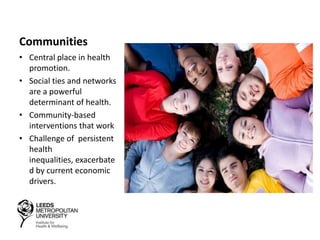
Communities
• Central place in health
promotion.
• Social ties and networks
are a powerful
determinant of health.
• Community-based
interventions that work
• Challenge of persistent
health
inequalities, exacerbate
d by current economic
drivers.
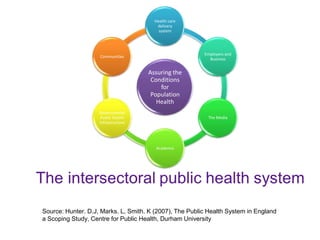
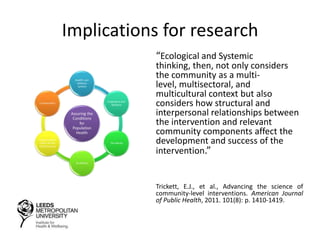
Assuring the
Conditions
for
Population
Health
Health care
delivery
system
Employers and
Business
The Media
Academia
Governmental
Public Health
Infrastructure
Communities
Source: Hunter. D.J, Marks. L, Smith. K (2007), The Public Health System in England
a Scoping Study, Centre for Public Health, Durham University
To promote participation in policy-making and implementation
We pledge to:
• (ii) Empower the role of communities and strengthen civil
society contribution to policy-making and implementation by
adopting measures to enable their effective participation for
the public interest in decision-making;
• (v) Consider the contributions and capacities of civil society to
take action in advocacy, social mobilization and
implementation on social determinants of health;
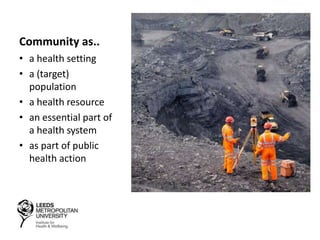
Community as..
• a health setting
• a (target)
population
• a health resource
• an essential part of
a health system
• as part of public
health action
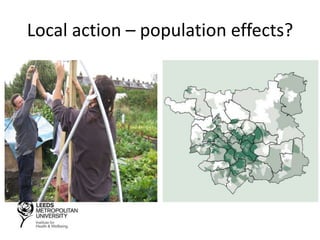
Local action – population effects?
Contemporary challenges
1. What is the place of communities in a public
health system?
2. How can community-based action impact on
health inequalities at a population level?
3. Can we develop a convincing evidence base
to underpin the work?
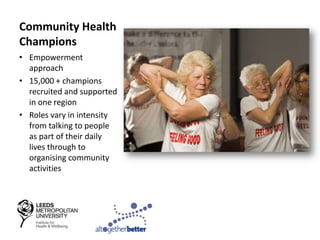
Community Health
Champions
• Empowerment
approach
• 15,000 + champions
recruited and supported
in one region
• Roles vary in intensity
from talking to people
as part of their daily
lives through to
organising community
activities
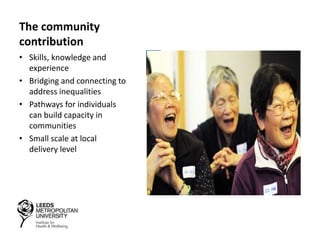
The community
contribution
• Skills, knowledge and
experience
• Bridging and connecting to
address inequalities
• Pathways for individuals
can build capacity in
communities
• Small scale at local
delivery level
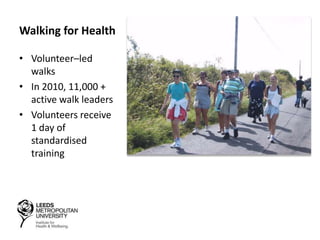
Walking for Health
• Volunteer–led
walks
• In 2010, 11,000 +
active walk leaders
• Volunteers receive
1 day of
standardised
training
How would you describe your group?
We’re a big group of friends, social
people who happen to walk on a
Monday morning. Again it’s like
secondary really, the walking.
Helpful as well. If you
see somebody
struggling we look after
each other.
It’s a talking group that goes for
walks.
A couple of hours well
spent in the morning.
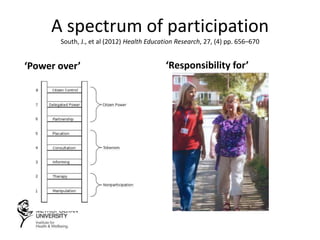
A spectrum of participation
South, J., et al (2012) Health Education Research, 27, (4) pp. 656–670
‘Power over’ ‘Responsibility for’
Implications for research
“Ecological and Systemic
thinking, then, not only considers
the community as a multi-
level, multisectoral, and
multicultural context but also
considers how structural and
interpersonal relationships between
the intervention and relevant
community components affect the
development and success of the
intervention.”
Trickett, E.J., et al., Advancing the science of
community-level interventions. American Journal
of Public Health, 2011. 101(8): p. 1410-1419.
Implications for practice
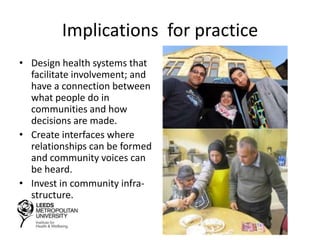
• Design health systems that
facilitate involvement; and
have a connection between
what people do in
communities and how
decisions are made.
• Create interfaces where
relationships can be formed
and community voices can
be heard.
• Invest in community infra-
structure.
Concluding remarks
“Lay involvement is possible at all
levels, planning, design, delivery and
governance of public health activities . . . but
requires people to think differently and be
prepared to demonstrate trust”. (Expert
hearing 3)
South, J., Meah, A., Branney, P. (2011)
Health Promotion International. 27: 2: 284-294.

Jane South NHPRC 2013

  • 1.
    Health promotion bycommunities and in communities: current issues for research and practice Jane South j.south@leedsmet.ac.uk 7th Nordic Health Promotion Research Conference, 17th-19th June, 2013, Vestfold University College
  • 2.
    Acknowledgements • ‘People inPublic Health’, study funded through National Institute funded by National Institute for Health Research (NIHR) Service Delivery and Organisation (SDO) Programme: http://www.leedsmet.ac.uk/piph • Evidence reviews & thematic evaluations on community health champions, commissioned by Altogether Better: www.altogetherbetter.org.uk • People Centred Public Health (2012) South, J. White, J., Gamsu, M. The Policy Press http://www.policypress.co.uk/display.asp?K=9781447305309&sf1= contributor&st1=Judy%20White&m=2&dc=2 • A pilot study of the walking for wellness project and the befriender role,2010-11, commissioned by Natural England.
  • 3.
    What are theknown knowns and the known unknowns?
  • 4.
    Communities • Central placein health promotion. • Social ties and networks are a powerful determinant of health. • Community-based interventions that work • Challenge of persistent health inequalities, exacerbate d by current economic drivers.
  • 5.
    Assuring the Conditions for Population Health Health care delivery system Employersand Business The Media Academia Governmental Public Health Infrastructure Communities Source: Hunter. D.J, Marks. L, Smith. K (2007), The Public Health System in England a Scoping Study, Centre for Public Health, Durham University
  • 6.
    To promote participationin policy-making and implementation We pledge to: • (ii) Empower the role of communities and strengthen civil society contribution to policy-making and implementation by adopting measures to enable their effective participation for the public interest in decision-making; • (v) Consider the contributions and capacities of civil society to take action in advocacy, social mobilization and implementation on social determinants of health;
  • 7.
    Community as.. • ahealth setting • a (target) population • a health resource • an essential part of a health system • as part of public health action
  • 8.
    Local action –population effects?
  • 9.
    Contemporary challenges 1. Whatis the place of communities in a public health system? 2. How can community-based action impact on health inequalities at a population level? 3. Can we develop a convincing evidence base to underpin the work?
  • 10.
    Community Health Champions • Empowerment approach •15,000 + champions recruited and supported in one region • Roles vary in intensity from talking to people as part of their daily lives through to organising community activities
  • 11.
    The community contribution • Skills,knowledge and experience • Bridging and connecting to address inequalities • Pathways for individuals can build capacity in communities • Small scale at local delivery level
  • 12.
    Walking for Health •Volunteer–led walks • In 2010, 11,000 + active walk leaders • Volunteers receive 1 day of standardised training
  • 13.
    How would youdescribe your group? We’re a big group of friends, social people who happen to walk on a Monday morning. Again it’s like secondary really, the walking. Helpful as well. If you see somebody struggling we look after each other. It’s a talking group that goes for walks. A couple of hours well spent in the morning.
  • 14.
    A spectrum ofparticipation South, J., et al (2012) Health Education Research, 27, (4) pp. 656–670 ‘Power over’ ‘Responsibility for’
  • 15.
    Implications for research “Ecologicaland Systemic thinking, then, not only considers the community as a multi- level, multisectoral, and multicultural context but also considers how structural and interpersonal relationships between the intervention and relevant community components affect the development and success of the intervention.” Trickett, E.J., et al., Advancing the science of community-level interventions. American Journal of Public Health, 2011. 101(8): p. 1410-1419.
  • 16.
    Implications for practice •Design health systems that facilitate involvement; and have a connection between what people do in communities and how decisions are made. • Create interfaces where relationships can be formed and community voices can be heard. • Invest in community infra- structure.
  • 17.
    Concluding remarks “Lay involvementis possible at all levels, planning, design, delivery and governance of public health activities . . . but requires people to think differently and be prepared to demonstrate trust”. (Expert hearing 3) South, J., Meah, A., Branney, P. (2011) Health Promotion International. 27: 2: 284-294.

Editor's Notes

  • #3 Need to acknowledge much our work has been done in collaboration with colleagues in CHPR Leeds met
  • #4 Photograph by AP/Charles Dharapak; obtained from Guardian website
  • #5 Pictures from Wakefield Groundwork
  • #16 Implications for research