From welfare state to
participatory society
Lessons from The Netherlands
7th Nordic Research Conference in Health Promotion
June 2013
www.pwc.nl
PwC
Outline
1. Population ageing
2. Population ageing in The
Netherlands
3. Pressure on the welfare state
4. From welfare state to
participatory society
5. Lessons from the daily practice
2
June 2013From welfare state to participatory society
PwC
1. Population ageing
Some global trends
Population ageing is a worldwide
phenomenon, caused by:
• Decrease in fertility
• Decrease in mortality rates
• Higher life expectancy
• Some Western European
countries (and the US) faced a
rapid temporary increase of birth
rates shortly after WW2: The
Babyboom
Furthermore we see trends such as
• Urbanization
• Digitalization
• Individualization
• …
June 2013From welfare state to participatory society
3
PwC
1. Population ageing
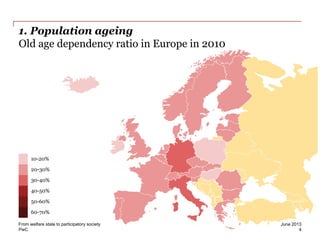
Old age dependency ratio in Europe in 2010
June 2013From welfare state to participatory society
4
10-20%
20-30%
30-40%
40-50%
50-60%
60-70%
PwC
1. Population ageing
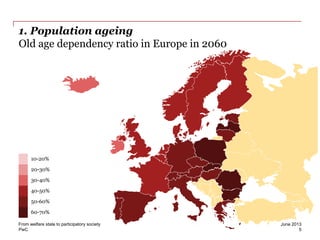
Old age dependency ratio in Europe in 2060
June 2013From welfare state to participatory society
5
10-20%
20-30%
30-40%
40-50%
50-60%
60-70%
PwC
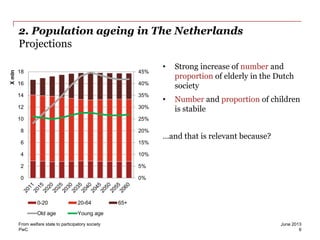
2. Population ageing in The Netherlands
Projections
• Strong increase of number and
proportion of elderly in the Dutch
society
• Number and proportion of children
is stabile
…and that is relevant because?
June 2013From welfare state to participatory society
6
0%
5%
10%
15%
20%
25%
30%
35%
40%
45%
0
2
4
6
8
10
12
14
16
18
Xmln
0-20 20-64 65+
Old age Young age
PwC
2. Population ageing in The Netherlands
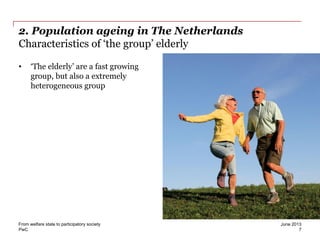
Characteristics of ‘the group’ elderly
• ‘The elderly’ are a fast growing
group, but also a extremely
heterogeneous group
June 2013From welfare state to participatory society
7
PwC
2. Population ageing in The Netherlands
Characteristics of ‘the group’ elderly
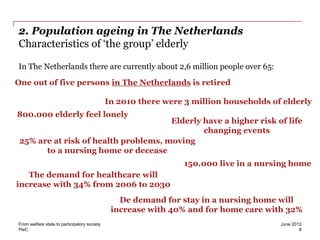
In The Netherlands there are currently about 2,6 million people over 65:
June 2013From welfare state to participatory society
8
One out of five persons in The Netherlands is retired
In 2010 there were 3 million households of elderly
800.000 elderly feel lonely
25% are at risk of health problems, moving
to a nursing home or decease
150.000 live in a nursing home
Elderly have a higher risk of life
changing events
The demand for healthcare will
increase with 34% from 2006 to 2030
De demand for stay in a nursing home will
increase with 40% and for home care with 32%
PwC
2. Population ageing in The Netherlands
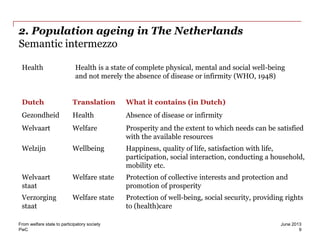
Semantic intermezzo
June 2013From welfare state to participatory society
9
Health Health is a state of complete physical, mental and social well-being
and not merely the absence of disease or infirmity (WHO, 1948)
Dutch Translation What it contains (in Dutch)
Gezondheid Health Absence of disease or infirmity
Welvaart Welfare Prosperity and the extent to which needs can be satisfied
with the available resources
Welzijn Wellbeing Happiness, quality of life, satisfaction with life,
participation, social interaction, conducting a household,
mobility etc.
Welvaart
staat
Welfare state Protection of collective interests and protection and
promotion of prosperity
Verzorging
staat
Welfare state Protection of well-being, social security, providing rights
to (health)care
PwC
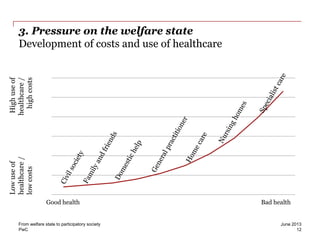
3. Pressure on the welfare state
Development of costs and use of healthcare
June 2013From welfare state to participatory society
10
Good health Bad health
Lowuseof
healthcare/
lowcosts
Highuseof
healthcare/
highcosts
PwC
3. Pressure on the welfare state
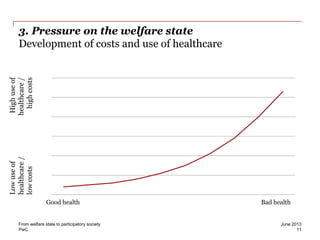
Development of costs and use of healthcare
June 2013From welfare state to participatory society
11
Good health Bad health
Lowuseof
healthcare/
lowcosts
Highuseof
healthcare/
highcosts
PwC
3. Pressure on the welfare state
Development of costs and use of healthcare
June 2013From welfare state to participatory society
12
Good health Bad health
Lowuseof
healthcare/
lowcosts
Highuseof
healthcare/
highcosts
PwC
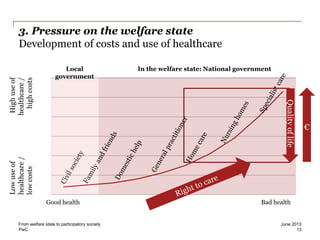
3. Pressure on the welfare state
Development of costs and use of healthcare
June 2013From welfare state to participatory society
13
Good health Bad health
Lowuseof
healthcare/
lowcosts
Highuseof
healthcare/
highcosts
In the welfare state: National government
€
Local
government
Qualityoflife
PwC
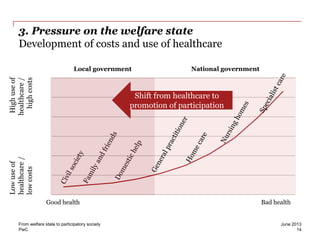
3. Pressure on the welfare state
Development of costs and use of healthcare
June 2013From welfare state to participatory society
14
Good health Bad health
Lowuseof
healthcare/
lowcosts
Highuseof
healthcare/
highcosts
National governmentLocal government
Shift from healthcare to
promotion of participation
PwC
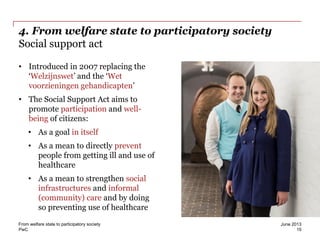
4. From welfare state to participatory society
Social support act
• Introduced in 2007 replacing the
‘Welzijnswet’ and the ‘Wet
voorzieningen gehandicapten’
• The Social Support Act aims to
promote participation and well-
being of citizens:
• As a goal in itself
• As a mean to directly prevent
people from getting ill and use of
healthcare
• As a mean to strengthen social
infrastructures and informal
(community) care and by doing
so preventing use of healthcare
June 2013From welfare state to participatory society
15
PwC
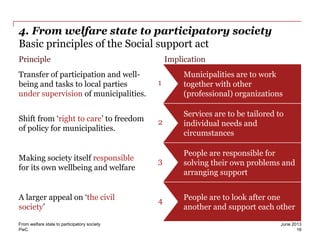
4. From welfare state to participatory society
Basic principles of the Social support act
Municipalities are to work
together with other
(professional) organizations
Transfer of participation and well-
being and tasks to local parties
under supervision of municipalities.
1
Services are to be tailored to
individual needs and
circumstances
Shift from ‘right to care’ to freedom
of policy for municipalities.
2
People are responsible for
solving their own problems and
arranging support
Making society itself responsible
for its own wellbeing and welfare
3
People are to look after one
another and support each other
A larger appeal on ‘the civil
society’
4
16
June 2013From welfare state to participatory society
Principle Implication
PwC
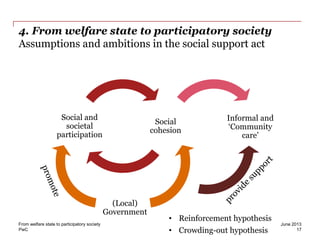
4. From welfare state to participatory society
Assumptions and ambitions in the social support act
Social
cohesion
Social and
societal
participation
June 2013From welfare state to participatory society
17
Informal and
‘Community
care’
(Local)
Government
• Reinforcement hypothesis
• Crowding-out hypothesis
PwC
June 2013From welfare state to participatory society
18
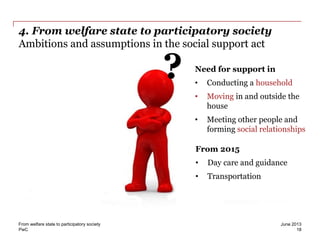
4. From welfare state to participatory society
Ambitions and assumptions in the social support act
? Need for support in
• Conducting a household
• Moving in and outside the
house
• Meeting other people and
forming social relationships
From 2015
• Day care and guidance
• Transportation
PwC
June 2013From welfare state to participatory society
19
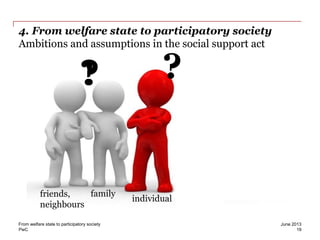
4. From welfare state to participatory society
Ambitions and assumptions in the social support act
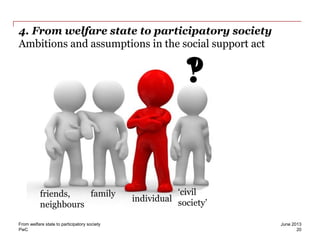
individual
familyfriends,
neighbours
?!?
PwC
June 2013From welfare state to participatory society
20
4. From welfare state to participatory society
Ambitions and assumptions in the social support act
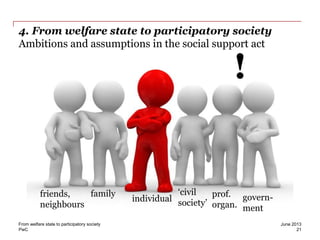
individual
familyfriends,
neighbours
‘civil
society’
!?
PwC
June 2013From welfare state to participatory society
21
4. From welfare state to participatory society
Ambitions and assumptions in the social support act
individual
familyfriends,
neighbours
‘civil
society’
prof.
organ.
govern-
ment
!
PwC
5. Lessons from the daily practice
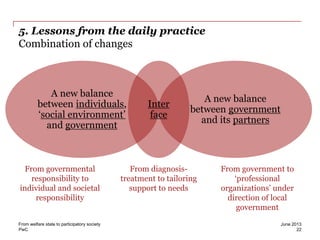
Combination of changes
A new balance
between individuals,
‘social environment’
and government
A new balance
between government
and its partners
June 2013From welfare state to participatory society
22
From governmental
responsibility to
individual and societal
responsibility
From diagnosis-
treatment to tailoring
support to needs
From government to
‘professional
organizations’ under
direction of local
government
Inter
face
PwC
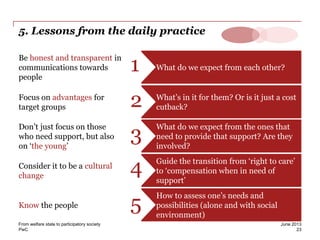
5. Lessons from the daily practice
What do we expect from each other?
Be honest and transparent in
communications towards
people
1
What’s in it for them? Or is it just a cost
cutback?
Focus on advantages for
target groups 2
What do we expect from the ones that
need to provide that support? Are they
involved?
Don’t just focus on those
who need support, but also
on ‘the young’
3
Guide the transition from ‘right to care’
to ‘compensation when in need of
support’
Consider it to be a cultural
change
4
How to assess one’s needs and
possibilities (alone and with social
environment)
Know the people 5
23
June 2013From welfare state to participatory society
PwC
5. Lessons from the daily practice
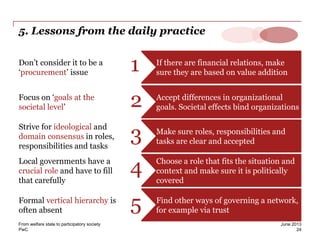
If there are financial relations, make
sure they are based on value addition
Don’t consider it to be a
‘procurement’ issue 1
Accept differences in organizational
goals. Societal effects bind organizations
Focus on ‘goals at the
societal level’ 2
Make sure roles, responsibilities and
tasks are clear and accepted
Strive for ideological and
domain consensus in roles,
responsibilities and tasks
3
Choose a role that fits the situation and
context and make sure it is politically
covered
Local governments have a
crucial role and have to fill
that carefully
4
Find other ways of governing a network,
for example via trust
Formal vertical hierarchy is
often absent 5
24
June 2013From welfare state to participatory society
PwC
5. Lessons from the daily practice
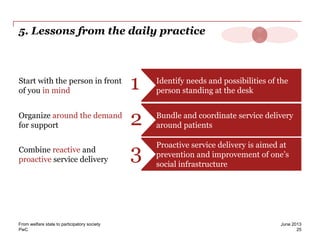
Identify needs and possibilities of the
person standing at the desk
Start with the person in front
of you in mind 1
Bundle and coordinate service delivery
around patients
Organize around the demand
for support 2
Proactive service delivery is aimed at
prevention and improvement of one’s
social infrastructure
Combine reactive and
proactive service delivery 3
25
June 2013From welfare state to participatory society
From welfare state to
participatory society
Lessons from The Netherlands
7th Nordic Research Conference in Health Promotion
June 2013
www.pwc.nl
© 2013 PwC. All rights reserved. Not for further distribution without the permission of PwC.
"PwC" refers to the network of member firms of PricewaterhouseCoopers International
Limited (PwCIL), or, as the context requires, individual member firms of the PwC network.
Please see www.pwc.com/structure for further details.

Rene van Kujik NHPRC 2013

  • 1.
    From welfare stateto participatory society Lessons from The Netherlands 7th Nordic Research Conference in Health Promotion June 2013 www.pwc.nl
  • 2.
    PwC Outline 1. Population ageing 2.Population ageing in The Netherlands 3. Pressure on the welfare state 4. From welfare state to participatory society 5. Lessons from the daily practice 2 June 2013From welfare state to participatory society
  • 3.
    PwC 1. Population ageing Someglobal trends Population ageing is a worldwide phenomenon, caused by: • Decrease in fertility • Decrease in mortality rates • Higher life expectancy • Some Western European countries (and the US) faced a rapid temporary increase of birth rates shortly after WW2: The Babyboom Furthermore we see trends such as • Urbanization • Digitalization • Individualization • … June 2013From welfare state to participatory society 3
  • 4.
    PwC 1. Population ageing Oldage dependency ratio in Europe in 2010 June 2013From welfare state to participatory society 4 10-20% 20-30% 30-40% 40-50% 50-60% 60-70%
  • 5.
    PwC 1. Population ageing Oldage dependency ratio in Europe in 2060 June 2013From welfare state to participatory society 5 10-20% 20-30% 30-40% 40-50% 50-60% 60-70%
  • 6.
    PwC 2. Population ageingin The Netherlands Projections • Strong increase of number and proportion of elderly in the Dutch society • Number and proportion of children is stabile …and that is relevant because? June 2013From welfare state to participatory society 6 0% 5% 10% 15% 20% 25% 30% 35% 40% 45% 0 2 4 6 8 10 12 14 16 18 Xmln 0-20 20-64 65+ Old age Young age
  • 7.
    PwC 2. Population ageingin The Netherlands Characteristics of ‘the group’ elderly • ‘The elderly’ are a fast growing group, but also a extremely heterogeneous group June 2013From welfare state to participatory society 7
  • 8.
    PwC 2. Population ageingin The Netherlands Characteristics of ‘the group’ elderly In The Netherlands there are currently about 2,6 million people over 65: June 2013From welfare state to participatory society 8 One out of five persons in The Netherlands is retired In 2010 there were 3 million households of elderly 800.000 elderly feel lonely 25% are at risk of health problems, moving to a nursing home or decease 150.000 live in a nursing home Elderly have a higher risk of life changing events The demand for healthcare will increase with 34% from 2006 to 2030 De demand for stay in a nursing home will increase with 40% and for home care with 32%
  • 9.
    PwC 2. Population ageingin The Netherlands Semantic intermezzo June 2013From welfare state to participatory society 9 Health Health is a state of complete physical, mental and social well-being and not merely the absence of disease or infirmity (WHO, 1948) Dutch Translation What it contains (in Dutch) Gezondheid Health Absence of disease or infirmity Welvaart Welfare Prosperity and the extent to which needs can be satisfied with the available resources Welzijn Wellbeing Happiness, quality of life, satisfaction with life, participation, social interaction, conducting a household, mobility etc. Welvaart staat Welfare state Protection of collective interests and protection and promotion of prosperity Verzorging staat Welfare state Protection of well-being, social security, providing rights to (health)care
  • 10.
    PwC 3. Pressure onthe welfare state Development of costs and use of healthcare June 2013From welfare state to participatory society 10 Good health Bad health Lowuseof healthcare/ lowcosts Highuseof healthcare/ highcosts
  • 11.
    PwC 3. Pressure onthe welfare state Development of costs and use of healthcare June 2013From welfare state to participatory society 11 Good health Bad health Lowuseof healthcare/ lowcosts Highuseof healthcare/ highcosts
  • 12.
    PwC 3. Pressure onthe welfare state Development of costs and use of healthcare June 2013From welfare state to participatory society 12 Good health Bad health Lowuseof healthcare/ lowcosts Highuseof healthcare/ highcosts
  • 13.
    PwC 3. Pressure onthe welfare state Development of costs and use of healthcare June 2013From welfare state to participatory society 13 Good health Bad health Lowuseof healthcare/ lowcosts Highuseof healthcare/ highcosts In the welfare state: National government € Local government Qualityoflife
  • 14.
    PwC 3. Pressure onthe welfare state Development of costs and use of healthcare June 2013From welfare state to participatory society 14 Good health Bad health Lowuseof healthcare/ lowcosts Highuseof healthcare/ highcosts National governmentLocal government Shift from healthcare to promotion of participation
  • 15.
    PwC 4. From welfarestate to participatory society Social support act • Introduced in 2007 replacing the ‘Welzijnswet’ and the ‘Wet voorzieningen gehandicapten’ • The Social Support Act aims to promote participation and well- being of citizens: • As a goal in itself • As a mean to directly prevent people from getting ill and use of healthcare • As a mean to strengthen social infrastructures and informal (community) care and by doing so preventing use of healthcare June 2013From welfare state to participatory society 15
  • 16.
    PwC 4. From welfarestate to participatory society Basic principles of the Social support act Municipalities are to work together with other (professional) organizations Transfer of participation and well- being and tasks to local parties under supervision of municipalities. 1 Services are to be tailored to individual needs and circumstances Shift from ‘right to care’ to freedom of policy for municipalities. 2 People are responsible for solving their own problems and arranging support Making society itself responsible for its own wellbeing and welfare 3 People are to look after one another and support each other A larger appeal on ‘the civil society’ 4 16 June 2013From welfare state to participatory society Principle Implication
  • 17.
    PwC 4. From welfarestate to participatory society Assumptions and ambitions in the social support act Social cohesion Social and societal participation June 2013From welfare state to participatory society 17 Informal and ‘Community care’ (Local) Government • Reinforcement hypothesis • Crowding-out hypothesis
  • 18.
    PwC June 2013From welfarestate to participatory society 18 4. From welfare state to participatory society Ambitions and assumptions in the social support act ? Need for support in • Conducting a household • Moving in and outside the house • Meeting other people and forming social relationships From 2015 • Day care and guidance • Transportation
  • 19.
    PwC June 2013From welfarestate to participatory society 19 4. From welfare state to participatory society Ambitions and assumptions in the social support act individual familyfriends, neighbours ?!?
  • 20.
    PwC June 2013From welfarestate to participatory society 20 4. From welfare state to participatory society Ambitions and assumptions in the social support act individual familyfriends, neighbours ‘civil society’ !?
  • 21.
    PwC June 2013From welfarestate to participatory society 21 4. From welfare state to participatory society Ambitions and assumptions in the social support act individual familyfriends, neighbours ‘civil society’ prof. organ. govern- ment !
  • 22.
    PwC 5. Lessons fromthe daily practice Combination of changes A new balance between individuals, ‘social environment’ and government A new balance between government and its partners June 2013From welfare state to participatory society 22 From governmental responsibility to individual and societal responsibility From diagnosis- treatment to tailoring support to needs From government to ‘professional organizations’ under direction of local government Inter face
  • 23.
    PwC 5. Lessons fromthe daily practice What do we expect from each other? Be honest and transparent in communications towards people 1 What’s in it for them? Or is it just a cost cutback? Focus on advantages for target groups 2 What do we expect from the ones that need to provide that support? Are they involved? Don’t just focus on those who need support, but also on ‘the young’ 3 Guide the transition from ‘right to care’ to ‘compensation when in need of support’ Consider it to be a cultural change 4 How to assess one’s needs and possibilities (alone and with social environment) Know the people 5 23 June 2013From welfare state to participatory society
  • 24.
    PwC 5. Lessons fromthe daily practice If there are financial relations, make sure they are based on value addition Don’t consider it to be a ‘procurement’ issue 1 Accept differences in organizational goals. Societal effects bind organizations Focus on ‘goals at the societal level’ 2 Make sure roles, responsibilities and tasks are clear and accepted Strive for ideological and domain consensus in roles, responsibilities and tasks 3 Choose a role that fits the situation and context and make sure it is politically covered Local governments have a crucial role and have to fill that carefully 4 Find other ways of governing a network, for example via trust Formal vertical hierarchy is often absent 5 24 June 2013From welfare state to participatory society
  • 25.
    PwC 5. Lessons fromthe daily practice Identify needs and possibilities of the person standing at the desk Start with the person in front of you in mind 1 Bundle and coordinate service delivery around patients Organize around the demand for support 2 Proactive service delivery is aimed at prevention and improvement of one’s social infrastructure Combine reactive and proactive service delivery 3 25 June 2013From welfare state to participatory society
  • 26.
    From welfare stateto participatory society Lessons from The Netherlands 7th Nordic Research Conference in Health Promotion June 2013 www.pwc.nl © 2013 PwC. All rights reserved. Not for further distribution without the permission of PwC. "PwC" refers to the network of member firms of PricewaterhouseCoopers International Limited (PwCIL), or, as the context requires, individual member firms of the PwC network. Please see www.pwc.com/structure for further details.