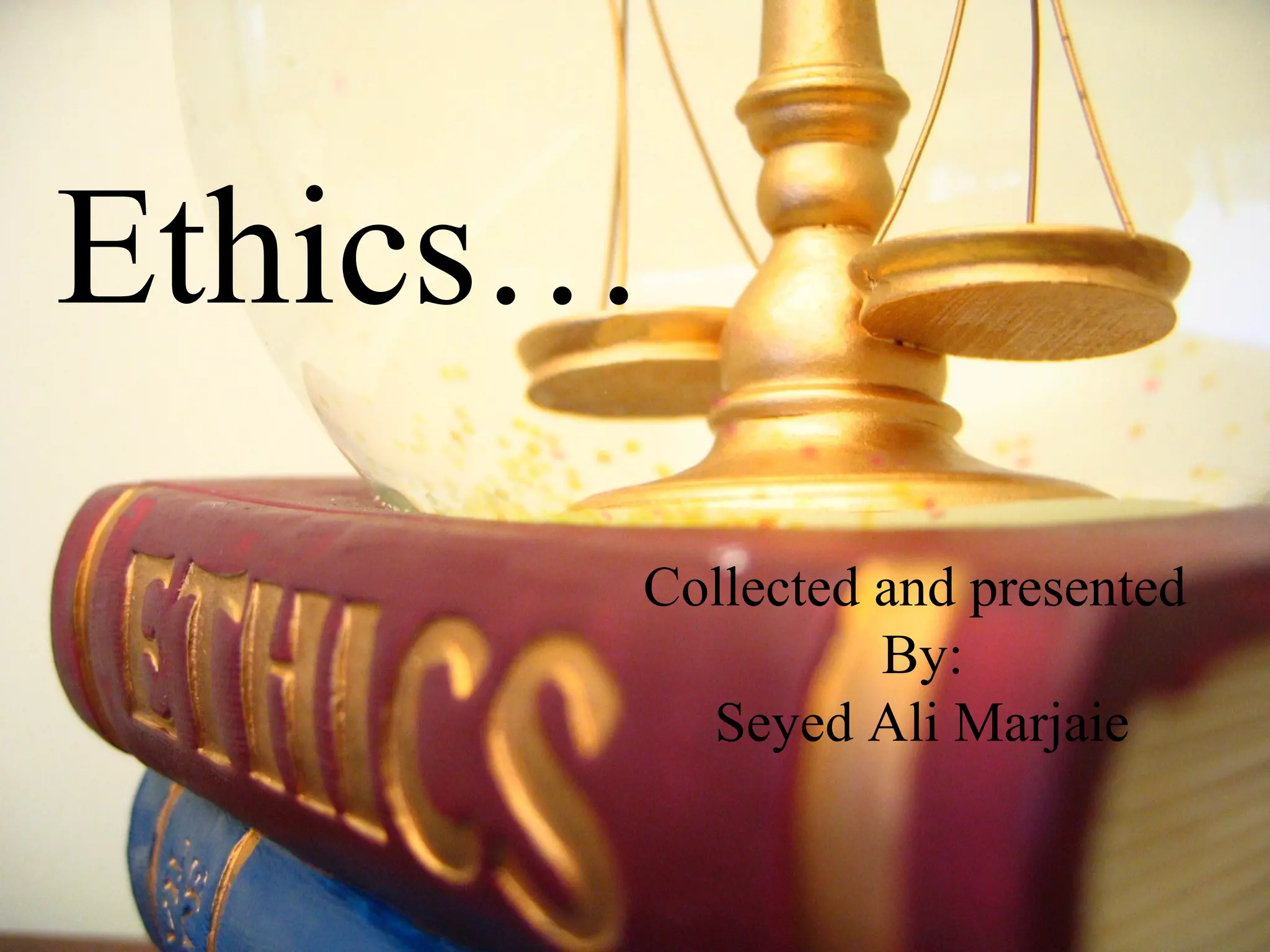
Ethics…
Collected and presented
By:
Seyed Ali Marjaie
Rules or standards that govern the conduct of
the person or the conduct of the members of
a profession!
Rules or standards that govern the conduct of
the person or the conduct of the members of
a profession!
via Latin ethica from the Ancient Greek
the adjective of ethos "custom, habit"
The word also traces to Ta Ethika, title
of Aristotle's work. Ethic "a person's
moral principles,"
via Latin ethica from the Ancient Greek
the adjective of ethos "custom, habit"
The word also traces to Ta Ethika, title
of Aristotle's work. Ethic "a person's
moral principles,"
Etymology
Ethics Is a Major Branch of PhilosophyEthics Is a Major Branch of Philosophy
As a major branch of philosophy,
encompassing right conduct and good life.
It is significantly broader than the common
conception of analyzing right and wrong.
A central aspect of ethics is "the good life",
the life worth living or life that is satisfying,
which is held by many philosophers to be
more important than moral conduct.
Personal ethics VS social ethicsPersonal ethics VS social ethics
• Personal ethics signifies a moral code
applicable to individuals, while social
ethics means moral theory applied to
groups. Social ethics can be synonymous
with social and political philosophy, in as
much as it is the foundation of a good
society or state.
Ethics is not limited to specific acts and defined moral codes,
but encompasses the whole of moral ideals and behaviors, a
person's philosophy of life
Ethics and MoralsEthics and Morals
• Ethics and morals are respectively akin to
theory and practice. Ethics denotes the
theory of right action and the greater
good,
• While morals indicate their practice.
"Moral" has a dual meaning.
Moral Dual MeaningMoral Dual Meaning
• The first indicates a person's comprehension
of morality and his capacity to put it into
practice. In this meaning, the antonym is
"amoral", indicating an inability to distinguish
between right and wrong.
• The second denotes the active practice of
those values. In this sense, the antonym is
"immoral", referring to actions that violate
ethical principles.
Morals vs. EthicsMorals vs. Ethics
• Individualized
code of right
and wrong
• Standardized
code of right
and wrong
Both define what is considered acceptable
behavior for the individual or the group…
Greek philosophyGreek philosophy
• Socrates was one of the first Greek philosophers
to encourage both scholars and the common
citizen to turn their attention from the outside
world to the condition of man. Knowledge having
a bearing on human life was placed highest, all
other knowledge being secondary. Self-
knowledge was considered necessary for success
and inherently an essential good. A self-aware
person will act completely within their
capabilities to their pinnacle, while an ignorant
person will flounder and encounter difficulty.
SocratesSocrates
• To Socrates, a person must become aware of every
fact (and its context) relevant to his existence, if he
wishes to attain self-knowledge. He posited that
people will naturally do what is good, if they know
what is right. Evil or bad actions, are the result of
ignorance. If a criminal were truly aware of the
mental and spiritual consequences of his actions, he
would neither commit nor even consider
committing them. Any person who knows what is
truly right will automatically do it, according to
Socrates. While he equated knowledge with virtue,
he similarly equated virtue with happiness. The
truly wise man will know what is right, do what is
good and therefore be happy.
• Aristotle posited an ethical system that may
be termed "self-realizationism". When a
person acts in accordance with his nature and
realizes his full potential, he will do good and
be content. At birth, a baby is not a person,
but a potential person. In order to become a
"real" person, the child's inherent potential
must be realized. Unhappiness and
frustration are caused by the unrealized
potential of a person, leading to failed goals
and a poor life. Aristotle said, "Nature does
nothing in vain."
AristotleAristotle
Therefore, it is imperative for persons
to act in accordance with their nature
and develop their latent talents, in
order to be content and complete.
Happiness was held to be the ultimate
goal. All other things, such as civic life or
wealth, are merely means to the end.
Self-realization, the awareness of one's
nature and the development of one's
talents, is the surest path to happiness.
• Hedonism posits that the principal
ethic is maximizing pleasure and
minimizing pain. There are several
schools of Hedonist thought ranging
from those advocating the indulgence
of even momentary desires to those
teaching a pursuit of spiritual bliss.
HedonismHedonism
Meta-ethicsMeta-ethics
Meta-ethics is concerned primarily with the
meaning of ethical judgments and/or
prescriptions and with the notion of which
properties, if any, are responsible for the truth
or validity thereof.
Meta-ethics as a discipline gained attention with
G.E. Moore's famous work Principia Ethica
from 1903 in which Moore first addressed
what he referred to as the naturalistic fallacy.
• Moore's rebuttal of naturalistic
ethics, his Open Question Argument
sparked an interest within the
analytic branch of western
philosophy to concern oneself with
second order questions about ethics;
specifically the semantics,
epistemology and ontology of ethics.
Descriptive ethicsDescriptive ethics
• Descriptive ethics is a value-free
approach to ethics which examines ethics
not from a top-down perspective but
rather observations of actual choices
made by moral agents in practice. Some
philosophers rely on descriptive ethics
and choices made and unchallenged by a
society or culture to derive categories,
which typically vary by context.
• This can lead to situational ethics
and situated ethics. These
philosophers often view aesthetics,
etiquette, and arbitration as more
fundamental, percolating "bottom
up" to imply the existence of, rather
than explicitly prescribe, theories of
value or of conduct.
The study of descriptive ethics include following:
• Ethical codes applied by various groups.
Some consider aesthetics itself the basis of
ethics – and a personal moral core
developed through art and storytelling as
very influential in one's later ethical choices.
• Informal theories of etiquette which tend to
be less rigorous and more situational. Some
consider etiquette a simple negative ethics,
i.e. where can one evade an uncomfortable
truth without doing wrong?
• Practices in arbitration and law, e.g. the
claim that ethics itself is a matter of
balancing "right versus right," i.e. putting
priorities on two things that are both right,
but which must be traded off carefully in
each situation.
• Observed choices made by ordinary people,
without expert aid or advice, who vote, buy,
and decide what is worth valuing. This is a
major concern of sociology, political science,
and economics
Applied ethicsApplied ethics
• Applied ethics is a discipline of
philosophy that attempts to apply ethical
theory to real-life situations. The lines of
distinction between meta-ethics,
normative ethics, and applied ethics are
often blurry. For example, the issue of
abortion can be seen as an applied
ethical topic since it involves a specific
type of controversial behaviour.
It can also depend on more general
normative principles, such as possible
rights of self-rule and right to life,
principles which are often litmus tests for
determining the morality of that
procedure. The issue also rests on meta-
ethical issues such as, "where do rights
come from?" and "what kind of beings
have rights?"
• Applied ethics is used in determining
public policy. For example, the following
would be questions of applied ethics: "Is
getting an abortion immoral?" "Is
euthanasia immoral?" "Is affirmative
action right or wrong?" "What are
human rights, and how do we determine
them?" and "Do animals have rights as
well?"
• A more specific question could be: "If
someone else can make better out of his/her
life than I can, is it then moral to sacrifice
myself for them if needed?" Without these
questions there is no clear fulcrum on which
to balance law, politics, and the practice of
arbitration — in fact, no common assumptions
of all participants—so the ability to formulate
the questions are prior to rights balancing.
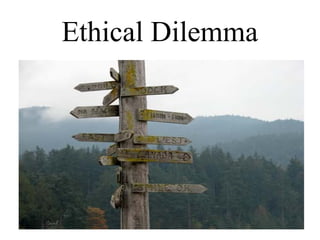
Ethical Dilemma
An ethical dilemma is a situation that will
often involve an apparent conflict between
moral imperatives, in which to obey one
would result in transgressing another.
This is also called an ethical paradox since in
moral philosophy, paradox plays a central
role in ethics debates. an animal is thought to
act only in its immediate perceived bodily
self-interests when faced with bodily harm,
and to have limited ability to perceive
alternatives - see fight or flight
Theoretical Ethics
Metaethics or analytical ethics:
theoretical study that inquires into semantic,
logical, and epistemological issues in ethics. It
investigates the meaning of ethical terms, the
nature of value judgments, and the
justification of ethical theories and judgments.
Normative ethics: theory which justifies which
acts are
morally good/bad.
Ethical Theories
•Deontological Theory
•Teleological theory…aka
“Utilitarianism”
•Principalism…aka
“Ethical Principles”
ETICS CONTINUUM
Ethics as an Ongoing Conversation
• World changes continually, and we have
to
• interpret/construe it over and over again.
• We come back to ideas again and again,
finding new
• meaning in them.
Questions?
Thank You

Ethics 1228346034059584-8 (1)

  • 1.
  • 2.
    Rules or standardsthat govern the conduct of the person or the conduct of the members of a profession! Rules or standards that govern the conduct of the person or the conduct of the members of a profession! via Latin ethica from the Ancient Greek the adjective of ethos "custom, habit" The word also traces to Ta Ethika, title of Aristotle's work. Ethic "a person's moral principles," via Latin ethica from the Ancient Greek the adjective of ethos "custom, habit" The word also traces to Ta Ethika, title of Aristotle's work. Ethic "a person's moral principles," Etymology
  • 3.
    Ethics Is aMajor Branch of PhilosophyEthics Is a Major Branch of Philosophy As a major branch of philosophy, encompassing right conduct and good life. It is significantly broader than the common conception of analyzing right and wrong. A central aspect of ethics is "the good life", the life worth living or life that is satisfying, which is held by many philosophers to be more important than moral conduct.
  • 4.
    Personal ethics VSsocial ethicsPersonal ethics VS social ethics • Personal ethics signifies a moral code applicable to individuals, while social ethics means moral theory applied to groups. Social ethics can be synonymous with social and political philosophy, in as much as it is the foundation of a good society or state. Ethics is not limited to specific acts and defined moral codes, but encompasses the whole of moral ideals and behaviors, a person's philosophy of life
  • 5.
    Ethics and MoralsEthicsand Morals • Ethics and morals are respectively akin to theory and practice. Ethics denotes the theory of right action and the greater good, • While morals indicate their practice. "Moral" has a dual meaning.
  • 6.
    Moral Dual MeaningMoralDual Meaning • The first indicates a person's comprehension of morality and his capacity to put it into practice. In this meaning, the antonym is "amoral", indicating an inability to distinguish between right and wrong. • The second denotes the active practice of those values. In this sense, the antonym is "immoral", referring to actions that violate ethical principles.
  • 7.
    Morals vs. EthicsMoralsvs. Ethics • Individualized code of right and wrong • Standardized code of right and wrong Both define what is considered acceptable behavior for the individual or the group…
  • 8.
    Greek philosophyGreek philosophy •Socrates was one of the first Greek philosophers to encourage both scholars and the common citizen to turn their attention from the outside world to the condition of man. Knowledge having a bearing on human life was placed highest, all other knowledge being secondary. Self- knowledge was considered necessary for success and inherently an essential good. A self-aware person will act completely within their capabilities to their pinnacle, while an ignorant person will flounder and encounter difficulty. SocratesSocrates
  • 9.
    • To Socrates,a person must become aware of every fact (and its context) relevant to his existence, if he wishes to attain self-knowledge. He posited that people will naturally do what is good, if they know what is right. Evil or bad actions, are the result of ignorance. If a criminal were truly aware of the mental and spiritual consequences of his actions, he would neither commit nor even consider committing them. Any person who knows what is truly right will automatically do it, according to Socrates. While he equated knowledge with virtue, he similarly equated virtue with happiness. The truly wise man will know what is right, do what is good and therefore be happy.
  • 10.
    • Aristotle positedan ethical system that may be termed "self-realizationism". When a person acts in accordance with his nature and realizes his full potential, he will do good and be content. At birth, a baby is not a person, but a potential person. In order to become a "real" person, the child's inherent potential must be realized. Unhappiness and frustration are caused by the unrealized potential of a person, leading to failed goals and a poor life. Aristotle said, "Nature does nothing in vain." AristotleAristotle
  • 11.
    Therefore, it isimperative for persons to act in accordance with their nature and develop their latent talents, in order to be content and complete. Happiness was held to be the ultimate goal. All other things, such as civic life or wealth, are merely means to the end. Self-realization, the awareness of one's nature and the development of one's talents, is the surest path to happiness.
  • 12.
    • Hedonism positsthat the principal ethic is maximizing pleasure and minimizing pain. There are several schools of Hedonist thought ranging from those advocating the indulgence of even momentary desires to those teaching a pursuit of spiritual bliss. HedonismHedonism
  • 13.
    Meta-ethicsMeta-ethics Meta-ethics is concernedprimarily with the meaning of ethical judgments and/or prescriptions and with the notion of which properties, if any, are responsible for the truth or validity thereof. Meta-ethics as a discipline gained attention with G.E. Moore's famous work Principia Ethica from 1903 in which Moore first addressed what he referred to as the naturalistic fallacy.
  • 14.
    • Moore's rebuttalof naturalistic ethics, his Open Question Argument sparked an interest within the analytic branch of western philosophy to concern oneself with second order questions about ethics; specifically the semantics, epistemology and ontology of ethics.
  • 15.
    Descriptive ethicsDescriptive ethics •Descriptive ethics is a value-free approach to ethics which examines ethics not from a top-down perspective but rather observations of actual choices made by moral agents in practice. Some philosophers rely on descriptive ethics and choices made and unchallenged by a society or culture to derive categories, which typically vary by context.
  • 16.
    • This canlead to situational ethics and situated ethics. These philosophers often view aesthetics, etiquette, and arbitration as more fundamental, percolating "bottom up" to imply the existence of, rather than explicitly prescribe, theories of value or of conduct.
  • 17.
    The study ofdescriptive ethics include following: • Ethical codes applied by various groups. Some consider aesthetics itself the basis of ethics – and a personal moral core developed through art and storytelling as very influential in one's later ethical choices. • Informal theories of etiquette which tend to be less rigorous and more situational. Some consider etiquette a simple negative ethics, i.e. where can one evade an uncomfortable truth without doing wrong?
  • 18.
    • Practices inarbitration and law, e.g. the claim that ethics itself is a matter of balancing "right versus right," i.e. putting priorities on two things that are both right, but which must be traded off carefully in each situation. • Observed choices made by ordinary people, without expert aid or advice, who vote, buy, and decide what is worth valuing. This is a major concern of sociology, political science, and economics
  • 19.
    Applied ethicsApplied ethics •Applied ethics is a discipline of philosophy that attempts to apply ethical theory to real-life situations. The lines of distinction between meta-ethics, normative ethics, and applied ethics are often blurry. For example, the issue of abortion can be seen as an applied ethical topic since it involves a specific type of controversial behaviour.
  • 20.
    It can alsodepend on more general normative principles, such as possible rights of self-rule and right to life, principles which are often litmus tests for determining the morality of that procedure. The issue also rests on meta- ethical issues such as, "where do rights come from?" and "what kind of beings have rights?"
  • 21.
    • Applied ethicsis used in determining public policy. For example, the following would be questions of applied ethics: "Is getting an abortion immoral?" "Is euthanasia immoral?" "Is affirmative action right or wrong?" "What are human rights, and how do we determine them?" and "Do animals have rights as well?"
  • 22.
    • A morespecific question could be: "If someone else can make better out of his/her life than I can, is it then moral to sacrifice myself for them if needed?" Without these questions there is no clear fulcrum on which to balance law, politics, and the practice of arbitration — in fact, no common assumptions of all participants—so the ability to formulate the questions are prior to rights balancing.
  • 23.
  • 24.
    An ethical dilemmais a situation that will often involve an apparent conflict between moral imperatives, in which to obey one would result in transgressing another. This is also called an ethical paradox since in moral philosophy, paradox plays a central role in ethics debates. an animal is thought to act only in its immediate perceived bodily self-interests when faced with bodily harm, and to have limited ability to perceive alternatives - see fight or flight
  • 25.
    Theoretical Ethics Metaethics oranalytical ethics: theoretical study that inquires into semantic, logical, and epistemological issues in ethics. It investigates the meaning of ethical terms, the nature of value judgments, and the justification of ethical theories and judgments. Normative ethics: theory which justifies which acts are morally good/bad.
  • 26.
    Ethical Theories •Deontological Theory •Teleologicaltheory…aka “Utilitarianism” •Principalism…aka “Ethical Principles”
  • 27.
    ETICS CONTINUUM Ethics asan Ongoing Conversation • World changes continually, and we have to • interpret/construe it over and over again. • We come back to ideas again and again, finding new • meaning in them.
  • 28.