



Topology for Computing
Chapter 4. Homology
Sangwoo Mo
TDA Study
October 16, 2017
Sangwoo Mo (TDA Study) Chap 4. Homology October 16, 2017 1 / 37
Table of Contents
1 Motivation
2 Euler characteristic
3 Homotopy
4 Homology
Sangwoo Mo (TDA Study) Chap 4. Homology October 16, 2017 2 / 37
Table of Contents
1 Motivation
2 Euler characteristic
3 Homotopy
4 Homology
Sangwoo Mo (TDA Study) Chap 4. Homology October 16, 2017 3 / 37
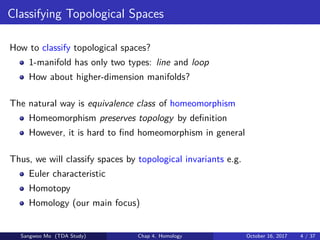
Classifying Topological Spaces
How to classify topological spaces?
1-manifold has only two types: line and loop
How about higher-dimension manifolds?
The natural way is equivalence class of homeomorphism
Homeomorphism preserves topology by denition
However, it is hard to nd homeomorphism in general
Thus, we will classify spaces by topological invariants e.g.
Euler characteristic
Homotopy
Homology (our main focus)
Sangwoo Mo (TDA Study) Chap 4. Homology October 16, 2017 4 / 37
Table of Contents
1 Motivation
2 Euler characteristic
3 Homotopy
4 Homology
Sangwoo Mo (TDA Study) Chap 4. Homology October 16, 2017 5 / 37
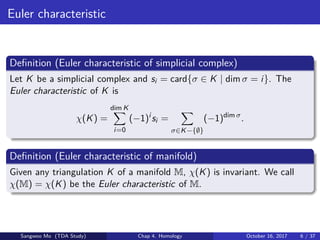
Euler characteristic
Denition (Euler characteristic of simplicial complex)
Let K be a simplicial complex and si = card{σ ∈ K | dim σ = i}. The
Euler characteristic of K is
χ(K) =
dim K
i=0
(−1)i
si =
σ∈K−{∅}
(−1)dim σ
.
Denition (Euler characteristic of manifold)
Given any triangulation K of a manifold M, χ(K) is invariant. We call
χ(M) = χ(K) be the Euler characteristic of M.
Sangwoo Mo (TDA Study) Chap 4. Homology October 16, 2017 6 / 37
Euler characteristic
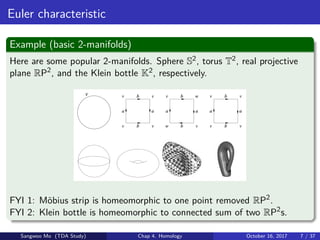
Example (basic 2-manifolds)
Here are some popular 2-manifolds. Sphere S2, torus T2, real projective
plane RP2
, and the Klein bottle K2, respectively.
FYI 1: M¨obius strip is homeomorphic to one point removed RP2
.
FYI 2: Klein bottle is homeomorphic to connected sum of two RP2
s.
Sangwoo Mo (TDA Study) Chap 4. Homology October 16, 2017 7 / 37
Euler characteristic
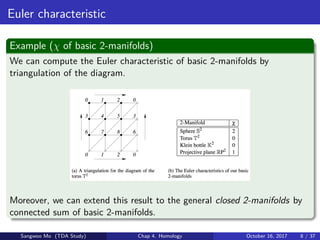
Example (χ of basic 2-manifolds)
We can compute the Euler characteristic of basic 2-manifolds by
triangulation of the diagram.
Moreover, we can extend this result to the general closed 2-manifolds by
connected sum of basic 2-manifolds.
Sangwoo Mo (TDA Study) Chap 4. Homology October 16, 2017 8 / 37
Connected Sum
Denition (connected sum)
The connected sum of two n-manifolds M1, M2 is
M1 # M2 = M1 − ˚Dn
1
∂˚Dn
1 =∂˚Dn
2
M2 − ˚Dn
2
where ˚Dn
1 , ˚Dn
2 are n-dimensional closed disks in M1, M2, respectively.
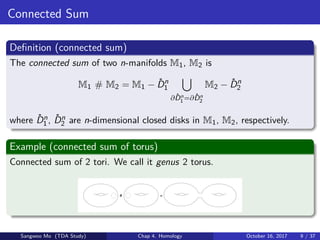
Example (connected sum of torus)
Connected sum of 2 tori. We call it genus 2 torus.
Sangwoo Mo (TDA Study) Chap 4. Homology October 16, 2017 9 / 37
Connected Sum
Theorem (χ of connected sum)
For compact surfaces M1, M2,
χ(M1 # M2) = χ(M1) + χ(M2) − 2.
Corollary (χ of connected sum of T2
/RP2
)
As corollary, χ(gT2) = 2 − 2g and χ(gRP2
) = 2 − g.
Sangwoo Mo (TDA Study) Chap 4. Homology October 16, 2017 10 / 37
Classication of 2-manifolds
We can prove that any closed surface are homeomorphic to the connected
sum of T2 or the connected sum of RP2
. (Sphere is genus 0 torus.)
Theorem (classication of 2-manifolds)
The closed 2-manifold M is homeomorphic to
the connected sum of T2 if it is orientable
the connected sum of RP2
if it is not orientable
Using Euler characteristic, we can also identify the number of connection.
Homeomorphism (and Euler characteristic) suceed to classify 2-manifolds.
However, we need better tools to classify higher-dimension manifolds.
Before we move on, we will introduce basic category theory to formally
dene invariant, from topological space to algebraic structure.
Sangwoo Mo (TDA Study) Chap 4. Homology October 16, 2017 11 / 37
Basic Category Theory
Denition (category)
A category C consists of:
(a) a collection Ob(C) of objects
(b) sets Mor(X, Y ) of morphisms for each pair X, Y ∈ Ob(C); including a
distinguished identity morphism 1 = 1X ∈ Mor(X, Y ) for each X
(c) a composition of morphisms function ◦ : Mor(X, Y ) × Mor(Y , Z)
→ Mor(X, Z) for each triple X, Y , Z ∈ Ob(C), satisfying
f ◦ 1 = 1 ◦ f = f , and (f ◦ g) ◦ h = f ◦ (g ◦ h)
Denition (functor)
A (covariant) functor F from a category C to a category D assigns
(a) object X ∈ C to an object F(X) ∈ D
(b) morphism f ∈ Mor(X, Y ) to a morphism F(f ) ∈ Mor(F(X), F(Y ));
such that F(1) = 1 and F(f ◦ g) = F(f ) ◦ F(g)
Sangwoo Mo (TDA Study) Chap 4. Homology October 16, 2017 12 / 37
Basic Category Theory
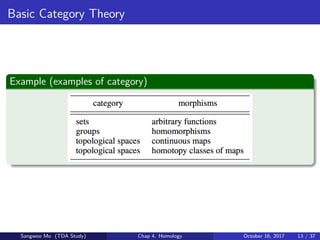
Example (examples of category)
Sangwoo Mo (TDA Study) Chap 4. Homology October 16, 2017 13 / 37
Basic Category Theory
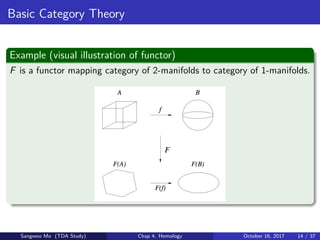
Example (visual illustration of functor)
F is a functor mapping category of 2-manifolds to category of 1-manifolds.
Sangwoo Mo (TDA Study) Chap 4. Homology October 16, 2017 14 / 37
Functor from Topology to Algebra
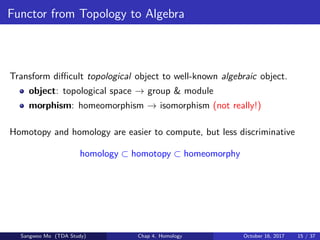
Transform dicult topological object to well-known algebraic object.
object: topological space → group & module
morphism: homeomorphism → isomorphism (not really!)
Homotopy and homology are easier to compute, but less discriminative
homology ⊂ homotopy ⊂ homeomorphy
Sangwoo Mo (TDA Study) Chap 4. Homology October 16, 2017 15 / 37
Table of Contents
1 Motivation
2 Euler characteristic
3 Homotopy
4 Homology
Sangwoo Mo (TDA Study) Chap 4. Homology October 16, 2017 16 / 37
Homotopy
Denition (homotopy)
The homotopy of two continuous functions f , g : X → Y is a continuous
function H : X × [0, 1] → Y such that H(x, 0) = f (x) and H(x, 1) = g(x)
for x ∈ X. We can think H as a continuous deformation of f into g.
Example (homotopy vs homeomorphy)
X and Y are homotopy equivalent, but not homeomorphic.
Sangwoo Mo (TDA Study) Chap 4. Homology October 16, 2017 17 / 37
Homotopy
Denition (homotopy group)
Choose base point s ∈ Sn and x ∈ X. The homotopy group πn(X, x) is
the set of homotopy classes of maps f : (Sn, s) → (X, x). For simply
connected space, πn(X, x) is independent to x, thus we can write πn(X).
We call π1(X) be the fundamental group.
Remark (homotopy ‘group’)
Remark that πn(X) has a group structure. Even more, for n ≥ 2, πn(X)
becomes an abelian group.
Sangwoo Mo (TDA Study) Chap 4. Homology October 16, 2017 18 / 37
Homotopy
Intuitively, homotopy group counts the number of loops
Example (fundamental group of torus)
The fundamental group of torus is π1(T2) = Z × Z.
Sangwoo Mo (TDA Study) Chap 4. Homology October 16, 2017 19 / 37
Undecidability of Homeomorphy/Homotopy
Theorem (undecidability of homeomorphy/homotopy)
For manifolds with dimension higher than 4, homeomorphy/homotopy
problem is undecidable.
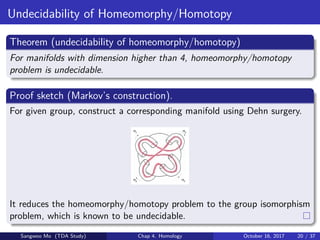
Proof sketch (Markov’s construction).
For given group, construct a corresponding manifold using Dehn surgery.
It reduces the homeomorphy/homotopy problem to the group isomorphism
problem, which is known to be undecidable.
Sangwoo Mo (TDA Study) Chap 4. Homology October 16, 2017 20 / 37
Limitation of Homotopy
Homotopy group is one way to classify topological spaces
However, it has several problems:
not combinatorial
hard to compute
infinite description of πn(X)
⇒ It motivates the homology, the combinatorial computable functor with
nite description
Sangwoo Mo (TDA Study) Chap 4. Homology October 16, 2017 21 / 37
Table of Contents
1 Motivation
2 Euler characteristic
3 Homotopy
4 Homology
Sangwoo Mo (TDA Study) Chap 4. Homology October 16, 2017 22 / 37
Homology
There are several ways to dene homology (e.g. CW-complex), but we will
only cover simplicial homology; We only consider a simplicial complex K
First, we will dene chain and cycle, the extension of path and loop
Denition (chain group)
The kth chain group Ck(K), + of K is the free abelian group on the
oriented k-simplices. An element of Ck(K) is a k-chain,
c =
q
nq[σq], nq ∈ Z, σq ∈ K.
Sangwoo Mo (TDA Study) Chap 4. Homology October 16, 2017 23 / 37
Homology
Denition (boundary homomorphism)
The boundary homomorphism ∂k : Ck(K) → Ck−1(K) is
∂kσ =
i
(−1)i
[v0, v1, ..., ˆvi , ..., vn]
where ˆvi indicates that vi is deleted from the sequence.
Example (boundary homomorphism of simplices)
∂1[a, b] = b − a
∂2[a, b, c] = [b, c] − [a, c] + [a, b]
∂3[a, b, c, d] = [b, c, d] − [a, c, d] + [a, b, d] − [a, b, c]
Sangwoo Mo (TDA Study) Chap 4. Homology October 16, 2017 24 / 37
Homology
Denition (chain complex)
The chain complex C∗ is a sequence of chain groups
0 −→ Cn
∂n
−→ Cn−1 −→ ... −→ C1
∂1
−→ C0
∂0
−→ 0
Denition (cycle, boundary)
The kth cycle group is Zk = ker ∂k and the kth boundary group is
Bk = im ∂k+1. Elements of Zk and Bk are cycle and boundary.
Sangwoo Mo (TDA Study) Chap 4. Homology October 16, 2017 25 / 37
Homology
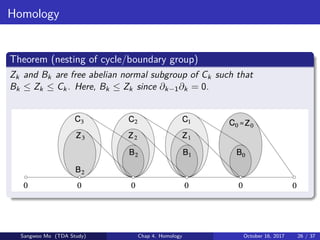
Theorem (nesting of cycle/boundary group)
Zk and Bk are free abelian normal subgroup of Ck such that
Bk ≤ Zk ≤ Ck. Here, Bk ≤ Zk since ∂k−1∂k = 0.
Sangwoo Mo (TDA Study) Chap 4. Homology October 16, 2017 26 / 37
Homology
Denition (homology group)
The kth homology group is
Hk = Zk/Bk = ker ∂k/im ∂k−1.
Note that homology groups are nitely generated abelian.
Denition (Betti number)
The kth Betti number βk = βk(Hk) is the rank of the free part of Hk.
Sangwoo Mo (TDA Study) Chap 4. Homology October 16, 2017 27 / 37
Understanding Homology
For simplicity, we only consider subcomplexes of S3
Subcomplexes of S3 easy to handle (torsion-free)
Algorithmically, simple one point compactication converts R3 to S3
For 3-dim torsion-free space, Betti numbers have intuitive meaning
Alexander Duality:
β0 measures the number of components
β1 measures the number of tunnels
β0 measures the number of voids
Sangwoo Mo (TDA Study) Chap 4. Homology October 16, 2017 28 / 37
Understanding Homology
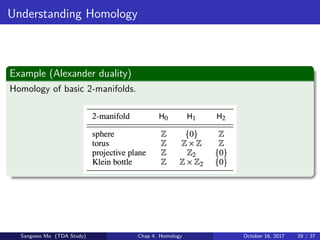
Example (Alexander duality)
Homology of basic 2-manifolds.
Sangwoo Mo (TDA Study) Chap 4. Homology October 16, 2017 29 / 37
Invariance
We hope homology be invariant for same underlying space
First approach was proving that any two triangulations of a
topological space have a common renement (Hauptvermutung)
However, it was false for manifolds of dimension ≥ 5
For general spaces, singular homology is introduced
Simplical homology is equivalent to singular homology
Algorithmically, we can just compute (easy) simplical homology
Sangwoo Mo (TDA Study) Chap 4. Homology October 16, 2017 30 / 37
Relation to Euler characteristic
The sequence of homology groups also forms a chain complex
0 −→ Hn −→ Hn−1 −→ ... −→ H1 −→ H0 −→ 0
Denition (Euler charactersitic of chain complex)
The Euler charactersitic of chain complex C∗ is
χ(C∗) =
i
(−1)i
rank(Ci ).
Theorem (Euler-Poincar´e formula)
χ(C∗) = χ(H∗(C∗)) =
i
(−1)i
βi .
Sangwoo Mo (TDA Study) Chap 4. Homology October 16, 2017 31 / 37
Relation to Homotopy
Theorem (Hurewicz theorem)
For any space X and positive integer k there is a group homomorphism
h∗ : πk(X) → Hk(X).
If X is (n − 1)-connected, h∗ is an isomorphism for all 2 ≤ k ≤ n and
abelinization for n = 1. In particular, the theorem says that
H1(X) ∼= π1(X)/[π1(X), π1(X)].
Sangwoo Mo (TDA Study) Chap 4. Homology October 16, 2017 32 / 37
Homology with coecients
We assumed chain group be the free abelian group, which is Z-module
We may replace this ring with any PID D, such as Z2
Denition (homology with coecients)
The kth homology with ring of coecients D is
Hk(K; D) = Zk(K; D)/Bk(K; D).
Our goal is to compute Hk(K; D) for arbitrary D, using Hk(K)
If we use Z2, the computation becomes greatly simple (see Chap 7.)
Sangwoo Mo (TDA Study) Chap 4. Homology October 16, 2017 33 / 37
Homology with coecients
Denition (short exact sequence)
The short exact sequence is seqeunce of groups
0
ϕ3
−→ A
ϕ2
−→ B
ϕ1
−→ C
ϕ0
−→ 0
such that im ϕi = ker ϕi−1.
Theorem (splitting lemma)
For short exact sequence, B ∼= A × C.
Sangwoo Mo (TDA Study) Chap 4. Homology October 16, 2017 34 / 37
Homology with coecients
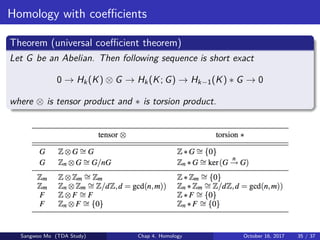
Theorem (universal coecient theorem)
Let G be an Abelian. Then following sequence is short exact
0 → Hk(K) ⊗ G → Hk(K; G) → Hk−1(K) ∗ G → 0
where ⊗ is tensor product and ∗ is torsion product.
Sangwoo Mo (TDA Study) Chap 4. Homology October 16, 2017 35 / 37
Homology with coecients
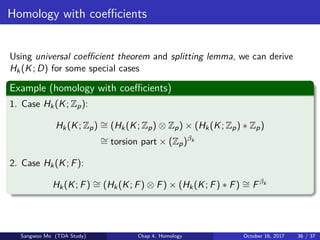
Using universal coecient theorem and splitting lemma, we can derive
Hk(K; D) for some special cases
Example (homology with coecients)
1. Case Hk(K; Zp):
Hk(K; Zp) ∼= (Hk(K; Zp) ⊗ Zp) × (Hk(K; Zp) ∗ Zp)
∼= torsion part × (Zp)βk
2. Case Hk(K; F):
Hk(K; F) ∼= (Hk(K; F) ⊗ F) × (Hk(K; F) ∗ F) ∼= Fβk
Sangwoo Mo (TDA Study) Chap 4. Homology October 16, 2017 36 / 37
Questions?
Sangwoo Mo (TDA Study) Chap 4. Homology October 16, 2017 37 / 37

Topology for Computing: Homology

  • 1.
    Topology for Computing Chapter4. Homology Sangwoo Mo TDA Study October 16, 2017 Sangwoo Mo (TDA Study) Chap 4. Homology October 16, 2017 1 / 37
  • 2.
    Table of Contents 1Motivation 2 Euler characteristic 3 Homotopy 4 Homology Sangwoo Mo (TDA Study) Chap 4. Homology October 16, 2017 2 / 37
  • 3.
    Table of Contents 1Motivation 2 Euler characteristic 3 Homotopy 4 Homology Sangwoo Mo (TDA Study) Chap 4. Homology October 16, 2017 3 / 37
  • 4.
    Classifying Topological Spaces Howto classify topological spaces? 1-manifold has only two types: line and loop How about higher-dimension manifolds? The natural way is equivalence class of homeomorphism Homeomorphism preserves topology by denition However, it is hard to nd homeomorphism in general Thus, we will classify spaces by topological invariants e.g. Euler characteristic Homotopy Homology (our main focus) Sangwoo Mo (TDA Study) Chap 4. Homology October 16, 2017 4 / 37
  • 5.
    Table of Contents 1Motivation 2 Euler characteristic 3 Homotopy 4 Homology Sangwoo Mo (TDA Study) Chap 4. Homology October 16, 2017 5 / 37
  • 6.
    Euler characteristic Definition (Eulercharacteristic of simplicial complex) Let K be a simplicial complex and si = card{σ ∈ K | dim σ = i}. The Euler characteristic of K is χ(K) = dim K i=0 (−1)i si = σ∈K−{∅} (−1)dim σ . Definition (Euler characteristic of manifold) Given any triangulation K of a manifold M, χ(K) is invariant. We call χ(M) = χ(K) be the Euler characteristic of M. Sangwoo Mo (TDA Study) Chap 4. Homology October 16, 2017 6 / 37
  • 7.
    Euler characteristic Example (basic2-manifolds) Here are some popular 2-manifolds. Sphere S2, torus T2, real projective plane RP2 , and the Klein bottle K2, respectively. FYI 1: M¨obius strip is homeomorphic to one point removed RP2 . FYI 2: Klein bottle is homeomorphic to connected sum of two RP2 s. Sangwoo Mo (TDA Study) Chap 4. Homology October 16, 2017 7 / 37
  • 8.
    Euler characteristic Example (χof basic 2-manifolds) We can compute the Euler characteristic of basic 2-manifolds by triangulation of the diagram. Moreover, we can extend this result to the general closed 2-manifolds by connected sum of basic 2-manifolds. Sangwoo Mo (TDA Study) Chap 4. Homology October 16, 2017 8 / 37
  • 9.
    Connected Sum Definition (connectedsum) The connected sum of two n-manifolds M1, M2 is M1 # M2 = M1 − ˚Dn 1 ∂˚Dn 1 =∂˚Dn 2 M2 − ˚Dn 2 where ˚Dn 1 , ˚Dn 2 are n-dimensional closed disks in M1, M2, respectively. Example (connected sum of torus) Connected sum of 2 tori. We call it genus 2 torus. Sangwoo Mo (TDA Study) Chap 4. Homology October 16, 2017 9 / 37
  • 10.
    Connected Sum Theorem (χof connected sum) For compact surfaces M1, M2, χ(M1 # M2) = χ(M1) + χ(M2) − 2. Corollary (χ of connected sum of T2 /RP2 ) As corollary, χ(gT2) = 2 − 2g and χ(gRP2 ) = 2 − g. Sangwoo Mo (TDA Study) Chap 4. Homology October 16, 2017 10 / 37
  • 11.
    Classication of 2-manifolds Wecan prove that any closed surface are homeomorphic to the connected sum of T2 or the connected sum of RP2 . (Sphere is genus 0 torus.) Theorem (classication of 2-manifolds) The closed 2-manifold M is homeomorphic to the connected sum of T2 if it is orientable the connected sum of RP2 if it is not orientable Using Euler characteristic, we can also identify the number of connection. Homeomorphism (and Euler characteristic) suceed to classify 2-manifolds. However, we need better tools to classify higher-dimension manifolds. Before we move on, we will introduce basic category theory to formally dene invariant, from topological space to algebraic structure. Sangwoo Mo (TDA Study) Chap 4. Homology October 16, 2017 11 / 37
  • 12.
    Basic Category Theory Definition(category) A category C consists of: (a) a collection Ob(C) of objects (b) sets Mor(X, Y ) of morphisms for each pair X, Y ∈ Ob(C); including a distinguished identity morphism 1 = 1X ∈ Mor(X, Y ) for each X (c) a composition of morphisms function ◦ : Mor(X, Y ) × Mor(Y , Z) → Mor(X, Z) for each triple X, Y , Z ∈ Ob(C), satisfying f ◦ 1 = 1 ◦ f = f , and (f ◦ g) ◦ h = f ◦ (g ◦ h) Definition (functor) A (covariant) functor F from a category C to a category D assigns (a) object X ∈ C to an object F(X) ∈ D (b) morphism f ∈ Mor(X, Y ) to a morphism F(f ) ∈ Mor(F(X), F(Y )); such that F(1) = 1 and F(f ◦ g) = F(f ) ◦ F(g) Sangwoo Mo (TDA Study) Chap 4. Homology October 16, 2017 12 / 37
  • 13.
    Basic Category Theory Example(examples of category) Sangwoo Mo (TDA Study) Chap 4. Homology October 16, 2017 13 / 37
  • 14.
    Basic Category Theory Example(visual illustration of functor) F is a functor mapping category of 2-manifolds to category of 1-manifolds. Sangwoo Mo (TDA Study) Chap 4. Homology October 16, 2017 14 / 37
  • 15.
    Functor from Topologyto Algebra Transform difficult topological object to well-known algebraic object. object: topological space → group & module morphism: homeomorphism → isomorphism (not really!) Homotopy and homology are easier to compute, but less discriminative homology ⊂ homotopy ⊂ homeomorphy Sangwoo Mo (TDA Study) Chap 4. Homology October 16, 2017 15 / 37
  • 16.
    Table of Contents 1Motivation 2 Euler characteristic 3 Homotopy 4 Homology Sangwoo Mo (TDA Study) Chap 4. Homology October 16, 2017 16 / 37
  • 17.
    Homotopy Definition (homotopy) The homotopyof two continuous functions f , g : X → Y is a continuous function H : X × [0, 1] → Y such that H(x, 0) = f (x) and H(x, 1) = g(x) for x ∈ X. We can think H as a continuous deformation of f into g. Example (homotopy vs homeomorphy) X and Y are homotopy equivalent, but not homeomorphic. Sangwoo Mo (TDA Study) Chap 4. Homology October 16, 2017 17 / 37
  • 18.
    Homotopy Definition (homotopy group) Choosebase point s ∈ Sn and x ∈ X. The homotopy group πn(X, x) is the set of homotopy classes of maps f : (Sn, s) → (X, x). For simply connected space, πn(X, x) is independent to x, thus we can write πn(X). We call π1(X) be the fundamental group. Remark (homotopy ‘group’) Remark that πn(X) has a group structure. Even more, for n ≥ 2, πn(X) becomes an abelian group. Sangwoo Mo (TDA Study) Chap 4. Homology October 16, 2017 18 / 37
  • 19.
    Homotopy Intuitively, homotopy groupcounts the number of loops Example (fundamental group of torus) The fundamental group of torus is π1(T2) = Z × Z. Sangwoo Mo (TDA Study) Chap 4. Homology October 16, 2017 19 / 37
  • 20.
    Undecidability of Homeomorphy/Homotopy Theorem(undecidability of homeomorphy/homotopy) For manifolds with dimension higher than 4, homeomorphy/homotopy problem is undecidable. Proof sketch (Markov’s construction). For given group, construct a corresponding manifold using Dehn surgery. It reduces the homeomorphy/homotopy problem to the group isomorphism problem, which is known to be undecidable. Sangwoo Mo (TDA Study) Chap 4. Homology October 16, 2017 20 / 37
  • 21.
    Limitation of Homotopy Homotopygroup is one way to classify topological spaces However, it has several problems: not combinatorial hard to compute infinite description of πn(X) ⇒ It motivates the homology, the combinatorial computable functor with finite description Sangwoo Mo (TDA Study) Chap 4. Homology October 16, 2017 21 / 37
  • 22.
    Table of Contents 1Motivation 2 Euler characteristic 3 Homotopy 4 Homology Sangwoo Mo (TDA Study) Chap 4. Homology October 16, 2017 22 / 37
  • 23.
    Homology There are severalways to dene homology (e.g. CW-complex), but we will only cover simplicial homology; We only consider a simplicial complex K First, we will dene chain and cycle, the extension of path and loop Denition (chain group) The kth chain group Ck(K), + of K is the free abelian group on the oriented k-simplices. An element of Ck(K) is a k-chain, c = q nq[σq], nq ∈ Z, σq ∈ K. Sangwoo Mo (TDA Study) Chap 4. Homology October 16, 2017 23 / 37
  • 24.
    Homology Definition (boundary homomorphism) Theboundary homomorphism ∂k : Ck(K) → Ck−1(K) is ∂kσ = i (−1)i [v0, v1, ..., ˆvi , ..., vn] where ˆvi indicates that vi is deleted from the sequence. Example (boundary homomorphism of simplices) ∂1[a, b] = b − a ∂2[a, b, c] = [b, c] − [a, c] + [a, b] ∂3[a, b, c, d] = [b, c, d] − [a, c, d] + [a, b, d] − [a, b, c] Sangwoo Mo (TDA Study) Chap 4. Homology October 16, 2017 24 / 37
  • 25.
    Homology Definition (chain complex) Thechain complex C∗ is a sequence of chain groups 0 −→ Cn ∂n −→ Cn−1 −→ ... −→ C1 ∂1 −→ C0 ∂0 −→ 0 Definition (cycle, boundary) The kth cycle group is Zk = ker ∂k and the kth boundary group is Bk = im ∂k+1. Elements of Zk and Bk are cycle and boundary. Sangwoo Mo (TDA Study) Chap 4. Homology October 16, 2017 25 / 37
  • 26.
    Homology Theorem (nesting ofcycle/boundary group) Zk and Bk are free abelian normal subgroup of Ck such that Bk ≤ Zk ≤ Ck. Here, Bk ≤ Zk since ∂k−1∂k = 0. Sangwoo Mo (TDA Study) Chap 4. Homology October 16, 2017 26 / 37
  • 27.
    Homology Definition (homology group) Thekth homology group is Hk = Zk/Bk = ker ∂k/im ∂k−1. Note that homology groups are finitely generated abelian. Definition (Betti number) The kth Betti number βk = βk(Hk) is the rank of the free part of Hk. Sangwoo Mo (TDA Study) Chap 4. Homology October 16, 2017 27 / 37
  • 28.
    Understanding Homology For simplicity,we only consider subcomplexes of S3 Subcomplexes of S3 easy to handle (torsion-free) Algorithmically, simple one point compactication converts R3 to S3 For 3-dim torsion-free space, Betti numbers have intuitive meaning Alexander Duality: β0 measures the number of components β1 measures the number of tunnels β0 measures the number of voids Sangwoo Mo (TDA Study) Chap 4. Homology October 16, 2017 28 / 37
  • 29.
    Understanding Homology Example (Alexanderduality) Homology of basic 2-manifolds. Sangwoo Mo (TDA Study) Chap 4. Homology October 16, 2017 29 / 37
  • 30.
    Invariance We hope homologybe invariant for same underlying space First approach was proving that any two triangulations of a topological space have a common refinement (Hauptvermutung) However, it was false for manifolds of dimension ≥ 5 For general spaces, singular homology is introduced Simplical homology is equivalent to singular homology Algorithmically, we can just compute (easy) simplical homology Sangwoo Mo (TDA Study) Chap 4. Homology October 16, 2017 30 / 37
  • 31.
    Relation to Eulercharacteristic The sequence of homology groups also forms a chain complex 0 −→ Hn −→ Hn−1 −→ ... −→ H1 −→ H0 −→ 0 Definition (Euler charactersitic of chain complex) The Euler charactersitic of chain complex C∗ is χ(C∗) = i (−1)i rank(Ci ). Theorem (Euler-Poincar´e formula) χ(C∗) = χ(H∗(C∗)) = i (−1)i βi . Sangwoo Mo (TDA Study) Chap 4. Homology October 16, 2017 31 / 37
  • 32.
    Relation to Homotopy Theorem(Hurewicz theorem) For any space X and positive integer k there is a group homomorphism h∗ : πk(X) → Hk(X). If X is (n − 1)-connected, h∗ is an isomorphism for all 2 ≤ k ≤ n and abelinization for n = 1. In particular, the theorem says that H1(X) ∼= π1(X)/[π1(X), π1(X)]. Sangwoo Mo (TDA Study) Chap 4. Homology October 16, 2017 32 / 37
  • 33.
    Homology with coecients Weassumed chain group be the free abelian group, which is Z-module We may replace this ring with any PID D, such as Z2 Denition (homology with coecients) The kth homology with ring of coecients D is Hk(K; D) = Zk(K; D)/Bk(K; D). Our goal is to compute Hk(K; D) for arbitrary D, using Hk(K) If we use Z2, the computation becomes greatly simple (see Chap 7.) Sangwoo Mo (TDA Study) Chap 4. Homology October 16, 2017 33 / 37
  • 34.
    Homology with coefficients Definition(short exact sequence) The short exact sequence is seqeunce of groups 0 ϕ3 −→ A ϕ2 −→ B ϕ1 −→ C ϕ0 −→ 0 such that im ϕi = ker ϕi−1. Theorem (splitting lemma) For short exact sequence, B ∼= A × C. Sangwoo Mo (TDA Study) Chap 4. Homology October 16, 2017 34 / 37
  • 35.
    Homology with coefficients Theorem(universal coefficient theorem) Let G be an Abelian. Then following sequence is short exact 0 → Hk(K) ⊗ G → Hk(K; G) → Hk−1(K) ∗ G → 0 where ⊗ is tensor product and ∗ is torsion product. Sangwoo Mo (TDA Study) Chap 4. Homology October 16, 2017 35 / 37
  • 36.
    Homology with coefficients Usinguniversal coefficient theorem and splitting lemma, we can derive Hk(K; D) for some special cases Example (homology with coefficients) 1. Case Hk(K; Zp): Hk(K; Zp) ∼= (Hk(K; Zp) ⊗ Zp) × (Hk(K; Zp) ∗ Zp) ∼= torsion part × (Zp)βk 2. Case Hk(K; F): Hk(K; F) ∼= (Hk(K; F) ⊗ F) × (Hk(K; F) ∗ F) ∼= Fβk Sangwoo Mo (TDA Study) Chap 4. Homology October 16, 2017 36 / 37
  • 37.
    Questions? Sangwoo Mo (TDAStudy) Chap 4. Homology October 16, 2017 37 / 37