Downloaded 14 times
![NOTES ON INTERSECTION THEORY
HEINRICH HARTMANN
1. Motivation from Topology
Intersection theory addresses the following question:
Given a space X and a collection of subspaces Z1, . . . , Zn ⊂ X.
How many points lie in the intersection Z1 ∩ · · · ∩ Zn?
In general this question very hard to answer. More can be said if we
modify our question a bit:
(1) Assume X is a smooth and compact manifold.
(2) Assume Zi admit triangulations and meet transversally.
(3) Choose orientations on X and Zi and count the number of points in
Z1 ∩ · · · ∩ Zn with the appropriate signs.
Under this assumptions the signed count of intersection points does not
change if we move Zi in their homology class.
It turns out that every collection of (singular) sub-manifolds Zi can be
made transversal inside their homology classes and that we can define a
product structure on the homology groups by “taking transversal intersec-
tions”:
[Z1] · [Z2] = [Z1 ∩ Z2]
where Zi are representatives of [Zi] meeting transversally.
In this way we reformulated our initial question into computing the degree
of a certain 0-dimensional homology cycle
#or
Z1 ∩ · · · ∩ Zn = deg([Z1] · · · · · [Z1]).
There are many topological tools to compute these intersection products.
The most important ones being (Poincare-) duality and the theory of char-
acteristic classes in the case Zi are vanishing loci of sections of vector bun-
dles.
This picture remains basically the same if we change our setting from
differentiable manifolds to complex analytic spaces. Here are the main dif-
ferences.
(1) Every analytic space carries a canonical orientation. So all the signs
introduced above disappear. (Good news!)
(2) Every analytic space admits a triangulation. (Good news!)
(3) Not every intersection can be made transversal inside a family of
analytic spaces. (Bad News!)
One can still use topological deformations (introducing maybe neg-
ative orientations) or replace Zi by a linear combination of movable
cycles (which may have negative coefficients).
Date: 30.04.2010.
1](https://image.slidesharecdn.com/intersectiontheory-140817145315-phpapp02/75/Notes-on-Intersection-theory-1-2048.jpg)
![2 HEINRICH HARTMANN
(4) Analytic singularities are not too bad. In many cases one can assign
an “intersection multiplicity” or an “excess-intersection class” to a
component of a degenerate intersection which measures the local
contribution to the intersection product.
In the algebraic setting of schemes we cannot use the topological theory
alluded to above. Instead one has to redo the whole theory using algebraic
methods only. In my opinion it is nevertheless very helpful to keep the
topological motivation in mind. In this note we will review the some aspects
of this algebraic theory of intersections following Fulton’s book [Ful84].
References
[Ful84] William Fulton, Intersection theory, second edition, Springer 1998
2. Chow Groups
A “scheme” is for us a scheme of finite type over a fixed field κ in the
sense of in Hartshorn’s book. A variety is a irreducible and reduced scheme.
Definition 2.1. [Ful84, Section 1.3] Let X be a scheme the group of k-
dimensional cycles is the free abelian group generated by all k-dimensional
subvarieties.
Zk(X) = Z [Z] | Z ⊂ X k-dimensional variety
Let W ⊂ X be a k + 1-dimensional variety, and f ∈ K(W) a rational
function on W. There is an associated divisor on W
div(f) =
Z⊂W
ordZ(f)[Z] ∈ Zk(W).
The sum runs over all k-dimensional sub-varieties Y of W and ordZ(f) is
the order function on K(W) defined by the valuation ring OW,Z ⊂ K(W).
Geometrically this is the order of vanishing of f along V .
The equivalence relation on Zk(X) generated by div(f) ∼ 0 for all k + 1-
dimensional sub-varieties W ⊂ X and f ∈ K(W) is called rational equiv-
alence. The quotient Ak(X) = Zk/ ∼ is called the k-dimensional Chow
group of X. We set A∗(X) = ⊕kAk(X) and A∗(X) = ⊕kAk(X), Ak(X) =
An−k(X) if X is of pure dimension n.
On Chow groups we have the following basic operations.
(1) Proper push-forward [Ful84, Section 1.4]. For a proper morphism
f : X → Y there is a unique homomorphism f∗ : Ak(X) → Ak(Y )
with the property that if Z ⊂ X is a sub-variety and W = f(Z)
(which is a subvariety of Y ) then f∗[Z] = deg(Z/W)[W].
(2) Fundamental cycles [Ful84, Section 1.5]. A subscheme Y ⊂ X de-
termines a cycle [Y ] ∈ A∗(X) by
[Y ] =
i
mi[Yi]
where Yi are the irreducible components of Y and mi = length(OY,Yi )
are the geometric multiplicities of Yi in Y .](https://image.slidesharecdn.com/intersectiontheory-140817145315-phpapp02/75/Notes-on-Intersection-theory-2-2048.jpg)
![NOTES ON INTERSECTION THEORY 3
(3) Flat pull-back [Ful84, Section 1.6]. For a flat morphism f : X → Y
of constant relative dimension n there is a unique homomorphism
f∗ : Ak(Y ) → Ak+n(X) mapping a sub-variety Z ⊂ Y to the funda-
mental cycle of the inverse image scheme f−1(Z).
(4) Gysin morphisms [Ful84, Chapter 6]. Let i : X → Y be a regular
embedding of codimension d then there is a Gysin morphism i∗ :
Ak(Y ) → Ak−d(X).
If Z ⊂ Y is a variety intersecting X properly then i∗([Z]) can be
represented by a linear combination of the irreducible components
of the intersection scheme.
If Z intersects X transversally then i∗([Z]) = [Z ∩ X] is the fun-
damental cycle of the (reduced) intersection scheme.
The moving lemmas given below can be used to reduce the general
definition to this cases. There is also a direct construction due to
Fulton which uses a deformation to the normal cone.
(5) Intersection Product [Ful84, Chapter 8]. If X is a non-singular vari-
ety of dimension n then there is a product on A∗(X). In this case
the diagonal embedding δ : X → X × X is a regular embedding and
the product is defined as
α · β = δ∗
(α × β)
for α, β ∈ A∗(X).
Proposition 2.2 (Moving lemma). [Ful84, Section 11.4]. If X is non-
sigular, quasi-projective and α and β are cycles on X then there exists a
cycle β ∼ β such that α and β intersect properly.
If moreover κ is algebraically closed there is a β ∼ β such that α and β
meet transversally.
There are various compatibilities between these operations.
3. Chern Classes
Let L be a line bundle on a scheme X we define a first Chern operation
c1(L) ∩ : Ak(X) −→ Ak−1(X)
by the following procedure. For a k-dimensional subvariety Z ⊂ X the line
bundle L|Z can be represented by a Cartier divisor D, with OZ(D) = L|Z.
The associated Weil divisor is also denoted also by D and defines a k − 1-
cycle [D] on X. This cycle is unique up to rational equivalence, and thus
we can define c1(L) ∩ [Z] = [D].
To construct higher Chern operators we consider projectivized bundles.
Let E be a vector bundle over X of rank r > 0, we denote by
π : P(E) = Proj(Sym∗
OX
E∨
) −→ X
the associated bundle of projective spaces. It comes with a canonical line
bundle OP(E)(1) which is relatively ample and restricts fiber-wise to the
canonical bundle on the projective space P(Ex).
Proposition 3.1. Let ξ = c1(OP(E)(1)), then the morphism
π∗
: A∗
(X) 1, ξ, . . . , ξr−1
−→ A∗
(P(E)), α ⊗ ξk
→ ξk
∩ π∗
α](https://image.slidesharecdn.com/intersectiontheory-140817145315-phpapp02/75/Notes-on-Intersection-theory-3-2048.jpg)
![4 HEINRICH HARTMANN
is an isomorphism of A∗(X) modules.
We define higher Chern operations in the following way. For α ∈ Ak(X)
we consider
π∗
(ξr
∩ α) ∈ A∗(P(E)) ∼= A∗(X) 1, ξ, . . . , ξr−1
which we decompose according to the proposition in classes
−ξr
∩ π∗
α = ξ0
∩ π∗
αr + ξ1
∩ π∗
αr−1 + · · · + ξr−1
∩ π∗
α1
and set ci(E) ∩ α = αi. Thus we get the fundamental relation
r
p=0
ξr−p
π∗
(cp(E) ∩ α) = 0(1)
with c0(E) ∩ α := α in A∗(P(E)).
We also define Chern cycle classes as cp(E) = cp(E) ∩ [X]. If X is a non-
singular variety the Chern operations can be reconstructed from the Chern
classes via ci(E) ∩ α = ci(E) · α.
Chern classes have the following geometric significance.
Proposition 3.2. [Ful84, 14.4.2] Let X be a variety and assume there are
s1, . . . , sr−p+1 general sections1
of E then
cp(E) = [{ x ∈ X | s1(x), . . . , sr−p+1(x) linearly dependent }].
In particular
c1(E) = [{ x ∈ X | det(s1(x), . . . , sr(x)) = 0 }] = c1(det(E)),
cr(E) = [{ x ∈ X | s1(x) = 0 }].
Warning: It is not true that cp(E) = ctop(Λr−p+1(E)) since s1 ∧· · ·∧sr−p+1
is not a generic section.
If X is not a variety and si are not general there are localized Chern
classes which are supported on the corresponding zero-schemes and push
forward to the Chern classes constructed in X.
Remark 3.3. The vector bundle π∗(E) ⊗ O(1) has a canonical nowhere-
vanishing section. It follows from this that cr(π∗(E) ⊗ O(1)) = 0. using the
formula for chern classes of tensor products with line bundles, we derive at
the fundamental relation (1).
4. Cones and Segre Classes
Definition 4.1. Let E be a vector bundle on a scheme X of dimension n.
The Segre operations s0(E), . . . , sn(E) are defined to be inverse to the Chern
operations
st(E) = s0(E)t0
+ · · · + sn(E)tn
:= 1/ct(E).
In particular s0(E) = [X], s1(E) = −c1(E), s2 = −c2(E) + c1(E)2. The
Segre classes are defined as sp(E) = sp(E) ∩ [X] ∈ A∗(X).
1This means for us the intersection schemes defining cp have the expected dimension
and a suitable depth-condition is satisfied. If X is Cohen-Macaulay (e.g. smooth), κ is
algebraically closed and E is globally generated then there are always general sections
[Ful84, B.9].](https://image.slidesharecdn.com/intersectiontheory-140817145315-phpapp02/75/Notes-on-Intersection-theory-4-2048.jpg)
![NOTES ON INTERSECTION THEORY 5
Why Segre classes?
(1) The Segre classes (not the operations) admit a generalization to
cones, which is used e.g. in Fulton’s definition of the intersection
product (and Daniel’s talk today).
(2) The Chern classes are more convenient for computations since cp(E) =
0 for p > rk(E).
(3) Segre classes also have a geometric interpretation similar to Propo-
sition 3.2.
Proposition 4.2. [Ful84, 14.3.2, 14.4.2] Let X be a variety and assume
there are s1, . . . , sr+p−1 general sections of E then
(−1)p
sp(E) = [{ x ∈ X | rk(s1(x), . . . , sr+p−1(x)) ≤ r − 1 }].
Proposition 4.3. Let E be a vector bundle of rank r > 0 over X and
π : P(E) → X the associated projective bundle. Denote by ξ = c1(OP(E)(1))
the first Chern operation. Then
sp(E) = π∗(ξr+p−1
∩ [P(E)]).
Note that π∗(ξk ∩ [P(E)]) = 0 for k < r − 1 = dim(P(E)/X).
Proof. Define ˜st(E) = n
p=0 π∗(ξr+p−1 ∩ [P(E)])tp, n = dim(X). We want
to show ˜st(E) = st(E) or equivalently ˜st(E) ct(E) = 1. We calculate
˜st(E) ct(E) =
r
q=0
cq(E)tq
n
p=0
π∗(ξr+p−1
∩ [P(E)])tp
=
d p+q=d
π∗(π∗
cq(E)ξr+p−1
∩ [P(E)])td
q ≤ r, p ≤ n, p, q ≥ 0
= π∗(ξr−1
∩ [P(E)])t0
+
d>0 p+q=d
π∗((π∗
cq(E)ξr−q
)ξd−1
∩ [P(E)])
= [X]t0
+ 0.
In the last step we used the fundamental relation (1) and the fact that
π∗(ξr−1 ∩ [P(E)]) = [X]. The latter is inituitively clear since fiber-wise
c1(O(1))r−1 ∩ [Pr−1] is represented by a point. A proof can be found in
[Ful84, Prop. 3.1.].
We now introduce the notion of cones.
Definition 4.4. Let X be a scheme and S∗, ∗ ≥ 0 a graded OX-algebra
satisfying the following conditions.
(1) The canonical morphism OX → S0 is an isomorphism.
(2) It is S∗ generated by S1 as an S0-algebra.
We define the associated cone to be
π : C = SpecX
(S∗
) −→ X,
the projective cone
q : P(C) = ProjX
(S∗
) −→ X
and the projective closure of C as P(C ⊕ 1) = ProjX
(S∗[z]), where the
grading on the polynomial ring S∗[z] is determined by deg(z) = 1. Also
z determines a section of the canonical line bundle O(1)P(C⊕1). Its zero](https://image.slidesharecdn.com/intersectiontheory-140817145315-phpapp02/75/Notes-on-Intersection-theory-5-2048.jpg)
![6 HEINRICH HARTMANN
scheme is canonically isomorphic to P(C) and the complement to C. The
Cartier divisor P(C) ⊂ P(C ⊕ 1) is called hyperplane at infinity.
Definition 4.5. Let C be a cone over a scheme X and q : P(C ⊕1) → X the
projective closure of C with canonical bundle OP(C⊕1)(1). Then we define
the Segre class of C as
s(C) = q∗(
k≥0
c1(OP(C⊕1)(1))k
∩ [P(C ⊕ 1)]).
Remark 4.6. If E = C is a vector bundle of positive rank, then s(C) =
p sp(E). This follows form the fact that P(C) ⊂ P(C ⊕ 1) is a Cartier
divisor in class OP(C⊕1)(1) and Proposition 4.3.
By the same argument we may replace P(C ⊕1) by P(C) in the definition
of s(C) if C is pure dimensional and there are no components Ci of relative
dimension zero over X. We always have s(C) = s(C ⊕ 1).
Definition 4.7. Let Y ⊂ X be a subscheme of X defined by an ideal
I ⊂ OX. We define a graded algebra ⊕k≥0Ik/Ik+1 which is easily seen to
fulfill the assumptions of definition 4.4. The associated cone
C(Y/X) = SpecX
k
Ik
/Ik+1
−→ Y
is called normal cone of Y in X and
s(Y/X) = s(C(Y/X))
is called the Segre class of Y in X.
Before we comment on the geometric interpretation we establish some
basic properties of Segre classes of sub-schemes.
Lemma 4.8. [Ful84, Lem. 4.2] Let X be a purely n-dimensional scheme,
X1, . . . , Xr the (reduced) irreducible components of X and mi the geometric
multiplicity of Xi in X. If Y ⊂ X is a subscheme and Yi = Y ∩ Xi (as
schemes) then
s(Y/X) =
i
mis(Yi/Xi).
Proof. As we will need the following construction later on, we give a rather
detailed proof. Let MY X be the blowup of Y × {0} in X × A1. The excep-
tional divisor of MY X is EY X = P(C(Y × {0}/X × A1)) = P(C(Y/X) ⊕ 1).
Note that this scheme occures in the definition of the Segre class. We will
reduce the proposition to an equality between Cartier divisors on MY X.
We claim that the irreducible components of MY X are MYi Xi with mul-
tiplicities mi.
Indeed, as Y × {0} in X × A1 is nowhere dense every irreducible component
of X × A1 meets X × A1 Y × {0}. On the other hand the exceptional
divisor E ⊂ MY E is Cartier and hence contains no irreducible components.
Hence we can compare the components (and multiplicities) on the comple-
ment of the exceptional locus, where canonical map π : MY X → X × A1 is
an isomorphism.
It remains to show that the strict transforms of the irreducible components
Xi×A1 of X×A1 are given by MYi Xi. There is a closed embedding MYi Xi →](https://image.slidesharecdn.com/intersectiontheory-140817145315-phpapp02/75/Notes-on-Intersection-theory-6-2048.jpg)
![NOTES ON INTERSECTION THEORY 7
MY X ×X Xi by compatibility of blowup and pullback [Ful84, B.6.9]. We
compose this morphism with the closed embedding MY X ×X Xi → MY X.
Now MYi Xi is irreducible and maps birationally onto Xi × A1. This shows
the claim.
The exceptional divisor EY X of MY X restricts to the exceptional divi-
sors EYi Xi of MYi Xi [Ful84, B.6.9]. As MY X is pure dimensional and the
exceptional divisor E is Cartier, we can apply [Ful84, Lemma 1.7] which
tells us that
[EY X] =
i
mi[EY X ∩ MYi Xi] =
i
mi[EYi Xi]
as divisors on MY X. This yields the equality
[P(C(Y/X) ⊕ 1)] =
i
mi[P(C(Yi/Xi) ⊕ 1)]
of fundamental classes in Zn(MY X). Capping with c1(O(1))k and pushing
down to X we get the required identity of Segre classes.
Proposition 4.9. [Ful84, Prop. 4.2] Let X and X be pure dimensional
schemes, f : X → X a morphism, Y ⊂ X a subscheme, with inverse image
scheme f−1(Y ) = Y and g : Y → Y the restriction of f.
(1) If f is proper X irreducible and f maps the irreducible components
of X onto X, then
g∗s(Y /X ) = deg(f)s(Y/X).
(2) If f is flat2
then
g∗
s(Y/X) = s(Y /X ).
Proof. Ad (1). The degree of f is defined to be deg(f) = i mideg(fi) where
Xi are the irreducible components of X and fi : Xi → X the restriction of
f. (Hence fi is a map between varieties and the usual definition of degree
applies). Using the Lemma we can easily reduce to the case that X is
irreducible.
With the notation of the proof of the Lemma. Let M = MY X and
M = MY X , with exceptional divisors E = EY X and E = EY X . We
have a canonical map F : MY X → MY X induced by f : X → X. It is
F∗[E] = [E ] as Cartier divisors on MY X . This follows from [Ful84, B.6.9]
since Y → X is the pullback of Y → X along f : X → X.
It is F∗[MY X ] = d[MY X], d = deg(f) and by the projection formula we
find
F∗[E ] = F∗(c1(F∗
OM (E)) ∩ [M ]) = c1(OM ([E])) ∩ F∗[M ] = d[E].
Let G : E → E be the restriction of F to the exceptional divisors. Under
the identifications E = P(C(Y/X) ⊕ 1) and E = P(C(Y /X ) ⊕ 1) we have
G∗OP(C(Y/X)⊕1)(1) = OP(C(Y /X )⊕1)(1). This follows form the fact that G
is induced by a mapping between the normal cones which is compatible with
the Gm action on the fibers (i.e. the grading of the sheaves of algebras).
2We always assume flat morphisms to have a constant relative dimension.](https://image.slidesharecdn.com/intersectiontheory-140817145315-phpapp02/75/Notes-on-Intersection-theory-7-2048.jpg)
![8 HEINRICH HARTMANN
The proposition follows now form the following straight forward compu-
tation. Denote by q : E → X and q : E → X the canonical bundle
projections. We have
g∗s(Y , X ) = g∗q∗
k
c1(OE (1))k
∩ [E ] = q∗G∗
k
c1(G∗
OE(1))k
∩ [E ]
= q∗
k
c1(OE(1))k
∩ G∗[E ] = dq∗
k
c1(OE(1))k
∩ G∗[E]
= ds(Y, X).
For (2) we conclude similarly
g∗
s(Y/X) = g∗
q∗
k
c1(OE(1))k
∩ [E] = q∗G∗
k
c1(OE(1))k
∩ [E]
= q∗
k
c1(OE (1))k
∩ [E ] = s(Y /X ).
We showed in particular birational invariance of Segre classes.
Corollary 4.10. If f : X → X is a birational morphism between varieties,
and Y ⊂ X and arbitrary subscheme with pre-image scheme f−1(Y ) = Y ,
then
f∗s(Y /X ) = s(Y/X).
4.1. Examples.
(1) If Y ⊂ X is a regular embedding, then the normal cone is a vector
bundle CY X = NY X and the Segre class is given by
s(Y/X) = c(NY X)−1
∩ [Y ].
(2) A point P ∈ X is regularly embedded if and only if X is smooth at
P. In this case its Segre class is s(P/X) = [P].
If P is not a smooth point, then s(P/X) = (eP X)[P] where epX
is Samuel’s multiplicity defined as the leading coefficient of the poly-
nomial
t → length(OX,P /mt
P ), t 0
divided by n!.
(3) Let Y ⊂ X be a proper closed subscheme of a variety X. Let π :
˜X → X be the blowup of X along Y . The exceptional divisor E is
Cartier and hence regularly embedded with normal bundle O ˜X(E)|E.
Combining this with birational invariance we find
s(Y/X) = π∗
k
(−c1(O(E)))k
∩ [E]
= π∗
k
(−1)k
c1(O(E))k+1
∩ [ ˜X].
This is Segre’s original definition.
Example 4.11. The cusp X = {x2 −y3} ⊂ A2 is resolved by f : A1 → C, t →
(t3, t2) = (x, y). Let P = {x = y = 0} then f∗([P]) = [t2 = t3 = 0] = 2[t =
0] ∈ A1(A1). This shows eP X = 2.](https://image.slidesharecdn.com/intersectiontheory-140817145315-phpapp02/75/Notes-on-Intersection-theory-8-2048.jpg)
![NOTES ON INTERSECTION THEORY 9
Let π : X → X be the blowup of X = A2 in P = {x = y = 0}. Let
E ⊂ ˜X be the exceptional divisor. The proposition says in this case that
deg(π)s(P/X) = π∗s(E/ ˜X) = π∗c(NE
˜X)−1
∩ [E] = π∗(−c1(O(E)) ∩ [E]).
Using s(P/X) = [P], we can deduce the birationality (deg(π) = 1) from the
self intersection formula E2 = −1 and vice versa.
5. Gauss–Bonnet formula
Theorem 5.1. Let X be a proper, non-singular variety of dimension n over
the complex numbers κ = C then
cn(TX) = χtop
(X)
where TX is the tangent bundle on X and χtop(X) = n
i=0 hi(Xan, Q) is
the topological Euler characteristic of the associated complex manifold. We
denote the degree of a zero-cycle α ∈ A0(X) by α = deg(α).
We give a sketch of an algebraic proof to this topological theorem using
some more advanced techniques.
Proof. Let ∆ ⊂ X × X be the diagonal. We show that both sides of the
equation are equal to deg([∆] · [∆]).
Step 1. We claim that
cn(TX) = deg([∆] · [∆]).
Let i : X → ∆ ⊂ X × X be the inclusion, then TX = i∗N∆(X × X) by
definition. By the excess intersection formula we find
[∆] · [∆] = i∗i∗
[∆] = i∗(cn(N∆(X × X)) ∩ [X]) = i∗(cn(TX) ∩ [X]).
Step 2. It is deg([∆].[∆]) = χ(O∆ ⊗L O∆). This can be seen as follows.
χ(O∆ ⊗L
O∆) = ch(O∆ ⊗L
O∆) · td(X × X)
= ch(O∆) · ch(O∆) · td(X × X)
= ([∆] + α) · ([∆] + α) · (1 + β)
= [∆] · [∆]
The first step is Hirzbruch-Riemann-Roch theorem. The second step follows
form the fact that ch : K(X) → A∗(X)Q is a ring homomorphism. The third
step uses Grothendieck-Riemann-Roch for embeddings i : Y → X:
ch(i∗OY ) = i∗(ch(OY ) ∩ td(NY X)).
Recall that the Todd class of a bundle is always td(E) = 1 + β with β of
higher codimension. This justifies the last step.
Step 3. χ(O∆ ⊗L O∆) = χtop(X). The cohomology sheaves of O∆ ⊗L O∆
are the denoted by Tori(O∆, O∆) = Hi(O∆ ⊗L O∆) it follows
χ(O∆ ⊗L
O∆) =
i
(−1)i
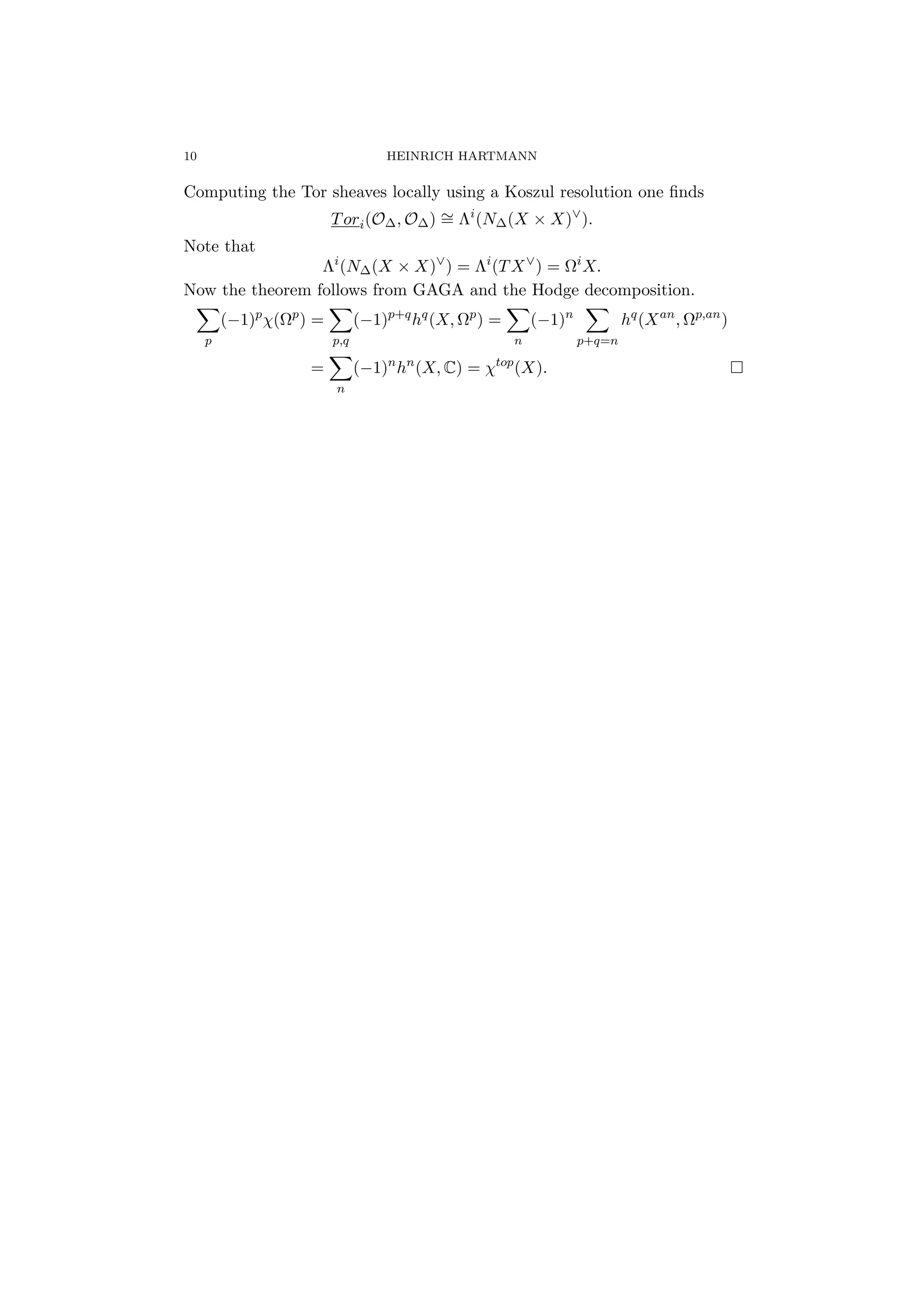
χ(Tori(O∆, O∆)).](https://image.slidesharecdn.com/intersectiontheory-140817145315-phpapp02/75/Notes-on-Intersection-theory-9-2048.jpg)

This document discusses intersection theory in the context of algebraic geometry, specifically by exploring how to count intersection points of subspaces within a manifold. It covers the transition from classical topology to algebraic methods while maintaining topological motivations and introduces concepts such as Chow groups, Chern classes, and Segre classes. The document also includes definitions and propositions essential for understanding these topics and their implications in mathematical theory.


