An elementary introduction to information geometry
Frank Nielsen
Sony Computer Science Laboratories Inc, Japan
@FrnkNlsn
Slides: FrankNielsen.github.com
http://arxiv.org/abs/1808.08271
From Information Theory (IT) to Information Sciences (IS)
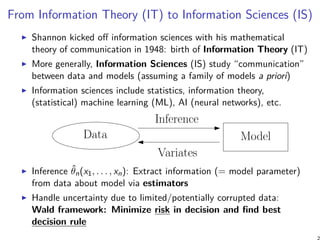
Shannon kicked off information sciences with his mathematical
theory of communication in 1948: birth of Information Theory (IT)
More generally, Information Sciences (IS) study “communication”
between data and models (assuming a family of models a priori)
Information sciences include statistics, information theory,
(statistical) machine learning (ML), AI (neural networks), etc.
Inference
Variates
Data Model
Inference ˆθn(x1, . . . , xn): Extract information (= model parameter)
from data about model via estimators
Handle uncertainty due to limited/potentially corrupted data:
Wald framework: Minimize risk in decision and find best
decision rule
What is information geometry? A broad definition
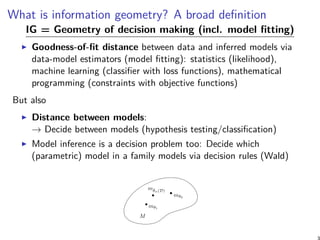
IG = Geometry of decision making (incl. model fitting)
Goodness-of-fit distance between data and inferred models via
data-model estimators (model fitting): statistics (likelihood),
machine learning (classifier with loss functions), mathematical
programming (constraints with objective functions)
But also
Distance between models:
→ Decide between models (hypothesis testing/classification)
Model inference is a decision problem too: Decide which
(parametric) model in a family models via decision rules (Wald)
M
mθ1
mθ2
mˆθn(D)
Outline of this talk
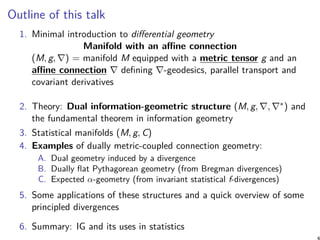
1. Minimal introduction to differential geometry
Manifold with an affine connection
(M, g, ∇) = manifold M equipped with a metric tensor g and an
affine connection ∇ defining ∇-geodesics, parallel transport and
covariant derivatives
2. Theory: Dual information-geometric structure (M, g, ∇, ∇∗) and
the fundamental theorem in information geometry
3. Statistical manifolds (M, g, C)
4. Examples of dually metric-coupled connection geometry:
A. Dual geometry induced by a divergence
B. Dually flat Pythagorean geometry (from Bregman divergences)
C. Expected α-geometry (from invariant statistical f-divergences)
5. Some applications of these structures and a quick overview of some
principled divergences
6. Summary: IG and its uses in statistics
4
1.
Basics of Riemannian
and
non-Riemannian
differential geometry
5
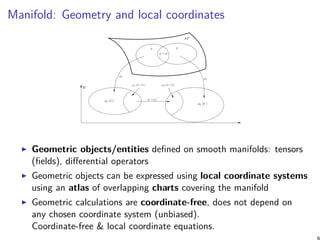
Manifold: Geometry and local coordinates
Geometric objects/entities defined on smooth manifolds: tensors
(fields), differential operators
Geometric objects can be expressed using local coordinate systems
using an atlas of overlapping charts covering the manifold
Geometric calculations are coordinate-free, does not depend on
any chosen coordinate system (unbiased).
Coordinate-free & local coordinate equations.
Two essential geometric concepts on a manifold: g and ∇
Metric tensor (field) g:
allows to measure on tangent planes angles between vectors and
vector magnitudes (“lengths”)
Connection ∇:
a differential operator (hence the ’gradient’ notation ∇) that allows
to
1. calculate the covariant derivative Z = ∇YX :=: ∇(X, Y) of a vector
field X by another vector field Y
2. “parallel transport” vectors between different tangent planes along
smooth curves (path dependent)
3. define ∇-geodesics as autoparallel curves
7
Smooth vector fields X ∈ F(M)
Tangent plane Tp linearly approximates the manifold M at point p
Tangent bundle TM = ∪pTp = {(p, v), p ∈ M, v ∈ Tp}
(More generally, fiber bundles like tensor bundles)
A tangent vector v plays the role of a directional derivative: vf
means derivative of smooth function f ∈ F(M) along the direction v
Technically, a smooth vector field X is defined as a “cross-section”
for the tangent bundle: X ∈ X(M) = Γ(TM)
In local coordinates, X =
∑
i Xiei
Σ
= Xiei using Einstein convention
on dummy indices
(X)B = (Xi) with (X)B the contravariant vector components in
the natural basis B = {ei = ∂i}i with ∂i :=: ∂
∂xi
in chart (U, x).
(Visualize coordinate lines in a chart)
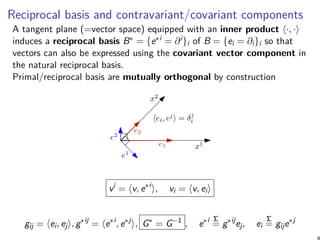
Reciprocal basis and contravariant/covariant components
A tangent plane (=vector space) equipped with an inner product ⟨·, ·⟩
induces a reciprocal basis B∗ = {e∗i
= ∂i}i of B = {ei = ∂i}i so that
vectors can also be expressed using the covariant vector component in
the natural reciprocal basis.
Primal/reciprocal basis are mutually orthogonal by construction
x1
x2
e1
e2
e1
e2
ei, ej
= δj
i
vi
= ⟨v, e∗i
⟩, vi = ⟨v, ei⟩
gij = ⟨ei, ej⟩, g∗ij
= ⟨e∗i
, e∗j
⟩, G∗
= G−1
, e∗i Σ
= g∗ij
ej, ei
Σ
= gije∗j
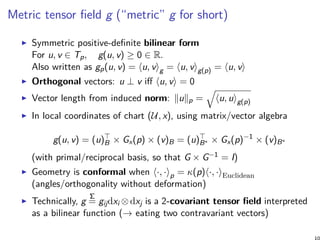
Metric tensor field g (“metric” g for short)
Symmetric positive-definite bilinear form
For u, v ∈ Tp, g(u, v) ≥ 0 ∈ R.
Also written as gp(u, v) = ⟨u, v⟩g = ⟨u, v⟩g(p) = ⟨u, v⟩
Orthogonal vectors: u ⊥ v iff ⟨u, v⟩ = 0
Vector length from induced norm: ∥u∥p =
√
⟨u, u⟩g(p)
In local coordinates of chart (U, x), using matrix/vector algebra
g(u, v) = (u)⊤
B × Gx(p) × (v)B = (u)⊤
B∗ × Gx(p)−1
× (v)B∗
(with primal/reciprocal basis, so that G × G−1 = I)
Geometry is conformal when ⟨·, ·⟩p = κ(p)⟨·, ·⟩Euclidean
(angles/orthogonality without deformation)
Technically, g
Σ
= gijdxi ⊗ dxj is a 2-covariant tensor field interpreted
as a bilinear function (→ eating two contravariant vectors)
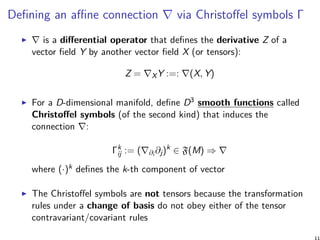
Defining an affine connection ∇ via Christoffel symbols Γ
∇ is a differential operator that defines the derivative Z of a
vector field Y by another vector field X (or tensors):
Z = ∇XY :=: ∇(X, Y)
For a D-dimensional manifold, define D3 smooth functions called
Christoffel symbols (of the second kind) that induces the
connection ∇:
Γk
ij := (∇∂i ∂j)k
∈ F(M) ⇒ ∇
where (·)k defines the k-th component of vector
The Christoffel symbols are not tensors because the transformation
rules under a change of basis do not obey either of the tensor
contravariant/covariant rules
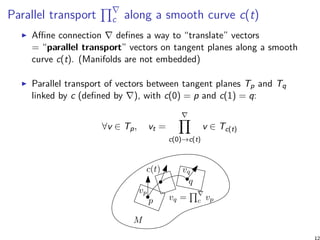
Parallel transport
∏∇
c along a smooth curve c(t)
Affine connection ∇ defines a way to “translate” vectors
= “parallel transport” vectors on tangent planes along a smooth
curve c(t). (Manifolds are not embedded)
Parallel transport of vectors between tangent planes Tp and Tq
linked by c (defined by ∇), with c(0) = p and c(1) = q:
∀v ∈ Tp, vt =
∇∏
c(0)→c(t)
v ∈ Tc(t)
M
p
q
c(t)
vq = c vp
vq
vp
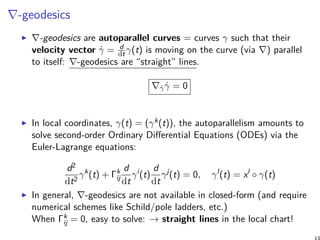
∇-geodesics
∇-geodesics are autoparallel curves = curves γ such that their
velocity vector ˙γ = d
dtγ(t) is moving on the curve (via ∇) parallel
to itself: ∇-geodesics are “straight” lines.
∇˙γ ˙γ = 0
In local coordinates, γ(t) = (γk(t)), the autoparallelism amounts to
solve second-order Ordinary Differential Equations (ODEs) via the
Euler-Lagrange equations:
d2
dt2
γk
(t) + Γk
ij
d
dt
γi
(t)
d
dt
γj
(t) = 0, γl
(t) = xl
◦ γ(t)
In general, ∇-geodesics are not available in closed-form (and require
numerical schemes like Schild/pole ladders, etc.)
When Γk
ij = 0, easy to solve: → straight lines in the local chart!
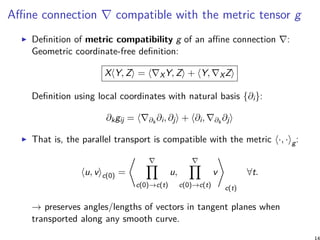
Affine connection ∇ compatible with the metric tensor g
Definition of metric compatibility g of an affine connection ∇:
Geometric coordinate-free definition:
X⟨Y, Z⟩ = ⟨∇XY, Z⟩ + ⟨Y, ∇XZ⟩
Definition using local coordinates with natural basis {∂i}:
∂kgij = ⟨∇∂k
∂i, ∂j⟩ + ⟨∂i, ∇∂k
∂j⟩
That is, the parallel transport is compatible with the metric ⟨·, ·⟩g:
⟨u, v⟩c(0) =
⟨ ∇∏
c(0)→c(t)
u,
∇∏
c(0)→c(t)
v
⟩
c(t)
∀t.
→ preserves angles/lengths of vectors in tangent planes when
transported along any smooth curve.
Fundamental theorem of Riemannian geometry
Theorem (Levi-Civita connection from metric tensor)
There exists a unique torsion-free affine connection compatible with the
metric called the Levi-Civita connection: LC∇
Christoffel symbols of the Levi-Civita connection can be expressed
from the metric tensor
LC
Γk
ij
Σ
=
1
2
gkl
(∂igil + ∂jgil − ∂lgij)
where gij denote the matrix elements of the inverse matrix g−1.
“Geometric” equation defining the Levi-Civita connection is given by
the Koszul formula:
2g(∇XY, Z) = X(g(Y, Z)) + Y(g(X, Z)) − Z(g(X, Y))
+ g([X, Y], Z) − g([X, Z], Y) − g([Y, Z], X).
Curvature tensor R of an affine connection ∇
Riemann-Christoffel 4D curvature tensor R (Ri
jkl):
Geometric equation:
R(X, Y)Z = ∇X∇YX − ∇Y∇XZ − ∇[X,Y]Z
where [X, Y](f) = X(Y(f)) − Y(X(f)) (∀f ∈ F(M)) is the Lie bracket
of vector fields
Manifold is flat = ∇-flat (i.e., R = 0) when there exists a
coordinate system x such that Γk
ij(x) = 0, i.e., all connection
coefficients vanish
Manifold is torsion-free when connection is symmetric: Γk
ij = Γk
ji
Geometric equation:
∇XY − ∇YX = [X, Y]
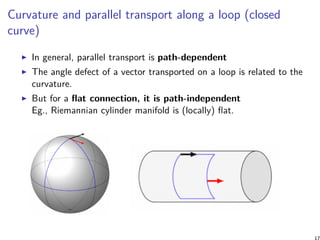
Curvature and parallel transport along a loop (closed
curve)
In general, parallel transport is path-dependent
The angle defect of a vector transported on a loop is related to the
curvature.
But for a flat connection, it is path-independent
Eg., Riemannian cylinder manifold is (locally) flat.
2.
Information-geometric
structure:
Dual connections compatible
with the metric
and
dual parallel transport
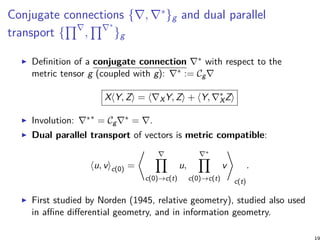
Conjugate connections {∇, ∇∗
}g and dual parallel
transport {
∏∇
,
∏∇∗
}g
Definition of a conjugate connection ∇∗ with respect to the
metric tensor g (coupled with g): ∇∗ := Cg∇
X⟨Y, Z⟩ = ⟨∇XY, Z⟩ + ⟨Y, ∇∗
XZ⟩
Involution: ∇∗∗
= Cg∇∗ = ∇.
Dual parallel transport of vectors is metric compatible:
⟨u, v⟩c(0) =
⟨ ∇∏
c(0)→c(t)
u,
∇∗
∏
c(0)→c(t)
v
⟩
c(t)
.
First studied by Norden (1945, relative geometry), studied also used
in affine differential geometry, and in information geometry.
A 1D family of dualistic structures of information geometry
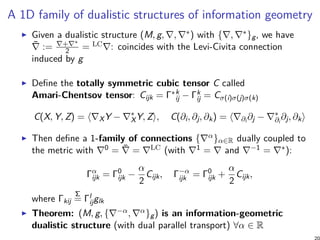
Given a dualistic structure (M, g, ∇, ∇∗) with {∇, ∇∗}g, we have
¯∇ := ∇+∇∗
2 = LC∇: coincides with the Levi-Civita connection
induced by g
Define the totally symmetric cubic tensor C called
Amari-Chentsov tensor: Cijk = Γ∗k
ij − Γk
ij = Cσ(i)σ(j)σ(k)
C(X, Y, Z) = ⟨∇XY − ∇∗
XY, Z⟩, C(∂i, ∂j, ∂k) = ⟨∇∂i ∂j − ∇∗
∂i
∂j, ∂k⟩
Then define a 1-family of connections {∇α}α∈R dually coupled to
the metric with ∇0 = ¯∇ = ∇LC (with ∇1 = ∇ and ∇−1 = ∇∗):
Γα
ijk = Γ0
ijk −
α
2
Cijk, Γ−α
ijk = Γ0
ijk +
α
2
Cijk,
where Γkij
Σ
= Γl
ijglk
Theorem: (M, g, {∇−α, ∇α}g) is an information-geometric
dualistic structure (with dual parallel transport) ∀α ∈ R
The fundamental theorem of information geometry
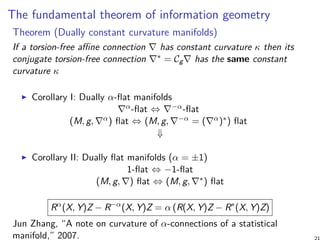
Theorem (Dually constant curvature manifolds)
If a torsion-free affine connection ∇ has constant curvature κ then its
conjugate torsion-free connection ∇∗ = Cg∇ has the same constant
curvature κ
Corollary I: Dually α-flat manifolds
∇α-flat ⇔ ∇−α-flat
(M, g, ∇α) flat ⇔ (M, g, ∇−α = (∇α)∗) flat
⇓
Corollary II: Dually flat manifolds (α = ±1)
1-flat ⇔ −1-flat
(M, g, ∇) flat ⇔ (M, g, ∇∗) flat
Rα
(X, Y)Z − R−α
(X, Y)Z = α (R(X, Y)Z − R∗
(X, Y)Z)
Jun Zhang, “A note on curvature of α-connections of a statistical
manifold,” 2007.
Panorama of information-geometric structures
Riemannian Manifolds
(M, g) = (M, g, LC
)
Smooth Manifolds
Conjugate Connection Manifolds
(M, g, , ∗
)
(M, g, C = Γ∗
− Γ)
Distance = Non-metric divergence Distance = Metric geodesic length
g = Fisher
g
Fisher
gij = E[∂il∂jl]
Spherical Manifold Hyperbolic Manifold
Self-dual Manifold
Dually flat Manifolds
(M, F, F∗
)
(Hessian Manifolds)
Dual Legendre potentials
Bregman Pythagorean theorem
Divergence Manifold
(M, Dg
, D
, D ∗
= D∗
)
D
− flat ⇔ D ∗
− flat
f-divergences Bregman divergence
Expected Manifold
(M, Fisher
g, −α
, α
)
α-geometry
Multinomial
family
LC
= + ∗
2
Euclidean Manifold
Location-scale
family
Location
family
Parametric
families
Fisher-Riemannian
Manifold
KL∗ on exponential families
KL on mixture families
Conformal divergences on deformed families
Etc.
Frank Nielsen
Cubic skewness tensor
Cijk = E[∂il∂jl∂kl]
αC = αFisher
g
α = 1+α
2
+ 1−α
2
∗
Γ±α = ¯Γ α
2
C(M, g, −α
, α
)
(M, g, αC)
canonical
divergence
I[pθ : p
θ
] = D(θ : θ )
Divergence D induces structure (M, Dg, D∇α, D∇−α) ≡ (M, Dg, DαC)
Convex potential F induces structure (M, Fg, F∇α, F∇−α) ≡ (M, Fg, FαC)
(via Bregman divergence BF)
Dually flat manifold
=
Bregman dual Pythagorean
geometry
Dually flat manifold
Consider a strictly convex smooth function F, called a potential
function
Associate its Bregman divergence (parameter divergence):
BF(θ : θ′
) := F(θ) − F(θ′
) − (θ − θ′
)⊤
∇F(θ′
)
The induced information-geometric structure is
(M, Fg, FC) := (M, BF g, BF C) with:
F
g := BF
g = −
[
∂i∂jBF(θ : θ′
)|θ′=θ
]
= ∇2
F(θ)
F
Γ := BF
Γijk(θ) = 0
F
Cijk := BF
Cijk = ∂i∂j∂kF(θ)
The manifold is F∇-flat
Levi-Civita connection LC∇ is obtained from the metric tensor Fg
(usually not flat), and we get the conjugate connection
(F∇)∗ = F∇−1 from (M, Fg, FC)
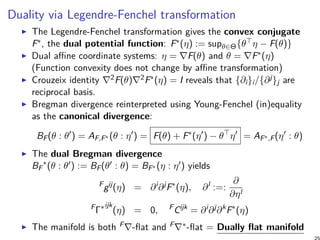
Duality via Legendre-Fenchel transformation
The Legendre-Fenchel transformation gives the convex conjugate
F∗, the dual potential function: F∗(η) := supθ∈Θ{θ⊤η − F(θ)}
Dual affine coordinate systems: η = ∇F(θ) and θ = ∇F∗(η)
(Function convexity does not change by affine transformation)
Crouzeix identity ∇2F(θ)∇2F∗(η) = I reveals that {∂i}i/{∂j}j are
reciprocal basis.
Bregman divergence reinterpreted using Young-Fenchel (in)equality
as the canonical divergence:
BF(θ : θ′
) = AF,F∗ (θ : η′
) = F(θ) + F∗
(η′
) − θ⊤
η′
= AF∗,F(η′
: θ)
The dual Bregman divergence
BF
∗
(θ : θ′) := BF(θ′ : θ) = BF∗ (η : η′) yields
F
gij
(η) = ∂i
∂j
F∗
(η), ∂l
:=:
∂
∂ηl
F
Γ∗ijk
(η) = 0, F
Cijk
= ∂i
∂j
∂k
F∗
(η)
The manifold is both F∇-flat and F∇∗-flat = Dually flat manifold
Dual Pythagorean theorems
Any pair of points can either be linked using the ∇-geodesic (θ-straight
[PQ]) or the ∇∗-geodesic (η-straight [PQ]∗).
→ There are 23 = 8 geodesic triangles.
P
Q
R
P
Q
R
D(P : R) = D(P : Q) + D(Q : R)
BF (θ(P) : θ(R)) = BF (θ(P) : θ(Q)) + BF (θ(Q) : θ(R))
D∗
(P : R) = D∗
(P : Q) + D∗
(Q : R)
BF ∗ (η(P) : η(R)) = BF ∗ (η(P) : η(Q)) + BF ∗ (η(Q) : η(R))
γ∗
(P, Q) ⊥F γ(Q, R)
γ(P, Q) ⊥F γ∗
(Q, R)
γ∗
(P, Q) ⊥F γ(Q, R) ⇔ (η(P) − η(Q))⊤
θ(Q) − θ(R) = 0
γ(P, Q) ⊥F γ∗
(Q, R) ⇔ (θ(P) − θ(Q))⊤
η(Q) − η(R) = 0
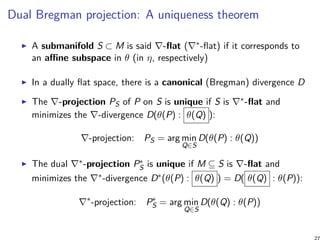
Dual Bregman projection: A uniqueness theorem
A submanifold S ⊂ M is said ∇-flat (∇∗-flat) if it corresponds to
an affine subspace in θ (in η, respectively)
In a dually flat space, there is a canonical (Bregman) divergence D
The ∇-projection PS of P on S is unique if S is ∇∗-flat and
minimizes the ∇-divergence D(θ(P) : θ(Q) ):
∇-projection: PS = arg min
Q∈S
D(θ(P) : θ(Q))
The dual ∇∗-projection P∗
S is unique if M ⊆ S is ∇-flat and
minimizes the ∇∗-divergence D∗(θ(P) : θ(Q) ) = D( θ(Q) : θ(P)):
∇∗
-projection: P∗
S = arg min
Q∈S
D(θ(Q) : θ(P))
Expected α-Geometry
from
Fisher information metric
and
skewness cubic tensor
of
a parametric family of
distributions
Fisher Information Matrix (FIM), positive semi-definite
Parametric family of probability distributions P := {pθ(x)}θ for
θ ∈ Θ
Likelihood function L(θ; x) and log-likelihood function
l(θ; x) := log L(θ; x)
Score vector sθ = ∇θl = (∂il)i indicates the sensitivity of the
likelihood ∂il :=: ∂
∂θi
l(θ; x)
Fisher information matrix (FIM) of D × D for dim(Θ) = D:
PI(θ) := Eθ [∂il∂jl]ij ≽ 0
Cramér-Rao lower bound1 on the variance of any unbiased estimator
Vθ[ˆθn(X)] ≽
1
n
PI−1
(θ)
FIM invariant by reparameterization of the sample space X, and
covariant by reparameterization of the parameter space Θ.
1F. Nielsen. “Cramér-Rao lower bound and information geometry”. In: Connected at
Infinity II. Springer, 2013.
Some examples of Fisher information matrices
FIM of an exponential family: Include Gaussian, Beta, ∆D, etc.
E =
{
pθ(x) = exp
( D∑
i=1
ti(x)θi − F(θ) + k(x)
)
such that θ ∈ Θ
}
F is the strictly convex cumulant function
EI(θ) = Covθ[t(X)] = ∇2
F(θ) = ∇2
F∗
(η)−1
≻ 0
FIM of a mixture family: Include statistical mixtures, ∆D
M =
{
pθ(x) =
D∑
i=1
θiFi(x) + C(x) such that θ ∈ Θ
}
with {Fi(x)}i linearly independent on X,
∫
Fi(x)dµ(x) = 0 and∫
C(x)dµ(x) = 1
MI(θ) = Eθ
[
Fi(x)Fj(x)
p2
θ(x)
]
=
∫
X
Fi(x)Fj(x)
pθ(x)
dµ(x) ≻ 0
Expected α-geometry from expected dual α-connections
Fisher “information metric” tensor from FIM (regular models)
Pg(u, v) := (u)⊤
θ PIθ(θ)(v)θ ≻ 0
Exponential connection and mixture connection:
P∇e
:= Eθ [(∂i∂jl)(∂kl)] , P∇m
:= Eθ [(∂i∂jl + ∂il∂jl)(∂kl)]
Dualistic structure (P, Pg, m
P ∇, e
P∇) with cubic skewness tensor:
Cijk = Eθ [∂il∂jl∂kl]
It follows a one-family of α-CCMs: {(P, Pg, P∇−α, P∇+α)}α with
PΓαk
ij := −
1 + α
2
Cijk = Eθ
[(
∂i∂jl +
1 − α
2
∂il∂jl
)
(∂kl)
]
P∇−α + P∇α
2
= LC
P ∇ := LC
∇(Pg)
In case of an exponential family E or a mixture family M, we get
Dually Flat Manifolds (Bregman geometry/ std f-divergence)
e
MΓ = m
MΓ = e
EΓ = m
E Γ = 0
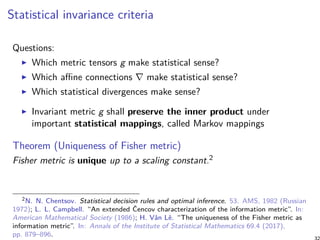
Statistical invariance criteria
Questions:
Which metric tensors g make statistical sense?
Which affine connections ∇ make statistical sense?
Which statistical divergences make sense?
Invariant metric g shall preserve the inner product under
important statistical mappings, called Markov mappings
Theorem (Uniqueness of Fisher metric)
Fisher metric is unique up to a scaling constant.2
2N. N. Chentsov. Statistical decision rules and optimal inference. 53. AMS, 1982 (Russian
1972); L. L. Campbell. “An extended Čencov characterization of the information metric”. In:
American Mathematical Society (1986); H. Vân Lê. “The uniqueness of the Fisher metric as
information metric”. In: Annals of the Institute of Statistical Mathematics 69.4 (2017),
pp. 879–896.
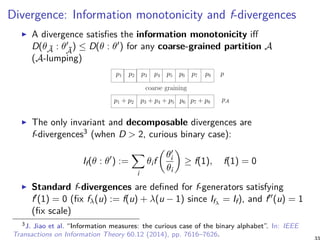
Divergence: Information monotonicity and f-divergences
A divergence satisfies the information monotonicity iff
D(θ ¯A : θ′
¯A
) ≤ D(θ : θ′) for any coarse-grained partition A
(A-lumping)
p1 + p2 p3 + p4 + p5 p6 p7 + p8
p
pA
p1 p2 p3 p4 p5 p6 p7 p8
coarse graining
The only invariant and decomposable divergences are
f-divergences3 (when D > 2, curious binary case):
If(θ : θ′
) :=
∑
i
θif
(
θ′
i
θi
)
≥ f(1), f(1) = 0
Standard f-divergences are defined for f-generators satisfying
f′(1) = 0 (fix fλ(u) := f(u) + λ(u − 1) since Ifλ
= If), and f′′(u) = 1
(fix scale)
3J. Jiao et al. “Information measures: the curious case of the binary alphabet”. In: IEEE
Transactions on Information Theory 60.12 (2014), pp. 7616–7626.
Properties of Csiszár-Ali-Silvey f-divergences
Statistical f-divergences are invariant4 under one-to-one/sufficient
statistic transformations y = t(x) of the sample space:
p(x; θ) = q(y(x); θ).
If[p(x; θ) : p(x; θ′
)] =
∫
X
p(x; θ)f
(
p(x; θ′)
p(x; θ)
)
dµ(x)
=
∫
Y
q(y; θ)f
(
q(y; θ′)
q(y; θ)
)
dµ(y)
= If[q(y; θ) : q(y; θ′
)]
Dual f-divergences for reference duality:
If
∗
[p(x; θ) : p(x; θ′
)] = If[p(x; θ′
) : p(x; θ)] = If⋄ [p(x; θ) : p(x; θ′
)]
for the standard conjugate f-generator (diamond f⋄ generator):
f⋄
(u) := uf
(
1
u
)
4Y. Qiao and N. Minematsu. “A Study on Invariance of f-Divergence and Its Application to
Speech Recognition”. In: IEEE Transactions on Signal Processing 58.7 (2010), pp. 3884–3890.
Some common examples of f-divergences
The family of α-divergences:
Iα[p : q] :=
4
1 − α2
(
1 −
∫
p
1−α
2 (x)q1+α
(x)dµ(x)
)
obtained for f(u) = 4
1−α2 (1 − u
1+α
2 ), and include
Kullback-Leibler KL[p : q] =
∫
p(x) log p(x)
q(x) dµ(x) for f(u) = − log u
(α = 1)
reverse Kullback-Leibler KL∗
[p : q] =
∫
q(x) log q(x)
p(x) dµ(x) for
f(u) = u log u (α = −1)
squared Hellinger divergence H2
[p : q] =
∫
(
√
p(x) −
√
q(x))2
dµ(x)
for f(u) = (
√
u − 1)2
(α = 0)
Pearson and Neyman chi-squared divergences
Jensen-Shannon divergence (bounded):
1
2
∫ (
p(x) log
2p(x)
p(x) + q(x)
+ q(x) log
2q(x)
p(x) + q(x)
)
dµ(x)
for f(u) = −(u + 1) log 1+u
2 + u log u
Total Variation (metric) 1
2
∫
|p(x) − q(x)|dµ(x) for f(u) = 1
2|u − 1|
Invariant f-divergences yields Fisher metric/α-connections
Invariant (separable) standard f-divergences related infinitesimally to
the Fisher metric:
If[p(x; θ) : p(x; θ + dθ)] =
∫
p(x; θ)f
(
p(x; θ + dθ)
p(x; θ)
)
dµ(x)
Σ
=
1
2
Fgij(θ)dθi
dθj
A statistical parameter divergence on a parametric family of
distributions yield an equivalent parameter divergence:
PD(θ : θ′
) := DP[p(x; θ) : p(x; θ′
)]
Thus we can build the information-geometric structure induced by
this parameter divergence PD(· : ·)
For PD(· : ·) = If[· : ·], the induced ±1-divergence connections
If
P∇ := P If ∇ and
(If)∗
P ∇ := P I∗
f ∇ are the expected ±α-connections
with α = 2f′′′(1) + 3. +1/ − 1-connection =e/m-connection
4.
Some applications of the
information-geometric
manifolds
(M, g, ∇, ∇∗) ≡ (M, g, C)
(M, g, ∇−α, ∇α) ≡ (M, g, αC)
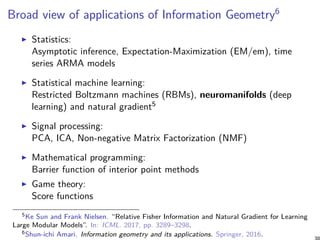
Broad view of applications of Information Geometry6
Statistics:
Asymptotic inference, Expectation-Maximization (EM/em), time
series ARMA models
Statistical machine learning:
Restricted Boltzmann machines (RBMs), neuromanifolds (deep
learning) and natural gradient5
Signal processing:
PCA, ICA, Non-negative Matrix Factorization (NMF)
Mathematical programming:
Barrier function of interior point methods
Game theory:
Score functions
5Ke Sun and Frank Nielsen. “Relative Fisher Information and Natural Gradient for Learning
Large Modular Models”. In: ICML. 2017, pp. 3289–3298.
6Shun-ichi Amari. Information geometry and its applications. Springer, 2016.
Hypothesis testing in the
dually flat exponential family
manifold
Bayesian Hypothesis Testing/Binary classification7
Given two distributions P0 and P1, classify observations X1:n (= decision
problem) as either iid sampled from P0 or from P1? For example, P0 =
signal, P1 = noise (assume same prior w1 = w2 = 1
2)
x1 x2
p0(x) p1(x)
x
Assume P0 ∼ Pθ0
, P1 ∼ Pθ1
∈ E belong to an exponential family
manifold E = {Pθ} with dually flat structure (E, Eg, E∇e, E∇m).
This structure can also be derived from a divergence manifold
structure (E, KL∗
).
Therefore KL[Pθ : Pθ′ ] amounts to a Bregman divergence (for the
cumulant function of the exponential family):
KL[Pθ : Pθ′ ] = BF(θ′
: θ)
Hypothesis Testing (HT)/Binary classification10
The best exponent error8 α∗ of the best Maximum A Priori (MAP)
decision rule is found by minimizing the Bhattacharyya distance to get
the Chernoff information:
C[P1, P2] = − log min
α∈(0,1)
∫
x∈X
pα
1 (x)p1−α
2 (x)dµ(x) ≥ 0,
On E, the Bhattacharyya distance amounts to a skew Jensen
parameter divergence9:
J
(α)
F (θ1 : θ2) = αF(θ1) + (1 − α)F(θ2) − F(θ1 + (1 − α)θ2),
Theorem: Chernoff information = Bregman divergence for exponential
families at the optimal exponent value:
C[Pθ1
: Pθ2
] = B(θ1 : θ
(α∗)
12 ) = B(θ2 : θ
(α∗)
12 )
8G.-T. Pham, R. Boyer, and F. Nielsen. “Computational Information Geometry for Binary
Classification of High-Dimensional Random Tensors”. In: Entropy 20.3 (2018), p. 203.
9F. Nielsen and S. Boltz. “The Burbea-Rao and Bhattacharyya centroids”. In: IEEE
Transactions on Information Theory 57.8 (2011).
10Nielsen, “An Information-Geometric Characterization of Chernoff Information”.
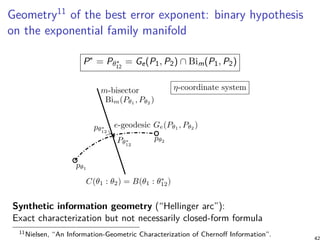
Geometry11
of the best error exponent: binary hypothesis
on the exponential family manifold
P∗
= Pθ∗
12
= Ge(P1, P2) ∩ Bim(P1, P2)
pθ1
pθ2
pθ∗
12
m-bisector
e-geodesic Ge(Pθ1
, Pθ2
)
η-coordinate system
Pθ∗
12
C(θ1 : θ2) = B(θ1 : θ∗
12)
Bim(Pθ1
, Pθ2
)
Synthetic information geometry (“Hellinger arc”):
Exact characterization but not necessarily closed-form formula
11Nielsen, “An Information-Geometric Characterization of Chernoff Information”.
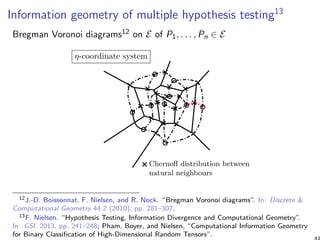
Information geometry of multiple hypothesis testing13
Bregman Voronoi diagrams12 on E of P1, . . . , Pn ∈ E
η-coordinate system
Chernoff distribution between
natural neighbours
12J.-D. Boissonnat, F. Nielsen, and R. Nock. “Bregman Voronoi diagrams”. In: Discrete &
Computational Geometry 44.2 (2010), pp. 281–307.
13F. Nielsen. “Hypothesis Testing, Information Divergence and Computational Geometry”.
In: GSI. 2013, pp. 241–248; Pham, Boyer, and Nielsen, “Computational Information Geometry
for Binary Classification of High-Dimensional Random Tensors”.
Clustering statistical
w-mixtures on the dually flat
mixture family manifold M
44
Dually flat mixture family manifold14
Consider D + 1 prescribed component distributions {p0, . . . , pD} and
form the mixture manifold M by considering all their convex weighted
combinations M = {mθ(x) =
∑D
i=0 wipi(x)}
0
0.05
0.1
0.15
0.2
0.25
0.3
0.35
0.4
0.45
0.5
-4 -2 0 2 4 6 8
M1
M2
Gaussian(-2,1)
Cauchy(2,1)
Laplace(0,1)
Information-geometric structure: (M, Mg, M∇−1, M∇1) is dually flat
and equivalent to (Mθ, KL). That is, the KL between two mixtures with
prescribed components is equivalent to a Bregman divergence.
KL[mθ : mθ′ ] = BF(θ : θ′
), F(θ) = −h(mθ) =
∫
mθ(x) log mθ(x)dµ(x)
14F. Nielsen and R. Nock. “On the geometric of mixtures of prescribed distributions”. In:
IEEE ICASSP. 2018. 45
Clustering on the dually flat w-mixture family manifold
Apply Bregman k-means15 on Monte Carlo dually flat spaces16 of
w-GMMs (Gaussian Mixture Models)
0
0.05
0.1
0.15
0.2
0.25
-4 -2 0 2 4
Because F = −h(m(x; θ)) is the negative differential entropy of a
mixture (not available in closed form17), we approximate F by
Monte-Carlo convex ˜FX and get a sequence of tractable dually flat
manifolds converging to the ideal mixture manifold
15F. Nielsen and R. Nock. “Sided and symmetrized Bregman centroids”. In: IEEE
transactions on Information Theory 55.6 (2009).
16F. Nielsen and G. Hadjeres. “Monte Carlo Information Geometry: The dually flat case”.
In: CoRR abs/1803.07225 (2018).
17F. Nielsen and K. Sun. “Guaranteed Bounds on Information-Theoretic Measures of
Univariate Mixtures Using Piecewise Log-Sum-Exp Inequalities”. In: Entropy 18.12 (2016),
p. 442.
Divergences and geometry:
Not one-to-one in general
47
If (P : Q) = p(x)f (q(x)
p(x) dν(x)
BF (P : Q) = F(P) − F(Q) − P − Q, F(Q)
tBF (P : Q) = BF (P :Q)
√
1+ F (Q) 2
CD,g(P : Q) = g(Q)D(P : Q)
BF,g(P : Q; W) = WBF
P
Q : Q
W
Dv
(P : Q) = D(v(P) : v(Q))
v-Divergence Dv
total Bregman divergence tB(· : ·) Bregman divergence BF (· : ·)
conformal divergence CD,g(· : ·)
Csisz´ar f-divergence If (· : ·)
scaled Bregman divergence BF (· : ·; ·)
scaled conformal divergence CD,g(· : ·; ·)
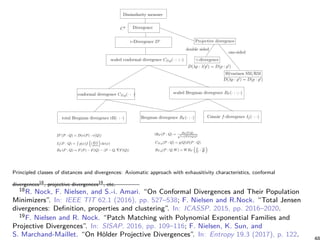
Dissimilarity measure
Divergence
Projective divergence
γ-divergence
H¨yvarinen SM/RM
D(λp : λ p ) = D(p : p )
D(λp : p ) = D(p : p )
one-sided
double sided
C3
Principled classes of distances and divergences: Axiomatic approach with exhausitivity characteristics, conformal
divergences18
, projective divergences19
, etc.
18R. Nock, F. Nielsen, and S.-i. Amari. “On Conformal Divergences and Their Population
Minimizers”. In: IEEE TIT 62.1 (2016), pp. 527–538; F. Nielsen and R.Nock. “Total Jensen
divergences: Definition, properties and clustering”. In: ICASSP. 2015, pp. 2016–2020.
19F. Nielsen and R. Nock. “Patch Matching with Polynomial Exponential Families and
Projective Divergences”. In: SISAP. 2016, pp. 109–116; F. Nielsen, K. Sun, and
S. Marchand-Maillet. “On Hölder Projective Divergences”. In: Entropy 19.3 (2017), p. 122.
Summary I: Information-geometric structures
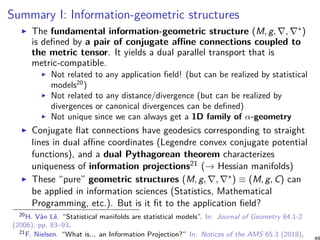
The fundamental information-geometric structure (M, g, ∇, ∇∗)
is defined by a pair of conjugate affine connections coupled to
the metric tensor. It yields a dual parallel transport that is
metric-compatible.
Not related to any application field! (but can be realized by statistical
models20
)
Not related to any distance/divergence (but can be realized by
divergences or canonical divergences can be defined)
Not unique since we can always get a 1D family of α-geometry
Conjugate flat connections have geodesics corresponding to straight
lines in dual affine coordinates (Legendre convex conjugate potential
functions), and a dual Pythagorean theorem characterizes
uniqueness of information projections21 (→ Hessian manifolds)
These “pure” geometric structures (M, g, ∇, ∇∗) ≡ (M, g, C) can
be applied in information sciences (Statistics, Mathematical
Programming, etc.). But is it fit to the application field?
20H. Vân Lê. “Statistical manifolds are statistical models”. In: Journal of Geometry 84.1-2
(2006), pp. 83–93.
21F. Nielsen. “What is... an Information Projection?” In: Notices of the AMS 65.3 (2018).
Summary II: Applications of the structures in Statistics
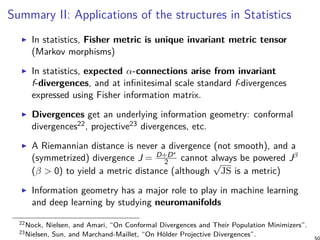
In statistics, Fisher metric is unique invariant metric tensor
(Markov morphisms)
In statistics, expected α-connections arise from invariant
f-divergences, and at infinitesimal scale standard f-divergences
expressed using Fisher information matrix.
Divergences get an underlying information geometry: conformal
divergences22, projective23 divergences, etc.
A Riemannian distance is never a divergence (not smooth), and a
(symmetrized) divergence J = D+D∗
2 cannot always be powered Jβ
(β > 0) to yield a metric distance (although
√
JS is a metric)
Information geometry has a major role to play in machine learning
and deep learning by studying neuromanifolds
22Nock, Nielsen, and Amari, “On Conformal Divergences and Their Population Minimizers”.
23Nielsen, Sun, and Marchand-Maillet, “On Hölder Projective Divergences”.

An elementary introduction to information geometry

  • 1.
    An elementary introductionto information geometry Frank Nielsen Sony Computer Science Laboratories Inc, Japan @FrnkNlsn Slides: FrankNielsen.github.com http://arxiv.org/abs/1808.08271
  • 2.
    From Information Theory(IT) to Information Sciences (IS) Shannon kicked off information sciences with his mathematical theory of communication in 1948: birth of Information Theory (IT) More generally, Information Sciences (IS) study “communication” between data and models (assuming a family of models a priori) Information sciences include statistics, information theory, (statistical) machine learning (ML), AI (neural networks), etc. Inference Variates Data Model Inference ˆθn(x1, . . . , xn): Extract information (= model parameter) from data about model via estimators Handle uncertainty due to limited/potentially corrupted data: Wald framework: Minimize risk in decision and find best decision rule
  • 3.
    What is informationgeometry? A broad definition IG = Geometry of decision making (incl. model fitting) Goodness-of-fit distance between data and inferred models via data-model estimators (model fitting): statistics (likelihood), machine learning (classifier with loss functions), mathematical programming (constraints with objective functions) But also Distance between models: → Decide between models (hypothesis testing/classification) Model inference is a decision problem too: Decide which (parametric) model in a family models via decision rules (Wald) M mθ1 mθ2 mˆθn(D)
  • 4.
    Outline of thistalk 1. Minimal introduction to differential geometry Manifold with an affine connection (M, g, ∇) = manifold M equipped with a metric tensor g and an affine connection ∇ defining ∇-geodesics, parallel transport and covariant derivatives 2. Theory: Dual information-geometric structure (M, g, ∇, ∇∗) and the fundamental theorem in information geometry 3. Statistical manifolds (M, g, C) 4. Examples of dually metric-coupled connection geometry: A. Dual geometry induced by a divergence B. Dually flat Pythagorean geometry (from Bregman divergences) C. Expected α-geometry (from invariant statistical f-divergences) 5. Some applications of these structures and a quick overview of some principled divergences 6. Summary: IG and its uses in statistics 4
  • 5.
  • 6.
    Manifold: Geometry andlocal coordinates Geometric objects/entities defined on smooth manifolds: tensors (fields), differential operators Geometric objects can be expressed using local coordinate systems using an atlas of overlapping charts covering the manifold Geometric calculations are coordinate-free, does not depend on any chosen coordinate system (unbiased). Coordinate-free & local coordinate equations.
  • 7.
    Two essential geometricconcepts on a manifold: g and ∇ Metric tensor (field) g: allows to measure on tangent planes angles between vectors and vector magnitudes (“lengths”) Connection ∇: a differential operator (hence the ’gradient’ notation ∇) that allows to 1. calculate the covariant derivative Z = ∇YX :=: ∇(X, Y) of a vector field X by another vector field Y 2. “parallel transport” vectors between different tangent planes along smooth curves (path dependent) 3. define ∇-geodesics as autoparallel curves 7
  • 8.
    Smooth vector fieldsX ∈ F(M) Tangent plane Tp linearly approximates the manifold M at point p Tangent bundle TM = ∪pTp = {(p, v), p ∈ M, v ∈ Tp} (More generally, fiber bundles like tensor bundles) A tangent vector v plays the role of a directional derivative: vf means derivative of smooth function f ∈ F(M) along the direction v Technically, a smooth vector field X is defined as a “cross-section” for the tangent bundle: X ∈ X(M) = Γ(TM) In local coordinates, X = ∑ i Xiei Σ = Xiei using Einstein convention on dummy indices (X)B = (Xi) with (X)B the contravariant vector components in the natural basis B = {ei = ∂i}i with ∂i :=: ∂ ∂xi in chart (U, x). (Visualize coordinate lines in a chart)
  • 9.
    Reciprocal basis andcontravariant/covariant components A tangent plane (=vector space) equipped with an inner product ⟨·, ·⟩ induces a reciprocal basis B∗ = {e∗i = ∂i}i of B = {ei = ∂i}i so that vectors can also be expressed using the covariant vector component in the natural reciprocal basis. Primal/reciprocal basis are mutually orthogonal by construction x1 x2 e1 e2 e1 e2 ei, ej = δj i vi = ⟨v, e∗i ⟩, vi = ⟨v, ei⟩ gij = ⟨ei, ej⟩, g∗ij = ⟨e∗i , e∗j ⟩, G∗ = G−1 , e∗i Σ = g∗ij ej, ei Σ = gije∗j
  • 10.
    Metric tensor fieldg (“metric” g for short) Symmetric positive-definite bilinear form For u, v ∈ Tp, g(u, v) ≥ 0 ∈ R. Also written as gp(u, v) = ⟨u, v⟩g = ⟨u, v⟩g(p) = ⟨u, v⟩ Orthogonal vectors: u ⊥ v iff ⟨u, v⟩ = 0 Vector length from induced norm: ∥u∥p = √ ⟨u, u⟩g(p) In local coordinates of chart (U, x), using matrix/vector algebra g(u, v) = (u)⊤ B × Gx(p) × (v)B = (u)⊤ B∗ × Gx(p)−1 × (v)B∗ (with primal/reciprocal basis, so that G × G−1 = I) Geometry is conformal when ⟨·, ·⟩p = κ(p)⟨·, ·⟩Euclidean (angles/orthogonality without deformation) Technically, g Σ = gijdxi ⊗ dxj is a 2-covariant tensor field interpreted as a bilinear function (→ eating two contravariant vectors)
  • 11.
    Defining an affineconnection ∇ via Christoffel symbols Γ ∇ is a differential operator that defines the derivative Z of a vector field Y by another vector field X (or tensors): Z = ∇XY :=: ∇(X, Y) For a D-dimensional manifold, define D3 smooth functions called Christoffel symbols (of the second kind) that induces the connection ∇: Γk ij := (∇∂i ∂j)k ∈ F(M) ⇒ ∇ where (·)k defines the k-th component of vector The Christoffel symbols are not tensors because the transformation rules under a change of basis do not obey either of the tensor contravariant/covariant rules
  • 12.
    Parallel transport ∏∇ c alonga smooth curve c(t) Affine connection ∇ defines a way to “translate” vectors = “parallel transport” vectors on tangent planes along a smooth curve c(t). (Manifolds are not embedded) Parallel transport of vectors between tangent planes Tp and Tq linked by c (defined by ∇), with c(0) = p and c(1) = q: ∀v ∈ Tp, vt = ∇∏ c(0)→c(t) v ∈ Tc(t) M p q c(t) vq = c vp vq vp
  • 13.
    ∇-geodesics ∇-geodesics are autoparallelcurves = curves γ such that their velocity vector ˙γ = d dtγ(t) is moving on the curve (via ∇) parallel to itself: ∇-geodesics are “straight” lines. ∇˙γ ˙γ = 0 In local coordinates, γ(t) = (γk(t)), the autoparallelism amounts to solve second-order Ordinary Differential Equations (ODEs) via the Euler-Lagrange equations: d2 dt2 γk (t) + Γk ij d dt γi (t) d dt γj (t) = 0, γl (t) = xl ◦ γ(t) In general, ∇-geodesics are not available in closed-form (and require numerical schemes like Schild/pole ladders, etc.) When Γk ij = 0, easy to solve: → straight lines in the local chart!
  • 14.
    Affine connection ∇compatible with the metric tensor g Definition of metric compatibility g of an affine connection ∇: Geometric coordinate-free definition: X⟨Y, Z⟩ = ⟨∇XY, Z⟩ + ⟨Y, ∇XZ⟩ Definition using local coordinates with natural basis {∂i}: ∂kgij = ⟨∇∂k ∂i, ∂j⟩ + ⟨∂i, ∇∂k ∂j⟩ That is, the parallel transport is compatible with the metric ⟨·, ·⟩g: ⟨u, v⟩c(0) = ⟨ ∇∏ c(0)→c(t) u, ∇∏ c(0)→c(t) v ⟩ c(t) ∀t. → preserves angles/lengths of vectors in tangent planes when transported along any smooth curve.
  • 15.
    Fundamental theorem ofRiemannian geometry Theorem (Levi-Civita connection from metric tensor) There exists a unique torsion-free affine connection compatible with the metric called the Levi-Civita connection: LC∇ Christoffel symbols of the Levi-Civita connection can be expressed from the metric tensor LC Γk ij Σ = 1 2 gkl (∂igil + ∂jgil − ∂lgij) where gij denote the matrix elements of the inverse matrix g−1. “Geometric” equation defining the Levi-Civita connection is given by the Koszul formula: 2g(∇XY, Z) = X(g(Y, Z)) + Y(g(X, Z)) − Z(g(X, Y)) + g([X, Y], Z) − g([X, Z], Y) − g([Y, Z], X).
  • 16.
    Curvature tensor Rof an affine connection ∇ Riemann-Christoffel 4D curvature tensor R (Ri jkl): Geometric equation: R(X, Y)Z = ∇X∇YX − ∇Y∇XZ − ∇[X,Y]Z where [X, Y](f) = X(Y(f)) − Y(X(f)) (∀f ∈ F(M)) is the Lie bracket of vector fields Manifold is flat = ∇-flat (i.e., R = 0) when there exists a coordinate system x such that Γk ij(x) = 0, i.e., all connection coefficients vanish Manifold is torsion-free when connection is symmetric: Γk ij = Γk ji Geometric equation: ∇XY − ∇YX = [X, Y]
  • 17.
    Curvature and paralleltransport along a loop (closed curve) In general, parallel transport is path-dependent The angle defect of a vector transported on a loop is related to the curvature. But for a flat connection, it is path-independent Eg., Riemannian cylinder manifold is (locally) flat.
  • 18.
  • 19.
    Conjugate connections {∇,∇∗ }g and dual parallel transport { ∏∇ , ∏∇∗ }g Definition of a conjugate connection ∇∗ with respect to the metric tensor g (coupled with g): ∇∗ := Cg∇ X⟨Y, Z⟩ = ⟨∇XY, Z⟩ + ⟨Y, ∇∗ XZ⟩ Involution: ∇∗∗ = Cg∇∗ = ∇. Dual parallel transport of vectors is metric compatible: ⟨u, v⟩c(0) = ⟨ ∇∏ c(0)→c(t) u, ∇∗ ∏ c(0)→c(t) v ⟩ c(t) . First studied by Norden (1945, relative geometry), studied also used in affine differential geometry, and in information geometry.
  • 20.
    A 1D familyof dualistic structures of information geometry Given a dualistic structure (M, g, ∇, ∇∗) with {∇, ∇∗}g, we have ¯∇ := ∇+∇∗ 2 = LC∇: coincides with the Levi-Civita connection induced by g Define the totally symmetric cubic tensor C called Amari-Chentsov tensor: Cijk = Γ∗k ij − Γk ij = Cσ(i)σ(j)σ(k) C(X, Y, Z) = ⟨∇XY − ∇∗ XY, Z⟩, C(∂i, ∂j, ∂k) = ⟨∇∂i ∂j − ∇∗ ∂i ∂j, ∂k⟩ Then define a 1-family of connections {∇α}α∈R dually coupled to the metric with ∇0 = ¯∇ = ∇LC (with ∇1 = ∇ and ∇−1 = ∇∗): Γα ijk = Γ0 ijk − α 2 Cijk, Γ−α ijk = Γ0 ijk + α 2 Cijk, where Γkij Σ = Γl ijglk Theorem: (M, g, {∇−α, ∇α}g) is an information-geometric dualistic structure (with dual parallel transport) ∀α ∈ R
  • 21.
    The fundamental theoremof information geometry Theorem (Dually constant curvature manifolds) If a torsion-free affine connection ∇ has constant curvature κ then its conjugate torsion-free connection ∇∗ = Cg∇ has the same constant curvature κ Corollary I: Dually α-flat manifolds ∇α-flat ⇔ ∇−α-flat (M, g, ∇α) flat ⇔ (M, g, ∇−α = (∇α)∗) flat ⇓ Corollary II: Dually flat manifolds (α = ±1) 1-flat ⇔ −1-flat (M, g, ∇) flat ⇔ (M, g, ∇∗) flat Rα (X, Y)Z − R−α (X, Y)Z = α (R(X, Y)Z − R∗ (X, Y)Z) Jun Zhang, “A note on curvature of α-connections of a statistical manifold,” 2007.
  • 22.
    Panorama of information-geometricstructures Riemannian Manifolds (M, g) = (M, g, LC ) Smooth Manifolds Conjugate Connection Manifolds (M, g, , ∗ ) (M, g, C = Γ∗ − Γ) Distance = Non-metric divergence Distance = Metric geodesic length g = Fisher g Fisher gij = E[∂il∂jl] Spherical Manifold Hyperbolic Manifold Self-dual Manifold Dually flat Manifolds (M, F, F∗ ) (Hessian Manifolds) Dual Legendre potentials Bregman Pythagorean theorem Divergence Manifold (M, Dg , D , D ∗ = D∗ ) D − flat ⇔ D ∗ − flat f-divergences Bregman divergence Expected Manifold (M, Fisher g, −α , α ) α-geometry Multinomial family LC = + ∗ 2 Euclidean Manifold Location-scale family Location family Parametric families Fisher-Riemannian Manifold KL∗ on exponential families KL on mixture families Conformal divergences on deformed families Etc. Frank Nielsen Cubic skewness tensor Cijk = E[∂il∂jl∂kl] αC = αFisher g α = 1+α 2 + 1−α 2 ∗ Γ±α = ¯Γ α 2 C(M, g, −α , α ) (M, g, αC) canonical divergence I[pθ : p θ ] = D(θ : θ ) Divergence D induces structure (M, Dg, D∇α, D∇−α) ≡ (M, Dg, DαC) Convex potential F induces structure (M, Fg, F∇α, F∇−α) ≡ (M, Fg, FαC) (via Bregman divergence BF)
  • 23.
    Dually flat manifold = Bregmandual Pythagorean geometry
  • 24.
    Dually flat manifold Considera strictly convex smooth function F, called a potential function Associate its Bregman divergence (parameter divergence): BF(θ : θ′ ) := F(θ) − F(θ′ ) − (θ − θ′ )⊤ ∇F(θ′ ) The induced information-geometric structure is (M, Fg, FC) := (M, BF g, BF C) with: F g := BF g = − [ ∂i∂jBF(θ : θ′ )|θ′=θ ] = ∇2 F(θ) F Γ := BF Γijk(θ) = 0 F Cijk := BF Cijk = ∂i∂j∂kF(θ) The manifold is F∇-flat Levi-Civita connection LC∇ is obtained from the metric tensor Fg (usually not flat), and we get the conjugate connection (F∇)∗ = F∇−1 from (M, Fg, FC)
  • 25.
    Duality via Legendre-Fencheltransformation The Legendre-Fenchel transformation gives the convex conjugate F∗, the dual potential function: F∗(η) := supθ∈Θ{θ⊤η − F(θ)} Dual affine coordinate systems: η = ∇F(θ) and θ = ∇F∗(η) (Function convexity does not change by affine transformation) Crouzeix identity ∇2F(θ)∇2F∗(η) = I reveals that {∂i}i/{∂j}j are reciprocal basis. Bregman divergence reinterpreted using Young-Fenchel (in)equality as the canonical divergence: BF(θ : θ′ ) = AF,F∗ (θ : η′ ) = F(θ) + F∗ (η′ ) − θ⊤ η′ = AF∗,F(η′ : θ) The dual Bregman divergence BF ∗ (θ : θ′) := BF(θ′ : θ) = BF∗ (η : η′) yields F gij (η) = ∂i ∂j F∗ (η), ∂l :=: ∂ ∂ηl F Γ∗ijk (η) = 0, F Cijk = ∂i ∂j ∂k F∗ (η) The manifold is both F∇-flat and F∇∗-flat = Dually flat manifold
  • 26.
    Dual Pythagorean theorems Anypair of points can either be linked using the ∇-geodesic (θ-straight [PQ]) or the ∇∗-geodesic (η-straight [PQ]∗). → There are 23 = 8 geodesic triangles. P Q R P Q R D(P : R) = D(P : Q) + D(Q : R) BF (θ(P) : θ(R)) = BF (θ(P) : θ(Q)) + BF (θ(Q) : θ(R)) D∗ (P : R) = D∗ (P : Q) + D∗ (Q : R) BF ∗ (η(P) : η(R)) = BF ∗ (η(P) : η(Q)) + BF ∗ (η(Q) : η(R)) γ∗ (P, Q) ⊥F γ(Q, R) γ(P, Q) ⊥F γ∗ (Q, R) γ∗ (P, Q) ⊥F γ(Q, R) ⇔ (η(P) − η(Q))⊤ θ(Q) − θ(R) = 0 γ(P, Q) ⊥F γ∗ (Q, R) ⇔ (θ(P) − θ(Q))⊤ η(Q) − η(R) = 0
  • 27.
    Dual Bregman projection:A uniqueness theorem A submanifold S ⊂ M is said ∇-flat (∇∗-flat) if it corresponds to an affine subspace in θ (in η, respectively) In a dually flat space, there is a canonical (Bregman) divergence D The ∇-projection PS of P on S is unique if S is ∇∗-flat and minimizes the ∇-divergence D(θ(P) : θ(Q) ): ∇-projection: PS = arg min Q∈S D(θ(P) : θ(Q)) The dual ∇∗-projection P∗ S is unique if M ⊆ S is ∇-flat and minimizes the ∇∗-divergence D∗(θ(P) : θ(Q) ) = D( θ(Q) : θ(P)): ∇∗ -projection: P∗ S = arg min Q∈S D(θ(Q) : θ(P))
  • 28.
    Expected α-Geometry from Fisher informationmetric and skewness cubic tensor of a parametric family of distributions
  • 29.
    Fisher Information Matrix(FIM), positive semi-definite Parametric family of probability distributions P := {pθ(x)}θ for θ ∈ Θ Likelihood function L(θ; x) and log-likelihood function l(θ; x) := log L(θ; x) Score vector sθ = ∇θl = (∂il)i indicates the sensitivity of the likelihood ∂il :=: ∂ ∂θi l(θ; x) Fisher information matrix (FIM) of D × D for dim(Θ) = D: PI(θ) := Eθ [∂il∂jl]ij ≽ 0 Cramér-Rao lower bound1 on the variance of any unbiased estimator Vθ[ˆθn(X)] ≽ 1 n PI−1 (θ) FIM invariant by reparameterization of the sample space X, and covariant by reparameterization of the parameter space Θ. 1F. Nielsen. “Cramér-Rao lower bound and information geometry”. In: Connected at Infinity II. Springer, 2013.
  • 30.
    Some examples ofFisher information matrices FIM of an exponential family: Include Gaussian, Beta, ∆D, etc. E = { pθ(x) = exp ( D∑ i=1 ti(x)θi − F(θ) + k(x) ) such that θ ∈ Θ } F is the strictly convex cumulant function EI(θ) = Covθ[t(X)] = ∇2 F(θ) = ∇2 F∗ (η)−1 ≻ 0 FIM of a mixture family: Include statistical mixtures, ∆D M = { pθ(x) = D∑ i=1 θiFi(x) + C(x) such that θ ∈ Θ } with {Fi(x)}i linearly independent on X, ∫ Fi(x)dµ(x) = 0 and∫ C(x)dµ(x) = 1 MI(θ) = Eθ [ Fi(x)Fj(x) p2 θ(x) ] = ∫ X Fi(x)Fj(x) pθ(x) dµ(x) ≻ 0
  • 31.
    Expected α-geometry fromexpected dual α-connections Fisher “information metric” tensor from FIM (regular models) Pg(u, v) := (u)⊤ θ PIθ(θ)(v)θ ≻ 0 Exponential connection and mixture connection: P∇e := Eθ [(∂i∂jl)(∂kl)] , P∇m := Eθ [(∂i∂jl + ∂il∂jl)(∂kl)] Dualistic structure (P, Pg, m P ∇, e P∇) with cubic skewness tensor: Cijk = Eθ [∂il∂jl∂kl] It follows a one-family of α-CCMs: {(P, Pg, P∇−α, P∇+α)}α with PΓαk ij := − 1 + α 2 Cijk = Eθ [( ∂i∂jl + 1 − α 2 ∂il∂jl ) (∂kl) ] P∇−α + P∇α 2 = LC P ∇ := LC ∇(Pg) In case of an exponential family E or a mixture family M, we get Dually Flat Manifolds (Bregman geometry/ std f-divergence) e MΓ = m MΓ = e EΓ = m E Γ = 0
  • 32.
    Statistical invariance criteria Questions: Whichmetric tensors g make statistical sense? Which affine connections ∇ make statistical sense? Which statistical divergences make sense? Invariant metric g shall preserve the inner product under important statistical mappings, called Markov mappings Theorem (Uniqueness of Fisher metric) Fisher metric is unique up to a scaling constant.2 2N. N. Chentsov. Statistical decision rules and optimal inference. 53. AMS, 1982 (Russian 1972); L. L. Campbell. “An extended Čencov characterization of the information metric”. In: American Mathematical Society (1986); H. Vân Lê. “The uniqueness of the Fisher metric as information metric”. In: Annals of the Institute of Statistical Mathematics 69.4 (2017), pp. 879–896.
  • 33.
    Divergence: Information monotonicityand f-divergences A divergence satisfies the information monotonicity iff D(θ ¯A : θ′ ¯A ) ≤ D(θ : θ′) for any coarse-grained partition A (A-lumping) p1 + p2 p3 + p4 + p5 p6 p7 + p8 p pA p1 p2 p3 p4 p5 p6 p7 p8 coarse graining The only invariant and decomposable divergences are f-divergences3 (when D > 2, curious binary case): If(θ : θ′ ) := ∑ i θif ( θ′ i θi ) ≥ f(1), f(1) = 0 Standard f-divergences are defined for f-generators satisfying f′(1) = 0 (fix fλ(u) := f(u) + λ(u − 1) since Ifλ = If), and f′′(u) = 1 (fix scale) 3J. Jiao et al. “Information measures: the curious case of the binary alphabet”. In: IEEE Transactions on Information Theory 60.12 (2014), pp. 7616–7626.
  • 34.
    Properties of Csiszár-Ali-Silveyf-divergences Statistical f-divergences are invariant4 under one-to-one/sufficient statistic transformations y = t(x) of the sample space: p(x; θ) = q(y(x); θ). If[p(x; θ) : p(x; θ′ )] = ∫ X p(x; θ)f ( p(x; θ′) p(x; θ) ) dµ(x) = ∫ Y q(y; θ)f ( q(y; θ′) q(y; θ) ) dµ(y) = If[q(y; θ) : q(y; θ′ )] Dual f-divergences for reference duality: If ∗ [p(x; θ) : p(x; θ′ )] = If[p(x; θ′ ) : p(x; θ)] = If⋄ [p(x; θ) : p(x; θ′ )] for the standard conjugate f-generator (diamond f⋄ generator): f⋄ (u) := uf ( 1 u ) 4Y. Qiao and N. Minematsu. “A Study on Invariance of f-Divergence and Its Application to Speech Recognition”. In: IEEE Transactions on Signal Processing 58.7 (2010), pp. 3884–3890.
  • 35.
    Some common examplesof f-divergences The family of α-divergences: Iα[p : q] := 4 1 − α2 ( 1 − ∫ p 1−α 2 (x)q1+α (x)dµ(x) ) obtained for f(u) = 4 1−α2 (1 − u 1+α 2 ), and include Kullback-Leibler KL[p : q] = ∫ p(x) log p(x) q(x) dµ(x) for f(u) = − log u (α = 1) reverse Kullback-Leibler KL∗ [p : q] = ∫ q(x) log q(x) p(x) dµ(x) for f(u) = u log u (α = −1) squared Hellinger divergence H2 [p : q] = ∫ ( √ p(x) − √ q(x))2 dµ(x) for f(u) = ( √ u − 1)2 (α = 0) Pearson and Neyman chi-squared divergences Jensen-Shannon divergence (bounded): 1 2 ∫ ( p(x) log 2p(x) p(x) + q(x) + q(x) log 2q(x) p(x) + q(x) ) dµ(x) for f(u) = −(u + 1) log 1+u 2 + u log u Total Variation (metric) 1 2 ∫ |p(x) − q(x)|dµ(x) for f(u) = 1 2|u − 1|
  • 36.
    Invariant f-divergences yieldsFisher metric/α-connections Invariant (separable) standard f-divergences related infinitesimally to the Fisher metric: If[p(x; θ) : p(x; θ + dθ)] = ∫ p(x; θ)f ( p(x; θ + dθ) p(x; θ) ) dµ(x) Σ = 1 2 Fgij(θ)dθi dθj A statistical parameter divergence on a parametric family of distributions yield an equivalent parameter divergence: PD(θ : θ′ ) := DP[p(x; θ) : p(x; θ′ )] Thus we can build the information-geometric structure induced by this parameter divergence PD(· : ·) For PD(· : ·) = If[· : ·], the induced ±1-divergence connections If P∇ := P If ∇ and (If)∗ P ∇ := P I∗ f ∇ are the expected ±α-connections with α = 2f′′′(1) + 3. +1/ − 1-connection =e/m-connection
  • 37.
    4. Some applications ofthe information-geometric manifolds (M, g, ∇, ∇∗) ≡ (M, g, C) (M, g, ∇−α, ∇α) ≡ (M, g, αC)
  • 38.
    Broad view ofapplications of Information Geometry6 Statistics: Asymptotic inference, Expectation-Maximization (EM/em), time series ARMA models Statistical machine learning: Restricted Boltzmann machines (RBMs), neuromanifolds (deep learning) and natural gradient5 Signal processing: PCA, ICA, Non-negative Matrix Factorization (NMF) Mathematical programming: Barrier function of interior point methods Game theory: Score functions 5Ke Sun and Frank Nielsen. “Relative Fisher Information and Natural Gradient for Learning Large Modular Models”. In: ICML. 2017, pp. 3289–3298. 6Shun-ichi Amari. Information geometry and its applications. Springer, 2016.
  • 39.
    Hypothesis testing inthe dually flat exponential family manifold
  • 40.
    Bayesian Hypothesis Testing/Binaryclassification7 Given two distributions P0 and P1, classify observations X1:n (= decision problem) as either iid sampled from P0 or from P1? For example, P0 = signal, P1 = noise (assume same prior w1 = w2 = 1 2) x1 x2 p0(x) p1(x) x Assume P0 ∼ Pθ0 , P1 ∼ Pθ1 ∈ E belong to an exponential family manifold E = {Pθ} with dually flat structure (E, Eg, E∇e, E∇m). This structure can also be derived from a divergence manifold structure (E, KL∗ ). Therefore KL[Pθ : Pθ′ ] amounts to a Bregman divergence (for the cumulant function of the exponential family): KL[Pθ : Pθ′ ] = BF(θ′ : θ)
  • 41.
    Hypothesis Testing (HT)/Binaryclassification10 The best exponent error8 α∗ of the best Maximum A Priori (MAP) decision rule is found by minimizing the Bhattacharyya distance to get the Chernoff information: C[P1, P2] = − log min α∈(0,1) ∫ x∈X pα 1 (x)p1−α 2 (x)dµ(x) ≥ 0, On E, the Bhattacharyya distance amounts to a skew Jensen parameter divergence9: J (α) F (θ1 : θ2) = αF(θ1) + (1 − α)F(θ2) − F(θ1 + (1 − α)θ2), Theorem: Chernoff information = Bregman divergence for exponential families at the optimal exponent value: C[Pθ1 : Pθ2 ] = B(θ1 : θ (α∗) 12 ) = B(θ2 : θ (α∗) 12 ) 8G.-T. Pham, R. Boyer, and F. Nielsen. “Computational Information Geometry for Binary Classification of High-Dimensional Random Tensors”. In: Entropy 20.3 (2018), p. 203. 9F. Nielsen and S. Boltz. “The Burbea-Rao and Bhattacharyya centroids”. In: IEEE Transactions on Information Theory 57.8 (2011). 10Nielsen, “An Information-Geometric Characterization of Chernoff Information”.
  • 42.
    Geometry11 of the besterror exponent: binary hypothesis on the exponential family manifold P∗ = Pθ∗ 12 = Ge(P1, P2) ∩ Bim(P1, P2) pθ1 pθ2 pθ∗ 12 m-bisector e-geodesic Ge(Pθ1 , Pθ2 ) η-coordinate system Pθ∗ 12 C(θ1 : θ2) = B(θ1 : θ∗ 12) Bim(Pθ1 , Pθ2 ) Synthetic information geometry (“Hellinger arc”): Exact characterization but not necessarily closed-form formula 11Nielsen, “An Information-Geometric Characterization of Chernoff Information”.
  • 43.
    Information geometry ofmultiple hypothesis testing13 Bregman Voronoi diagrams12 on E of P1, . . . , Pn ∈ E η-coordinate system Chernoff distribution between natural neighbours 12J.-D. Boissonnat, F. Nielsen, and R. Nock. “Bregman Voronoi diagrams”. In: Discrete & Computational Geometry 44.2 (2010), pp. 281–307. 13F. Nielsen. “Hypothesis Testing, Information Divergence and Computational Geometry”. In: GSI. 2013, pp. 241–248; Pham, Boyer, and Nielsen, “Computational Information Geometry for Binary Classification of High-Dimensional Random Tensors”.
  • 44.
    Clustering statistical w-mixtures onthe dually flat mixture family manifold M 44
  • 45.
    Dually flat mixturefamily manifold14 Consider D + 1 prescribed component distributions {p0, . . . , pD} and form the mixture manifold M by considering all their convex weighted combinations M = {mθ(x) = ∑D i=0 wipi(x)} 0 0.05 0.1 0.15 0.2 0.25 0.3 0.35 0.4 0.45 0.5 -4 -2 0 2 4 6 8 M1 M2 Gaussian(-2,1) Cauchy(2,1) Laplace(0,1) Information-geometric structure: (M, Mg, M∇−1, M∇1) is dually flat and equivalent to (Mθ, KL). That is, the KL between two mixtures with prescribed components is equivalent to a Bregman divergence. KL[mθ : mθ′ ] = BF(θ : θ′ ), F(θ) = −h(mθ) = ∫ mθ(x) log mθ(x)dµ(x) 14F. Nielsen and R. Nock. “On the geometric of mixtures of prescribed distributions”. In: IEEE ICASSP. 2018. 45
  • 46.
    Clustering on thedually flat w-mixture family manifold Apply Bregman k-means15 on Monte Carlo dually flat spaces16 of w-GMMs (Gaussian Mixture Models) 0 0.05 0.1 0.15 0.2 0.25 -4 -2 0 2 4 Because F = −h(m(x; θ)) is the negative differential entropy of a mixture (not available in closed form17), we approximate F by Monte-Carlo convex ˜FX and get a sequence of tractable dually flat manifolds converging to the ideal mixture manifold 15F. Nielsen and R. Nock. “Sided and symmetrized Bregman centroids”. In: IEEE transactions on Information Theory 55.6 (2009). 16F. Nielsen and G. Hadjeres. “Monte Carlo Information Geometry: The dually flat case”. In: CoRR abs/1803.07225 (2018). 17F. Nielsen and K. Sun. “Guaranteed Bounds on Information-Theoretic Measures of Univariate Mixtures Using Piecewise Log-Sum-Exp Inequalities”. In: Entropy 18.12 (2016), p. 442.
  • 47.
    Divergences and geometry: Notone-to-one in general 47
  • 48.
    If (P :Q) = p(x)f (q(x) p(x) dν(x) BF (P : Q) = F(P) − F(Q) − P − Q, F(Q) tBF (P : Q) = BF (P :Q) √ 1+ F (Q) 2 CD,g(P : Q) = g(Q)D(P : Q) BF,g(P : Q; W) = WBF P Q : Q W Dv (P : Q) = D(v(P) : v(Q)) v-Divergence Dv total Bregman divergence tB(· : ·) Bregman divergence BF (· : ·) conformal divergence CD,g(· : ·) Csisz´ar f-divergence If (· : ·) scaled Bregman divergence BF (· : ·; ·) scaled conformal divergence CD,g(· : ·; ·) Dissimilarity measure Divergence Projective divergence γ-divergence H¨yvarinen SM/RM D(λp : λ p ) = D(p : p ) D(λp : p ) = D(p : p ) one-sided double sided C3 Principled classes of distances and divergences: Axiomatic approach with exhausitivity characteristics, conformal divergences18 , projective divergences19 , etc. 18R. Nock, F. Nielsen, and S.-i. Amari. “On Conformal Divergences and Their Population Minimizers”. In: IEEE TIT 62.1 (2016), pp. 527–538; F. Nielsen and R.Nock. “Total Jensen divergences: Definition, properties and clustering”. In: ICASSP. 2015, pp. 2016–2020. 19F. Nielsen and R. Nock. “Patch Matching with Polynomial Exponential Families and Projective Divergences”. In: SISAP. 2016, pp. 109–116; F. Nielsen, K. Sun, and S. Marchand-Maillet. “On Hölder Projective Divergences”. In: Entropy 19.3 (2017), p. 122.
  • 49.
    Summary I: Information-geometricstructures The fundamental information-geometric structure (M, g, ∇, ∇∗) is defined by a pair of conjugate affine connections coupled to the metric tensor. It yields a dual parallel transport that is metric-compatible. Not related to any application field! (but can be realized by statistical models20 ) Not related to any distance/divergence (but can be realized by divergences or canonical divergences can be defined) Not unique since we can always get a 1D family of α-geometry Conjugate flat connections have geodesics corresponding to straight lines in dual affine coordinates (Legendre convex conjugate potential functions), and a dual Pythagorean theorem characterizes uniqueness of information projections21 (→ Hessian manifolds) These “pure” geometric structures (M, g, ∇, ∇∗) ≡ (M, g, C) can be applied in information sciences (Statistics, Mathematical Programming, etc.). But is it fit to the application field? 20H. Vân Lê. “Statistical manifolds are statistical models”. In: Journal of Geometry 84.1-2 (2006), pp. 83–93. 21F. Nielsen. “What is... an Information Projection?” In: Notices of the AMS 65.3 (2018).
  • 50.
    Summary II: Applicationsof the structures in Statistics In statistics, Fisher metric is unique invariant metric tensor (Markov morphisms) In statistics, expected α-connections arise from invariant f-divergences, and at infinitesimal scale standard f-divergences expressed using Fisher information matrix. Divergences get an underlying information geometry: conformal divergences22, projective23 divergences, etc. A Riemannian distance is never a divergence (not smooth), and a (symmetrized) divergence J = D+D∗ 2 cannot always be powered Jβ (β > 0) to yield a metric distance (although √ JS is a metric) Information geometry has a major role to play in machine learning and deep learning by studying neuromanifolds 22Nock, Nielsen, and Amari, “On Conformal Divergences and Their Population Minimizers”. 23Nielsen, Sun, and Marchand-Maillet, “On Hölder Projective Divergences”.