CED 426
Structural Theory II
Lecture 2
Castigliano’s Theorem
Castigliano’s Theorem for Trusses
Mary Joanne C. Aniñon
Instructor
Castigliano’s Theorem
• Alberto Castigliano published a book in 1879 in which he outlined a
method for determining the deflection or slope at a point in a
structure, be it a truss, beam, or frame.
• This method is also referred to as Castigliano’s second theorem, or
the method of least work
• It only applies to structures that have constant temperature,
unyielding supports, and linear elastic material response.
Castigliano’s Theorem
• The theorem states that:
• The displacement at a point in a structure is equal to the first partial
derivative of the strain energy in the structure with respect to a force acting
at the point and in the direction of displacement.
• The slope at a point in a structure is equal to the first partial derivative of the
strain energy in the structure with respect to a couple moment acting at the
point and in the direction of rotation.
Castigliano’s Theorem for Trusses
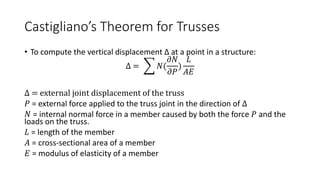
• To compute the vertical displacement Δ at a point in a structure:
∆ = 𝑁(
𝜕𝑁
𝜕𝑃
)
𝐿
𝐴𝐸
Δ = external joint displacement of the truss
𝑃 = external force applied to the truss joint in the direction of Δ
𝑁 = internal normal force in a member caused by both the force 𝑃 and the
loads on the truss.
𝐿 = length of the member
𝐴 = cross-sectional area of a member
𝐸 = modulus of elasticity of a member
Castigliano’s Theorem for Trusses
• Note:
In order to determine the partial derivative in this equation, it will
be necessary to treat 𝑃 as a variable (not a specific numerical
quantity), and furthermore, each member force 𝑁 must be
expressed as a function of 𝑃.
Procedure for Analysis
External Force, 𝑷
• Place a force 𝑷 on the truss at the joint where the desired
displacement is to be determined. This force is assumed to have a
variable magnitude in order to obtain the change ∂N/∂P.
• Be sure 𝑷 is directed along the line of action of the displacement.
Procedure for Analysis
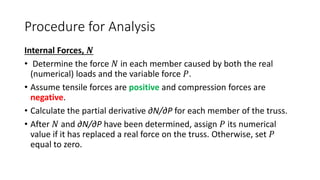
Internal Forces, 𝑵
• Determine the force 𝑁 in each member caused by both the real
(numerical) loads and the variable force 𝑃.
• Assume tensile forces are positive and compression forces are
negative.
• Calculate the partial derivative ∂N/∂P for each member of the truss.
• After 𝑁 and ∂N/∂P have been determined, assign 𝑃 its numerical
value if it has replaced a real force on the truss. Otherwise, set 𝑃
equal to zero.
Procedure for Analysis
Castigliano’s Theorem
• Apply Castigliano’s theorem to determine the desired displacement
∆. It is important to retain the algebraic signs for corresponding values
of 𝑁 and ∂N/∂P when substituting these terms into the equation.
• If the resultant sum ∑ 𝑁(∂N/∂P) L/AE is positive, ∆ is in the same
direction as 𝑃. If a negative value results, ∆ is opposite to 𝑃.
Example 1
Problem:
Determine the vertical displacement of joint C of the truss shown
below. The cross-sectional area of each member is A = 400mm2 and
E=200 GPa.
EXAMPLE 1
Solution:
• External Force, 𝑷
A vertical force 𝑷 is applied to the truss at joint
C, since this is where the vertical displacement is to be
determined. 4 kN
P
A B
C
EXAMPLE 1
Solution:
• Internal Force, 𝑵
𝑀𝐴 = 0 :
P(4)+4(3)-RB(8)=0
RB= 0.5P + 1.5 kN
𝐹𝑌 = 0:
RAY + RB -P=0
RAY= 0.5P - 1.5 kN
𝐹𝑥 = 0:
4 – RAX = 0
RAX = 4 kN
A B
C
RB
RAY
RAX
4 kN
P
EXAMPLE 1
Solution:
• Internal Force, 𝑵
𝐹𝑌 = 0 @ pt. B:
RBC (3/5) + RB = 0
RBC= -0.833P – 2.5 kN
𝐹𝑥 = 0@ pt. B:
- RBC (4/5)– RBA = 0
RBA = 0.667P + 2 kN
RBC
B
RB
RBA
EXAMPLE 1
Solution:
• Internal Force, 𝑵
𝐹𝑌 = 0 @ pt. A:
RAC (3/5) + RAY = 0
RAC= -0.833P + 2.5 kN
RAC
A
RAY
RAX RAB
EXAMPLE 1
Solution:
• Castigliano’s Theorem
Arrange the data in tabular form:
Members N ∂N/∂P N (P=0) L N(∂N/∂P)L
AB 0.667P + 2 0.667 2 8 10.672
AC -0.833P + 2.5 -0.833 2.5 5 -10.413
BC -0.833P - 2.5 -0.833 -2.5 5 10.413
∑ = 10.672
EXAMPLE 1
Solution:
• Castigliano’s Theorem
Applying the formula:
∆ = 𝑁(
𝜕𝑁
𝜕𝑃
)
𝐿
𝐴𝐸
1𝑘𝑁 ∙ Δ𝐻𝑣 =
5657.28 𝑘𝑁2 ∙ 𝑚
𝐴𝐸
Δ𝐻𝑣 =
(5657.28 𝑘𝑁 ∙ 𝑚)(103 𝑁
𝑘𝑁
)
(3𝑥10−3 𝑚2)(200𝑥109 𝑁
𝑚2)
Δ𝐻𝑣 = 0.0094288 m or 9.4288 mm
Example 2
Problem:
Determine the vertical displacement of joint C of the truss shown
below. Assume that A = 300mm2 and E = 200 GPa.
Example 2
Solution:
Example 2
Solution:
Example 2
Solution:
Try to solve this…
P
Where P = 0
Problem:
Determine the vertical
displacement of joint C of the truss
shown below. Assume that A =
300mm2 and E = 200 GPa.

Topic1_Castiglianos Theorem.pptx

  • 1.
    CED 426 Structural TheoryII Lecture 2 Castigliano’s Theorem Castigliano’s Theorem for Trusses Mary Joanne C. Aniñon Instructor
  • 2.
    Castigliano’s Theorem • AlbertoCastigliano published a book in 1879 in which he outlined a method for determining the deflection or slope at a point in a structure, be it a truss, beam, or frame. • This method is also referred to as Castigliano’s second theorem, or the method of least work • It only applies to structures that have constant temperature, unyielding supports, and linear elastic material response.
  • 3.
    Castigliano’s Theorem • Thetheorem states that: • The displacement at a point in a structure is equal to the first partial derivative of the strain energy in the structure with respect to a force acting at the point and in the direction of displacement. • The slope at a point in a structure is equal to the first partial derivative of the strain energy in the structure with respect to a couple moment acting at the point and in the direction of rotation.
  • 4.
    Castigliano’s Theorem forTrusses • To compute the vertical displacement Δ at a point in a structure: ∆ = 𝑁( 𝜕𝑁 𝜕𝑃 ) 𝐿 𝐴𝐸 Δ = external joint displacement of the truss 𝑃 = external force applied to the truss joint in the direction of Δ 𝑁 = internal normal force in a member caused by both the force 𝑃 and the loads on the truss. 𝐿 = length of the member 𝐴 = cross-sectional area of a member 𝐸 = modulus of elasticity of a member
  • 5.
    Castigliano’s Theorem forTrusses • Note: In order to determine the partial derivative in this equation, it will be necessary to treat 𝑃 as a variable (not a specific numerical quantity), and furthermore, each member force 𝑁 must be expressed as a function of 𝑃.
  • 6.
    Procedure for Analysis ExternalForce, 𝑷 • Place a force 𝑷 on the truss at the joint where the desired displacement is to be determined. This force is assumed to have a variable magnitude in order to obtain the change ∂N/∂P. • Be sure 𝑷 is directed along the line of action of the displacement.
  • 7.
    Procedure for Analysis InternalForces, 𝑵 • Determine the force 𝑁 in each member caused by both the real (numerical) loads and the variable force 𝑃. • Assume tensile forces are positive and compression forces are negative. • Calculate the partial derivative ∂N/∂P for each member of the truss. • After 𝑁 and ∂N/∂P have been determined, assign 𝑃 its numerical value if it has replaced a real force on the truss. Otherwise, set 𝑃 equal to zero.
  • 8.
    Procedure for Analysis Castigliano’sTheorem • Apply Castigliano’s theorem to determine the desired displacement ∆. It is important to retain the algebraic signs for corresponding values of 𝑁 and ∂N/∂P when substituting these terms into the equation. • If the resultant sum ∑ 𝑁(∂N/∂P) L/AE is positive, ∆ is in the same direction as 𝑃. If a negative value results, ∆ is opposite to 𝑃.
  • 9.
    Example 1 Problem: Determine thevertical displacement of joint C of the truss shown below. The cross-sectional area of each member is A = 400mm2 and E=200 GPa.
  • 10.
    EXAMPLE 1 Solution: • ExternalForce, 𝑷 A vertical force 𝑷 is applied to the truss at joint C, since this is where the vertical displacement is to be determined. 4 kN P A B C
  • 11.
    EXAMPLE 1 Solution: • InternalForce, 𝑵 𝑀𝐴 = 0 : P(4)+4(3)-RB(8)=0 RB= 0.5P + 1.5 kN 𝐹𝑌 = 0: RAY + RB -P=0 RAY= 0.5P - 1.5 kN 𝐹𝑥 = 0: 4 – RAX = 0 RAX = 4 kN A B C RB RAY RAX 4 kN P
  • 12.
    EXAMPLE 1 Solution: • InternalForce, 𝑵 𝐹𝑌 = 0 @ pt. B: RBC (3/5) + RB = 0 RBC= -0.833P – 2.5 kN 𝐹𝑥 = 0@ pt. B: - RBC (4/5)– RBA = 0 RBA = 0.667P + 2 kN RBC B RB RBA
  • 13.
    EXAMPLE 1 Solution: • InternalForce, 𝑵 𝐹𝑌 = 0 @ pt. A: RAC (3/5) + RAY = 0 RAC= -0.833P + 2.5 kN RAC A RAY RAX RAB
  • 14.
    EXAMPLE 1 Solution: • Castigliano’sTheorem Arrange the data in tabular form: Members N ∂N/∂P N (P=0) L N(∂N/∂P)L AB 0.667P + 2 0.667 2 8 10.672 AC -0.833P + 2.5 -0.833 2.5 5 -10.413 BC -0.833P - 2.5 -0.833 -2.5 5 10.413 ∑ = 10.672
  • 15.
    EXAMPLE 1 Solution: • Castigliano’sTheorem Applying the formula: ∆ = 𝑁( 𝜕𝑁 𝜕𝑃 ) 𝐿 𝐴𝐸 1𝑘𝑁 ∙ Δ𝐻𝑣 = 5657.28 𝑘𝑁2 ∙ 𝑚 𝐴𝐸 Δ𝐻𝑣 = (5657.28 𝑘𝑁 ∙ 𝑚)(103 𝑁 𝑘𝑁 ) (3𝑥10−3 𝑚2)(200𝑥109 𝑁 𝑚2) Δ𝐻𝑣 = 0.0094288 m or 9.4288 mm
  • 16.
    Example 2 Problem: Determine thevertical displacement of joint C of the truss shown below. Assume that A = 300mm2 and E = 200 GPa.
  • 17.
  • 18.
  • 19.
  • 20.
    Try to solvethis… P Where P = 0 Problem: Determine the vertical displacement of joint C of the truss shown below. Assume that A = 300mm2 and E = 200 GPa.