Medical Electronics
V.Bharathi M.E.,M.B.A.,(PhD)
Asst.Prof Dept of ECE
Kongunadu college of Engg& Tech,Trichy
29 January 20191
Syllabus
29 January 20192
Unit –I Syllabus
Electro-physiology and Bio-potential
Recording
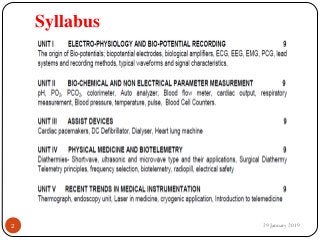
The origin of Bio-potentials; biopotential electrodes,
biological amplifiers, ECG, EEG, EMG, PCG, lead
systems and recording methods, typical waveforms
and signal characteristics.
29 January 20193
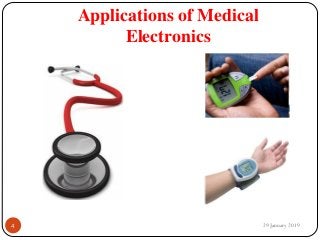
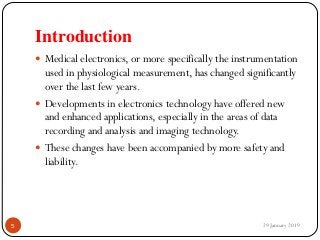
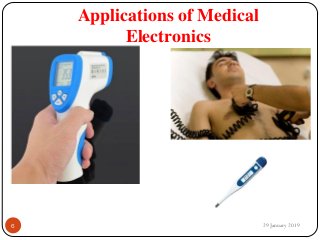
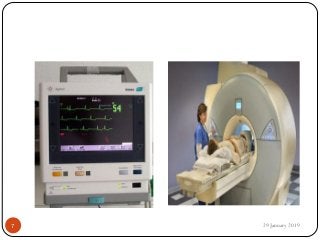
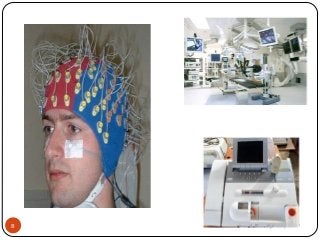
Applications of Medical
Electronics
29 January 20194
Introduction
 Medical electronics, or more specifically the instrumentation
used in physiological measurement, has changed significantly
over the last few years.
 Developments in electronics technology have offered new
and enhanced applications, especially in the areas of data
recording and analysis and imaging technology.
 These changes have been accompanied by more safety and
liability.
29 January 20195
Applications of Medical
Electronics
29 January 20196
29 January 20197
29 January 20198
The origin of Bio-potentials
Introduction
 For anyone concerned with the field of bio-medical
instrumentation they should be aware of physical and
chemical factor that are responsible for the origin
 Bioelectric phenomenon is of immense importance to
biomedical engineers because these potentials are routinely
recorded in modern clinical practice
29 January 20199
To understand the origin of biopotential
Bioelectric phenomena at the cellular level
 Volume conductor fields of simple bioelectric sources
 Volume conductor fields of complex bioelectric sources
 Volume conductor fields as a necessary link between
cellular activity and gross externally recorded biological
signals as we need to focus on
29 January 201910
Cells and their structures
 Basic living unit of the body is the Cell
 To understand the function of organs and their structures of
the body it is essential to know about the basic organization
of the cell and the functions of its component parts
 The entire body contains about 100 trillions Cells .Among
this 25 trillion Cells are red blood cells which transport
oxygen form lungs to the tissues
 Generally all cells have ability to reproduce new cells when
they are destroyed
29 January 201911
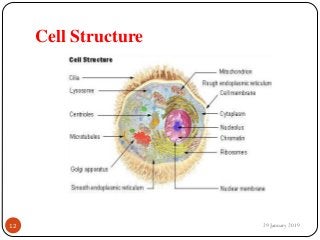
Cell Structure
29 January 201912
A cell consists of a
Plasma membrane
 It is selectively permeable to (various ions such as) Na+, K+
and intracellular anions.
 The fluid inside the plasma membrane called the
intracellular fluid(ICF)
 The fluid outside the plasma membrane is called the
extracellular fluid (ECF)
29 January 201913
Nucleus:
 It is the largest single organized cellular component.
 It is a distinct spherical or oval structure located near the
center of the cell. It is covered by a double-layered
membranous structure
Cytoplasm:
 It is a gel-like mass with membrane-bound structures
suspending in it
29 January 201914
Bio potential electrodes and
Transducer
 A medical instruments perform a specific function on a
biological system. the function may be the exact
measurement of physiological parameters like blood
pressure ,velocity of blood, action potential of heart muscles,
temperature ,pHValue of the blood
 The biomedical measuring devices should cause minimal
disturbances to the normal physiological function and are to
be used with safety instrumentation
29 January 201915
Design of biomedical Instruments
 When we design a medical instrument the following factors
should be considered
1. Accuracy
2. Frequency response
3. Hysteresis
4. Isolation
5. Linearity
6. Sensitivity
7. Signal to noise ratio
8. Simplicity
9. Stability
10. Precision
29 January 201916
 Accuracy –It is the closeness with which a instrument
reading approaches the true value of the variable being
measures
 Frequency response – It is the response of the instruments for
various components
 Hysteresis- Output response for the measured value
 Isolation – Electrical safety on the subject where the measurement
is done
 Linearity – Constant output value from the instrument
29 January 201917
 Sensitivity-The instrument is how much sensible
 Signal to noise ratio- Ration of input and output
 Simplicity-The components to be simple not complex
 Stability- produces stable output
 Precision- Reproducibility of the measurements
29 January 201918
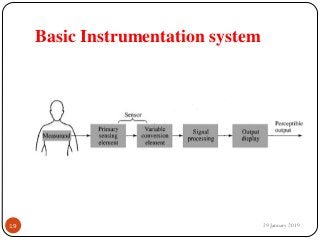
Basic Instrumentation system
29 January 201919
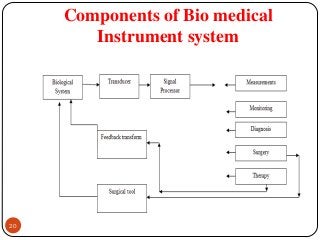
Components of Bio medical
Instrument system
29 January 201920
 Transducer –Transducer is device capable of converting one
form of energy or signal to electrical signal
 Signal Processor - It an important instrument system which
amplified,modifies,analyzes
29 January 201921
Electrodes
 Electrodes are employed to pick up the electrical signals of
the body .
 In the biomedical instrumentation system the pair of
electrodes plays the role of the transducer.
 Since the electrodes are transferring the bio electric event to
the input of the amplifier ,the amplifier should be designed
such that it accommodates the characteristics of electrode
 Medical electrodes comprises of a lead, metal and electrode
conducting paste
29 January 201922
Contd…
 Medical electrodes proceed with quantification of internal
ionic currents and results in diagnosis of various ocular,
nervous, cardiac, and muscular disorders.
 The device works through provision of an electrical contact
between apparatus used to monitor activities and patient
 The electrodes used in medical devices can be segmented as
reusable disc, disposable, headbands and saline based
electrodes
29 January 201923
Contd…
 In addition, the electrodes can also be classified based on
their applications such as ECG Electrodes, Blood Gas
Electrodes, EEG/EMG/ENG Electrodes, and Defibrillator
Electrodes.
 Moreover, they can also be sub segmented as Fetal Scalp
Electrodes, Electrosurgical Electrodes,TENS Electrodes,
Pacemaker Electrodes, pH Electrodes, Nasopharyngeal
Electrodes, and Ion-selective Electrodes.
29 January 201924
Half cell potential or Electrode
potential
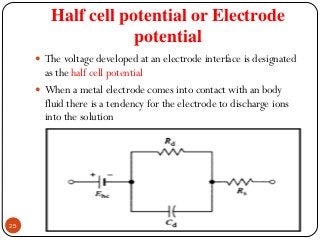
 The voltage developed at an electrode interface is designated
as the half cell potential
 When a metal electrode comes into contact with an body
fluid there is a tendency for the electrode to discharge ions
into the solution
29 January 201925
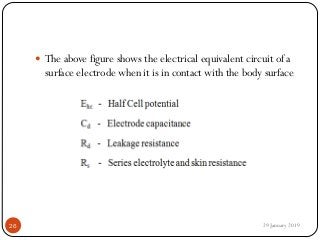
 The above figure shows the electrical equivalent circuit of a
surface electrode when it is in contact with the body surface
29 January 201926
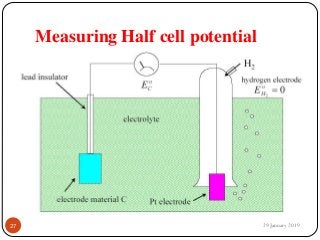
Measuring Half cell potential
29 January 201927
29 January 201928
Polarization
 If there is a current between the electrode and
electrolyte, the observed half cell potential is often
altered due to polarization
29 January 201929
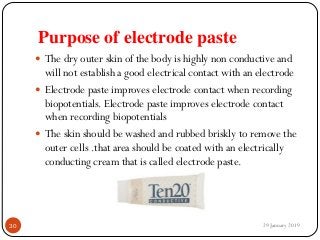
Purpose of electrode paste
 The dry outer skin of the body is highly non conductive and
will not establish a good electrical contact with an electrode
 Electrode paste improves electrode contact when recording
biopotentials. Electrode paste improves electrode contact
when recording biopotentials
 The skin should be washed and rubbed briskly to remove the
outer cells .that area should be coated with an electrically
conducting cream that is called electrode paste.
29 January 201930
 Generally the conductivity of the skin is directly proportional
to the moisture of the skin
 Example the ECG electrode contact impedance on dry skin is
about 100 Kilohms means after applying electrode paste it is
reduced to 10 Kilohms
 Alcohol, electrode paste ,saline solution has negligible
impedance around 1000Hz
29 January 201931
Electrode material
 The electrode ,electrode paste and body fluids can produce a
battery like action causing ions to accumulate on the
electrodes, such polarization of the electrode will affect the
signal transfer
 Polarization- If there is a current between the electrode
and electrolyte, the observed half cell potential is often
altered due to polarization.
29 January 201932
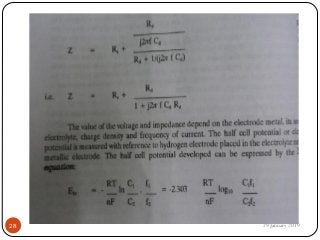
Nernst Equation
 When two aqueous ionic solutions of different concentration
are separated by an ion-selective semi-permeable membrane,
an electric potential exists across the membrane.
 The Nernst equation for half cell potential is
29 January 201933
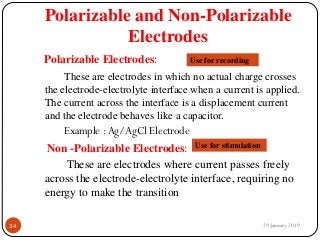
Polarizable and Non-Polarizable
Electrodes
Polarizable Electrodes:
These are electrodes in which no actual charge crosses
the electrode-electrolyte interface when a current is applied.
The current across the interface is a displacement current
and the electrode behaves like a capacitor.
Example :Ag/AgCl Electrode
Non -Polarizable Electrodes:
These are electrodes where current passes freely
across the electrode-electrolyte interface, requiring no
energy to make the transition
29 January 201934
Use for recording
Use for stimulation
Types of Electrodes
29 January 201935
There are three types of electrodes
 Micro Electrode: these are used to measure the bio
electric potential near or with in a single cell.These are
called intracellular electrodes
 Depth and needle Electrodes:These are used to measure
the bio electric potential of the highly localized extra cellular
regions in brain or group of muscles
 Surface electrodes:These are used to measure the
potential available from the surface of the skin and are usede
to sense the potential form heart, brain and nerves
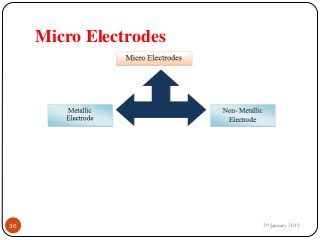
Micro Electrodes
29 January 201936
Micro Electrodes
 Micro electrode have smaller diameter and during
insertion of the electrode into the cell ,there is no
damage to the cell
 When micro electrode is used to measure the potential
of the cell ,another electrode called reference electrode
is placed outside of the cell
 The size of the cell is determined by the size of the cell
29 January 201937
Metal electrode
 Metal micro electrode are formed by electrolytically
etching the tip of a fine tungsten or stainless steel wire
to a fine point, this technique is known as
Elecrtopointing
 Micro electrode are coated with insulating material
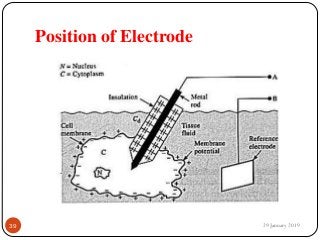
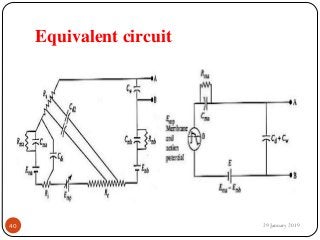
 The figure shows the position of the electrode and its
equivalent circuit
29 January 201938
Position of Electrode
29 January 201939
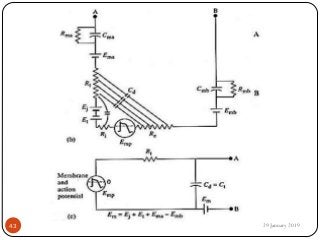
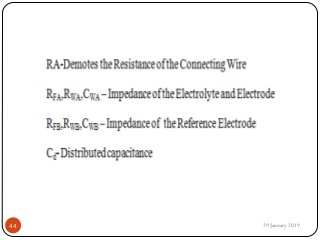
Equivalent circuit
29 January 201940
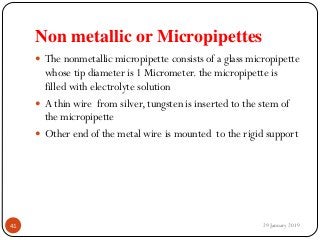
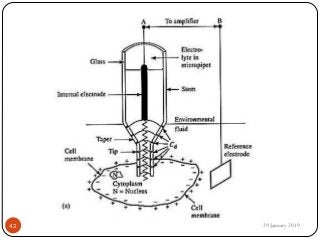
Non metallic or Micropipettes
 The nonmetallic micropipette consists of a glass micropipette
whose tip diameter is 1 Micrometer. the micropipette is
filled with electrolyte solution
 A thin wire from silver, tungsten is inserted to the stem of
the micropipette
 Other end of the metal wire is mounted to the rigid support
29 January 201941
29 January 201942
29 January 201943
29 January 201944
Depth and needle Electrode
 Depth and needle electrode is used to study the electrical
activity of neurons in superficial layers of the brain.Normaly
each electrode consists of bundle of teflon insulated
platinum(90%) and iridium(10%)
 The end of the wire is rounded for ease of insertion into the
brain
 Each individual wire is acts as electrode.Therefore the depth
of the electrode impedance is smaller than the
Microelectrode
29 January 201945
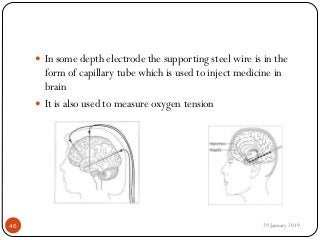
 In some depth electrode the supporting steel wire is in the
form of capillary tube which is used to inject medicine in
brain
 It is also used to measure oxygen tension
29 January 201946
Surface Electrode
29 January 201947
 Generally larger area surface electrodes are used to sense
ECG potentials ad smaller area surface electrodes are used to
sense EEG & EMG potentials
1. Metal plate Electrode
2. Suction cup electrode
3. Adhesive tape electrode

Medical electronics slide share

  • 1.
    Medical Electronics V.Bharathi M.E.,M.B.A.,(PhD) Asst.ProfDept of ECE Kongunadu college of Engg& Tech,Trichy 29 January 20191
  • 2.
  • 3.
    Unit –I Syllabus Electro-physiologyand Bio-potential Recording The origin of Bio-potentials; biopotential electrodes, biological amplifiers, ECG, EEG, EMG, PCG, lead systems and recording methods, typical waveforms and signal characteristics. 29 January 20193
  • 4.
  • 5.
    Introduction  Medical electronics,or more specifically the instrumentation used in physiological measurement, has changed significantly over the last few years.  Developments in electronics technology have offered new and enhanced applications, especially in the areas of data recording and analysis and imaging technology.  These changes have been accompanied by more safety and liability. 29 January 20195
  • 6.
  • 7.
  • 8.
  • 9.
    The origin ofBio-potentials Introduction  For anyone concerned with the field of bio-medical instrumentation they should be aware of physical and chemical factor that are responsible for the origin  Bioelectric phenomenon is of immense importance to biomedical engineers because these potentials are routinely recorded in modern clinical practice 29 January 20199
  • 10.
    To understand theorigin of biopotential Bioelectric phenomena at the cellular level  Volume conductor fields of simple bioelectric sources  Volume conductor fields of complex bioelectric sources  Volume conductor fields as a necessary link between cellular activity and gross externally recorded biological signals as we need to focus on 29 January 201910
  • 11.
    Cells and theirstructures  Basic living unit of the body is the Cell  To understand the function of organs and their structures of the body it is essential to know about the basic organization of the cell and the functions of its component parts  The entire body contains about 100 trillions Cells .Among this 25 trillion Cells are red blood cells which transport oxygen form lungs to the tissues  Generally all cells have ability to reproduce new cells when they are destroyed 29 January 201911
  • 12.
  • 13.
    A cell consistsof a Plasma membrane  It is selectively permeable to (various ions such as) Na+, K+ and intracellular anions.  The fluid inside the plasma membrane called the intracellular fluid(ICF)  The fluid outside the plasma membrane is called the extracellular fluid (ECF) 29 January 201913
  • 14.
    Nucleus:  It isthe largest single organized cellular component.  It is a distinct spherical or oval structure located near the center of the cell. It is covered by a double-layered membranous structure Cytoplasm:  It is a gel-like mass with membrane-bound structures suspending in it 29 January 201914
  • 15.
    Bio potential electrodesand Transducer  A medical instruments perform a specific function on a biological system. the function may be the exact measurement of physiological parameters like blood pressure ,velocity of blood, action potential of heart muscles, temperature ,pHValue of the blood  The biomedical measuring devices should cause minimal disturbances to the normal physiological function and are to be used with safety instrumentation 29 January 201915
  • 16.
    Design of biomedicalInstruments  When we design a medical instrument the following factors should be considered 1. Accuracy 2. Frequency response 3. Hysteresis 4. Isolation 5. Linearity 6. Sensitivity 7. Signal to noise ratio 8. Simplicity 9. Stability 10. Precision 29 January 201916
  • 17.
     Accuracy –Itis the closeness with which a instrument reading approaches the true value of the variable being measures  Frequency response – It is the response of the instruments for various components  Hysteresis- Output response for the measured value  Isolation – Electrical safety on the subject where the measurement is done  Linearity – Constant output value from the instrument 29 January 201917
  • 18.
     Sensitivity-The instrumentis how much sensible  Signal to noise ratio- Ration of input and output  Simplicity-The components to be simple not complex  Stability- produces stable output  Precision- Reproducibility of the measurements 29 January 201918
  • 19.
  • 20.
    Components of Biomedical Instrument system 29 January 201920
  • 21.
     Transducer –Transduceris device capable of converting one form of energy or signal to electrical signal  Signal Processor - It an important instrument system which amplified,modifies,analyzes 29 January 201921
  • 22.
    Electrodes  Electrodes areemployed to pick up the electrical signals of the body .  In the biomedical instrumentation system the pair of electrodes plays the role of the transducer.  Since the electrodes are transferring the bio electric event to the input of the amplifier ,the amplifier should be designed such that it accommodates the characteristics of electrode  Medical electrodes comprises of a lead, metal and electrode conducting paste 29 January 201922
  • 23.
    Contd…  Medical electrodesproceed with quantification of internal ionic currents and results in diagnosis of various ocular, nervous, cardiac, and muscular disorders.  The device works through provision of an electrical contact between apparatus used to monitor activities and patient  The electrodes used in medical devices can be segmented as reusable disc, disposable, headbands and saline based electrodes 29 January 201923
  • 24.
    Contd…  In addition,the electrodes can also be classified based on their applications such as ECG Electrodes, Blood Gas Electrodes, EEG/EMG/ENG Electrodes, and Defibrillator Electrodes.  Moreover, they can also be sub segmented as Fetal Scalp Electrodes, Electrosurgical Electrodes,TENS Electrodes, Pacemaker Electrodes, pH Electrodes, Nasopharyngeal Electrodes, and Ion-selective Electrodes. 29 January 201924
  • 25.
    Half cell potentialor Electrode potential  The voltage developed at an electrode interface is designated as the half cell potential  When a metal electrode comes into contact with an body fluid there is a tendency for the electrode to discharge ions into the solution 29 January 201925
  • 26.
     The abovefigure shows the electrical equivalent circuit of a surface electrode when it is in contact with the body surface 29 January 201926
  • 27.
    Measuring Half cellpotential 29 January 201927
  • 28.
  • 29.
    Polarization  If thereis a current between the electrode and electrolyte, the observed half cell potential is often altered due to polarization 29 January 201929
  • 30.
    Purpose of electrodepaste  The dry outer skin of the body is highly non conductive and will not establish a good electrical contact with an electrode  Electrode paste improves electrode contact when recording biopotentials. Electrode paste improves electrode contact when recording biopotentials  The skin should be washed and rubbed briskly to remove the outer cells .that area should be coated with an electrically conducting cream that is called electrode paste. 29 January 201930
  • 31.
     Generally theconductivity of the skin is directly proportional to the moisture of the skin  Example the ECG electrode contact impedance on dry skin is about 100 Kilohms means after applying electrode paste it is reduced to 10 Kilohms  Alcohol, electrode paste ,saline solution has negligible impedance around 1000Hz 29 January 201931
  • 32.
    Electrode material  Theelectrode ,electrode paste and body fluids can produce a battery like action causing ions to accumulate on the electrodes, such polarization of the electrode will affect the signal transfer  Polarization- If there is a current between the electrode and electrolyte, the observed half cell potential is often altered due to polarization. 29 January 201932
  • 33.
    Nernst Equation  Whentwo aqueous ionic solutions of different concentration are separated by an ion-selective semi-permeable membrane, an electric potential exists across the membrane.  The Nernst equation for half cell potential is 29 January 201933
  • 34.
    Polarizable and Non-Polarizable Electrodes PolarizableElectrodes: These are electrodes in which no actual charge crosses the electrode-electrolyte interface when a current is applied. The current across the interface is a displacement current and the electrode behaves like a capacitor. Example :Ag/AgCl Electrode Non -Polarizable Electrodes: These are electrodes where current passes freely across the electrode-electrolyte interface, requiring no energy to make the transition 29 January 201934 Use for recording Use for stimulation
  • 35.
    Types of Electrodes 29January 201935 There are three types of electrodes  Micro Electrode: these are used to measure the bio electric potential near or with in a single cell.These are called intracellular electrodes  Depth and needle Electrodes:These are used to measure the bio electric potential of the highly localized extra cellular regions in brain or group of muscles  Surface electrodes:These are used to measure the potential available from the surface of the skin and are usede to sense the potential form heart, brain and nerves
  • 36.
  • 37.
    Micro Electrodes  Microelectrode have smaller diameter and during insertion of the electrode into the cell ,there is no damage to the cell  When micro electrode is used to measure the potential of the cell ,another electrode called reference electrode is placed outside of the cell  The size of the cell is determined by the size of the cell 29 January 201937
  • 38.
    Metal electrode  Metalmicro electrode are formed by electrolytically etching the tip of a fine tungsten or stainless steel wire to a fine point, this technique is known as Elecrtopointing  Micro electrode are coated with insulating material  The figure shows the position of the electrode and its equivalent circuit 29 January 201938
  • 39.
  • 40.
  • 41.
    Non metallic orMicropipettes  The nonmetallic micropipette consists of a glass micropipette whose tip diameter is 1 Micrometer. the micropipette is filled with electrolyte solution  A thin wire from silver, tungsten is inserted to the stem of the micropipette  Other end of the metal wire is mounted to the rigid support 29 January 201941
  • 42.
  • 43.
  • 44.
  • 45.
    Depth and needleElectrode  Depth and needle electrode is used to study the electrical activity of neurons in superficial layers of the brain.Normaly each electrode consists of bundle of teflon insulated platinum(90%) and iridium(10%)  The end of the wire is rounded for ease of insertion into the brain  Each individual wire is acts as electrode.Therefore the depth of the electrode impedance is smaller than the Microelectrode 29 January 201945
  • 46.
     In somedepth electrode the supporting steel wire is in the form of capillary tube which is used to inject medicine in brain  It is also used to measure oxygen tension 29 January 201946
  • 47.
    Surface Electrode 29 January201947  Generally larger area surface electrodes are used to sense ECG potentials ad smaller area surface electrodes are used to sense EEG & EMG potentials 1. Metal plate Electrode 2. Suction cup electrode 3. Adhesive tape electrode