VOLUNTARY TRAINING PROGRAM 2011
Air Pollution: Sources and impacts
Air Pollution
Sources and Impacts
VOLUNTARY TRAINING PROGRAM 2011
Air Pollution: Sources and impacts
Content
 Historical Background
 Sulphur oxides
 Nitrogen oxides
 Particulate matter
 Ozone depleting substances
 MARPOL Annex VI: An overview
VOLUNTARY TRAINING PROGRAM 2011
Air Pollution: Sources and impacts
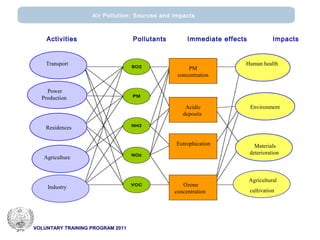
Activities Pollutants Immediate effects Impacts
Residences
Power
Production
Transport
Agriculture
Industry
PM
concentration
Acidic
deposits
Εutrophication
Ozone
concentration
Materials
deterioration
Human health
Agricultural
cultivation
Environment
VOLUNTARY TRAINING PROGRAM 2011
Air Pollution: Sources and impacts
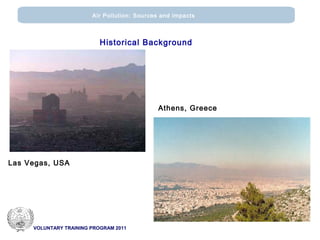
Historical Background
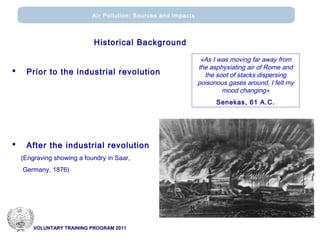
 Prior to the industrial revolution
 After the industrial revolution
(Engraving showing a foundry in Saar,
Germany, 1876)
«Αs I was moving far away from
the asphyxiating air of Rome and
the soot of stacks dispersing
poisonous gases around, I felt my
mood changing»
Senekas, 61 A.C.
VOLUNTARY TRAINING PROGRAM 2011
Air Pollution: Sources and impacts
Historical Background
Las Vegas, USA
Athens, Greece
VOLUNTARY TRAINING PROGRAM 2011
Air Pollution: Sources and impacts
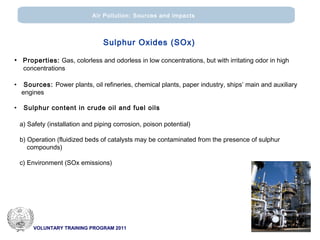
Sulphur Oxides (SOx)
• Properties: Gas, colorless and odorless in low concentrations, but with irritating odor in high
concentrations
• Sources: Power plants, oil refineries, chemical plants, paper industry, ships’ main and auxiliary
engines
• Sulphur content in crude oil and fuel oils
a) Safety (installation and piping corrosion, poison potential)
b) Operation (fluidized beds of catalysts may be contaminated from the presence of sulphur
compounds)
c) Environment (SOx emissions)
VOLUNTARY TRAINING PROGRAM 2011
Air Pollution: Sources and impacts
Sulphur Oxides (SOx)
Impacts to human health
• Short term exposure in high concentrations, might cause bronchoconstriction and increased
asthma symptoms.
• Long term exposure might cause serious respiratory problems and deteriorate existing
cardiovascular illnesses
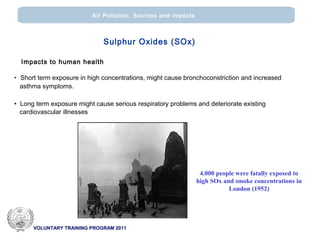
London, 1952
4.000 people were fatally exposed to
high SOx and smoke concentrations in
London (1952)
VOLUNTARY TRAINING PROGRAM 2011
Air Pollution: Sources and impacts
Environmental impacts
Acid rain
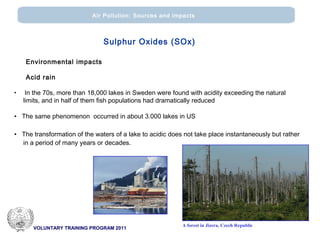
• In the 70s, more than 18,000 lakes in Sweden were found with acidity exceeding the natural
limits, and in half of them fish populations had dramatically reduced
• The same phenomenon occurred in about 3.000 lakes in US
• The transformation of the waters of a lake to acidic does not take place instantaneously but rather
in a period of many years or decades.
A forest in Jizera, Czech Republic
Sulphur Oxides (SOx)
VOLUNTARY TRAINING PROGRAM 2011
Air Pollution: Sources and impacts
Acid rain formation mechanism
• H2SO4 and HNO3 are formed as a result of the reaction between the water and sulphur as well as
nitrogen oxides with the sun radiation and oxygen as catalysts
• Normal rain is slightly acidic (pH 5,5) due to CO2 dissolution and H2CO3 formation
• Most lakes have a pH ranging from 6 to 8. Values as low as 4.3 have been reported in several
lakes facing acid rain problems
Sulphur Oxides (SOx)
VOLUNTARY TRAINING PROGRAM 2011
Air Pollution: Sources and impacts
Impacts of acid rain
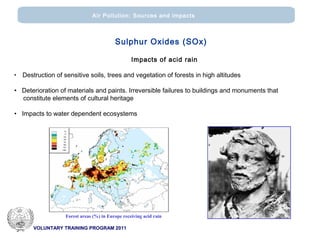
• Destruction of sensitive soils, trees and vegetation of forests in high altitudes
• Deterioration of materials and paints. Irreversible failures to buildings and monuments that
constitute elements of cultural heritage
• Impacts to water dependent ecosystems
Forest areas (%) in Europe receiving acid rain
Sulphur Oxides (SOx)
VOLUNTARY TRAINING PROGRAM 2011
Air Pollution: Sources and impacts
Nitrogen Oxides (ΝΟx)
NOx formation in ship’s engines
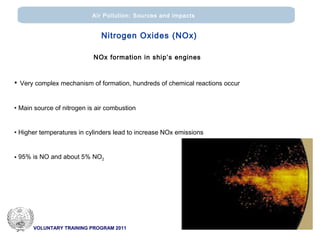
• Very complex mechanism of formation, hundreds of chemical reactions occur
• Main source of nitrogen is air combustion
• Higher temperatures in cylinders lead to increase NOx emissions
• 95% is ΝΟ and about 5% NO2
VOLUNTARY TRAINING PROGRAM 2011
Air Pollution: Sources and impacts
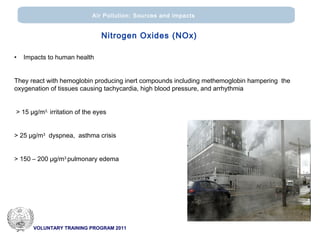
• Impacts to human health
They react with hemoglobin producing inert compounds including methemoglobin hampering the
oxygenation of tissues causing tachycardia, high blood pressure, and arrhythmia
> 15 μg/m3,
irritation of the eyes
> 25 μg/m3
dyspnea, asthma crisis
> 150 – 200 μg/m3
pulmonary edema
Nitrogen Oxides (ΝΟx)
VOLUNTARY TRAINING PROGRAM 2011
Air Pollution: Sources and impacts
Secondary ozone formation
ΝΟx + VOCs + sun radiation Ο3 + Photochemical pollution
Photochemical smog occurs in sunny periods with high temperatures, low moisture and relatively
high levels of nitrogen oxides and hydrocarbons.
Nitrogen Oxides (ΝΟx)
VOLUNTARY TRAINING PROGRAM 2011
Air Pollution: Sources and impacts
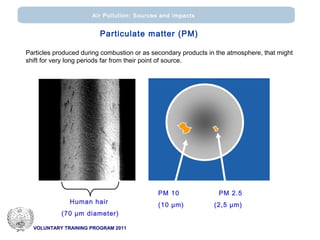
Human hair
(70 μm diameter)
PM 10 PM 2.5
(10 μm) (2,5 μm)
Particulate matter (PM)
Particles produced during combustion or as secondary products in the atmosphere, that might
shift for very long periods far from their point of source.
VOLUNTARY TRAINING PROGRAM 2011
Air Pollution: Sources and impacts
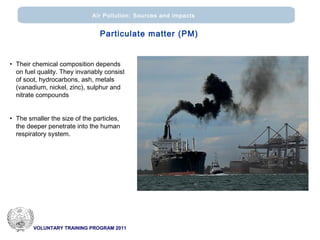
• Their chemical composition depends
on fuel quality. They invariably consist
of soot, hydrocarbons, ash, metals
(vanadium, nickel, zinc), sulphur and
nitrate compounds
• The smaller the size of the particles,
the deeper penetrate into the human
respiratory system.
Particulate matter (PM)
VOLUNTARY TRAINING PROGRAM 2011
Air Pollution: Sources and impacts
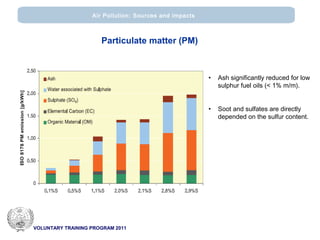
• Ash significantly reduced for low
sulphur fuel oils (< 1% m/m).
• Soot and sulfates are directly
depended on the sulfur content.
Particulate matter (PM)
VOLUNTARY TRAINING PROGRAM 2011
Air Pollution: Sources and impacts
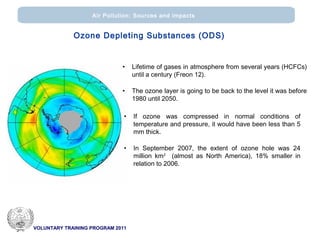
• Lifetime of gases in atmosphere from several years (HCFCs)
until a century (Freon 12).
• The ozone layer is going to be back to the level it was before
1980 until 2050.
• If ozone was compressed in normal conditions of
temperature and pressure, it would have been less than 5
mm thick.
• In September 2007, the extent of ozone hole was 24
million km2
(almost as North America), 18% smaller in
relation to 2006.
Ozone Depleting Substances (ODS)
VOLUNTARY TRAINING PROGRAM 2011
Air Pollution: Sources and impacts
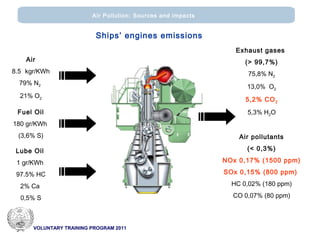
Exhaust gases
(> 99,7%)
75,8% Ν2
13,0% Ο2
5,2% CO2
5,3% H2O
Air pollutants
(< 0,3%)
ΝΟx 0,17% (1500 ppm)
SOx 0,15% (800 ppm)
HC 0,02% (180 ppm)
CO 0,07% (80 ppm)
Fuel Oil
180 gr/KWh
(3,6% S)
Lube Oil
1 gr/KWh
97.5% HC
2% Ca
0,5% S
Air
8.5 kgr/KWh
79% Ν2
21% Ο2
Ships’ engines emissions
VOLUNTARY TRAINING PROGRAM 2011
Air Pollution: Sources and impacts
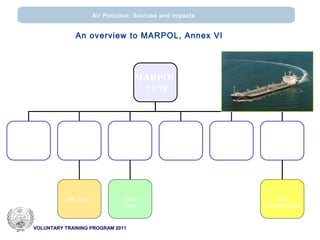
ΜΑRPOL
73/78
Annex Ι
Oil
Annex ΙΙ
Noxious Bulk
Liquid Substances
Annex III
Packaged
Harmful
Substances
Annex IV
Sewage
Annex V
Garbage
Annex VI
Air Emissions
IBC Code IMDG
Code
NOx
Technical Code
An overview to MARPOL, Annex VI
VOLUNTARY TRAINING PROGRAM 2011
Air Pollution: Sources and impacts
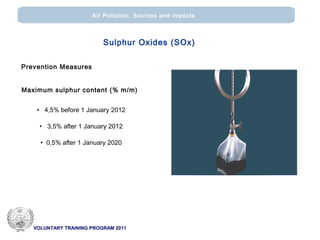
Prevention Measures
Μaximum sulphur content (% m/m)
• 4,5% before 1 January 2012
• 3,5% after 1 January 2012
• 0,5% after 1 January 2020
Sulphur Oxides (SOx)
VOLUNTARY TRAINING PROGRAM 2011
Air Pollution: Sources and impacts
Prevention Measures
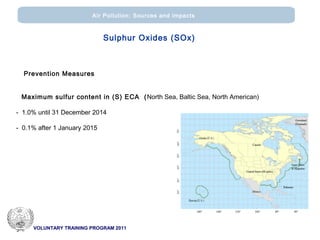
Maximum sulfur content in (S) ECA (North Sea, Baltic Sea, North American)
- 1.0% until 31 December 2014
- 0.1% after 1 January 2015
Sulphur Oxides (SOx)
VOLUNTARY TRAINING PROGRAM 2011
Air Pollution: Sources and impacts
Prevention Measures
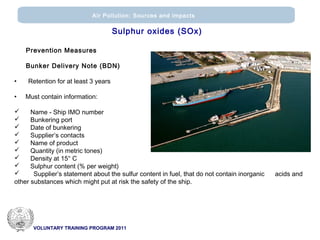
Bunker Delivery Note (ΒDN)
• Retention for at least 3 years
• Must contain information:
 Name - Ship ΙΜΟ number
 Bunkering port
 Date of bunkering
 Supplier’s contacts
 Name of product
 Quantity (in metric tones)
 Density at 15° C
 Sulphur content (% per weight)
 Supplier’s statement about the sulfur content in fuel, that do not contain inorganic acids and
other substances which might put at risk the safety of the ship.
Sulphur oxides (SOx)
VOLUNTARY TRAINING PROGRAM 2011
Air Pollution: Sources and impacts
Sulphur oxides (SOx)
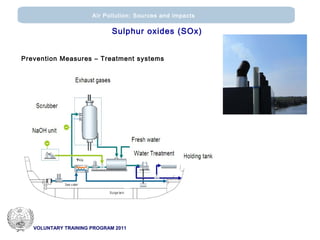
Prevention Measures – Treatment systems
VOLUNTARY TRAINING PROGRAM 2011
Air Pollution: Sources and impacts
Nitrogen oxides (ΝΟx)
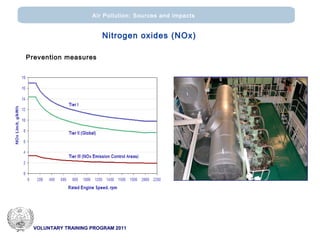
Prevention measures
VOLUNTARY TRAINING PROGRAM 2011
Air Pollution: Sources and impacts
Nitrogen oxides (ΝΟx)
Prevention measures
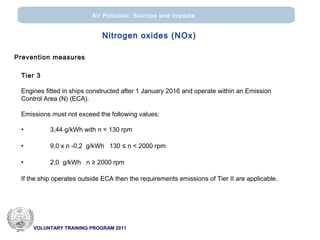
Tier 3
Engines fitted in ships constructed after 1 January 2016 and operate within an Emission
Control Area (N) (ΕCA).
Emissions must not exceed the following values:
• 3,44 g/kWh with n < 130 rpm
• 9,0 x n -0,2 g/kWh 130 ≤ n < 2000 rpm
• 2,0 g/kWh n ≥ 2000 rpm
If the ship operates outside ECA then the requirements emissions of Tier II are applicable.
VOLUNTARY TRAINING PROGRAM 2011
Air Pollution: Sources and impacts
Nitrogen oxides (ΝΟx)
Prevention measures
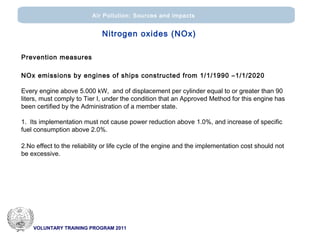
NOx emissions by engines of ships constructed from 1/1/1990 –1/1/2020
Every engine above 5.000 kW, and of displacement per cylinder equal to or greater than 90
liters, must comply to Tier I, under the condition that an Approved Method for this engine has
been certified by the Administration of a member state.
1. Its implementation must not cause power reduction above 1.0%, and increase of specific
fuel consumption above 2.0%.
2.No effect to the reliability or life cycle of the engine and the implementation cost should not
be excessive.
VOLUNTARY TRAINING PROGRAM 2011
Air Pollution: Sources and impacts
Nitrogen oxides (ΝΟx)
Prevention measures
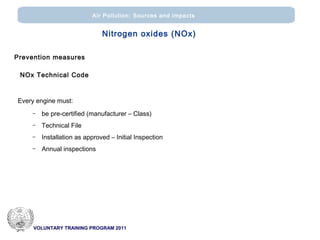
NOx Technical Code
Every engine must:
– be pre-certified (manufacturer – Class)
– Technical File
– Installation as approved – Initial Inspection
– Annual inspections
VOLUNTARY TRAINING PROGRAM 2011
Air Pollution: Sources and impacts
Nitrogen oxides (ΝΟx)
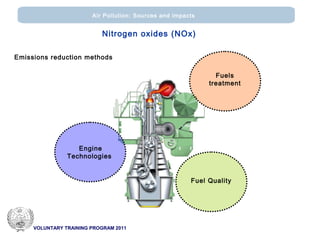
Emissions reduction methods
Fuels
treatment
Fuel Quality
Engine
Technologies
VOLUNTARY TRAINING PROGRAM 2011
Air Pollution: Sources and impacts
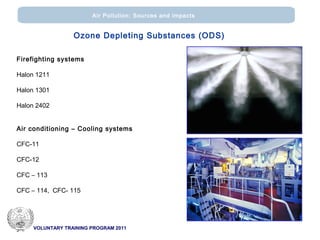
Firefighting systems
Ηalon 1211
Halon 1301
Halon 2402
Air conditioning – Cooling systems
CFC-11
CFC-12
CFC – 113
CFC – 114, CFC- 115
Ozone Depleting Substances (ODS)
VOLUNTARY TRAINING PROGRAM 2011
Air Pollution: Sources and impacts
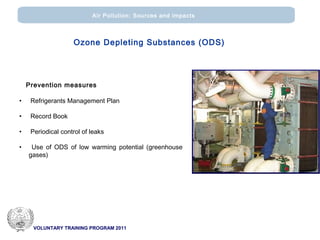
Prevention measures
• Refrigerants Management Plan
• Record Book
• Periodical control of leaks
• Use of ODS of low warming potential (greenhouse
gases)
Ozone Depleting Substances (ODS)
VOLUNTARY TRAINING PROGRAM 2011
Air Pollution: Sources and impacts
Thank you for your attention!
Questions

Topic 6 air pollution, sources and impacts

  • 1.
    VOLUNTARY TRAINING PROGRAM2011 Air Pollution: Sources and impacts Air Pollution Sources and Impacts
  • 2.
    VOLUNTARY TRAINING PROGRAM2011 Air Pollution: Sources and impacts Content  Historical Background  Sulphur oxides  Nitrogen oxides  Particulate matter  Ozone depleting substances  MARPOL Annex VI: An overview
  • 3.
    VOLUNTARY TRAINING PROGRAM2011 Air Pollution: Sources and impacts Activities Pollutants Immediate effects Impacts Residences Power Production Transport Agriculture Industry PM concentration Acidic deposits Εutrophication Ozone concentration Materials deterioration Human health Agricultural cultivation Environment
  • 4.
    VOLUNTARY TRAINING PROGRAM2011 Air Pollution: Sources and impacts Historical Background  Prior to the industrial revolution  After the industrial revolution (Engraving showing a foundry in Saar, Germany, 1876) «Αs I was moving far away from the asphyxiating air of Rome and the soot of stacks dispersing poisonous gases around, I felt my mood changing» Senekas, 61 A.C.
  • 5.
    VOLUNTARY TRAINING PROGRAM2011 Air Pollution: Sources and impacts Historical Background Las Vegas, USA Athens, Greece
  • 6.
    VOLUNTARY TRAINING PROGRAM2011 Air Pollution: Sources and impacts Sulphur Oxides (SOx) • Properties: Gas, colorless and odorless in low concentrations, but with irritating odor in high concentrations • Sources: Power plants, oil refineries, chemical plants, paper industry, ships’ main and auxiliary engines • Sulphur content in crude oil and fuel oils a) Safety (installation and piping corrosion, poison potential) b) Operation (fluidized beds of catalysts may be contaminated from the presence of sulphur compounds) c) Environment (SOx emissions)
  • 7.
    VOLUNTARY TRAINING PROGRAM2011 Air Pollution: Sources and impacts Sulphur Oxides (SOx) Impacts to human health • Short term exposure in high concentrations, might cause bronchoconstriction and increased asthma symptoms. • Long term exposure might cause serious respiratory problems and deteriorate existing cardiovascular illnesses London, 1952 4.000 people were fatally exposed to high SOx and smoke concentrations in London (1952)
  • 8.
    VOLUNTARY TRAINING PROGRAM2011 Air Pollution: Sources and impacts Environmental impacts Acid rain • In the 70s, more than 18,000 lakes in Sweden were found with acidity exceeding the natural limits, and in half of them fish populations had dramatically reduced • The same phenomenon occurred in about 3.000 lakes in US • The transformation of the waters of a lake to acidic does not take place instantaneously but rather in a period of many years or decades. A forest in Jizera, Czech Republic Sulphur Oxides (SOx)
  • 9.
    VOLUNTARY TRAINING PROGRAM2011 Air Pollution: Sources and impacts Acid rain formation mechanism • H2SO4 and HNO3 are formed as a result of the reaction between the water and sulphur as well as nitrogen oxides with the sun radiation and oxygen as catalysts • Normal rain is slightly acidic (pH 5,5) due to CO2 dissolution and H2CO3 formation • Most lakes have a pH ranging from 6 to 8. Values as low as 4.3 have been reported in several lakes facing acid rain problems Sulphur Oxides (SOx)
  • 10.
    VOLUNTARY TRAINING PROGRAM2011 Air Pollution: Sources and impacts Impacts of acid rain • Destruction of sensitive soils, trees and vegetation of forests in high altitudes • Deterioration of materials and paints. Irreversible failures to buildings and monuments that constitute elements of cultural heritage • Impacts to water dependent ecosystems Forest areas (%) in Europe receiving acid rain Sulphur Oxides (SOx)
  • 11.
    VOLUNTARY TRAINING PROGRAM2011 Air Pollution: Sources and impacts Nitrogen Oxides (ΝΟx) NOx formation in ship’s engines • Very complex mechanism of formation, hundreds of chemical reactions occur • Main source of nitrogen is air combustion • Higher temperatures in cylinders lead to increase NOx emissions • 95% is ΝΟ and about 5% NO2
  • 12.
    VOLUNTARY TRAINING PROGRAM2011 Air Pollution: Sources and impacts • Impacts to human health They react with hemoglobin producing inert compounds including methemoglobin hampering the oxygenation of tissues causing tachycardia, high blood pressure, and arrhythmia > 15 μg/m3, irritation of the eyes > 25 μg/m3 dyspnea, asthma crisis > 150 – 200 μg/m3 pulmonary edema Nitrogen Oxides (ΝΟx)
  • 13.
    VOLUNTARY TRAINING PROGRAM2011 Air Pollution: Sources and impacts Secondary ozone formation ΝΟx + VOCs + sun radiation Ο3 + Photochemical pollution Photochemical smog occurs in sunny periods with high temperatures, low moisture and relatively high levels of nitrogen oxides and hydrocarbons. Nitrogen Oxides (ΝΟx)
  • 14.
    VOLUNTARY TRAINING PROGRAM2011 Air Pollution: Sources and impacts Human hair (70 μm diameter) PM 10 PM 2.5 (10 μm) (2,5 μm) Particulate matter (PM) Particles produced during combustion or as secondary products in the atmosphere, that might shift for very long periods far from their point of source.
  • 15.
    VOLUNTARY TRAINING PROGRAM2011 Air Pollution: Sources and impacts • Their chemical composition depends on fuel quality. They invariably consist of soot, hydrocarbons, ash, metals (vanadium, nickel, zinc), sulphur and nitrate compounds • The smaller the size of the particles, the deeper penetrate into the human respiratory system. Particulate matter (PM)
  • 16.
    VOLUNTARY TRAINING PROGRAM2011 Air Pollution: Sources and impacts • Ash significantly reduced for low sulphur fuel oils (< 1% m/m). • Soot and sulfates are directly depended on the sulfur content. Particulate matter (PM)
  • 17.
    VOLUNTARY TRAINING PROGRAM2011 Air Pollution: Sources and impacts • Lifetime of gases in atmosphere from several years (HCFCs) until a century (Freon 12). • The ozone layer is going to be back to the level it was before 1980 until 2050. • If ozone was compressed in normal conditions of temperature and pressure, it would have been less than 5 mm thick. • In September 2007, the extent of ozone hole was 24 million km2 (almost as North America), 18% smaller in relation to 2006. Ozone Depleting Substances (ODS)
  • 18.
    VOLUNTARY TRAINING PROGRAM2011 Air Pollution: Sources and impacts Exhaust gases (> 99,7%) 75,8% Ν2 13,0% Ο2 5,2% CO2 5,3% H2O Air pollutants (< 0,3%) ΝΟx 0,17% (1500 ppm) SOx 0,15% (800 ppm) HC 0,02% (180 ppm) CO 0,07% (80 ppm) Fuel Oil 180 gr/KWh (3,6% S) Lube Oil 1 gr/KWh 97.5% HC 2% Ca 0,5% S Air 8.5 kgr/KWh 79% Ν2 21% Ο2 Ships’ engines emissions
  • 19.
    VOLUNTARY TRAINING PROGRAM2011 Air Pollution: Sources and impacts ΜΑRPOL 73/78 Annex Ι Oil Annex ΙΙ Noxious Bulk Liquid Substances Annex III Packaged Harmful Substances Annex IV Sewage Annex V Garbage Annex VI Air Emissions IBC Code IMDG Code NOx Technical Code An overview to MARPOL, Annex VI
  • 20.
    VOLUNTARY TRAINING PROGRAM2011 Air Pollution: Sources and impacts Prevention Measures Μaximum sulphur content (% m/m) • 4,5% before 1 January 2012 • 3,5% after 1 January 2012 • 0,5% after 1 January 2020 Sulphur Oxides (SOx)
  • 21.
    VOLUNTARY TRAINING PROGRAM2011 Air Pollution: Sources and impacts Prevention Measures Maximum sulfur content in (S) ECA (North Sea, Baltic Sea, North American) - 1.0% until 31 December 2014 - 0.1% after 1 January 2015 Sulphur Oxides (SOx)
  • 22.
    VOLUNTARY TRAINING PROGRAM2011 Air Pollution: Sources and impacts Prevention Measures Bunker Delivery Note (ΒDN) • Retention for at least 3 years • Must contain information:  Name - Ship ΙΜΟ number  Bunkering port  Date of bunkering  Supplier’s contacts  Name of product  Quantity (in metric tones)  Density at 15° C  Sulphur content (% per weight)  Supplier’s statement about the sulfur content in fuel, that do not contain inorganic acids and other substances which might put at risk the safety of the ship. Sulphur oxides (SOx)
  • 23.
    VOLUNTARY TRAINING PROGRAM2011 Air Pollution: Sources and impacts Sulphur oxides (SOx) Prevention Measures – Treatment systems
  • 24.
    VOLUNTARY TRAINING PROGRAM2011 Air Pollution: Sources and impacts Nitrogen oxides (ΝΟx) Prevention measures
  • 25.
    VOLUNTARY TRAINING PROGRAM2011 Air Pollution: Sources and impacts Nitrogen oxides (ΝΟx) Prevention measures Tier 3 Engines fitted in ships constructed after 1 January 2016 and operate within an Emission Control Area (N) (ΕCA). Emissions must not exceed the following values: • 3,44 g/kWh with n < 130 rpm • 9,0 x n -0,2 g/kWh 130 ≤ n < 2000 rpm • 2,0 g/kWh n ≥ 2000 rpm If the ship operates outside ECA then the requirements emissions of Tier II are applicable.
  • 26.
    VOLUNTARY TRAINING PROGRAM2011 Air Pollution: Sources and impacts Nitrogen oxides (ΝΟx) Prevention measures NOx emissions by engines of ships constructed from 1/1/1990 –1/1/2020 Every engine above 5.000 kW, and of displacement per cylinder equal to or greater than 90 liters, must comply to Tier I, under the condition that an Approved Method for this engine has been certified by the Administration of a member state. 1. Its implementation must not cause power reduction above 1.0%, and increase of specific fuel consumption above 2.0%. 2.No effect to the reliability or life cycle of the engine and the implementation cost should not be excessive.
  • 27.
    VOLUNTARY TRAINING PROGRAM2011 Air Pollution: Sources and impacts Nitrogen oxides (ΝΟx) Prevention measures NOx Technical Code Every engine must: – be pre-certified (manufacturer – Class) – Technical File – Installation as approved – Initial Inspection – Annual inspections
  • 28.
    VOLUNTARY TRAINING PROGRAM2011 Air Pollution: Sources and impacts Nitrogen oxides (ΝΟx) Emissions reduction methods Fuels treatment Fuel Quality Engine Technologies
  • 29.
    VOLUNTARY TRAINING PROGRAM2011 Air Pollution: Sources and impacts Firefighting systems Ηalon 1211 Halon 1301 Halon 2402 Air conditioning – Cooling systems CFC-11 CFC-12 CFC – 113 CFC – 114, CFC- 115 Ozone Depleting Substances (ODS)
  • 30.
    VOLUNTARY TRAINING PROGRAM2011 Air Pollution: Sources and impacts Prevention measures • Refrigerants Management Plan • Record Book • Periodical control of leaks • Use of ODS of low warming potential (greenhouse gases) Ozone Depleting Substances (ODS)
  • 31.
    VOLUNTARY TRAINING PROGRAM2011 Air Pollution: Sources and impacts Thank you for your attention! Questions