Environmental pollution:
Sources, causes
Sources, causes,
, effect and
effect and
control
control
Dr.
Dr. Renu
Renu Bhargava
Bhargava
Professor,
Professor, Env
Env Engg
Engg Section,
Section,
Deptt
Deptt of Civil
of Civil Engg
Engg.,
.,
IIT,
IIT, Roorkee
Roorkee
Pollution
Pollution
Pollution may be defined as ‘an undesirable change in the physical, chemical
or biological characteristics of our air, water and land that may or will harmfully,
affect human life, the lives of the desirable species, our industrial processes,
living conditions and cultural assets, or that may or will waste or deteriorate our
raw materials.
Pollution is mostly man made, but it can also be natural. Natural pollution is
caused by volcanic eruptions, emission of natural gases, soil erosion, ultraviolet
rays, cosmic rays etc.
Types of Pollution
Types of Pollution
• Atmospheric (air) pollution
• Water pollution
• Soil/land pollution
• Radioactive pollution
• Noise pollution
Air Pollution
Definition
Definition
Presence of foreign material in the air
which are harmful to man and
environment.
Sources of Air Pollution
A. Natural
B. Anthropogenic
Domestic
Commercial
Agricultural
Industrial
Transportation related sources
Natural sources
Natural sources
Natural pollutant emissions vary from one
location to another, with seasonal,
geological and meteorological conditions
and with the type of vegetation
eg. Volcanic eruptions, forest fires, dust
storms etc.
Domestic Sources
Domestic Sources
In residential areas, domestic activities are the
major causes of pollutant emissions.
Activity Pollutants released
Space heating CO, CO2, NOx, Sox, soot, smoke (if fossil fuels are burned at the
residence)
Cooking Fats ( as solids, liquids, and vapors), particles, odors
Cleaning Solvent vapors, dust, lint, spray can propellants
Gardening Pesticides, fertilizers (some of which may be highly toxic)
Painting Principally solvent vapors
Washing Detergent particles, soap particles, lint
Commercial Sources
Commercial Sources
• commercial sources of air pollution include
the public services industries eg.,dry
cleaning of clothes.
• Other include restaurants, hotels, schools,
printing and painting.
Agricultural Sources
• animal feed operations
• Cotton particles during harvesting and
processing in sufficient quantities
• Pesticides and insecticides
Industrial sources
Industrial sources
A few of the polluting industries are
• Fertilizer and explosive manufactures
(produces NOx)
• Paper plants, natural gas cleaning and
processing plants, oil refineries, synthetic
fibers plant ( Hydrogen sulfide)
• Cast iron and other metallurgical
processes ( CO)
• Industries related to petroleum and natural
gas industries (VOCs)
Transportation related sources
• Except agriculture the transportation
sector releases one third of the total
emissions of VOCs, nitrogen oxides, and
lead and more two thirds of the carbon
monoxide.
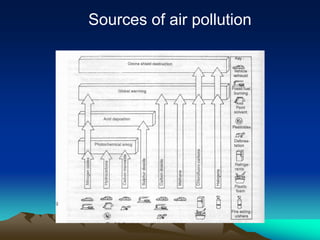
Sources of air pollution
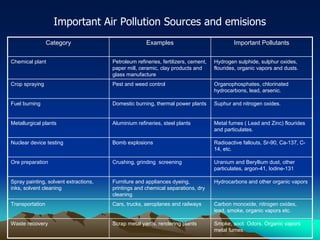
Important Air Pollution Sources and emisions
Category Examples Important Pollutants
Chemical plant Petroleum refineries, fertilizers, cement,
paper mill, ceramic, clay products and
glass manufacture
Hydrogen sulphide, sulphur oxides,
flourides, organic vapors and dusts.
Crop spraying Pest and weed control Organophosphates, chlorinated
hydrocarbons, lead, arsenic.
Fuel burning Domestic burning, thermal power plants Suphur and nitrogen oxides.
Metallurgical plants Aluminium refineries, steel plants Metal fumes ( Lead and Zinc) flourides
and particulates.
Nuclear device testing Bomb explosions Radioactive fallouts, Sr-90, Ca-137, C-
14, etc.
Ore preparation Crushing, grinding screening Uranium and Beryllium dust, other
particulates, argon-41, Iodine-131
Spray painting, solvent extractions,
inks, solvent cleaning
Furniture and appliances dyeing,
printings and chemical separations, dry
cleaning
Hydrocarbons and other organic vapors
Transportation Cars, trucks, aeroplanes and railways Carbon monoxide, nitrogen oxides,
lead, smoke, organic vapors etc.
Waste recovery Scrap metal yards, rendering plants Smoke, soot. Odors. Organic vapors
metal fumes.
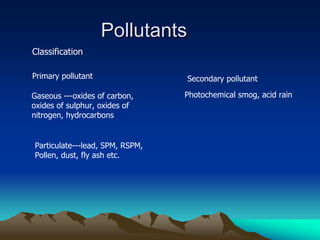
Pollutants
Pollutants
Classification
Primary pollutant Secondary pollutant
Photochemical smog, acid rain
Gaseous ---oxides of carbon,
oxides of sulphur, oxides of
nitrogen, hydrocarbons
Particulate---lead, SPM, RSPM,
Pollen, dust, fly ash etc.
Photochemical smog
Photochemical smog
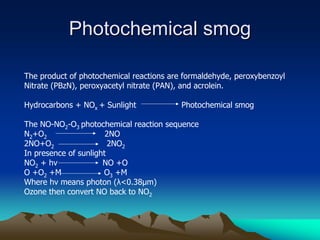
The product of photochemical reactions are formaldehyde, peroxybenzoyl
Nitrate (PBzN), peroxyacetyl nitrate (PAN), and acrolein.
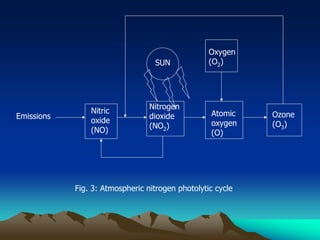
Hydrocarbons + NOx + Sunlight Photochemical smog
The NO-NO2-O3 photochemical reaction sequence
N2+O2 2NO
2NO+O2 2NO2
In presence of sunlight
NO2 + hv NO +O
O +O2 +M O3 +M
Where hv means photon (λ<0.38µm)
Ozone then convert NO back to NO2
Emissions
Nitric
oxide
(NO)
Nitrogen
dioxide
(NO2)
Atomic
oxygen
(O)
Ozone
(O3)
Oxygen
(O2)
SUN
Fig. 3: Atmospheric nitrogen photolytic cycle
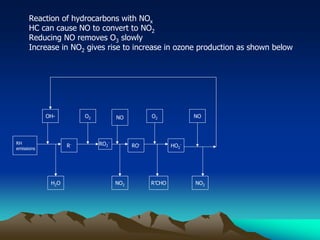
Reaction of hydrocarbons with NOx
HC can cause NO to convert to NO2
Reducing NO removes O3 slowly
Increase in NO2 gives rise to increase in ozone production as shown below
RO2
-
NO
R-
RH
emissions
RO-
HO2
-
H2O
OH- O2 NO
NO2
O2
R’CHO NO2
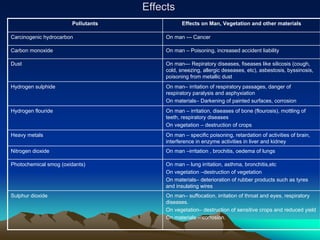
Effects
Effects
Pollutants Effects on Man, Vegetation and other materials
Carcinogenic hydrocarbon On man --- Cancer
Carbon monoxide On man – Poisoning, increased accident liability
Dust On man--- Repiratory diseases, fiseases like silicosis (cough,
cold, sneezing, allergic deseases, etc), asbestosis, byssinosis,
poisoning from metallic dust
Hydrogen sulphide On man– irritation of respiratory passages, danger of
respiratory paralysis and asphyxiation
On materials– Darkening of painted surfaces, corrosion
Hydrogen flouride On man – irritation, diseases of bone (flourosis), mottling of
teeth, respiratory diseases
On vegetation – destruction of crops
Heavy metals On man – specific poisoning, retardation of activities of brain,
interference in enzyme activities in liver and kidney
Nitrogen dioxide On man –irritation , brochitis, oedema of lungs
Photochemical smog (oxidants) On man – lung irritation, asthma, bronchitis,etc
On vegetation –destruction of vegetation
On materials– deterioration of rubber products such as tyres
and insulating wires
Sulphur dioxide On man– suffocation, irritation of throat and eyes, respiratory
diseases.
On vegetation– destruction of sensitive crops and reduced yield
On materials – corrosion.
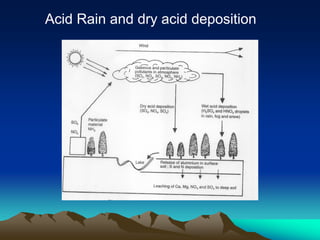
Acid Rain and dry acid deposition
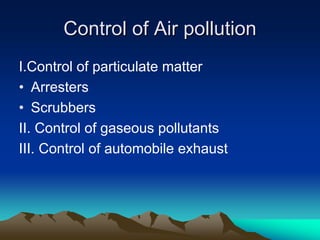
Control of Air pollution
I.Control of particulate matter
• Arresters
• Scrubbers
II. Control of gaseous pollutants
III. Control of automobile exhaust
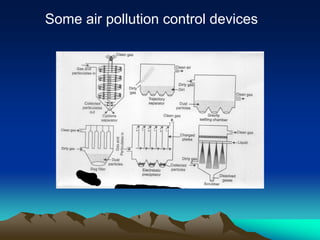
Some air pollution control devices
Air pollution Meteorology
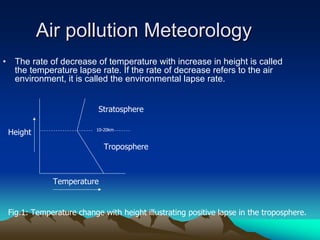
• The rate of decrease of temperature with increase in height is called
the temperature lapse rate. If the rate of decrease refers to the air
environment, it is called the environmental lapse rate.
10-20km
Stratosphere
Troposphere
Height
Temperature
Fig.1: Temperature change with height illustrating positive lapse in the troposphere.
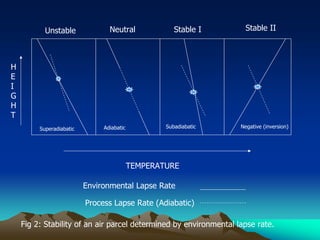
Superadiabatic
TEMPERATURE
H
E
I
G
H
T
Unstable Neutral Stable I Stable II
Adiabatic Subadiabatic Negative (inversion)
Environmental Lapse Rate
Process Lapse Rate (Adiabatic)
Fig 2: Stability of an air parcel determined by environmental lapse rate.
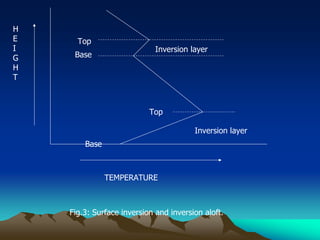
Top
Inversion layer
Inversion layer
Top
Base
Base
H
E
I
G
H
T
TEMPERATURE
Fig.3: Surface inversion and inversion aloft.
Assesment
Assesment
The pollution can be assesed by the use of
a. High volume sampler
b. Gas bubbler
c. Respirable dust monitoring equipments
d. Stack monitoring
Water pollution
Water pollution
It is defined as the addition of some
substance (organic, inorganic, biological or
radiological) or factor (heat), which
degrade the quality of water so that it
either becomes health hazards or unfit for
use.
Sources of water pollution
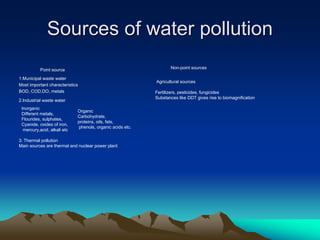
Non-point sources
Point source
1.Municipal waste water
Most important characteristics
BOD, COD,DO, metals
Agricultural sources
Fertilizers, pesticides, fungicides
Substances like DDT gives rise to biomagnification
2.Industrial waste water
Inorganic
Different metals,
Flourides, sulphates,
Cyanide, oxides of iron,
mercury,acid, alkali etc
Organic
Carbohydrate,
proteins, oils, fats,
phenols, organic acids etc.
3. Thermal pollution
Main sources are thermal and nuclear power plant
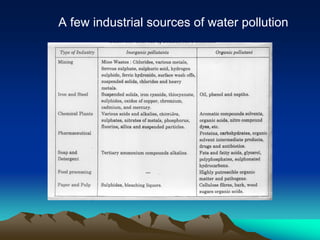
A few industrial sources of water pollution
Effect on the aquatic system
• The oxygen demand in waste consumes Do from water and it may
bring it down to a value less than 4ppm which is threshold value for
the survival of fish and other aquatic life. Reduced DO also eliminate
the sensitive species like plankton, molusc and fish while annelid
worm and some insect larvae are tolerant to low DO content.
• The DO of the water depends upon the temperature of water
• Heavy metals and high temperature also affects the organisms
• Eutrophication algal bloom
Effects on human health
• The waste water or sewage contains pathogens which when
consumed causes jaundice, cholera, typhoid, amoebiosis etc.
• Heavy metals can cause serious health problems. Murcuric
compounds are converted by bacterial actions into methyl mercury
which causes numbness of limbs, lips and tongue, blurring of vision
and metal derangement
• Minimata desease was caused in 1952 in Japan due to consumption
of mercury
• Cadmium can cause itai itai disease which is a painful disease of
bones and joints, cancer of lungs and liver.
• lead causes anaemia, headache, loss of muscle power and bluish
line around gums
Excess nitrate (ground water) may be fatal for infants. It causes
Methaemoglobinemia or blue baby disease
Haemoglobin + nitrate methaemoglobin
Flouride Causes teeth deformaty hardening of bones and
Skeletal florosis
Control
Control
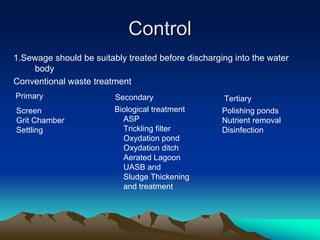
1.Sewage should be suitably treated before discharging into the water
body
Conventional waste treatment
Primary Secondary Tertiary
Biological treatment
ASP
Trickling filter
Oxydation pond
Oxydation ditch
Aerated Lagoon
UASB and
Sludge Thickening
and treatment
Polishing ponds
Nutrient removal
Disinfection
Screen
Grit Chamber
Settling
Soil /land Pollution
• The top soil gets polluted by the addition of the substances to the soil which
adversely affect physical, chemical and biological properties of soil and reduces its
productivity
• The process of soil production is very slow and hence the soil can be considered as
non-renewable resource.
• Soil pollution may occur by dumping and disposing the waste directly on land,
application of agrochemicals or indirectly through air pollution.
• Main soil pollutants are
• Industrial waste
• Pesticides
• Fertilizers and manures
• Discarded waste
• Solid and semi solid
• Radioactive sources
• And other polluting materials entering indirectly
Effect
Effect
• Salination of the soil
• The soil may become infertile
• The pollutants may leach down with the rain water polluting the
ground water
Control
Control
• Manage the solid waste properly
• Pneumatic pipes should be laid for
collecting and disposing waste
• Industrial waste should be dumped in
special pits
• Chemical fertilizers and pesticides used
may be reduced--- biofertilizer,
biopesticides
Radioactive pollution
• Natural sources--- from earth’s crust
• Man made sources
• Nuclear power plant
• Atomic explosions
• Nuclear fall out
• Radioactive isotopes used in laboratories,
radiation therapy
Effects of radioactive pollution
• It depends upon half life, energy releasing
capacity, rate of diffusion, rate of
deposition of pollutant and the
environmental factors like wind,
temperature and rainfall
• The radiations can cause demage to skin,
sun burns,impair metabollism etc.
control
control
• Proper precaution should be taken to
prevent the nuclear fall out
• Leakage should be checked
• Safe Disposal of radioactive waste
• Regular monitoring
• Prevent occupational exposure
Noise pollution
Noise pollution

Environmental Pollution; Types, Causes & Resolutions. IITR

  • 1.
    Environmental pollution: Environmental pollution: Sources,causes Sources, causes, , effect and effect and control control Dr. Dr. Renu Renu Bhargava Bhargava Professor, Professor, Env Env Engg Engg Section, Section, Deptt Deptt of Civil of Civil Engg Engg., ., IIT, IIT, Roorkee Roorkee
  • 2.
    Pollution Pollution Pollution may bedefined as ‘an undesirable change in the physical, chemical or biological characteristics of our air, water and land that may or will harmfully, affect human life, the lives of the desirable species, our industrial processes, living conditions and cultural assets, or that may or will waste or deteriorate our raw materials. Pollution is mostly man made, but it can also be natural. Natural pollution is caused by volcanic eruptions, emission of natural gases, soil erosion, ultraviolet rays, cosmic rays etc.
  • 3.
    Types of Pollution Typesof Pollution • Atmospheric (air) pollution • Water pollution • Soil/land pollution • Radioactive pollution • Noise pollution
  • 4.
  • 5.
    Definition Definition Presence of foreignmaterial in the air which are harmful to man and environment.
  • 6.
    Sources of AirPollution Sources of Air Pollution A. Natural B. Anthropogenic Domestic Commercial Agricultural Industrial Transportation related sources
  • 7.
    Natural sources Natural sources Naturalpollutant emissions vary from one location to another, with seasonal, geological and meteorological conditions and with the type of vegetation eg. Volcanic eruptions, forest fires, dust storms etc.
  • 8.
    Domestic Sources Domestic Sources Inresidential areas, domestic activities are the major causes of pollutant emissions. Activity Pollutants released Space heating CO, CO2, NOx, Sox, soot, smoke (if fossil fuels are burned at the residence) Cooking Fats ( as solids, liquids, and vapors), particles, odors Cleaning Solvent vapors, dust, lint, spray can propellants Gardening Pesticides, fertilizers (some of which may be highly toxic) Painting Principally solvent vapors Washing Detergent particles, soap particles, lint
  • 9.
    Commercial Sources Commercial Sources •commercial sources of air pollution include the public services industries eg.,dry cleaning of clothes. • Other include restaurants, hotels, schools, printing and painting.
  • 10.
    Agricultural Sources Agricultural Sources •animal feed operations • Cotton particles during harvesting and processing in sufficient quantities • Pesticides and insecticides
  • 11.
    Industrial sources Industrial sources Afew of the polluting industries are • Fertilizer and explosive manufactures (produces NOx) • Paper plants, natural gas cleaning and processing plants, oil refineries, synthetic fibers plant ( Hydrogen sulfide) • Cast iron and other metallurgical processes ( CO) • Industries related to petroleum and natural gas industries (VOCs)
  • 12.
    Transportation related sources Transportationrelated sources • Except agriculture the transportation sector releases one third of the total emissions of VOCs, nitrogen oxides, and lead and more two thirds of the carbon monoxide.
  • 13.
    Sources of airpollution
  • 14.
    Important Air PollutionSources and emisions Category Examples Important Pollutants Chemical plant Petroleum refineries, fertilizers, cement, paper mill, ceramic, clay products and glass manufacture Hydrogen sulphide, sulphur oxides, flourides, organic vapors and dusts. Crop spraying Pest and weed control Organophosphates, chlorinated hydrocarbons, lead, arsenic. Fuel burning Domestic burning, thermal power plants Suphur and nitrogen oxides. Metallurgical plants Aluminium refineries, steel plants Metal fumes ( Lead and Zinc) flourides and particulates. Nuclear device testing Bomb explosions Radioactive fallouts, Sr-90, Ca-137, C- 14, etc. Ore preparation Crushing, grinding screening Uranium and Beryllium dust, other particulates, argon-41, Iodine-131 Spray painting, solvent extractions, inks, solvent cleaning Furniture and appliances dyeing, printings and chemical separations, dry cleaning Hydrocarbons and other organic vapors Transportation Cars, trucks, aeroplanes and railways Carbon monoxide, nitrogen oxides, lead, smoke, organic vapors etc. Waste recovery Scrap metal yards, rendering plants Smoke, soot. Odors. Organic vapors metal fumes.
  • 15.
    Pollutants Pollutants Classification Primary pollutant Secondarypollutant Photochemical smog, acid rain Gaseous ---oxides of carbon, oxides of sulphur, oxides of nitrogen, hydrocarbons Particulate---lead, SPM, RSPM, Pollen, dust, fly ash etc.
  • 16.
    Photochemical smog Photochemical smog Theproduct of photochemical reactions are formaldehyde, peroxybenzoyl Nitrate (PBzN), peroxyacetyl nitrate (PAN), and acrolein. Hydrocarbons + NOx + Sunlight Photochemical smog The NO-NO2-O3 photochemical reaction sequence N2+O2 2NO 2NO+O2 2NO2 In presence of sunlight NO2 + hv NO +O O +O2 +M O3 +M Where hv means photon (λ<0.38µm) Ozone then convert NO back to NO2
  • 17.
  • 18.
    Reaction of hydrocarbonswith NOx HC can cause NO to convert to NO2 Reducing NO removes O3 slowly Increase in NO2 gives rise to increase in ozone production as shown below RO2 - NO R- RH emissions RO- HO2 - H2O OH- O2 NO NO2 O2 R’CHO NO2
  • 19.
    Effects Effects Pollutants Effects onMan, Vegetation and other materials Carcinogenic hydrocarbon On man --- Cancer Carbon monoxide On man – Poisoning, increased accident liability Dust On man--- Repiratory diseases, fiseases like silicosis (cough, cold, sneezing, allergic deseases, etc), asbestosis, byssinosis, poisoning from metallic dust Hydrogen sulphide On man– irritation of respiratory passages, danger of respiratory paralysis and asphyxiation On materials– Darkening of painted surfaces, corrosion Hydrogen flouride On man – irritation, diseases of bone (flourosis), mottling of teeth, respiratory diseases On vegetation – destruction of crops Heavy metals On man – specific poisoning, retardation of activities of brain, interference in enzyme activities in liver and kidney Nitrogen dioxide On man –irritation , brochitis, oedema of lungs Photochemical smog (oxidants) On man – lung irritation, asthma, bronchitis,etc On vegetation –destruction of vegetation On materials– deterioration of rubber products such as tyres and insulating wires Sulphur dioxide On man– suffocation, irritation of throat and eyes, respiratory diseases. On vegetation– destruction of sensitive crops and reduced yield On materials – corrosion.
  • 20.
    Acid Rain anddry acid deposition
  • 21.
    Control of Airpollution Control of Air pollution I.Control of particulate matter • Arresters • Scrubbers II. Control of gaseous pollutants III. Control of automobile exhaust
  • 22.
    Some air pollutioncontrol devices
  • 23.
    Air pollution Meteorology Airpollution Meteorology • The rate of decrease of temperature with increase in height is called the temperature lapse rate. If the rate of decrease refers to the air environment, it is called the environmental lapse rate. 10-20km Stratosphere Troposphere Height Temperature Fig.1: Temperature change with height illustrating positive lapse in the troposphere.
  • 24.
    Superadiabatic TEMPERATURE H E I G H T Unstable Neutral StableI Stable II Adiabatic Subadiabatic Negative (inversion) Environmental Lapse Rate Process Lapse Rate (Adiabatic) Fig 2: Stability of an air parcel determined by environmental lapse rate.
  • 25.
  • 26.
    Assesment Assesment The pollution canbe assesed by the use of a. High volume sampler b. Gas bubbler c. Respirable dust monitoring equipments d. Stack monitoring
  • 27.
    Water pollution Water pollution Itis defined as the addition of some substance (organic, inorganic, biological or radiological) or factor (heat), which degrade the quality of water so that it either becomes health hazards or unfit for use.
  • 28.
    Sources of waterpollution Sources of water pollution Non-point sources Point source 1.Municipal waste water Most important characteristics BOD, COD,DO, metals Agricultural sources Fertilizers, pesticides, fungicides Substances like DDT gives rise to biomagnification 2.Industrial waste water Inorganic Different metals, Flourides, sulphates, Cyanide, oxides of iron, mercury,acid, alkali etc Organic Carbohydrate, proteins, oils, fats, phenols, organic acids etc. 3. Thermal pollution Main sources are thermal and nuclear power plant
  • 29.
    A few industrialsources of water pollution
  • 30.
    Effect on theaquatic system Effect on the aquatic system • The oxygen demand in waste consumes Do from water and it may bring it down to a value less than 4ppm which is threshold value for the survival of fish and other aquatic life. Reduced DO also eliminate the sensitive species like plankton, molusc and fish while annelid worm and some insect larvae are tolerant to low DO content. • The DO of the water depends upon the temperature of water • Heavy metals and high temperature also affects the organisms • Eutrophication algal bloom
  • 31.
    Effects on humanhealth Effects on human health • The waste water or sewage contains pathogens which when consumed causes jaundice, cholera, typhoid, amoebiosis etc. • Heavy metals can cause serious health problems. Murcuric compounds are converted by bacterial actions into methyl mercury which causes numbness of limbs, lips and tongue, blurring of vision and metal derangement • Minimata desease was caused in 1952 in Japan due to consumption of mercury • Cadmium can cause itai itai disease which is a painful disease of bones and joints, cancer of lungs and liver. • lead causes anaemia, headache, loss of muscle power and bluish line around gums
  • 32.
    Excess nitrate (groundwater) may be fatal for infants. It causes Methaemoglobinemia or blue baby disease Haemoglobin + nitrate methaemoglobin Flouride Causes teeth deformaty hardening of bones and Skeletal florosis
  • 33.
    Control Control 1.Sewage should besuitably treated before discharging into the water body Conventional waste treatment Primary Secondary Tertiary Biological treatment ASP Trickling filter Oxydation pond Oxydation ditch Aerated Lagoon UASB and Sludge Thickening and treatment Polishing ponds Nutrient removal Disinfection Screen Grit Chamber Settling
  • 34.
    Soil /land Pollution Soil/land Pollution • The top soil gets polluted by the addition of the substances to the soil which adversely affect physical, chemical and biological properties of soil and reduces its productivity • The process of soil production is very slow and hence the soil can be considered as non-renewable resource. • Soil pollution may occur by dumping and disposing the waste directly on land, application of agrochemicals or indirectly through air pollution. • Main soil pollutants are • Industrial waste • Pesticides • Fertilizers and manures • Discarded waste • Solid and semi solid • Radioactive sources • And other polluting materials entering indirectly
  • 35.
    Effect Effect • Salination ofthe soil • The soil may become infertile • The pollutants may leach down with the rain water polluting the ground water
  • 36.
    Control Control • Manage thesolid waste properly • Pneumatic pipes should be laid for collecting and disposing waste • Industrial waste should be dumped in special pits • Chemical fertilizers and pesticides used may be reduced--- biofertilizer, biopesticides
  • 37.
    Radioactive pollution Radioactive pollution •Natural sources--- from earth’s crust • Man made sources • Nuclear power plant • Atomic explosions • Nuclear fall out • Radioactive isotopes used in laboratories, radiation therapy
  • 38.
    Effects of radioactivepollution Effects of radioactive pollution • It depends upon half life, energy releasing capacity, rate of diffusion, rate of deposition of pollutant and the environmental factors like wind, temperature and rainfall • The radiations can cause demage to skin, sun burns,impair metabollism etc.
  • 39.
    control control • Proper precautionshould be taken to prevent the nuclear fall out • Leakage should be checked • Safe Disposal of radioactive waste • Regular monitoring • Prevent occupational exposure
  • 40.