1
MATHEMATICS SCHOOL BASED ASSESMENT
DETERMINING THE DIMENSIONS OF A CORN
FARM TO GIVE MAXIMUM USE OF SPACE
2
TABLE OF CONTENTS
TITLE PAGE
Acknowledgement………………………………………………………………………………………...3
Title of Project……………………………………………………………………………………………….4
Purpose of Project…………………………………………………………………………………………4
Problem Statement …….………………………………………………………………………………..5
Problem Formulation …………………..……………………………………………………………….6
Data Analysis ……………..…………………………………………………………………………………7
Problem Calculation and Analysis …….…………………………………………………………..8
Discussion of Findings .…………….……………………………..…………………………………….9
Conclusion …………………………….………………………………………………………………………9
Bibliography …………………………………………………………………………………………………10
3
ACKNOWLEDGEMENT
I would like to express my special thanks to all the persons who helped me with
this project.
Thank you all for your continuous help and support.
4
TITLE OF PROJECT
Determining the maximum dimensions of a corn farm and the number of seedlings
that can be planted on it.
INTRODUCTION
PURPOSE OF STUDY
The purpose of the project is to determine the dimensions that will give maximum
space for the amount of wire that a farmer has available.
My neighbor, Farmer Joe was given two rolls of wire by the Rural Agricultural
Development Authority (RADA) Foundation. This is in aid of helping him to put
up a fencing for the corn he wanted to invest in. Each roll of wire is 50 metres
long. Mr. Joe has sought my assistance with the calculations for the maximum
space that he can enclose with his 100 metres of wire and the number of corn
seedlings that he can plant. He wants a rectangular farm for his corn, and he wants
to utilize as much space as possible.
Problem Solution
1 roll of wire = 50 metre
2 rolls of wire = 2 x 50 = 100 m
Mr. Joe has 100 metres of wire available.
5
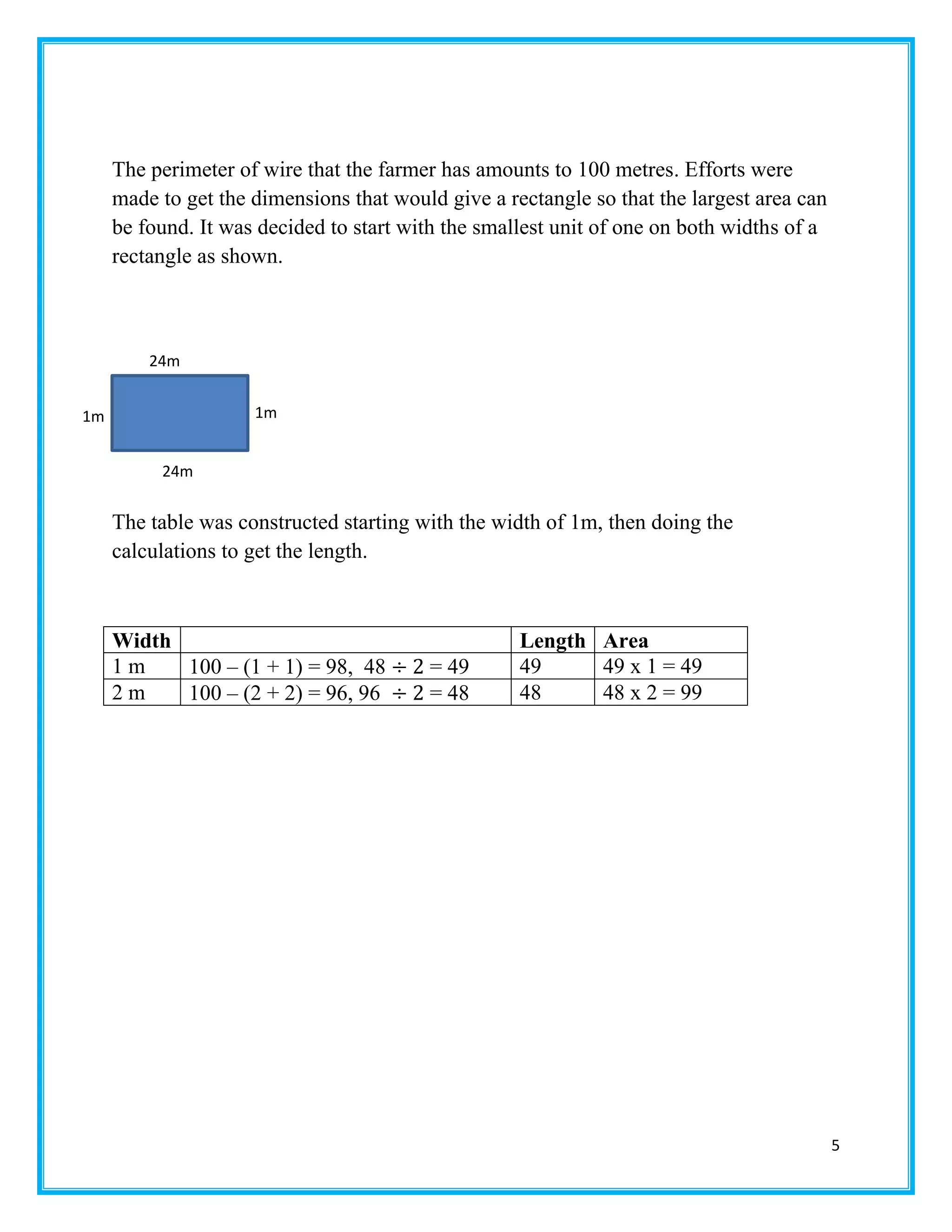
The perimeter of wire that the farmer has amounts to 100 metres. Efforts were
made to get the dimensions that would give a rectangle so that the largest area can
be found. It was decided to start with the smallest unit of one on both widths of a
rectangle as shown.
The table was constructed starting with the width of 1m, then doing the
calculations to get the length.
Width Length Area
1 m 100 – (1 + 1) = 98, 48 ÷ 2 = 49 49 49 x 1 = 49
2 m 100 – (2 + 2) = 96, 96 ÷ 2 = 48 48 48 x 2 = 99
1m
24m
24m
1m
6
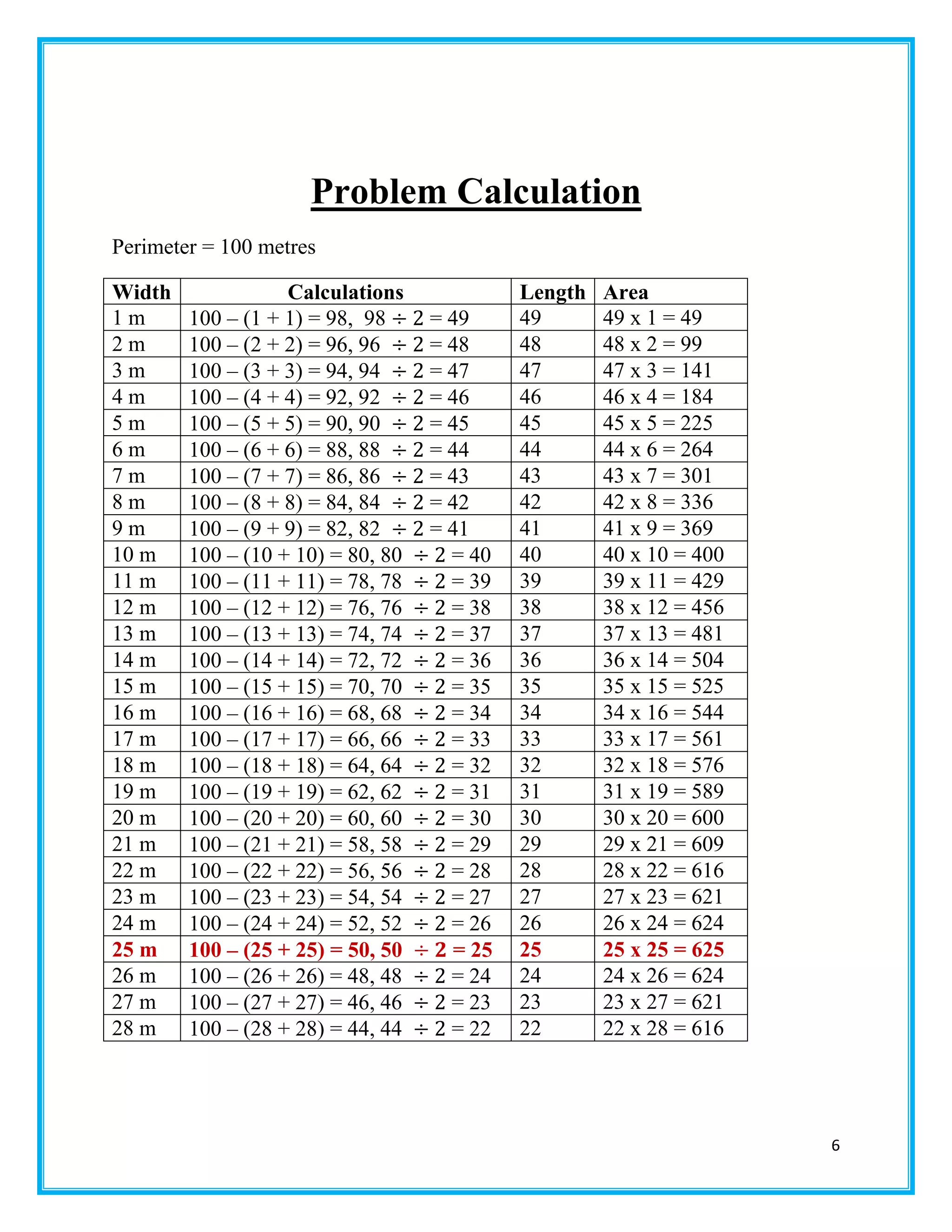
Problem Calculation
Perimeter = 100 metres
Width Calculations Length Area
1 m 100 – (1 + 1) = 98, 98 ÷ 2 = 49 49 49 x 1 = 49
2 m 100 – (2 + 2) = 96, 96 ÷ 2 = 48 48 48 x 2 = 99
3 m 100 – (3 + 3) = 94, 94 ÷ 2 = 47 47 47 x 3 = 141
4 m 100 – (4 + 4) = 92, 92 ÷ 2 = 46 46 46 x 4 = 184
5 m 100 – (5 + 5) = 90, 90 ÷ 2 = 45 45 45 x 5 = 225
6 m 100 – (6 + 6) = 88, 88 ÷ 2 = 44 44 44 x 6 = 264
7 m 100 – (7 + 7) = 86, 86 ÷ 2 = 43 43 43 x 7 = 301
8 m 100 – (8 + 8) = 84, 84 ÷ 2 = 42 42 42 x 8 = 336
9 m 100 – (9 + 9) = 82, 82 ÷ 2 = 41 41 41 x 9 = 369
10 m 100 – (10 + 10) = 80, 80 ÷ 2 = 40 40 40 x 10 = 400
11 m 100 – (11 + 11) = 78, 78 ÷ 2 = 39 39 39 x 11 = 429
12 m 100 – (12 + 12) = 76, 76 ÷ 2 = 38 38 38 x 12 = 456
13 m 100 – (13 + 13) = 74, 74 ÷ 2 = 37 37 37 x 13 = 481
14 m 100 – (14 + 14) = 72, 72 ÷ 2 = 36 36 36 x 14 = 504
15 m 100 – (15 + 15) = 70, 70 ÷ 2 = 35 35 35 x 15 = 525
16 m 100 – (16 + 16) = 68, 68 ÷ 2 = 34 34 34 x 16 = 544
17 m 100 – (17 + 17) = 66, 66 ÷ 2 = 33 33 33 x 17 = 561
18 m 100 – (18 + 18) = 64, 64 ÷ 2 = 32 32 32 x 18 = 576
19 m 100 – (19 + 19) = 62, 62 ÷ 2 = 31 31 31 x 19 = 589
20 m 100 – (20 + 20) = 60, 60 ÷ 2 = 30 30 30 x 20 = 600
21 m 100 – (21 + 21) = 58, 58 ÷ 2 = 29 29 29 x 21 = 609
22 m 100 – (22 + 22) = 56, 56 ÷ 2 = 28 28 28 x 22 = 616
23 m 100 – (23 + 23) = 54, 54 ÷ 2 = 27 27 27 x 23 = 621
24 m 100 – (24 + 24) = 52, 52 ÷ 2 = 26 26 26 x 24 = 624
25 m 100 – (25 + 25) = 50, 50 ÷ 𝟐 = 25 25 25 x 25 = 625
26 m 100 – (26 + 26) = 48, 48 ÷ 2 = 24 24 24 x 26 = 624
27 m 100 – (27 + 27) = 46, 46 ÷ 2 = 23 23 23 x 27 = 621
28 m 100 – (28 + 28) = 44, 44 ÷ 2 = 22 22 22 x 28 = 616
7
The lengths and the widths were then used to find the area, and the highest value
observed.
DATA ANALYSIS
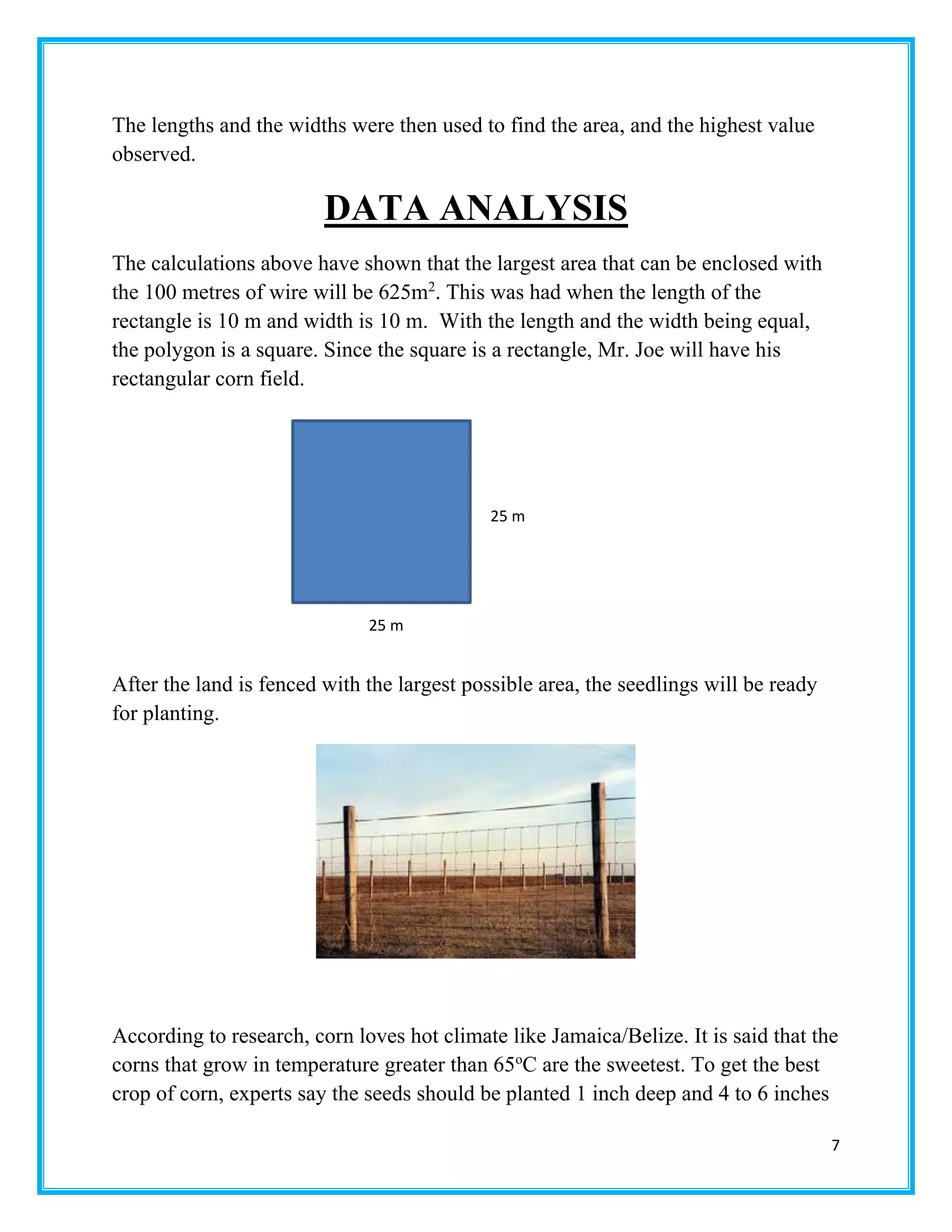
The calculations above have shown that the largest area that can be enclosed with
the 100 metres of wire will be 625m2
. This was had when the length of the
rectangle is 10 m and width is 10 m. With the length and the width being equal,
the polygon is a square. Since the square is a rectangle, Mr. Joe will have his
rectangular corn field.
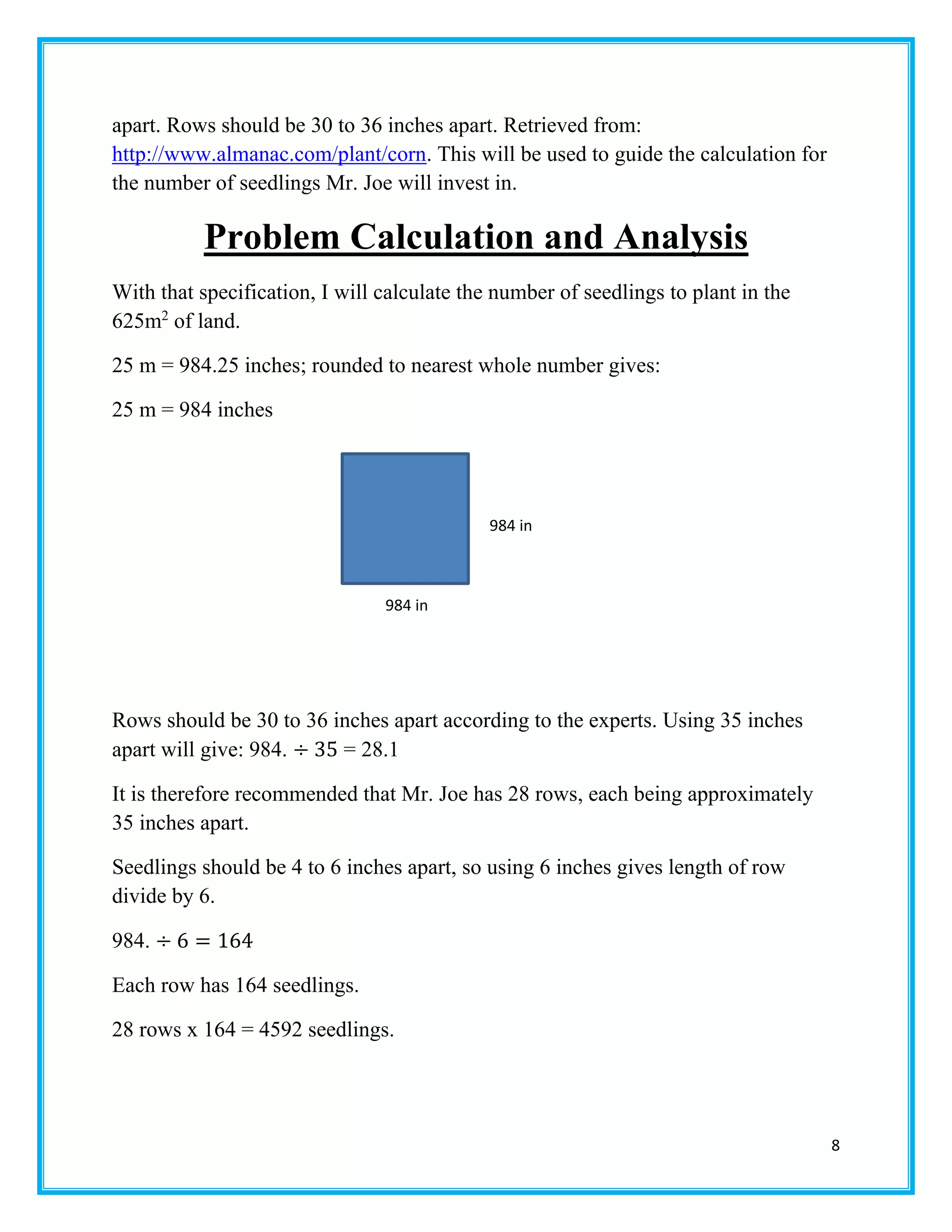
After the land is fenced with the largest possible area, the seedlings will be ready
for planting.
According to research, corn loves hot climate like Jamaica/Belize. It is said that the
corns that grow in temperature greater than 65o
C are the sweetest. To get the best
crop of corn, experts say the seeds should be planted 1 inch deep and 4 to 6 inches
25 m
25 m
8
apart. Rows should be 30 to 36 inches apart. Retrieved from:
http://www.almanac.com/plant/corn. This will be used to guide the calculation for
the number of seedlings Mr. Joe will invest in.
Problem Calculation and Analysis
With that specification, I will calculate the number of seedlings to plant in the
625m2
of land.
25 m = 984.25 inches; rounded to nearest whole number gives:
25 m = 984 inches
Rows should be 30 to 36 inches apart according to the experts. Using 35 inches
apart will give: 984. ÷ 35 = 28.1
It is therefore recommended that Mr. Joe has 28 rows, each being approximately
35 inches apart.
Seedlings should be 4 to 6 inches apart, so using 6 inches gives length of row
divide by 6.
984. ÷ 6 = 164
Each row has 164 seedlings.
28 rows x 164 = 4592 seedlings.
984 in
984 in
9
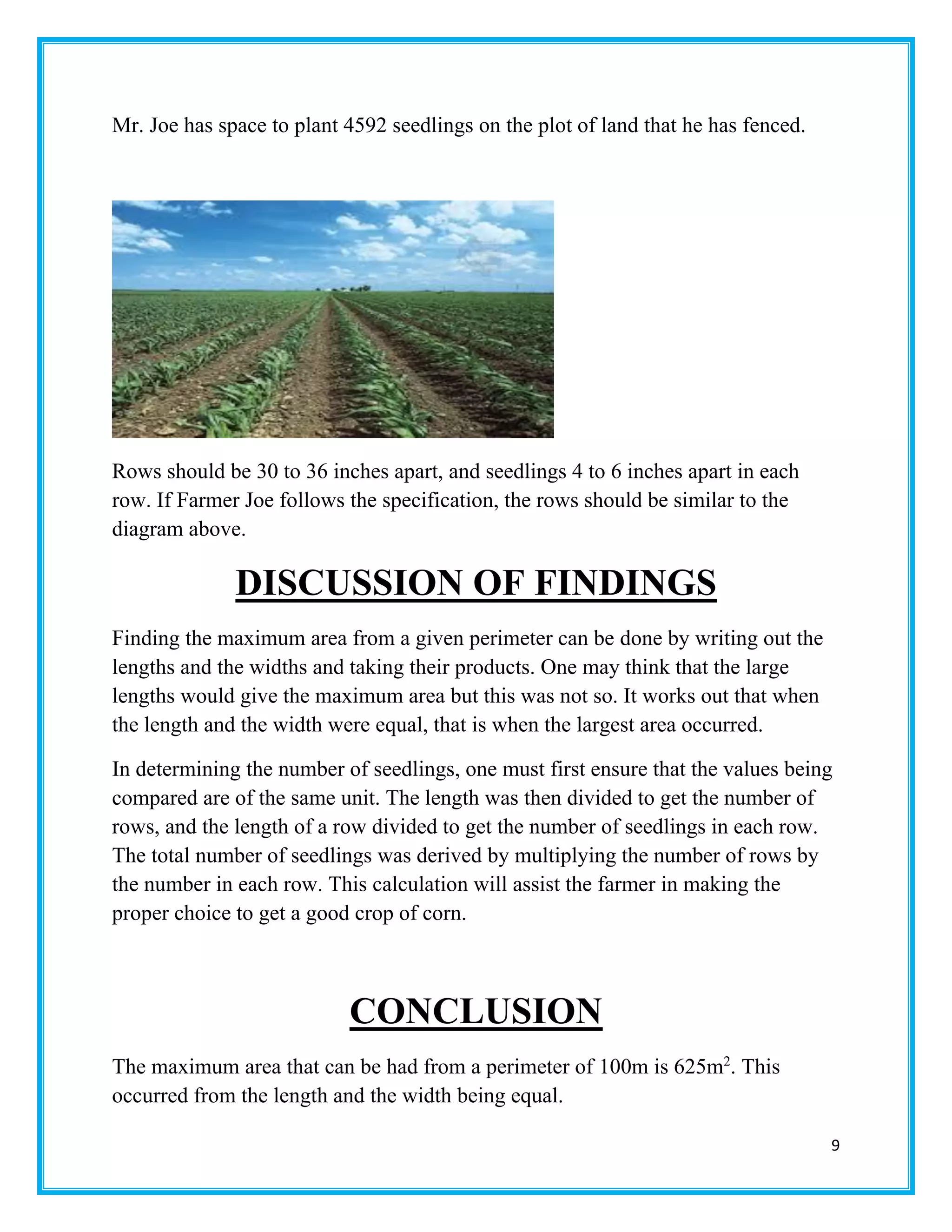
Mr. Joe has space to plant 4592 seedlings on the plot of land that he has fenced.
Rows should be 30 to 36 inches apart, and seedlings 4 to 6 inches apart in each
row. If Farmer Joe follows the specification, the rows should be similar to the
diagram above.
DISCUSSION OF FINDINGS
Finding the maximum area from a given perimeter can be done by writing out the
lengths and the widths and taking their products. One may think that the large
lengths would give the maximum area but this was not so. It works out that when
the length and the width were equal, that is when the largest area occurred.
In determining the number of seedlings, one must first ensure that the values being
compared are of the same unit. The length was then divided to get the number of
rows, and the length of a row divided to get the number of seedlings in each row.
The total number of seedlings was derived by multiplying the number of rows by
the number in each row. This calculation will assist the farmer in making the
proper choice to get a good crop of corn.
CONCLUSION
The maximum area that can be had from a perimeter of 100m is 625m2
. This
occurred from the length and the width being equal.
10
The total number of seedlings to be planted on this plot of land, based on the
recommended spacing of experts, is 4592.
11
BIBLIOGRAPHY
Sweet Corn: Planting, Growing and Harvesting Sweet Corn. Retrieved from
http://www.almanac.com/plant/corn
Toolsie, R. (1996). Mathematics: A Complete Course with C.X.C. Questions, San
Fernando: Caribbean Educational Publishers.

CSEC Mathematics Workshop SBA

  • 1.
    1 MATHEMATICS SCHOOL BASEDASSESMENT DETERMINING THE DIMENSIONS OF A CORN FARM TO GIVE MAXIMUM USE OF SPACE
  • 2.
    2 TABLE OF CONTENTS TITLEPAGE Acknowledgement………………………………………………………………………………………...3 Title of Project……………………………………………………………………………………………….4 Purpose of Project…………………………………………………………………………………………4 Problem Statement …….………………………………………………………………………………..5 Problem Formulation …………………..……………………………………………………………….6 Data Analysis ……………..…………………………………………………………………………………7 Problem Calculation and Analysis …….…………………………………………………………..8 Discussion of Findings .…………….……………………………..…………………………………….9 Conclusion …………………………….………………………………………………………………………9 Bibliography …………………………………………………………………………………………………10
  • 3.
    3 ACKNOWLEDGEMENT I would liketo express my special thanks to all the persons who helped me with this project. Thank you all for your continuous help and support.
  • 4.
    4 TITLE OF PROJECT Determiningthe maximum dimensions of a corn farm and the number of seedlings that can be planted on it. INTRODUCTION PURPOSE OF STUDY The purpose of the project is to determine the dimensions that will give maximum space for the amount of wire that a farmer has available. My neighbor, Farmer Joe was given two rolls of wire by the Rural Agricultural Development Authority (RADA) Foundation. This is in aid of helping him to put up a fencing for the corn he wanted to invest in. Each roll of wire is 50 metres long. Mr. Joe has sought my assistance with the calculations for the maximum space that he can enclose with his 100 metres of wire and the number of corn seedlings that he can plant. He wants a rectangular farm for his corn, and he wants to utilize as much space as possible. Problem Solution 1 roll of wire = 50 metre 2 rolls of wire = 2 x 50 = 100 m Mr. Joe has 100 metres of wire available.
  • 5.
    5 The perimeter ofwire that the farmer has amounts to 100 metres. Efforts were made to get the dimensions that would give a rectangle so that the largest area can be found. It was decided to start with the smallest unit of one on both widths of a rectangle as shown. The table was constructed starting with the width of 1m, then doing the calculations to get the length. Width Length Area 1 m 100 – (1 + 1) = 98, 48 ÷ 2 = 49 49 49 x 1 = 49 2 m 100 – (2 + 2) = 96, 96 ÷ 2 = 48 48 48 x 2 = 99 1m 24m 24m 1m
  • 6.
    6 Problem Calculation Perimeter =100 metres Width Calculations Length Area 1 m 100 – (1 + 1) = 98, 98 ÷ 2 = 49 49 49 x 1 = 49 2 m 100 – (2 + 2) = 96, 96 ÷ 2 = 48 48 48 x 2 = 99 3 m 100 – (3 + 3) = 94, 94 ÷ 2 = 47 47 47 x 3 = 141 4 m 100 – (4 + 4) = 92, 92 ÷ 2 = 46 46 46 x 4 = 184 5 m 100 – (5 + 5) = 90, 90 ÷ 2 = 45 45 45 x 5 = 225 6 m 100 – (6 + 6) = 88, 88 ÷ 2 = 44 44 44 x 6 = 264 7 m 100 – (7 + 7) = 86, 86 ÷ 2 = 43 43 43 x 7 = 301 8 m 100 – (8 + 8) = 84, 84 ÷ 2 = 42 42 42 x 8 = 336 9 m 100 – (9 + 9) = 82, 82 ÷ 2 = 41 41 41 x 9 = 369 10 m 100 – (10 + 10) = 80, 80 ÷ 2 = 40 40 40 x 10 = 400 11 m 100 – (11 + 11) = 78, 78 ÷ 2 = 39 39 39 x 11 = 429 12 m 100 – (12 + 12) = 76, 76 ÷ 2 = 38 38 38 x 12 = 456 13 m 100 – (13 + 13) = 74, 74 ÷ 2 = 37 37 37 x 13 = 481 14 m 100 – (14 + 14) = 72, 72 ÷ 2 = 36 36 36 x 14 = 504 15 m 100 – (15 + 15) = 70, 70 ÷ 2 = 35 35 35 x 15 = 525 16 m 100 – (16 + 16) = 68, 68 ÷ 2 = 34 34 34 x 16 = 544 17 m 100 – (17 + 17) = 66, 66 ÷ 2 = 33 33 33 x 17 = 561 18 m 100 – (18 + 18) = 64, 64 ÷ 2 = 32 32 32 x 18 = 576 19 m 100 – (19 + 19) = 62, 62 ÷ 2 = 31 31 31 x 19 = 589 20 m 100 – (20 + 20) = 60, 60 ÷ 2 = 30 30 30 x 20 = 600 21 m 100 – (21 + 21) = 58, 58 ÷ 2 = 29 29 29 x 21 = 609 22 m 100 – (22 + 22) = 56, 56 ÷ 2 = 28 28 28 x 22 = 616 23 m 100 – (23 + 23) = 54, 54 ÷ 2 = 27 27 27 x 23 = 621 24 m 100 – (24 + 24) = 52, 52 ÷ 2 = 26 26 26 x 24 = 624 25 m 100 – (25 + 25) = 50, 50 ÷ 𝟐 = 25 25 25 x 25 = 625 26 m 100 – (26 + 26) = 48, 48 ÷ 2 = 24 24 24 x 26 = 624 27 m 100 – (27 + 27) = 46, 46 ÷ 2 = 23 23 23 x 27 = 621 28 m 100 – (28 + 28) = 44, 44 ÷ 2 = 22 22 22 x 28 = 616
  • 7.
    7 The lengths andthe widths were then used to find the area, and the highest value observed. DATA ANALYSIS The calculations above have shown that the largest area that can be enclosed with the 100 metres of wire will be 625m2 . This was had when the length of the rectangle is 10 m and width is 10 m. With the length and the width being equal, the polygon is a square. Since the square is a rectangle, Mr. Joe will have his rectangular corn field. After the land is fenced with the largest possible area, the seedlings will be ready for planting. According to research, corn loves hot climate like Jamaica/Belize. It is said that the corns that grow in temperature greater than 65o C are the sweetest. To get the best crop of corn, experts say the seeds should be planted 1 inch deep and 4 to 6 inches 25 m 25 m
  • 8.
    8 apart. Rows shouldbe 30 to 36 inches apart. Retrieved from: http://www.almanac.com/plant/corn. This will be used to guide the calculation for the number of seedlings Mr. Joe will invest in. Problem Calculation and Analysis With that specification, I will calculate the number of seedlings to plant in the 625m2 of land. 25 m = 984.25 inches; rounded to nearest whole number gives: 25 m = 984 inches Rows should be 30 to 36 inches apart according to the experts. Using 35 inches apart will give: 984. ÷ 35 = 28.1 It is therefore recommended that Mr. Joe has 28 rows, each being approximately 35 inches apart. Seedlings should be 4 to 6 inches apart, so using 6 inches gives length of row divide by 6. 984. ÷ 6 = 164 Each row has 164 seedlings. 28 rows x 164 = 4592 seedlings. 984 in 984 in
  • 9.
    9 Mr. Joe hasspace to plant 4592 seedlings on the plot of land that he has fenced. Rows should be 30 to 36 inches apart, and seedlings 4 to 6 inches apart in each row. If Farmer Joe follows the specification, the rows should be similar to the diagram above. DISCUSSION OF FINDINGS Finding the maximum area from a given perimeter can be done by writing out the lengths and the widths and taking their products. One may think that the large lengths would give the maximum area but this was not so. It works out that when the length and the width were equal, that is when the largest area occurred. In determining the number of seedlings, one must first ensure that the values being compared are of the same unit. The length was then divided to get the number of rows, and the length of a row divided to get the number of seedlings in each row. The total number of seedlings was derived by multiplying the number of rows by the number in each row. This calculation will assist the farmer in making the proper choice to get a good crop of corn. CONCLUSION The maximum area that can be had from a perimeter of 100m is 625m2 . This occurred from the length and the width being equal.
  • 10.
    10 The total numberof seedlings to be planted on this plot of land, based on the recommended spacing of experts, is 4592.
  • 11.
    11 BIBLIOGRAPHY Sweet Corn: Planting,Growing and Harvesting Sweet Corn. Retrieved from http://www.almanac.com/plant/corn Toolsie, R. (1996). Mathematics: A Complete Course with C.X.C. Questions, San Fernando: Caribbean Educational Publishers.