

Building lifetime relationships with
our clients and employees.
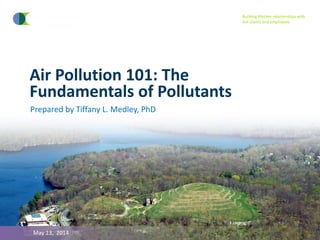
Air Pollution 101: The
Fundamentals of Pollutants
Prepared by Tiffany L. Medley, PhD
May 13, 2014
Air Pollution 101
• Overview of the Criteria Air Pollutants
• NOx, CO, SO2, Particulate, VOC, Ozone
• Why are they regulated?
• Greenhouse Gases
• What are they?
• How are they being measured?
• Current and upcoming regulations that may affect your
facility
© 2014 Cornerstone. All rights reserved. | Confidential
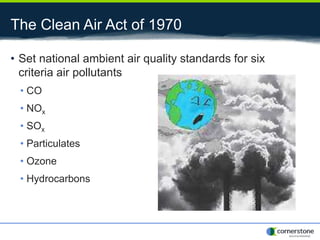
The Clean Air Act of 1970
• Set national ambient air quality standards for six
criteria air pollutants
• CO
• NOx
• SOx
• Particulates
• Ozone
• Hydrocarbons
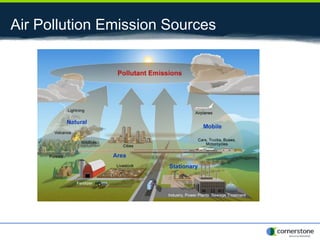
Air Pollution Emission Sources
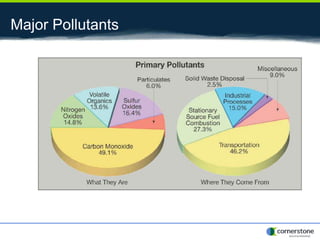
Major Pollutants
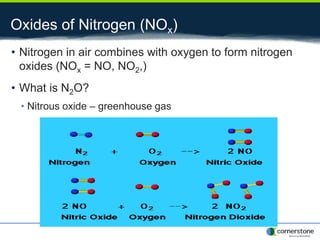
Oxides of Nitrogen (NOx)
• Nitrogen in air combines with oxygen to form nitrogen
oxides (NOx = NO, NO2,)
• What is N2O?
• Nitrous oxide – greenhouse gas
Oxides of Nitrogen (NOx)
• Environmental Effects
• Contributes to acid rain
• Contributes to photochemical smog
• Health Effects
• In high concentrations it causes asphyxiation
• Respiratory irritant
• Damages alveoli which can lead to emphysema
© 2014 Cornerstone. All rights reserved. | Confidential
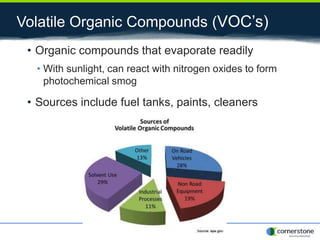
Volatile Organic Compounds (VOC’s)
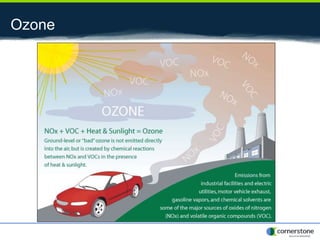
• Organic compounds that evaporate readily
• With sunlight, can react with nitrogen oxides to form
photochemical smog
• Sources include fuel tanks, paints, cleaners
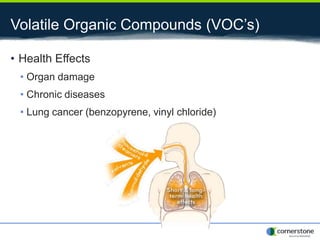
Volatile Organic Compounds (VOC’s)
• Health Effects
• Organ damage
• Chronic diseases
• Lung cancer (benzopyrene, vinyl chloride)
Ozone
Ozone
• Health Effects
• Makes breathing difficult
• Irritates eyes nose and throat
• Bad Air Quality Days or Action Days in the summer
• NJDEP sends out alerts to subscribers
• Owners of emergency generators are not allowed to test
generators on air quality action days
Carbon Monoxide (CO)
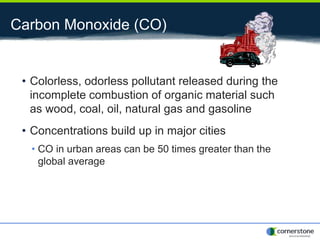
• Colorless, odorless pollutant released during the
incomplete combustion of organic material such
as wood, coal, oil, natural gas and gasoline
• Concentrations build up in major cities
• CO in urban areas can be 50 times greater than the
global average
Carbon Monoxide (CO)
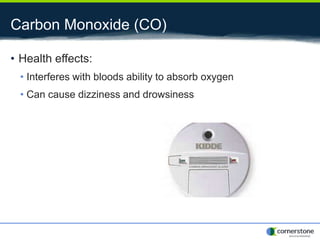
• Health effects:
• Interferes with bloods ability to absorb oxygen
• Can cause dizziness and drowsiness
Oxides of Sulfur (SO2, SO3)
• Gaseous pollutants that form where sulfur containing
fuels are burned. Sulfur combines with oxygen in air
to form SOx
• SOx can also combine with water in air to form
sulfuric acid (potential harmful secondary pollutant)
Oxides of Sulfur (SO2, SO3)
• Health Effects
• Stings eyes and burns the throat
• Respiratory irritant
• Damages alveoli in lungs which can lead to emphysema
• Contributes to lung and heart diseases
• Environmental Effects
• Damages Plants
• Precursor to acid rain
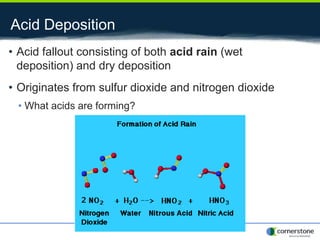
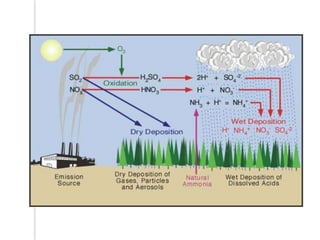
Acid Deposition
• Acid fallout consisting of both acid rain (wet
deposition) and dry deposition
• Originates from sulfur dioxide and nitrogen dioxide
• What acids are forming?
Acid Deposition
• Wet deposition
• Acids deposited in rain, snow and fog
• Dry deposition
• When dust particles containing sulfate or nitrate settle on
Earth and react with water
Acid Deposition
• In the Eastern United States, sulfur dioxide is the
main cause of acidity
• From the combustion of coal fired power plants with limited
sulfur controls in the Upper Ohio River Valley
• In the Western United States, nitrogen dioxide is the
main cause of acidity
• From automotive exhaust
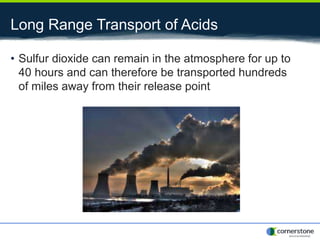
Long Range Transport of Acids
• Sulfur dioxide can remain in the atmosphere for up to
40 hours and can therefore be transported hundreds
of miles away from their release point
National Atmospheric Deposition Program
(1980)
• Collect samples from more than 250 sampling
locations each week
The data shaped Clean Air Act of 1990
regulations on reducing sulfur dioxide and
nitrous oxide emissions
•Goal was to achieve a 50% reduction is
SO2 emissions by 2010
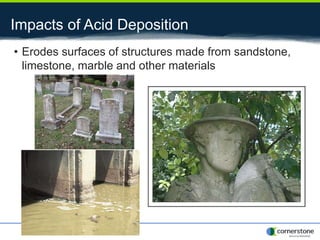
Impacts of Acid Deposition
• Erodes surfaces of structures made from sandstone,
limestone, marble and other materials
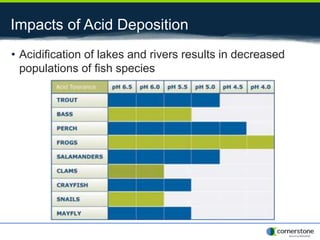
Impacts of Acid Deposition
• Acidification of lakes and rivers results in decreased
populations of fish species
Control of Acid Deposition
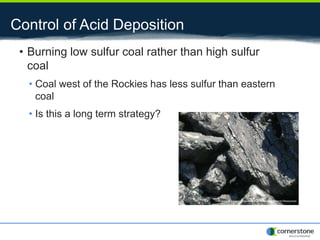
• Burning low sulfur coal rather than high sulfur
coal
• Coal west of the Rockies has less sulfur than eastern
coal
• Is this a long term strategy?
Control of Acid Deposition
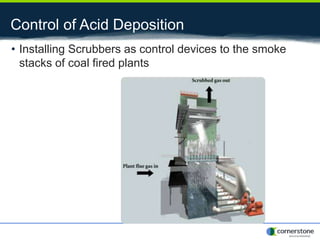
• Installing Scrubbers as control devices to the smoke
stacks of coal fired plants
Regulations to Decrease SOx emissions
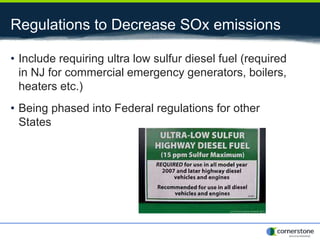
• Include requiring ultra low sulfur diesel fuel (required
in NJ for commercial emergency generators, boilers,
heaters etc.)
• Being phased into Federal regulations for other
States
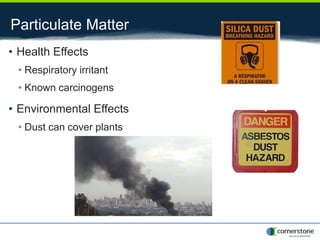
Particulate Matter
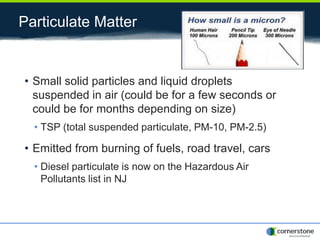
• Small solid particles and liquid droplets
suspended in air (could be for a few seconds or
could be for months depending on size)
• TSP (total suspended particulate, PM-10, PM-2.5)
• Emitted from burning of fuels, road travel, cars
• Diesel particulate is now on the Hazardous Air
Pollutants list in NJ
Particulate Matter
• Health Effects
• Respiratory irritant
• Known carcinogens
• Environmental Effects
• Dust can cover plants
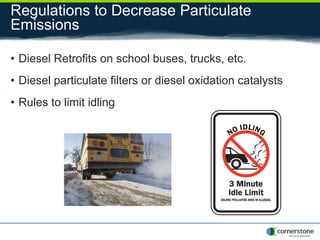
Regulations to Decrease Particulate
Emissions
• Diesel Retrofits on school buses, trucks, etc.
• Diesel particulate filters or diesel oxidation catalysts
• Rules to limit idling
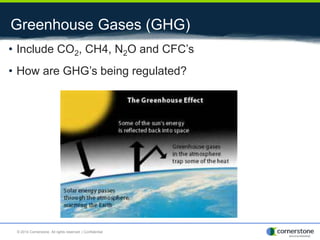
Greenhouse Gases (GHG)
• Include CO2, CH4, N2O and CFC’s
• How are GHG’s being regulated?
© 2014 Cornerstone. All rights reserved. | Confidential
Understanding the Carbon Cycle
• Carbon exists in our bodies (49% of dry
human weight), other organisms, the
atmosphere, the ocean, ocean sediments
and as calcium carbonate (rocks, shells
and skeletons)
• Carbon is recycled rapidly
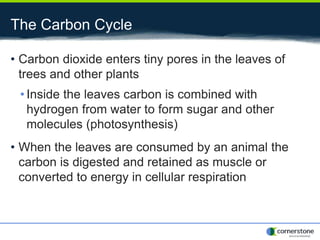
The Carbon Cycle
• Carbon dioxide enters tiny pores in the leaves of
trees and other plants
• Inside the leaves carbon is combined with
hydrogen from water to form sugar and other
molecules (photosynthesis)
• When the leaves are consumed by an animal the
carbon is digested and retained as muscle or
converted to energy in cellular respiration
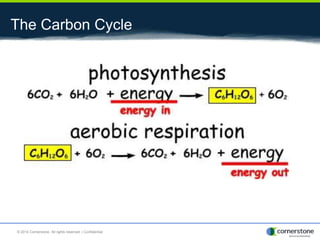
The Carbon Cycle
© 2014 Cornerstone. All rights reserved. | Confidential
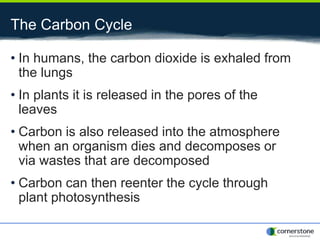
The Carbon Cycle
• In humans, the carbon dioxide is exhaled from
the lungs
• In plants it is released in the pores of the
leaves
• Carbon is also released into the atmosphere
when an organism dies and decomposes or
via wastes that are decomposed
• Carbon can then reenter the cycle through
plant photosynthesis
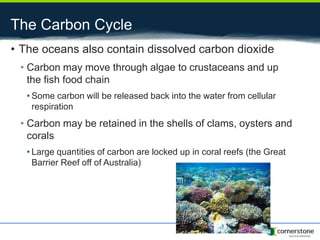
The Carbon Cycle
• The oceans also contain dissolved carbon dioxide
• Carbon may move through algae to crustaceans and up
the fish food chain
• Some carbon will be released back into the water from cellular
respiration
• Carbon may be retained in the shells of clams, oysters and
corals
• Large quantities of carbon are locked up in coral reefs (the Great
Barrier Reef off of Australia)
The Carbon Cycle
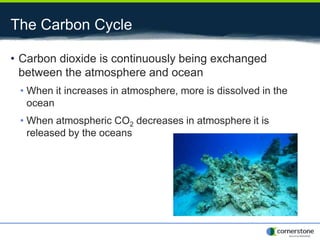
• Carbon dioxide is continuously being exchanged
between the atmosphere and ocean
• When it increases in atmosphere, more is dissolved in the
ocean
• When atmospheric CO2 decreases in atmosphere it is
released by the oceans
The Carbon Cycle
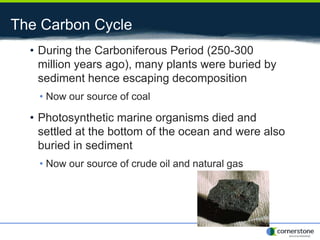
• During the Carboniferous Period (250-300
million years ago), many plants were buried by
sediment hence escaping decomposition
• Now our source of coal
• Photosynthetic marine organisms died and
settled at the bottom of the ocean and were also
buried in sediment
• Now our source of crude oil and natural gas
The Carbon Cycle
• 200 years ago humans discovered the
potential of fossil fuels which has resulted
in a dramatic increase in CO2 being
released into our atmosphere
•From 1870 to 2008- CO2 in the
atmosphere has increased by more than
30%
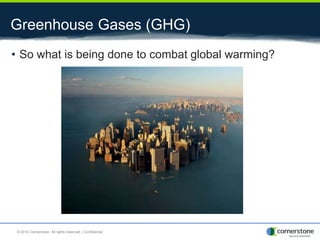
Greenhouse Gases (GHG)
• So what is being done to combat global warming?
© 2014 Cornerstone. All rights reserved. | Confidential
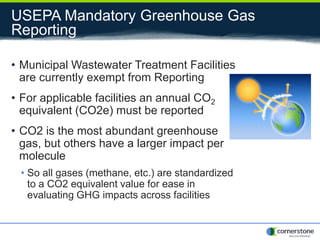
USEPA Mandatory Greenhouse Gas
Reporting
• Municipal Wastewater Treatment Facilities
are currently exempt from Reporting
• For applicable facilities an annual CO2
equivalent (CO2e) must be reported
• CO2 is the most abundant greenhouse
gas, but others have a larger impact per
molecule
• So all gases (methane, etc.) are standardized
to a CO2 equivalent value for ease in
evaluating GHG impacts across facilities
Can GHG’s make me a Title V Facility??
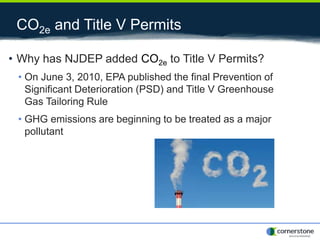
CO2e and Title V Permits
• Why has NJDEP added CO2e to Title V Permits?
• On June 3, 2010, EPA published the final Prevention of
Significant Deterioration (PSD) and Title V Greenhouse
Gas Tailoring Rule
• GHG emissions are beginning to be treated as a major
pollutant
GHG Tailoring Rule and Title V
applicability
• Beginning after July 1, 2011, existing or newly
constructed GHG emission sources (not already
subject to title V) that emit or have a PTE equal to or
greater than:
100,000 TPY CO2e, and
100 TPY GHGs mass basis
© 2014 Cornerstone. All rights reserved. | Confidential
NJDEP now requests a CO2 equivalent
value for Title V Permits
• Have added CO2e to the total facility emissions
inventory page (Section C)
• CO2e is based on the maximum potential fuel usage
for all equipment by fuel type
• Use the EPA emission factors for GHG Inventories
http://www.epa.gov/climateleadership/inventory/ghg-
emissions.html
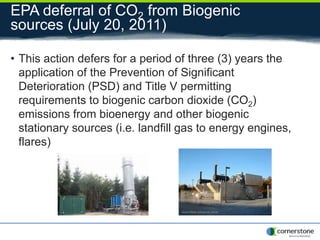
EPA deferral of CO2 from Biogenic
sources (July 20, 2011)
• This action defers for a period of three (3) years the
application of the Prevention of Significant
Deterioration (PSD) and Title V permitting
requirements to biogenic carbon dioxide (CO2)
emissions from bioenergy and other biogenic
stationary sources (i.e. landfill gas to energy engines,
flares)
GHG Tailoring rule and PSD applicability
• The threshold for CO2e has been
increased from 250 tpy for other Major
pollutants to a 75,000 tpy increase for
CO2e during modification
Concerns?
• If the July 20, 2011 deferral is NOT extended,
biogenic emissions (potential) could put you over
100,000 tons of CO2e
• OR…If you become subject to PSD for another major
pollutant and you exceed 75,000 CO2e during
modification:
• You will be subject to BACT (Best Achievable Control
Technology) for greenhouse gases
Concerns?
• Potential non-exemption for biogenic sources could
also impact the Mandatory GHG Reporting.
• Wastewater treatment facilities may have to report if your
emissions from the combustion of digester gas is greater
than 25,000 CO2e
Things to Consider
• Take time to measure
your initial CO2e from the
existing sources in your
permit
• It is likely that that number
will be used in the future to
determine if you have
exceeded 75,000 tons of
CO2e during a modification
In Conclusion…..
• Regulating Air Pollution is necessary
• Your Air Permit Compliance conditions are relevant
and important to reducing air pollution
© 2014 Cornerstone. All rights reserved. | Confidential
Questions????
Tiffany L. Medley, PhD, Senior Project
Manager
Cornerstone Environmental Group
754 Route 18 South, Suite 104
East Brunswick, NJ 08816
(845) 695-0265
Tiffany.Medley@CornerstoneEG.com

NJWEA 2014: Air Pollution 101

  • 1.
    Building lifetime relationshipswith our clients and employees. Air Pollution 101: The Fundamentals of Pollutants Prepared by Tiffany L. Medley, PhD May 13, 2014
  • 2.
    Air Pollution 101 •Overview of the Criteria Air Pollutants • NOx, CO, SO2, Particulate, VOC, Ozone • Why are they regulated? • Greenhouse Gases • What are they? • How are they being measured? • Current and upcoming regulations that may affect your facility © 2014 Cornerstone. All rights reserved. | Confidential
  • 3.
    The Clean AirAct of 1970 • Set national ambient air quality standards for six criteria air pollutants • CO • NOx • SOx • Particulates • Ozone • Hydrocarbons
  • 4.
  • 5.
  • 6.
    Oxides of Nitrogen(NOx) • Nitrogen in air combines with oxygen to form nitrogen oxides (NOx = NO, NO2,) • What is N2O? • Nitrous oxide – greenhouse gas
  • 7.
    Oxides of Nitrogen(NOx) • Environmental Effects • Contributes to acid rain • Contributes to photochemical smog • Health Effects • In high concentrations it causes asphyxiation • Respiratory irritant • Damages alveoli which can lead to emphysema © 2014 Cornerstone. All rights reserved. | Confidential
  • 8.
    Volatile Organic Compounds(VOC’s) • Organic compounds that evaporate readily • With sunlight, can react with nitrogen oxides to form photochemical smog • Sources include fuel tanks, paints, cleaners
  • 9.
    Volatile Organic Compounds(VOC’s) • Health Effects • Organ damage • Chronic diseases • Lung cancer (benzopyrene, vinyl chloride)
  • 10.
  • 11.
    Ozone • Health Effects •Makes breathing difficult • Irritates eyes nose and throat • Bad Air Quality Days or Action Days in the summer • NJDEP sends out alerts to subscribers • Owners of emergency generators are not allowed to test generators on air quality action days
  • 13.
    Carbon Monoxide (CO) •Colorless, odorless pollutant released during the incomplete combustion of organic material such as wood, coal, oil, natural gas and gasoline • Concentrations build up in major cities • CO in urban areas can be 50 times greater than the global average
  • 14.
    Carbon Monoxide (CO) •Health effects: • Interferes with bloods ability to absorb oxygen • Can cause dizziness and drowsiness
  • 15.
    Oxides of Sulfur(SO2, SO3) • Gaseous pollutants that form where sulfur containing fuels are burned. Sulfur combines with oxygen in air to form SOx • SOx can also combine with water in air to form sulfuric acid (potential harmful secondary pollutant)
  • 16.
    Oxides of Sulfur(SO2, SO3) • Health Effects • Stings eyes and burns the throat • Respiratory irritant • Damages alveoli in lungs which can lead to emphysema • Contributes to lung and heart diseases • Environmental Effects • Damages Plants • Precursor to acid rain
  • 17.
    Acid Deposition • Acidfallout consisting of both acid rain (wet deposition) and dry deposition • Originates from sulfur dioxide and nitrogen dioxide • What acids are forming?
  • 18.
    Acid Deposition • Wetdeposition • Acids deposited in rain, snow and fog • Dry deposition • When dust particles containing sulfate or nitrate settle on Earth and react with water
  • 20.
    Acid Deposition • Inthe Eastern United States, sulfur dioxide is the main cause of acidity • From the combustion of coal fired power plants with limited sulfur controls in the Upper Ohio River Valley • In the Western United States, nitrogen dioxide is the main cause of acidity • From automotive exhaust
  • 21.
    Long Range Transportof Acids • Sulfur dioxide can remain in the atmosphere for up to 40 hours and can therefore be transported hundreds of miles away from their release point
  • 22.
    National Atmospheric DepositionProgram (1980) • Collect samples from more than 250 sampling locations each week The data shaped Clean Air Act of 1990 regulations on reducing sulfur dioxide and nitrous oxide emissions •Goal was to achieve a 50% reduction is SO2 emissions by 2010
  • 23.
    Impacts of AcidDeposition • Erodes surfaces of structures made from sandstone, limestone, marble and other materials
  • 24.
    Impacts of AcidDeposition • Acidification of lakes and rivers results in decreased populations of fish species
  • 25.
    Control of AcidDeposition • Burning low sulfur coal rather than high sulfur coal • Coal west of the Rockies has less sulfur than eastern coal • Is this a long term strategy?
  • 26.
    Control of AcidDeposition • Installing Scrubbers as control devices to the smoke stacks of coal fired plants
  • 27.
    Regulations to DecreaseSOx emissions • Include requiring ultra low sulfur diesel fuel (required in NJ for commercial emergency generators, boilers, heaters etc.) • Being phased into Federal regulations for other States
  • 28.
    Particulate Matter • Smallsolid particles and liquid droplets suspended in air (could be for a few seconds or could be for months depending on size) • TSP (total suspended particulate, PM-10, PM-2.5) • Emitted from burning of fuels, road travel, cars • Diesel particulate is now on the Hazardous Air Pollutants list in NJ
  • 29.
    Particulate Matter • HealthEffects • Respiratory irritant • Known carcinogens • Environmental Effects • Dust can cover plants
  • 30.
    Regulations to DecreaseParticulate Emissions • Diesel Retrofits on school buses, trucks, etc. • Diesel particulate filters or diesel oxidation catalysts • Rules to limit idling
  • 31.
    Greenhouse Gases (GHG) •Include CO2, CH4, N2O and CFC’s • How are GHG’s being regulated? © 2014 Cornerstone. All rights reserved. | Confidential
  • 32.
    Understanding the CarbonCycle • Carbon exists in our bodies (49% of dry human weight), other organisms, the atmosphere, the ocean, ocean sediments and as calcium carbonate (rocks, shells and skeletons) • Carbon is recycled rapidly
  • 33.
    The Carbon Cycle •Carbon dioxide enters tiny pores in the leaves of trees and other plants • Inside the leaves carbon is combined with hydrogen from water to form sugar and other molecules (photosynthesis) • When the leaves are consumed by an animal the carbon is digested and retained as muscle or converted to energy in cellular respiration
  • 34.
    The Carbon Cycle ©2014 Cornerstone. All rights reserved. | Confidential
  • 35.
    The Carbon Cycle •In humans, the carbon dioxide is exhaled from the lungs • In plants it is released in the pores of the leaves • Carbon is also released into the atmosphere when an organism dies and decomposes or via wastes that are decomposed • Carbon can then reenter the cycle through plant photosynthesis
  • 36.
    The Carbon Cycle •The oceans also contain dissolved carbon dioxide • Carbon may move through algae to crustaceans and up the fish food chain • Some carbon will be released back into the water from cellular respiration • Carbon may be retained in the shells of clams, oysters and corals • Large quantities of carbon are locked up in coral reefs (the Great Barrier Reef off of Australia)
  • 37.
    The Carbon Cycle •Carbon dioxide is continuously being exchanged between the atmosphere and ocean • When it increases in atmosphere, more is dissolved in the ocean • When atmospheric CO2 decreases in atmosphere it is released by the oceans
  • 38.
    The Carbon Cycle •During the Carboniferous Period (250-300 million years ago), many plants were buried by sediment hence escaping decomposition • Now our source of coal • Photosynthetic marine organisms died and settled at the bottom of the ocean and were also buried in sediment • Now our source of crude oil and natural gas
  • 39.
    The Carbon Cycle •200 years ago humans discovered the potential of fossil fuels which has resulted in a dramatic increase in CO2 being released into our atmosphere •From 1870 to 2008- CO2 in the atmosphere has increased by more than 30%
  • 40.
    Greenhouse Gases (GHG) •So what is being done to combat global warming? © 2014 Cornerstone. All rights reserved. | Confidential
  • 41.
    USEPA Mandatory GreenhouseGas Reporting • Municipal Wastewater Treatment Facilities are currently exempt from Reporting • For applicable facilities an annual CO2 equivalent (CO2e) must be reported • CO2 is the most abundant greenhouse gas, but others have a larger impact per molecule • So all gases (methane, etc.) are standardized to a CO2 equivalent value for ease in evaluating GHG impacts across facilities
  • 42.
    Can GHG’s makeme a Title V Facility??
  • 43.
    CO2e and TitleV Permits • Why has NJDEP added CO2e to Title V Permits? • On June 3, 2010, EPA published the final Prevention of Significant Deterioration (PSD) and Title V Greenhouse Gas Tailoring Rule • GHG emissions are beginning to be treated as a major pollutant
  • 44.
    GHG Tailoring Ruleand Title V applicability • Beginning after July 1, 2011, existing or newly constructed GHG emission sources (not already subject to title V) that emit or have a PTE equal to or greater than: 100,000 TPY CO2e, and 100 TPY GHGs mass basis © 2014 Cornerstone. All rights reserved. | Confidential
  • 45.
    NJDEP now requestsa CO2 equivalent value for Title V Permits • Have added CO2e to the total facility emissions inventory page (Section C) • CO2e is based on the maximum potential fuel usage for all equipment by fuel type • Use the EPA emission factors for GHG Inventories http://www.epa.gov/climateleadership/inventory/ghg- emissions.html
  • 46.
    EPA deferral ofCO2 from Biogenic sources (July 20, 2011) • This action defers for a period of three (3) years the application of the Prevention of Significant Deterioration (PSD) and Title V permitting requirements to biogenic carbon dioxide (CO2) emissions from bioenergy and other biogenic stationary sources (i.e. landfill gas to energy engines, flares)
  • 47.
    GHG Tailoring ruleand PSD applicability • The threshold for CO2e has been increased from 250 tpy for other Major pollutants to a 75,000 tpy increase for CO2e during modification
  • 48.
    Concerns? • If theJuly 20, 2011 deferral is NOT extended, biogenic emissions (potential) could put you over 100,000 tons of CO2e • OR…If you become subject to PSD for another major pollutant and you exceed 75,000 CO2e during modification: • You will be subject to BACT (Best Achievable Control Technology) for greenhouse gases
  • 49.
    Concerns? • Potential non-exemptionfor biogenic sources could also impact the Mandatory GHG Reporting. • Wastewater treatment facilities may have to report if your emissions from the combustion of digester gas is greater than 25,000 CO2e
  • 50.
    Things to Consider •Take time to measure your initial CO2e from the existing sources in your permit • It is likely that that number will be used in the future to determine if you have exceeded 75,000 tons of CO2e during a modification
  • 51.
    In Conclusion….. • RegulatingAir Pollution is necessary • Your Air Permit Compliance conditions are relevant and important to reducing air pollution © 2014 Cornerstone. All rights reserved. | Confidential
  • 52.
    Questions???? Tiffany L. Medley,PhD, Senior Project Manager Cornerstone Environmental Group 754 Route 18 South, Suite 104 East Brunswick, NJ 08816 (845) 695-0265 Tiffany.Medley@CornerstoneEG.com