Nibras Al Haq
Grade: 9
SMIS

        No of Slides: 29
Nibras Al Haq C.M
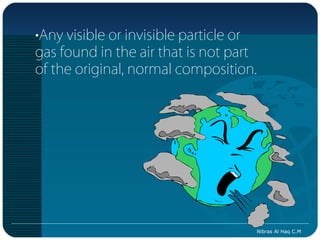
•Any visible or invisible particle or
gas found in the air that is not part
of the original, normal composition.


                                        Nibras Al Haq C.M
Natural: forest fires, pollen, dust storm


Unnatural: man-made; coal, wood
and other fuels used in cars, homes,
and factories for energy


                                            Nibras Al Haq C.M
Nibras Al Haq C.M
AQI: Air Quality Index
•Indicates whether pollutant levels in air may
cause health concerns.
•Ranges from 0 (least concern) to 500 (greatest
concern)


                                        Nibras Al Haq C.M
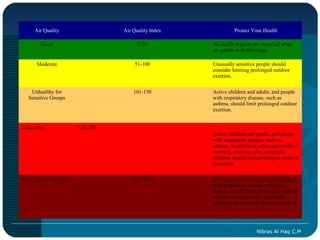
Air Quality                   Air Quality Index             Protect Your Health

        Good                             0-50          No health impacts are expected when
                                                       air quality is in this range.

      Moderate                          51-100         Unusually sensitive people should
                                                       consider limiting prolonged outdoor
                                                       exertion.

   Unhealthy for                       101-150         Active children and adults, and people
  Sensitive Groups                                     with respiratory disease, such as
                                                       asthma, should limit prolonged outdoor
                                                       exertion.


Unhealthy                151-200
                                                       Active children and adults, and people
                                                       with respiratory disease, such as
                                                       asthma, should limit prolonged outdoor
                                                       exertion, everyone else, especially
                                                       children should limit prolonged outdoor
                                                       excretion.

Very Unhealthy (Alert)                 201-300         Active children and adults, and people
                                                       with respiratory disease, such as
                                                       asthma, should limit prolonged outdoor
                                                       exertion everyone else, especially
                                                       children, should limit outdoor exertion.


                                                                           Nibras Al Haq C.M
Nibras Al Haq C.M
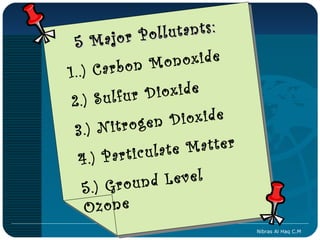
ajor Poll utants:
 5 M
       arbon M  onoxide
1..) C
             Dioxide
 2.) Sulfur
                  Dioxide
 3.)  Nitrogen
        articula te Matter
  4.) P
   5.) Groun  d Level
    Ozone
                             Nibras Al Haq C.M
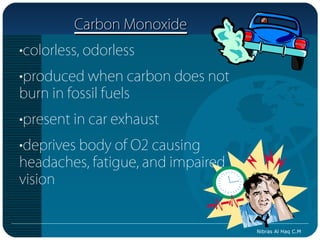
Carbon Monoxide
•colorless, odorless
•produced when carbon does not
burn in fossil fuels
•present in car exhaust
•deprives body of O2 causing
headaches, fatigue, and impaired
vision


                                   Nibras Al Haq C.M
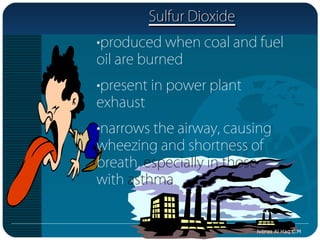
Sulfur Dioxide
•produced when coal and fuel
oil are burned
•present in power plant
exhaust
•narrows the airway, causing
wheezing and shortness of
breath, especially in those
with asthma


                          Nibras Al Haq C.M
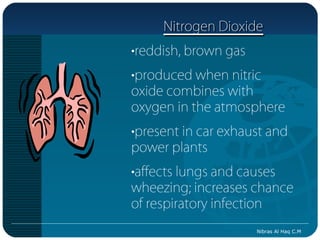
Nitrogen Dioxide
•reddish, brown gas
•produced when nitric
oxide combines with
oxygen in the atmosphere
•present in car exhaust and
power plants
•affects lungs and causes
wheezing; increases chance
of respiratory infection
                      Nibras Al Haq C.M
Particulate Matter
•particles of different sizes and
structures that are released into
the atmosphere
•present in many sources
including fossil fuels, dust, smoke,
fog, etc.
•can build up in respiratory system
•aggravates heart and lung
disease; increases risk of respiratory
infection                                Nibras Al Haq C.M
Ground Level Ozone
•at upper level, ozone shields Earth from
sun’s harmful UV rays
•at ground level, ozone is harmful
pollutants
•formed from car, power and chemical
plant exhaust
•irritate respiratory system and asthma;
reduces lung function by inflaming and
damaging lining of lungs
                                        Nibras Al Haq C.M
Nibras Al Haq C.M
Nibras Al Haq C.M
•Combination of gases with water vapor
and dust
  •Combination of words smoke and
  fog
    •Forms when heat and sunlight
    react gases (photochemical smog)
       •Occurs often with heavy traffic,
       high temperatures, and calm
       winds


                                       Nibras Al Haq C.M
Nibras Al Haq C.M
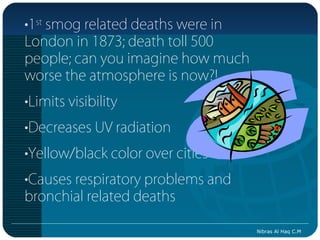
•1st smog related deaths were in
London in 1873; death toll 500
people; can you imagine how much
worse the atmosphere is now?!
•Limits visibility
•Decreases UV radiation
•Yellow/black color over cities
•Causes respiratory problems and
bronchial related deaths

                                   Nibras Al Haq C.M
Nibras Al Haq C.M
Nibras Al Haq C.M
Nibras Al Haq C.M
Nibras Al Haq C.M
Nibras Al Haq C.M
Nibras Al Haq C.M
Nibras Al Haq C.M
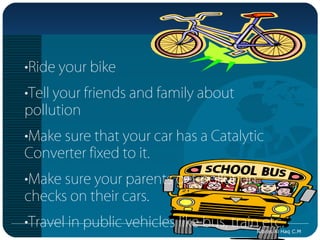
•Ride your bike
•Tell your friends and family about
pollution
•Make sure that your car has a Catalytic
Converter fixed to it.
•Make sure your parents get pollution
checks on their cars.
•Travel in public vehicles like bus, train etc.
                                          Nibras Al Haq C.M
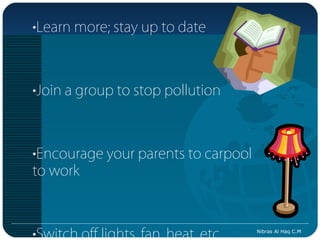
•Learn more; stay up to date


•Join a group to stop pollution


•Encourage your parents to carpool
to work


•Switch off lights, fan, heat, etc.   Nibras Al Haq C.M
Nibras Al Haq C.M
1. Wikipedia
2. Ask.com
3. p4pollution.wikispaces.com
4. YouTube
5. Slideshare.com
6. ibrary.thinkquest.org
7. www.sciencedaily.com
8. wunderground.com
9. ecopics.com
10. factmonster.com
11. Google images
12. photo bucket
13. Facebook

Air pollution PPT

  • 1.
    Nibras Al Haq Grade:9 SMIS No of Slides: 29
  • 3.
  • 4.
    •Any visible orinvisible particle or gas found in the air that is not part of the original, normal composition. Nibras Al Haq C.M
  • 5.
    Natural: forest fires,pollen, dust storm Unnatural: man-made; coal, wood and other fuels used in cars, homes, and factories for energy Nibras Al Haq C.M
  • 6.
  • 7.
    AQI: Air QualityIndex •Indicates whether pollutant levels in air may cause health concerns. •Ranges from 0 (least concern) to 500 (greatest concern) Nibras Al Haq C.M
  • 8.
    Air Quality Air Quality Index Protect Your Health Good 0-50 No health impacts are expected when air quality is in this range. Moderate 51-100 Unusually sensitive people should consider limiting prolonged outdoor exertion. Unhealthy for 101-150 Active children and adults, and people Sensitive Groups with respiratory disease, such as asthma, should limit prolonged outdoor exertion. Unhealthy 151-200 Active children and adults, and people with respiratory disease, such as asthma, should limit prolonged outdoor exertion, everyone else, especially children should limit prolonged outdoor excretion. Very Unhealthy (Alert) 201-300 Active children and adults, and people with respiratory disease, such as asthma, should limit prolonged outdoor exertion everyone else, especially children, should limit outdoor exertion. Nibras Al Haq C.M
  • 9.
  • 10.
    ajor Poll utants: 5 M arbon M onoxide 1..) C Dioxide 2.) Sulfur Dioxide 3.) Nitrogen articula te Matter 4.) P 5.) Groun d Level Ozone Nibras Al Haq C.M
  • 11.
    Carbon Monoxide •colorless, odorless •producedwhen carbon does not burn in fossil fuels •present in car exhaust •deprives body of O2 causing headaches, fatigue, and impaired vision Nibras Al Haq C.M
  • 12.
    Sulfur Dioxide •produced whencoal and fuel oil are burned •present in power plant exhaust •narrows the airway, causing wheezing and shortness of breath, especially in those with asthma Nibras Al Haq C.M
  • 13.
    Nitrogen Dioxide •reddish, browngas •produced when nitric oxide combines with oxygen in the atmosphere •present in car exhaust and power plants •affects lungs and causes wheezing; increases chance of respiratory infection Nibras Al Haq C.M
  • 14.
    Particulate Matter •particles ofdifferent sizes and structures that are released into the atmosphere •present in many sources including fossil fuels, dust, smoke, fog, etc. •can build up in respiratory system •aggravates heart and lung disease; increases risk of respiratory infection Nibras Al Haq C.M
  • 15.
    Ground Level Ozone •atupper level, ozone shields Earth from sun’s harmful UV rays •at ground level, ozone is harmful pollutants •formed from car, power and chemical plant exhaust •irritate respiratory system and asthma; reduces lung function by inflaming and damaging lining of lungs Nibras Al Haq C.M
  • 16.
  • 17.
  • 18.
    •Combination of gaseswith water vapor and dust •Combination of words smoke and fog •Forms when heat and sunlight react gases (photochemical smog) •Occurs often with heavy traffic, high temperatures, and calm winds Nibras Al Haq C.M
  • 19.
  • 20.
    •1st smog relateddeaths were in London in 1873; death toll 500 people; can you imagine how much worse the atmosphere is now?! •Limits visibility •Decreases UV radiation •Yellow/black color over cities •Causes respiratory problems and bronchial related deaths Nibras Al Haq C.M
  • 21.
  • 22.
  • 23.
  • 24.
  • 25.
  • 26.
  • 27.
  • 28.
    •Ride your bike •Tellyour friends and family about pollution •Make sure that your car has a Catalytic Converter fixed to it. •Make sure your parents get pollution checks on their cars. •Travel in public vehicles like bus, train etc. Nibras Al Haq C.M
  • 29.
    •Learn more; stayup to date •Join a group to stop pollution •Encourage your parents to carpool to work •Switch off lights, fan, heat, etc. Nibras Al Haq C.M
  • 31.
  • 32.
    1. Wikipedia 2. Ask.com 3.p4pollution.wikispaces.com 4. YouTube 5. Slideshare.com 6. ibrary.thinkquest.org 7. www.sciencedaily.com 8. wunderground.com 9. ecopics.com 10. factmonster.com 11. Google images 12. photo bucket 13. Facebook