





Researching
Children’s
     Lives
Who’s studying
  children?
Children’s real behavior
           vs.
What they interpret to be
  preferred behavior
“Legitimate adult-child
interaction depends on
    adult authority.”
Just as there are several
           distinct theoretical
           perspectives used in
Theories   explaining children’s
           experiences, several
   &       distinct methodological
           approaches also exist
METHODS    for researching
           children’s lives – and all
           involve ethical issues.
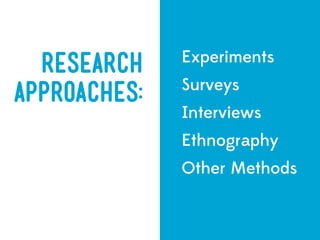
Experiments
  ResearCh
              Surveys
Approaches:
              Interviews
              Ethnography
              Other Methods
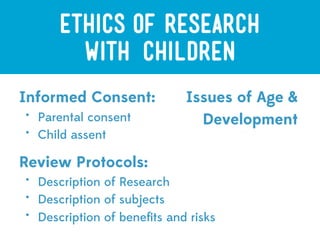
ETHICS OF RESEARCH
         with CHILDREN
Informed Consent:             Issues of Age &
•
    Parental consent            Development
•
    Child assent

Review Protocols:
•
    Description of Research
•
    Description of subjects
•
    Description of benefits and risks
Access
       Roles
(Supervisor? Leader?
 Observer? Friend?)
EXPERIMENTS
Researchers routinely use experimental designs
    to evaluate children’s development and
performance, to decide whether specific social
 conditions are harmful, and to determine the
       success of intervention programs.
Goal: Control
Experiments        Setting, test
   Involve...     interventions
                Focus: Individual
                differences among
                      children
                Concealment and
                  deception are
                common practices
Hypothesis: Changing family
Experiments in    process leads to decreased
    Mediating      symptoms in the children.
                     Mediating variables:
   Children’s      parental demoralization,
        Grief      parental warmth, stable
                 positive events and negative
                  stress events in the family
                 Findings: Interventions were
                 successful for older children,
                 but not for younger children
                    – Sandler et al., 1992
SURVEYS
Survey research on children
 has often been carried out
with parents about children.
Questionnaires or
   SURVEY        Interviews
RESEARCH         Sampling and
InvolveS...   Statistical Controls
               Issues of Privacy,
              Confidentiality, and
              Parental Influence
Semi-structured interviews
SURVEYS OF    with children at 4 months, 1
Children’s   year, and 2 years after death
                       of a parent
     Grief    Surveys using Competence
                Scale and and Locus of
                     Control Scale

             Findings challenge traditional
               ideas about children’s grief
                being expressed through
              periods of prolonged crying,
             aggression, or withdrawal and
               creating family dysfunction
             – Silverman and Worden, 1992
ETHNOGRAPHY
 Ethnography has been developed with the
  goal of acquainting the researcher with a
culture or subculture and in recording and
interpreting the everyday life of a group “on
    their grounds and on their terms.”
ETHNOGRAPHIES      Goal: Understand
                   children’s culture(s)
WITH CHILDREN
                     Focus: Access,
      Involve...   acceptance, and
                   determining limits
                      Authority,
                   Adult-as-Friend’,
                   or ‘Least Adult’?
Deliberately refrain from
ETHNOGRAPHIES OF      formulating hypotheses
     Children’s       Collect drawings and
                    comments on death from
          Grief    over 300 children, ages 4-19
                    Findings: Younger children
                        provide “immature”
                     representations of death;
                   grade school children present
                    emotions, beliefs, and ritual;
                     adolescents focus on the
                        “essence of death.”
                   – Wenestam & Wass, 1987
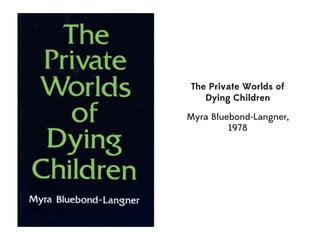
The Private Worlds of
   Dying Children

Myra Bluebond-Langner,
         1978
With The Boys: Little
 League Baseball and
Preadolescent Culture

 Gary Alan Fine, 1987
Gender Play: Girls and
   Boys in School

  Barrie Thorne, 1993
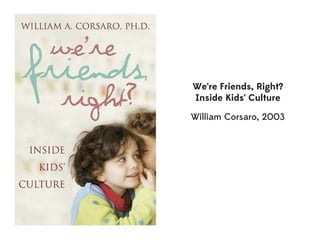
We’re Friends, Right?
Inside Kids’ Culture

William Corsaro, 2003
Other Methods
     Demographic Studies
Critical Feminist Methodology
 Multi-Method Approaches
Last Question:
Can adults ever really
study children’s lives in
     a valid way?
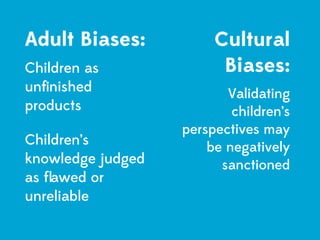
Adult Biases:           Cultural
Children as              Biases:
unfinished                 Validating
products                   children’s
                   perspectives may
Children’s             be negatively
knowledge judged         sanctioned
as flawed or
unreliable
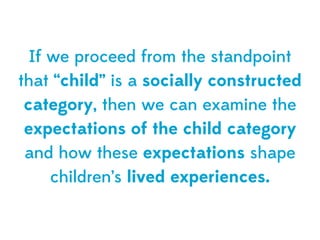
If we proceed from the standpoint
that “child” is a socially constructed
 category, then we can examine the
 expectations of the child category
 and how these expectations shape
     children’s lived experiences.
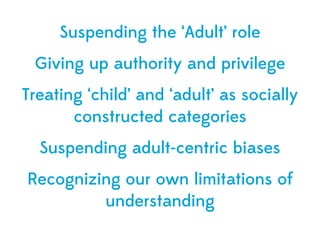
Suspending the ‘Adult’ role
 Giving up authority and privilege
Treating ‘child’ and ‘adult’ as socially
       constructed categories
  Suspending adult-centric biases
Recognizing our own limitations of
         understanding
THANK YOU.

Topic 5 - Research Methods for Studying Children

  • 1.
  • 3.
  • 4.
    Children’s real behavior vs. What they interpret to be preferred behavior
  • 5.
  • 6.
    Just as thereare several distinct theoretical perspectives used in Theories explaining children’s experiences, several & distinct methodological approaches also exist METHODS for researching children’s lives – and all involve ethical issues.
  • 7.
    Experiments ResearCh Surveys Approaches: Interviews Ethnography Other Methods
  • 8.
    ETHICS OF RESEARCH with CHILDREN Informed Consent: Issues of Age & • Parental consent Development • Child assent Review Protocols: • Description of Research • Description of subjects • Description of benefits and risks
  • 9.
    Access Roles (Supervisor? Leader? Observer? Friend?)
  • 10.
    EXPERIMENTS Researchers routinely useexperimental designs to evaluate children’s development and performance, to decide whether specific social conditions are harmful, and to determine the success of intervention programs.
  • 11.
    Goal: Control Experiments Setting, test Involve... interventions Focus: Individual differences among children Concealment and deception are common practices
  • 12.
    Hypothesis: Changing family Experimentsin process leads to decreased Mediating symptoms in the children. Mediating variables: Children’s parental demoralization, Grief parental warmth, stable positive events and negative stress events in the family Findings: Interventions were successful for older children, but not for younger children – Sandler et al., 1992
  • 13.
    SURVEYS Survey research onchildren has often been carried out with parents about children.
  • 14.
    Questionnaires or SURVEY Interviews RESEARCH Sampling and InvolveS... Statistical Controls Issues of Privacy, Confidentiality, and Parental Influence
  • 15.
    Semi-structured interviews SURVEYS OF with children at 4 months, 1 Children’s year, and 2 years after death of a parent Grief Surveys using Competence Scale and and Locus of Control Scale Findings challenge traditional ideas about children’s grief being expressed through periods of prolonged crying, aggression, or withdrawal and creating family dysfunction – Silverman and Worden, 1992
  • 16.
    ETHNOGRAPHY Ethnography hasbeen developed with the goal of acquainting the researcher with a culture or subculture and in recording and interpreting the everyday life of a group “on their grounds and on their terms.”
  • 17.
    ETHNOGRAPHIES Goal: Understand children’s culture(s) WITH CHILDREN Focus: Access, Involve... acceptance, and determining limits Authority, Adult-as-Friend’, or ‘Least Adult’?
  • 18.
    Deliberately refrain from ETHNOGRAPHIESOF formulating hypotheses Children’s Collect drawings and comments on death from Grief over 300 children, ages 4-19 Findings: Younger children provide “immature” representations of death; grade school children present emotions, beliefs, and ritual; adolescents focus on the “essence of death.” – Wenestam & Wass, 1987
  • 19.
    The Private Worldsof Dying Children Myra Bluebond-Langner, 1978
  • 20.
    With The Boys:Little League Baseball and Preadolescent Culture Gary Alan Fine, 1987
  • 21.
    Gender Play: Girlsand Boys in School Barrie Thorne, 1993
  • 22.
    We’re Friends, Right? InsideKids’ Culture William Corsaro, 2003
  • 23.
    Other Methods Demographic Studies Critical Feminist Methodology Multi-Method Approaches
  • 24.
  • 25.
    Can adults everreally study children’s lives in a valid way?
  • 26.
    Adult Biases: Cultural Children as Biases: unfinished Validating products children’s perspectives may Children’s be negatively knowledge judged sanctioned as flawed or unreliable
  • 27.
    If we proceedfrom the standpoint that “child” is a socially constructed category, then we can examine the expectations of the child category and how these expectations shape children’s lived experiences.
  • 28.
    Suspending the ‘Adult’role Giving up authority and privilege Treating ‘child’ and ‘adult’ as socially constructed categories Suspending adult-centric biases Recognizing our own limitations of understanding
  • 29.