Introduction of Mercuration
Briefintro of Mercuration:
Mercuration is of sufficient general applicability and importance in the
aromatic series to be regarded as a typical substitution reaction, like
nitration, sulfonation, or halogenation.
In general, mercuration proceeds easily with the formation of mono-,
di-, and polymercurated compounds.
2
3.
Introduction of Mercuration
Whatis Mercuration?
Mercuration is the process of combining or treating something with mercury or a
mercury salt.
It can be used to introduce mercury into organic compounds.
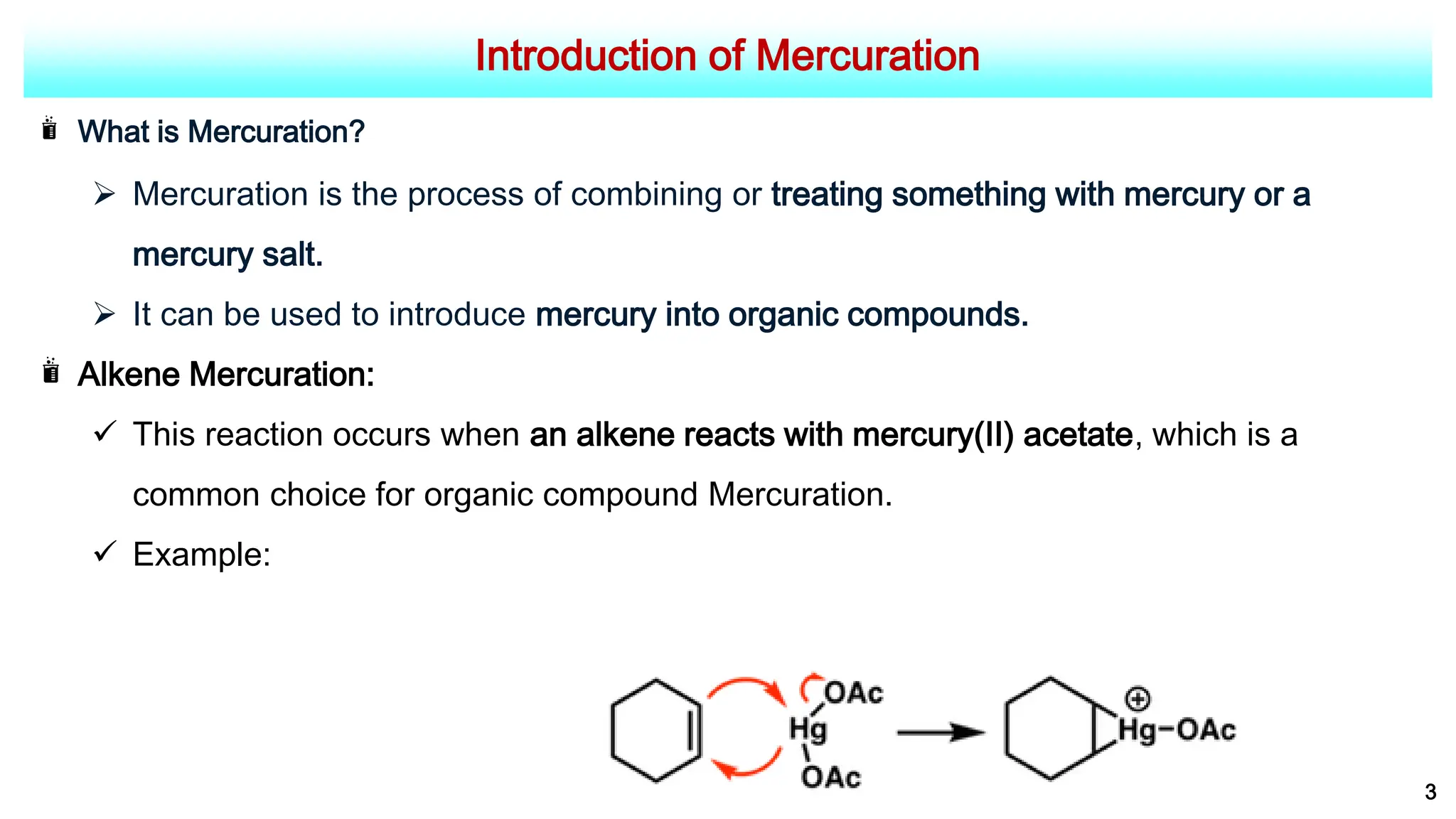
Alkene Mercuration:
This reaction occurs when an alkene reacts with mercury(II) acetate, which is a
common choice for organic compound Mercuration.
Example:
3
4.
Introduction of Oxymercuration
Whatis Oxymercuration Reaction?
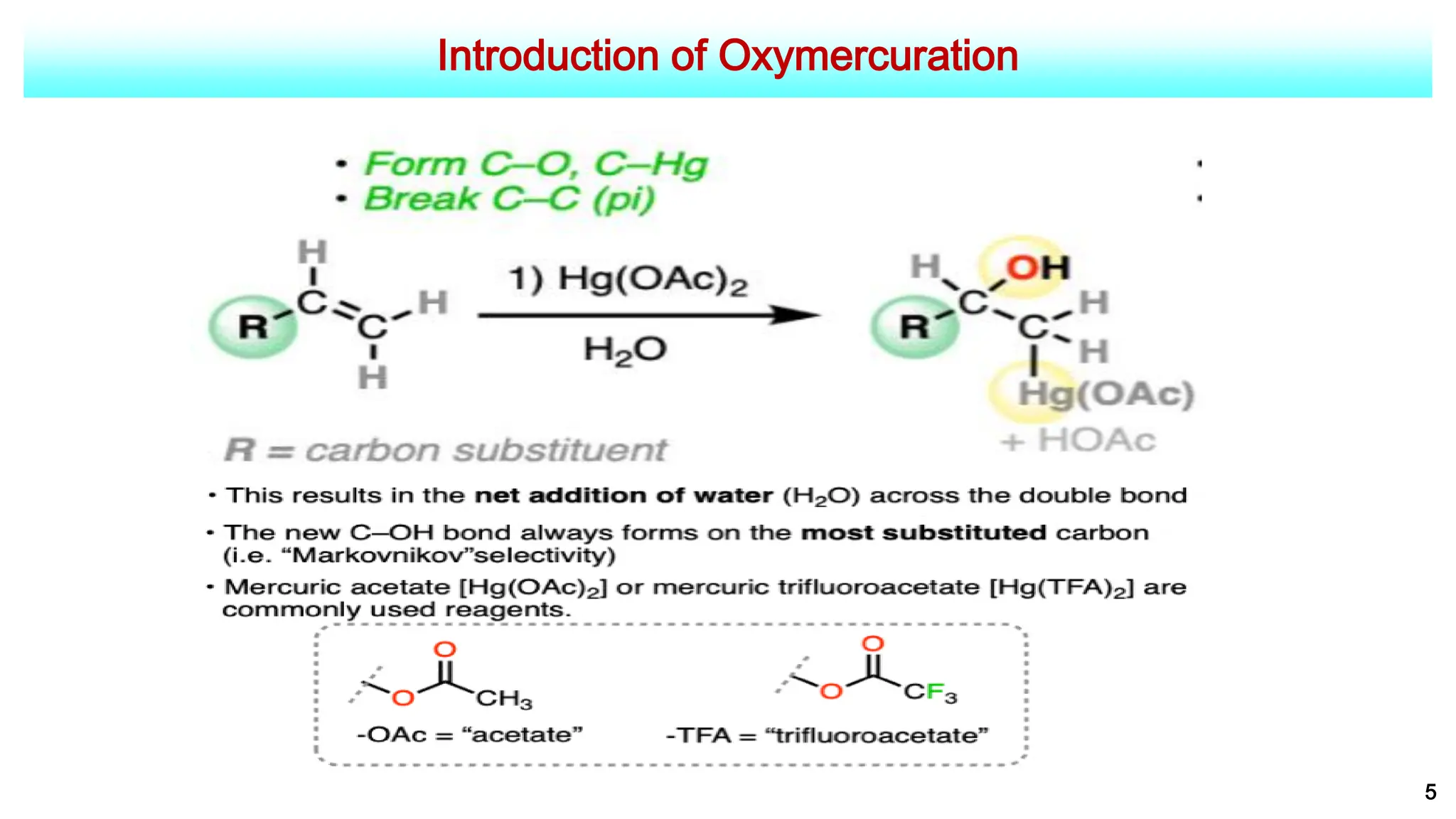
The oxymercuration reaction is an electrophilic addition organic reaction that transforms an
alkene into a neutral alcohol.
Oxymercuration-Demercuration of Alkenes
Treatment of alkenes with mercury (II) salts and water leads to the addition of water and mercury
across the C-C pi bond. This is called oxymercuration.
Addition to the alkene occurs such that OH forms a bond to the most substituted carbon, making
it selective for Markovnikov products.
4
What is Markovnikov’s Rule?
When a protic acid (HX) is added to an asymmetric alkene, the acidic
hydrogen attaches itself to the carbon having a greater number of hydrogen
substituents; whereas the halide group attaches itself to the carbon atom
which has a greater number of alkyl substituents.
Introduction of Oxymercuration
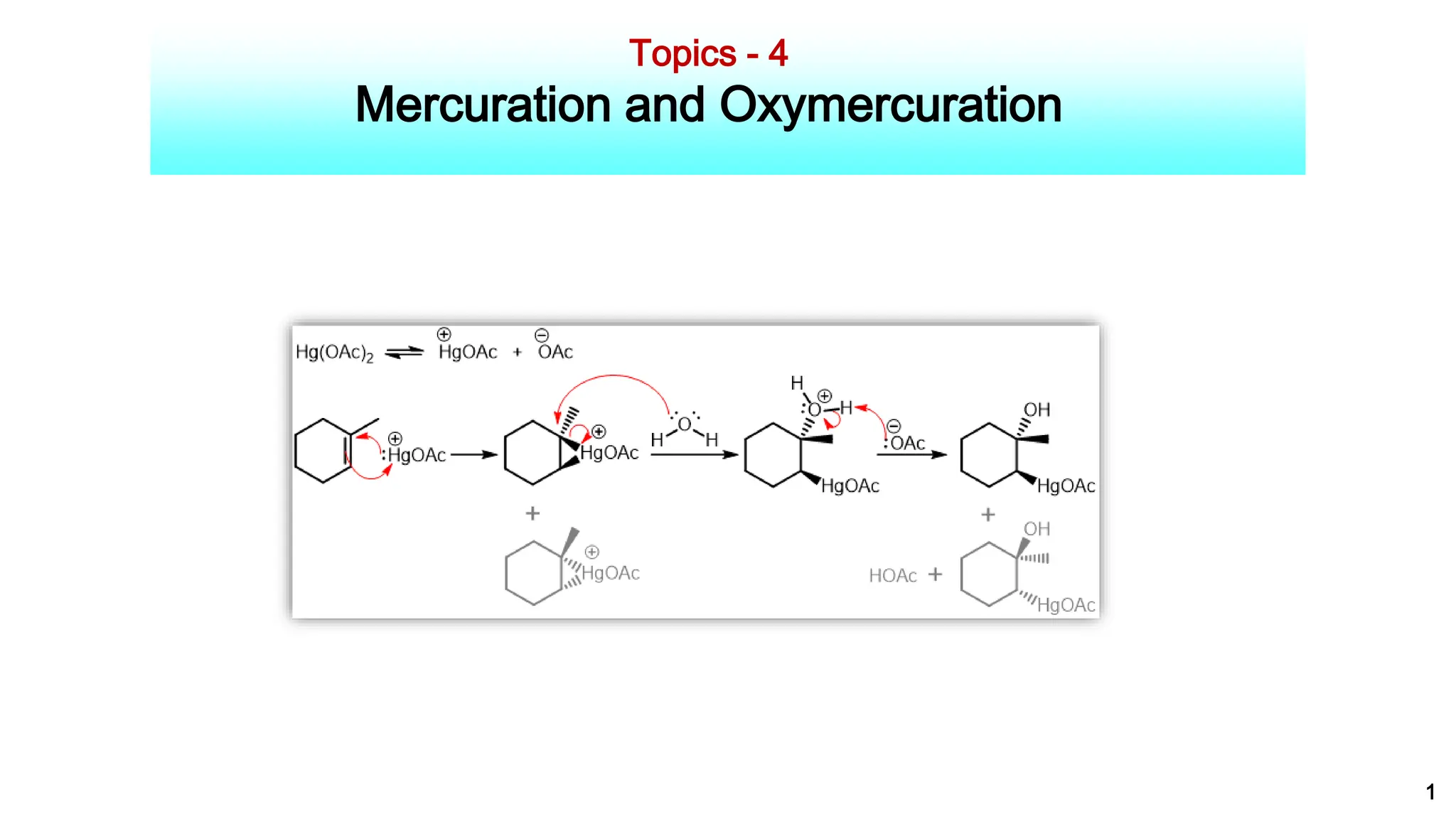
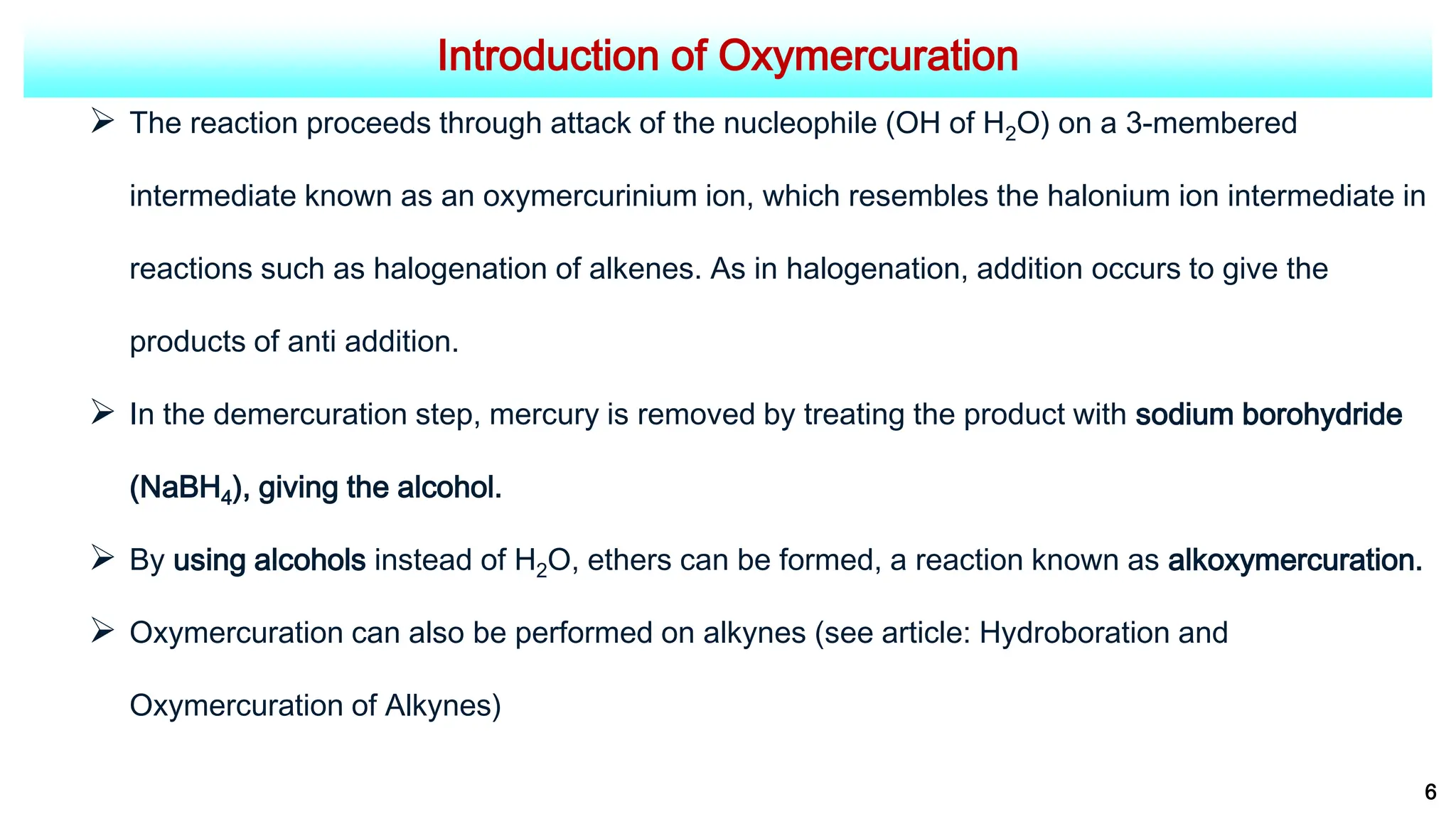
The reaction proceeds through attack of the nucleophile (OH of H2O) on a 3-membered
intermediate known as an oxymercurinium ion, which resembles the halonium ion intermediate in
reactions such as halogenation of alkenes. As in halogenation, addition occurs to give the
products of anti addition.
In the demercuration step, mercury is removed by treating the product with sodium borohydride
(NaBH4), giving the alcohol.
By using alcohols instead of H2O, ethers can be formed, a reaction known as alkoxymercuration.
Oxymercuration can also be performed on alkynes (see article: Hydroboration and
Oxymercuration of Alkynes)
6
7.
Advantages of Oxymercuration
Advantagesof Oxymercuration Reaction
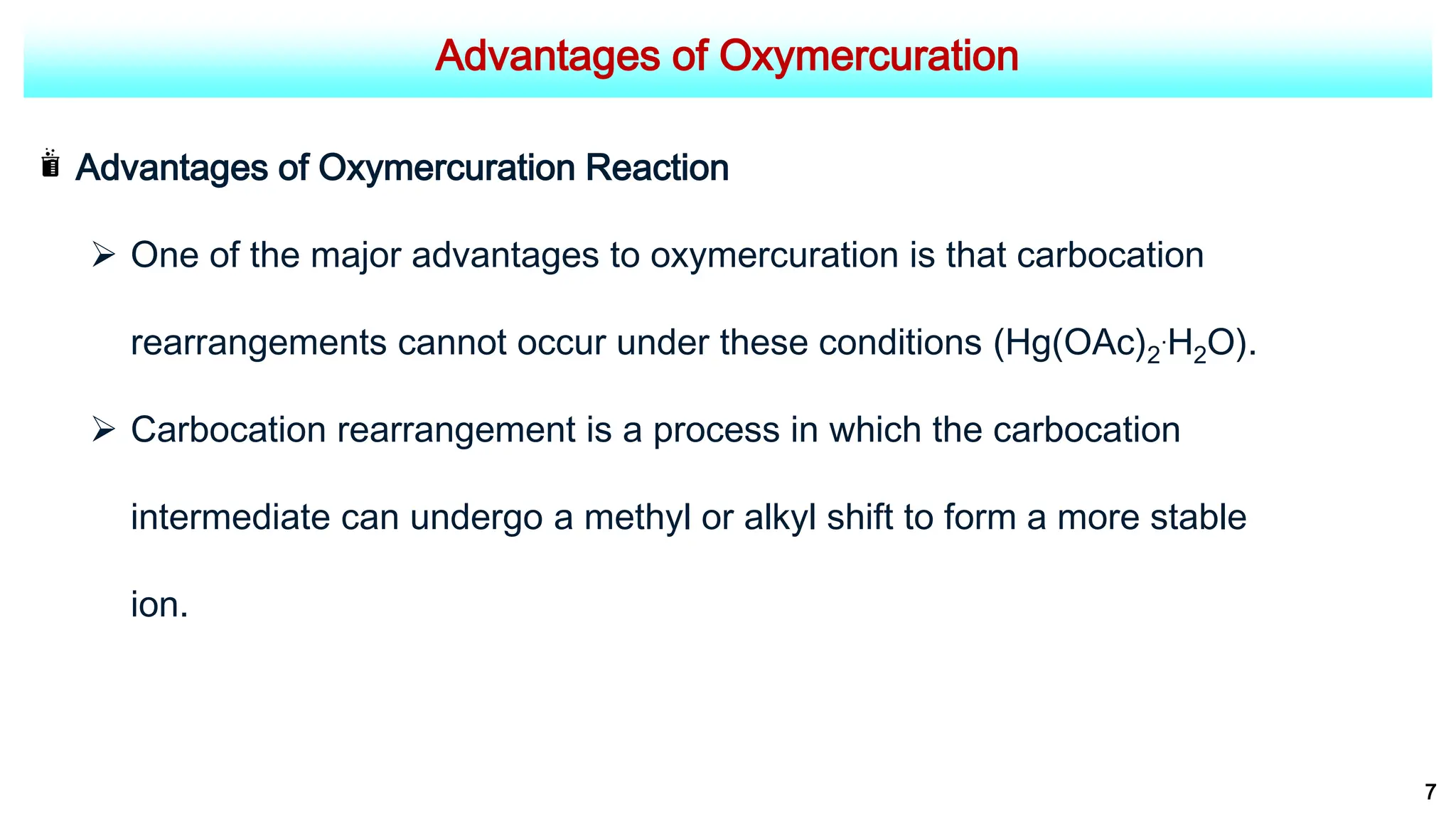
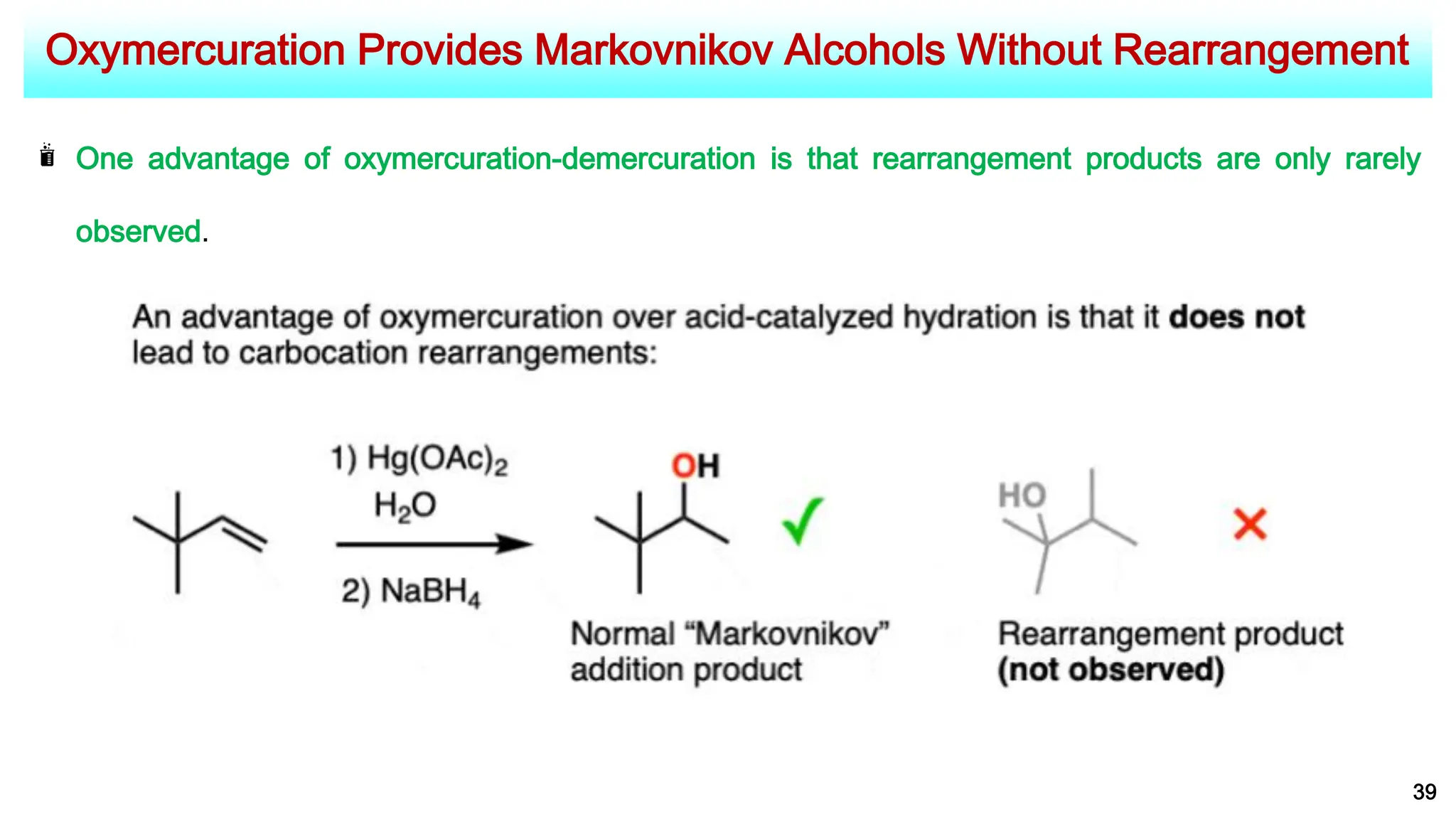
One of the major advantages to oxymercuration is that carbocation
rearrangements cannot occur under these conditions (Hg(OAc)2
.H2O).
Carbocation rearrangement is a process in which the carbocation
intermediate can undergo a methyl or alkyl shift to form a more stable
ion.
7
8.
Precaution of OxymercurationReaction
8
Organomercury compounds tend to be highly toxic, and it is best to avoid handling
them if at all possible.
In the demercuration step, treatment with sodium borohydride (NaBH4) replaces C-
Hg with C-H, resulting in the alcohol and a little pool of elemental liquid mercury
that accumulates at the bottom of the flask.
9.
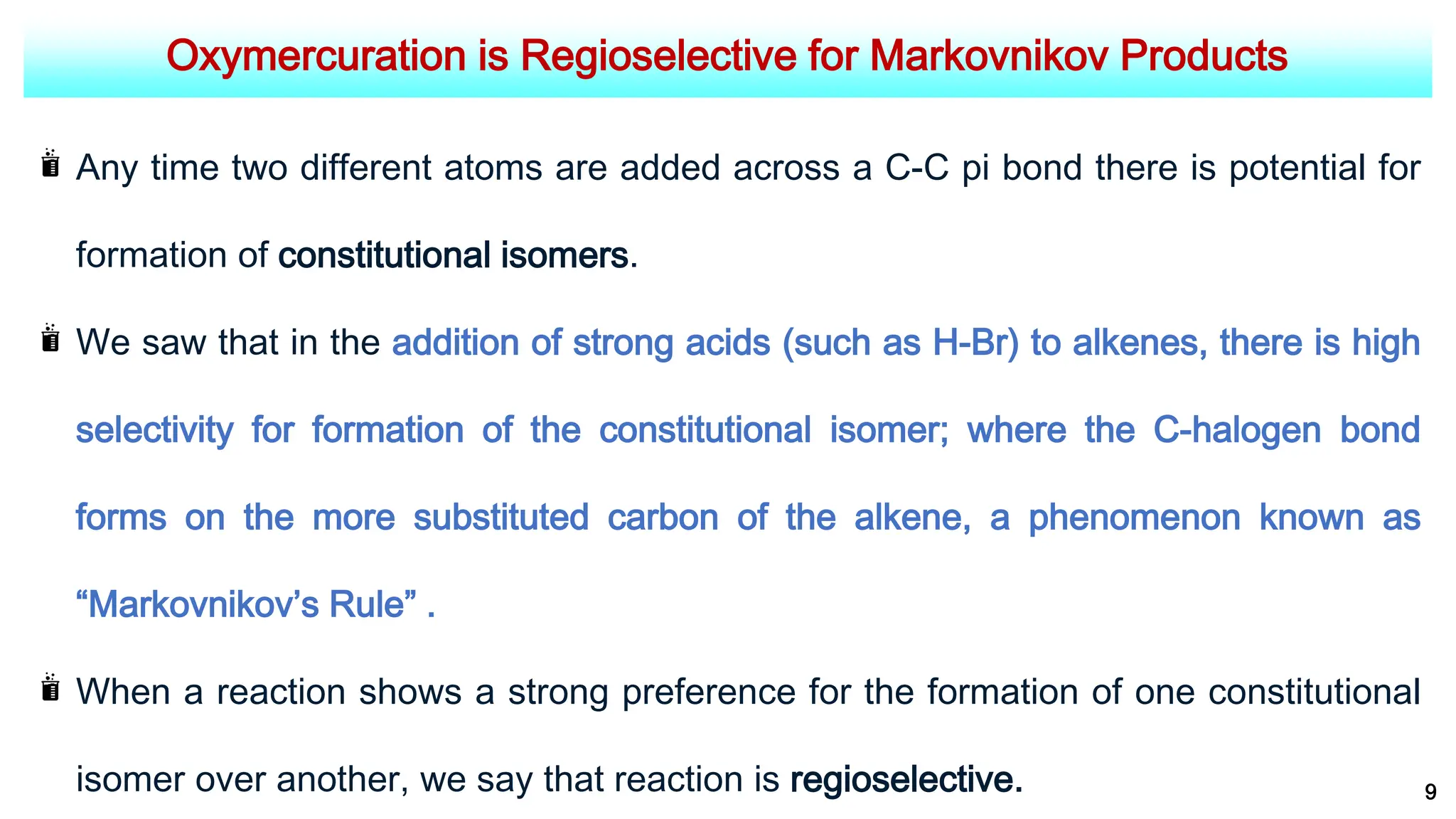
Oxymercuration is Regioselectivefor Markovnikov Products
9
Any time two different atoms are added across a C-C pi bond there is potential for
formation of constitutional isomers.
We saw that in the addition of strong acids (such as H-Br) to alkenes, there is high
selectivity for formation of the constitutional isomer; where the C-halogen bond
forms on the more substituted carbon of the alkene, a phenomenon known as
“Markovnikov’s Rule” .
When a reaction shows a strong preference for the formation of one constitutional
isomer over another, we say that reaction is regioselective.
10.
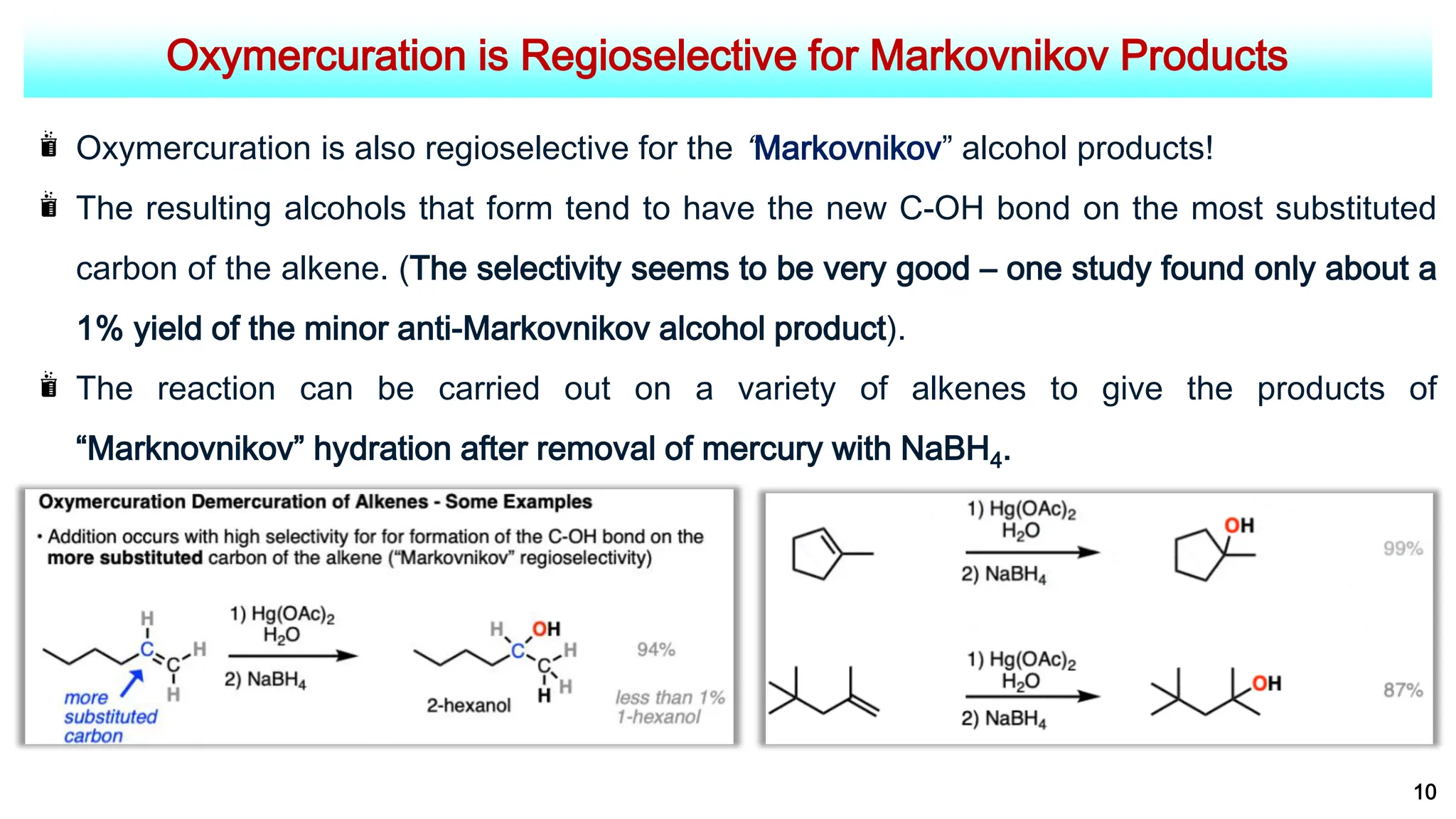
Oxymercuration is Regioselectivefor Markovnikov Products
10
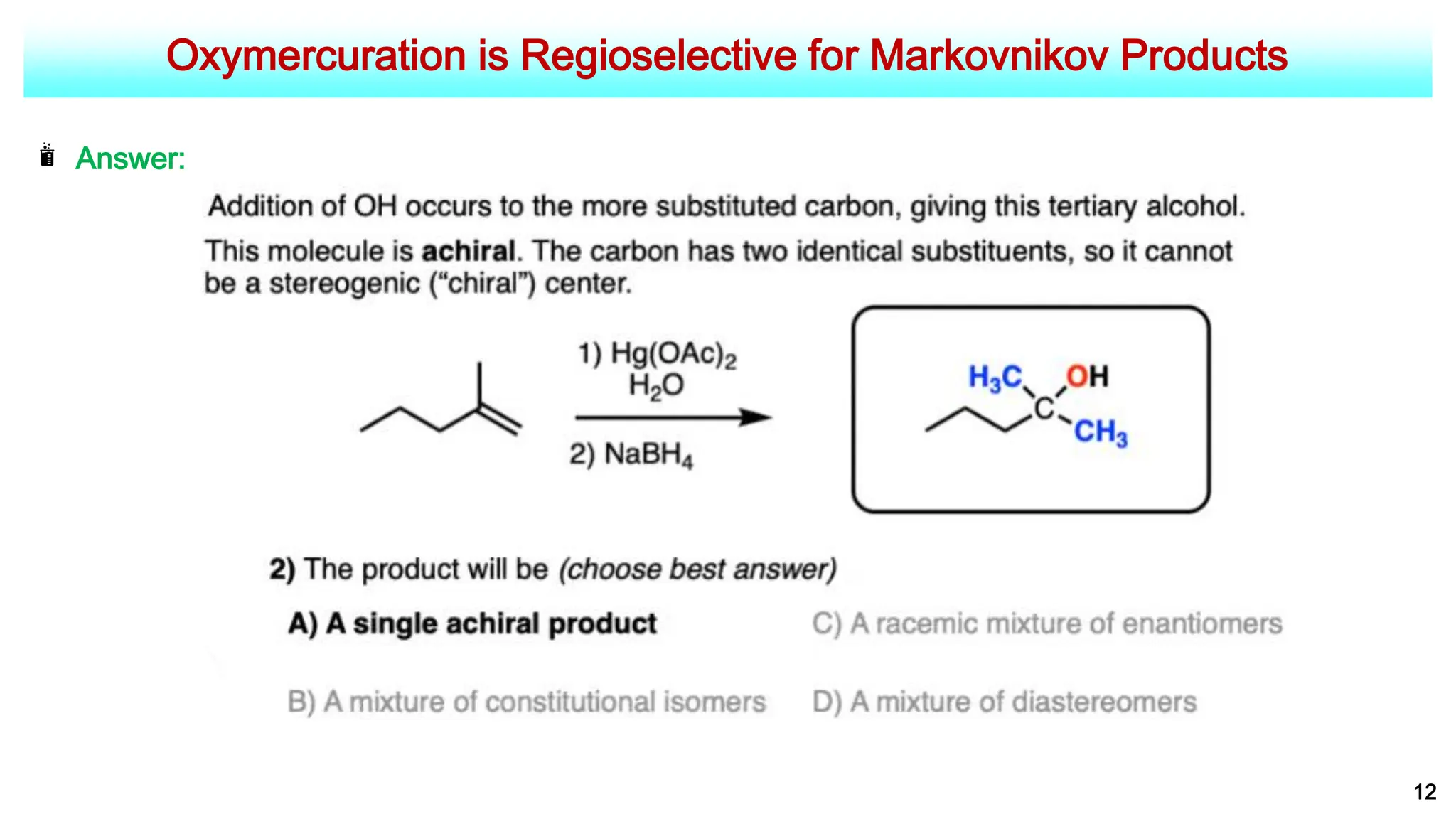
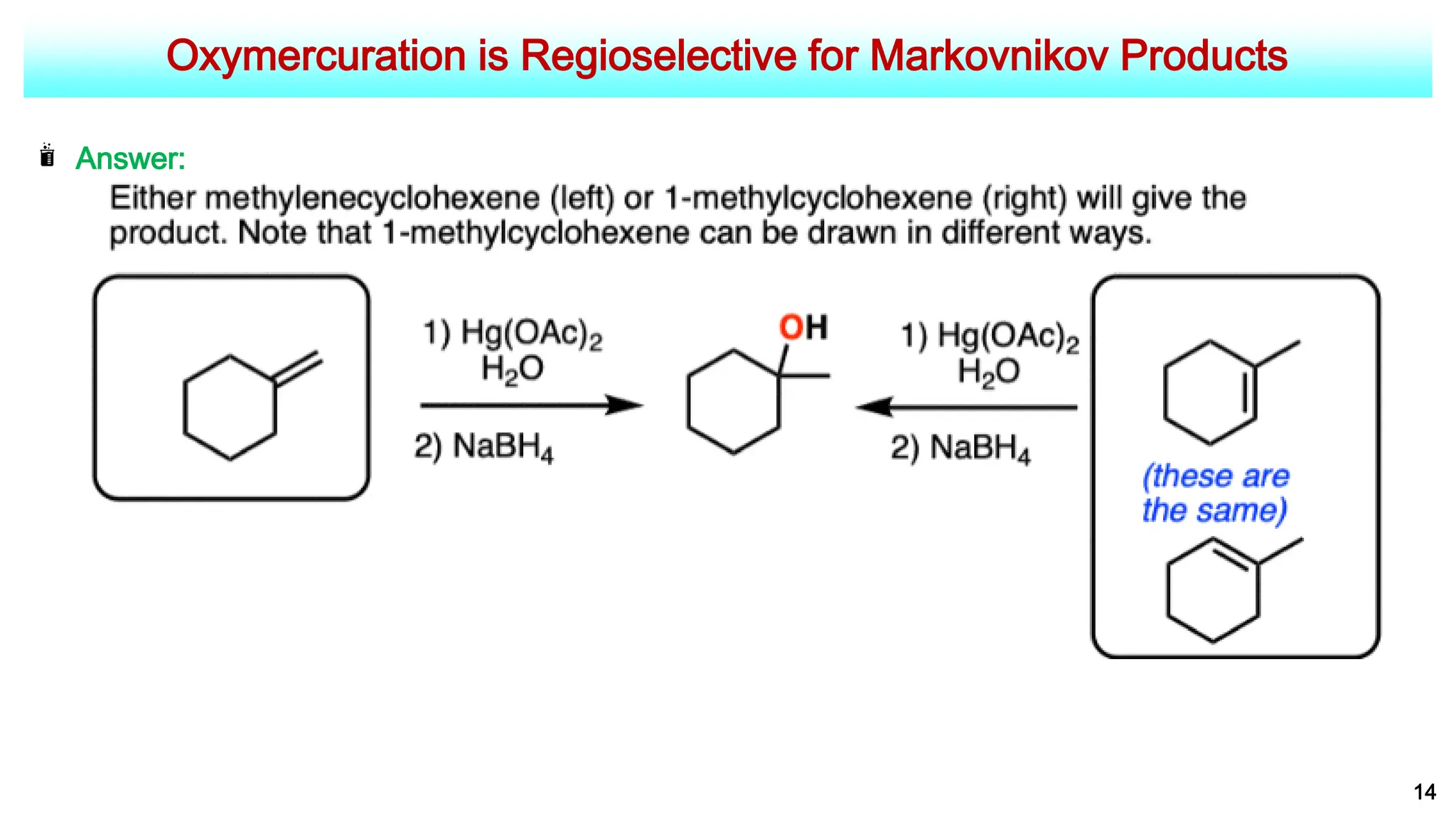
Oxymercuration is also regioselective for the “Markovnikov” alcohol products!
The resulting alcohols that form tend to have the new C-OH bond on the most substituted
carbon of the alkene. (The selectivity seems to be very good – one study found only about a
1% yield of the minor anti-Markovnikov alcohol product).
The reaction can be carried out on a variety of alkenes to give the products of
“Marknovnikov” hydration after removal of mercury with NaBH4.
The Mechanism ofOxymercuration Goes Through A 3-Membered
“Mercurinium Ion”
15
The first step of oxymercuration results in a new organomercury compound with a C-Hg
bond.
Unlike many compounds with carbon-metal bonds, organomercury compounds are actually
quite stable to handling.
They are (reasonably) stable to air, can be purified with column chromatography, and can
even be distilled (!) .
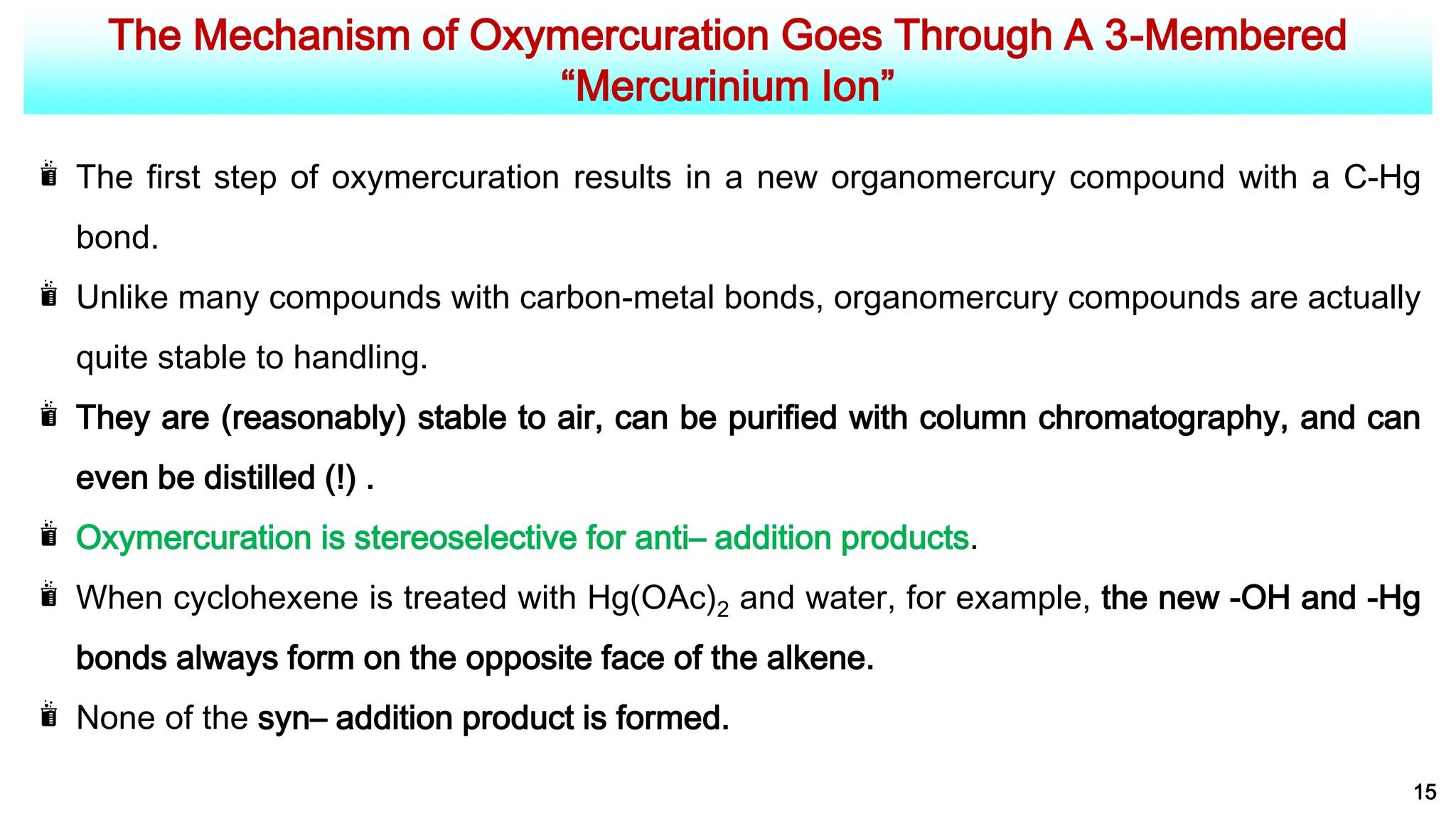
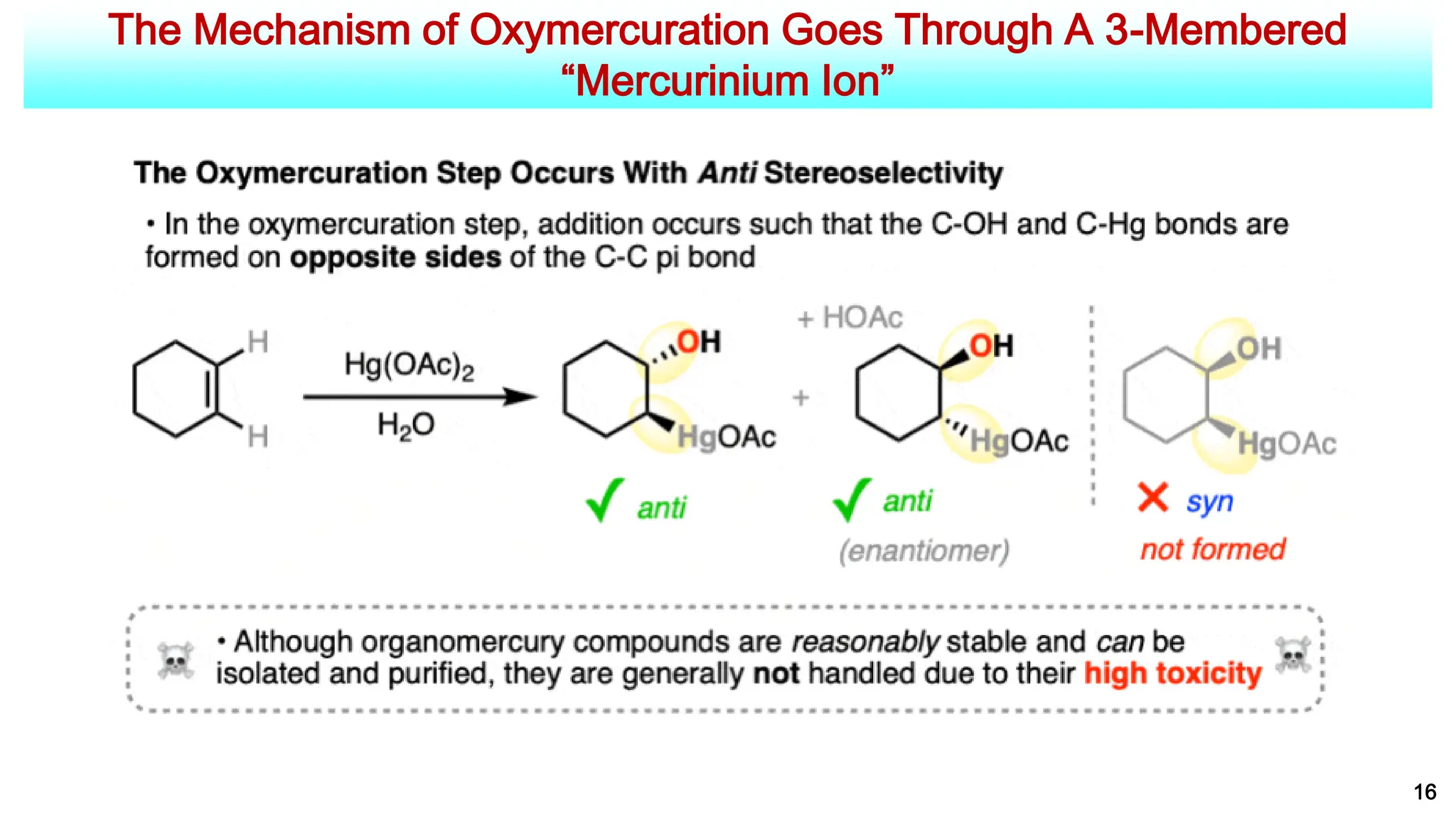
Oxymercuration is stereoselective for anti– addition products.
When cyclohexene is treated with Hg(OAc)2 and water, for example, the new -OH and -Hg
bonds always form on the opposite face of the alkene.
None of the syn– addition product is formed.
16.
The Mechanism ofOxymercuration Goes Through A 3-Membered
“Mercurinium Ion”
16
17.
Explain the Mechanismof Oxymercuration ?
17
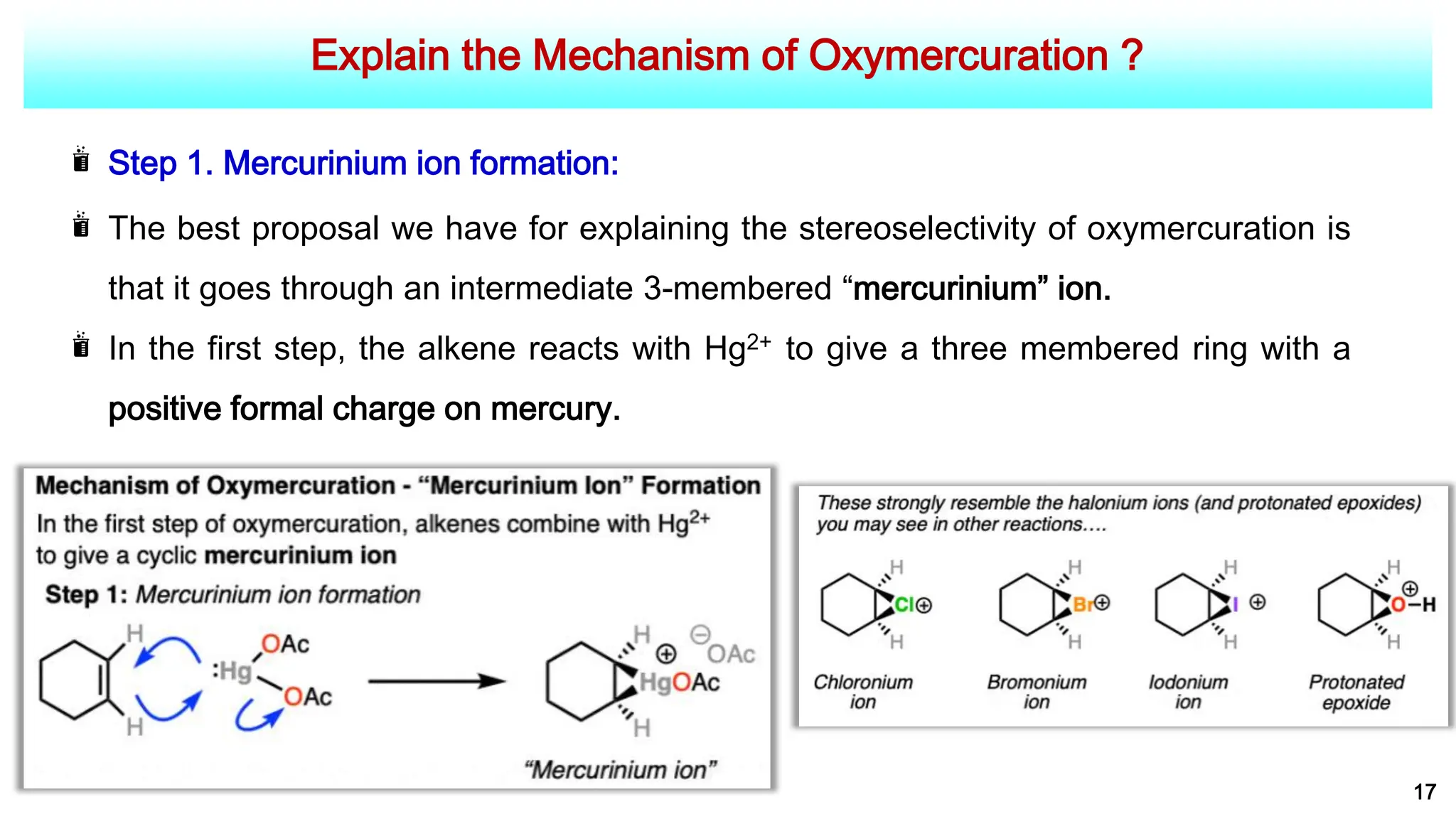
Step 1. Mercurinium ion formation:
The best proposal we have for explaining the stereoselectivity of oxymercuration is
that it goes through an intermediate 3-membered “mercurinium” ion.
In the first step, the alkene reacts with Hg2+ to give a three membered ring with a
positive formal charge on mercury.
18.
18
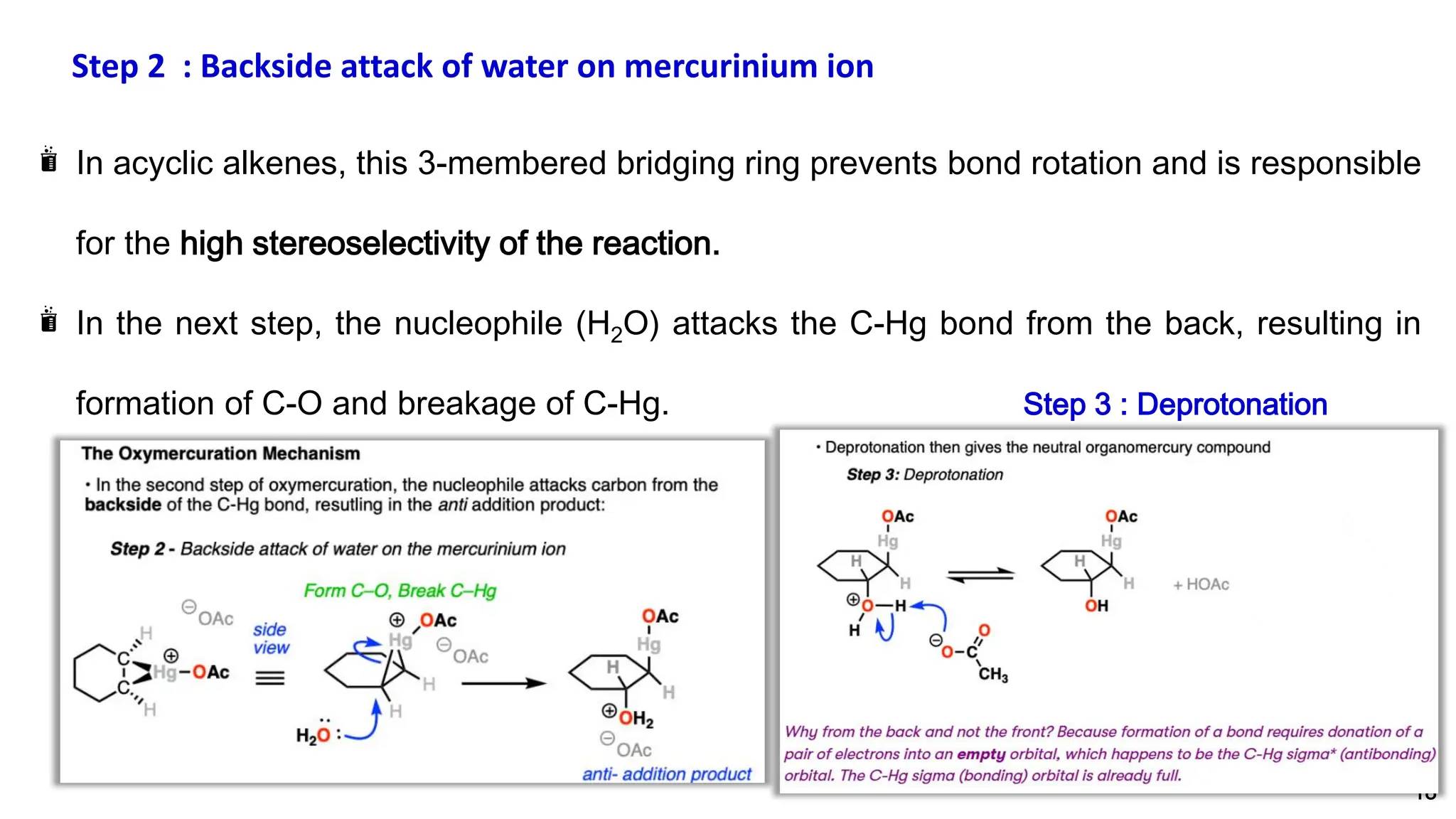
In acyclic alkenes,this 3-membered bridging ring prevents bond rotation and is responsible
for the high stereoselectivity of the reaction.
In the next step, the nucleophile (H2O) attacks the C-Hg bond from the back, resulting in
formation of C-O and breakage of C-Hg. Step 3 : Deprotonation
Step 2 : Backside attack of water on mercurinium ion
19.
Demercuration
19
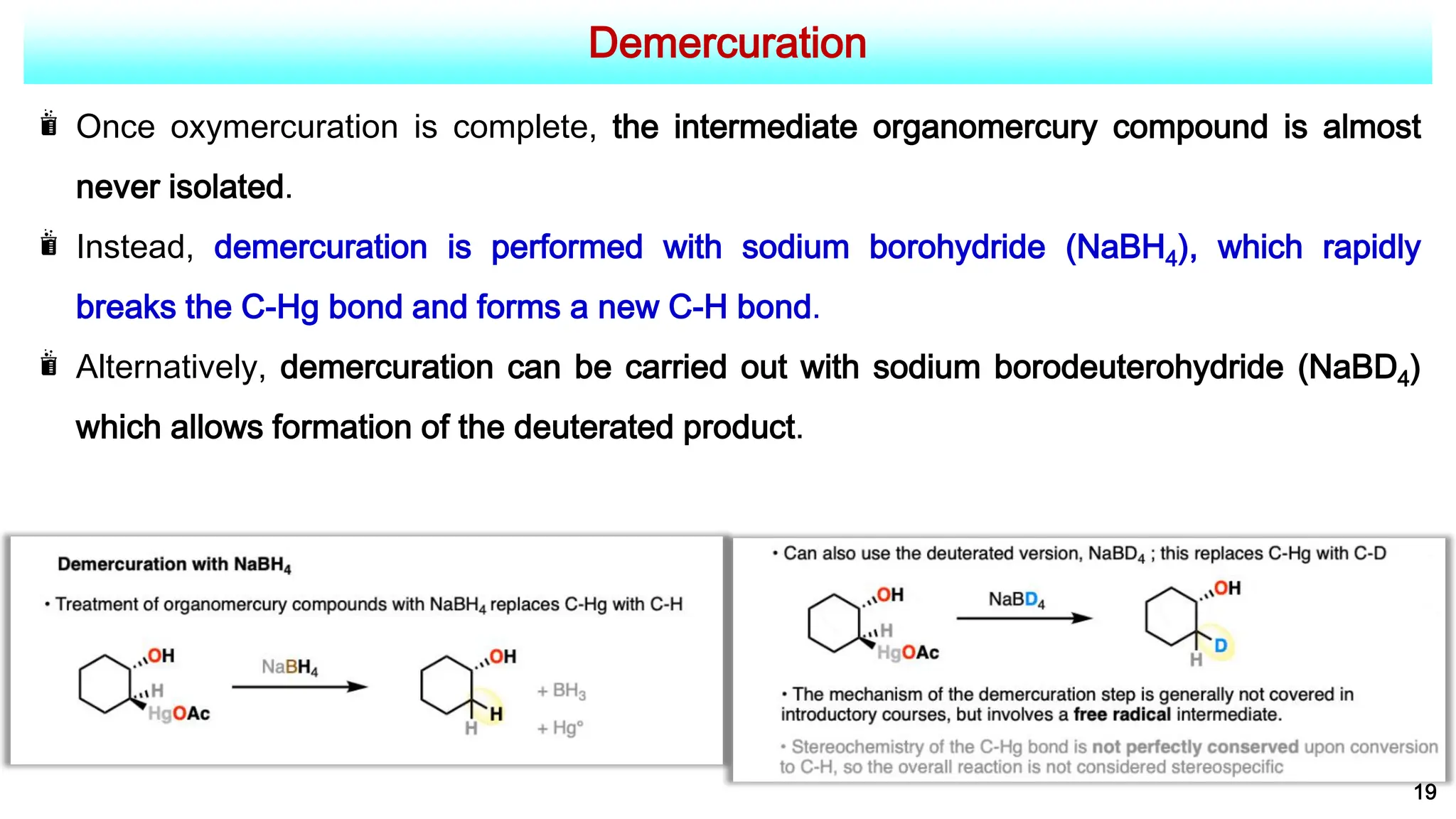
Once oxymercuration iscomplete, the intermediate organomercury compound is almost
never isolated.
Instead, demercuration is performed with sodium borohydride (NaBH4), which rapidly
breaks the C-Hg bond and forms a new C-H bond.
Alternatively, demercuration can be carried out with sodium borodeuterohydride (NaBD4)
which allows formation of the deuterated product.
20.
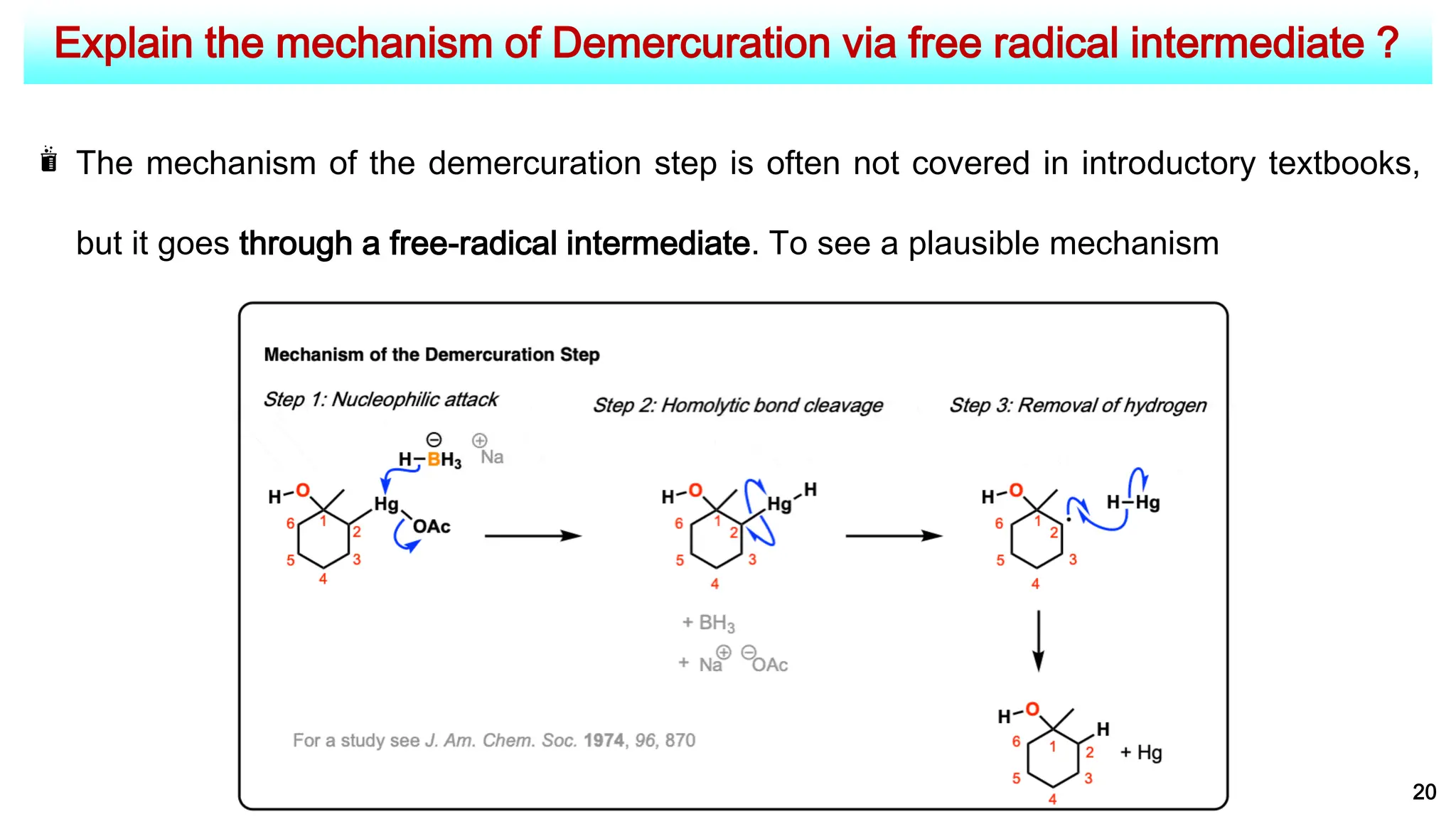
Explain the mechanismof Demercuration via free radical intermediate ?
20
The mechanism of the demercuration step is often not covered in introductory textbooks,
but it goes through a free-radical intermediate. To see a plausible mechanism
21.
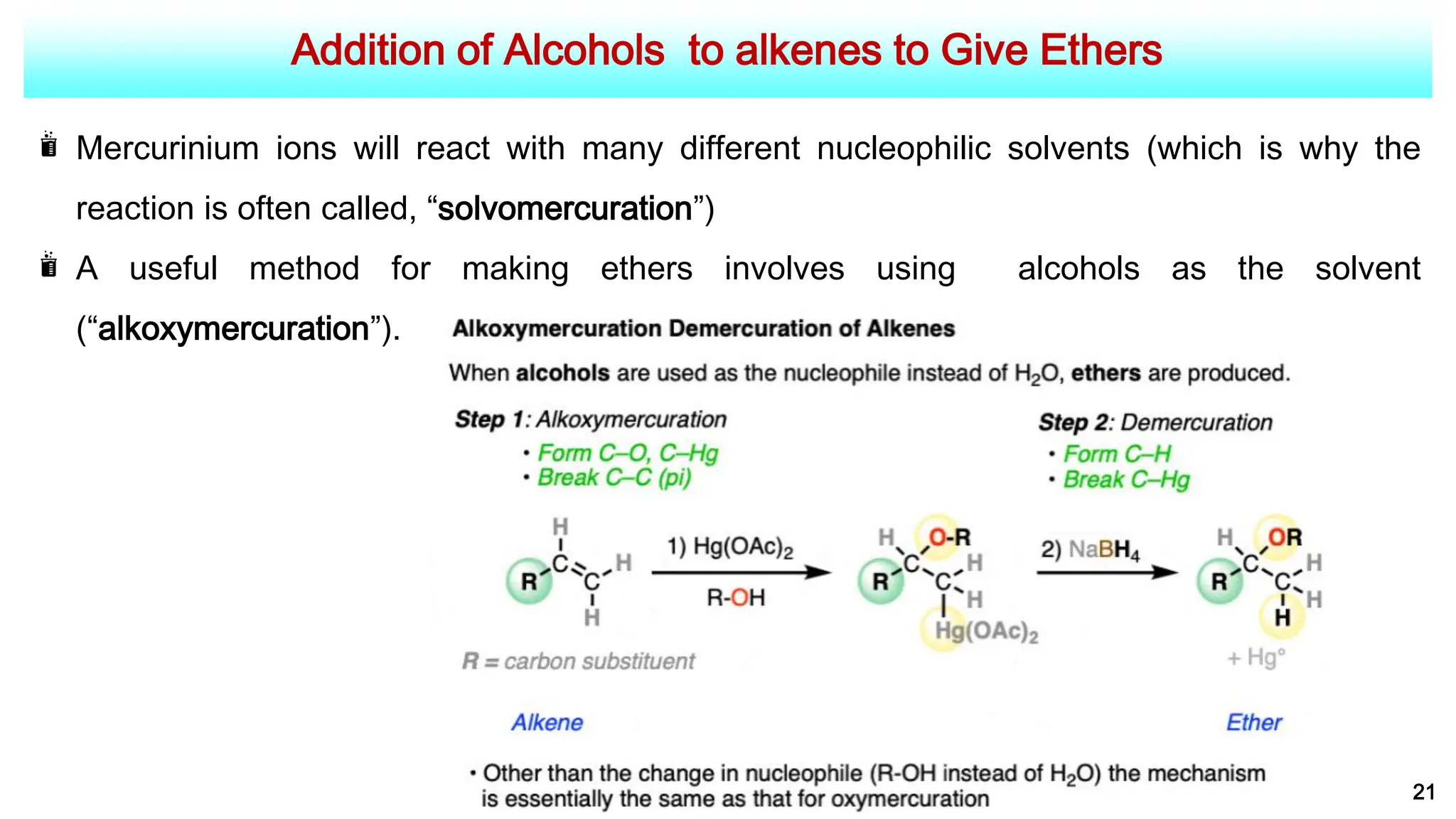
Addition of Alcoholsto alkenes to Give Ethers
21
Mercurinium ions will react with many different nucleophilic solvents (which is why the
reaction is often called, “solvomercuration”)
A useful method for making ethers involves using alcohols as the solvent
(“alkoxymercuration”).
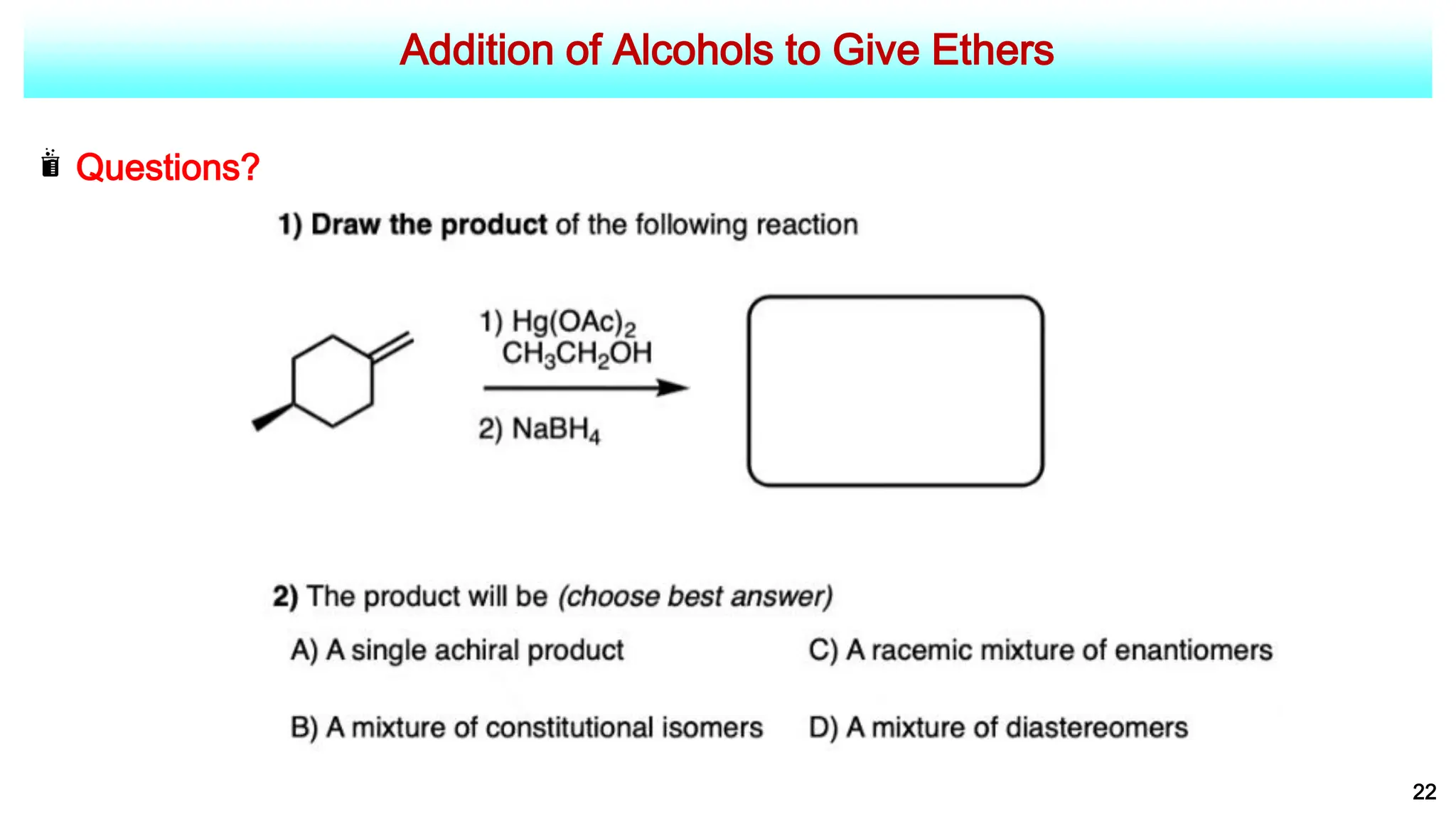
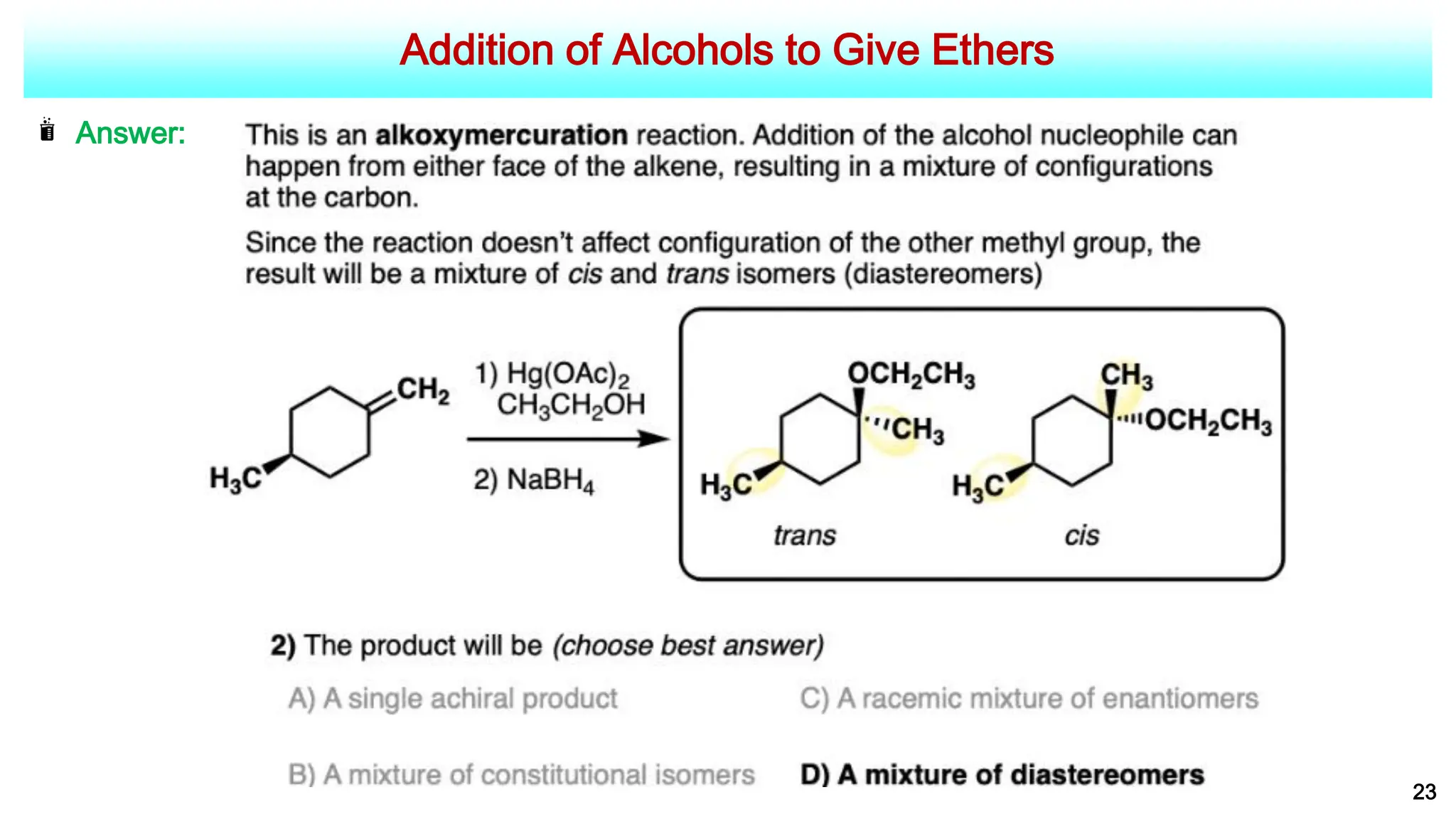
Addition of Alcoholsto Give Ethers
24
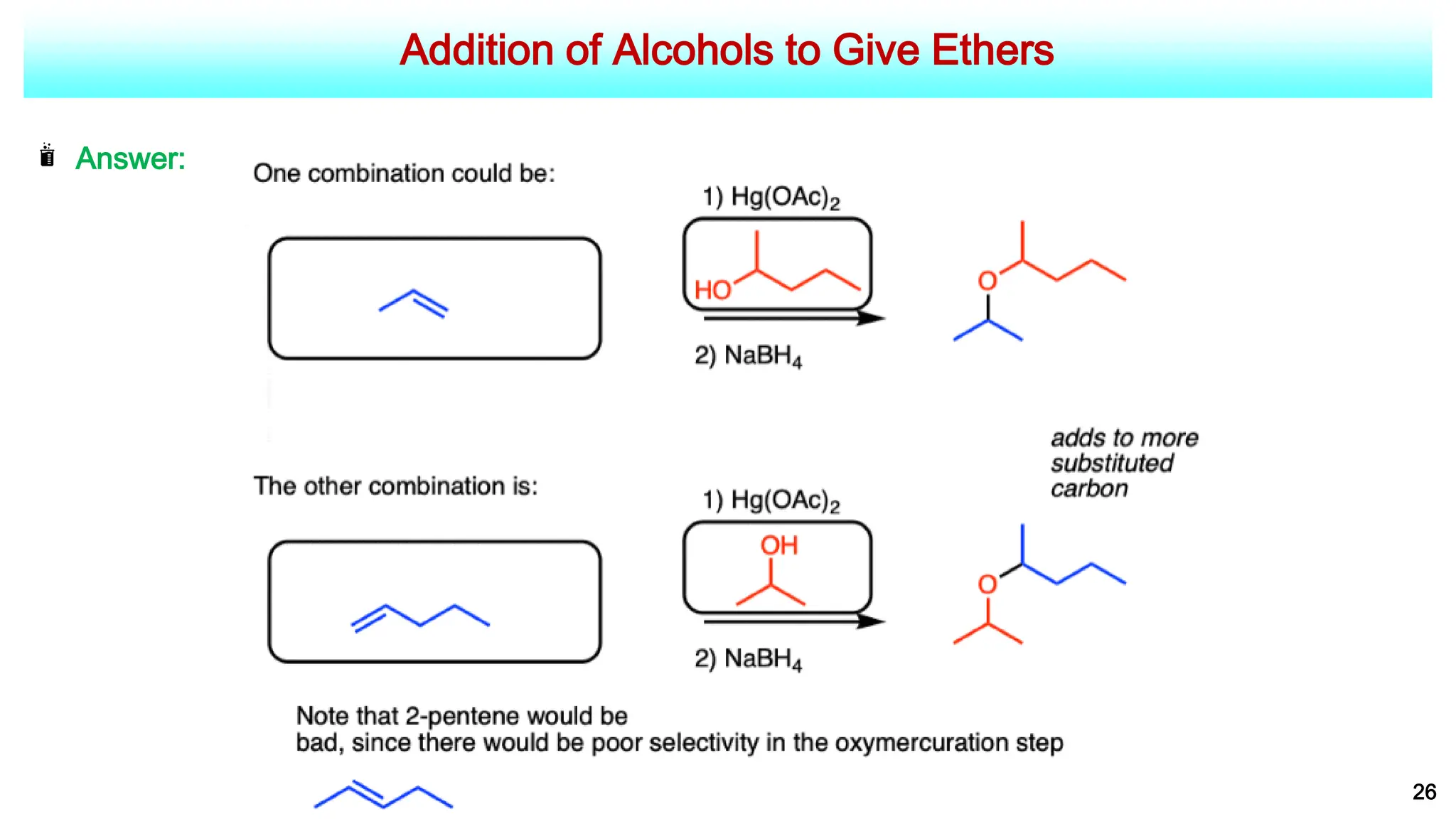
An advantage of oxymercuration over some other methods of ether formation is
that it can work well for making ethers of secondary and tertiary alcohols.
SN
2 reactions between alkoxide nucleophiles (RO(-)) and secondary alkyl halides
can run into problems from competing elimination reactions (E2). See this article on
The Williamson Ether Synthesis.
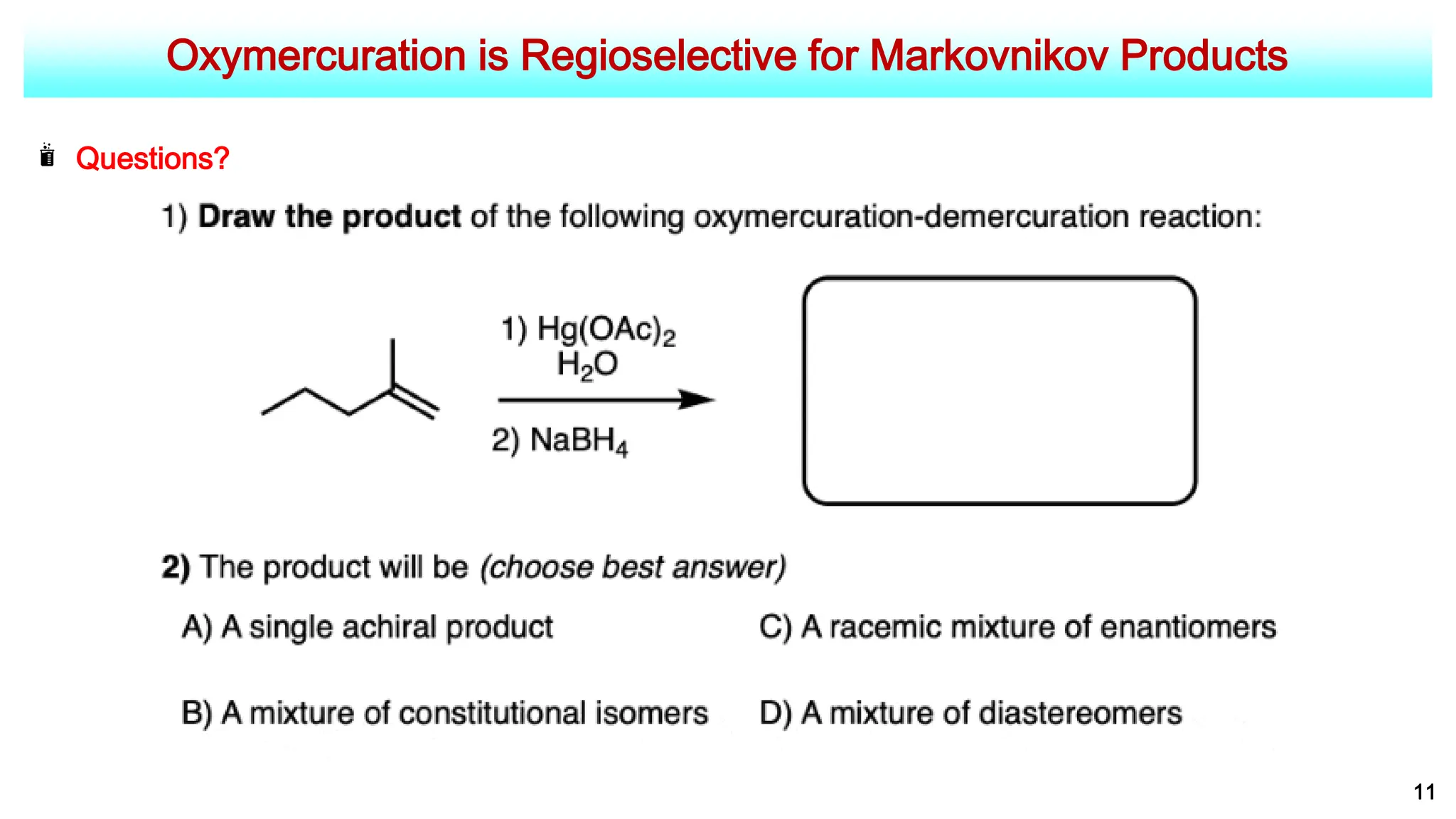
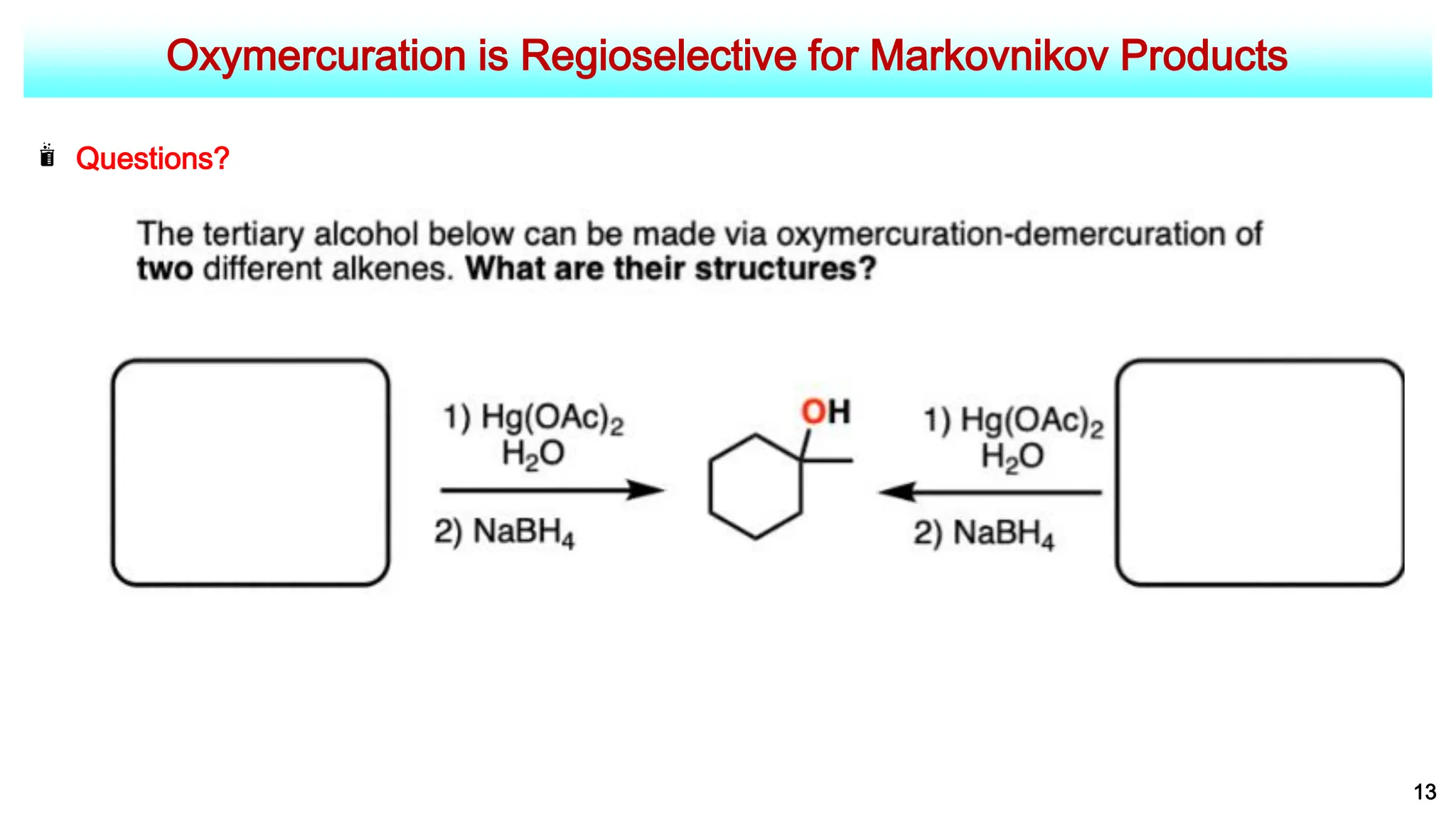
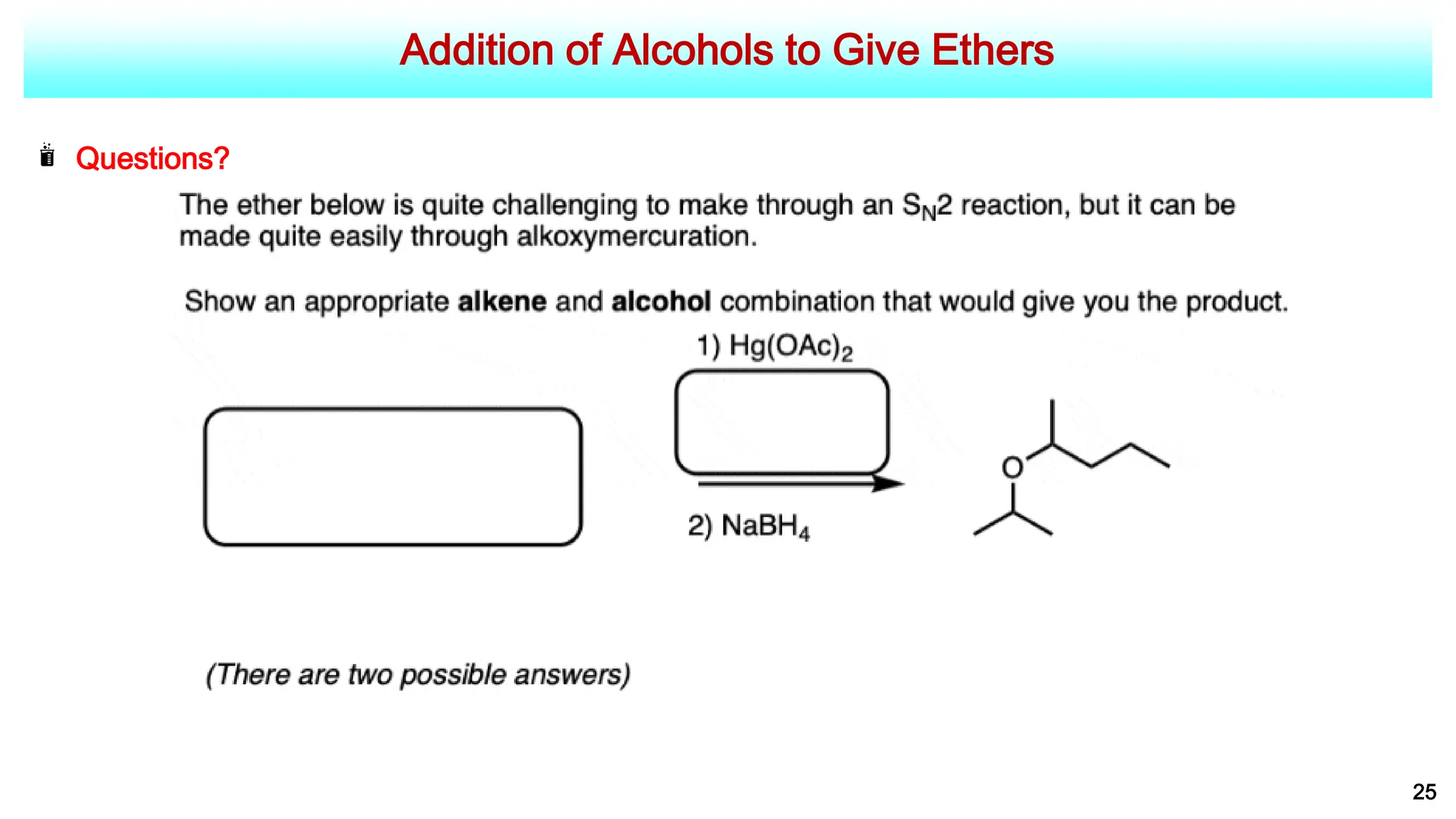
See if you can identify some starting materials for the formation of this ether from
an alkene and an alcohol.
Intramolecular Examples
27
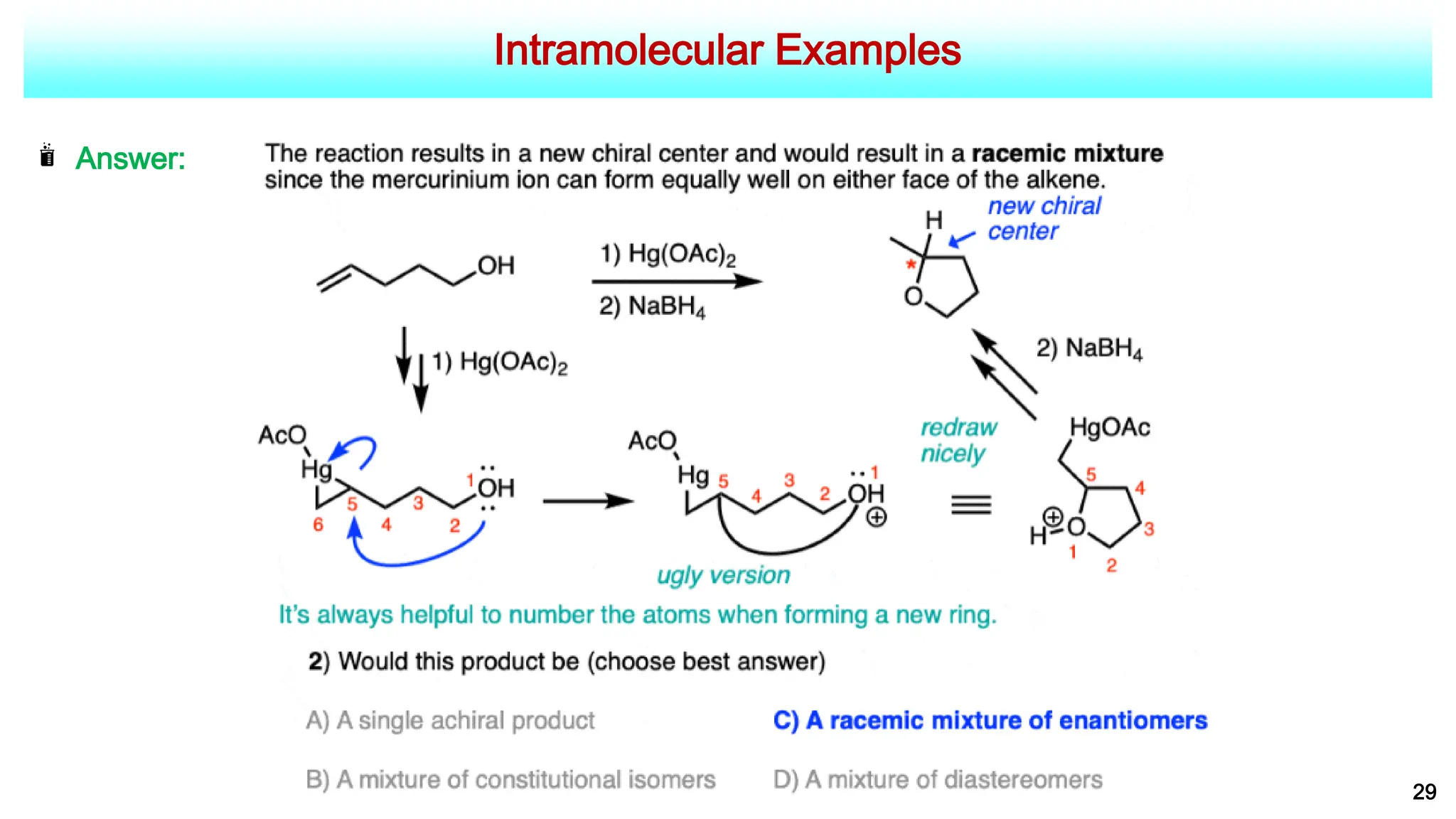
If themolecule has an alkene and alcohol, then it can react with itself.
This results in the formation of a cyclic product. Five- and six-membered rings
work best.
Instructors love testing their students’ understanding of reactions by
surprising them with intramolecular versions of reactions, since they involve
no new concepts but are a bit tricky if you haven’t practiced them.
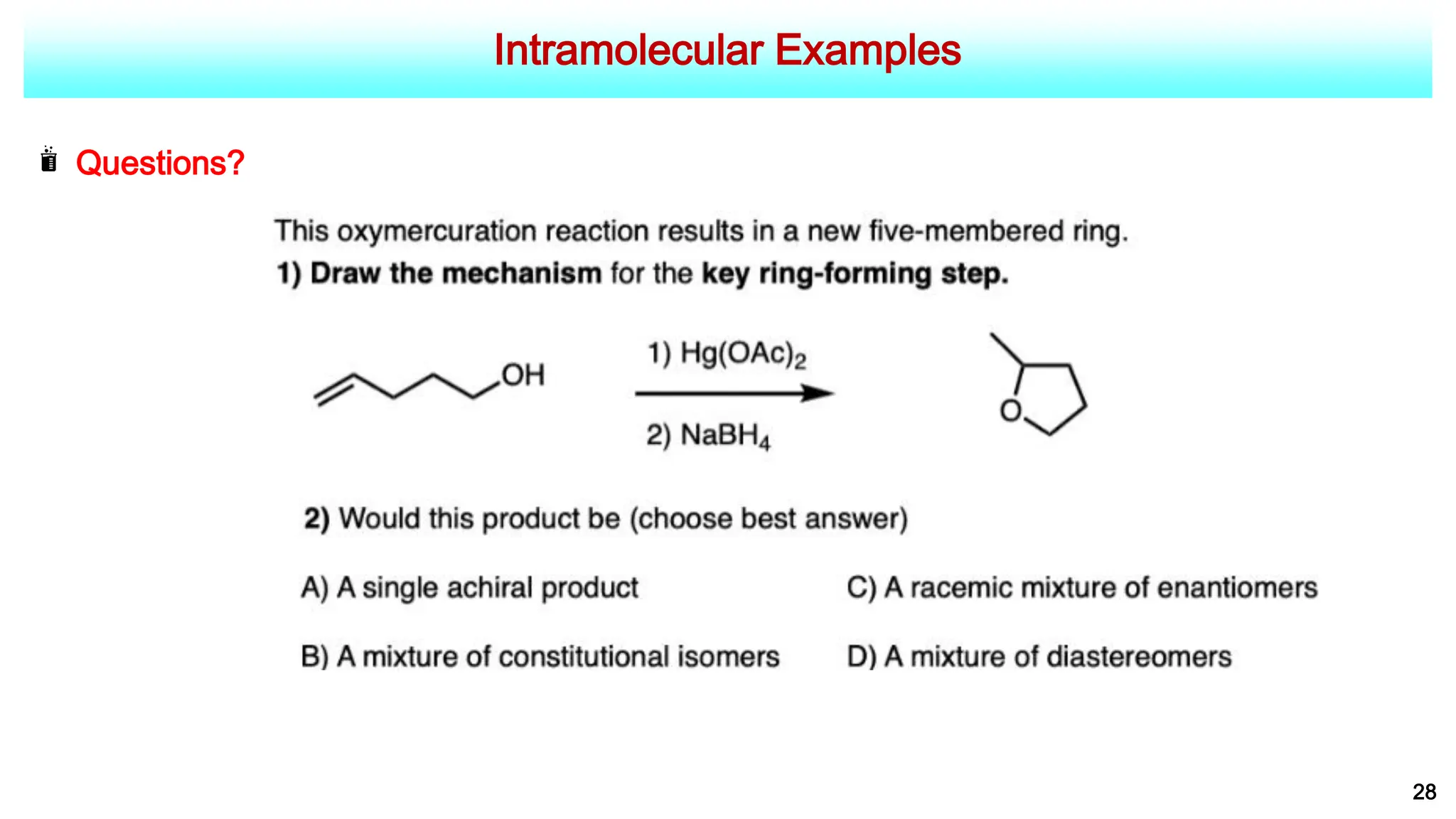
See if you can draw the product of the reaction below.
Summary
30
One of thekey takeaways from this chapter is to understand the contrast
between oxymercuration and acid-catalyzed hydration. Acid-catalyzed
hydration will potentially give carbocation rearrangements, but oxymercuration
will not.
Another is the contrast between the Markovnikov selectivity of oxymercuration
and the anti-Markovnikov selectivity of hydroboration.
A third key point is to see the similarity in mechanism between oxymercuration
of alkenes, halogenation of alkenes, and the opening of epoxides under acidic
conditions.
31.
Summary
31
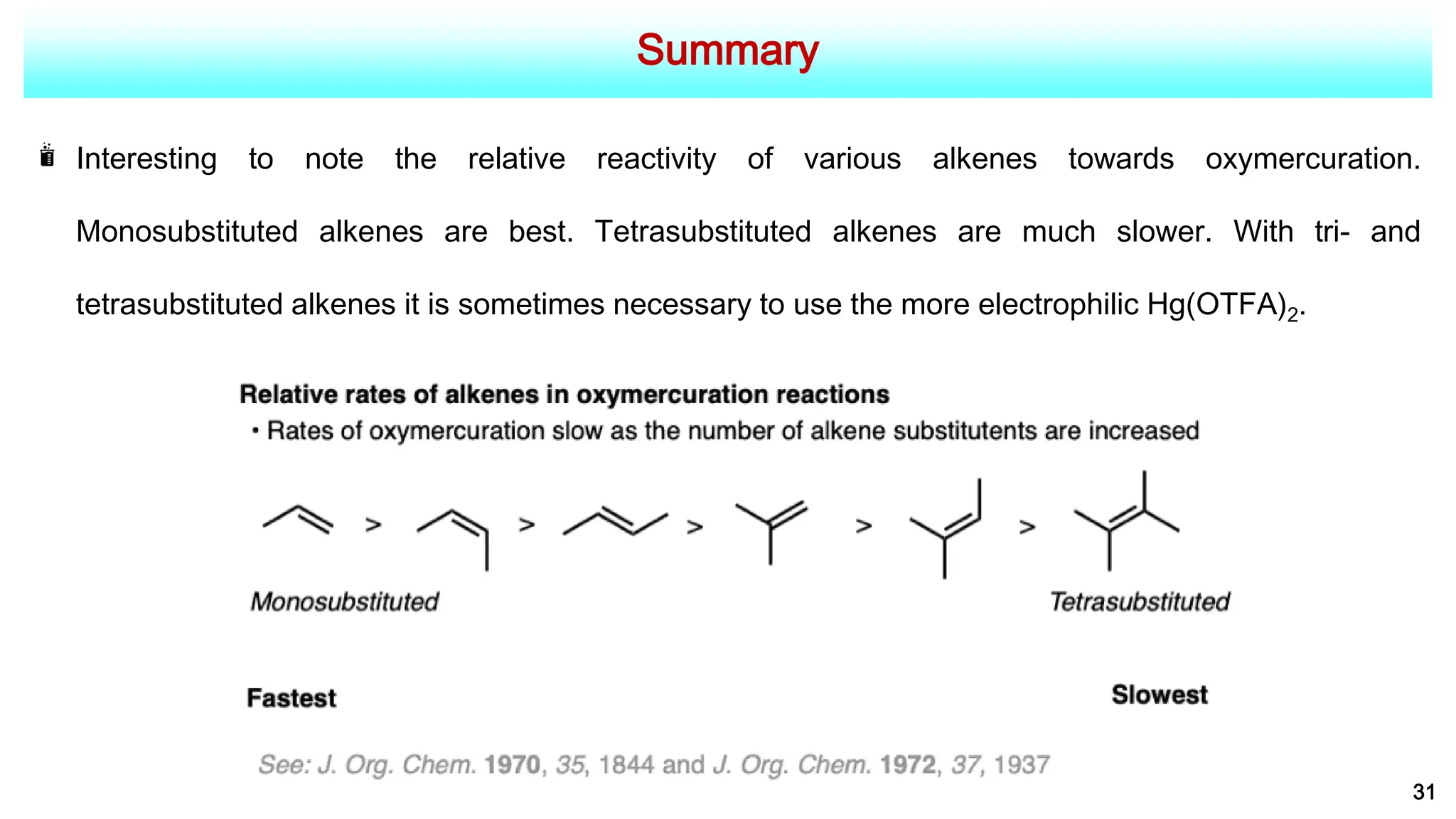
Interesting to notethe relative reactivity of various alkenes towards oxymercuration.
Monosubstituted alkenes are best. Tetrasubstituted alkenes are much slower. With tri- and
tetrasubstituted alkenes it is sometimes necessary to use the more electrophilic Hg(OTFA)2.
Understanding Markovnikov Selectivity
34
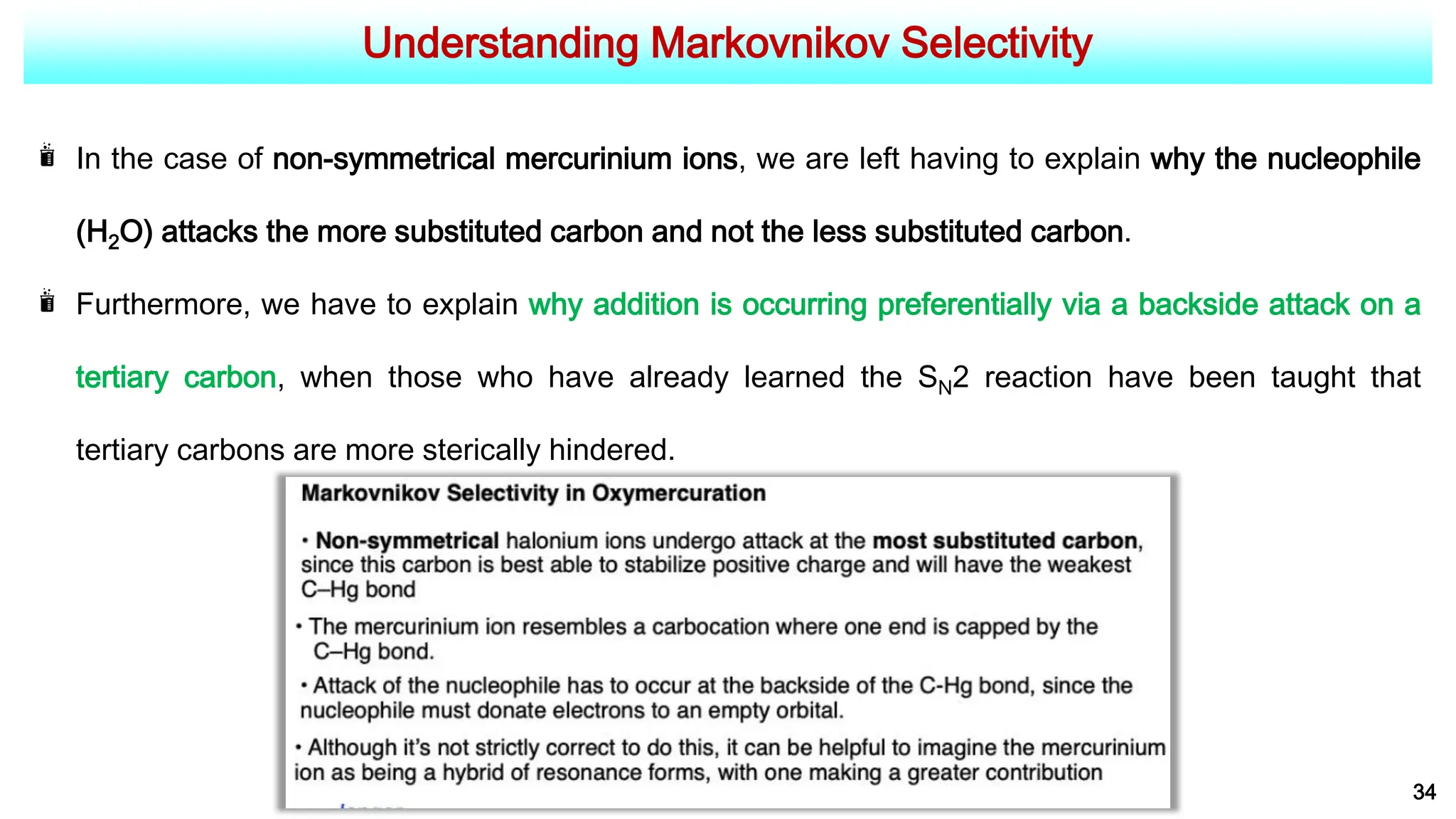
Inthe case of non-symmetrical mercurinium ions, we are left having to explain why the nucleophile
(H2O) attacks the more substituted carbon and not the less substituted carbon.
Furthermore, we have to explain why addition is occurring preferentially via a backside attack on a
tertiary carbon, when those who have already learned the SN2 reaction have been taught that
tertiary carbons are more sterically hindered.
35.
Understanding Markovnikov Selectivity
35
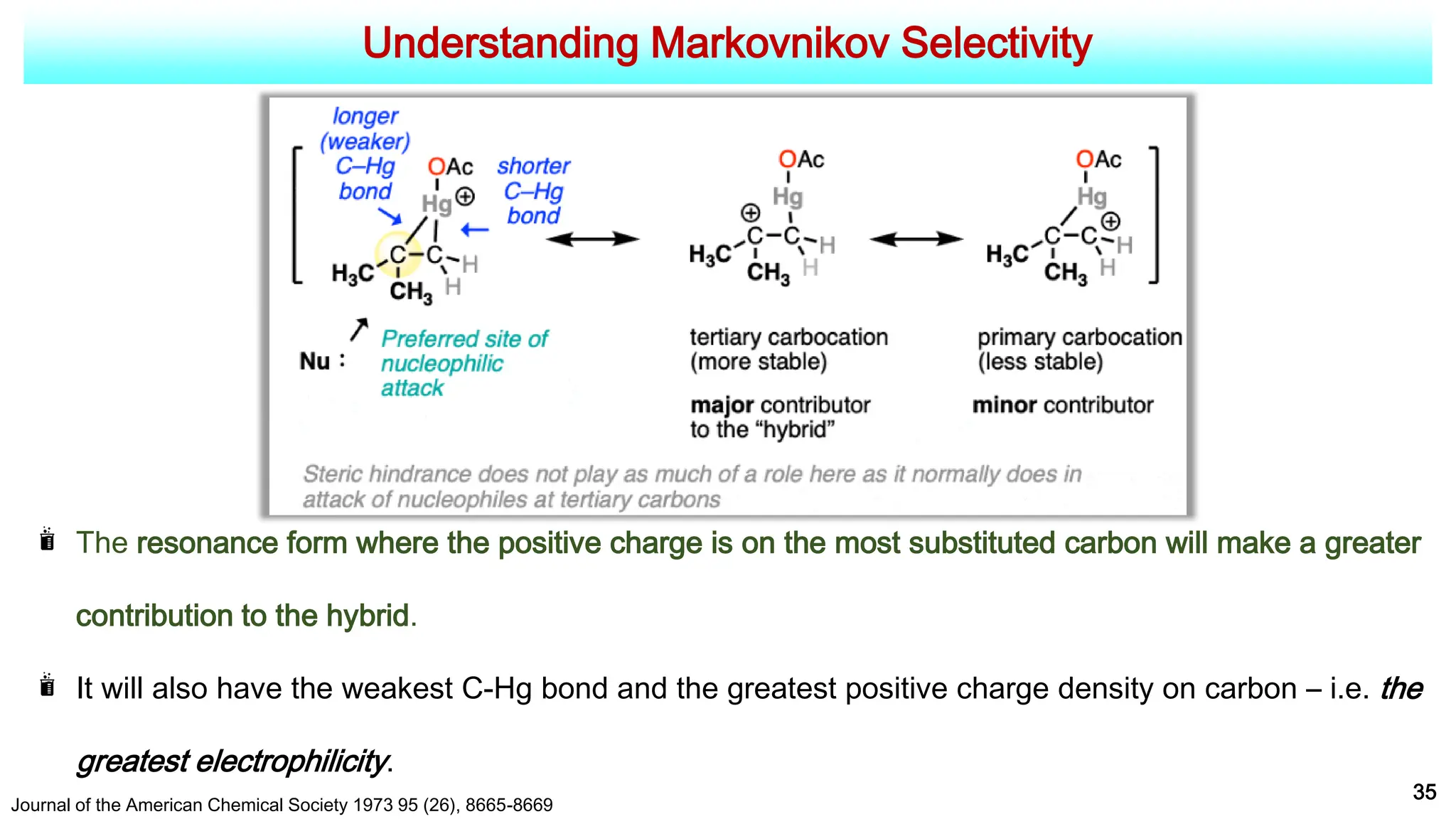
Theresonance form where the positive charge is on the most substituted carbon will make a greater
contribution to the hybrid.
It will also have the weakest C-Hg bond and the greatest positive charge density on carbon – i.e. the
greatest electrophilicity.
Journal of the American Chemical Society 1973 95 (26), 8665-8669
36.
Oxymercuration Provides MarkovnikovAlcohols Without Rearrangement
36
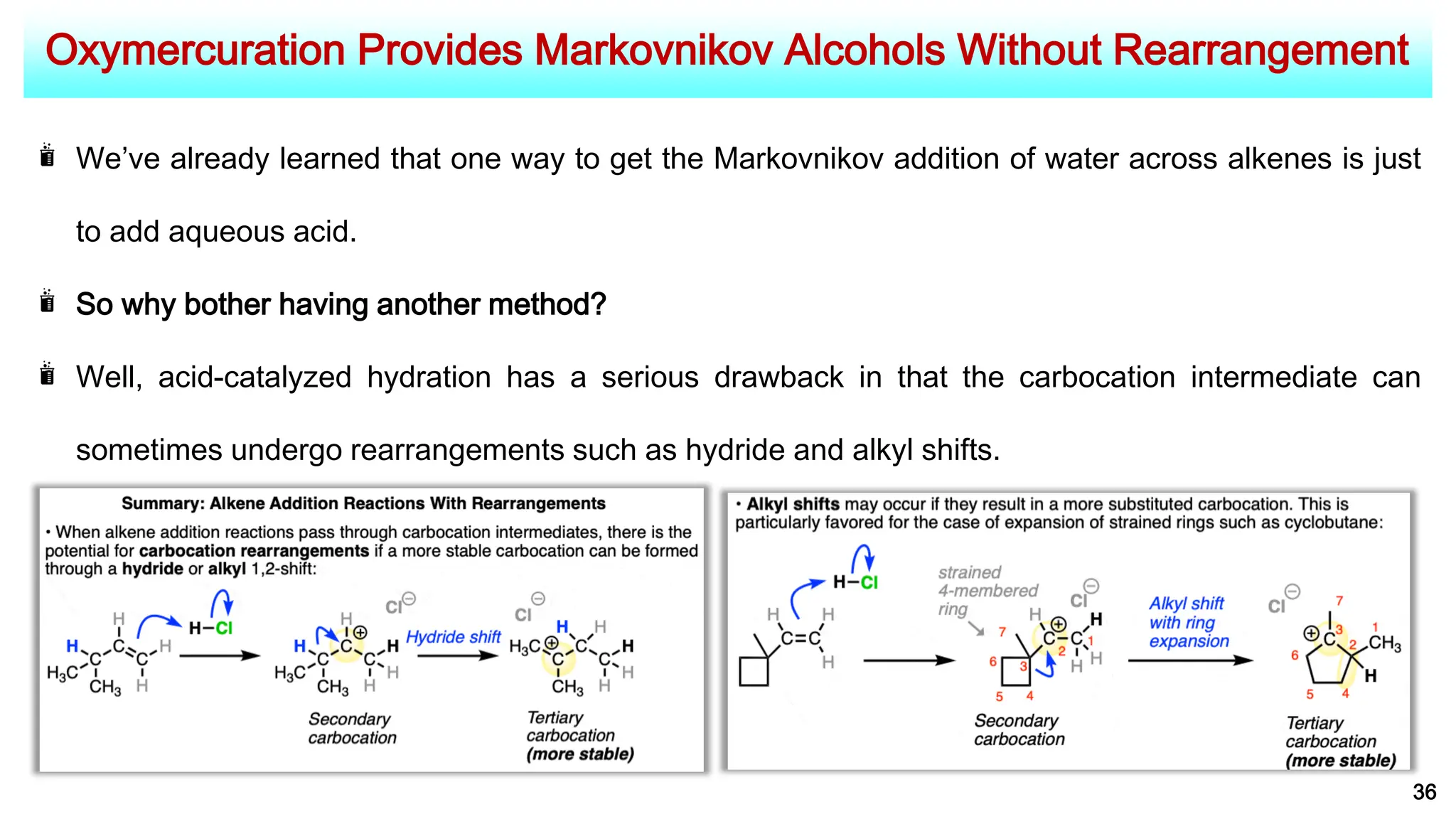
We’ve already learned that one way to get the Markovnikov addition of water across alkenes is just
to add aqueous acid.
So why bother having another method?
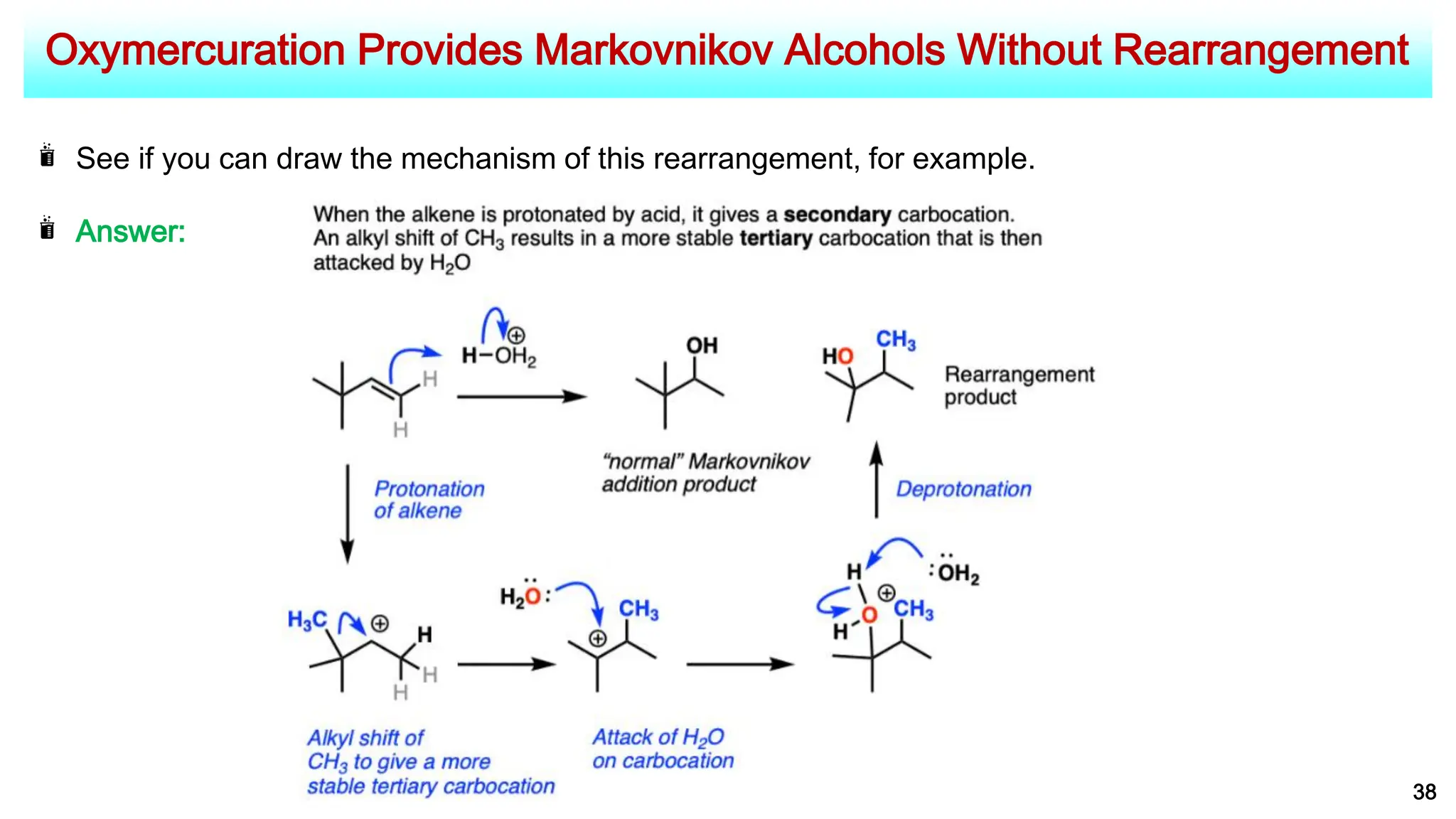
Well, acid-catalyzed hydration has a serious drawback in that the carbocation intermediate can
sometimes undergo rearrangements such as hydride and alkyl shifts.
37.
Oxymercuration Provides MarkovnikovAlcohols Without Rearrangement
37
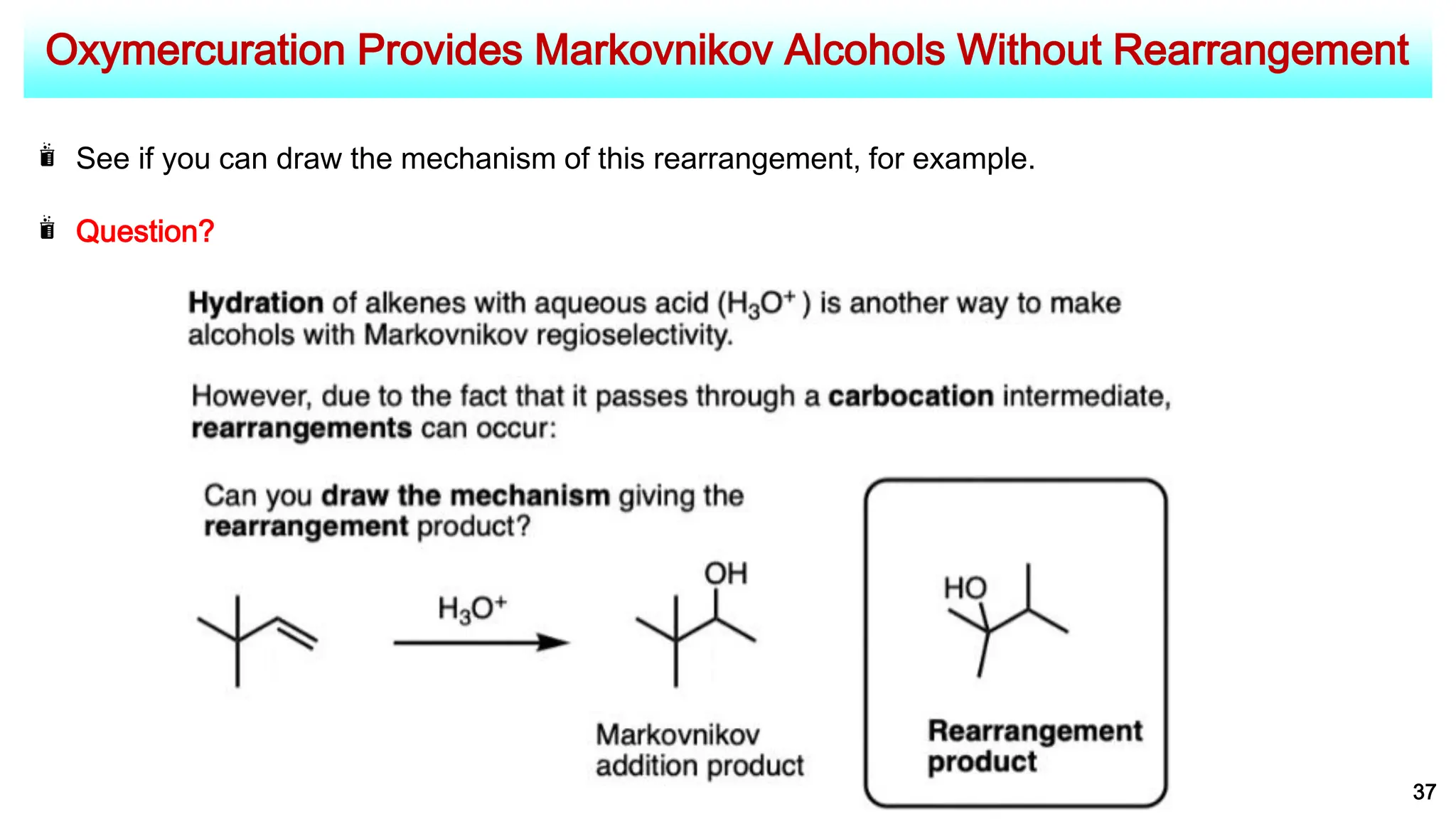
See if you can draw the mechanism of this rearrangement, for example.
Question?
38.
Oxymercuration Provides MarkovnikovAlcohols Without Rearrangement
38
See if you can draw the mechanism of this rearrangement, for example.
Answer:
39.
Oxymercuration Provides MarkovnikovAlcohols Without Rearrangement
39
One advantage of oxymercuration-demercuration is that rearrangement products are only rarely
observed.
40.
Oxymercuration-Demercuration of Alkenes
40
Whenan alkene is treated with a mercury(II) salt such as mercuric acetate [Hg(OAc)2] or mercuric
trifluoroacetate Hg(OCOCF3)2 in the presence of H2O, addition occurs across the C-C pi bond,
resulting in a new C-OH bond and a C-Hg bond. This reaction is called oxymercuration.
It is alternatively called “solvomercuration” since addition will generally incorporate any nucleophilic
solvent that happens to be around, whether that be H2O, alcohols, carboxylic acids, or others.

![Oxymercuration-Demercuration of Alkenes
40
When an alkene is treated with a mercury(II) salt such as mercuric acetate [Hg(OAc)2] or mercuric
trifluoroacetate Hg(OCOCF3)2 in the presence of H2O, addition occurs across the C-C pi bond,
resulting in a new C-OH bond and a C-Hg bond. This reaction is called oxymercuration.
It is alternatively called “solvomercuration” since addition will generally incorporate any nucleophilic
solvent that happens to be around, whether that be H2O, alcohols, carboxylic acids, or others.](https://image.slidesharecdn.com/topic-4mercurationandoxymercurationppt-final-250402094359-207526aa/75/Topic-4-Mercuration-and-Oxymercuration-PPT-Final-pdf-40-2048.jpg)


