Chapter 14

    Capital Markets
          By
Md. Shahedur Rahaman
      Chowdhury
                   14-1
Chapter Outline
• Capital market and securities
• Fund raisers in the capital markets
• The three-sector economy of the United
  States
• Physical and electronic markets
• Rapid adjustment of prices as an indication
  of efficiency
• Security legislation
                                                14-2
Security Markets
• Consist of various government bonds and
  corporate common stock
• The markets are influenced by variables like:
  – Interest rates
  – Investor confidence
  – Economic growth
  – Global crises, etc.


                                             14-3
Types of Security Markets
• Money markets
  – Short-term markets comprising of securities with
    maturities of one year or less
    • Treasury bills, commercial paper, negotiable
      certificates of deposits
• Capital markets
  – Long-term markets consisting of securities
    having maturities greater than one year
    • Bonds, common stock, preferred stock, convertible
      securities
    • These securities comprise a firm’s capital structure

                                                             14-4
International Capital Markets
• Have played an important role over the last
  decade due to various factors:
  – The Soviet Union disbanded in 1991
  – China has moved along a capitalistic course for several
    decades
  – Central and Eastern European countries “privatized”
    many of their state industries during the 1990s
  – Continuing development of international “free trade”


                                                          14-5
International Capital Markets
             (cont’d)
– Establishment of NAFTA in 1994
– CAFTA reduces trade barriers
– The six original members of EU abolished internal tariffs
  in 1968
– WTO strives to further liberalize international trade
– Euro still considered second most important international
  currency
– Value of “euro cash” in circulation now exceeds value of
  dollars in circulation worldwide


                                                         14-6
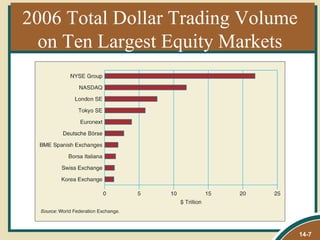
2006 Total Dollar Trading Volume
  on Ten Largest Equity Markets


                                   14-7
International Capital Markets
         as a Source of Funds
• An opportunity for companies to raise debt
  capital at the lowest cost
• Many list their common stock around the
  world to:
  – Increase liquidity for the stockholders
  – Provide opportunities for the potential sale of
    new stock in foreign countries
• About 3.7% of foreign investment has been
  invested in government securities
                                                      14-8
Competition for Funds
      in the U.S. Capital Markets
• Securities available in the capital market:
  – The federal government
  – Government agencies
  – State governments
  – Local municipalities
• Investors must choose among corporate and
  noncorporate securities with the desire to:
  – Maximize returns for any given level of risk

                                                   14-9
Government Securities
• U.S. government securities - Treasury
  – Manages the federal government’s debt in order
    to balance the flow of funds
  – Sells short- or long-term securities to finance
    shortfalls or retires in case of surplus
• Federally sponsored credit agencies
  – Governmental units issuing securities on a
    separate basis from those sold by U.S. Treasury
  – Includes:
    • Federal Home Loan Banks (FHLB)
                                                 14-10
Government Securities (cont’d)

     • Federal National Mortgage Association (Fannie Mae)
     • Farm Credit Banks
     • Student Loan Marketing Association
• State and local securities
  – Municipal securities or tax-exempt offerings
  – Investors - high marginal tax brackets
  – Supported by revenue-generating projects


                                                       14-11
Corporate Securities
• Corporate bonds
  – Debt instruments having a fixed life and to be
    repaid at maturity
  – As bonds come due and are paid off, the
    corporation normally replaces this debt with new
    bonds
• Preferred stock
  – Least used of all long-term securities since the
    dividend is not tax-deductible to the corporation

                                                   14-12
Corporate Securities (cont’d)
• Common stock
  – Sold by companies desiring new equity capital
  – Either sold as a new issue in an initial public
    offering (IPO) or as a secondary offering
  – Treasury stock: When a company purchases its
    own stock – availability of surplus cash


                                                 14-13
Internal versus External
               Sources of Funds
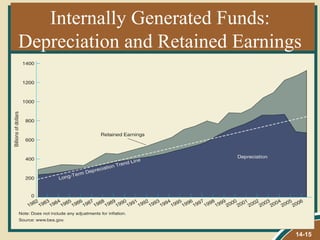
• Internally generated funds include retained
  earnings and cash flow added back from
  depreciation
  – Composition of internal funds is a function of:
     •   Corporate profitability
     •   The dividends paid
     •   The resultant retained earnings
     •   The depreciation tax shield firms avail


                                                      14-14
Internally Generated Funds:
Depreciation and Retained Earnings


                                 14-15
The Supply of Capital Funds
• Household sector - major supplier of funds
• Indirect investments:
  – Household savings generated by wages
  – Transfer payments from the government
  – Wages and dividends from the corporations
     • These are funneled to financial intermediaries
     • Diverse financial institutions channel funds into
       commercial banks, mutual savings banks, and credit
       unions


                                                       14-16
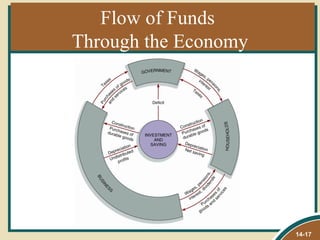
Flow of Funds
Through the Economy


                      14-17
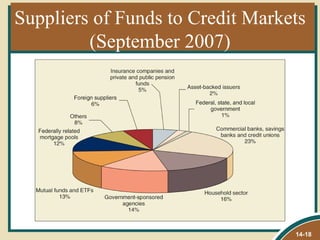
Suppliers of Funds to Credit Markets
         (September 2007)


                                  14-18
The Role of the Security Markets
• The capital markets are divided into many
  functional subsets
  – Each specific market serves a certain type of
    security
• Secondary trading:
  – The security trades in appropriate markets – not
    original offering
  – Provides liquidity to investors and keeps the
    prices competitive

                                                    14-19
The Role of the Security Markets
              (cont’d)
• Security markets provide liquidity by:
  – Enabling corporations to raise funds by selling
    new issues of securities
  – Allowing investor to sell them with relative ease
    and speed
• Corporations and government units would
  not be able to raise large amounts of capital
  for economic growth – without markets


                                                    14-20
The Organization
        of the Security Markets
• Security markets structuring has changed
  because of:
  – Technological advances which include:
    • The rise of electronic communication networks
      (ECNs)
    • Mergers or alliances between exchanges
    • Transformation of member exchanges into public
      companies
    • Acquisition of leading ECNs by the traditional
      exchanges

                                                       14-21
Traditional Organized Exchanges
• Either national or regional, both structured in
  similar fashion
• Historically, exchanges have central trading
  location, securities bought & sold in auction market
  by brokers acting as agents for buyers & sellers
• Each stock trades at a physical location, trading
  post, on exchange’s trading floor
• Brokers are registered members of exchanges


                                                   14-22
Regional Exchanges
• Began by trading securities of local firms
• Also listed on national exchanges but continued to
  be traded on regionals
• Trade primarily done in nationally known
  companies
• Trading in same companies common between
  NYSE and regionals like Chicago Stock Exchange
  — dual trading
• More than 90 percent of companies traded on the
  Chicago Stock Exchange also listed on the NYSE -
  dual trading
                                                 14-23
Listing Requirements
• A firm’s securities can be traded on an exchange if
  company meets listing requirements and has been
  approved by board of governors of that exchange
• All exchanges have minimum requirements that
  must be met before trading occurs in company’s
  common stock
• NYSE - biggest exchange, generates most dollar
  volume in large companies, listing requirements
  are most restrictive
• NASDAQ has less restrictive listing requirements
  than NYSE
                                                   14-24
Electronic Communication
           Networks (ECNs)
• Electronic trading systems that automatically buy
  and sell orders at specified prices
  – Also known as alternative trading systems (ATSs)
  – Have SEC approval to be fully integrated into the
    national market system
  – Can choose to act as broker-dealer or an exchange
  – Lower the cost of trading
  – Forced organized security exchanges to make significant
    changes in their operations and structure


                                                        14-25
The New York Stock Exchange
• In 2006, NYSE merged with a large ECN and
  became a public company
  – Comprises of thousands of huge companies whose
    shares are listed on the NYSE
  – Specialists meet to buy and sell securities through a bid
    and ask market, called an auction market
     • They are registered members of the exchange
  – In addition to acquiring Archipelago, NYSE merged with
    Euronext
  – NYSE acquired American Stock Exchange in 2008


                                                           14-26
The NASDAQ Market
• NASDAQ:
 – Was once considered an OTC market
 – All trades done electronically
 – Second largest exchange in the U.S.
 – Currently owns 30% of London Stock Exchange
 – Known for trading technology and listing of many
   of the world’s largest technology companies


                                                14-27
The NASDAQ Market (cont’d)
– Created SuperMontage, electronic trading
  system that integrates trading process with limit
  orders, time stamps for receipt of orders,
  multiple quotes, etc.
– Acquired the largest ECN called INET, and later
  BRUT
– Created more speed and price efficiency in
  order executions
– Divides its markets into national and small
  capitalization markets
                                                 14-28
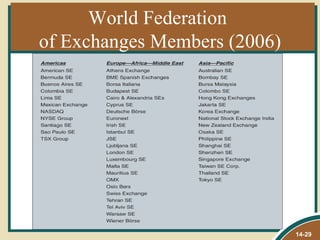
World Federation
of Exchanges Members (2006)


                              14-29
Market Efficiency
• Markets in general are efficient when:
  – Prices adjust rapidly to new information
  – There is a continuous market, in which each
    successive trade is made at a price closer to the
    previous price
  – The market can absorb large dollar amounts of
    securities without destabilizing the prices
• The important variable affecting efficiency is
  the certainty of income stream
                                                   14-30
Market Efficiency (cont’d)
• Fixed income securities, with known
  maturities, have reasonably efficient markets
  – The most efficient is that for U.S. government
    securities
  – Corporate bond markets are reasonable to a
    degree
  – Common stocks market has been supported
    through decimalization, ECNs, etc.


                                                     14-31
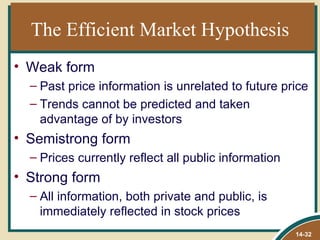
The Efficient Market Hypothesis
• Weak form
  – Past price information is unrelated to future price
  – Trends cannot be predicted and taken
    advantage of by investors
• Semistrong form
  – Prices currently reflect all public information
• Strong form
  – All information, both private and public, is
    immediately reflected in stock prices
                                                      14-32
End
Q


          8-33
Q&A

      8-34
Thank You.

             8-35

Topic 006 updated

  • 1.
    Chapter 14 Capital Markets By Md. Shahedur Rahaman Chowdhury 14-1
  • 2.
    Chapter Outline • Capitalmarket and securities • Fund raisers in the capital markets • The three-sector economy of the United States • Physical and electronic markets • Rapid adjustment of prices as an indication of efficiency • Security legislation 14-2
  • 3.
    Security Markets • Consistof various government bonds and corporate common stock • The markets are influenced by variables like: – Interest rates – Investor confidence – Economic growth – Global crises, etc. 14-3
  • 4.
    Types of SecurityMarkets • Money markets – Short-term markets comprising of securities with maturities of one year or less • Treasury bills, commercial paper, negotiable certificates of deposits • Capital markets – Long-term markets consisting of securities having maturities greater than one year • Bonds, common stock, preferred stock, convertible securities • These securities comprise a firm’s capital structure 14-4
  • 5.
    International Capital Markets •Have played an important role over the last decade due to various factors: – The Soviet Union disbanded in 1991 – China has moved along a capitalistic course for several decades – Central and Eastern European countries “privatized” many of their state industries during the 1990s – Continuing development of international “free trade” 14-5
  • 6.
    International Capital Markets (cont’d) – Establishment of NAFTA in 1994 – CAFTA reduces trade barriers – The six original members of EU abolished internal tariffs in 1968 – WTO strives to further liberalize international trade – Euro still considered second most important international currency – Value of “euro cash” in circulation now exceeds value of dollars in circulation worldwide 14-6
  • 7.
    2006 Total DollarTrading Volume on Ten Largest Equity Markets 14-7
  • 8.
    International Capital Markets as a Source of Funds • An opportunity for companies to raise debt capital at the lowest cost • Many list their common stock around the world to: – Increase liquidity for the stockholders – Provide opportunities for the potential sale of new stock in foreign countries • About 3.7% of foreign investment has been invested in government securities 14-8
  • 9.
    Competition for Funds in the U.S. Capital Markets • Securities available in the capital market: – The federal government – Government agencies – State governments – Local municipalities • Investors must choose among corporate and noncorporate securities with the desire to: – Maximize returns for any given level of risk 14-9
  • 10.
    Government Securities • U.S.government securities - Treasury – Manages the federal government’s debt in order to balance the flow of funds – Sells short- or long-term securities to finance shortfalls or retires in case of surplus • Federally sponsored credit agencies – Governmental units issuing securities on a separate basis from those sold by U.S. Treasury – Includes: • Federal Home Loan Banks (FHLB) 14-10
  • 11.
    Government Securities (cont’d) • Federal National Mortgage Association (Fannie Mae) • Farm Credit Banks • Student Loan Marketing Association • State and local securities – Municipal securities or tax-exempt offerings – Investors - high marginal tax brackets – Supported by revenue-generating projects 14-11
  • 12.
    Corporate Securities • Corporatebonds – Debt instruments having a fixed life and to be repaid at maturity – As bonds come due and are paid off, the corporation normally replaces this debt with new bonds • Preferred stock – Least used of all long-term securities since the dividend is not tax-deductible to the corporation 14-12
  • 13.
    Corporate Securities (cont’d) •Common stock – Sold by companies desiring new equity capital – Either sold as a new issue in an initial public offering (IPO) or as a secondary offering – Treasury stock: When a company purchases its own stock – availability of surplus cash 14-13
  • 14.
    Internal versus External Sources of Funds • Internally generated funds include retained earnings and cash flow added back from depreciation – Composition of internal funds is a function of: • Corporate profitability • The dividends paid • The resultant retained earnings • The depreciation tax shield firms avail 14-14
  • 15.
    Internally Generated Funds: Depreciationand Retained Earnings 14-15
  • 16.
    The Supply ofCapital Funds • Household sector - major supplier of funds • Indirect investments: – Household savings generated by wages – Transfer payments from the government – Wages and dividends from the corporations • These are funneled to financial intermediaries • Diverse financial institutions channel funds into commercial banks, mutual savings banks, and credit unions 14-16
  • 17.
    Flow of Funds Throughthe Economy 14-17
  • 18.
    Suppliers of Fundsto Credit Markets (September 2007) 14-18
  • 19.
    The Role ofthe Security Markets • The capital markets are divided into many functional subsets – Each specific market serves a certain type of security • Secondary trading: – The security trades in appropriate markets – not original offering – Provides liquidity to investors and keeps the prices competitive 14-19
  • 20.
    The Role ofthe Security Markets (cont’d) • Security markets provide liquidity by: – Enabling corporations to raise funds by selling new issues of securities – Allowing investor to sell them with relative ease and speed • Corporations and government units would not be able to raise large amounts of capital for economic growth – without markets 14-20
  • 21.
    The Organization of the Security Markets • Security markets structuring has changed because of: – Technological advances which include: • The rise of electronic communication networks (ECNs) • Mergers or alliances between exchanges • Transformation of member exchanges into public companies • Acquisition of leading ECNs by the traditional exchanges 14-21
  • 22.
    Traditional Organized Exchanges •Either national or regional, both structured in similar fashion • Historically, exchanges have central trading location, securities bought & sold in auction market by brokers acting as agents for buyers & sellers • Each stock trades at a physical location, trading post, on exchange’s trading floor • Brokers are registered members of exchanges 14-22
  • 23.
    Regional Exchanges • Beganby trading securities of local firms • Also listed on national exchanges but continued to be traded on regionals • Trade primarily done in nationally known companies • Trading in same companies common between NYSE and regionals like Chicago Stock Exchange — dual trading • More than 90 percent of companies traded on the Chicago Stock Exchange also listed on the NYSE - dual trading 14-23
  • 24.
    Listing Requirements • Afirm’s securities can be traded on an exchange if company meets listing requirements and has been approved by board of governors of that exchange • All exchanges have minimum requirements that must be met before trading occurs in company’s common stock • NYSE - biggest exchange, generates most dollar volume in large companies, listing requirements are most restrictive • NASDAQ has less restrictive listing requirements than NYSE 14-24
  • 25.
    Electronic Communication Networks (ECNs) • Electronic trading systems that automatically buy and sell orders at specified prices – Also known as alternative trading systems (ATSs) – Have SEC approval to be fully integrated into the national market system – Can choose to act as broker-dealer or an exchange – Lower the cost of trading – Forced organized security exchanges to make significant changes in their operations and structure 14-25
  • 26.
    The New YorkStock Exchange • In 2006, NYSE merged with a large ECN and became a public company – Comprises of thousands of huge companies whose shares are listed on the NYSE – Specialists meet to buy and sell securities through a bid and ask market, called an auction market • They are registered members of the exchange – In addition to acquiring Archipelago, NYSE merged with Euronext – NYSE acquired American Stock Exchange in 2008 14-26
  • 27.
    The NASDAQ Market •NASDAQ: – Was once considered an OTC market – All trades done electronically – Second largest exchange in the U.S. – Currently owns 30% of London Stock Exchange – Known for trading technology and listing of many of the world’s largest technology companies 14-27
  • 28.
    The NASDAQ Market(cont’d) – Created SuperMontage, electronic trading system that integrates trading process with limit orders, time stamps for receipt of orders, multiple quotes, etc. – Acquired the largest ECN called INET, and later BRUT – Created more speed and price efficiency in order executions – Divides its markets into national and small capitalization markets 14-28
  • 29.
    World Federation of ExchangesMembers (2006) 14-29
  • 30.
    Market Efficiency • Marketsin general are efficient when: – Prices adjust rapidly to new information – There is a continuous market, in which each successive trade is made at a price closer to the previous price – The market can absorb large dollar amounts of securities without destabilizing the prices • The important variable affecting efficiency is the certainty of income stream 14-30
  • 31.
    Market Efficiency (cont’d) •Fixed income securities, with known maturities, have reasonably efficient markets – The most efficient is that for U.S. government securities – Corporate bond markets are reasonable to a degree – Common stocks market has been supported through decimalization, ECNs, etc. 14-31
  • 32.
    The Efficient MarketHypothesis • Weak form – Past price information is unrelated to future price – Trends cannot be predicted and taken advantage of by investors • Semistrong form – Prices currently reflect all public information • Strong form – All information, both private and public, is immediately reflected in stock prices 14-32
  • 33.
    End Q 8-33
  • 34.
    Q&A 8-34
  • 35.