Rote Learning
What is it?
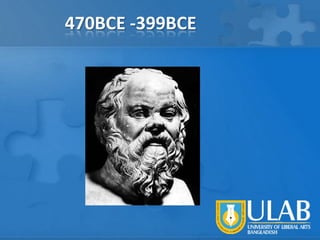
470BCE -399BCE
• “[It] destroys memory [and] weakens the
mind, relieving it of…work that makes it
strong. [It] is an inhuman thing.”
• The sentiment above is from Phaedrus - Plato
quoting Socrates in 500 B.C. Greece. The “it”
in the quote is writing.
• Socratic method is a form of inquiry and
discussion between individuals, based on
asking and answering questions to stimulate
critical thinking and to illuminate ideas. It is
a dialectical method.
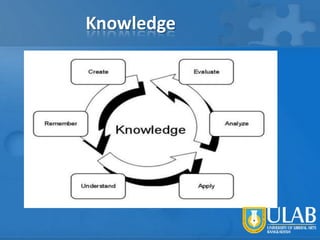
Knowledge
Rote Learning
• Rote learning is a learning technique
which focuses on memorization. The
major practice involved in rote learning is
learning by repetition by which students
commit information to memory in a
highly structured way.
• The idea is that one will be able to
quickly recall the meaning of the material
the more one repeats it. Rote methods
are routinely used when quick
memorization is required, such s learning
one's lines in a play or memorizing a
telephone number.
Human Memory
• Memory is our ability
to encode, store, retain and
subsequently recall information and past
experiences in the human brain. It can be
thought of in general terms as the use of past
experience to affect or influence current
behaviour.
• The popular image of memory is as a kind of
tiny filing cabinet full of individual memory
folders in which information is stored away, or
perhaps as a neural super-computer of huge
capacity and speed.
• But in the light of modern biological and
psychological knowledge, these metaphors may
not be entirely useful and, today, experts believe
that memory is in fact far more complex and
subtle than that.
How our Memory works
• The three main processes involved in human
memory are:
encoding,storage and recall (retrieval).
• Additionally, the process of memory
consolidation (which can be considered to be
either part of the encoding process or
the storage process) is treated as a separate
process in its own right.
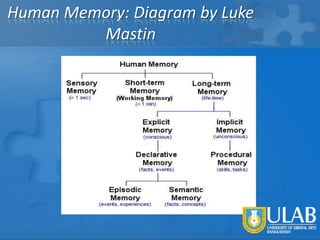
Human Memory: Diagram by Luke
Mastin
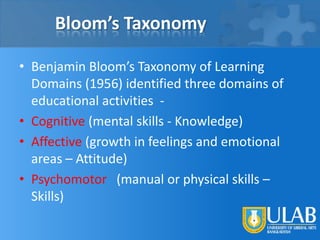
Bloom’s Taxonomy
• Benjamin Bloom’s Taxonomy of Learning
Domains (1956) identified three domains of
educational activities • Cognitive (mental skills - Knowledge)
• Affective (growth in feelings and emotional
areas – Attitude)
• Psychomotor (manual or physical skills –
Skills)
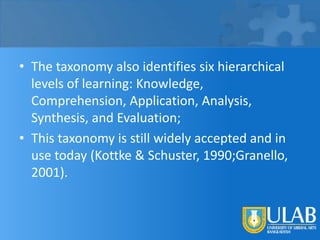
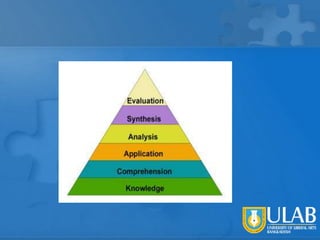
• The taxonomy also identifies six hierarchical
levels of learning: Knowledge,
Comprehension, Application, Analysis,
Synthesis, and Evaluation;
• This taxonomy is still widely accepted and in
use today (Kottke & Schuster, 1990;Granello,
2001).
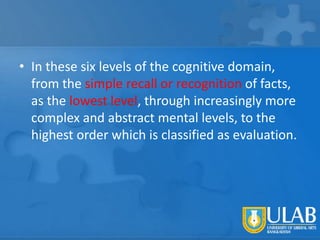
• In these six levels of the cognitive domain,
from the simple recall or recognition of facts,
as the lowest level, through increasingly more
complex and abstract mental levels, to the
highest order which is classified as evaluation.
Courses in National Curriculum for
Secondary level
• Agriculture, Arts and Crafts, Bangla, Buddha
Religion, Business Studies, Christianity,
English, Hindu Religion, Home Science,
Humanities, ICT Career Education, Islam
Religion, Maths & Higher Mathematics,
Physical Education, Science Education
Model followed in the
development of curriculum
• National Curriculum 2012 has been developed
based on the objective-learning outcome
model. According to this model, aims and
general objectives of education are
determined first. Then subjects and subjectwise learning objectives suitable to attaining
those objectives are selected. To achieve
subject-wise objectives, terminal learning
outcomes for different grades are determined.
• Terminal learning outcomes are classified into
class-wise learning outcomes. Class-wise learning
outcomes are further divided under three heads:
cognitive, affective and psychomotor domains.
Then contents suitable for a class, teachinglearning activities, assessment techniques and
other strategies are laid on the basis of class-wise
learning outcomes. This model is also called
product oriented model.
• Many countries in the present world follow this
model to develop their curriculum.
Curriculum framework
• Aims
• Creating knowledgeable, skilled, rational,
creative and patriotic human resources full of
human, social and moral qualities through
holistic development of the learners;
• Objectives:
There are 18 different objectives
Some methods and techniques of
teaching-learning activities
• Much of the learners’ learning depends on the
methods and techniques of the teacher/s.
These methods and techniques depend on
learners’ abilities, tendencies, and the
characteristics of the lesson. If appropriate
methods and techniques are applied properly,
learners can learn easily.
• Some methods and techniques are discussed
briefly in the below:
•
•
•
•

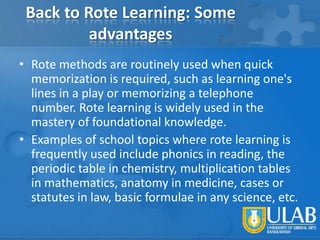
Question and answer method
Group based cooperative method
Demonstration methods
Investigation process
Back to Rote Learning: Some
advantages
• Rote methods are routinely used when quick
memorization is required, such as learning one's
lines in a play or memorizing a telephone
number. Rote learning is widely used in the
mastery of foundational knowledge.
• Examples of school topics where rote learning is
frequently used include phonics in reading, the
periodic table in chemistry, multiplication tables
in mathematics, anatomy in medicine, cases or
statutes in law, basic formulae in any science, etc.
• However, in math and science, rote methods
are often used, for example to memorize
formulas. There is greater understanding if
students commit a formula to memory
through exercises that use the formula rather
than through rote repetition of the formula.
• Newer standards often recommend that
students derive formulas themselves to
achieve the best understanding.
Disadvantages…
• By definition, rote learning eschews
comprehension, so by itself it is an ineffective
tool in mastering any complex subject at an
advanced level.
• Rote learning is sometimes disparaged with the
derogative terms parrot fashion, regurgitation,
cramming, or mugging because one who engages
in rote learning may give the wrong impression of
having understood what they have written or
said.
• However, students who learn with
understanding are able to transfer their
knowledge to tasks requiring problem-solving
with greater success than those who learn
only by rote.
Rote vs Meanigful
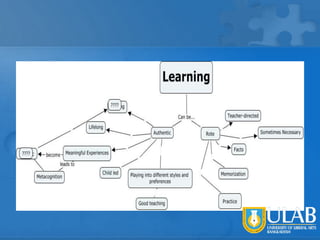
• The difference between meaningful and rote
learning is that rot learning entails
memorization, while meaningful learning
involves understanding. Rot learning needs a
person with quick memory, it is time
consuming due to repetition. In meaningful
learning the entire concept learned is stored
for a long time.
Story of a rote learner!
Learning theories
9.1 Learning theories are very important aspects in education. The Trial and Error Theory of Thorn
the Condition Reflex of Pavlov, Gestalt theory of Koffka and Köhler have been in educational practi
for a long time. The theory of Cognitive Development of Piaget that endorses difference of ability
among children according to their age has special contribution in education. In this theory, childre
aged 1-16 are categorized in 4 groups as per the difference in their abilities: (a) 0-2 years: sensorim
stage (b) 2-7 years; pre
occupational stage (c) 7-11 years: concrete operational stage (d) 11-16 years: formal operational st
The cognitive abilities of
learners are very vital in the process of curriculum development and teaching-learning activities. I
extremely essential to have an
understanding of the age level of children and their abilities and inabilities in perception. The theo
mentioned above belong to the
behaviorism. However the most talked about learning theory in the modern world is the construct
theory.
Constructivist theory
The constructivist theory is considered to be the latest theory on how learners
learn. The word ‘construct’ comes from the Latin word
‘constrvere’, which means ‘to organise’ or ‘to construct’. This is why, the main
theme of this theory is to develop ideas. The theory also
believes that learning takes place through continuous changes and development in
our thinking brought by different types of tangible
information. Every individual learner develops new knowledge and ideas in own
way according to his/her own experience and environment.
If we encounter anything new, we compare and contrast it with our previous
knowledge and experience. Thus we acquire or develop our new
ideas. In this process if anything appears irrelevant, we discard it. In the field of
learning Jerome Bruner emphasizes more on the development
of environment and language. He perceives that environment has more effects on
the development of a language and opines that a child uses
unique ways to solve his problems in the process of learning development. The
whole process is related to a child’s previous experience and

Rote Learning

  • 1.
  • 2.
  • 3.
    • “[It] destroysmemory [and] weakens the mind, relieving it of…work that makes it strong. [It] is an inhuman thing.”
  • 4.
    • The sentimentabove is from Phaedrus - Plato quoting Socrates in 500 B.C. Greece. The “it” in the quote is writing.
  • 5.
    • Socratic methodis a form of inquiry and discussion between individuals, based on asking and answering questions to stimulate critical thinking and to illuminate ideas. It is a dialectical method.
  • 6.
  • 8.
    Rote Learning • Rotelearning is a learning technique which focuses on memorization. The major practice involved in rote learning is learning by repetition by which students commit information to memory in a highly structured way.
  • 10.
    • The ideais that one will be able to quickly recall the meaning of the material the more one repeats it. Rote methods are routinely used when quick memorization is required, such s learning one's lines in a play or memorizing a telephone number.
  • 11.
    Human Memory • Memoryis our ability to encode, store, retain and subsequently recall information and past experiences in the human brain. It can be thought of in general terms as the use of past experience to affect or influence current behaviour.
  • 12.
    • The popularimage of memory is as a kind of tiny filing cabinet full of individual memory folders in which information is stored away, or perhaps as a neural super-computer of huge capacity and speed. • But in the light of modern biological and psychological knowledge, these metaphors may not be entirely useful and, today, experts believe that memory is in fact far more complex and subtle than that.
  • 13.
    How our Memoryworks • The three main processes involved in human memory are: encoding,storage and recall (retrieval). • Additionally, the process of memory consolidation (which can be considered to be either part of the encoding process or the storage process) is treated as a separate process in its own right.
  • 14.
    Human Memory: Diagramby Luke Mastin
  • 15.
    Bloom’s Taxonomy • BenjaminBloom’s Taxonomy of Learning Domains (1956) identified three domains of educational activities • Cognitive (mental skills - Knowledge) • Affective (growth in feelings and emotional areas – Attitude) • Psychomotor (manual or physical skills – Skills)
  • 16.
    • The taxonomyalso identifies six hierarchical levels of learning: Knowledge, Comprehension, Application, Analysis, Synthesis, and Evaluation; • This taxonomy is still widely accepted and in use today (Kottke & Schuster, 1990;Granello, 2001).
  • 18.
    • In thesesix levels of the cognitive domain, from the simple recall or recognition of facts, as the lowest level, through increasingly more complex and abstract mental levels, to the highest order which is classified as evaluation.
  • 19.
    Courses in NationalCurriculum for Secondary level • Agriculture, Arts and Crafts, Bangla, Buddha Religion, Business Studies, Christianity, English, Hindu Religion, Home Science, Humanities, ICT Career Education, Islam Religion, Maths & Higher Mathematics, Physical Education, Science Education
  • 21.
    Model followed inthe development of curriculum • National Curriculum 2012 has been developed based on the objective-learning outcome model. According to this model, aims and general objectives of education are determined first. Then subjects and subjectwise learning objectives suitable to attaining those objectives are selected. To achieve subject-wise objectives, terminal learning outcomes for different grades are determined.
  • 22.
    • Terminal learningoutcomes are classified into class-wise learning outcomes. Class-wise learning outcomes are further divided under three heads: cognitive, affective and psychomotor domains. Then contents suitable for a class, teachinglearning activities, assessment techniques and other strategies are laid on the basis of class-wise learning outcomes. This model is also called product oriented model. • Many countries in the present world follow this model to develop their curriculum.
  • 23.
    Curriculum framework • Aims •Creating knowledgeable, skilled, rational, creative and patriotic human resources full of human, social and moral qualities through holistic development of the learners; • Objectives: There are 18 different objectives
  • 24.
    Some methods andtechniques of teaching-learning activities • Much of the learners’ learning depends on the methods and techniques of the teacher/s. These methods and techniques depend on learners’ abilities, tendencies, and the characteristics of the lesson. If appropriate methods and techniques are applied properly, learners can learn easily. • Some methods and techniques are discussed briefly in the below:
  • 25.
    • • • • Question and answermethod Group based cooperative method Demonstration methods Investigation process
  • 26.
    Back to RoteLearning: Some advantages • Rote methods are routinely used when quick memorization is required, such as learning one's lines in a play or memorizing a telephone number. Rote learning is widely used in the mastery of foundational knowledge. • Examples of school topics where rote learning is frequently used include phonics in reading, the periodic table in chemistry, multiplication tables in mathematics, anatomy in medicine, cases or statutes in law, basic formulae in any science, etc.
  • 27.
    • However, inmath and science, rote methods are often used, for example to memorize formulas. There is greater understanding if students commit a formula to memory through exercises that use the formula rather than through rote repetition of the formula. • Newer standards often recommend that students derive formulas themselves to achieve the best understanding.
  • 28.
    Disadvantages… • By definition,rote learning eschews comprehension, so by itself it is an ineffective tool in mastering any complex subject at an advanced level. • Rote learning is sometimes disparaged with the derogative terms parrot fashion, regurgitation, cramming, or mugging because one who engages in rote learning may give the wrong impression of having understood what they have written or said.
  • 29.
    • However, studentswho learn with understanding are able to transfer their knowledge to tasks requiring problem-solving with greater success than those who learn only by rote.
  • 30.
    Rote vs Meanigful •The difference between meaningful and rote learning is that rot learning entails memorization, while meaningful learning involves understanding. Rot learning needs a person with quick memory, it is time consuming due to repetition. In meaningful learning the entire concept learned is stored for a long time.
  • 32.
    Story of arote learner!
  • 35.
    Learning theories 9.1 Learningtheories are very important aspects in education. The Trial and Error Theory of Thorn the Condition Reflex of Pavlov, Gestalt theory of Koffka and Köhler have been in educational practi for a long time. The theory of Cognitive Development of Piaget that endorses difference of ability among children according to their age has special contribution in education. In this theory, childre aged 1-16 are categorized in 4 groups as per the difference in their abilities: (a) 0-2 years: sensorim stage (b) 2-7 years; pre occupational stage (c) 7-11 years: concrete operational stage (d) 11-16 years: formal operational st The cognitive abilities of learners are very vital in the process of curriculum development and teaching-learning activities. I extremely essential to have an understanding of the age level of children and their abilities and inabilities in perception. The theo mentioned above belong to the behaviorism. However the most talked about learning theory in the modern world is the construct theory.
  • 36.
    Constructivist theory The constructivisttheory is considered to be the latest theory on how learners learn. The word ‘construct’ comes from the Latin word ‘constrvere’, which means ‘to organise’ or ‘to construct’. This is why, the main theme of this theory is to develop ideas. The theory also believes that learning takes place through continuous changes and development in our thinking brought by different types of tangible information. Every individual learner develops new knowledge and ideas in own way according to his/her own experience and environment. If we encounter anything new, we compare and contrast it with our previous knowledge and experience. Thus we acquire or develop our new ideas. In this process if anything appears irrelevant, we discard it. In the field of learning Jerome Bruner emphasizes more on the development of environment and language. He perceives that environment has more effects on the development of a language and opines that a child uses unique ways to solve his problems in the process of learning development. The whole process is related to a child’s previous experience and

Editor's Notes

  • #4 http://brightideasusa.blogspot.com/2005/12/socrates-was-against-writing.html
  • #5 Phaedrus means ‘dialogue’
  • #6 Dialectical:a method of discovering the truth of ideas by discussion and logical argument and by considering ideas that are opposed to each other
  • #9 Rote:the process of learning something by repeating it until you remember it rather than by understanding the meaning of it