Chapter 01 The Goals and Functions of Financial Management 1-
Chapter Outline Introduction to Finance Forms of Organizations Risk-Return Tradeoff Primary Goal of Financial Managers Role of Financial Managers 1-
Relationship between Finance, Economics and Accounting Economics provides structure for decision making in many important areas Provides a broad picture of economic environment Accounting provides financial data in various forms Income statements Balance sheets Statement of cash flows Finance links economic theory with the numbers of accounting 1-
Evolution of the Field of Finance At the turn of the century: Emerged as a field separate from economics By 1930s: Financial practices revolved around such topics as: Preservation of capital Maintenance of liquidity Reorganization of financially troubled corporations Bankruptcy process 1-
Evolution of the Field of Finance (cont’d) By mid-1950s: Finance becomes more analytical Financial capital (money) was used to purchase real capital (long-term plant and equipment) Cash and inventory management Capital structure theory Dividend policy 1-
Modern Issues in Finance Focus has been on: Risk-return relationships Maximization of return for a given level of risk Portfolio management Capital structure theory New financial products with a focus on hedging are being widely used Inflation  – a key variable in financial decisions 1-
Modern Issues in Finance (cont’d) The following are significant to financial managers during decision making: Effects of inflation and disinflation on financial forecasting Required rates of return for capital budgeting decisions Cost of capital 1-
The Impact of the Internet Internet and its acceptance has enabled acceleration of e-commerce solutions for “old economy” companies E-commerce solutions for existing companies B2C B2B Spurt in new business models and companies Amazon.com eBay 1-
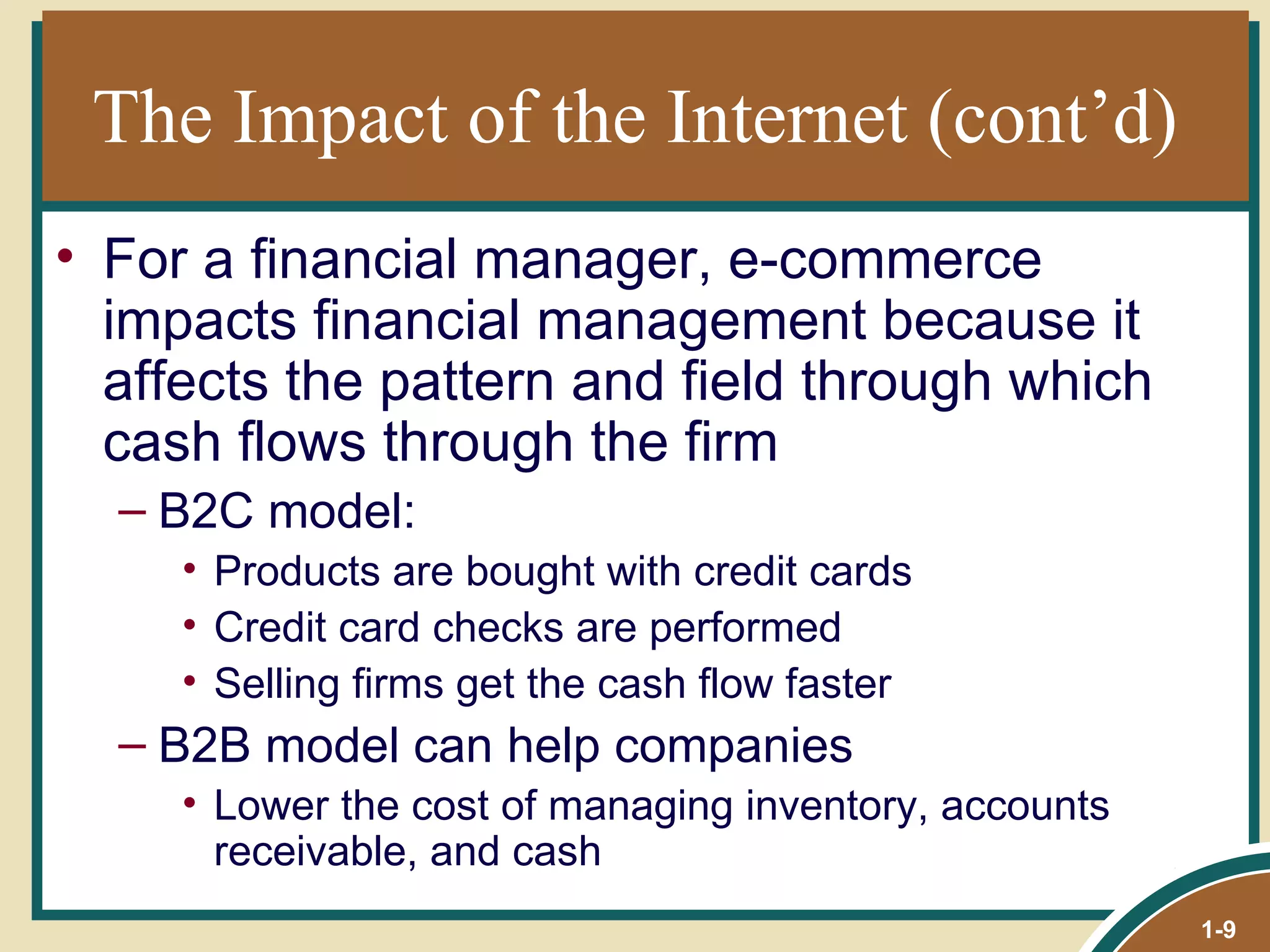
The Impact of the Internet (cont’d) For a financial manager, e-commerce impacts financial management because it affects the pattern and field through which cash flows through the firm B2C model: Products are bought with credit cards Credit card checks are performed Selling firms get the cash flow faster B2B model can help companies Lower the cost of managing inventory, accounts receivable, and cash 1-
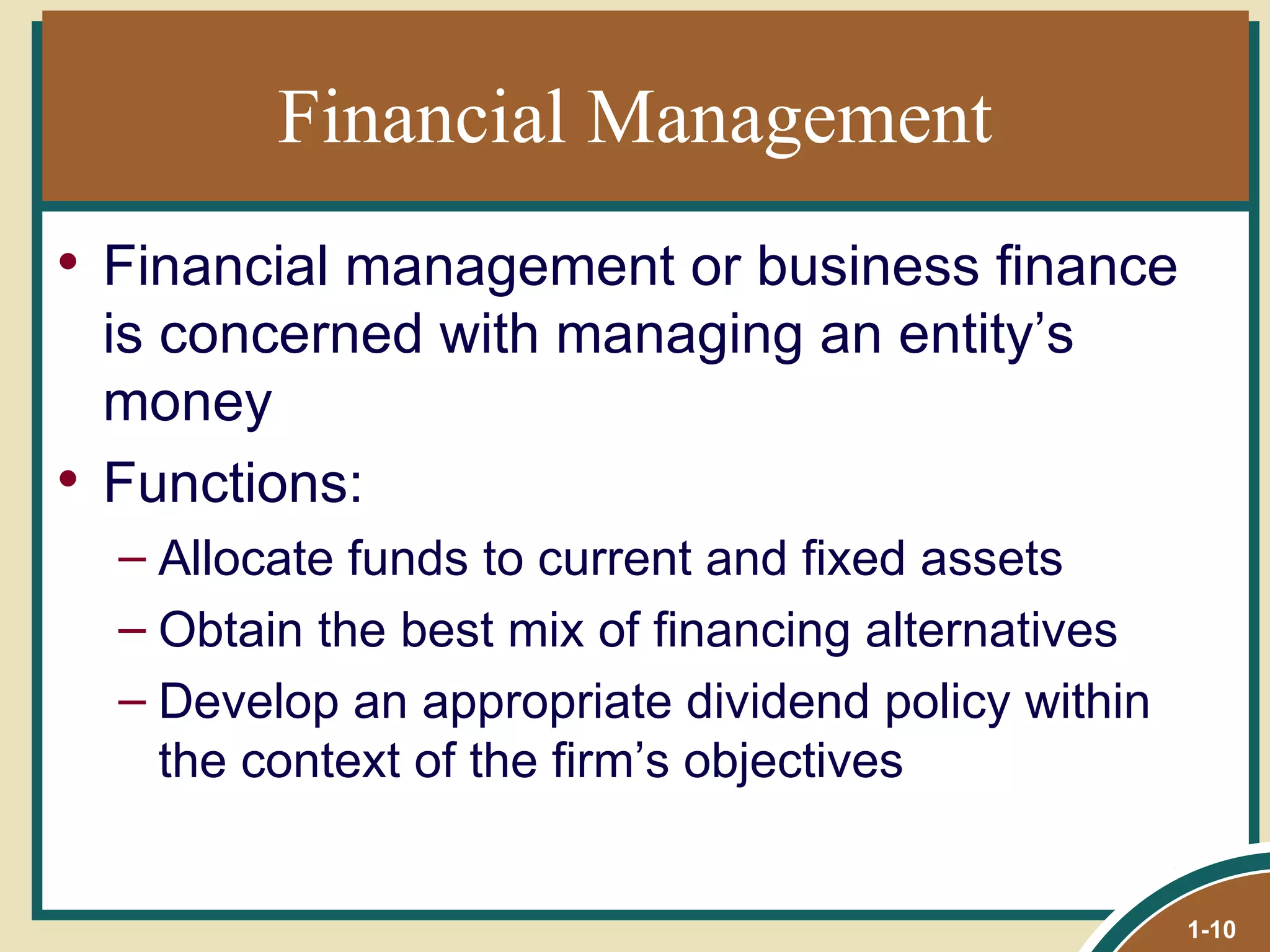
Financial Management Financial management or business finance is concerned with managing an entity’s money Functions: Allocate funds to current and fixed assets Obtain the best mix of financing alternatives Develop an appropriate dividend policy within the context of the firm’s objectives 1-
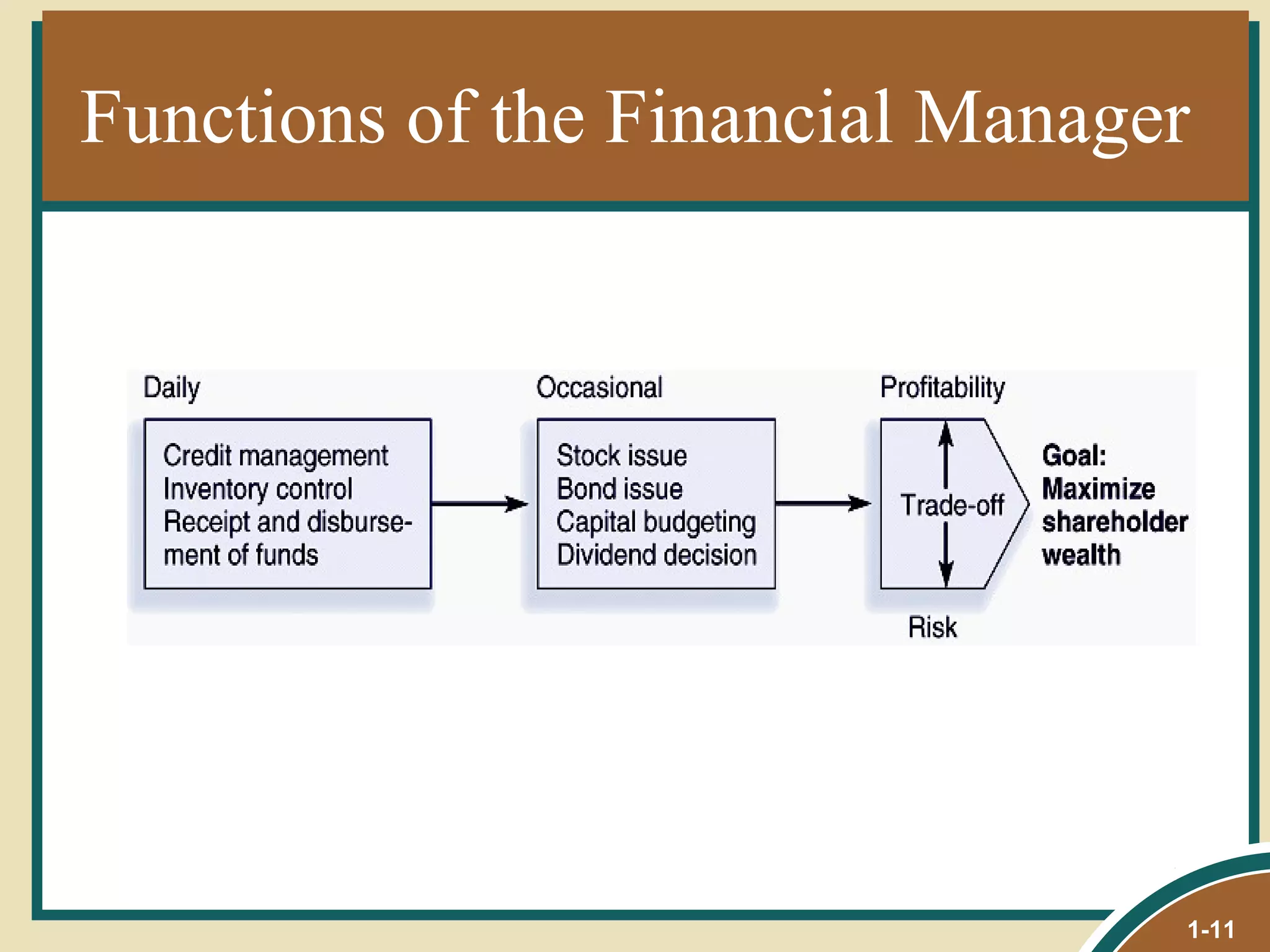
Functions of the Financial Manager 1-
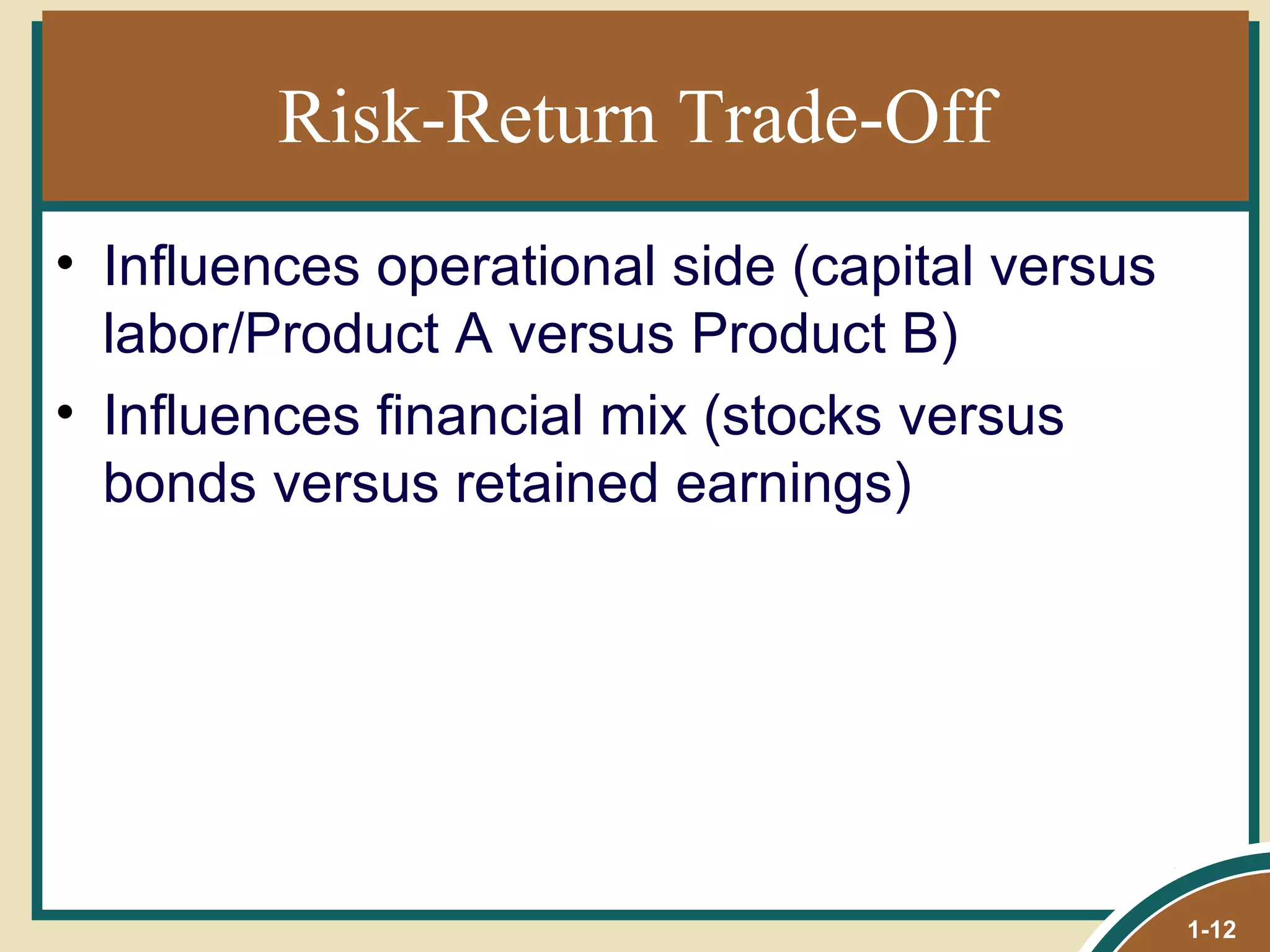
Risk-Return Trade-Off Influences operational side (capital versus labor/Product A versus Product B) Influences financial mix (stocks versus bonds versus retained earnings) 1-
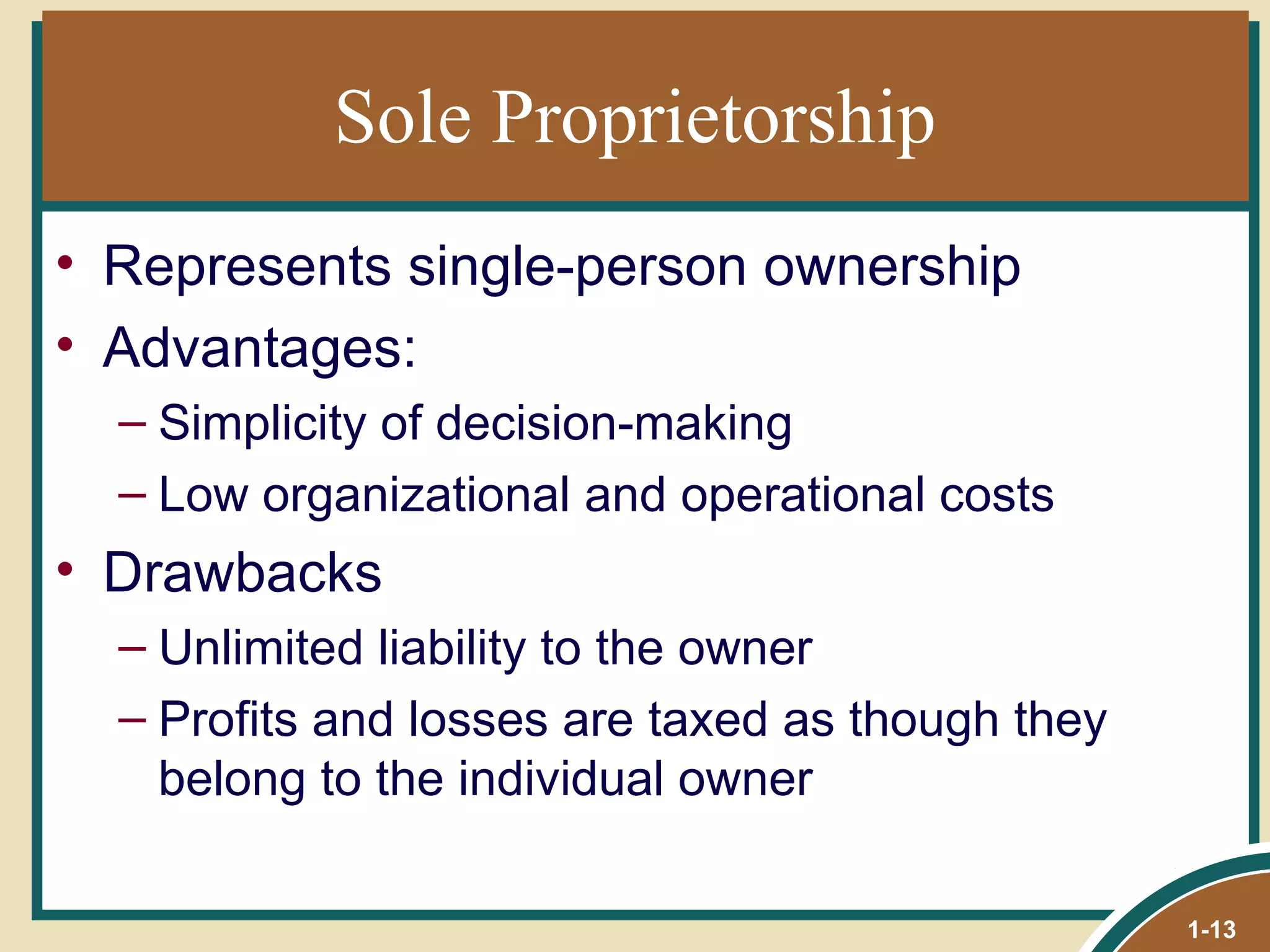
Sole Proprietorship Represents single-person ownership  Advantages: Simplicity of decision-making Low organizational and operational costs Drawbacks Unlimited liability to the owner Profits and losses are taxed as though they belong to the individual owner 1-
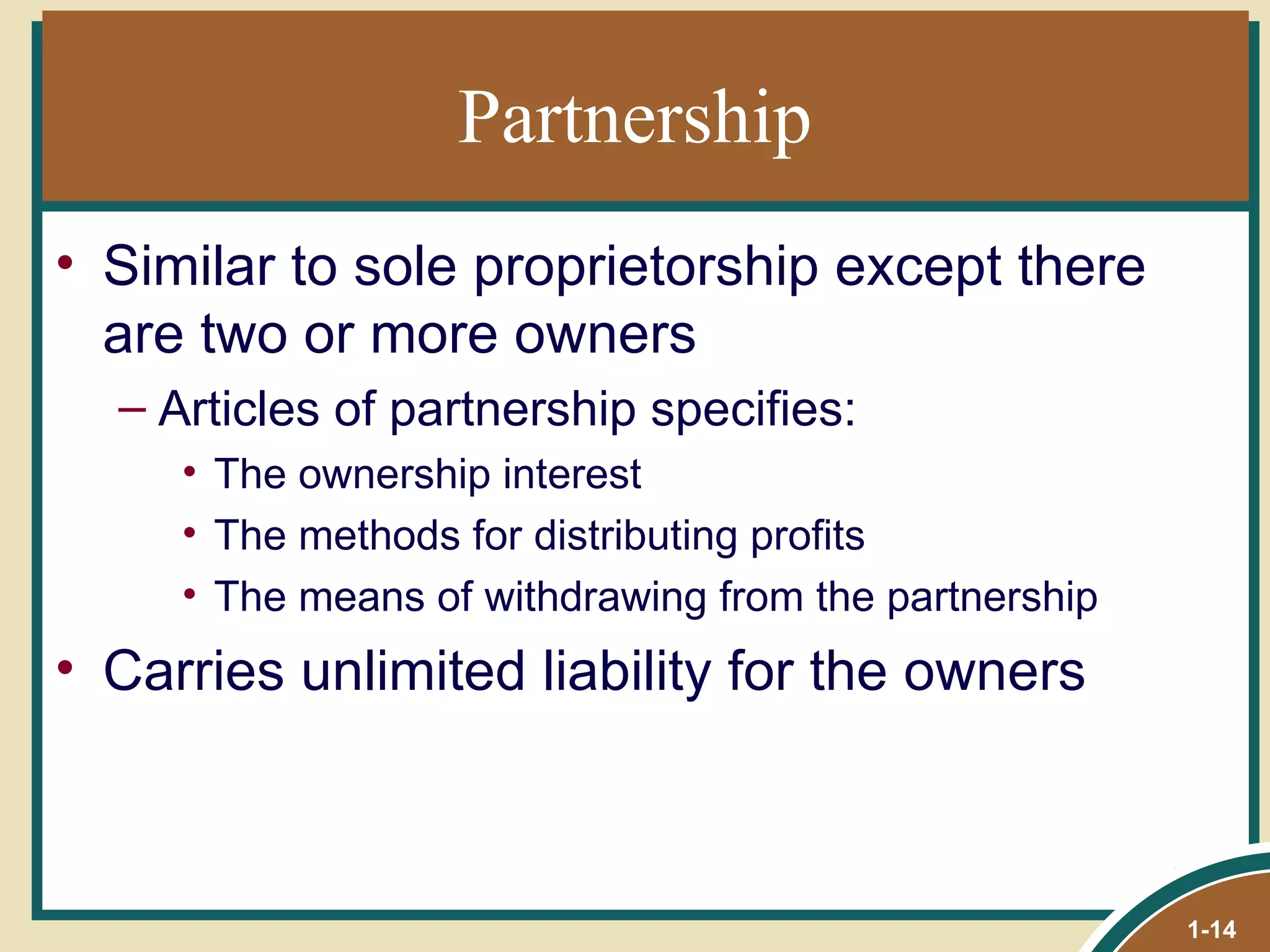
Partnership Similar to sole proprietorship except there are two or more owners Articles of partnership specifies:  The ownership interest The methods for distributing profits The means of withdrawing from the partnership Carries unlimited liability for the owners 1-
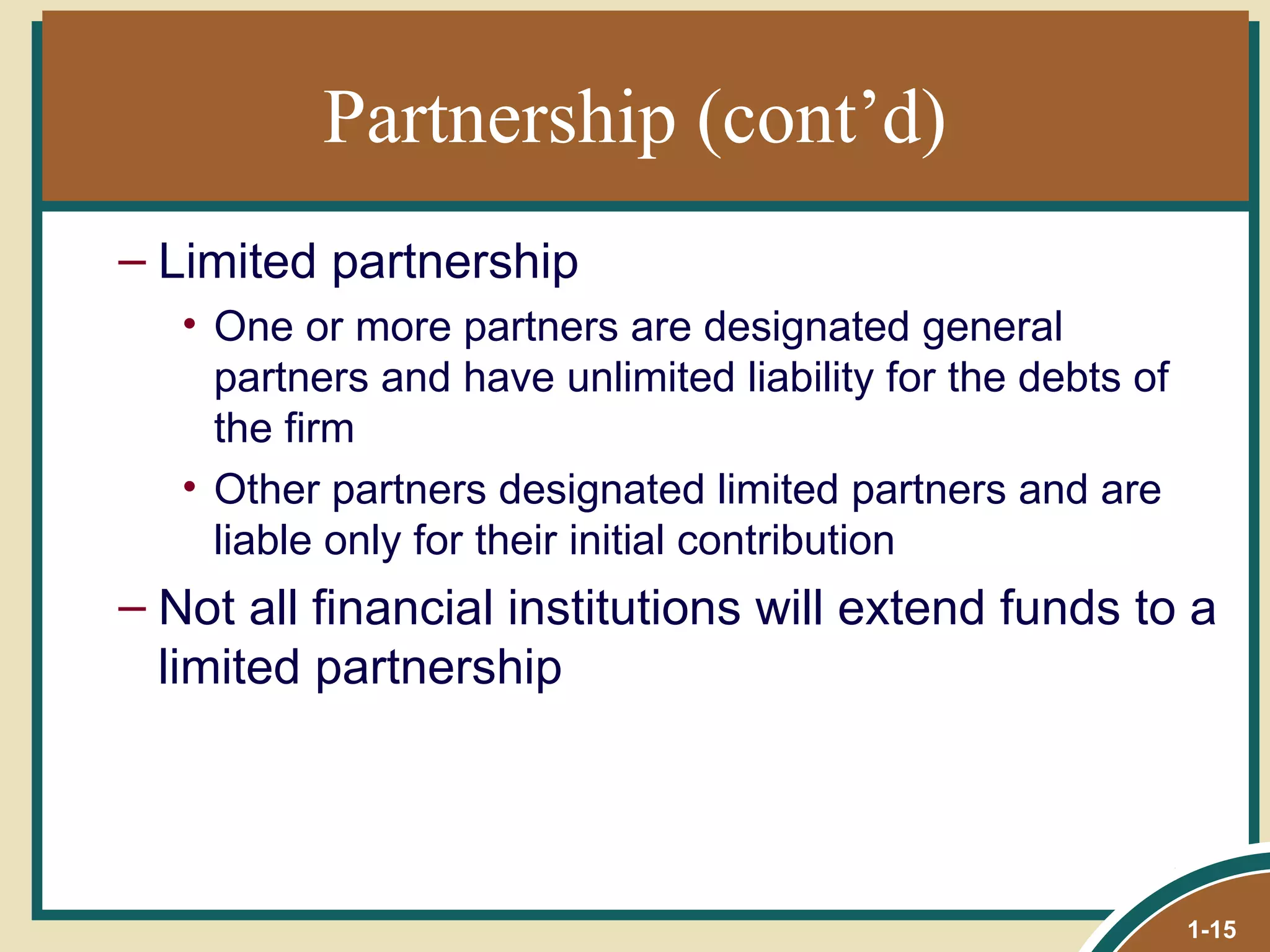
Partnership (cont’d) Limited partnership One or more partners are designated general partners and have unlimited liability for the debts of the firm Other partners designated limited partners and are liable only for their initial contribution Not all financial institutions will extend funds to a limited partnership 1-
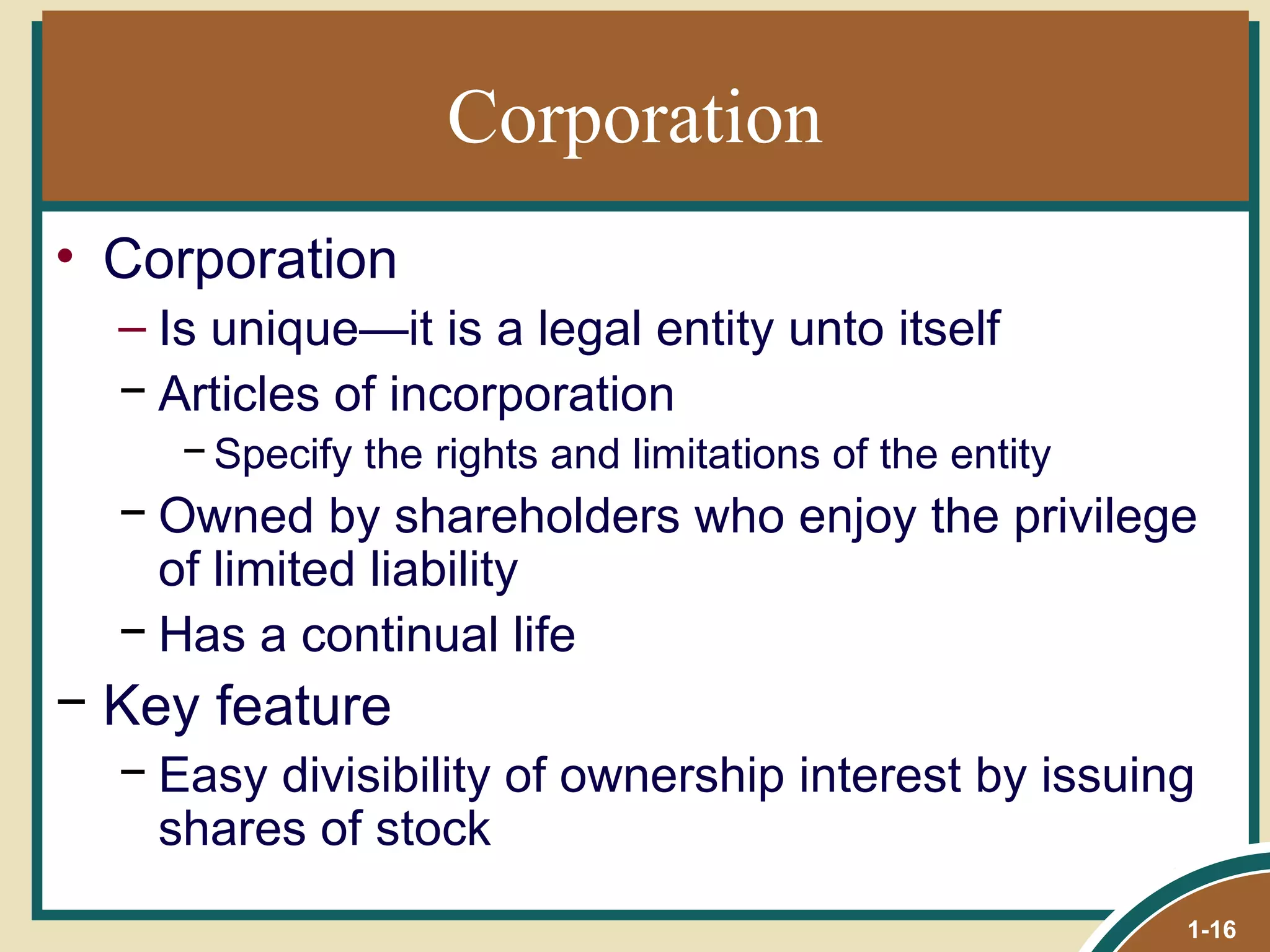
Corporation Corporation Is unique—it is a legal entity unto itself Articles of incorporation Specify the rights and limitations of the entity Owned by shareholders who enjoy the privilege of limited liability Has a continual life Key feature Easy divisibility of ownership interest by issuing shares of stock 1-
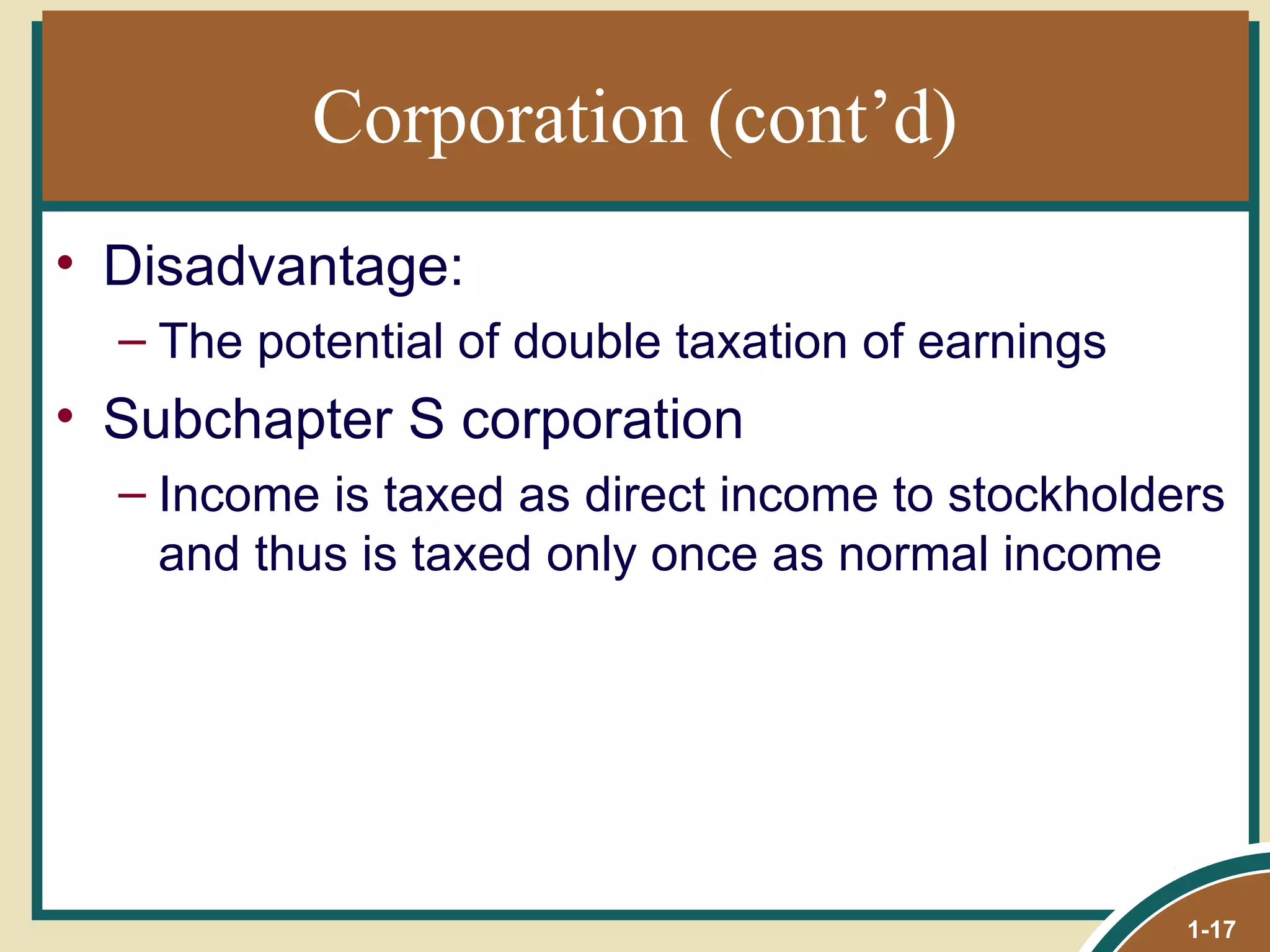
Corporation (cont’d) Disadvantage: The potential of double taxation of earnings Subchapter S corporation Income is taxed as direct income to stockholders and thus is taxed only once as normal income 1-
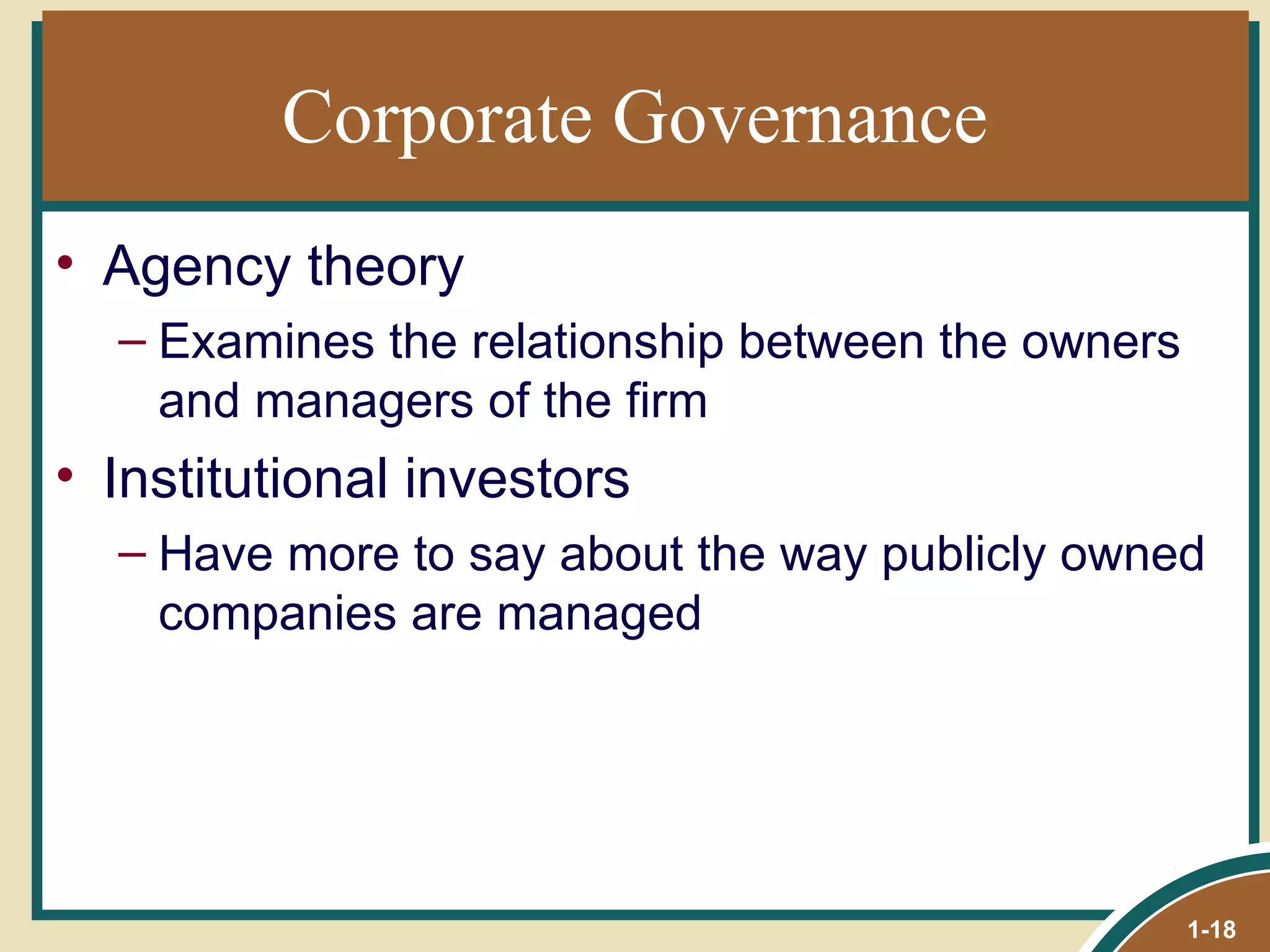
Corporate Governance Agency theory Examines the relationship between the owners and managers of the firm Institutional investors Have more to say about the way publicly owned companies are managed 1-
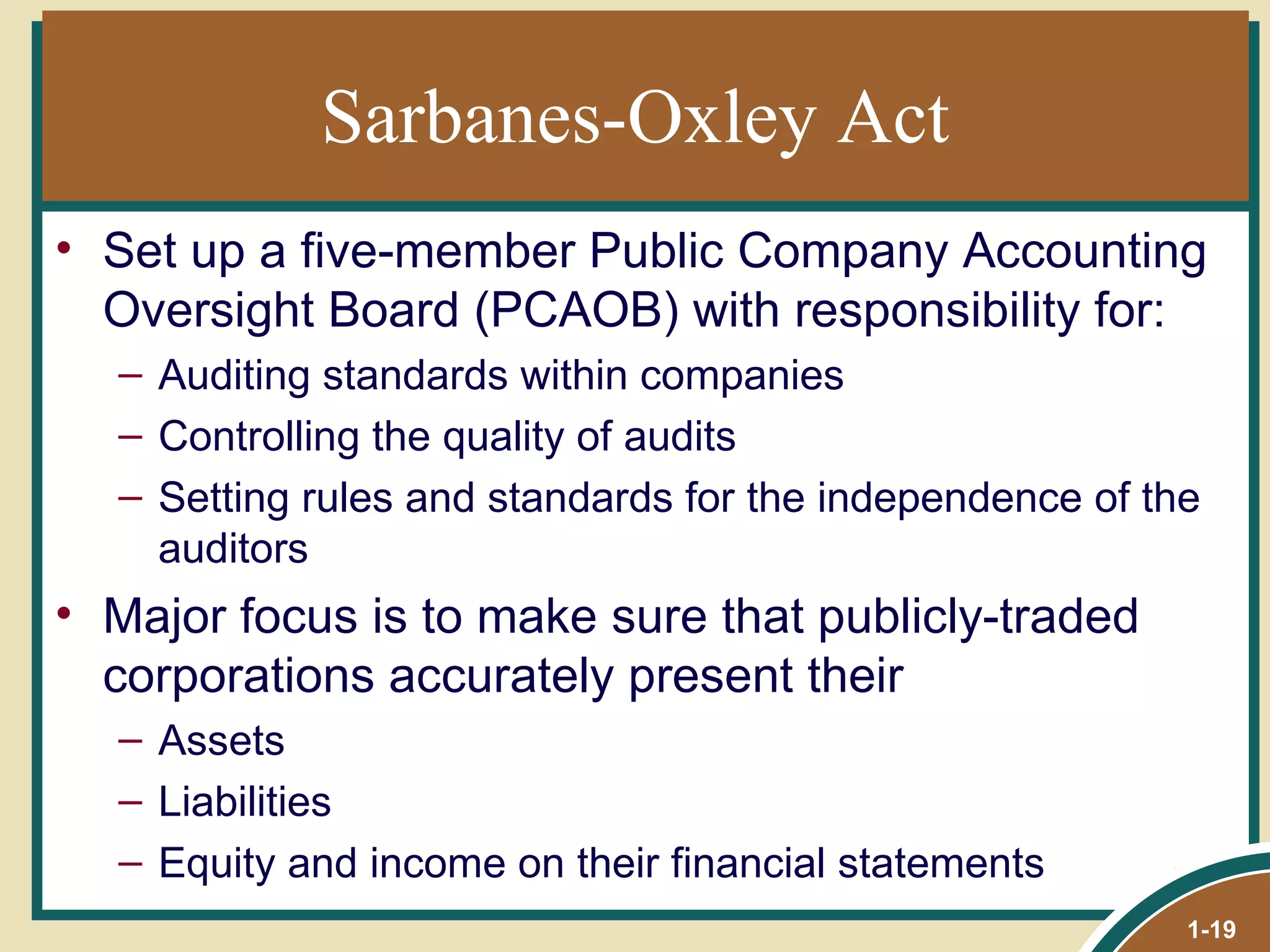
Sarbanes-Oxley Act Set up a five-member Public Company Accounting Oversight Board (PCAOB) with responsibility for: Auditing standards within companies Controlling the quality of audits Setting rules and standards for the independence of the auditors Major focus is to make sure that publicly-traded corporations accurately present their Assets Liabilities Equity and income on their financial statements 1-
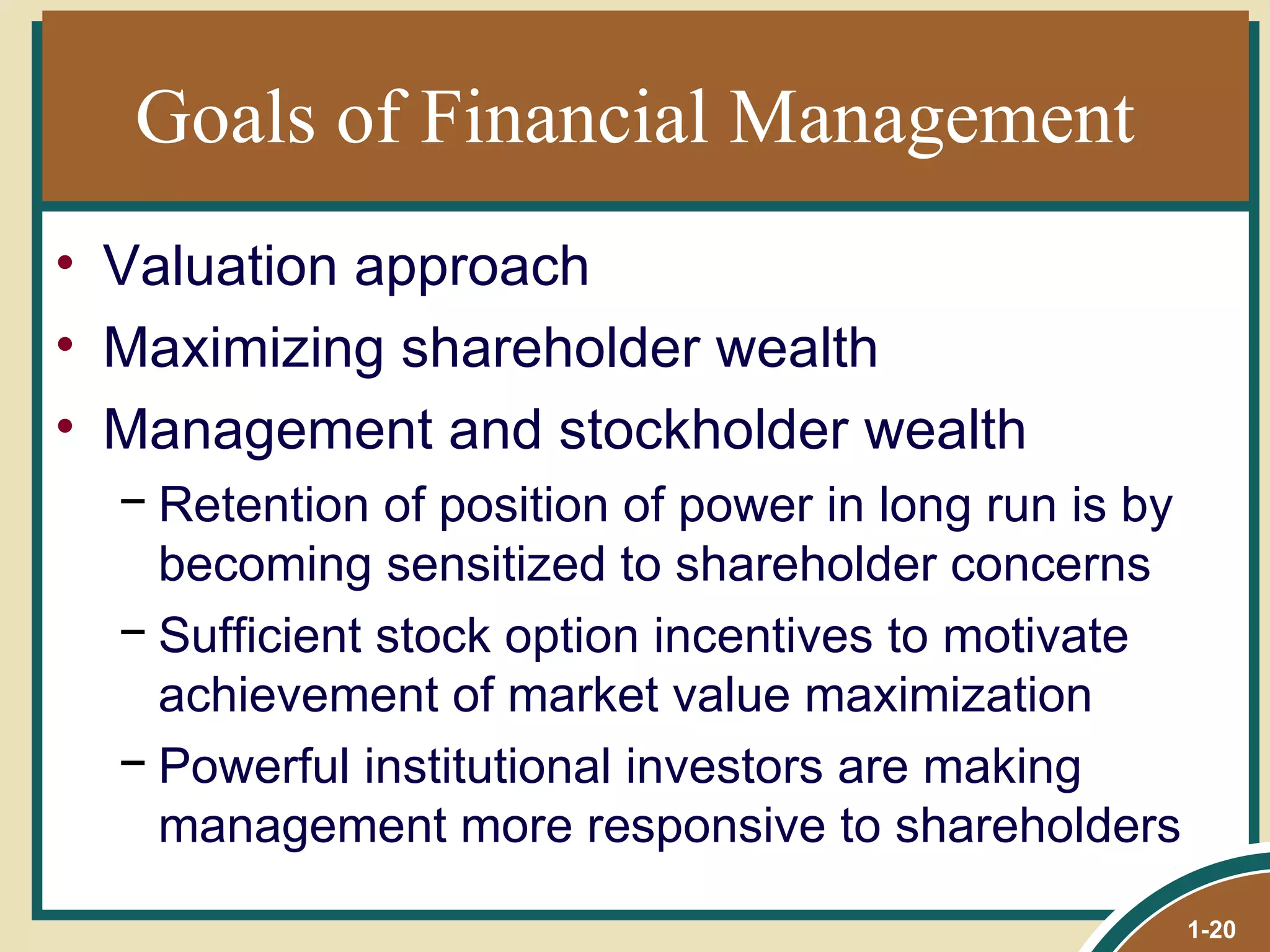
Goals of Financial Management Valuation approach Maximizing shareholder wealth Management and stockholder wealth Retention of position of power in long run is by becoming sensitized to shareholder concerns Sufficient stock option incentives to motivate achievement of market value maximization Powerful institutional investors are making management more responsive to shareholders 1-
Social Responsibility Adopting policies that: Maximize values in the market  Attracts capital Provides employment Offers benefits to the society Certain cost-increasing activities may have to be mandatory rather than voluntary initially, to ensure burden falls equally over all business firms 1-
Ethical Behavior Ethical behavior creates invaluable reputation Insider trading Protected against by the Securities and Exchange Commission (SEC) 1-
The Role of Financial Markets Financial markets are indicators of maximization of shareholder value and the ethical or the unethical behavior that may influence the value of the company Participants in the financial market range over the public, private, and government institutions Public financial markets Corporate financial markets 1-
Structure and Functions  of the Financial Markets Money markets Deals with short-term securities that have a life of one year or less Securities in these markets include:  Commercial paper sold by corporations to finance their daily operations, or certificates of deposit with maturities of less than 12 months sold by banks 1-
Structure and Functions  of the Financial Markets (cont’d) Capital markets Defined as those where securities have a life of more than one year Long-term markets Securities include:  Common stock Preferred stock Corporate and government bonds 1-
Allocation of Capital Primary market When a corporation uses the financial markets to raise new funds, the sale of securities is made by way of a new issue Secondary market When the securities are sold to the public (institutions and individuals) Financial managers are given feedback about their firms’ performance  1-
Return Maximization  and Risk Minimization Investors can choose risk level that meets their objective and maximizes return for that given level of risk Companies that are rewarded with high-priced securities can raise new funds in the money and capital markets at a lower cost compared to competitors Firms pay a penalty for failing to perform competitively 1-
Restructuring Restructuring can result in: Changes in the capital structure (liabilities and equity on the balance sheet) Selling of low-profit-margin divisions with the proceeds of the sale reinvested in better investment opportunities Removal of or large reductions in the current management team Has also included mergers and acquisitions 1-
Internationalization  of Financial Markets Allocation of capital and the search for low-cost sources of financing in global market The impact of international affairs and technology has resulted in the need for future financial managers to understand  International capital flows Computerized electronic funds transfer systems Foreign currency hedging strategies 1-
Technological Impact  on Capital Markets Consolidation among major stock markets and mergers of brokerage firms with domestic and international partners Electronic markets have gained popularity as against traditional organized exchanges such as NASDAQ Resulted in the merger of NYSE with Archipelago, and NASDAQ bought out Instinet from Reuters 1-
Q End 1-
Q & A 1-
Thank You. 1-

Lecture 01

  • 1.
    Chapter 01 TheGoals and Functions of Financial Management 1-
  • 2.
    Chapter Outline Introductionto Finance Forms of Organizations Risk-Return Tradeoff Primary Goal of Financial Managers Role of Financial Managers 1-
  • 3.
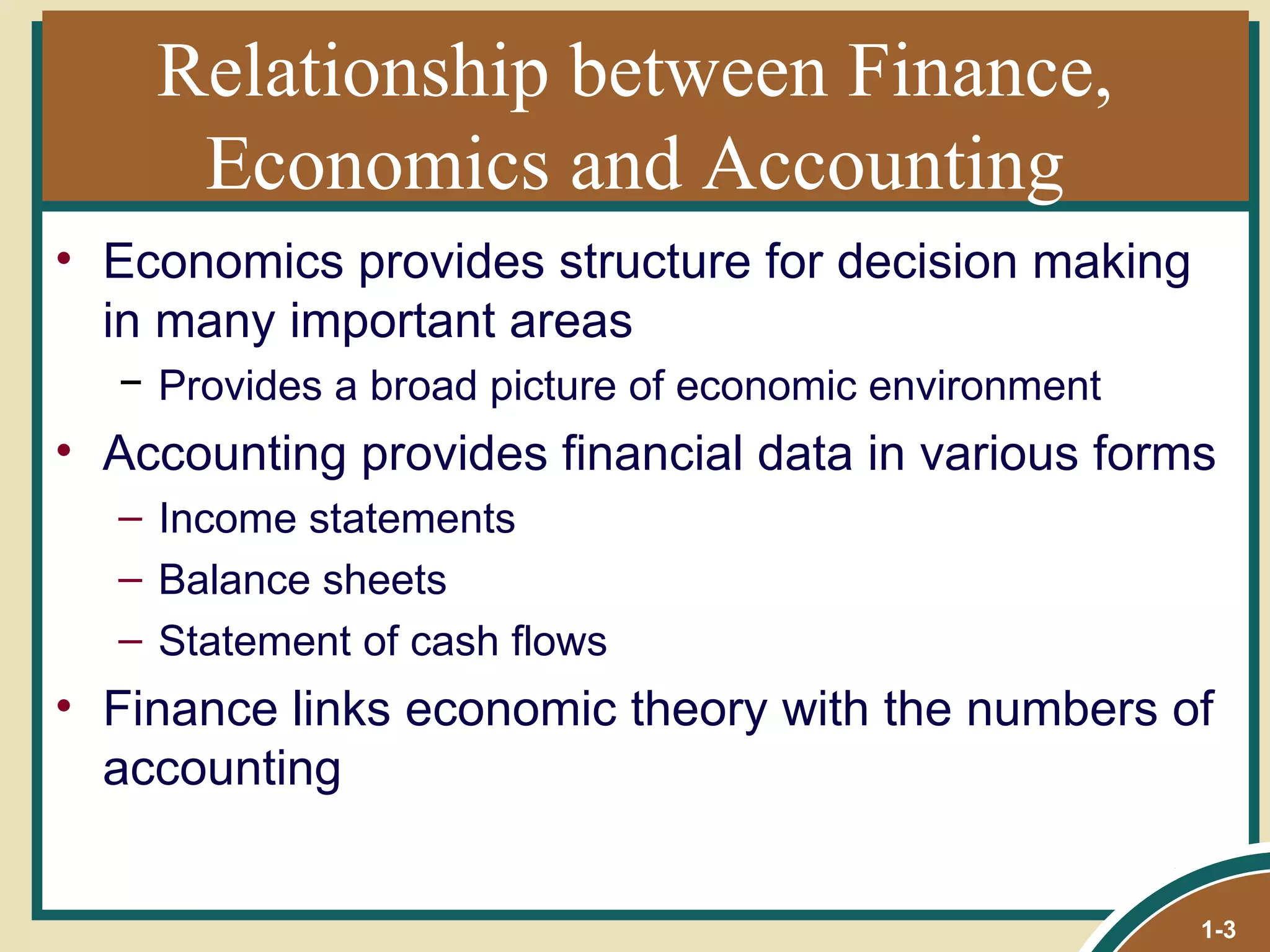
    Relationship between Finance,Economics and Accounting Economics provides structure for decision making in many important areas Provides a broad picture of economic environment Accounting provides financial data in various forms Income statements Balance sheets Statement of cash flows Finance links economic theory with the numbers of accounting 1-
  • 4.
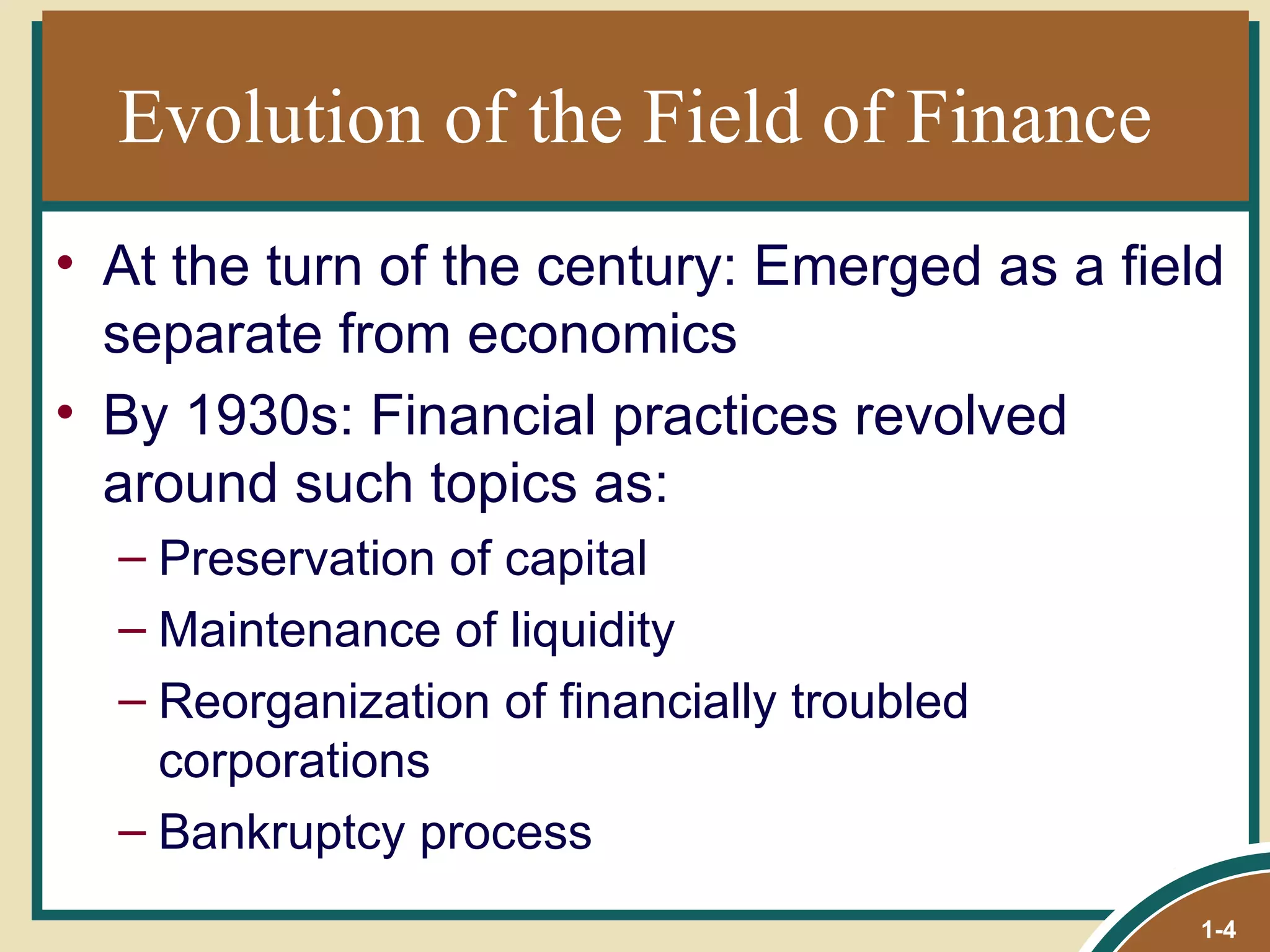
    Evolution of theField of Finance At the turn of the century: Emerged as a field separate from economics By 1930s: Financial practices revolved around such topics as: Preservation of capital Maintenance of liquidity Reorganization of financially troubled corporations Bankruptcy process 1-
  • 5.
    Evolution of theField of Finance (cont’d) By mid-1950s: Finance becomes more analytical Financial capital (money) was used to purchase real capital (long-term plant and equipment) Cash and inventory management Capital structure theory Dividend policy 1-
  • 6.
    Modern Issues inFinance Focus has been on: Risk-return relationships Maximization of return for a given level of risk Portfolio management Capital structure theory New financial products with a focus on hedging are being widely used Inflation – a key variable in financial decisions 1-
  • 7.
    Modern Issues inFinance (cont’d) The following are significant to financial managers during decision making: Effects of inflation and disinflation on financial forecasting Required rates of return for capital budgeting decisions Cost of capital 1-
  • 8.
    The Impact ofthe Internet Internet and its acceptance has enabled acceleration of e-commerce solutions for “old economy” companies E-commerce solutions for existing companies B2C B2B Spurt in new business models and companies Amazon.com eBay 1-
  • 9.
    The Impact ofthe Internet (cont’d) For a financial manager, e-commerce impacts financial management because it affects the pattern and field through which cash flows through the firm B2C model: Products are bought with credit cards Credit card checks are performed Selling firms get the cash flow faster B2B model can help companies Lower the cost of managing inventory, accounts receivable, and cash 1-
  • 10.
    Financial Management Financialmanagement or business finance is concerned with managing an entity’s money Functions: Allocate funds to current and fixed assets Obtain the best mix of financing alternatives Develop an appropriate dividend policy within the context of the firm’s objectives 1-
  • 11.
    Functions of theFinancial Manager 1-
  • 12.
    Risk-Return Trade-Off Influencesoperational side (capital versus labor/Product A versus Product B) Influences financial mix (stocks versus bonds versus retained earnings) 1-
  • 13.
    Sole Proprietorship Representssingle-person ownership Advantages: Simplicity of decision-making Low organizational and operational costs Drawbacks Unlimited liability to the owner Profits and losses are taxed as though they belong to the individual owner 1-
  • 14.
    Partnership Similar tosole proprietorship except there are two or more owners Articles of partnership specifies: The ownership interest The methods for distributing profits The means of withdrawing from the partnership Carries unlimited liability for the owners 1-
  • 15.
    Partnership (cont’d) Limitedpartnership One or more partners are designated general partners and have unlimited liability for the debts of the firm Other partners designated limited partners and are liable only for their initial contribution Not all financial institutions will extend funds to a limited partnership 1-
  • 16.
    Corporation Corporation Isunique—it is a legal entity unto itself Articles of incorporation Specify the rights and limitations of the entity Owned by shareholders who enjoy the privilege of limited liability Has a continual life Key feature Easy divisibility of ownership interest by issuing shares of stock 1-
  • 17.
    Corporation (cont’d) Disadvantage:The potential of double taxation of earnings Subchapter S corporation Income is taxed as direct income to stockholders and thus is taxed only once as normal income 1-
  • 18.
    Corporate Governance Agencytheory Examines the relationship between the owners and managers of the firm Institutional investors Have more to say about the way publicly owned companies are managed 1-
  • 19.
    Sarbanes-Oxley Act Setup a five-member Public Company Accounting Oversight Board (PCAOB) with responsibility for: Auditing standards within companies Controlling the quality of audits Setting rules and standards for the independence of the auditors Major focus is to make sure that publicly-traded corporations accurately present their Assets Liabilities Equity and income on their financial statements 1-
  • 20.
    Goals of FinancialManagement Valuation approach Maximizing shareholder wealth Management and stockholder wealth Retention of position of power in long run is by becoming sensitized to shareholder concerns Sufficient stock option incentives to motivate achievement of market value maximization Powerful institutional investors are making management more responsive to shareholders 1-
  • 21.
    Social Responsibility Adoptingpolicies that: Maximize values in the market Attracts capital Provides employment Offers benefits to the society Certain cost-increasing activities may have to be mandatory rather than voluntary initially, to ensure burden falls equally over all business firms 1-
  • 22.
    Ethical Behavior Ethicalbehavior creates invaluable reputation Insider trading Protected against by the Securities and Exchange Commission (SEC) 1-
  • 23.
    The Role ofFinancial Markets Financial markets are indicators of maximization of shareholder value and the ethical or the unethical behavior that may influence the value of the company Participants in the financial market range over the public, private, and government institutions Public financial markets Corporate financial markets 1-
  • 24.
    Structure and Functions of the Financial Markets Money markets Deals with short-term securities that have a life of one year or less Securities in these markets include: Commercial paper sold by corporations to finance their daily operations, or certificates of deposit with maturities of less than 12 months sold by banks 1-
  • 25.
    Structure and Functions of the Financial Markets (cont’d) Capital markets Defined as those where securities have a life of more than one year Long-term markets Securities include: Common stock Preferred stock Corporate and government bonds 1-
  • 26.
    Allocation of CapitalPrimary market When a corporation uses the financial markets to raise new funds, the sale of securities is made by way of a new issue Secondary market When the securities are sold to the public (institutions and individuals) Financial managers are given feedback about their firms’ performance 1-
  • 27.
    Return Maximization and Risk Minimization Investors can choose risk level that meets their objective and maximizes return for that given level of risk Companies that are rewarded with high-priced securities can raise new funds in the money and capital markets at a lower cost compared to competitors Firms pay a penalty for failing to perform competitively 1-
  • 28.
    Restructuring Restructuring canresult in: Changes in the capital structure (liabilities and equity on the balance sheet) Selling of low-profit-margin divisions with the proceeds of the sale reinvested in better investment opportunities Removal of or large reductions in the current management team Has also included mergers and acquisitions 1-
  • 29.
    Internationalization ofFinancial Markets Allocation of capital and the search for low-cost sources of financing in global market The impact of international affairs and technology has resulted in the need for future financial managers to understand International capital flows Computerized electronic funds transfer systems Foreign currency hedging strategies 1-
  • 30.
    Technological Impact on Capital Markets Consolidation among major stock markets and mergers of brokerage firms with domestic and international partners Electronic markets have gained popularity as against traditional organized exchanges such as NASDAQ Resulted in the merger of NYSE with Archipelago, and NASDAQ bought out Instinet from Reuters 1-
  • 31.
  • 32.
  • 33.