Financial Institutions, Markets and
Institutions.
Prepared By:
Atha Ullah Akakheel
MBA (Finance)
Management Sciences AWKUMDate: 26 Feb 2015 11:55
Finance Terms
• Finance: The proper management of money.
• Money: The current medium of exchange or means of payment.
• Credit or Loan: A sum of money to be returned normally with
interest.
Classification of finance
Public finance
Private finance
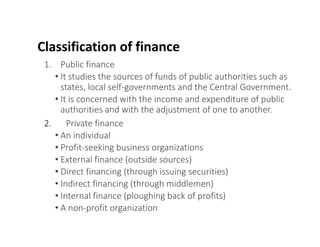
Classification of finance
1. Public finance
• It studies the sources of funds of public authorities such as
states, local self-governments and the Central Government.
• It is concerned with the income and expenditure of public
authorities and with the adjustment of one to another.
2. Private finance
• An individual
• Profit-seeking business organizations
• External finance (outside sources)
• Direct financing (through issuing securities)
• Indirect financing (through middlemen)
• Internal finance (ploughing back of profits)
• A non-profit organization
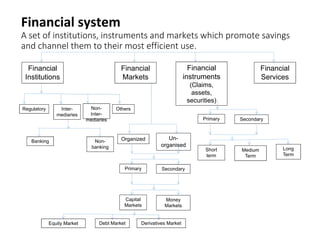
Financial system
A set of institutions, instruments and markets which promote savings
and channel them to their most efficient use.
Financial
Institutions
Financial
Markets
Financial
instruments
(Claims,
assets,
securities)
Financial
Services
Regulatory Inter-
mediaries
Non-
Inter-
mediaries
Others
Banking Non-
banking
Organized Un-
organised
Primary Secondary
Capital
Markets
Money
Markets
Equity Market Debt Market Derivatives Market
Primary Secondary
Short
term
Medium
Term
Long
Term
Financial Institution:
A financial institution is an institution whose primary source of profits
is through financial asset transactions.
 Afinancial institution acts as an agent that provides financial
services for its clients.
 Financial institutions generally fall under financial regulation from a
government authority.
 Financial Institutions- act as mobilisers and depositories of saving
and as the custodian of finance.
Functions of Financial Institutions
The principal function of financial institutions is to collect funds
from the investors and direct the funds to various financial services
providers in search for those funds.
Financial Markets
A financial market is a market in which financial assets are traded. In
addition to enabling exchange of previously issued financial assets
• Financial markets include all markets where transactions relating to
the trading of financial securities and extending credit take place.
Financial Markets
• Physical Asset markets
• Spot markets
• Money markets
• Mortgage markets
• The primary market
• The secondary market
• Private markets
• The money market
• The capital market
• Security exchanges
Financial Asset Markets:
Financial asset markets, on the other hand deal with stocks,
bonds, notes, mortgages and other financial instruments.
Spot Markets:
Spot markets and future markets the terms that refer to whether
the assets are being bought or sold on the spot delivery or for
delivery at some future date. Such as six months or a year in future.
Money Markets:
Are the markets for short term, highly liquid debt securities.
Mortgage Markets:
Deals with loan and residential, commercial and real estate and on
farmland.
The Primary Market:
When a security is created and sold for the first time in the financial
marketplace, the transaction takes place in the primary market. It is
also known as Initial Public Offering (I PO)
The Secondary Market:
Once a security has been issued, it may be traded from one investor to
another.
The Money Market:
Short term securities are traded in money market. Network of dealers
operate in this market.
The Capital Market:
Long term securities traded in the capital market.
Security Exchanges:
Security exchanges facilitate trading of stock or bond among investors.
Six basic functions of financial markets
•Borrowing and Lending
•Price Determination
•Information Aggregation and Coordination
•Risk Sharing
•Liquidity
•Efficiency
Financial Instruments
Financial instruments are cash, evidence of an ownership interest in an
entity, or a contractual right to receive, or deliver, cash or another
financial instrument.
Cash instruments :are financial instruments whose value is
determined directly by markets. They can be divided into Securities,
which are readily transferable, and other cash instruments such as
Loans and Deposits, where both borrower and lender have to agree on
a transfer
Derivatives instruments: are financial contracts, or financial
instruments, whose prices are derived from the price of something
else
Types of Financial Institutions
Financial institution are divide into to forms
Depository
Non Depository
Non Depository
Are financial intermediaries that do not accept deposits but do
pool the payments of many people in the form of premiums or
contributions and either invest it or provide credit to others.
 Pension funds,
 Securities firms,
 Government-sponsored enterprises,
 Finance companies.
Types Of Financial Institutions
• Banks
• Savings & loan Associations
• Investment Companies
• Credit Unions
• Insurance Companies
• Mutual Funds
• Pension Funds
• Brokerage Houses
1) Banks
• A bank is a commercial or state institution that provides
financial services, including issuing money in various forms,
receiving deposits of money, lending money and processing
transactions and the creating of credit.
1.1)Central Bank
• A central bank, reserve bank or monetary authority, is an
entity responsible for the monetary policy of its country or of
a group of member states, such as the European Central Bank
(ECB) in the European Union, the Federal Reserve System in
the United States of America, State Bank in Pakistan.
• Its primary responsibility is to maintain the stability of the
national currency and money supply, but more active duties
include controlling subsidized-loan interest rates, and acting
as a “lender of last resort” to the banking sector during times

of financial crisis
1.2) Commercial Banks
• A commercial bank accepts deposits from customers and in
turn makes loans, even in excess of the deposits; a process
known as fractional-reserve banking. Some banks (called
Banks of issue) issue banknotes as legal tender.
1.3) Investment Banks
• Investment banks help companies and governments and their
agencies to raise money by issuing and selling securities in
the primary market. They assist public and private
corporations in raising funds in the capital markets (both
equity and debt), as well as in providing strategic advisory
services for mergers, acquisitions and other types of financial
transactions.
1.4) Saving Banks
• A savings bank is a financial institution whose primary
purpose is accepting savings deposits. It may also perform
some other functions.
1.5) Micro Finance Banks
• For the purpose of poverty reduction program, such kind of
banks are working in the different countries with the
contribution of UNO or World Bank.
• In Pakistan 7 Micro Finance Banks are providing services
under the SBP prudential regulation.
1.6) Islamic Banks
• Islamic banking refers to a system of banking or banking
activity that is consistent with Islamic law (Sharia) principles
and guided by Islamic economics. In particular, Islamic law
prohibits usury, the collection and payment of interest, also
commonly called riba in Islamic discourse.
1.7) Specialized Banks
1. ZTBL
• The Zarai Taraqiati Bank Limited It is also known as Agricultural
Development Bank of Pakistan (ADBP).
• It is the premier financial institution geared towards the
development of the agricultural sector through the provision of
financial services and technical know-how.
2. IDBP
• Industrial Development Bank of Pakistan is one of Pakistan's oldest
development financing institution created with the primary
objective of extending term finance for investment in the
manufacturing sector and SME Sector of the economy.
1.7cont…) Specialized Banks
3. SME Bank
• Promote the business.
• Positive impact on Financial environment.
• Financing of projects.
• Tell revenue generation schemes to entrepreneurs.
1.8) Non-banking financial company
• Non-bank financial companies (NBFCs) also known as a non-bank
or a non-bank bank, are financial institutions that provide
banking services without meeting the legal definition of a bank,
i.e. one that does not hold a banking license.
• Operations are, regardless of this, still exercised under bank
regulation. However this depends on the jurisdiction, as in some
jurisdictions, such as New Zealand, any company can do the
business of banking, and there are no banking licenses issued.
1.8 cont..) Non-banking financial company
• Non-bank institutions frequently acts as suppliers of loans and
credit facilities, supporting investments in property, providing
services relating to events within peoples lives such as funding
private education, wealth management and retirement planning.
• however they are typically not allowed to take deposits from the
general public and have to find other means of funding their
operations such as issuing debt instruments. In India, most NBFCs
raise capital through Chit Funds.
2) Investment company
• Generally, an "investment company" is a company (corporation,
business trust, partnership, or limited liability company) that
issues securities and is primarily engaged in the business of
investing in securities.
• An investment company invests the money it receives from
investors on a collective basis, and each investor shares in the
profits and losses in proportion to the investor’s interest in the
investment company.
3) Leasing Companies
A lease or tenancy is the right to use or occupy personal property or
real property given by a lessor to another person (usually called the
lessee or tenant) for a fixed or indefinite period of time, whereby the
lessee obtains exclusive possession of the property in return for
paying the lessor a fixed or determinable consideration (payment).
4) Insurances Companies
• Insurance companies may be classified as
1. Life insurance companies, which sell life insurance,
annuities and pensions products.
2. Non-life or general insurance companies, which sell
other types of insurance.
5) Mutual Fund
• An investment which is comprised of a pool of funds collected
from many investors for the purpose of investing in securities
such as stocks, bonds, money market securities and similar
assets.
• Mutual funds are operated by money mangers, who invest the
fund's capital and attempt to produce capital gains and income
for the fund's investors. A mutual fund's portfolio is structured
and maintained to match the investment objectives stated in its
prospectus
6) Pension Funds:
Pension funds are retirement plans funded by corporations
or government agencies for their workers and administered
generally by the trust departments of commercial banks or by life
insurance companies. Pension funds invest primarily in bonds,
stocks, mortgages and real estate.
7) Credit Unions:
• Credit unions are cooperative associations whose
members are supposed to have a common bond, such
as being employees of the same firm. Member's
savings are loans and home mortgage, credit unions
are often the cheapest source of funds available to the
individual borrowers.
8) Brokerage Houses
Stock brokers assist people in investing, online only companies
are called 'discount brokerages', companies with a branch
presence are called 'full service brokerages' or 'private client
services.
Conclusion
To review, we have looked at the relationship between
institutions and Financial Markets. This growing field of
research may offer us a new insight into the dynamics of
economic growth within and among various economies.

Financial Institutions, Instruments and Markets.

  • 2.
    Financial Institutions, Marketsand Institutions. Prepared By: Atha Ullah Akakheel MBA (Finance) Management Sciences AWKUMDate: 26 Feb 2015 11:55
  • 3.
    Finance Terms • Finance:The proper management of money. • Money: The current medium of exchange or means of payment. • Credit or Loan: A sum of money to be returned normally with interest. Classification of finance Public finance Private finance
  • 4.
    Classification of finance 1.Public finance • It studies the sources of funds of public authorities such as states, local self-governments and the Central Government. • It is concerned with the income and expenditure of public authorities and with the adjustment of one to another. 2. Private finance • An individual • Profit-seeking business organizations • External finance (outside sources) • Direct financing (through issuing securities) • Indirect financing (through middlemen) • Internal finance (ploughing back of profits) • A non-profit organization
  • 5.
    Financial system A setof institutions, instruments and markets which promote savings and channel them to their most efficient use. Financial Institutions Financial Markets Financial instruments (Claims, assets, securities) Financial Services Regulatory Inter- mediaries Non- Inter- mediaries Others Banking Non- banking Organized Un- organised Primary Secondary Capital Markets Money Markets Equity Market Debt Market Derivatives Market Primary Secondary Short term Medium Term Long Term
  • 6.
    Financial Institution: A financialinstitution is an institution whose primary source of profits is through financial asset transactions.  Afinancial institution acts as an agent that provides financial services for its clients.  Financial institutions generally fall under financial regulation from a government authority.  Financial Institutions- act as mobilisers and depositories of saving and as the custodian of finance.
  • 7.
    Functions of FinancialInstitutions The principal function of financial institutions is to collect funds from the investors and direct the funds to various financial services providers in search for those funds.
  • 8.
    Financial Markets A financialmarket is a market in which financial assets are traded. In addition to enabling exchange of previously issued financial assets • Financial markets include all markets where transactions relating to the trading of financial securities and extending credit take place.
  • 9.
    Financial Markets • PhysicalAsset markets • Spot markets • Money markets • Mortgage markets • The primary market • The secondary market • Private markets • The money market • The capital market • Security exchanges
  • 10.
    Financial Asset Markets: Financialasset markets, on the other hand deal with stocks, bonds, notes, mortgages and other financial instruments. Spot Markets: Spot markets and future markets the terms that refer to whether the assets are being bought or sold on the spot delivery or for delivery at some future date. Such as six months or a year in future. Money Markets: Are the markets for short term, highly liquid debt securities. Mortgage Markets: Deals with loan and residential, commercial and real estate and on farmland. The Primary Market: When a security is created and sold for the first time in the financial marketplace, the transaction takes place in the primary market. It is also known as Initial Public Offering (I PO)
  • 11.
    The Secondary Market: Oncea security has been issued, it may be traded from one investor to another. The Money Market: Short term securities are traded in money market. Network of dealers operate in this market. The Capital Market: Long term securities traded in the capital market. Security Exchanges: Security exchanges facilitate trading of stock or bond among investors.
  • 12.
    Six basic functionsof financial markets •Borrowing and Lending •Price Determination •Information Aggregation and Coordination •Risk Sharing •Liquidity •Efficiency
  • 13.
    Financial Instruments Financial instrumentsare cash, evidence of an ownership interest in an entity, or a contractual right to receive, or deliver, cash or another financial instrument. Cash instruments :are financial instruments whose value is determined directly by markets. They can be divided into Securities, which are readily transferable, and other cash instruments such as Loans and Deposits, where both borrower and lender have to agree on a transfer Derivatives instruments: are financial contracts, or financial instruments, whose prices are derived from the price of something else
  • 14.
    Types of FinancialInstitutions Financial institution are divide into to forms Depository Non Depository Non Depository Are financial intermediaries that do not accept deposits but do pool the payments of many people in the form of premiums or contributions and either invest it or provide credit to others.  Pension funds,  Securities firms,  Government-sponsored enterprises,  Finance companies.
  • 15.
    Types Of FinancialInstitutions • Banks • Savings & loan Associations • Investment Companies • Credit Unions • Insurance Companies • Mutual Funds • Pension Funds • Brokerage Houses
  • 16.
    1) Banks • Abank is a commercial or state institution that provides financial services, including issuing money in various forms, receiving deposits of money, lending money and processing transactions and the creating of credit.
  • 17.
    1.1)Central Bank • Acentral bank, reserve bank or monetary authority, is an entity responsible for the monetary policy of its country or of a group of member states, such as the European Central Bank (ECB) in the European Union, the Federal Reserve System in the United States of America, State Bank in Pakistan. • Its primary responsibility is to maintain the stability of the national currency and money supply, but more active duties include controlling subsidized-loan interest rates, and acting as a “lender of last resort” to the banking sector during times of financial crisis
  • 18.
    1.2) Commercial Banks •A commercial bank accepts deposits from customers and in turn makes loans, even in excess of the deposits; a process known as fractional-reserve banking. Some banks (called Banks of issue) issue banknotes as legal tender.
  • 19.
    1.3) Investment Banks •Investment banks help companies and governments and their agencies to raise money by issuing and selling securities in the primary market. They assist public and private corporations in raising funds in the capital markets (both equity and debt), as well as in providing strategic advisory services for mergers, acquisitions and other types of financial transactions.
  • 20.
    1.4) Saving Banks •A savings bank is a financial institution whose primary purpose is accepting savings deposits. It may also perform some other functions.
  • 21.
    1.5) Micro FinanceBanks • For the purpose of poverty reduction program, such kind of banks are working in the different countries with the contribution of UNO or World Bank. • In Pakistan 7 Micro Finance Banks are providing services under the SBP prudential regulation.
  • 22.
    1.6) Islamic Banks •Islamic banking refers to a system of banking or banking activity that is consistent with Islamic law (Sharia) principles and guided by Islamic economics. In particular, Islamic law prohibits usury, the collection and payment of interest, also commonly called riba in Islamic discourse.
  • 23.
    1.7) Specialized Banks 1.ZTBL • The Zarai Taraqiati Bank Limited It is also known as Agricultural Development Bank of Pakistan (ADBP). • It is the premier financial institution geared towards the development of the agricultural sector through the provision of financial services and technical know-how. 2. IDBP • Industrial Development Bank of Pakistan is one of Pakistan's oldest development financing institution created with the primary objective of extending term finance for investment in the manufacturing sector and SME Sector of the economy.
  • 24.
    1.7cont…) Specialized Banks 3.SME Bank • Promote the business. • Positive impact on Financial environment. • Financing of projects. • Tell revenue generation schemes to entrepreneurs.
  • 25.
    1.8) Non-banking financialcompany • Non-bank financial companies (NBFCs) also known as a non-bank or a non-bank bank, are financial institutions that provide banking services without meeting the legal definition of a bank, i.e. one that does not hold a banking license. • Operations are, regardless of this, still exercised under bank regulation. However this depends on the jurisdiction, as in some jurisdictions, such as New Zealand, any company can do the business of banking, and there are no banking licenses issued.
  • 26.
    1.8 cont..) Non-bankingfinancial company • Non-bank institutions frequently acts as suppliers of loans and credit facilities, supporting investments in property, providing services relating to events within peoples lives such as funding private education, wealth management and retirement planning. • however they are typically not allowed to take deposits from the general public and have to find other means of funding their operations such as issuing debt instruments. In India, most NBFCs raise capital through Chit Funds.
  • 27.
    2) Investment company •Generally, an "investment company" is a company (corporation, business trust, partnership, or limited liability company) that issues securities and is primarily engaged in the business of investing in securities. • An investment company invests the money it receives from investors on a collective basis, and each investor shares in the profits and losses in proportion to the investor’s interest in the investment company.
  • 28.
    3) Leasing Companies Alease or tenancy is the right to use or occupy personal property or real property given by a lessor to another person (usually called the lessee or tenant) for a fixed or indefinite period of time, whereby the lessee obtains exclusive possession of the property in return for paying the lessor a fixed or determinable consideration (payment).
  • 29.
    4) Insurances Companies •Insurance companies may be classified as 1. Life insurance companies, which sell life insurance, annuities and pensions products. 2. Non-life or general insurance companies, which sell other types of insurance.
  • 30.
    5) Mutual Fund •An investment which is comprised of a pool of funds collected from many investors for the purpose of investing in securities such as stocks, bonds, money market securities and similar assets. • Mutual funds are operated by money mangers, who invest the fund's capital and attempt to produce capital gains and income for the fund's investors. A mutual fund's portfolio is structured and maintained to match the investment objectives stated in its prospectus
  • 31.
    6) Pension Funds: Pensionfunds are retirement plans funded by corporations or government agencies for their workers and administered generally by the trust departments of commercial banks or by life insurance companies. Pension funds invest primarily in bonds, stocks, mortgages and real estate.
  • 32.
    7) Credit Unions: •Credit unions are cooperative associations whose members are supposed to have a common bond, such as being employees of the same firm. Member's savings are loans and home mortgage, credit unions are often the cheapest source of funds available to the individual borrowers.
  • 33.
    8) Brokerage Houses Stockbrokers assist people in investing, online only companies are called 'discount brokerages', companies with a branch presence are called 'full service brokerages' or 'private client services.
  • 34.
    Conclusion To review, wehave looked at the relationship between institutions and Financial Markets. This growing field of research may offer us a new insight into the dynamics of economic growth within and among various economies.