Chapter 07

• Current Asset Management

           By
  Md. Shahedur Rahaman
        Chowdhury
                             7-1
Chapter Outline
• What is current asset management
• Cash management and its importance
• Management of marketable securities
• Accounts receivable and inventory
  management
• Inventory management and policy decisions
  required
• Liquidity vis-à-vis returns
                                          7-2
Cash Management
• Financial managers actively attempt to keep
  cash (non-earning asset) to a minimum
  – It is critical to have sufficient cash to assuage
    emergencies
  – Steps to improve overall profitability of a firm:
     • Minimize cash balances
     • Have accurate knowledge of when cash moves in and
       out of the firm


                                                        7-3
Reasons for Holding Cash Balances
• Transactions balances
  – Payments towards planned expenses
• Compensative balances for banks
  – Compensate a bank for services provided rather
    than paying directly for them
• Precautionary needs
  – Emergency purposes


                                                 7-4
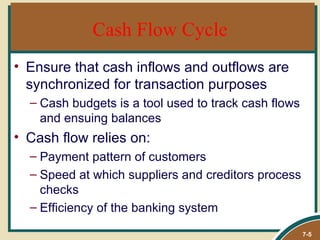
Cash Flow Cycle
• Ensure that cash inflows and outflows are
  synchronized for transaction purposes
  – Cash budgets is a tool used to track cash flows
    and ensuing balances
• Cash flow relies on:
  – Payment pattern of customers
  – Speed at which suppliers and creditors process
    checks
  – Efficiency of the banking system

                                                      7-5
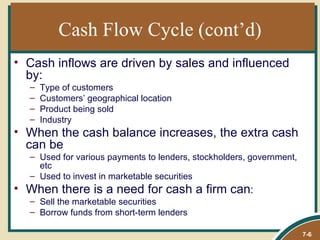
Cash Flow Cycle (cont’d)
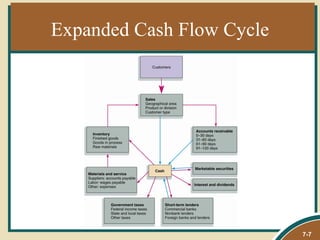
• Cash inflows are driven by sales and influenced
  by:
  –   Type of customers
  –   Customers’ geographical location
  –   Product being sold
  –   Industry
• When the cash balance increases, the extra cash
  can be
  – Used for various payments to lenders, stockholders, government,
    etc
  – Used to invest in marketable securities
• When there is a need for cash a firm can:
  – Sell the marketable securities
  – Borrow funds from short-term lenders

                                                                      7-6
Expanded Cash Flow Cycle


                           7-7
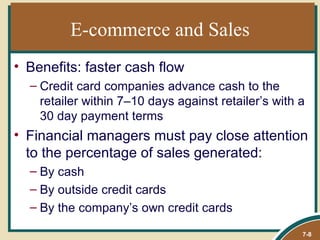
E-commerce and Sales
• Benefits: faster cash flow
  – Credit card companies advance cash to the
    retailer within 7–10 days against retailer’s with a
    30 day payment terms
• Financial managers must pay close attention
  to the percentage of sales generated:
  – By cash
  – By outside credit cards
  – By the company’s own credit cards

                                                      7-8
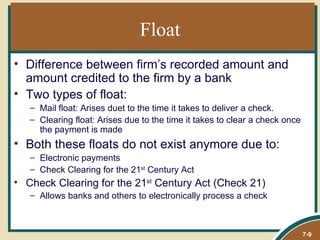
Float
• Difference between firm’s recorded amount and
  amount credited to the firm by a bank
• Two types of float:
   – Mail float: Arises duet to the time it takes to deliver a check.
   – Clearing float: Arises due to the time it takes to clear a check once
     the payment is made
• Both these floats do not exist anymore due to:
   – Electronic payments
   – Check Clearing for the 21st Century Act
• Check Clearing for the 21st Century Act (Check 21)
   – Allows banks and others to electronically process a check


                                                                             7-9
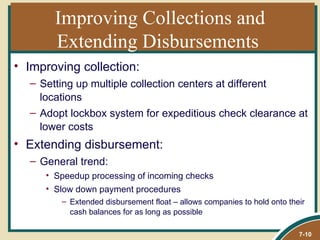
Improving Collections and
       Extending Disbursements
• Improving collection:
  – Setting up multiple collection centers at different
    locations
  – Adopt lockbox system for expeditious check clearance at
    lower costs
• Extending disbursement:
  – General trend:
     • Speedup processing of incoming checks
     • Slow down payment procedures
        – Extended disbursement float – allows companies to hold onto their
          cash balances for as long as possible

                                                                         7-10
Cost-Benefit Analysis
• Allows companies to analyze the benefits,
  received by investing on an efficiently
  maintained cash management program


                                              7-11
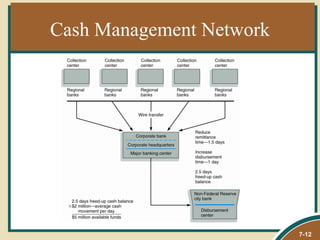
Cash Management Network


                          7-12
Electronic Funds Transfer
• Funds are moved between computer terminals
  without the use of a ‘check’
  – Automated clearinghouses (ACH): Transfers information between
    financial institutions and between accounts using computer tape
• International fund transfer is carried out through
  SWIFT (Society for Worldwide Interbank Financial
  Telecommunications)
  – Uses a proprietary secure messaging system
  – Each message is encrypted
  – Every money transaction is authenticated by a code, using smart
    card technology
  – Assumes financial liability for the accuracy, completeness, and
    confidentiality of transaction
                                                                      7-13
International Cash Management
• Factors differentiating international cash
  management from domestic based systems:
  – Differing payment methods and/or higher popularity
    of electronic funds transfer
  – Subject to international boundaries, time zone
    differences, currency fluctuations, and interest rate
    changes
  – Differing banking systems and check clearing
    processes
  – Differing account balance management and
    information reporting systems
  – Cultural, tax, and accounting differences
                                                        7-14
International Cash Management
               (cont’d)
• Financial managers try to keep as much
  cash as possible in a country with a strong
  currency and vice versa
• Sweep account:
  – Allows companies to maintain zero balances
  – Excess cash is swept into an interest-earning
    account


                                                    7-15
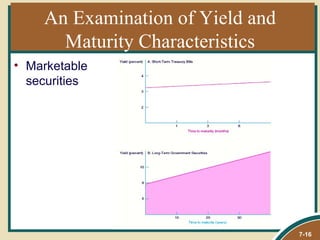
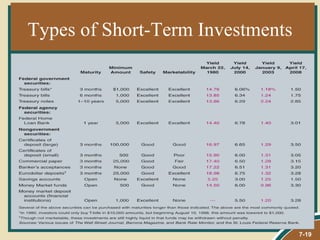
An Examination of Yield and
      Maturity Characteristics
• Marketable
  securities


                                  7-16
Marketable Securities
• When a firm has excess funds, it should be
  converted from cash into interest-earning securities
• Types of securities:
  – Treasury bills: Short-term obligations of the government
  – Treasury notes: Government obligations with a maturity of 1-10
    years
  – Federal agency securities: Offerings of government organizations
  – Certificate of deposit: Offered by commercial banks, savings, and
    other financial institutions
  – Commercial paper: Represents unsecured promissory notes
    issued by large business organizations
  – Banker’s acceptances: Short-term securities that arise from
    foreign trade


                                                                   7-17
Management of Accounts
            Receivable
• Accounts receivable as an investment
  – Should be based on the level of return earned
    equals or exceeds the potential gain from other
    investments
• Credit policy administration
  – Credit standards
  – Terms of trade
  – Collection policy


                                                  7-18
Types of Short-Term Investments


                                  7-19
Credit Standards
• Determine the nature of credit risk based on:
  – Prior records of payment and financial stability,
    current net worth, and other related factors
• 5 Cs of credit:
  – Character
  – Capital
  – Capacity
  – Conditions
  – Collateral
                                                        7-20
Credit Standards (cont’d)
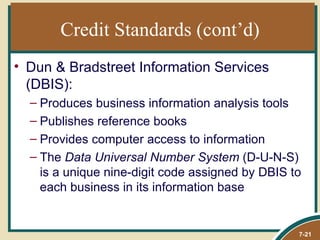
• Dun & Bradstreet Information Services
  (DBIS):
  – Produces business information analysis tools
  – Publishes reference books
  – Provides computer access to information
  – The Data Universal Number System (D-U-N-S)
    is a unique nine-digit code assigned by DBIS to
    each business in its information base


                                                  7-21
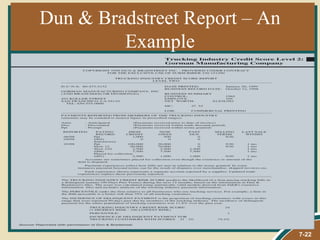
Dun & Bradstreet Report – An
         Example


                               7-22
Terms of Trade
• Stated term of credit extension:
  – Has a strong impact on the eventual size of
    accounts receivable balance
  – Creates a need for firms to consider the use of
    cash discounts


                                                      7-23
Collection Policy
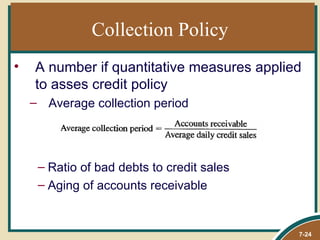
•   A number if quantitative measures applied
    to asses credit policy
    – Average collection period


     – Ratio of bad debts to credit sales
     – Aging of accounts receivable


                                            7-24
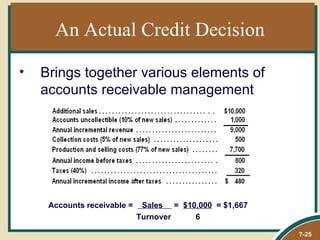
An Actual Credit Decision

•   Brings together various elements of
    accounts receivable management


     Accounts receivable =    Sales = $10,000 = $1,667
                             Turnover    6

                                                         7-25
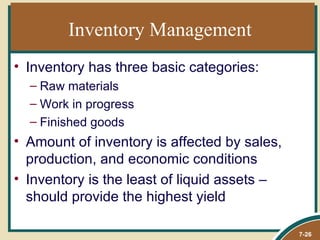
Inventory Management
• Inventory has three basic categories:
  – Raw materials
  – Work in progress
  – Finished goods
• Amount of inventory is affected by sales,
  production, and economic conditions
• Inventory is the least of liquid assets –
  should provide the highest yield

                                              7-26
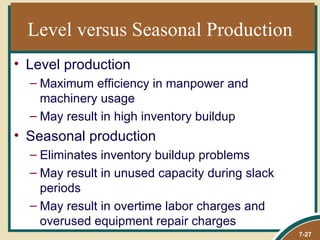
Level versus Seasonal Production
• Level production
  – Maximum efficiency in manpower and
    machinery usage
  – May result in high inventory buildup
• Seasonal production
  – Eliminates inventory buildup problems
  – May result in unused capacity during slack
    periods
  – May result in overtime labor charges and
    overused equipment repair charges
                                                 7-27
Inventory Policy in Inflation (and
             Deflation)
• Inventory position can be protected in an
  environment of price instability by:
  – Taking moderate inventory positions
  – Hedging with a futures contract to sell at a
    stipulated price some months from now
• Rapid price movements in inventory may
  also have a major impact on the reported
  income of the firm

                                                   7-28
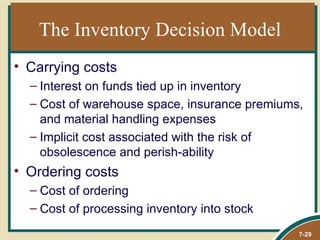
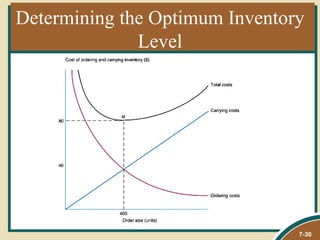
The Inventory Decision Model
• Carrying costs
  – Interest on funds tied up in inventory
  – Cost of warehouse space, insurance premiums,
    and material handling expenses
  – Implicit cost associated with the risk of
    obsolescence and perish-ability
• Ordering costs
  – Cost of ordering
  – Cost of processing inventory into stock
                                               7-29
Determining the Optimum Inventory
              Level


                                7-30
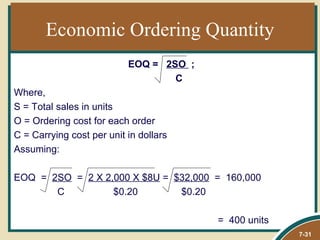
Economic Ordering Quantity
                           EOQ = 2SO ;
                                   C
Where,
S = Total sales in units
O = Ordering cost for each order
C = Carrying cost per unit in dollars
Assuming:

EOQ = 2SO = 2 X 2,000 X $8U = $32,000 = 160,000
       C          $0.20        $0.20

                                         = 400 units
                                                       7-31
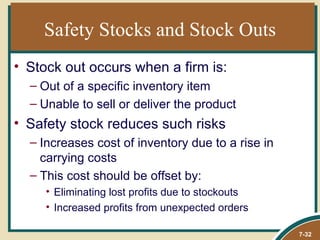
Safety Stocks and Stock Outs
• Stock out occurs when a firm is:
  – Out of a specific inventory item
  – Unable to sell or deliver the product
• Safety stock reduces such risks
  – Increases cost of inventory due to a rise in
    carrying costs
  – This cost should be offset by:
     • Eliminating lost profits due to stockouts
     • Increased profits from unexpected orders

                                                   7-32
Safety Stocks and Stock Outs
                (cont’d)
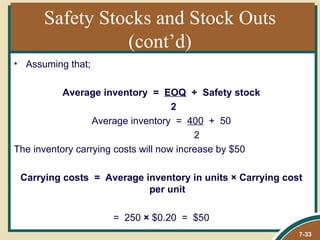
• Assuming that;

           Average inventory = EOQ + Safety stock
                                     2
                  Average inventory = 400 + 50
                                          2
The inventory carrying costs will now increase by $50

 Carrying costs = Average inventory in units × Carrying cost
                           per unit

                     = 250 × $0.20 = $50
                                                           7-33
Just-in-Time Inventory Management
• Basic requirements for JIT:
  – Quality production that continually satisfies
    customer requirements
  – Close ties between suppliers, manufactures, and
    customers
  – Minimization of the level of inventory
• Cost Savings from lower inventory:
  – On average, JIT has reduced inventory to sales
    ratio by 10% over the last decade

                                                 7-34
Advantages of JIT
• Reduction in space due to reduced
  warehouse space requirement
• Reduced construction and overhead
  expenses for utilities and manpower
• Better technology with the development of
  electronic data interchange systems (EDI)
  – EDI reduces re-keying errors and duplication of
    forms
• Reduction in costs from quality control
• Elimination of waste
                                                  7-35
Areas of Concern for JIT
• Integration costs
• Parts shortages could lead to lost sales and
  slow growth
  – Un-forecasted increase in sales:
     • Inability to keep up with demand
  – Un-forecasted decrease in sales:
     • Inventory can pile up
• A revaluation may be needed in high-growth
  industries fostering dynamic technologies
                                             7-36
End
Q


          7-37
Q&A

      7-38
Thank You.

             7-39

Topic 004

  • 1.
    Chapter 07 • CurrentAsset Management By Md. Shahedur Rahaman Chowdhury 7-1
  • 2.
    Chapter Outline • Whatis current asset management • Cash management and its importance • Management of marketable securities • Accounts receivable and inventory management • Inventory management and policy decisions required • Liquidity vis-à-vis returns 7-2
  • 3.
    Cash Management • Financialmanagers actively attempt to keep cash (non-earning asset) to a minimum – It is critical to have sufficient cash to assuage emergencies – Steps to improve overall profitability of a firm: • Minimize cash balances • Have accurate knowledge of when cash moves in and out of the firm 7-3
  • 4.
    Reasons for HoldingCash Balances • Transactions balances – Payments towards planned expenses • Compensative balances for banks – Compensate a bank for services provided rather than paying directly for them • Precautionary needs – Emergency purposes 7-4
  • 5.
    Cash Flow Cycle •Ensure that cash inflows and outflows are synchronized for transaction purposes – Cash budgets is a tool used to track cash flows and ensuing balances • Cash flow relies on: – Payment pattern of customers – Speed at which suppliers and creditors process checks – Efficiency of the banking system 7-5
  • 6.
    Cash Flow Cycle(cont’d) • Cash inflows are driven by sales and influenced by: – Type of customers – Customers’ geographical location – Product being sold – Industry • When the cash balance increases, the extra cash can be – Used for various payments to lenders, stockholders, government, etc – Used to invest in marketable securities • When there is a need for cash a firm can: – Sell the marketable securities – Borrow funds from short-term lenders 7-6
  • 7.
  • 8.
    E-commerce and Sales •Benefits: faster cash flow – Credit card companies advance cash to the retailer within 7–10 days against retailer’s with a 30 day payment terms • Financial managers must pay close attention to the percentage of sales generated: – By cash – By outside credit cards – By the company’s own credit cards 7-8
  • 9.
    Float • Difference betweenfirm’s recorded amount and amount credited to the firm by a bank • Two types of float: – Mail float: Arises duet to the time it takes to deliver a check. – Clearing float: Arises due to the time it takes to clear a check once the payment is made • Both these floats do not exist anymore due to: – Electronic payments – Check Clearing for the 21st Century Act • Check Clearing for the 21st Century Act (Check 21) – Allows banks and others to electronically process a check 7-9
  • 10.
    Improving Collections and Extending Disbursements • Improving collection: – Setting up multiple collection centers at different locations – Adopt lockbox system for expeditious check clearance at lower costs • Extending disbursement: – General trend: • Speedup processing of incoming checks • Slow down payment procedures – Extended disbursement float – allows companies to hold onto their cash balances for as long as possible 7-10
  • 11.
    Cost-Benefit Analysis • Allowscompanies to analyze the benefits, received by investing on an efficiently maintained cash management program 7-11
  • 12.
  • 13.
    Electronic Funds Transfer •Funds are moved between computer terminals without the use of a ‘check’ – Automated clearinghouses (ACH): Transfers information between financial institutions and between accounts using computer tape • International fund transfer is carried out through SWIFT (Society for Worldwide Interbank Financial Telecommunications) – Uses a proprietary secure messaging system – Each message is encrypted – Every money transaction is authenticated by a code, using smart card technology – Assumes financial liability for the accuracy, completeness, and confidentiality of transaction 7-13
  • 14.
    International Cash Management •Factors differentiating international cash management from domestic based systems: – Differing payment methods and/or higher popularity of electronic funds transfer – Subject to international boundaries, time zone differences, currency fluctuations, and interest rate changes – Differing banking systems and check clearing processes – Differing account balance management and information reporting systems – Cultural, tax, and accounting differences 7-14
  • 15.
    International Cash Management (cont’d) • Financial managers try to keep as much cash as possible in a country with a strong currency and vice versa • Sweep account: – Allows companies to maintain zero balances – Excess cash is swept into an interest-earning account 7-15
  • 16.
    An Examination ofYield and Maturity Characteristics • Marketable securities 7-16
  • 17.
    Marketable Securities • Whena firm has excess funds, it should be converted from cash into interest-earning securities • Types of securities: – Treasury bills: Short-term obligations of the government – Treasury notes: Government obligations with a maturity of 1-10 years – Federal agency securities: Offerings of government organizations – Certificate of deposit: Offered by commercial banks, savings, and other financial institutions – Commercial paper: Represents unsecured promissory notes issued by large business organizations – Banker’s acceptances: Short-term securities that arise from foreign trade 7-17
  • 18.
    Management of Accounts Receivable • Accounts receivable as an investment – Should be based on the level of return earned equals or exceeds the potential gain from other investments • Credit policy administration – Credit standards – Terms of trade – Collection policy 7-18
  • 19.
    Types of Short-TermInvestments 7-19
  • 20.
    Credit Standards • Determinethe nature of credit risk based on: – Prior records of payment and financial stability, current net worth, and other related factors • 5 Cs of credit: – Character – Capital – Capacity – Conditions – Collateral 7-20
  • 21.
    Credit Standards (cont’d) •Dun & Bradstreet Information Services (DBIS): – Produces business information analysis tools – Publishes reference books – Provides computer access to information – The Data Universal Number System (D-U-N-S) is a unique nine-digit code assigned by DBIS to each business in its information base 7-21
  • 22.
    Dun & BradstreetReport – An Example 7-22
  • 23.
    Terms of Trade •Stated term of credit extension: – Has a strong impact on the eventual size of accounts receivable balance – Creates a need for firms to consider the use of cash discounts 7-23
  • 24.
    Collection Policy • A number if quantitative measures applied to asses credit policy – Average collection period – Ratio of bad debts to credit sales – Aging of accounts receivable 7-24
  • 25.
    An Actual CreditDecision • Brings together various elements of accounts receivable management Accounts receivable = Sales = $10,000 = $1,667 Turnover 6 7-25
  • 26.
    Inventory Management • Inventoryhas three basic categories: – Raw materials – Work in progress – Finished goods • Amount of inventory is affected by sales, production, and economic conditions • Inventory is the least of liquid assets – should provide the highest yield 7-26
  • 27.
    Level versus SeasonalProduction • Level production – Maximum efficiency in manpower and machinery usage – May result in high inventory buildup • Seasonal production – Eliminates inventory buildup problems – May result in unused capacity during slack periods – May result in overtime labor charges and overused equipment repair charges 7-27
  • 28.
    Inventory Policy inInflation (and Deflation) • Inventory position can be protected in an environment of price instability by: – Taking moderate inventory positions – Hedging with a futures contract to sell at a stipulated price some months from now • Rapid price movements in inventory may also have a major impact on the reported income of the firm 7-28
  • 29.
    The Inventory DecisionModel • Carrying costs – Interest on funds tied up in inventory – Cost of warehouse space, insurance premiums, and material handling expenses – Implicit cost associated with the risk of obsolescence and perish-ability • Ordering costs – Cost of ordering – Cost of processing inventory into stock 7-29
  • 30.
    Determining the OptimumInventory Level 7-30
  • 31.
    Economic Ordering Quantity EOQ = 2SO ; C Where, S = Total sales in units O = Ordering cost for each order C = Carrying cost per unit in dollars Assuming: EOQ = 2SO = 2 X 2,000 X $8U = $32,000 = 160,000 C $0.20 $0.20 = 400 units 7-31
  • 32.
    Safety Stocks andStock Outs • Stock out occurs when a firm is: – Out of a specific inventory item – Unable to sell or deliver the product • Safety stock reduces such risks – Increases cost of inventory due to a rise in carrying costs – This cost should be offset by: • Eliminating lost profits due to stockouts • Increased profits from unexpected orders 7-32
  • 33.
    Safety Stocks andStock Outs (cont’d) • Assuming that; Average inventory = EOQ + Safety stock 2 Average inventory = 400 + 50 2 The inventory carrying costs will now increase by $50 Carrying costs = Average inventory in units × Carrying cost per unit = 250 × $0.20 = $50 7-33
  • 34.
    Just-in-Time Inventory Management •Basic requirements for JIT: – Quality production that continually satisfies customer requirements – Close ties between suppliers, manufactures, and customers – Minimization of the level of inventory • Cost Savings from lower inventory: – On average, JIT has reduced inventory to sales ratio by 10% over the last decade 7-34
  • 35.
    Advantages of JIT •Reduction in space due to reduced warehouse space requirement • Reduced construction and overhead expenses for utilities and manpower • Better technology with the development of electronic data interchange systems (EDI) – EDI reduces re-keying errors and duplication of forms • Reduction in costs from quality control • Elimination of waste 7-35
  • 36.
    Areas of Concernfor JIT • Integration costs • Parts shortages could lead to lost sales and slow growth – Un-forecasted increase in sales: • Inability to keep up with demand – Un-forecasted decrease in sales: • Inventory can pile up • A revaluation may be needed in high-growth industries fostering dynamic technologies 7-36
  • 37.
    End Q 7-37
  • 38.
    Q&A 7-38
  • 39.