TOP TEN REASONS
WHY PROJECTS FAIL
Jim Stewart, PMP
JPStewart Associates
2


Learning points

• Learn to recognize the ten project failure signs in your
  organization.
• Understand what commonly used solution is not
  necessarily a solution at all.
• Learn the basics of risk management, one of the top ten
  reasons for project failure.
3


The nature of the problem


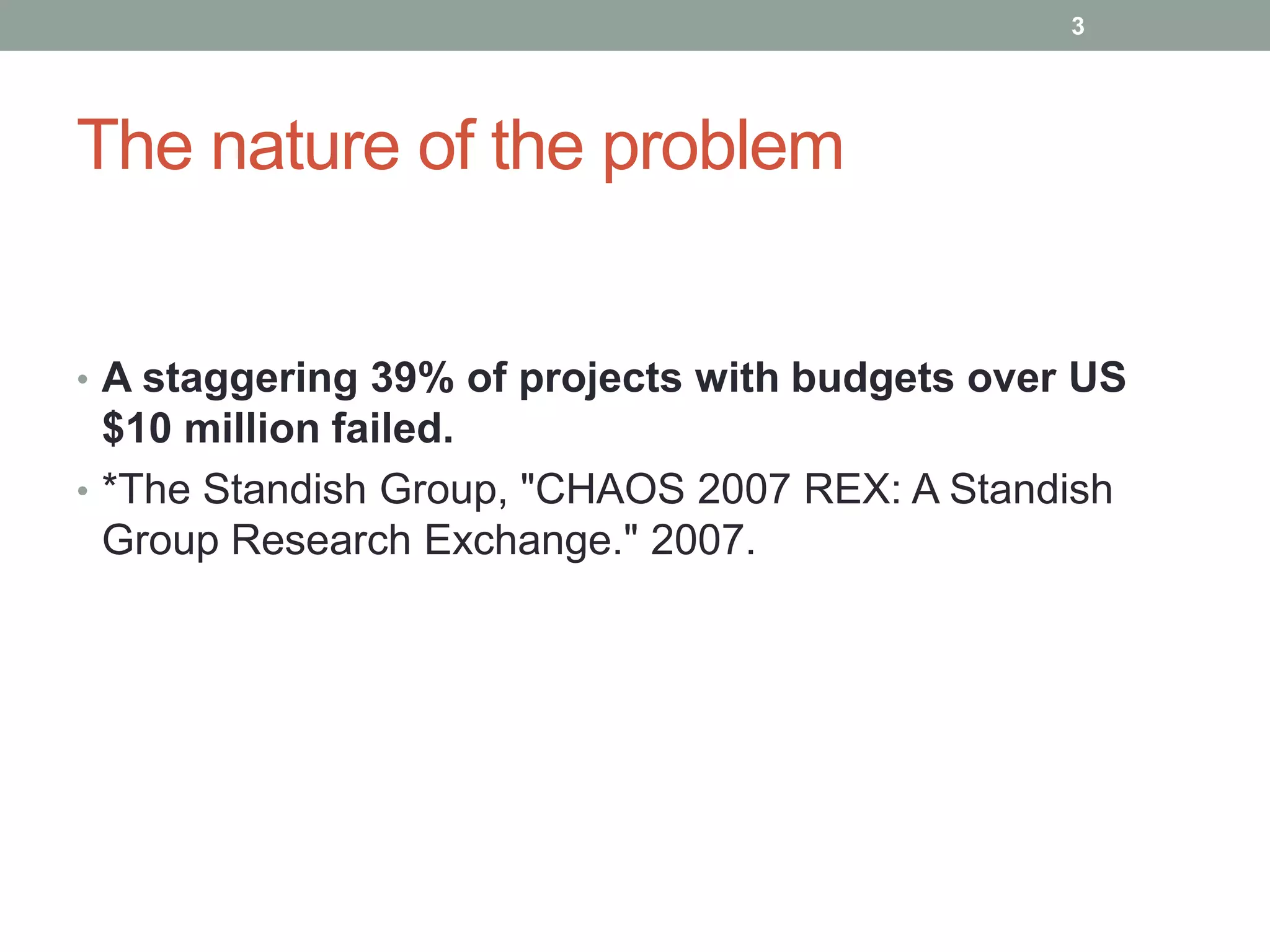
• A staggering 39% of projects with budgets over US
  $10 million failed.
• *The Standish Group, "CHAOS 2007 REX: A Standish
  Group Research Exchange." 2007.
4


Why projects fail
• There are many reasons that projects fail. If you talk to
  any project manager who has been practicing for a while,
  he or she will give you a list of reasons, some valid, some
  not.
• This list is my own opinion formed from running many
  projects and consulting on others in various stages of
  completion.
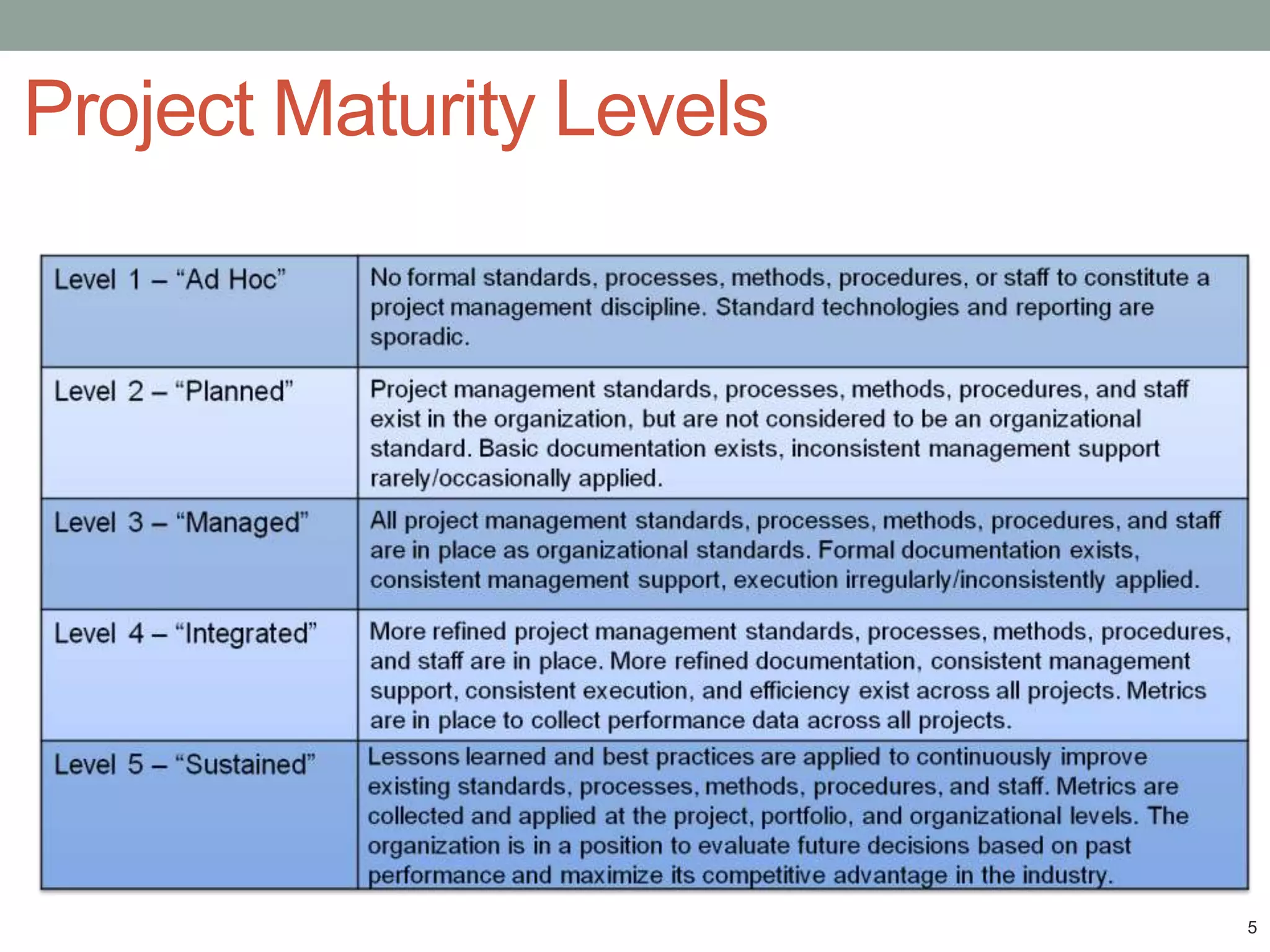
Project Maturity Levels


                          5
6


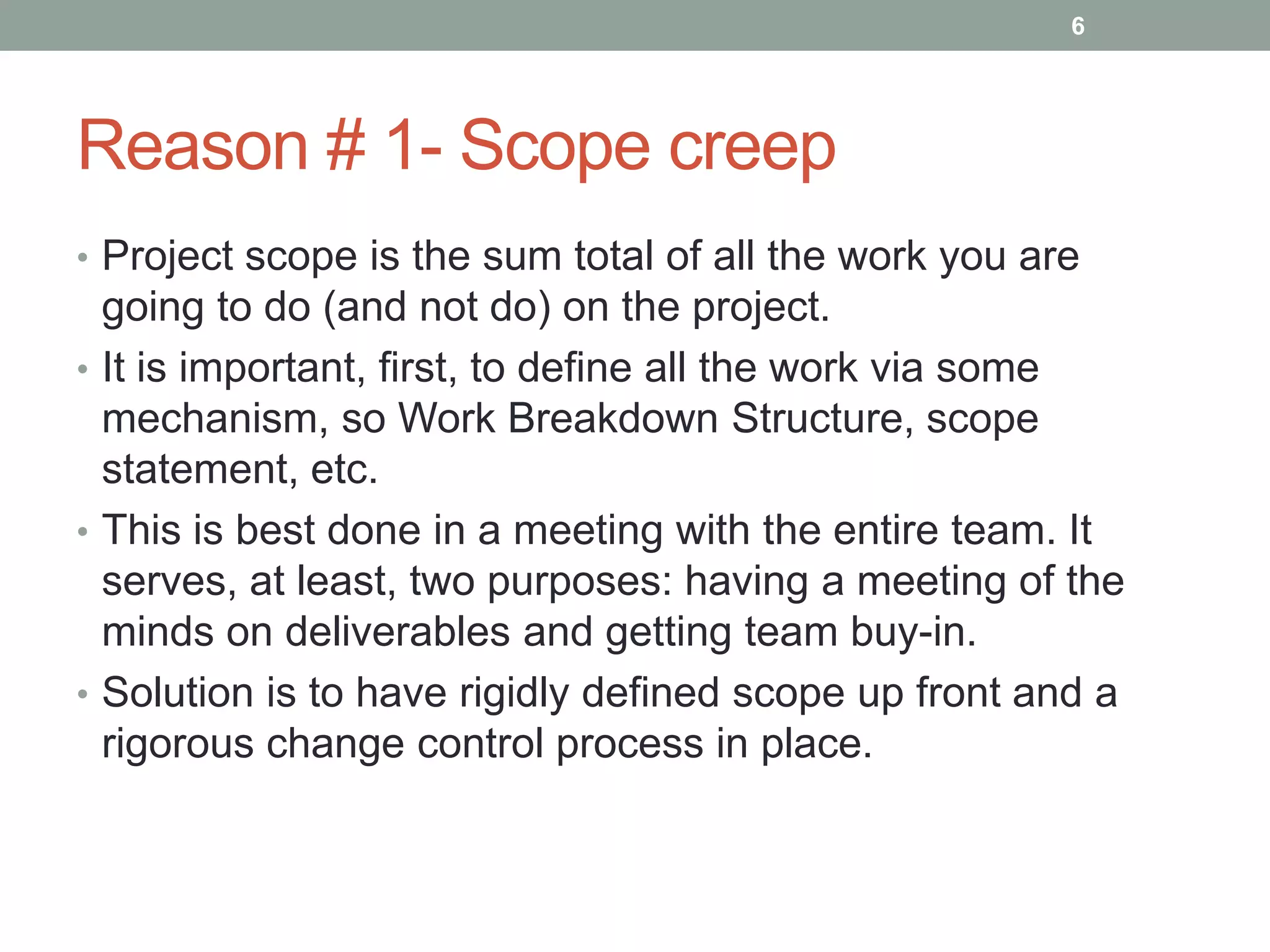
Reason # 1- Scope creep
• Project scope is the sum total of all the work you are
  going to do (and not do) on the project.
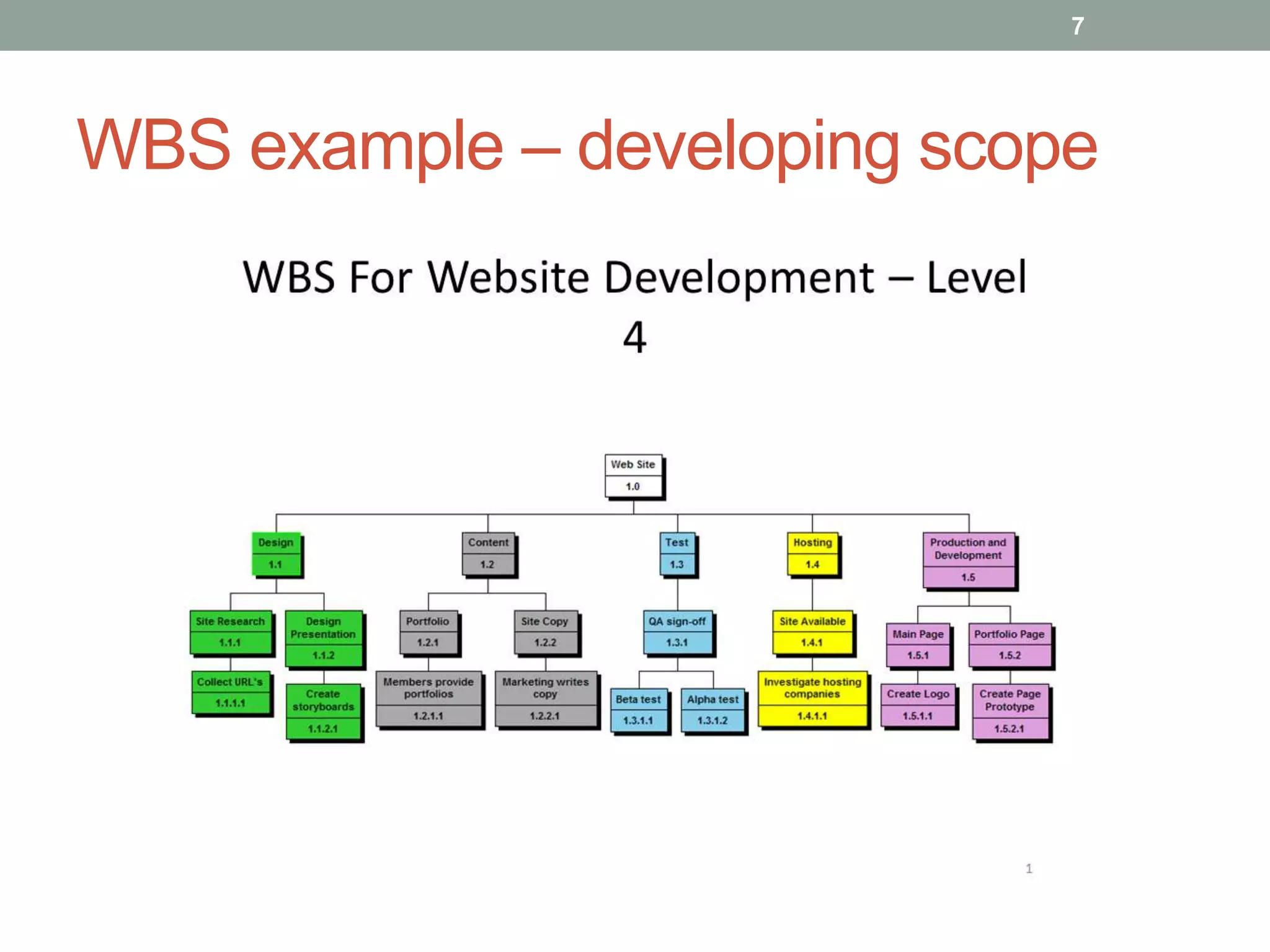
• It is important, first, to define all the work via some
  mechanism, so Work Breakdown Structure, scope
  statement, etc.
• This is best done in a meeting with the entire team. It
  serves, at least, two purposes: having a meeting of the
  minds on deliverables and getting team buy-in.
• Solution is to have rigidly defined scope up front and a
  rigorous change control process in place.
7


WBS example – developing scope
8


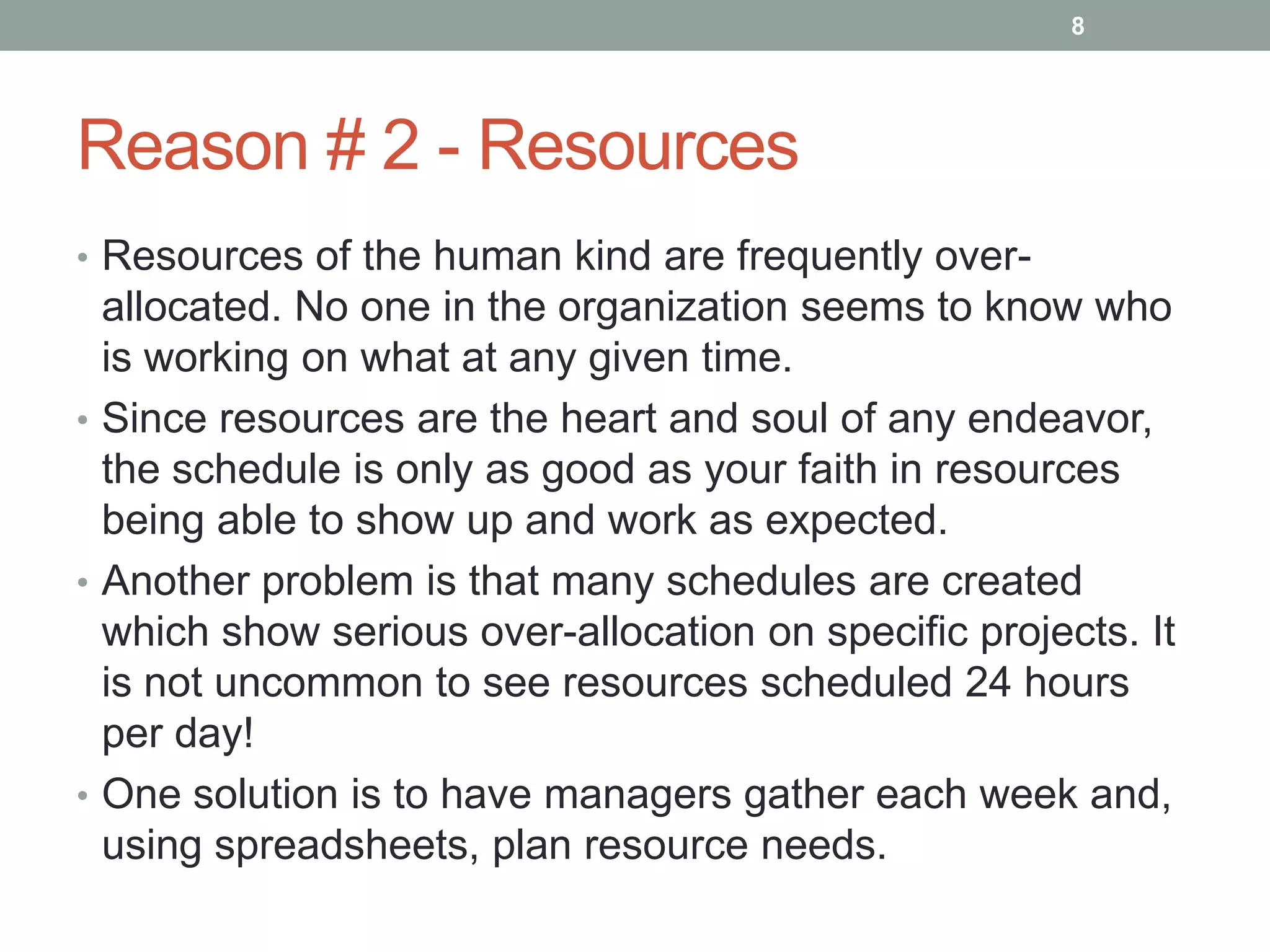
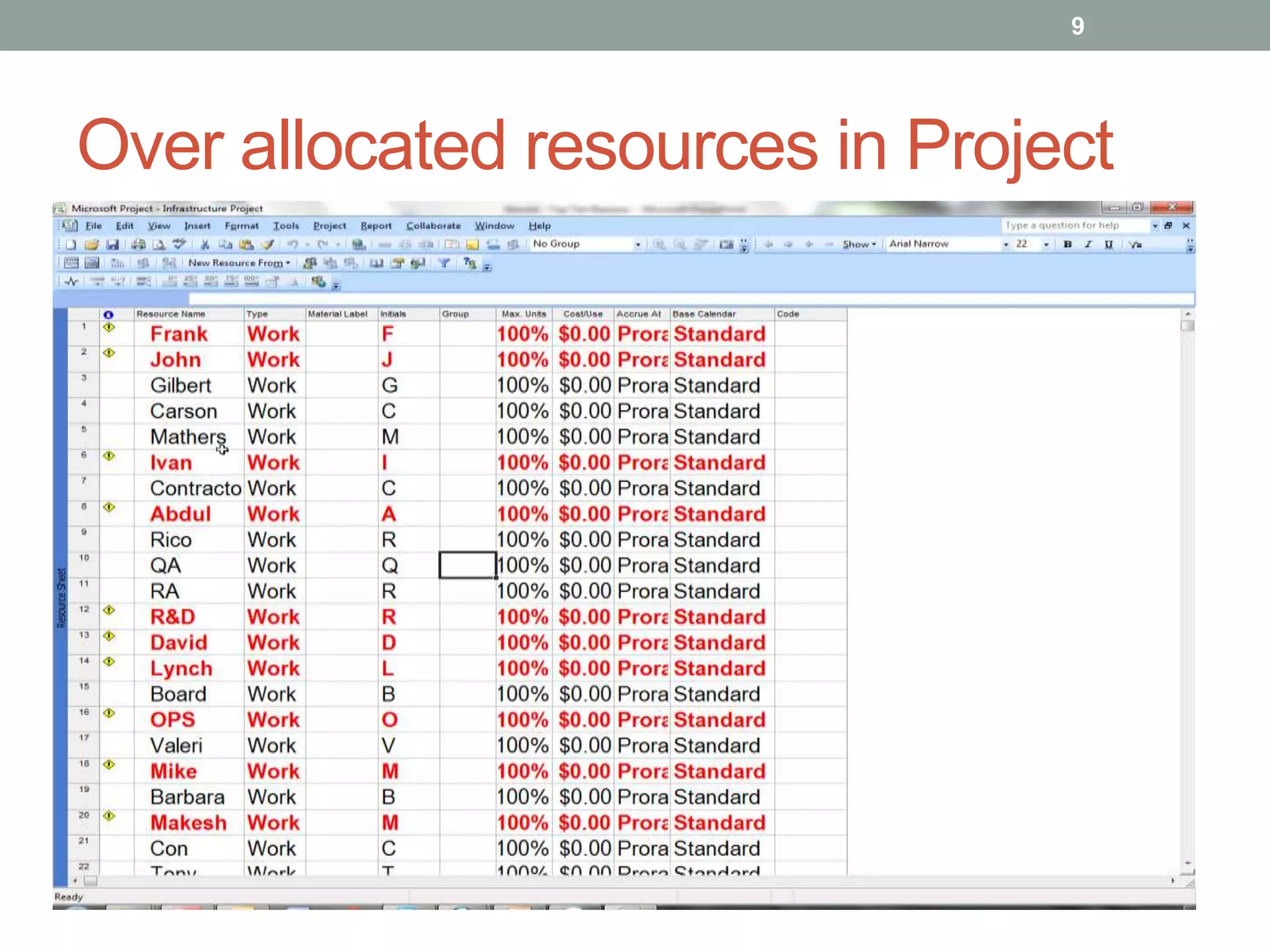
Reason # 2 - Resources
• Resources of the human kind are frequently over-
  allocated. No one in the organization seems to know who
  is working on what at any given time.
• Since resources are the heart and soul of any endeavor,
  the schedule is only as good as your faith in resources
  being able to show up and work as expected.
• Another problem is that many schedules are created
  which show serious over-allocation on specific projects. It
  is not uncommon to see resources scheduled 24 hours
  per day!
• One solution is to have managers gather each week and,
  using spreadsheets, plan resource needs.
9


Over allocated resources in Project
10


Reason #3 - Communications
• The Project Management Body of Knowledge dedicates
  an entire Knowledge Area to Communications.
• It‟s my contention that the average person is not a very
  good communicator. They either don‟t answer emails or
  only answer half of the questions asked.
• You should insist on getting team members trained in
  communications so they are connecting at a very high
  level.
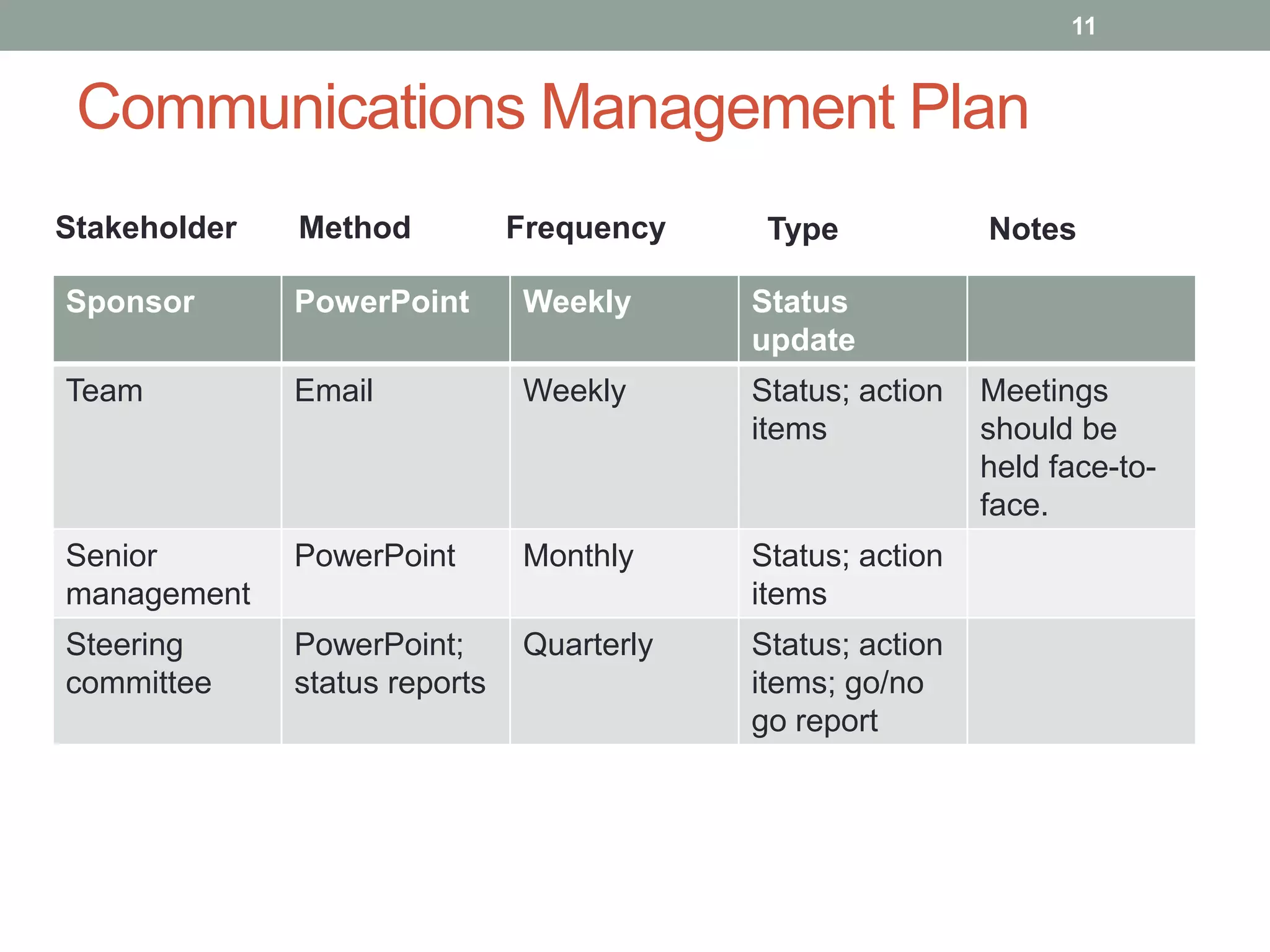
• You might also consider the creation of a Communications
  Management Plan which details which stakeholders will
  get what information when and by what means.
11


 Communications Management Plan
Stakeholder   Method           Frequency    Type            Notes

Sponsor       PowerPoint       Weekly      Status
                                           update
Team          Email            Weekly      Status; action   Meetings
                                           items            should be
                                                            held face-to-
                                                            face.
Senior        PowerPoint       Monthly     Status; action
management                                 items
Steering      PowerPoint;      Quarterly   Status; action
committee     status reports               items; go/no
                                           go report
12


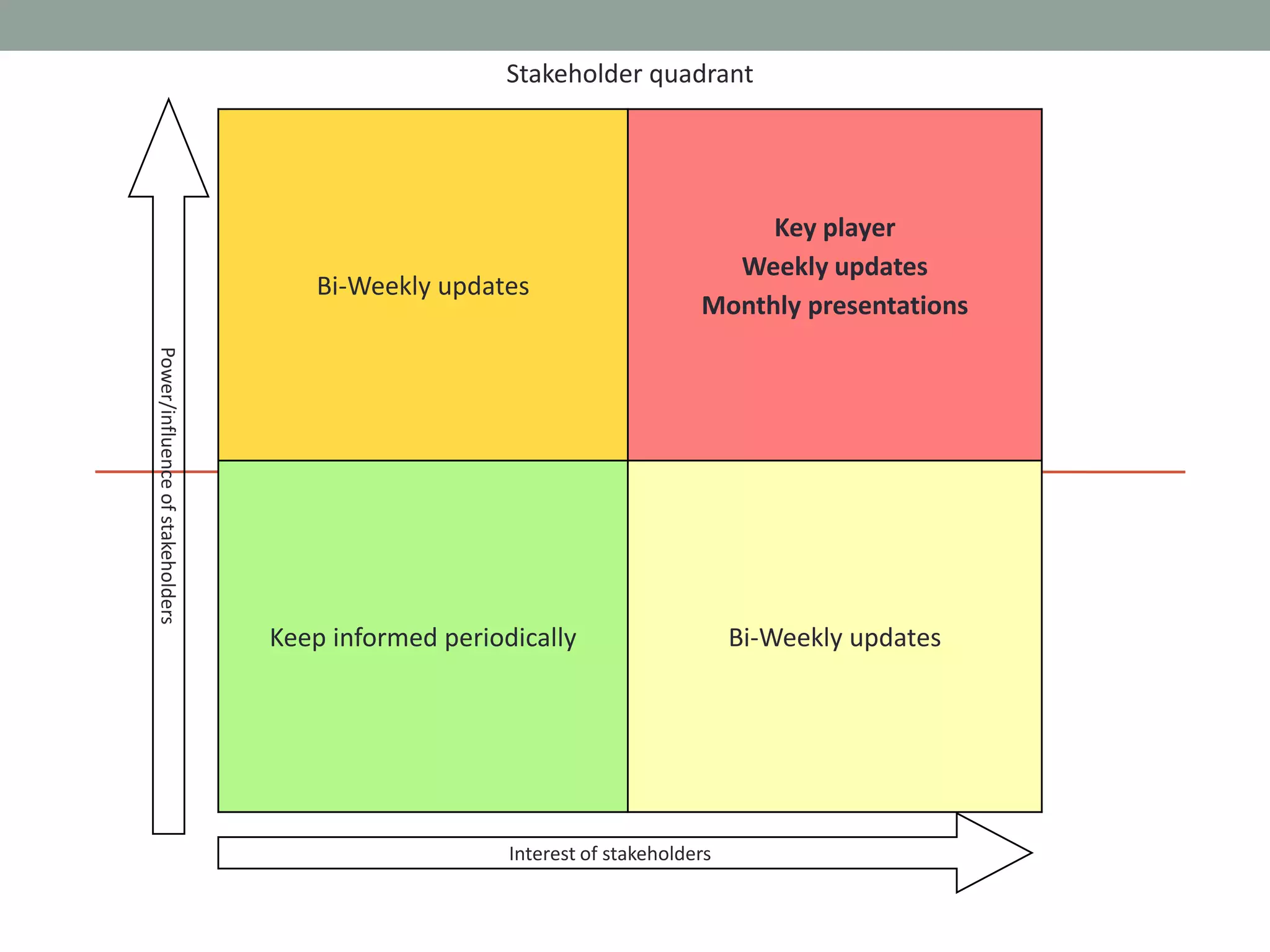
Reason #4 - Stakeholder Management
• A stakeholder has a vested interest in your project for
  good or for ill.
• The first step in this process is identifying stakeholders
  according to their power, influence, and interest.
• Once you know who your stakeholders are, you can
  develop a strategy for dealing with each one. This leads
  somewhat back to the previous Communications
  Management Plan.
• Keep stakeholders informed before and during the
  project.
Stakeholder quadrant


                                                                                 Key player
                                                                              Weekly updates
                                     Bi-Weekly updates
                                                                            Monthly presentations
Power/influence of stakeholders


                                  Keep informed periodically                     Bi-Weekly updates


                                                      Interest of stakeholders
14


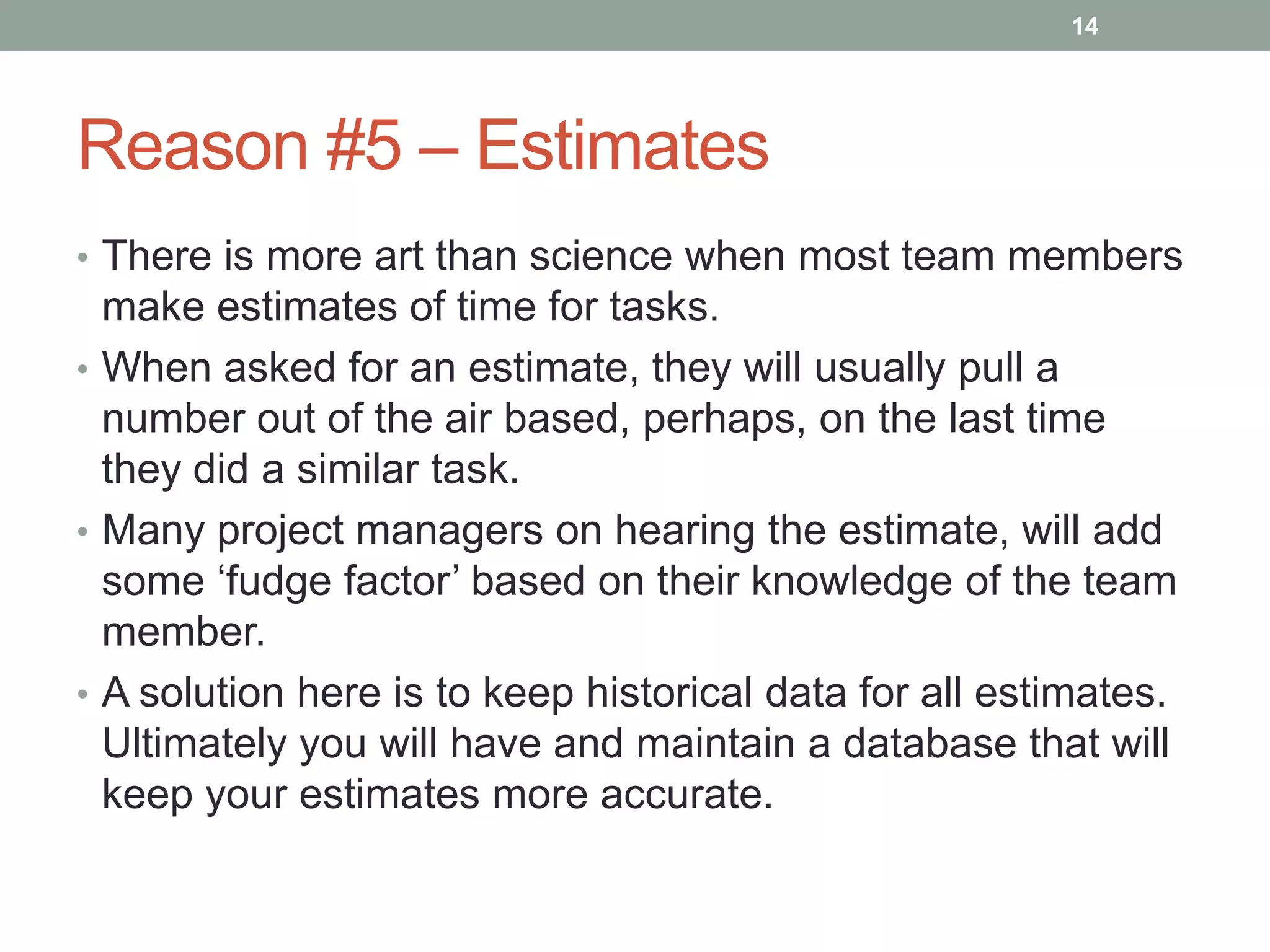
Reason #5 – Estimates
• There is more art than science when most team members
  make estimates of time for tasks.
• When asked for an estimate, they will usually pull a
  number out of the air based, perhaps, on the last time
  they did a similar task.
• Many project managers on hearing the estimate, will add
  some „fudge factor‟ based on their knowledge of the team
  member.
• A solution here is to keep historical data for all estimates.
  Ultimately you will have and maintain a database that will
  keep your estimates more accurate.
15


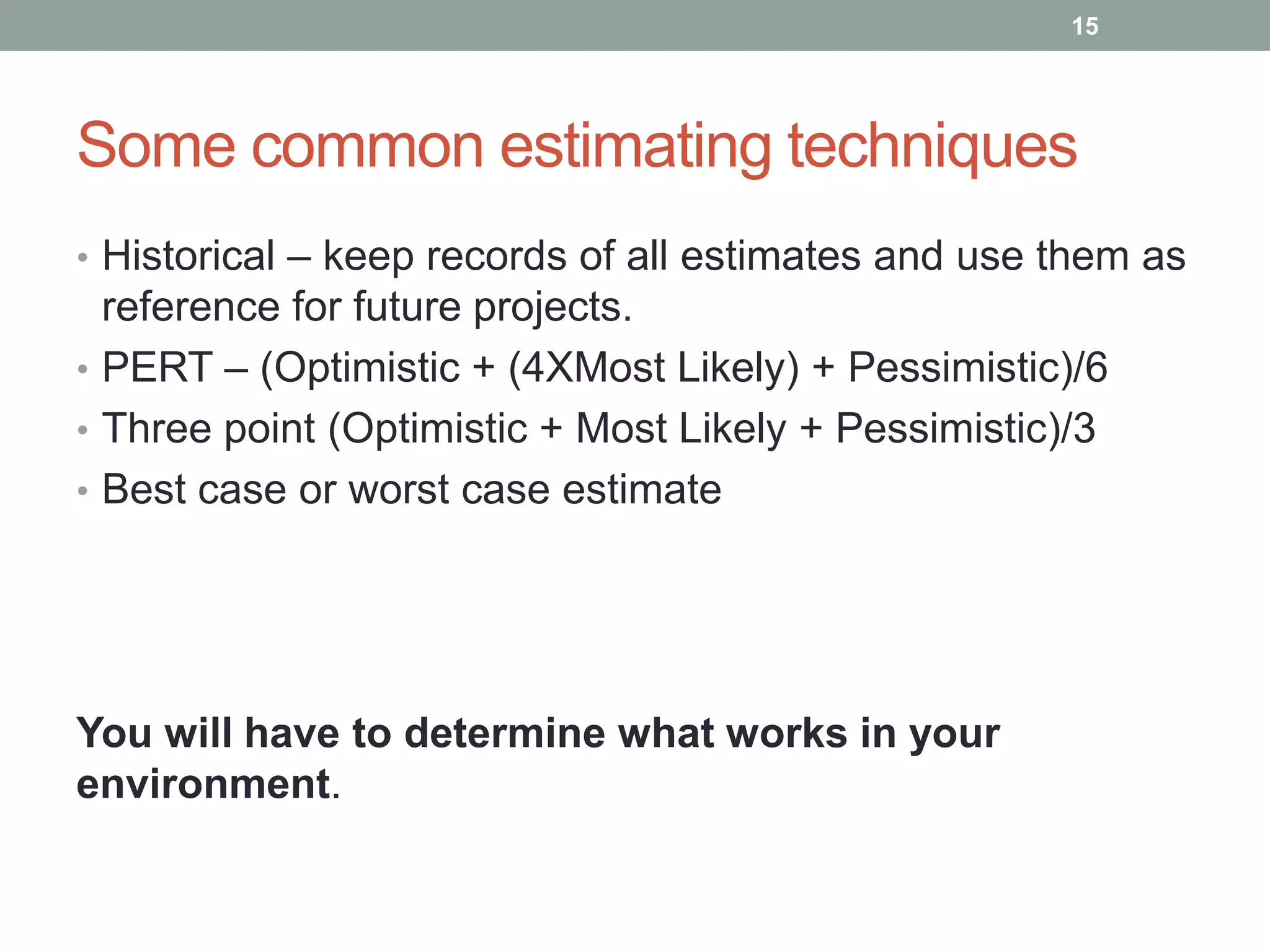
Some common estimating techniques
• Historical – keep records of all estimates and use them as
  reference for future projects.
• PERT – (Optimistic + (4XMost Likely) + Pessimistic)/6
• Three point (Optimistic + Most Likely + Pessimistic)/3
• Best case or worst case estimate


You will have to determine what works in your
environment.
16


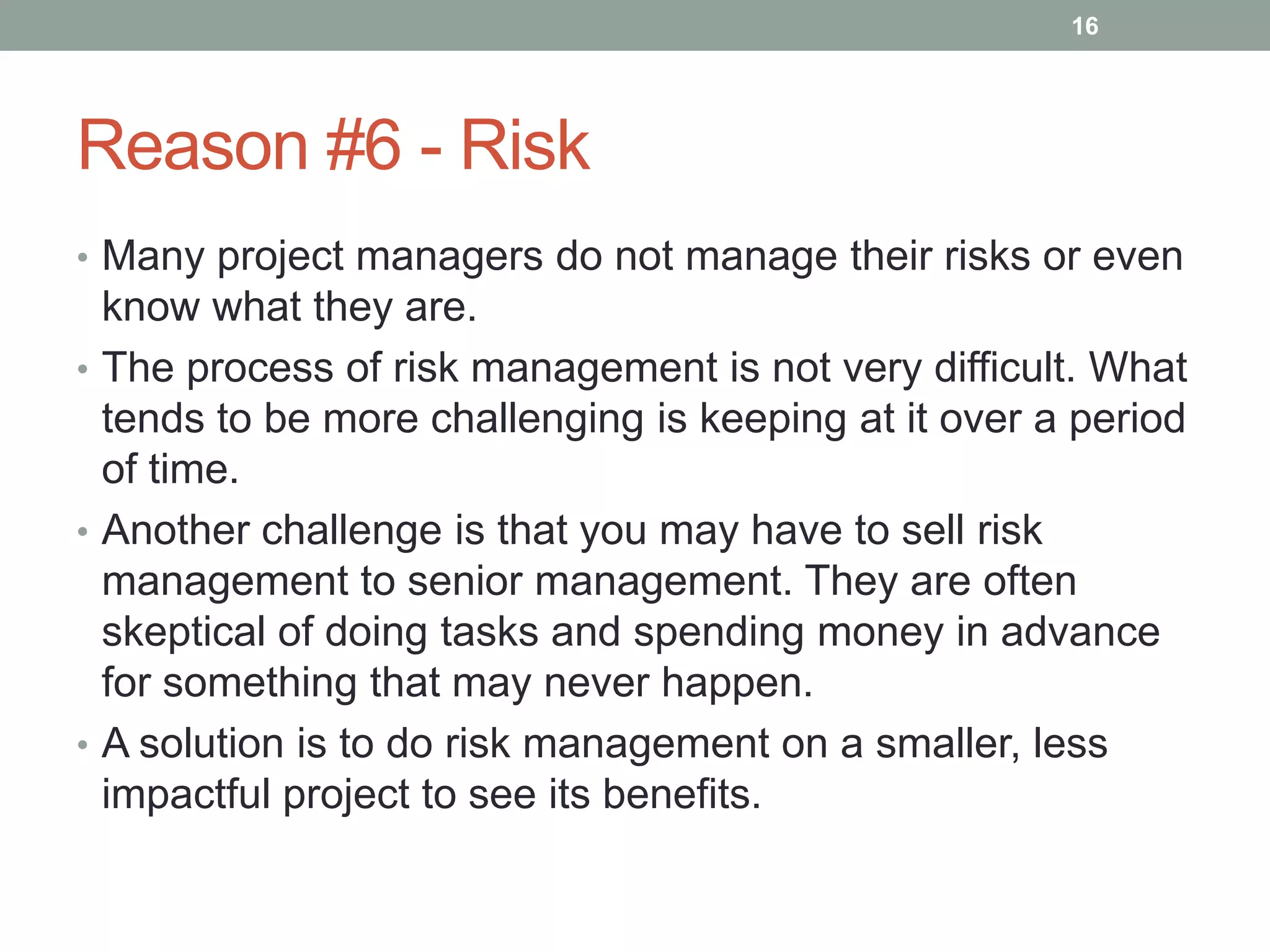
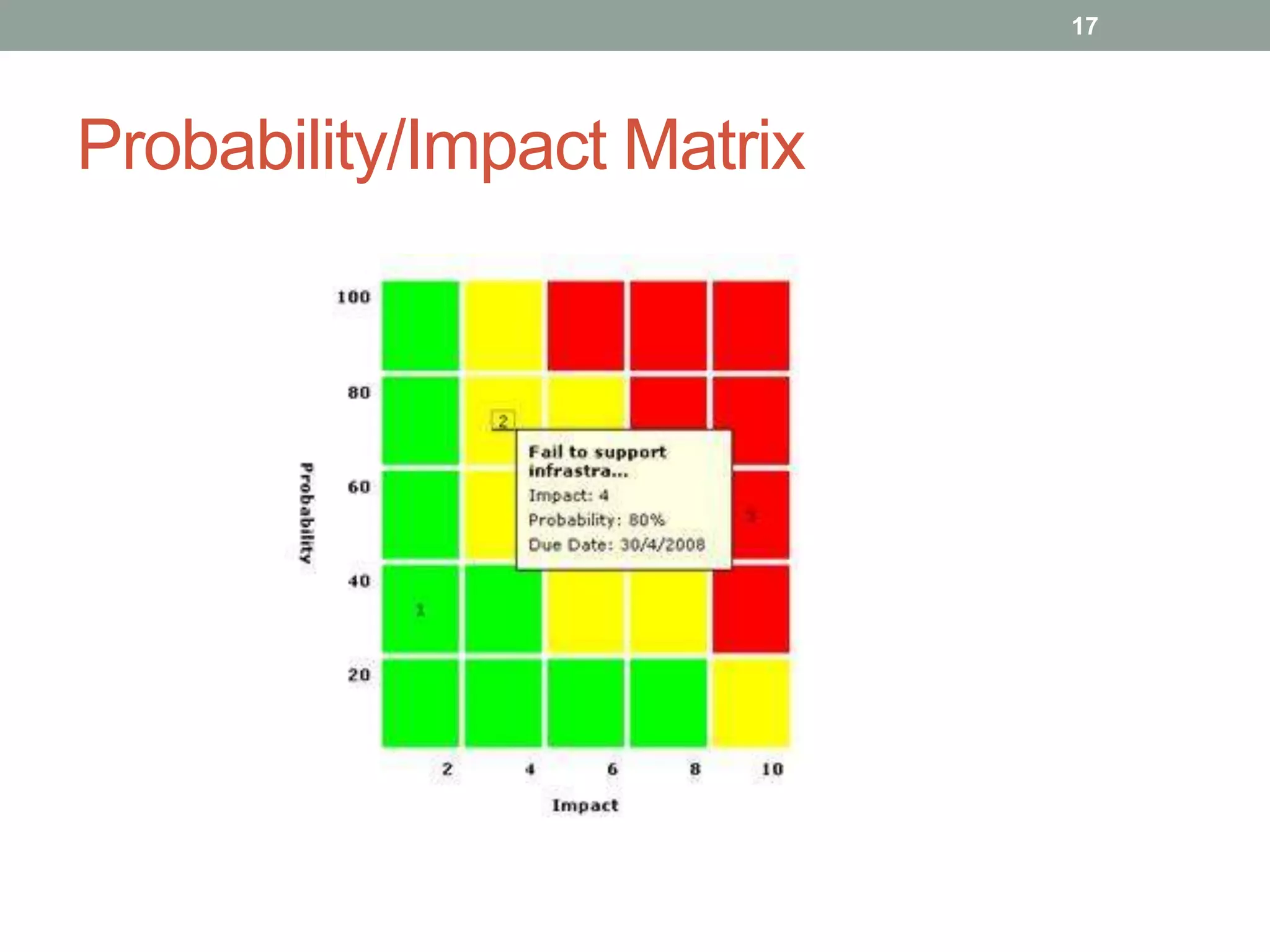
Reason #6 - Risk
• Many project managers do not manage their risks or even
  know what they are.
• The process of risk management is not very difficult. What
  tends to be more challenging is keeping at it over a period
  of time.
• Another challenge is that you may have to sell risk
  management to senior management. They are often
  skeptical of doing tasks and spending money in advance
  for something that may never happen.
• A solution is to do risk management on a smaller, less
  impactful project to see its benefits.
17


Probability/Impact Matrix
18


Risk response options
• Avoid – Remove the possibility of the risk occurring by
  removing the task or item that causes the risk.
• Transfer – Move the risk over to some third party either by
  insuring or subcontracting
• Mitigate – Reduce the probability or impact of the risk‟s
  occurrence by taking proactive steps.
• Accept – Do nothing.
19


Reason #7 – Unsupported project culture
• Many people do not even know what project management
  is or what a PM does.
• This lack of knowledge sometimes transfers over to
  corporations who fail to understand the role.
• Consequently, projects are not treated seriously enough.
  Schedules are handed off to junior people or secretaries,
  sometimes without the proper tools.
• The only solution here is education, especially at the
  senior management level.
20


Reason #8 – The Accidental Project
Manager
• Similar to the unsupported project manager, this takes it a
  step further.
• In this instance, an accomplished person is promoted to
  project manager. He may have been successful in, say, a
  technical role, but it does not mean he will be successful
  in a PM role.
• The technical role may have had him relating to
  machines. The PM role will require that he perform the
  delicate balance of interpersonal skills.
• As in the previous reason, the only solution here is
  education of both management and PM.
21


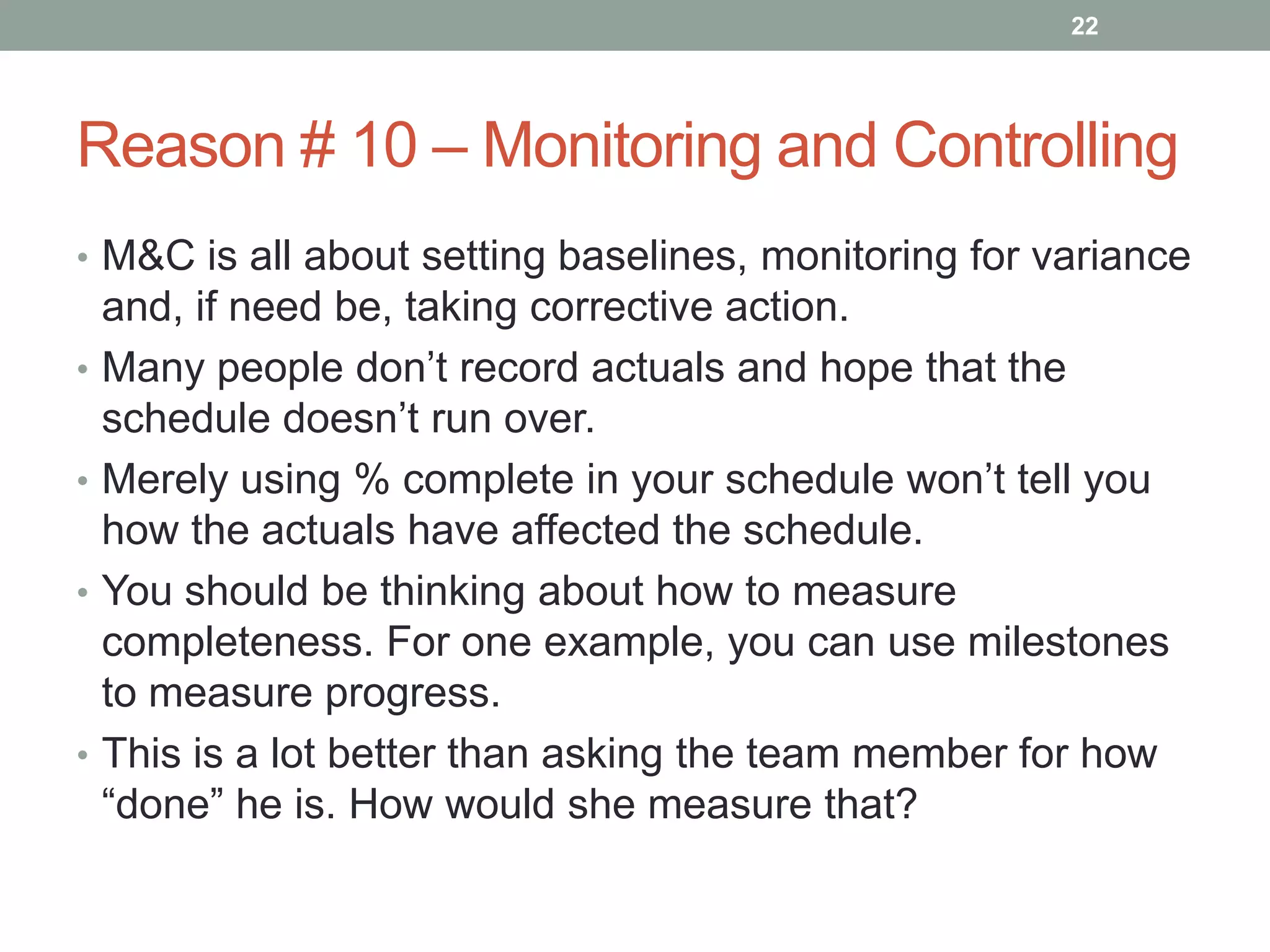
Reason #9 – Team Planning Sessions
• Ideally, you will bring the entire team together for a one or
  two-day session to plan the project.
• This serves several purposes. One is that it brings often
  far-flung teams together to meet and discuss issues.
  Another is that it brings much needed expertise to the PM
  so that she may create necessary project artifacts (WBS,
  schedule, risk register).
• This is a best practice and as such, should be aimed for.
  But if you are unable to bring the team together, it can
  work if you create, say, a WBS and circulate it among the
  team. Not optimal but much better than not doing it at all.
22


Reason # 10 – Monitoring and Controlling
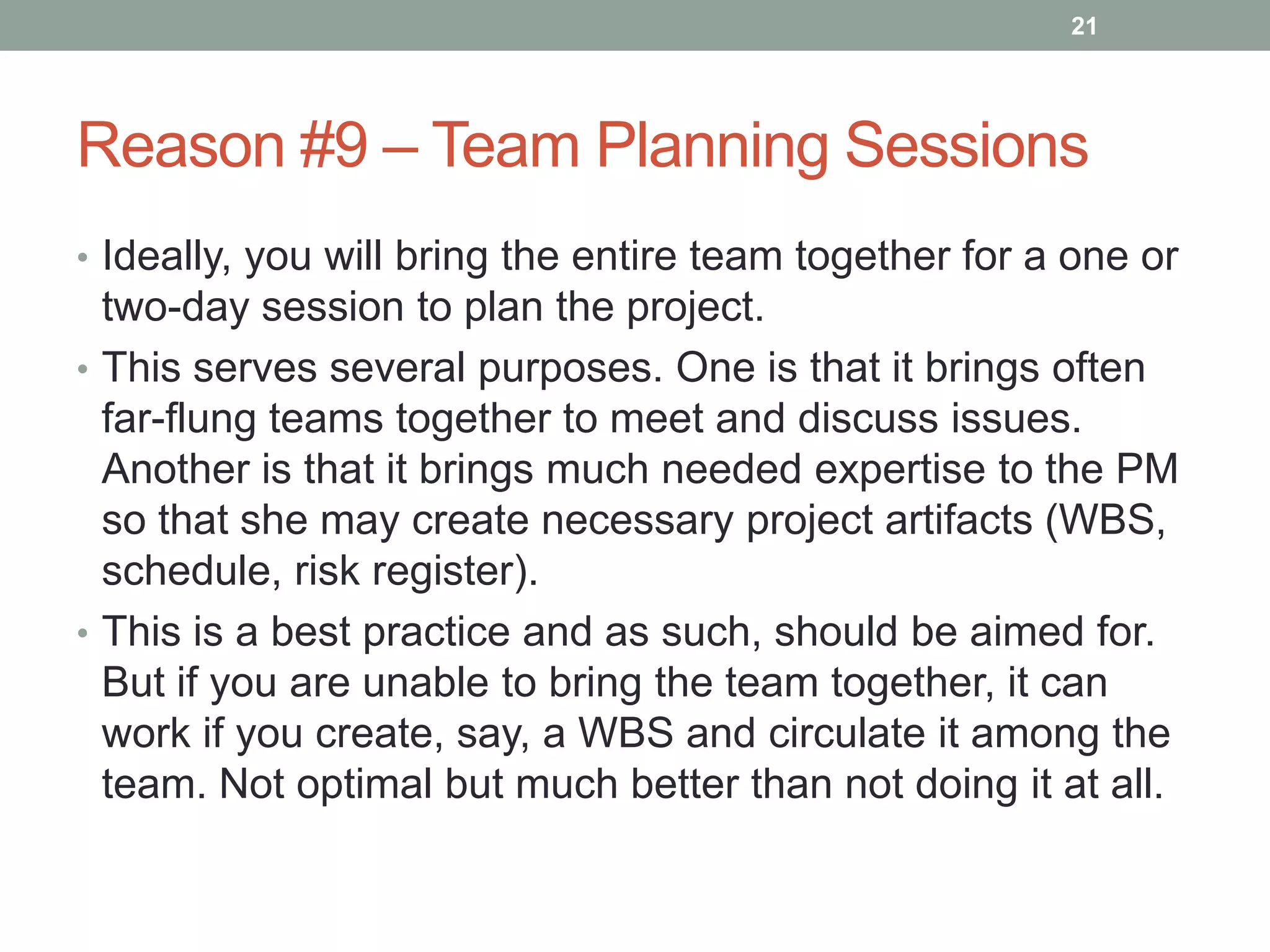
• M&C is all about setting baselines, monitoring for variance
    and, if need be, taking corrective action.
•   Many people don‟t record actuals and hope that the
    schedule doesn‟t run over.
•   Merely using % complete in your schedule won‟t tell you
    how the actuals have affected the schedule.
•   You should be thinking about how to measure
    completeness. For one example, you can use milestones
    to measure progress.
•   This is a lot better than asking the team member for how
    “done” he is. How would she measure that?
23


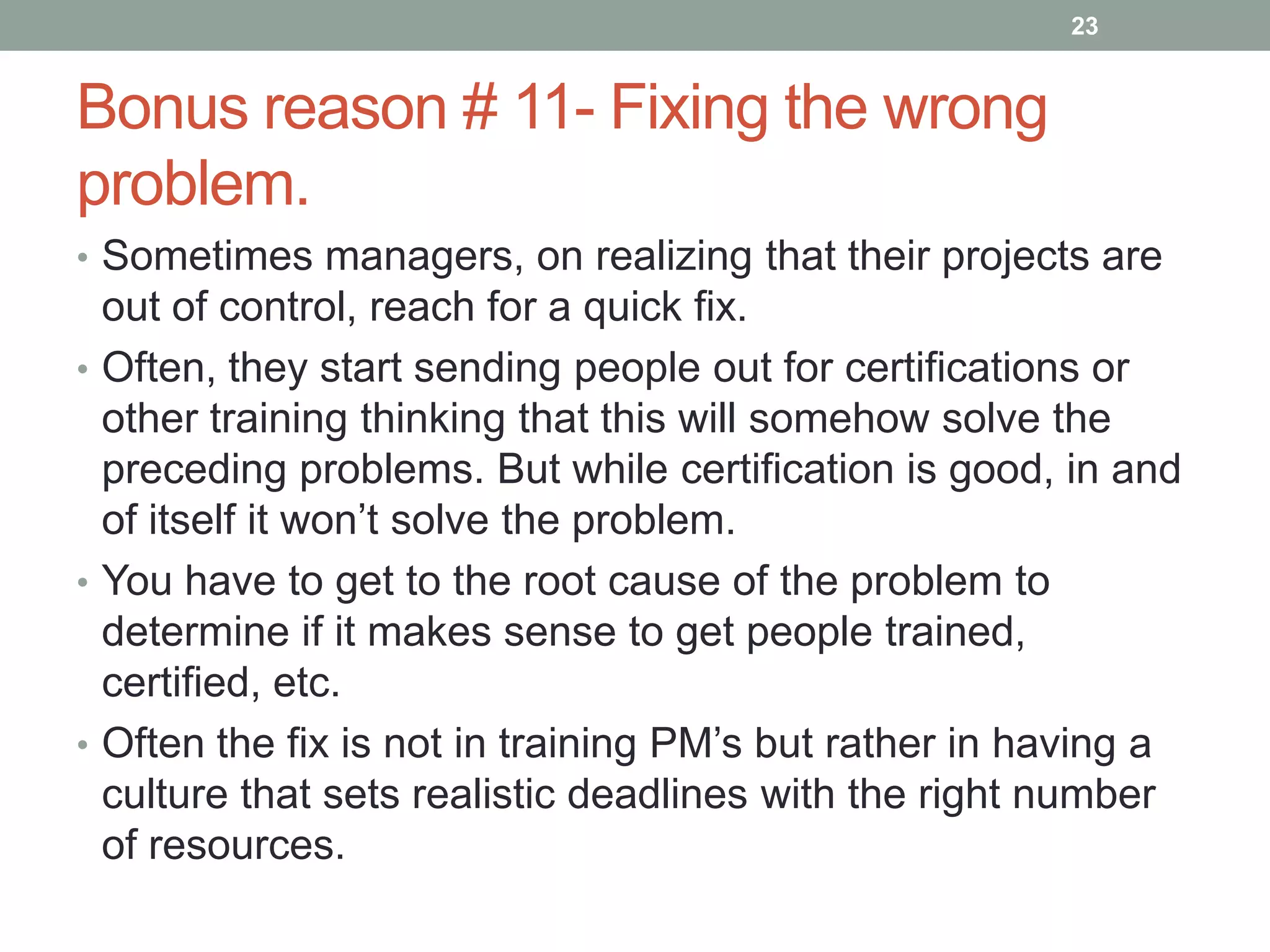
Bonus reason # 11- Fixing the wrong
problem.
• Sometimes managers, on realizing that their projects are
  out of control, reach for a quick fix.
• Often, they start sending people out for certifications or
  other training thinking that this will somehow solve the
  preceding problems. But while certification is good, in and
  of itself it won‟t solve the problem.
• You have to get to the root cause of the problem to
  determine if it makes sense to get people trained,
  certified, etc.
• Often the fix is not in training PM‟s but rather in having a
  culture that sets realistic deadlines with the right number
  of resources.
24


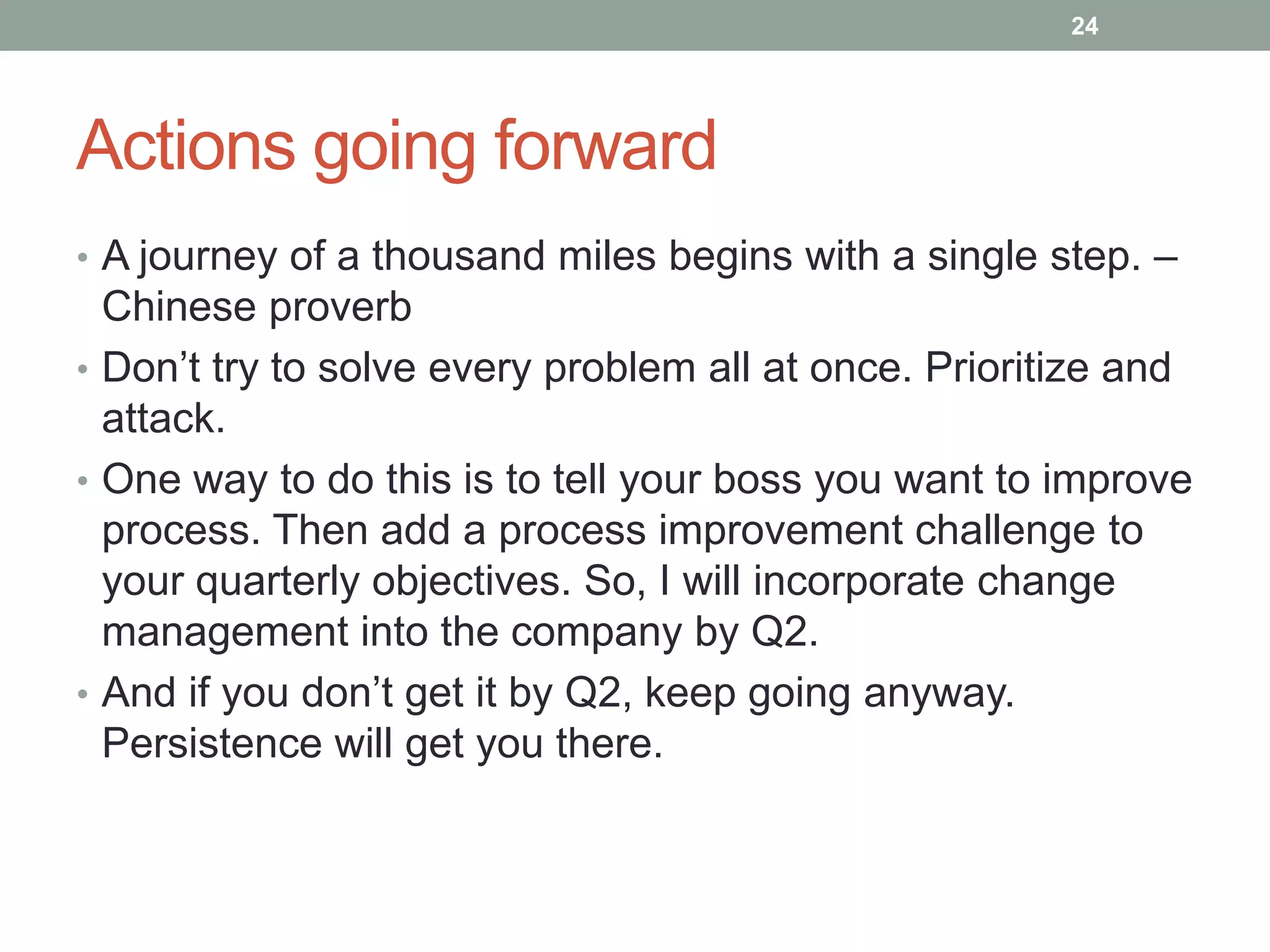
Actions going forward
• A journey of a thousand miles begins with a single step. –
  Chinese proverb
• Don‟t try to solve every problem all at once. Prioritize and
  attack.
• One way to do this is to tell your boss you want to improve
  process. Then add a process improvement challenge to
  your quarterly objectives. So, I will incorporate change
  management into the company by Q2.
• And if you don‟t get it by Q2, keep going anyway.
  Persistence will get you there.
25


Contact information

• Jim Stewart, PMP
• (781) 750-8748 (o)
• (781) 223-7218 (c)


• Linked In: http://www.linkedin.com/profile/edit?trk=hb_tab_pro_top
• Web Site: http://www.projmanage.com/
• Blog: http://theusefulpm.blogspot.com/
• Twitter: @JimPStewart

Top Ten Reasons Why Projects Fail

  • 1.
    TOP TEN REASONS WHYPROJECTS FAIL Jim Stewart, PMP JPStewart Associates
  • 2.
    2 Learning points • Learnto recognize the ten project failure signs in your organization. • Understand what commonly used solution is not necessarily a solution at all. • Learn the basics of risk management, one of the top ten reasons for project failure.
  • 3.
    3 The nature ofthe problem • A staggering 39% of projects with budgets over US $10 million failed. • *The Standish Group, "CHAOS 2007 REX: A Standish Group Research Exchange." 2007.
  • 4.
    4 Why projects fail •There are many reasons that projects fail. If you talk to any project manager who has been practicing for a while, he or she will give you a list of reasons, some valid, some not. • This list is my own opinion formed from running many projects and consulting on others in various stages of completion.
  • 5.
  • 6.
    6 Reason # 1-Scope creep • Project scope is the sum total of all the work you are going to do (and not do) on the project. • It is important, first, to define all the work via some mechanism, so Work Breakdown Structure, scope statement, etc. • This is best done in a meeting with the entire team. It serves, at least, two purposes: having a meeting of the minds on deliverables and getting team buy-in. • Solution is to have rigidly defined scope up front and a rigorous change control process in place.
  • 7.
    7 WBS example –developing scope
  • 8.
    8 Reason # 2- Resources • Resources of the human kind are frequently over- allocated. No one in the organization seems to know who is working on what at any given time. • Since resources are the heart and soul of any endeavor, the schedule is only as good as your faith in resources being able to show up and work as expected. • Another problem is that many schedules are created which show serious over-allocation on specific projects. It is not uncommon to see resources scheduled 24 hours per day! • One solution is to have managers gather each week and, using spreadsheets, plan resource needs.
  • 9.
  • 10.
    10 Reason #3 -Communications • The Project Management Body of Knowledge dedicates an entire Knowledge Area to Communications. • It‟s my contention that the average person is not a very good communicator. They either don‟t answer emails or only answer half of the questions asked. • You should insist on getting team members trained in communications so they are connecting at a very high level. • You might also consider the creation of a Communications Management Plan which details which stakeholders will get what information when and by what means.
  • 11.
    11 Communications ManagementPlan Stakeholder Method Frequency Type Notes Sponsor PowerPoint Weekly Status update Team Email Weekly Status; action Meetings items should be held face-to- face. Senior PowerPoint Monthly Status; action management items Steering PowerPoint; Quarterly Status; action committee status reports items; go/no go report
  • 12.
    12 Reason #4 -Stakeholder Management • A stakeholder has a vested interest in your project for good or for ill. • The first step in this process is identifying stakeholders according to their power, influence, and interest. • Once you know who your stakeholders are, you can develop a strategy for dealing with each one. This leads somewhat back to the previous Communications Management Plan. • Keep stakeholders informed before and during the project.
  • 13.
    Stakeholder quadrant Key player Weekly updates Bi-Weekly updates Monthly presentations Power/influence of stakeholders Keep informed periodically Bi-Weekly updates Interest of stakeholders
  • 14.
    14 Reason #5 –Estimates • There is more art than science when most team members make estimates of time for tasks. • When asked for an estimate, they will usually pull a number out of the air based, perhaps, on the last time they did a similar task. • Many project managers on hearing the estimate, will add some „fudge factor‟ based on their knowledge of the team member. • A solution here is to keep historical data for all estimates. Ultimately you will have and maintain a database that will keep your estimates more accurate.
  • 15.
    15 Some common estimatingtechniques • Historical – keep records of all estimates and use them as reference for future projects. • PERT – (Optimistic + (4XMost Likely) + Pessimistic)/6 • Three point (Optimistic + Most Likely + Pessimistic)/3 • Best case or worst case estimate You will have to determine what works in your environment.
  • 16.
    16 Reason #6 -Risk • Many project managers do not manage their risks or even know what they are. • The process of risk management is not very difficult. What tends to be more challenging is keeping at it over a period of time. • Another challenge is that you may have to sell risk management to senior management. They are often skeptical of doing tasks and spending money in advance for something that may never happen. • A solution is to do risk management on a smaller, less impactful project to see its benefits.
  • 17.
  • 18.
    18 Risk response options •Avoid – Remove the possibility of the risk occurring by removing the task or item that causes the risk. • Transfer – Move the risk over to some third party either by insuring or subcontracting • Mitigate – Reduce the probability or impact of the risk‟s occurrence by taking proactive steps. • Accept – Do nothing.
  • 19.
    19 Reason #7 –Unsupported project culture • Many people do not even know what project management is or what a PM does. • This lack of knowledge sometimes transfers over to corporations who fail to understand the role. • Consequently, projects are not treated seriously enough. Schedules are handed off to junior people or secretaries, sometimes without the proper tools. • The only solution here is education, especially at the senior management level.
  • 20.
    20 Reason #8 –The Accidental Project Manager • Similar to the unsupported project manager, this takes it a step further. • In this instance, an accomplished person is promoted to project manager. He may have been successful in, say, a technical role, but it does not mean he will be successful in a PM role. • The technical role may have had him relating to machines. The PM role will require that he perform the delicate balance of interpersonal skills. • As in the previous reason, the only solution here is education of both management and PM.
  • 21.
    21 Reason #9 –Team Planning Sessions • Ideally, you will bring the entire team together for a one or two-day session to plan the project. • This serves several purposes. One is that it brings often far-flung teams together to meet and discuss issues. Another is that it brings much needed expertise to the PM so that she may create necessary project artifacts (WBS, schedule, risk register). • This is a best practice and as such, should be aimed for. But if you are unable to bring the team together, it can work if you create, say, a WBS and circulate it among the team. Not optimal but much better than not doing it at all.
  • 22.
    22 Reason # 10– Monitoring and Controlling • M&C is all about setting baselines, monitoring for variance and, if need be, taking corrective action. • Many people don‟t record actuals and hope that the schedule doesn‟t run over. • Merely using % complete in your schedule won‟t tell you how the actuals have affected the schedule. • You should be thinking about how to measure completeness. For one example, you can use milestones to measure progress. • This is a lot better than asking the team member for how “done” he is. How would she measure that?
  • 23.
    23 Bonus reason #11- Fixing the wrong problem. • Sometimes managers, on realizing that their projects are out of control, reach for a quick fix. • Often, they start sending people out for certifications or other training thinking that this will somehow solve the preceding problems. But while certification is good, in and of itself it won‟t solve the problem. • You have to get to the root cause of the problem to determine if it makes sense to get people trained, certified, etc. • Often the fix is not in training PM‟s but rather in having a culture that sets realistic deadlines with the right number of resources.
  • 24.
    24 Actions going forward •A journey of a thousand miles begins with a single step. – Chinese proverb • Don‟t try to solve every problem all at once. Prioritize and attack. • One way to do this is to tell your boss you want to improve process. Then add a process improvement challenge to your quarterly objectives. So, I will incorporate change management into the company by Q2. • And if you don‟t get it by Q2, keep going anyway. Persistence will get you there.
  • 25.
    25 Contact information • JimStewart, PMP • (781) 750-8748 (o) • (781) 223-7218 (c) • Linked In: http://www.linkedin.com/profile/edit?trk=hb_tab_pro_top • Web Site: http://www.projmanage.com/ • Blog: http://theusefulpm.blogspot.com/ • Twitter: @JimPStewart