Produced by Wellesley Information Services, LLC, publisher of SAPinsider. © 2016 Wellesley Information Services. All rights reserved.
Top 10 Reasons Projects Fail — and
What You Can Do to Drive Project
Success
Barb Franks
NIMBL
1
In This Session
• We’ll briefly talk about what qualifies, in broad terms, as:
 Project success
 Project failure
• We’ll review …
 The top 10 reasons that lead to project failure, and
 What can be done to improve project outcomes
• At the end of the session you will have an opportunity to share whether you agree with
the top 10 list provided, and if not, you will have an opportunity to share your thoughts,
so we can learn from the experiences of our fellow attendees
2
What We’ll Cover
• What constitutes project success and project failure?
• Top 10 reasons projects fail
• Do you agree with this top 10 list?
• Wrap-up
3
What Constitutes Project Success and Failure in Broad Terms?
• Project success
 Met the success criteria as outlined in the project plan. E.g.,
 Scope (deliverables, goals, objectives)
 Quality targets
 On time
 On or under budget
• Project failure
 Did not meet the success criteria outlined by your organization or for a specific project
 Failure is a spectrum ranging from a challenged project (partial success/failure) to
cancelation (complete failure/total loss of sunk costs)
4
What We’ll Cover
• What constitutes project success and project failure?
• Top 10 reasons projects fail
• Do you agree with this top 10 list?
• Wrap-up
5
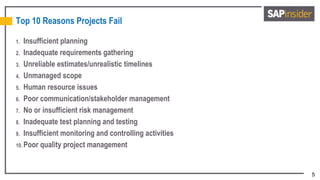
Top 10 Reasons Projects Fail
1. Insufficient planning
2. Inadequate requirements gathering
3. Unreliable estimates/unrealistic timelines
4. Unmanaged scope
5. Human resource issues
6. Poor communication/stakeholder management
7. No or insufficient risk management
8. Inadequate test planning and testing
9. Insufficient monitoring and controlling activities
10. Poor quality project management
6
# 1 Insufficient Planning
What is planning?
Planning out the work (and deliverables), how the work to create the deliverables will be
accomplished and by whom are key elements of project management planning processes.
The level of detail required for planning depends on industry, organizational, and/or project-
specific planning needs. Jumping into project work before proper planning can lead to poor
project outcomes.
7
What Project Planning Includes
• Stakeholder management
• Scope management
• Schedule and time management
• Cost management
• Quality management (includes test management)
• Staffing/human resource management
• Communication management
• Risk management (and issue management)
• Procurement management
8
Common Planning Mistakes
• Not involving key stakeholders/stakeholder groups in planning process/project kick-off meetings
• Failing to plan to the proper level of depth to meet industry, organizational, department and/or
project needs
• Not leveraging lessons learned on past, similar projects
• Not instituting performance measures (e.g., Earned Value), which assist in determining risk to
budget and schedule
• Underestimating the complexity of software development projects, and not factoring in time for
the unexpected
• Unrealistic budget or schedule commitments made before scope is defined and work is estimated
• Failure to include touchpoints/gate checks to validate progress on in-process deliverables
• Failing to address quality requirements and the handling of reported issues in a systematized and
prioritized fashion
• Failing to have a robust, yet flexible, scope management plan
9
How to Improve Planning
• Involve all key stakeholders/stakeholder groups in the planning/project kickoff meetings
• Plan to the proper level of depth to meet industry, organizational, department and/or project needs,
with a special focus on quality and scope management
• Leverage lessons learned on past, similar projects
• Use performance measures (e.g., Earned Value), which assist in determining risk to budget and
schedule
• Factor in time for researching technical solutions or for the unexpected, and re-estimate effort as
project progresses
• Refrain from making budget or schedule commitments, beyond high-level or with a rough order of
magnitude, until scope is defined and work is estimated
• Implement touchpoints/gate checks to validate progress on in-process deliverables
www.prioritymanagement.com/nsw/resources/resource.php?resource_id=66
The Informit article expands on the planning process to post delivery, and includes processes that may be extraneous to your needs, but I
believe it to be a valuable resource and therefore have included it:
www.informit.com/articles/article.aspx?p=100583&seqNum=3
10
#2 Inadequate Requirements Gathering
What is requirements gathering?
Determining the needs or conditions that must be met for a new or altered product or project.
The outcome of requirements gathering, to include addressing conflicting requirements, is
a clear, concise and agreed upon set of documented technical*, functional and business
requirements that when fulfilled meet customer needs and provide value.
*Where appropriate, especially at the early stage of the project.
www.pm-primer.com/collect-requirements-and-define-scope-processes/
11
Common Requirements Gathering Mistakes
• Attempting to solve the need or problem before you know what the need or problem is
• Business Analyst (BA) or other personnel skilled in requirements gathering and/or blueprinting was not a
project resource
• Not consulting with real users, or not focusing on the full range of users
• Focusing exclusively or heavily on technical and functional requirements, and not putting enough emphasis
on industry and business requirements
• Failure to address conflicting requirements before work begins
• Lack of prioritization for requirements (e.g., Priority Scales [1-10], MoSCoW principle)
• Assumptions were not validated
• Failure to clearly and concisely document the requirements, requester, decision points, etc.
• Poor or insufficient communication about requirements to all stakeholders/stakeholder groups
http://advisor.ciovp.com/sap-project-blueprint-practices.php
www.projecttimes.com/articles/requirements-prioritization-strategies.html
https://en.wikipedia.org/wiki/MoSCoW_method
12
How to Improve the Requirements Gathering Process
• Ask the customer to first describe the need or problem they are looking to solve, in their own words
• Leverage a BA or qualified professional to gather, document and track requirements
• Identify and leverage stakeholders to get a complete picture of the need or problem
 Must include real users from the start in interviewing and brainstorming sessions
• Confirm understanding of requirements in real time
• Make sure all requirements are SMART - Specific, Measurable, Achievable, Relevant, and Time-bound
• Document use cases, as this supports understanding and the development process
• Create a prototype or business process diagrams (e.g., current state  future state), where practical or
deemed necessary, to confirm, refine or expand requirements
• Get written sign off on the requirements, prototypes and/or business process diagram from all key
stakeholders and stakeholder groups
https://en.wikipedia.org/wiki/Requirements_elicitation
www.phase2technology.com/blog/what-the-heck-are-we-building-10-steps-to-successful-requirements-gathering/
13
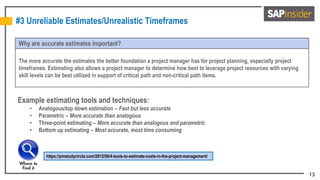
#3 Unreliable Estimates/Unrealistic Timeframes
Why are accurate estimates important?
The more accurate the estimates the better foundation a project manager has for project planning, especially project
timeframes. Estimating also allows a project manager to determine how best to leverage project resources with varying
skill levels can be best utilized in support of critical path and non-critical path items.
Example estimating tools and techniques:
• Analogous/top down estimation – Fast but less accurate
• Parametric – More accurate than analogous
• Three-point estimating – More accurate than analogous and parametric
• Bottom up estimating – Most accurate, most time consuming
https://pmstudycircle.com/2012/06/4-tools-to-estimate-costs-in-the-project-management/
14
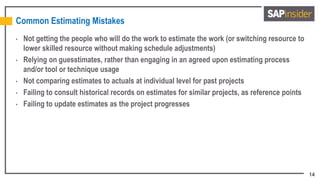
Common Estimating Mistakes
• Not getting the people who will do the work to estimate the work (or switching resource to
lower skilled resource without making schedule adjustments)
• Relying on guesstimates, rather than engaging in an agreed upon estimating process
and/or tool or technique usage
• Not comparing estimates to actuals at individual level for past projects
• Failing to consult historical records on estimates for similar projects, as reference points
• Failing to update estimates as the project progresses
15
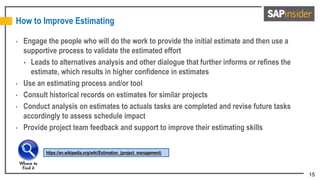
How to Improve Estimating
• Engage the people who will do the work to provide the initial estimate and then use a
supportive process to validate the estimated effort
 Leads to alternatives analysis and other dialogue that further informs or refines the
estimate, which results in higher confidence in estimates
• Use an estimating process and/or tool
• Consult historical records on estimates for similar projects
• Conduct analysis on estimates to actuals tasks are completed and revise future tasks
accordingly to assess schedule impact
• Provide project team feedback and support to improve their estimating skills
https://en.wikipedia.org/wiki/Estimation_(project_management)
16
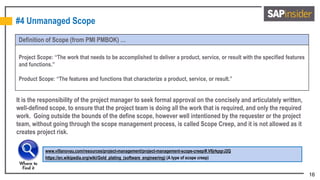
It is the responsibility of the project manager to seek formal approval on the concisely and articulately written,
well-defined scope, to ensure that the project team is doing all the work that is required, and only the required
work. Going outside the bounds of the define scope, however well intentioned by the requester or the project
team, without going through the scope management process, is called Scope Creep, and it is not allowed as it
creates project risk.
#4 Unmanaged Scope
Definition of Scope (from PMI PMBOK) …
Project Scope: “The work that needs to be accomplished to deliver a product, service, or result with the specified features
and functions.”
Product Scope: “The features and functions that characterize a product, service, or result.”
www.villanovau.com/resources/project-management/project-management-scope-creep/#.V6jrkpgrJ2Q
https://en.wikipedia.org/wiki/Gold_plating_(software_engineering) (A type of scope creep)
17
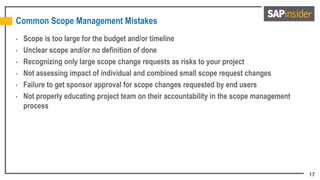
Common Scope Management Mistakes
• Scope is too large for the budget and/or timeline
• Unclear scope and/or no definition of done
• Recognizing only large scope change requests as risks to your project
• Not assessing impact of individual and combined small scope request changes
• Failure to get sponsor approval for scope changes requested by end users
• Not properly educating project team on their accountability in the scope management
process
18
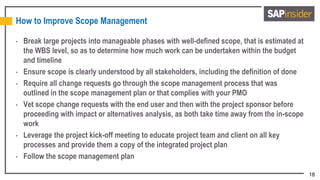
How to Improve Scope Management
• Break large projects into manageable phases with well-defined scope, that is estimated at
the WBS level, so as to determine how much work can be undertaken within the budget
and timeline
• Ensure scope is clearly understood by all stakeholders, including the definition of done
• Require all change requests go through the scope management process that was
outlined in the scope management plan or that complies with your PMO
• Vet scope change requests with the end user and then with the project sponsor before
proceeding with impact or alternatives analysis, as both take time away from the in-scope
work
• Leverage the project kick-off meeting to educate project team and client on all key
processes and provide them a copy of the integrated project plan
• Follow the scope management plan
19
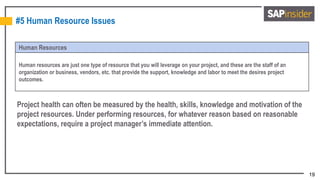
#5 Human Resource Issues
Human Resources
Human resources are just one type of resource that you will leverage on your project, and these are the staff of an
organization or business, vendors, etc. that provide the support, knowledge and labor to meet the desires project
outcomes.
Project health can often be measured by the health, skills, knowledge and motivation of the
project resources. Under performing resources, for whatever reason based on reasonable
expectations, require a project manager’s immediate attention.
20
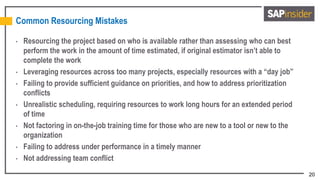
Common Resourcing Mistakes
• Resourcing the project based on who is available rather than assessing who can best
perform the work in the amount of time estimated, if original estimator isn’t able to
complete the work
• Leveraging resources across too many projects, especially resources with a “day job”
• Failing to provide sufficient guidance on priorities, and how to address prioritization
conflicts
• Unrealistic scheduling, requiring resources to work long hours for an extended period
of time
• Not factoring in on-the-job training time for those who are new to a tool or new to the
organization
• Failing to address under performance in a timely manner
• Not addressing team conflict
21
How to Improve Resourcing and Resource Outcomes
• Create and leverage a resource plan, e.g., how resources are obtained, and onboarding and
rolling-off resources
• Develop a Team Charter to facilitate team discussions and consensus building
• Create a realistic schedule that includes buffer (and training) time, as the unexpected is to be
expected, especially in software-related projects
• Look for resource leveling opportunities to reduce the strain on individuals or groups
• Seek to identify root cause of under performance
• Provide timely and constructive feedback and set expectations on what you expect and give
the support the individual will receive or can take advantage of to facilitate their success
• Give team members to the tools to deal with internal team conflict
www.projecttimes.com/articles/get-your-project-team-back-on-track-use-a-team-charter.html
22
#6 Poor Communication/Stakeholder Management
Communication and Stakeholder Management Defined
Stakeholders are individuals or groups that have a “stake” in your project, and can negatively or positively impact or be
impacted by the project. Examples are your customer and their staff, the project sponsor, a department, a regulatory
agency, investors, and/or the general public.
Communication is the imparting or exchanging of information or news, and can be verbal (written & oral) or non-verbal.
“The most important thing in communication is hearing what isn’t said.” – Peter F. Drucker
A good communication plan will help keep your stakeholders engaged and the team members doing the work
motivated by way of timely feedback on the work they are performing, connecting their efforts to the people
and business need they are solving.
23
Common Communication and Stakeholder Management Mistakes
• Non-existent communication and stakeholder management plans or failure to follow the plans
• Failing to identify the full range of project stakeholders
• Not taking the time to assess each stakeholder’s or group’s level of interest and
influence/power
• Engaging stakeholders only after an issue has arisen
• Not managing stakeholder engagement and expectations that have been previously set
• Setting unrealistic expectations with key stakeholders
• Not documenting meetings, decision points, action items, risks, etc. in a central location and
not pushing the information to all stakeholders
• Focusing too much attention on the issue rather than solution discovery
• Failure to “read the room”
• Insufficient active listening
• Not setting or sticking to the meeting agenda
24
How to Improve Communication and Stakeholder Management
• Monitor and refine your communication and stakeholder management strategies, which you have
documented in your plans
• Ensure all project stakeholders have been identified and classified (power/interest), adding
additional stakeholders as they are discovered
• Communicate and document early and often
 Make sure key communications engaging and predictable (content and delivery timeframe)
 Push information, don’t assume people will come to your project site/dashboard to stay informed
• Use active listening techniques to ensure a complete understanding of ideas or requests
 Convey interest using verbal and non-verbal messages, e.g., maintaining eye contact, nodding
your head and smiling, encouraging speaker to continue (“yes,” “Mmm hmm”), mirroring, etc.
• Be clear, concise and factual in all communications
• Acknowledge when you don’t have the answer
• Demonstrate good follow-through on open questions/issues/action items
25
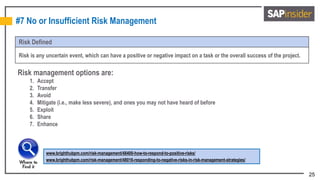
#7 No or Insufficient Risk Management
Risk Defined
Risk is any uncertain event, which can have a positive or negative impact on a task or the overall success of the project.
Risk management options are:
1. Accept
2. Transfer
3. Avoid
4. Mitigate (i.e., make less severe), and ones you may not have heard of before
5. Exploit
6. Share
7. Enhance
www.brighthubpm.com/risk-management/48400-how-to-respond-to-positive-risks/
www.brighthubpm.com/risk-management/48016-responding-to-negative-risks-in-risk-management-strategies/
26
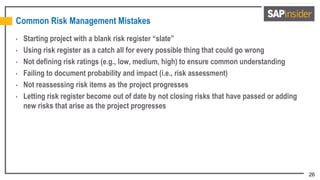
Common Risk Management Mistakes
• Starting project with a blank risk register “slate”
• Using risk register as a catch all for every possible thing that could go wrong
• Not defining risk ratings (e.g., low, medium, high) to ensure common understanding
• Failing to document probability and impact (i.e., risk assessment)
• Not reassessing risk items as the project progresses
• Letting risk register become out of date by not closing risks that have passed or adding
new risks that arise as the project progresses
27
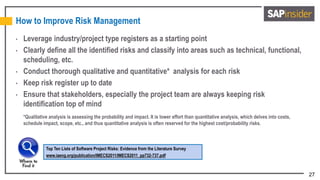
How to Improve Risk Management
• Leverage industry/project type registers as a starting point
• Clearly define all the identified risks and classify into areas such as technical, functional,
scheduling, etc.
• Conduct thorough qualitative and quantitative* analysis for each risk
• Keep risk register up to date
• Ensure that stakeholders, especially the project team are always keeping risk
identification top of mind
*Qualitative analysis is assessing the probability and impact. It is lower effort than quantitative analysis, which delves into costs,
schedule impact, scope, etc., and thus quantitative analysis is often reserved for the highest cost/probability risks.
Top Ten Lists of Software Project Risks: Evidence from the Literature Survey
www.iaeng.org/publication/IMECS2011/IMECS2011_pp732-737.pdf
28
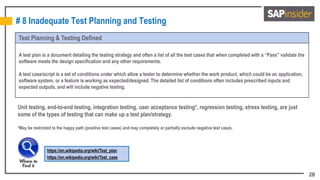
# 8 Inadequate Test Planning and Testing
Test Planning & Testing Defined
A test plan is a document detailing the testing strategy and often a list of all the test cases that when completed with a “Pass” validate the
software meets the design specification and any other requirements.
A test case/script is a set of conditions under which allow a tester to determine whether the work product, which could be an application,
software system, or a feature is working as expected/designed. The detailed list of conditions often includes prescribed inputs and
expected outputs, and will include negative testing.
https://en.wikipedia.org/wiki/Test_plan
https://en.wikipedia.org/wiki/Test_case
Unit testing, end-to-end testing, integration testing, user acceptance testing*, regression testing, stress testing, are just
some of the types of testing that can make up a test plan/strategy.
*May be restricted to the happy path (positive test cases) and may completely or partially exclude negative test cases.
29
Common Testing Planning and Testing Mistakes
• Ambiguous, missing, or incomplete requirements, which leads to testing gaps
• No test plan or superficial summaries that are not centralized
• Failing to tailor the rigor level of testing to the project needs
• Waiting too long to do testing, which may result in significant rework
• Test environment does not adequately represent the production system, in any way that would be
material to the type of testing that is being done (e.g., performance testing, interface testing, data
validation, etc.)
• Insufficient testing resources or resources not provided ample time to do the work properly
• Testers do not have the right mindset and seek to prove the software works (e.g., happy path
testing) rather than the goal being to find defects within permitted paths
• Unclear testing responsibilities and a lack of testing expertise/guidance (test lead)
• Test documentation not properly maintained or inadequate communication about testing which
leads to testing inefficiencies or at worst requires retesting
30
How to Improve Testing Planning and Testing
• Hold a meeting with all stakeholders to set expectations about the importance of testing, scope of testing
for the project and the commitment of human and system resources that are needed to perform testing, and
stress that testing is based off of documented requirements to hammer home the importance of complete
requirements
• Create a detailed test plan that follows business process and outlines all dependencies
• Get agreement from stakeholders about the level of rigor required for testing, as it will be different for
widely-used, mission critical software than it is for department-level app that will have few users and all can
be trained to follow the happy path(s)
• Ensure the test environment is set up to support the types of testing that will be applied
• Set the stage for testing by having the right number of resources, who have the proper background and
training to be most effective in helping to write test scripts (to include negative testing)
• Recruit a test lead
• Develop a test communication and documentation plan and ensure that the plans are being followed, you
must be especially rigorous if you need to satisfy internal and/or external audits for testing that involves
security, for example
31
#9 Insufficient Monitoring and Controlling
Monitoring & Controlling Defined
“The Monitoring and Controlling Process Group consists of those processes required to track, review, and orchestrate
the progress and performance of a project; identify any areas in which changes to the plan are required; and initiate the
corresponding changes." – A Guide to the Project Management Body of Knowledge (PMBOK Guide) Fifth Edition
www.brighthubpm.com/project-planning/1675-looking-at-project-monitor-and-control/
www.pmdocuments.com/project-monitoring-and-control-documents/
32
Common Monitoring and Controlling Mistakes
• Believing that while the project is behind schedule, the team will make up the time
• Not having a system in place for the tracking change requests and their disposition
• Failing to perform impact analysis or underestimating impact
• Not updating project plan and schedule to accommodate approved changes
• Metrics for defining project success, to include quality metrics, are not in place or not
clearly understood by all stakeholders
• Not developing contingency plans within risk response plans
• Failing to designate a responsible person for specific risks
• Not addressing productivity leaks
• Not saying “No,” when that is the right answer given project needs, risk tolerance, etc.
33
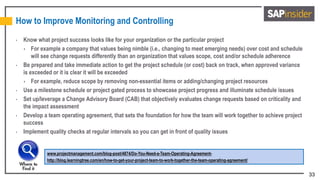
How to Improve Monitoring and Controlling
• Know what project success looks like for your organization or the particular project
 For example a company that values being nimble (i.e., changing to meet emerging needs) over cost and schedule
will see change requests differently than an organization that values scope, cost and/or schedule adherence
• Be prepared and take immediate action to get the project schedule (or cost) back on track, when approved variance
is exceeded or it is clear it will be exceeded
 For example, reduce scope by removing non-essential items or adding/changing project resources
• Use a milestone schedule or project gated process to showcase project progress and illuminate schedule issues
• Set up/leverage a Change Advisory Board (CAB) that objectively evaluates change requests based on criticality and
the impact assessment
• Develop a team operating agreement, that sets the foundation for how the team will work together to achieve project
success
• Implement quality checks at regular intervals so you can get in front of quality issues
www.projectmanagement.com/blog-post/4874/Do-You-Need-a-Team-Operating-Agreement-
http://blog.learningtree.com/en/how-to-get-your-project-team-to-work-together-the-team-operating-agreement/
34
#10 Poor Quality Project Management
Project & Project Management Defined
A project, unlike operations, is a temporary endeavor that has defined scope and a start and end date. Projects may bring
together resources that don’t usually or often work together. The development of a new software product is a project.
Project management “is the application of knowledge, skills, tools, and techniques to project activities to meet the project
requirements.” [PMI.org]
35
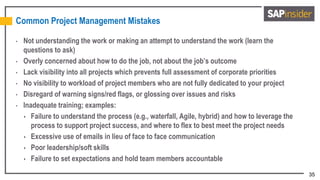
Common Project Management Mistakes
• Not understanding the work or making an attempt to understand the work (learn the
questions to ask)
• Overly concerned about how to do the job, not about the job’s outcome
• Lack visibility into all projects which prevents full assessment of corporate priorities
• No visibility to workload of project members who are not fully dedicated to your project
• Disregard of warning signs/red flags, or glossing over issues and risks
• Inadequate training; examples:
 Failure to understand the process (e.g., waterfall, Agile, hybrid) and how to leverage the
process to support project success, and where to flex to best meet the project needs
 Excessive use of emails in lieu of face to face communication
 Poor leadership/soft skills
 Failure to set expectations and hold team members accountable
36
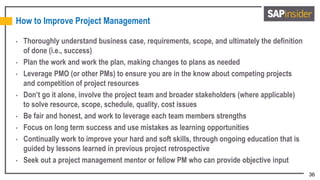
How to Improve Project Management
• Thoroughly understand business case, requirements, scope, and ultimately the definition
of done (i.e., success)
• Plan the work and work the plan, making changes to plans as needed
• Leverage PMO (or other PMs) to ensure you are in the know about competing projects
and competition of project resources
• Don’t go it alone, involve the project team and broader stakeholders (where applicable)
to solve resource, scope, schedule, quality, cost issues
• Be fair and honest, and work to leverage each team members strengths
• Focus on long term success and use mistakes as learning opportunities
• Continually work to improve your hard and soft skills, through ongoing education that is
guided by lessons learned in previous project retrospective
• Seek out a project management mentor or fellow PM who can provide objective input
37
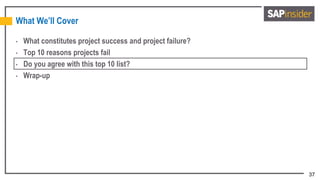
What We’ll Cover
• What constitutes project success and project failure?
• Top 10 reasons projects fail
• Do you agree with this top 10 list?
• Wrap-up
38
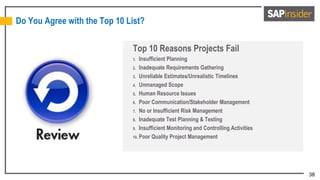
Do You Agree with the Top 10 List?
Top 10 Reasons Projects Fail
1. Insufficient Planning
2. Inadequate Requirements Gathering
3. Unreliable Estimates/Unrealistic Timelines
4. Unmanaged Scope
5. Human Resource Issues
6. Poor Communication/Stakeholder Management
7. No or Insufficient Risk Management
8. Inadequate Test Planning & Testing
9. Insufficient Monitoring and Controlling Activities
10. Poor Quality Project Management
39
What We’ll Cover
• What constitutes project success and project failure?
• Top 10 reasons projects fail
• Do you agree with this top 10 list?
• Wrap-up
40
Where to Find More Information
• www.projectmanagement.com/
 Project Management website – Great resource for a wide range of project management topics
• www.pmi.org/
 Project Management Institute – Project management certification information and
a wide range of resources for members
• http://sapsupport.info/support-innovations/sap-activate/
 SAP Activate project management methodology
• www.projectsmart.co.uk/most-it-projects-fail-will-yours.php
 Kelly Waters, “Most IT Projects Fail. Will Yours?” (Project Smart).
• www.pmsolutions.com/resources/category/white-papers
 Project Management Solutions white papers
• www.projectinsight.net/white-papers/
 Project Insight – Project Management Software white papers
Summary document
containing information to
use as a reminder about
the pitfalls to avoid when
managing a project
41
7 Key Points to Take Home
• Plan the work and then work the plan, updating as needed
• Spend sufficient time with all key stakeholders gathering and prioritizing requirements,
and documenting the scope and definition of done
• Obtain the right resources for your project and give them the tools and support they need
to succeed, and address team building and/or performance concerns as soon as they
arise
• Communication is paramount ~ do it early, often and make as engaging and informative
as possible (e.g., visuals, concise summaries, demos of in progress work, etc.)
• Test early and often to ensure deliverables are meeting quality targets
42
7 Key Points to Take Home (cont.)
• People are your most valuable project resource, take good care of them and they will take
good care of you
 Respect their time and other commitments
 Ensure everyone has a clear understanding of what is needed for project success, and
knows that they are a valued member of the team and as such their input is vital to
project success
• Never lose sight of the key leadership role a project manager plays on the project, and
work to improve your skills through continued education, mentorship programs, 360
feedback, etc.
43
Your Turn!
How to contact me:
Barbara Franks
Email: Barbara.Franks@benimbl.com
Please remember to complete your session evaluation
44
SAP and other SAP products and services mentioned herein as well as their respective logos are trademarks or registered trademarks of SAP SE (or an SAP affiliate company) in Germany and other
countries. All other product and service names mentioned are the trademarks of their respective companies. Wellesley Information Services is neither owned nor controlled by SAP SE.
Disclaimer

Projects2016_Franks_Top10ReasonsProjectsFail

  • 1.
    Produced by WellesleyInformation Services, LLC, publisher of SAPinsider. © 2016 Wellesley Information Services. All rights reserved. Top 10 Reasons Projects Fail — and What You Can Do to Drive Project Success Barb Franks NIMBL
  • 2.
    1 In This Session •We’ll briefly talk about what qualifies, in broad terms, as:  Project success  Project failure • We’ll review …  The top 10 reasons that lead to project failure, and  What can be done to improve project outcomes • At the end of the session you will have an opportunity to share whether you agree with the top 10 list provided, and if not, you will have an opportunity to share your thoughts, so we can learn from the experiences of our fellow attendees
  • 3.
    2 What We’ll Cover •What constitutes project success and project failure? • Top 10 reasons projects fail • Do you agree with this top 10 list? • Wrap-up
  • 4.
    3 What Constitutes ProjectSuccess and Failure in Broad Terms? • Project success  Met the success criteria as outlined in the project plan. E.g.,  Scope (deliverables, goals, objectives)  Quality targets  On time  On or under budget • Project failure  Did not meet the success criteria outlined by your organization or for a specific project  Failure is a spectrum ranging from a challenged project (partial success/failure) to cancelation (complete failure/total loss of sunk costs)
  • 5.
    4 What We’ll Cover •What constitutes project success and project failure? • Top 10 reasons projects fail • Do you agree with this top 10 list? • Wrap-up
  • 6.
    5 Top 10 ReasonsProjects Fail 1. Insufficient planning 2. Inadequate requirements gathering 3. Unreliable estimates/unrealistic timelines 4. Unmanaged scope 5. Human resource issues 6. Poor communication/stakeholder management 7. No or insufficient risk management 8. Inadequate test planning and testing 9. Insufficient monitoring and controlling activities 10. Poor quality project management
  • 7.
    6 # 1 InsufficientPlanning What is planning? Planning out the work (and deliverables), how the work to create the deliverables will be accomplished and by whom are key elements of project management planning processes. The level of detail required for planning depends on industry, organizational, and/or project- specific planning needs. Jumping into project work before proper planning can lead to poor project outcomes.
  • 8.
    7 What Project PlanningIncludes • Stakeholder management • Scope management • Schedule and time management • Cost management • Quality management (includes test management) • Staffing/human resource management • Communication management • Risk management (and issue management) • Procurement management
  • 9.
    8 Common Planning Mistakes •Not involving key stakeholders/stakeholder groups in planning process/project kick-off meetings • Failing to plan to the proper level of depth to meet industry, organizational, department and/or project needs • Not leveraging lessons learned on past, similar projects • Not instituting performance measures (e.g., Earned Value), which assist in determining risk to budget and schedule • Underestimating the complexity of software development projects, and not factoring in time for the unexpected • Unrealistic budget or schedule commitments made before scope is defined and work is estimated • Failure to include touchpoints/gate checks to validate progress on in-process deliverables • Failing to address quality requirements and the handling of reported issues in a systematized and prioritized fashion • Failing to have a robust, yet flexible, scope management plan
  • 10.
    9 How to ImprovePlanning • Involve all key stakeholders/stakeholder groups in the planning/project kickoff meetings • Plan to the proper level of depth to meet industry, organizational, department and/or project needs, with a special focus on quality and scope management • Leverage lessons learned on past, similar projects • Use performance measures (e.g., Earned Value), which assist in determining risk to budget and schedule • Factor in time for researching technical solutions or for the unexpected, and re-estimate effort as project progresses • Refrain from making budget or schedule commitments, beyond high-level or with a rough order of magnitude, until scope is defined and work is estimated • Implement touchpoints/gate checks to validate progress on in-process deliverables www.prioritymanagement.com/nsw/resources/resource.php?resource_id=66 The Informit article expands on the planning process to post delivery, and includes processes that may be extraneous to your needs, but I believe it to be a valuable resource and therefore have included it: www.informit.com/articles/article.aspx?p=100583&seqNum=3
  • 11.
    10 #2 Inadequate RequirementsGathering What is requirements gathering? Determining the needs or conditions that must be met for a new or altered product or project. The outcome of requirements gathering, to include addressing conflicting requirements, is a clear, concise and agreed upon set of documented technical*, functional and business requirements that when fulfilled meet customer needs and provide value. *Where appropriate, especially at the early stage of the project. www.pm-primer.com/collect-requirements-and-define-scope-processes/
  • 12.
    11 Common Requirements GatheringMistakes • Attempting to solve the need or problem before you know what the need or problem is • Business Analyst (BA) or other personnel skilled in requirements gathering and/or blueprinting was not a project resource • Not consulting with real users, or not focusing on the full range of users • Focusing exclusively or heavily on technical and functional requirements, and not putting enough emphasis on industry and business requirements • Failure to address conflicting requirements before work begins • Lack of prioritization for requirements (e.g., Priority Scales [1-10], MoSCoW principle) • Assumptions were not validated • Failure to clearly and concisely document the requirements, requester, decision points, etc. • Poor or insufficient communication about requirements to all stakeholders/stakeholder groups http://advisor.ciovp.com/sap-project-blueprint-practices.php www.projecttimes.com/articles/requirements-prioritization-strategies.html https://en.wikipedia.org/wiki/MoSCoW_method
  • 13.
    12 How to Improvethe Requirements Gathering Process • Ask the customer to first describe the need or problem they are looking to solve, in their own words • Leverage a BA or qualified professional to gather, document and track requirements • Identify and leverage stakeholders to get a complete picture of the need or problem  Must include real users from the start in interviewing and brainstorming sessions • Confirm understanding of requirements in real time • Make sure all requirements are SMART - Specific, Measurable, Achievable, Relevant, and Time-bound • Document use cases, as this supports understanding and the development process • Create a prototype or business process diagrams (e.g., current state  future state), where practical or deemed necessary, to confirm, refine or expand requirements • Get written sign off on the requirements, prototypes and/or business process diagram from all key stakeholders and stakeholder groups https://en.wikipedia.org/wiki/Requirements_elicitation www.phase2technology.com/blog/what-the-heck-are-we-building-10-steps-to-successful-requirements-gathering/
  • 14.
    13 #3 Unreliable Estimates/UnrealisticTimeframes Why are accurate estimates important? The more accurate the estimates the better foundation a project manager has for project planning, especially project timeframes. Estimating also allows a project manager to determine how best to leverage project resources with varying skill levels can be best utilized in support of critical path and non-critical path items. Example estimating tools and techniques: • Analogous/top down estimation – Fast but less accurate • Parametric – More accurate than analogous • Three-point estimating – More accurate than analogous and parametric • Bottom up estimating – Most accurate, most time consuming https://pmstudycircle.com/2012/06/4-tools-to-estimate-costs-in-the-project-management/
  • 15.
    14 Common Estimating Mistakes •Not getting the people who will do the work to estimate the work (or switching resource to lower skilled resource without making schedule adjustments) • Relying on guesstimates, rather than engaging in an agreed upon estimating process and/or tool or technique usage • Not comparing estimates to actuals at individual level for past projects • Failing to consult historical records on estimates for similar projects, as reference points • Failing to update estimates as the project progresses
  • 16.
    15 How to ImproveEstimating • Engage the people who will do the work to provide the initial estimate and then use a supportive process to validate the estimated effort  Leads to alternatives analysis and other dialogue that further informs or refines the estimate, which results in higher confidence in estimates • Use an estimating process and/or tool • Consult historical records on estimates for similar projects • Conduct analysis on estimates to actuals tasks are completed and revise future tasks accordingly to assess schedule impact • Provide project team feedback and support to improve their estimating skills https://en.wikipedia.org/wiki/Estimation_(project_management)
  • 17.
    16 It is theresponsibility of the project manager to seek formal approval on the concisely and articulately written, well-defined scope, to ensure that the project team is doing all the work that is required, and only the required work. Going outside the bounds of the define scope, however well intentioned by the requester or the project team, without going through the scope management process, is called Scope Creep, and it is not allowed as it creates project risk. #4 Unmanaged Scope Definition of Scope (from PMI PMBOK) … Project Scope: “The work that needs to be accomplished to deliver a product, service, or result with the specified features and functions.” Product Scope: “The features and functions that characterize a product, service, or result.” www.villanovau.com/resources/project-management/project-management-scope-creep/#.V6jrkpgrJ2Q https://en.wikipedia.org/wiki/Gold_plating_(software_engineering) (A type of scope creep)
  • 18.
    17 Common Scope ManagementMistakes • Scope is too large for the budget and/or timeline • Unclear scope and/or no definition of done • Recognizing only large scope change requests as risks to your project • Not assessing impact of individual and combined small scope request changes • Failure to get sponsor approval for scope changes requested by end users • Not properly educating project team on their accountability in the scope management process
  • 19.
    18 How to ImproveScope Management • Break large projects into manageable phases with well-defined scope, that is estimated at the WBS level, so as to determine how much work can be undertaken within the budget and timeline • Ensure scope is clearly understood by all stakeholders, including the definition of done • Require all change requests go through the scope management process that was outlined in the scope management plan or that complies with your PMO • Vet scope change requests with the end user and then with the project sponsor before proceeding with impact or alternatives analysis, as both take time away from the in-scope work • Leverage the project kick-off meeting to educate project team and client on all key processes and provide them a copy of the integrated project plan • Follow the scope management plan
  • 20.
    19 #5 Human ResourceIssues Human Resources Human resources are just one type of resource that you will leverage on your project, and these are the staff of an organization or business, vendors, etc. that provide the support, knowledge and labor to meet the desires project outcomes. Project health can often be measured by the health, skills, knowledge and motivation of the project resources. Under performing resources, for whatever reason based on reasonable expectations, require a project manager’s immediate attention.
  • 21.
    20 Common Resourcing Mistakes •Resourcing the project based on who is available rather than assessing who can best perform the work in the amount of time estimated, if original estimator isn’t able to complete the work • Leveraging resources across too many projects, especially resources with a “day job” • Failing to provide sufficient guidance on priorities, and how to address prioritization conflicts • Unrealistic scheduling, requiring resources to work long hours for an extended period of time • Not factoring in on-the-job training time for those who are new to a tool or new to the organization • Failing to address under performance in a timely manner • Not addressing team conflict
  • 22.
    21 How to ImproveResourcing and Resource Outcomes • Create and leverage a resource plan, e.g., how resources are obtained, and onboarding and rolling-off resources • Develop a Team Charter to facilitate team discussions and consensus building • Create a realistic schedule that includes buffer (and training) time, as the unexpected is to be expected, especially in software-related projects • Look for resource leveling opportunities to reduce the strain on individuals or groups • Seek to identify root cause of under performance • Provide timely and constructive feedback and set expectations on what you expect and give the support the individual will receive or can take advantage of to facilitate their success • Give team members to the tools to deal with internal team conflict www.projecttimes.com/articles/get-your-project-team-back-on-track-use-a-team-charter.html
  • 23.
    22 #6 Poor Communication/StakeholderManagement Communication and Stakeholder Management Defined Stakeholders are individuals or groups that have a “stake” in your project, and can negatively or positively impact or be impacted by the project. Examples are your customer and their staff, the project sponsor, a department, a regulatory agency, investors, and/or the general public. Communication is the imparting or exchanging of information or news, and can be verbal (written & oral) or non-verbal. “The most important thing in communication is hearing what isn’t said.” – Peter F. Drucker A good communication plan will help keep your stakeholders engaged and the team members doing the work motivated by way of timely feedback on the work they are performing, connecting their efforts to the people and business need they are solving.
  • 24.
    23 Common Communication andStakeholder Management Mistakes • Non-existent communication and stakeholder management plans or failure to follow the plans • Failing to identify the full range of project stakeholders • Not taking the time to assess each stakeholder’s or group’s level of interest and influence/power • Engaging stakeholders only after an issue has arisen • Not managing stakeholder engagement and expectations that have been previously set • Setting unrealistic expectations with key stakeholders • Not documenting meetings, decision points, action items, risks, etc. in a central location and not pushing the information to all stakeholders • Focusing too much attention on the issue rather than solution discovery • Failure to “read the room” • Insufficient active listening • Not setting or sticking to the meeting agenda
  • 25.
    24 How to ImproveCommunication and Stakeholder Management • Monitor and refine your communication and stakeholder management strategies, which you have documented in your plans • Ensure all project stakeholders have been identified and classified (power/interest), adding additional stakeholders as they are discovered • Communicate and document early and often  Make sure key communications engaging and predictable (content and delivery timeframe)  Push information, don’t assume people will come to your project site/dashboard to stay informed • Use active listening techniques to ensure a complete understanding of ideas or requests  Convey interest using verbal and non-verbal messages, e.g., maintaining eye contact, nodding your head and smiling, encouraging speaker to continue (“yes,” “Mmm hmm”), mirroring, etc. • Be clear, concise and factual in all communications • Acknowledge when you don’t have the answer • Demonstrate good follow-through on open questions/issues/action items
  • 26.
    25 #7 No orInsufficient Risk Management Risk Defined Risk is any uncertain event, which can have a positive or negative impact on a task or the overall success of the project. Risk management options are: 1. Accept 2. Transfer 3. Avoid 4. Mitigate (i.e., make less severe), and ones you may not have heard of before 5. Exploit 6. Share 7. Enhance www.brighthubpm.com/risk-management/48400-how-to-respond-to-positive-risks/ www.brighthubpm.com/risk-management/48016-responding-to-negative-risks-in-risk-management-strategies/
  • 27.
    26 Common Risk ManagementMistakes • Starting project with a blank risk register “slate” • Using risk register as a catch all for every possible thing that could go wrong • Not defining risk ratings (e.g., low, medium, high) to ensure common understanding • Failing to document probability and impact (i.e., risk assessment) • Not reassessing risk items as the project progresses • Letting risk register become out of date by not closing risks that have passed or adding new risks that arise as the project progresses
  • 28.
    27 How to ImproveRisk Management • Leverage industry/project type registers as a starting point • Clearly define all the identified risks and classify into areas such as technical, functional, scheduling, etc. • Conduct thorough qualitative and quantitative* analysis for each risk • Keep risk register up to date • Ensure that stakeholders, especially the project team are always keeping risk identification top of mind *Qualitative analysis is assessing the probability and impact. It is lower effort than quantitative analysis, which delves into costs, schedule impact, scope, etc., and thus quantitative analysis is often reserved for the highest cost/probability risks. Top Ten Lists of Software Project Risks: Evidence from the Literature Survey www.iaeng.org/publication/IMECS2011/IMECS2011_pp732-737.pdf
  • 29.
    28 # 8 InadequateTest Planning and Testing Test Planning & Testing Defined A test plan is a document detailing the testing strategy and often a list of all the test cases that when completed with a “Pass” validate the software meets the design specification and any other requirements. A test case/script is a set of conditions under which allow a tester to determine whether the work product, which could be an application, software system, or a feature is working as expected/designed. The detailed list of conditions often includes prescribed inputs and expected outputs, and will include negative testing. https://en.wikipedia.org/wiki/Test_plan https://en.wikipedia.org/wiki/Test_case Unit testing, end-to-end testing, integration testing, user acceptance testing*, regression testing, stress testing, are just some of the types of testing that can make up a test plan/strategy. *May be restricted to the happy path (positive test cases) and may completely or partially exclude negative test cases.
  • 30.
    29 Common Testing Planningand Testing Mistakes • Ambiguous, missing, or incomplete requirements, which leads to testing gaps • No test plan or superficial summaries that are not centralized • Failing to tailor the rigor level of testing to the project needs • Waiting too long to do testing, which may result in significant rework • Test environment does not adequately represent the production system, in any way that would be material to the type of testing that is being done (e.g., performance testing, interface testing, data validation, etc.) • Insufficient testing resources or resources not provided ample time to do the work properly • Testers do not have the right mindset and seek to prove the software works (e.g., happy path testing) rather than the goal being to find defects within permitted paths • Unclear testing responsibilities and a lack of testing expertise/guidance (test lead) • Test documentation not properly maintained or inadequate communication about testing which leads to testing inefficiencies or at worst requires retesting
  • 31.
    30 How to ImproveTesting Planning and Testing • Hold a meeting with all stakeholders to set expectations about the importance of testing, scope of testing for the project and the commitment of human and system resources that are needed to perform testing, and stress that testing is based off of documented requirements to hammer home the importance of complete requirements • Create a detailed test plan that follows business process and outlines all dependencies • Get agreement from stakeholders about the level of rigor required for testing, as it will be different for widely-used, mission critical software than it is for department-level app that will have few users and all can be trained to follow the happy path(s) • Ensure the test environment is set up to support the types of testing that will be applied • Set the stage for testing by having the right number of resources, who have the proper background and training to be most effective in helping to write test scripts (to include negative testing) • Recruit a test lead • Develop a test communication and documentation plan and ensure that the plans are being followed, you must be especially rigorous if you need to satisfy internal and/or external audits for testing that involves security, for example
  • 32.
    31 #9 Insufficient Monitoringand Controlling Monitoring & Controlling Defined “The Monitoring and Controlling Process Group consists of those processes required to track, review, and orchestrate the progress and performance of a project; identify any areas in which changes to the plan are required; and initiate the corresponding changes." – A Guide to the Project Management Body of Knowledge (PMBOK Guide) Fifth Edition www.brighthubpm.com/project-planning/1675-looking-at-project-monitor-and-control/ www.pmdocuments.com/project-monitoring-and-control-documents/
  • 33.
    32 Common Monitoring andControlling Mistakes • Believing that while the project is behind schedule, the team will make up the time • Not having a system in place for the tracking change requests and their disposition • Failing to perform impact analysis or underestimating impact • Not updating project plan and schedule to accommodate approved changes • Metrics for defining project success, to include quality metrics, are not in place or not clearly understood by all stakeholders • Not developing contingency plans within risk response plans • Failing to designate a responsible person for specific risks • Not addressing productivity leaks • Not saying “No,” when that is the right answer given project needs, risk tolerance, etc.
  • 34.
    33 How to ImproveMonitoring and Controlling • Know what project success looks like for your organization or the particular project  For example a company that values being nimble (i.e., changing to meet emerging needs) over cost and schedule will see change requests differently than an organization that values scope, cost and/or schedule adherence • Be prepared and take immediate action to get the project schedule (or cost) back on track, when approved variance is exceeded or it is clear it will be exceeded  For example, reduce scope by removing non-essential items or adding/changing project resources • Use a milestone schedule or project gated process to showcase project progress and illuminate schedule issues • Set up/leverage a Change Advisory Board (CAB) that objectively evaluates change requests based on criticality and the impact assessment • Develop a team operating agreement, that sets the foundation for how the team will work together to achieve project success • Implement quality checks at regular intervals so you can get in front of quality issues www.projectmanagement.com/blog-post/4874/Do-You-Need-a-Team-Operating-Agreement- http://blog.learningtree.com/en/how-to-get-your-project-team-to-work-together-the-team-operating-agreement/
  • 35.
    34 #10 Poor QualityProject Management Project & Project Management Defined A project, unlike operations, is a temporary endeavor that has defined scope and a start and end date. Projects may bring together resources that don’t usually or often work together. The development of a new software product is a project. Project management “is the application of knowledge, skills, tools, and techniques to project activities to meet the project requirements.” [PMI.org]
  • 36.
    35 Common Project ManagementMistakes • Not understanding the work or making an attempt to understand the work (learn the questions to ask) • Overly concerned about how to do the job, not about the job’s outcome • Lack visibility into all projects which prevents full assessment of corporate priorities • No visibility to workload of project members who are not fully dedicated to your project • Disregard of warning signs/red flags, or glossing over issues and risks • Inadequate training; examples:  Failure to understand the process (e.g., waterfall, Agile, hybrid) and how to leverage the process to support project success, and where to flex to best meet the project needs  Excessive use of emails in lieu of face to face communication  Poor leadership/soft skills  Failure to set expectations and hold team members accountable
  • 37.
    36 How to ImproveProject Management • Thoroughly understand business case, requirements, scope, and ultimately the definition of done (i.e., success) • Plan the work and work the plan, making changes to plans as needed • Leverage PMO (or other PMs) to ensure you are in the know about competing projects and competition of project resources • Don’t go it alone, involve the project team and broader stakeholders (where applicable) to solve resource, scope, schedule, quality, cost issues • Be fair and honest, and work to leverage each team members strengths • Focus on long term success and use mistakes as learning opportunities • Continually work to improve your hard and soft skills, through ongoing education that is guided by lessons learned in previous project retrospective • Seek out a project management mentor or fellow PM who can provide objective input
  • 38.
    37 What We’ll Cover •What constitutes project success and project failure? • Top 10 reasons projects fail • Do you agree with this top 10 list? • Wrap-up
  • 39.
    38 Do You Agreewith the Top 10 List? Top 10 Reasons Projects Fail 1. Insufficient Planning 2. Inadequate Requirements Gathering 3. Unreliable Estimates/Unrealistic Timelines 4. Unmanaged Scope 5. Human Resource Issues 6. Poor Communication/Stakeholder Management 7. No or Insufficient Risk Management 8. Inadequate Test Planning & Testing 9. Insufficient Monitoring and Controlling Activities 10. Poor Quality Project Management
  • 40.
    39 What We’ll Cover •What constitutes project success and project failure? • Top 10 reasons projects fail • Do you agree with this top 10 list? • Wrap-up
  • 41.
    40 Where to FindMore Information • www.projectmanagement.com/  Project Management website – Great resource for a wide range of project management topics • www.pmi.org/  Project Management Institute – Project management certification information and a wide range of resources for members • http://sapsupport.info/support-innovations/sap-activate/  SAP Activate project management methodology • www.projectsmart.co.uk/most-it-projects-fail-will-yours.php  Kelly Waters, “Most IT Projects Fail. Will Yours?” (Project Smart). • www.pmsolutions.com/resources/category/white-papers  Project Management Solutions white papers • www.projectinsight.net/white-papers/  Project Insight – Project Management Software white papers Summary document containing information to use as a reminder about the pitfalls to avoid when managing a project
  • 42.
    41 7 Key Pointsto Take Home • Plan the work and then work the plan, updating as needed • Spend sufficient time with all key stakeholders gathering and prioritizing requirements, and documenting the scope and definition of done • Obtain the right resources for your project and give them the tools and support they need to succeed, and address team building and/or performance concerns as soon as they arise • Communication is paramount ~ do it early, often and make as engaging and informative as possible (e.g., visuals, concise summaries, demos of in progress work, etc.) • Test early and often to ensure deliverables are meeting quality targets
  • 43.
    42 7 Key Pointsto Take Home (cont.) • People are your most valuable project resource, take good care of them and they will take good care of you  Respect their time and other commitments  Ensure everyone has a clear understanding of what is needed for project success, and knows that they are a valued member of the team and as such their input is vital to project success • Never lose sight of the key leadership role a project manager plays on the project, and work to improve your skills through continued education, mentorship programs, 360 feedback, etc.
  • 44.
    43 Your Turn! How tocontact me: Barbara Franks Email: Barbara.Franks@benimbl.com Please remember to complete your session evaluation
  • 45.
    44 SAP and otherSAP products and services mentioned herein as well as their respective logos are trademarks or registered trademarks of SAP SE (or an SAP affiliate company) in Germany and other countries. All other product and service names mentioned are the trademarks of their respective companies. Wellesley Information Services is neither owned nor controlled by SAP SE. Disclaimer