he overdenture: is any removable dental prosthesis
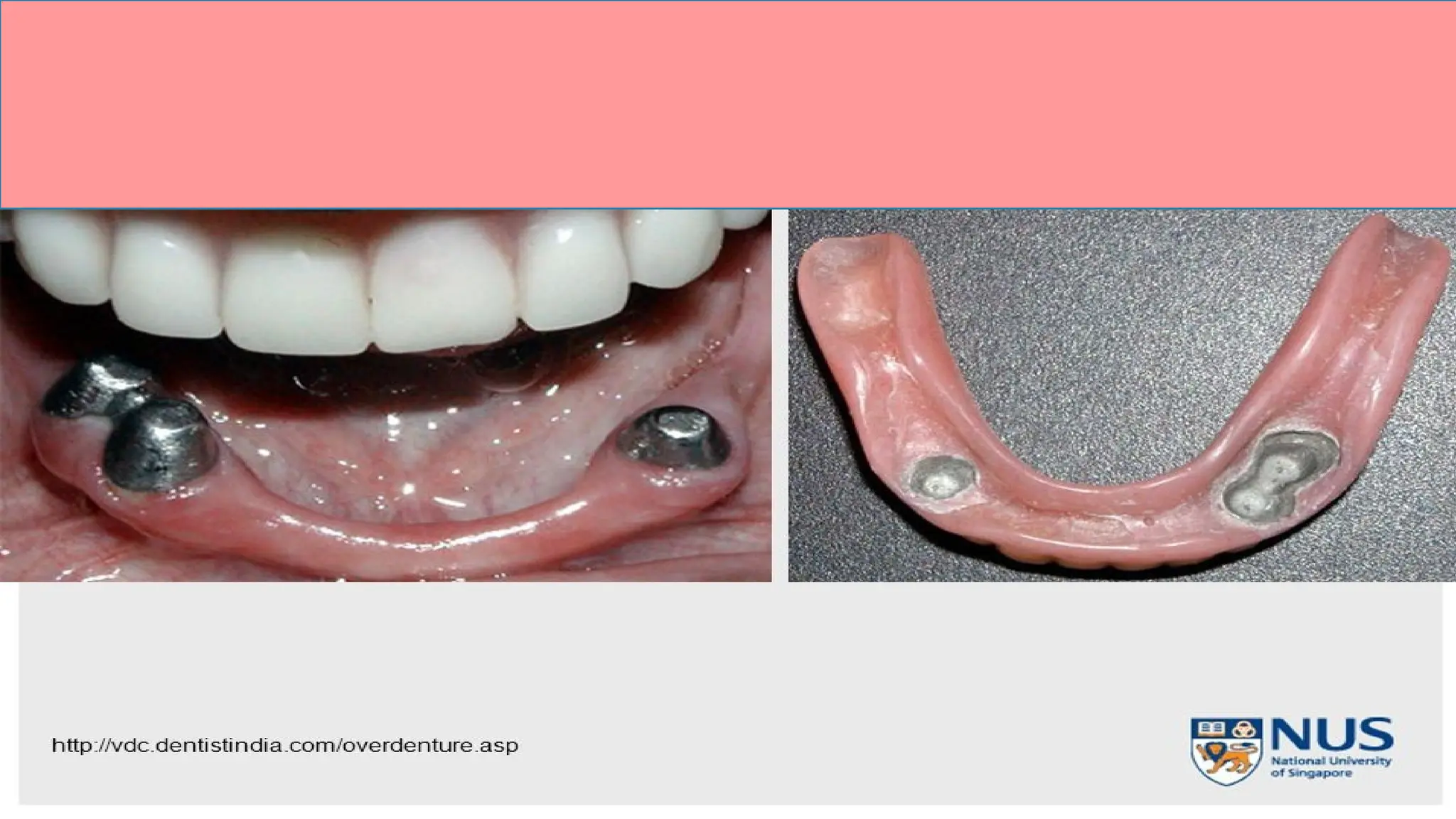
The overdenture: is any removable dental prosthesis that covers and rests on one or more remaining natural teeth, the roots of natural teeth, and/or dental implants
The overdenture: isany removable dental prosthesis
that covers and rests on one or more remaining natural
teeth, the roots of natural teeth, and/or dental implants;
a dental prosthesis that covers and is partially
supported by natural teeth, natural tooth roots, and/or
dental implant.
The overdenture is also called overlay denture, overlay
prosthesis or super imposed prosthesis.
3.
The important goalsof overdenture:
• 1-Maintains teeth as part of the residual ridge ; More support ,
Withstands more occlusal load , Retention improve
• 2-Decrease in the rate of bone resorption. Alveolar bone exists as
a support for teeth.
• 3- Retaining the proprioception.
• 4- An increase in the patient's manipulative skills in handling the
denture.
4.
Indications of Overdenture.
•1-few remaining teeth unsuitable for fixed or removable partial dentures.
• 2- Remaining teeth present with unhealthy periodontal condition.
• 3- Patients with class II or class III Angle's classification - Esthetics &
masticatory function improved.
• 4- Patients presenting abnormal jaw size large maxillary or mandibular
bone defects.
• 5- The construction of over-denture is an alternative line of treatment to
single dentures opposing few natural teeth.
• 6- Patients presenting congenitally missing teeth and congenital defects
as cleft palate, microdontia, amelogenesis or dentinogenesis imperfecta
or partial anodontia.
5.
Contraindications of Overdenture:
•1- Poor oral hygiene.
• 2- Inter-arch space inadequate to accept the denture and the
abutments.
• 3- Mentally and or physically handicapped.
• 4- Cost and time considerations.
• 5- When other treatment modalities promise superior results.
• 6- Lack of patient acceptance.
6.
Advantages of overdentureprosthesis
• 1. Preserving the remaining residual ridge by decreasing the rate of bone resorption.
• 2- Preservation the abutments as part of residual ridge to gain support.
• 3. Preserving the response of proprioceptive exist in the periodontal membrane of the
• abutment tooth.
• 4- The modified teeth provide a definite vertical stop for the denture base
• 5-Horizontal and torque forces are minimized.
• 6-Stability and support are increased
• 7-Patient acceptance and Psychological Benefits
• 8-A Simple Approach to the Problem Patient.
• 9-fewer post insertion problems
• 10- Convertibility& effective management.
• 11-Periodontal Maintenance.(by distributing the applied forces over the remaining
• teeth) physiological stimulation.
• 12- Provide retention through the attachments.
7.
Disadvantage of overdenture:
•1. The susceptibility of the overlaid teeth to caries is high.
• 2. Periodontal disease of the retained teeth.
• 3. Bony undercuts of the alveolar ridge are often found adjacent to
retained teeth over
• contoured (bulky denture) or under contoured flanges especially in
canine eminence.
• 4. Encroachment interocclusal distance beyond the denture space.
• 5- Overdenture construction is time consuming and expensive.
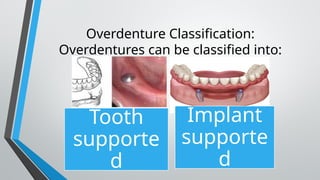
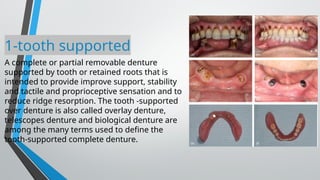
1-tooth supported
A completeor partial removable denture
supported by tooth or retained roots that is
intended to provide improve support, stability
and tactile and proprioceptive sensation and to
reduce ridge resorption. The tooth -supported
over denture is also called overlay denture,
telescopes denture and biological denture are
among the many terms used to define the
tooth-supported complete denture.
10.
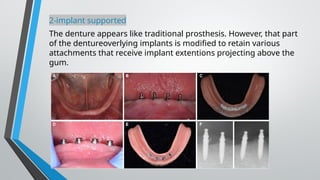
2-implant supported
The dentureappears like traditional prosthesis. However, that part
of the dentureoverlying implants is modified to retain various
attachments that receive implant extentions projecting above the
gum.
11.
Classification of toothsupported overdenture Based on the
method of abutment
preparation:
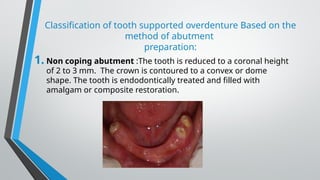
1. Non coping abutment :The tooth is reduced to a coronal height
of 2 to 3 mm. The crown is contoured to a convex or dome
shape. The tooth is endodontically treated and filled with
amalgam or composite restoration.
12.
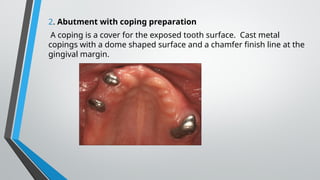
2. Abutment withcoping preparation
A coping is a cover for the exposed tooth surface. Cast metal
copings with a dome shaped surface and a chamfer finish line at the
gingival margin.
13.
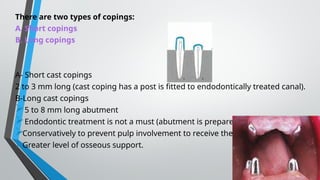
There are twotypes of copings:
A. Short copings
B. Long copings
A- Short cast copings
2 to 3 mm long (cast coping has a post is fitted to endodontically treated canal).
B-Long cast copings
5 to 8 mm long abutment
Endodontic treatment is not a must (abutment is prepared
Conservatively to prevent pulp involvement to receive the cast)
Greater level of osseous support.
14.
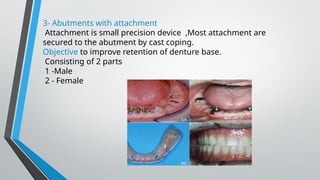
3- Abutments withattachment
Attachment is small precision device ,Most attachment are
secured to the abutment by cast coping.
Objective to improve retention of denture base.
Consisting of 2 parts
1 -Male
2 - Female
15.
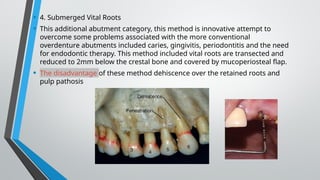
• 4. SubmergedVital Roots
• This additional abutment category, this method is innovative attempt to
overcome some problems associated with the more conventional
overdenture abutments included caries, gingivitis, periodontitis and the need
for endodontic therapy. This method included vital roots are transected and
reduced to 2mm below the crestal bone and covered by mucoperiosteal flap.
• The disadvantage of these method dehiscence over the retained roots and
pulp pathosis
16.
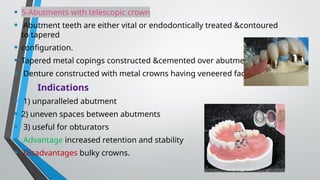
• 5-Abutments withtelescopic crown
• Abutment teeth are either vital or endodontically treated &contoured
to tapered
• configuration.
• Tapered metal copings constructed &cemented over abutments
• Denture constructed with metal crowns having veneered facings.
Indications
• 1) unparalleled abutment
• 2) uneven spaces between abutments
• 3) useful for obturators
• Advantage increased retention and stability
• Disadvantages bulky crowns.
17.
Classification of overdenture based on the type of the over denture
1. Immediate overdenture
The remaining teeth are reduced to accept the overdenture (on the cast), the
overdenture
are constructed prior to the preparation of abutment teeth and is inserted after the
preparation.
2- Transitional or intermediate overdenture
Used for patient in transition or preparation phase until permanent overdenture
constructed or patient with old partial denture and add new artificial teeth using selfcure
acrylic resin.
3-definitive overdenture
Conventional complete over denture constructed over one or more abutment teeth.
Could be made entirely of acrylic resin or in conjunction with metal bases.
18.
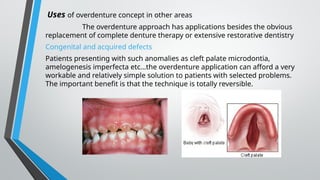
Uses of overdentureconcept in other areas
The overdenture approach has applications besides the obvious
replacement of complete denture therapy or extensive restorative dentistry
Congenital and acquired defects
Patients presenting with such anomalies as cleft palate microdontia,
amelogenesis imperfecta etc…the overdenture application can afford a very
workable and relatively simple solution to patients with selected problems.
The important benefit is that the technique is totally reversible.
19.
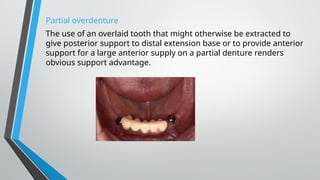
Partial overdenture
The useof an overlaid tooth that might otherwise be extracted to
give posterior support to distal extension base or to provide anterior
support for a large anterior supply on a partial denture renders
obvious support advantage.
20.
Sequence of Treatmentof Patient Who Need an Overdenture
A-Assessment of the patient
1. History (general and oral).
2. Clinical examination (visual and digital examination, radiographic examination and study model of the arch).
B-Treatment plan
Evaluation the abutments
1-Periodontal status.
2-Endodontic considerations
3-The number and position of abutment teeth in the arch
1-periodental status
Minimum mobility.
Have acceptable bone support, 5-7mm Amenable to periodontal therapy.
2-endodontic consideration The tooth must be treated endodontically to allow for sufficient reduction of clinical crown,
ideally patient with single rooted teeth with only one canal are the best candidate although multirooted teeth can also
be used.
3-the number and position of the abutment teeth in the arch In maxillary arch incisors are used, at least one tooth per
quadrant should be present, ideal is 2 teeth per quadrant. The stress is distributed over a rectangular area, A tripod
approach can also be used, most commonly used teeth in the mandible for abutment Canine, reasons – Position, Large
surface area, The Canine response, Time period of retention of the tooth, less susceptibility to periodontal breakdown,
fewer anatomical and positional difficulties
21.
periodontal treatment includes:
1.Initial therapy.
2. Surgical therapy.
a. Root planning with direct visual access.
b. Surgical reduction of periodontal pockets by gingivectomy and /or flap
procedures.
c. Surgical crown lengthening.
d. Widening of the attached gingiva through mucogingival surgery.
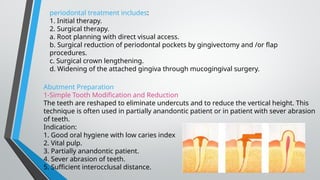
Abutment Preparation
1-Simple Tooth Modification and Reduction
The teeth are reshaped to eliminate undercuts and to reduce the vertical height. This
technique is often used in partially anandontic patient or in patient with sever abrasion
of teeth.
Indication:
1. Good oral hygiene with low caries index
2. Vital pulp.
3. Partially anandontic patient.
4. Sever abrasion of teeth.
5. Sufficient interocclusal distance.
22.
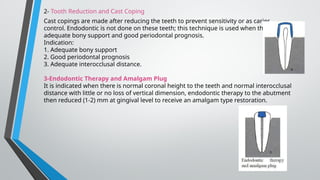
2- Tooth Reductionand Cast Coping
Cast copings are made after reducing the teeth to prevent sensitivity or as caries
control. Endodontic is not done on these teeth; this technique is used when there is
adequate bony support and good periodontal prognosis.
Indication:
1. Adequate bony support
2. Good periodontal prognosis
3. Adequate interocclusal distance.
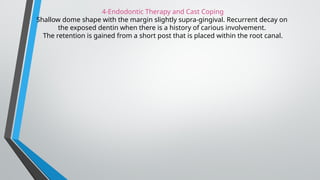
3-Endodontic Therapy and Amalgam Plug
It is indicated when there is normal coronal height to the teeth and normal interocclusal
distance with little or no loss of vertical dimension, endodontic therapy to the abutment
then reduced (1-2) mm at gingival level to receive an amalgam type restoration.
23.
4-Endodontic Therapy andCast Coping
Shallow dome shape with the margin slightly supra-gingival. Recurrent decay on
the exposed dentin when there is a history of carious involvement.
The retention is gained from a short post that is placed within the root canal.
24.
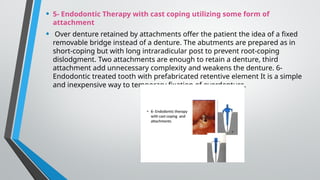
• 5- EndodonticTherapy with cast coping utilizing some form of
attachment
• Over denture retained by attachments offer the patient the idea of a fixed
removable bridge instead of a denture. The abutments are prepared as in
short-coping but with long intraradicular post to prevent root-coping
dislodgment. Two attachments are enough to retain a denture, third
attachment add unnecessary complexity and weakens the denture. 6-
Endodontic treated tooth with prefabricated retentive element It is a simple
and inexpensive way to temporary fixation of overdenture.