OVER-DENTURES AND ATTACHMENTS: A REVIEW OF LITERATURE
Rasmita Kumari Samantaray , Krishna Nanda , Debashish Sahoo
Indian Journal of Forensic Medicine & Toxicology,
October-December 2020, Vol. 14, Issue No. 4
Presented By- Dr. MIHIR GROVER
INTRODUCTION
• According to GPT 10, “Overdenture is a partial or
complete denture that covers and rests on one or
more remaining natural teeth, roots and/or dental
implants. It is also called as Overlay denture,
overlay prosthesis and superimposed prosthesis.
• Preventive prosthodontics “Emphasizes the
importance of any procedure that can delay or
eliminate future prosthodontic problems and
overdenture is an important part of the preventive
treatment modality”.
• De-Van’s golden statement: “Perpetual preservation
of what remains is more important than the
meticulous replacement of what is missing” still
rings true.
• Tooth supported overdentures have various
advantages over conventional complete dentures
such as maintenance of alveolar bone maintenance,
periodontal proprioception is preserved, improves
retention, stability and support,enhances
psychological comfort and increased mastication
efficacy.
INDICATIONS FOR OVERDENTURES
• For better support in morphologically
compromised dental arches.
• Cleft palate cases and congenital anomaly
cases like microdontia, amelogenesis
imperfecta, dentinogenesis imperfecta, and
partial anodontia.
• Dentures patients with maxillofacial trauma.
• Patients with worn-out dentition.
GENERAL CONSIDERATIONS DURING DIAGNOSIS AND
TREATMENT PLANNING FOR AN OVER-DENTURE
o Maintenance of Periodontal Health: Once an overdenture is planned
and constructed, the patient must maintain his teeth free from plaque.
The dentist should check for pocket formation around the abutments
periodically and failing may lead to the loss of abutment tooth.
o Reduction in Crown-root Ratio: Reduction in crown size during
preparation can be beneficial for the tooth, as it “reduces the crown-
root ratio” and “decreases the leverage forces acting on the tooth”.
o Success of Endodontic Therapy: Endodontic therapy may be necessary
for most abutment teeth because they need extensive crown
reduction.
o Number of Overdenture abutment teeth: “Two Abutments
On Opposing Sides Of The Arch Particularly In The Canine
Regions Will Provide Excellent Results”. Four Widely
separated Abutments Are Even Better.
o Adaptation and Coverage of Denture-Bearing Area: The
denture base should be well adapted to the soft tissues to
prevent accumulation of food debris and to evenly distribute
the force acting on the denture.
o Design of the Denture: As the denture base for overdentures
are thin, they have to be reinforced with metal. At the same
time they should be easy to fabricate and maintain.
o Ease of Use: The patient should be able to easily insert and
remove the denture without any harm to the denture base
or the abutment tooth.
ADVANTAGES OF OVERDENTURES
1. Maintains the integrity of the ridge.
2. Improves the “retention and stability” of the denture.
3. Improved proprioception leads to better
neuromuscular control. This helps in regulating the
biting force over the denture.
4. The psychological effect on the patient as extraction
can be avoided.
5. If there is abutment failure, the abutments can be
extracted and the overdenture can be relined and
used as a conventional complete denture.
DISADVANTAGES OF OVERDENTURES
1. Nutritional counseling, oral hygiene measures, and
fluoride application should be carried out periodically.
2. “High incidence of caries and periodontal disease around
the overdenture abutments”.
3. More costly than conventional dentures because: (a) Root
canal therapy and coronal restorations may be needed for
certain overdenture abutments. (b) Most cases need a
cast metal denture base, as acrylic is weaker.
4. Additional designing and laboratory work is needed.
5. Cannot be used in cases with reduced interarch space,
bony undercuts adjacent to the abutments, etc.
ABUTMENT PREPARATION
The preparation of abutment teeth is one of the keys
to the construction of overdenture. Assuming the
periodontal status to be good, the operator has
three choices:-
1. Preparation just above the mucosal level.
• The bare root face approach.
• The dome-shaped gold coping.
2. The use of attachments.
3. The thimble-shaped coping.
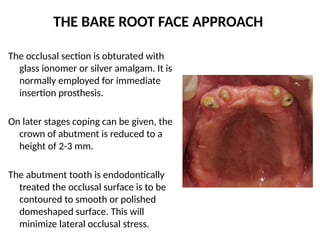
THE BARE ROOT FACE APPROACH
The occlusal section is obturated with
glass ionomer or silver amalgam. It is
normally employed for immediate
insertion prosthesis.
On later stages coping can be given, the
crown of abutment is reduced to a
height of 2-3 mm.
The abutment tooth is endodontically
treated the occlusal surface is to be
contoured to smooth or polished
domeshaped surface. This will
minimize lateral occlusal stress.
Advantages:
1. “It is the simplest,cheapest and least spaceconsuming”.
2. “It is ideal during maturation of edentulous ridge”of a
recently extracted case.
3. It should be replaced by an coping with precious or semi-
precious metal otherwise there is a chance of vertical
longitudinal root fracture.
Contraindications:
4. It should not be used for a long period where a natural
tooth is opposing the overdenture.
5. Leaving it as such may lead to longitudinal root fracture.
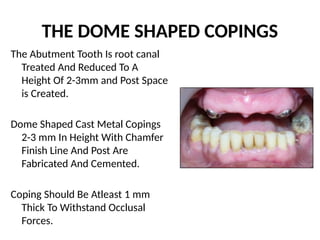
THE DOME SHAPED COPINGS
The Abutment Tooth Is root canal
Treated And Reduced To A
Height Of 2-3mm and Post Space
is Created.
Dome Shaped Cast Metal Copings
2-3 mm In Height With Chamfer
Finish Line And Post Are
Fabricated And Cemented.
Coping Should Be Atleast 1 mm
Thick To Withstand Occlusal
Forces.
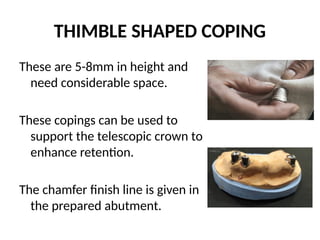
THIMBLE SHAPED COPING
These are 5-8mm in height and
need considerable space.
These copings can be used to
support the telescopic crown to
enhance retention.
The chamfer finish line is given in
the prepared abutment.
TYPES OF OVERDENTURE
• Two types:
1. Tooth supported overdenture
2. Implant-supported overdenture
BASED ON THE METHOD OF ABUTMENT
PREPARATION
1. Coping
2. Noncoping – with simple tooth modification
3. Attachments
4. Submerged vital roots: Effective in preserving
alveolar bone.
BASED ON LENGTH OF COPING
1. “Short coping – 2 to 3 mm long and normally
require endodontic therapy”.
2. “Long coping – 5 to 8 mm long, an attempt is
made to circumvent endodontic therapy by
conservative reduction”.
ATTACHMENTS USED IN TOOTH/ROOT/IMPLANT
SUPPORTED OVERDENTURE
Most of the attachments are secured to the
abutment by a cast coping.
The objective of attachment is to improve the
fixation, retention and stabilization of a
prosthesis.
CLASSIFICATION OF ATTACHMENTS
1. Stud attachment
2. Bar attachments
3. Magnetic attachments
REQUIREMENTS OF ATTACHMENTS
• Patients should have a low caries index.
• Sound periodontal health.
• The vertical space should be sufficient enough
to accommodate the attachment and denture
teeth.
DISADVANTAGES OF ATTACHMENTS
• Time-consuming and expensive.
• Difficulty in construction as well as repair.
• Require careful use by the Patient. So not
recommended for mentally and physically
handicapped patients is difficult.
STUD
ATTACHMENTS
STUD ATTACHMENTS CAN BE DIVIDED INTO
TWO GROUPS
THE EXTRA RADICULAR
ATTACHMENT
• “The Stud” (Male Part) usually
attached to metal coping cemented
over the prepared abutment and it
projects from the root surface of the
preparation.
• The Female Part Is attached to the
denture. Attachment of male
component to female component
provides retention.
• Eg- Ceka, O-Ring Series, Dalbos,
Gerber, Locator Attachment And
Rotherman.
THE INTRA RADICULAR
ATTACHMENT
• “The Stud”(Male element) forms
part of the denture base and
engages a specially produced
depression (housing or female part)
within the root contour.
• This attachment is indicated in
situations with reduced interocclusal
space.
• Eg- Logic, Zest attachment, ERA
attachment.
THE EXTRA RADICULAR ATTACHMENT
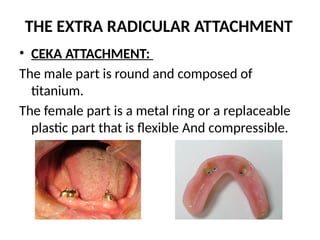
• CEKA ATTACHMENT:
The male part is round and composed of
titanium.
The female part is a metal ring or a replaceable
plastic part that is flexible And compressible.
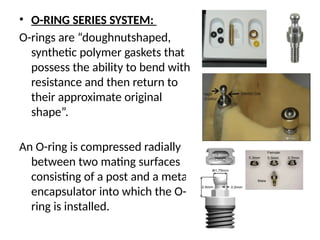
• O-RING SERIES SYSTEM:
O-rings are “doughnutshaped,
synthetic polymer gaskets that
possess the ability to bend with
resistance and then return to
their approximate original
shape”.
An O-ring is compressed radially
between two mating surfaces
consisting of a post and a metal
encapsulator into which the O-
ring is installed.
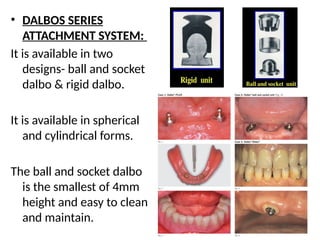
• DALBOS SERIES
ATTACHMENT SYSTEM:
It is available in two
designs- ball and socket
dalbo & rigid dalbo.
It is available in spherical
and cylindrical forms.
The ball and socket dalbo
is the smallest of 4mm
height and easy to clean
and maintain.
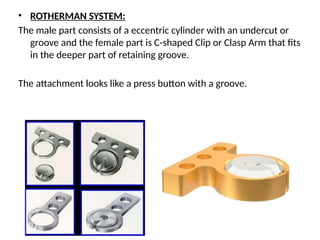
• ROTHERMAN SYSTEM:
The male part consists of a eccentric cylinder with an undercut or
groove and the female part is C-shaped Clip or Clasp Arm that fits
in the deeper part of retaining groove.
The attachment looks like a press button with a groove.
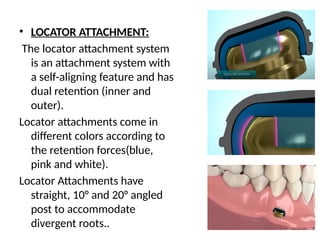
• LOCATOR ATTACHMENT:
The locator attachment system
is an attachment system with
a self-aligning feature and has
dual retention (inner and
outer).
Locator attachments come in
different colors according to
the retention forces(blue,
pink and white).
Locator Attachments have
straight, 10° and 20° angled
post to accommodate
divergent roots..
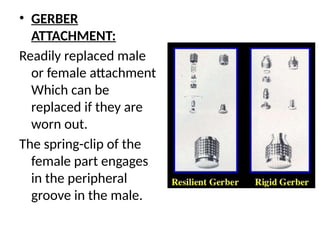
• GERBER
ATTACHMENT:
Readily replaced male
or female attachment
Which can be
replaced if they are
worn out.
The spring-clip of the
female part engages
in the peripheral
groove in the male.
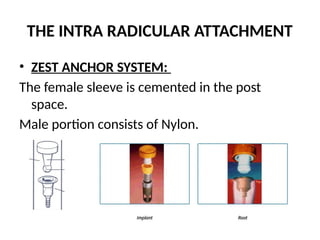
THE INTRA RADICULAR ATTACHMENT
• ZEST ANCHOR SYSTEM:
The female sleeve is cemented in the post
space.
Male portion consists of Nylon.
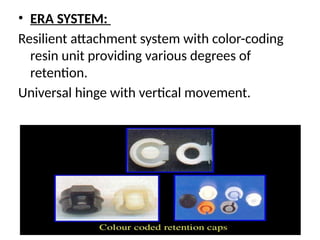
• ERA SYSTEM:
Resilient attachment system with color-coding
resin unit providing various degrees of
retention.
Universal hinge with vertical movement.
BAR
ATTACHMENTS
• Bar Attachment consists of a bar spanning an
edentulous area joining copings on the roots of
the abutment teeth on either side of the arch.
• Sleeves and clips placed in the denture attach to
the bar when the denture is inserted, providing
retention.
• The bar splints the abutment teeth and thus
distributes the forces.
• Oral hygiene maintenance is very much essential
otherwise it may lead to abutment loss.
• Depending on the number it can be a single bar
or multiple bars.
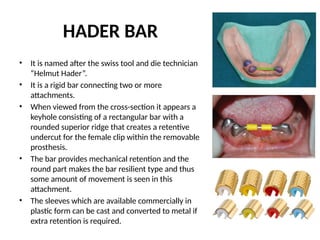
HADER BAR
• It is named after the swiss tool and die technician
“Helmut Hader”.
• It is a rigid bar connecting two or more
attachments.
• When viewed from the cross-section it appears a
keyhole consisting of a rectangular bar with a
rounded superior ridge that creates a retentive
undercut for the female clip within the removable
prosthesis.
• The bar provides mechanical retention and the
round part makes the bar resilient type and thus
some amount of movement is seen in this
attachment.
• The sleeves which are available commercially in
plastic form can be cast and converted to metal if
extra retention is required.
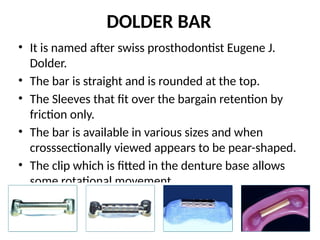
DOLDER BAR
• It is named after swiss prosthodontist Eugene J.
Dolder.
• The bar is straight and is rounded at the top.
• The Sleeves that fit over the bargain retention by
friction only.
• The bar is available in various sizes and when
crosssectionally viewed appears to be pear-shaped.
• The clip which is fitted in the denture base allows
some rotational movement.
• It is available in sizes in diameter of 1.6 and 2.2
mm.
ACKERMANN AND CM BAR
• These bars are round when viewed in cross-section.
• As they are round they offer some resiliency and can
be bent in all directions.
• A short extension of 5 mm is carried behind the most
distal root and the sleeve is positioned on this section.
• Sleeves or clips are made up of gold.
• Available in 1.8 mm diameter in plastic and gold.
• The CM bar is available in a 1.9 mm diameter and
used in long-span cases.
MAGNETIC
ATTACHMENTS
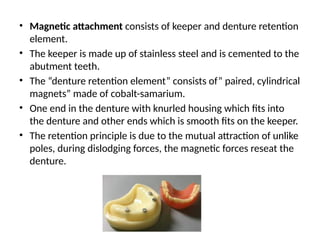
• Magnetic attachment consists of keeper and denture retention
element.
• The keeper is made up of stainless steel and is cemented to the
abutment teeth.
• The “denture retention element” consists of” paired, cylindrical
magnets” made of cobalt-samarium.
• One end in the denture with knurled housing which fits into
the denture and other ends which is smooth fits on the keeper.
• The retention principle is due to the mutual attraction of unlike
poles, during dislodging forces, the magnetic forces reseat the
denture.
Advantages of magnetic attachment:
• No path of insertion.
• No specialized casting or instruments required.
• No paralleling of abutment.
• Automatic reseating.
• Ease of repair and relining.
• Minimum forces are transmitted to roots.
Disadvantages of magnetic attachment:
• Alloy can corrode and fracture leading to loss of
magnetism with loss of retention and thus need for
constant replacement.
CONCLUSION
Overdenture helps reduce shrinkage of
surrounding bone and reduces pressure on the
alveolar ridge.
In the case of an overdenture prosthesis,
“proprioception is maintained” there is the
presence of “directional sensitivity; dimensional
discrimination; canine response and tactile
sensitivity.
CRITICAL ANALYSIS
• Pictures were missing.
• Abutment teeth used for bar attachments?
• A-P Spread in implant supported
overdentures?
REFERENCES
1. Preiskel HW. Overdentures made easy: A guide to implant and root supported
prostheses. Quintessence Publishing Company; 1996.
2. Brewer AA, Morrow RM:Overdentures made easy, The CV Mosby Co, St.
3. Samra RK, Bhide SV, Goyal C, Kaur T: Tooth supported overdenture: A concept
overshadowed but not yet forgotten-Journal of Oral Research and Review. 2015 Jan
1;7(1):16.
4. Bergendal T, Engquist B:Implant-supported overdentures: A longitudinal
prospective study. International Journal of Oral & Maxillofacial Implants. 1998 Mar
1;13(2).
5. Nallaswamy D:Textbook of prosthodontics. JP Medical Ltd; 2017 Sep 30.
6. Fontijn-Tekamp FA, Slagter AP, Van Der Bilt A, Van’T Hof MA, Witter DJ, Kalk W,
Jansen JA: Biting and chewing in overdentures, full dentures, and natural dentitions.
Journal of dental research. 2000 Jul;79(7):1519-24.
7. Mehta S, Kumar M, Bansal A, Batra R, Sharma C, Verma S:Prosthodontic
Rehabilitation of a Case with Overlay Denture: A Case Report. Dental Journal of
Advance Studies. 2018 Dec;6(02/03):134-6.
THANKYOU!

Over-Dentures PROSTHO and Attachments.pptx

  • 1.
    OVER-DENTURES AND ATTACHMENTS:A REVIEW OF LITERATURE Rasmita Kumari Samantaray , Krishna Nanda , Debashish Sahoo Indian Journal of Forensic Medicine & Toxicology, October-December 2020, Vol. 14, Issue No. 4 Presented By- Dr. MIHIR GROVER
  • 2.
    INTRODUCTION • According toGPT 10, “Overdenture is a partial or complete denture that covers and rests on one or more remaining natural teeth, roots and/or dental implants. It is also called as Overlay denture, overlay prosthesis and superimposed prosthesis. • Preventive prosthodontics “Emphasizes the importance of any procedure that can delay or eliminate future prosthodontic problems and overdenture is an important part of the preventive treatment modality”.
  • 3.
    • De-Van’s goldenstatement: “Perpetual preservation of what remains is more important than the meticulous replacement of what is missing” still rings true. • Tooth supported overdentures have various advantages over conventional complete dentures such as maintenance of alveolar bone maintenance, periodontal proprioception is preserved, improves retention, stability and support,enhances psychological comfort and increased mastication efficacy.
  • 4.
    INDICATIONS FOR OVERDENTURES •For better support in morphologically compromised dental arches. • Cleft palate cases and congenital anomaly cases like microdontia, amelogenesis imperfecta, dentinogenesis imperfecta, and partial anodontia. • Dentures patients with maxillofacial trauma. • Patients with worn-out dentition.
  • 5.
    GENERAL CONSIDERATIONS DURINGDIAGNOSIS AND TREATMENT PLANNING FOR AN OVER-DENTURE o Maintenance of Periodontal Health: Once an overdenture is planned and constructed, the patient must maintain his teeth free from plaque. The dentist should check for pocket formation around the abutments periodically and failing may lead to the loss of abutment tooth. o Reduction in Crown-root Ratio: Reduction in crown size during preparation can be beneficial for the tooth, as it “reduces the crown- root ratio” and “decreases the leverage forces acting on the tooth”. o Success of Endodontic Therapy: Endodontic therapy may be necessary for most abutment teeth because they need extensive crown reduction.
  • 6.
    o Number ofOverdenture abutment teeth: “Two Abutments On Opposing Sides Of The Arch Particularly In The Canine Regions Will Provide Excellent Results”. Four Widely separated Abutments Are Even Better. o Adaptation and Coverage of Denture-Bearing Area: The denture base should be well adapted to the soft tissues to prevent accumulation of food debris and to evenly distribute the force acting on the denture. o Design of the Denture: As the denture base for overdentures are thin, they have to be reinforced with metal. At the same time they should be easy to fabricate and maintain. o Ease of Use: The patient should be able to easily insert and remove the denture without any harm to the denture base or the abutment tooth.
  • 7.
    ADVANTAGES OF OVERDENTURES 1.Maintains the integrity of the ridge. 2. Improves the “retention and stability” of the denture. 3. Improved proprioception leads to better neuromuscular control. This helps in regulating the biting force over the denture. 4. The psychological effect on the patient as extraction can be avoided. 5. If there is abutment failure, the abutments can be extracted and the overdenture can be relined and used as a conventional complete denture.
  • 8.
    DISADVANTAGES OF OVERDENTURES 1.Nutritional counseling, oral hygiene measures, and fluoride application should be carried out periodically. 2. “High incidence of caries and periodontal disease around the overdenture abutments”. 3. More costly than conventional dentures because: (a) Root canal therapy and coronal restorations may be needed for certain overdenture abutments. (b) Most cases need a cast metal denture base, as acrylic is weaker. 4. Additional designing and laboratory work is needed. 5. Cannot be used in cases with reduced interarch space, bony undercuts adjacent to the abutments, etc.
  • 9.
    ABUTMENT PREPARATION The preparationof abutment teeth is one of the keys to the construction of overdenture. Assuming the periodontal status to be good, the operator has three choices:- 1. Preparation just above the mucosal level. • The bare root face approach. • The dome-shaped gold coping. 2. The use of attachments. 3. The thimble-shaped coping.
  • 10.
    THE BARE ROOTFACE APPROACH The occlusal section is obturated with glass ionomer or silver amalgam. It is normally employed for immediate insertion prosthesis. On later stages coping can be given, the crown of abutment is reduced to a height of 2-3 mm. The abutment tooth is endodontically treated the occlusal surface is to be contoured to smooth or polished domeshaped surface. This will minimize lateral occlusal stress.
  • 11.
    Advantages: 1. “It isthe simplest,cheapest and least spaceconsuming”. 2. “It is ideal during maturation of edentulous ridge”of a recently extracted case. 3. It should be replaced by an coping with precious or semi- precious metal otherwise there is a chance of vertical longitudinal root fracture. Contraindications: 4. It should not be used for a long period where a natural tooth is opposing the overdenture. 5. Leaving it as such may lead to longitudinal root fracture.
  • 12.
    THE DOME SHAPEDCOPINGS The Abutment Tooth Is root canal Treated And Reduced To A Height Of 2-3mm and Post Space is Created. Dome Shaped Cast Metal Copings 2-3 mm In Height With Chamfer Finish Line And Post Are Fabricated And Cemented. Coping Should Be Atleast 1 mm Thick To Withstand Occlusal Forces.
  • 13.
    THIMBLE SHAPED COPING Theseare 5-8mm in height and need considerable space. These copings can be used to support the telescopic crown to enhance retention. The chamfer finish line is given in the prepared abutment.
  • 14.
    TYPES OF OVERDENTURE •Two types: 1. Tooth supported overdenture 2. Implant-supported overdenture
  • 15.
    BASED ON THEMETHOD OF ABUTMENT PREPARATION 1. Coping 2. Noncoping – with simple tooth modification 3. Attachments 4. Submerged vital roots: Effective in preserving alveolar bone.
  • 16.
    BASED ON LENGTHOF COPING 1. “Short coping – 2 to 3 mm long and normally require endodontic therapy”. 2. “Long coping – 5 to 8 mm long, an attempt is made to circumvent endodontic therapy by conservative reduction”.
  • 17.
    ATTACHMENTS USED INTOOTH/ROOT/IMPLANT SUPPORTED OVERDENTURE Most of the attachments are secured to the abutment by a cast coping. The objective of attachment is to improve the fixation, retention and stabilization of a prosthesis.
  • 18.
    CLASSIFICATION OF ATTACHMENTS 1.Stud attachment 2. Bar attachments 3. Magnetic attachments
  • 19.
    REQUIREMENTS OF ATTACHMENTS •Patients should have a low caries index. • Sound periodontal health. • The vertical space should be sufficient enough to accommodate the attachment and denture teeth.
  • 20.
    DISADVANTAGES OF ATTACHMENTS •Time-consuming and expensive. • Difficulty in construction as well as repair. • Require careful use by the Patient. So not recommended for mentally and physically handicapped patients is difficult.
  • 21.
  • 22.
    STUD ATTACHMENTS CANBE DIVIDED INTO TWO GROUPS THE EXTRA RADICULAR ATTACHMENT • “The Stud” (Male Part) usually attached to metal coping cemented over the prepared abutment and it projects from the root surface of the preparation. • The Female Part Is attached to the denture. Attachment of male component to female component provides retention. • Eg- Ceka, O-Ring Series, Dalbos, Gerber, Locator Attachment And Rotherman. THE INTRA RADICULAR ATTACHMENT • “The Stud”(Male element) forms part of the denture base and engages a specially produced depression (housing or female part) within the root contour. • This attachment is indicated in situations with reduced interocclusal space. • Eg- Logic, Zest attachment, ERA attachment.
  • 23.
    THE EXTRA RADICULARATTACHMENT • CEKA ATTACHMENT: The male part is round and composed of titanium. The female part is a metal ring or a replaceable plastic part that is flexible And compressible.
  • 24.
    • O-RING SERIESSYSTEM: O-rings are “doughnutshaped, synthetic polymer gaskets that possess the ability to bend with resistance and then return to their approximate original shape”. An O-ring is compressed radially between two mating surfaces consisting of a post and a metal encapsulator into which the O- ring is installed.
  • 25.
    • DALBOS SERIES ATTACHMENTSYSTEM: It is available in two designs- ball and socket dalbo & rigid dalbo. It is available in spherical and cylindrical forms. The ball and socket dalbo is the smallest of 4mm height and easy to clean and maintain.
  • 26.
    • ROTHERMAN SYSTEM: Themale part consists of a eccentric cylinder with an undercut or groove and the female part is C-shaped Clip or Clasp Arm that fits in the deeper part of retaining groove. The attachment looks like a press button with a groove.
  • 27.
    • LOCATOR ATTACHMENT: Thelocator attachment system is an attachment system with a self-aligning feature and has dual retention (inner and outer). Locator attachments come in different colors according to the retention forces(blue, pink and white). Locator Attachments have straight, 10° and 20° angled post to accommodate divergent roots..
  • 28.
    • GERBER ATTACHMENT: Readily replacedmale or female attachment Which can be replaced if they are worn out. The spring-clip of the female part engages in the peripheral groove in the male.
  • 29.
    THE INTRA RADICULARATTACHMENT • ZEST ANCHOR SYSTEM: The female sleeve is cemented in the post space. Male portion consists of Nylon.
  • 30.
    • ERA SYSTEM: Resilientattachment system with color-coding resin unit providing various degrees of retention. Universal hinge with vertical movement.
  • 31.
  • 32.
    • Bar Attachmentconsists of a bar spanning an edentulous area joining copings on the roots of the abutment teeth on either side of the arch. • Sleeves and clips placed in the denture attach to the bar when the denture is inserted, providing retention. • The bar splints the abutment teeth and thus distributes the forces. • Oral hygiene maintenance is very much essential otherwise it may lead to abutment loss. • Depending on the number it can be a single bar or multiple bars.
  • 33.
    HADER BAR • Itis named after the swiss tool and die technician “Helmut Hader”. • It is a rigid bar connecting two or more attachments. • When viewed from the cross-section it appears a keyhole consisting of a rectangular bar with a rounded superior ridge that creates a retentive undercut for the female clip within the removable prosthesis. • The bar provides mechanical retention and the round part makes the bar resilient type and thus some amount of movement is seen in this attachment. • The sleeves which are available commercially in plastic form can be cast and converted to metal if extra retention is required.
  • 34.
    DOLDER BAR • Itis named after swiss prosthodontist Eugene J. Dolder. • The bar is straight and is rounded at the top. • The Sleeves that fit over the bargain retention by friction only. • The bar is available in various sizes and when crosssectionally viewed appears to be pear-shaped. • The clip which is fitted in the denture base allows some rotational movement. • It is available in sizes in diameter of 1.6 and 2.2 mm.
  • 35.
    ACKERMANN AND CMBAR • These bars are round when viewed in cross-section. • As they are round they offer some resiliency and can be bent in all directions. • A short extension of 5 mm is carried behind the most distal root and the sleeve is positioned on this section. • Sleeves or clips are made up of gold. • Available in 1.8 mm diameter in plastic and gold. • The CM bar is available in a 1.9 mm diameter and used in long-span cases.
  • 36.
  • 37.
    • Magnetic attachmentconsists of keeper and denture retention element. • The keeper is made up of stainless steel and is cemented to the abutment teeth. • The “denture retention element” consists of” paired, cylindrical magnets” made of cobalt-samarium. • One end in the denture with knurled housing which fits into the denture and other ends which is smooth fits on the keeper. • The retention principle is due to the mutual attraction of unlike poles, during dislodging forces, the magnetic forces reseat the denture.
  • 38.
    Advantages of magneticattachment: • No path of insertion. • No specialized casting or instruments required. • No paralleling of abutment. • Automatic reseating. • Ease of repair and relining. • Minimum forces are transmitted to roots. Disadvantages of magnetic attachment: • Alloy can corrode and fracture leading to loss of magnetism with loss of retention and thus need for constant replacement.
  • 39.
    CONCLUSION Overdenture helps reduceshrinkage of surrounding bone and reduces pressure on the alveolar ridge. In the case of an overdenture prosthesis, “proprioception is maintained” there is the presence of “directional sensitivity; dimensional discrimination; canine response and tactile sensitivity.
  • 40.
    CRITICAL ANALYSIS • Pictureswere missing. • Abutment teeth used for bar attachments? • A-P Spread in implant supported overdentures?
  • 41.
    REFERENCES 1. Preiskel HW.Overdentures made easy: A guide to implant and root supported prostheses. Quintessence Publishing Company; 1996. 2. Brewer AA, Morrow RM:Overdentures made easy, The CV Mosby Co, St. 3. Samra RK, Bhide SV, Goyal C, Kaur T: Tooth supported overdenture: A concept overshadowed but not yet forgotten-Journal of Oral Research and Review. 2015 Jan 1;7(1):16. 4. Bergendal T, Engquist B:Implant-supported overdentures: A longitudinal prospective study. International Journal of Oral & Maxillofacial Implants. 1998 Mar 1;13(2). 5. Nallaswamy D:Textbook of prosthodontics. JP Medical Ltd; 2017 Sep 30. 6. Fontijn-Tekamp FA, Slagter AP, Van Der Bilt A, Van’T Hof MA, Witter DJ, Kalk W, Jansen JA: Biting and chewing in overdentures, full dentures, and natural dentitions. Journal of dental research. 2000 Jul;79(7):1519-24. 7. Mehta S, Kumar M, Bansal A, Batra R, Sharma C, Verma S:Prosthodontic Rehabilitation of a Case with Overlay Denture: A Case Report. Dental Journal of Advance Studies. 2018 Dec;6(02/03):134-6.
  • 42.