DEVELOPMENT OF
TOOTH
SAQUIB SALAM
STUDENT OF
CAREER POSTGRADUATE INSTITUTE OF DENTAL
SCIENCES & HOSPITAL, LUCKNOW
INTRODUCTION
Development of tooth is a complex process.
The various tissues of the tooth and it’s supporting
structures develop from tooth germ.
The term tooth germ thus includes all the formative
tissues for the entire tooth and it’s supporting
structures.
Tooth germ has three main components
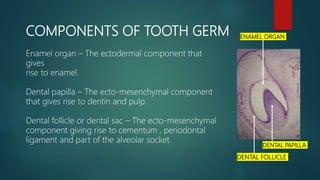
COMPONENTS OF TOOTH GERM
Enamel organ – The ectodermal component that
gives
rise to enamel.
Dental papilla – The ecto-mesenchymal component
that gives rise to dentin and pulp.
Dental follicle or dental sac – The ecto-mesenchymal
component giving rise to cementum , periodontal
ligament and part of the alveolar socket.
ENAMEL ORGAN
DENTAL PAPILLA
DENTAL FOLLICLE
STAGES OF TOOTH DEVELOPMENT
BUD STAGE
CAP STAGE
BELL STAGE - EARLY BELL STAGE
- LATE OR ADVANCED BELL STAGE
BUD STAGE
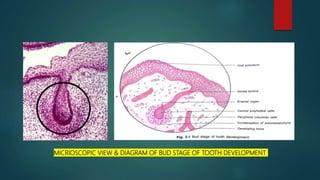
Enamel organ is bud shaped with peripheral cuboidal cells and central
polyhedral cells.
Peripheral cells of enamel organ are seperated from ectomesenchymal
components by a basement membrane.
All the cells are attached to each other by desmosomal junctions.
Ectomesenchymal condensation adjacent to enamel organ forms the dental
papilla.
Marginal condensation of ecto-mesenchymal cells enclosing dental papilla
and enamel organ is called dental follicle or dental sac.
MICRIOSCOPIC VIEW & DIAGRAM OF BUD STAGE OF TOOTH DEVELOPMENT
CAP STAGE
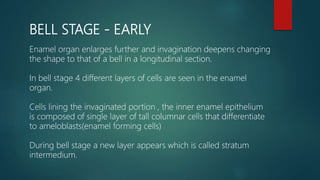
Enamel organ increases in size and attain the shape of a cap by
invagination of the deep portion of the bud.
Cell undergo change in shape so that three separate cell groups
can be identified.
Cells lining the convexity or the periphery of the cap are cuboidal
in shape and are called outer enamel epithelium.
The cells lining the concave or invaginated portion change to
columnar cells named as inner enamel epithelium.
The central polyhedral cells transform into a network of star shaped
cells called stellate reticulum.
Dental papilla gets partially enclosed by the invaginated portion of
enamel organ.
Cells of dental papilla undergo proliferation and further condensation.
Dental follicle shows further condensation of ectomesenchymal cells.
It becomes more fibrous and denser in cap stage.
MICROSCOPIC VIEW & DIAGRAM CAP STAGE OF TOOTH DEVELOPMENT
BELL STAGE - EARLY
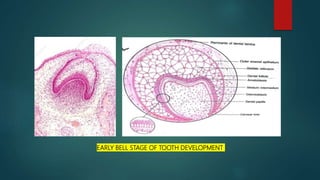
Enamel organ enlarges further and invagination deepens changing
the shape to that of a bell in a longitudinal section.
In bell stage 4 different layers of cells are seen in the enamel
organ.
Cells lining the invaginated portion , the inner enamel epithelium
is composed of single layer of tall columnar cells that differentiate
to ameloblasts(enamel forming cells)
During bell stage a new layer appears which is called stratum
intermedium.
Stratum intermedium is located between inner enamel epithelium
and stellate reticulum and is composed of 2 to 3 layers of squamous
cells.
Stellate reticulum expands further in early bell stage.
Cells of outer enamel epithelium lining the periphery of enamel
organ flattens to low cuboidal cells.
At the cervical region of enamel organ outer enamel epithelium
loops inward to join with inner enamel epithelium. This is called
cervical loop.
During early bell stage enamel organ loses its connection to oral ectoderm due to
degeneration of dental lamina.
Remnants of the dental lamina are called cell rests of serres.
Successional lamina develops at this stage which is the primordium for the permenent
successor.
Dental papilla is fully enclosed in the invaginated portion of the enamel organ in this
stage.
Peripheral cells of dental papilla differentiate into odontoblasts (dentin forming cells)
under the organizing influence of inner enamel epithelial cells.
Dental follicle become more fibrous with 3 layers i.e. Inner cellular, outer fibrous layer
and middle loose connective tissue.
EARLY BELL STAGE OF TOOTH DEVELOPMENT
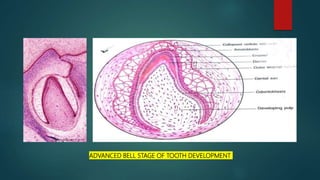
BELL STAGE – LATE OR ADVANCED
Differentiating feature between early and advanced bell stage is
formation of hard tissues.
Enamel organ shows 4 different layers, inner enamel epithelium,
stratum intermedium, stellate reticulum and outer enamel
epithelium.
Histological difference from early bell stage are
- Hard tissue formation
- Collapsed stellate reticulum and folding of outer
enamel epithelium bringing capillaries of the dental follicle
nearer to the ameloblasts.
Ameloblasts are brought closer to the dental follicle which now
becomes their source of nutrition.
Dental papilla shows differentiated odontoblast at the periphery.
Dental follicle is distinct enclosing enamel organ and dental papilla.
ADVANCED BELL STAGE OF TOOTH DEVELOPMENT
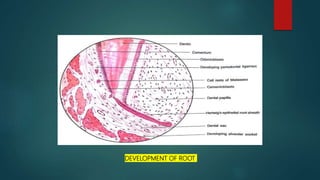
DEVELOPMENT OF ROOT
Root development occurs in advanced bell stage after the
enamel and dentin formation reaches the cervical region of
tooth.
The cervical loop which is composed of outer and inner enamel
epithelium, proliferates to form Hertwig’s epithelial root sheath
which determines the size , shape and number of roots to be
formed.
Inner cells of HERS exert an organizing influence on dental
papilla cells to differentiate in to odontoblasts that deposit
radicular dentin.
Once the root dentin is formed Hertwig’s epithelial root sheath
degenerate allowing the dental follicle cells to come in contact with
the dentin.
The cells of dental follicle differentiate to form cementoblasts and
lays down cementum over the root dentin.
As the cementum formation progresses the rest of the dental follicle
becomes more fibrous and develop into periodontal ligament.
The remnants of Hertwig’s epithelial root sheath remain in
peridontal ligament and are called ‘cell rests of malassez.’
DEVELOPMENT OF ROOT
THANK YOU

Development of tooth

  • 1.
    DEVELOPMENT OF TOOTH SAQUIB SALAM STUDENTOF CAREER POSTGRADUATE INSTITUTE OF DENTAL SCIENCES & HOSPITAL, LUCKNOW
  • 2.
    INTRODUCTION Development of toothis a complex process. The various tissues of the tooth and it’s supporting structures develop from tooth germ. The term tooth germ thus includes all the formative tissues for the entire tooth and it’s supporting structures. Tooth germ has three main components
  • 3.
    COMPONENTS OF TOOTHGERM Enamel organ – The ectodermal component that gives rise to enamel. Dental papilla – The ecto-mesenchymal component that gives rise to dentin and pulp. Dental follicle or dental sac – The ecto-mesenchymal component giving rise to cementum , periodontal ligament and part of the alveolar socket. ENAMEL ORGAN DENTAL PAPILLA DENTAL FOLLICLE
  • 4.
    STAGES OF TOOTHDEVELOPMENT BUD STAGE CAP STAGE BELL STAGE - EARLY BELL STAGE - LATE OR ADVANCED BELL STAGE
  • 5.
    BUD STAGE Enamel organis bud shaped with peripheral cuboidal cells and central polyhedral cells. Peripheral cells of enamel organ are seperated from ectomesenchymal components by a basement membrane. All the cells are attached to each other by desmosomal junctions. Ectomesenchymal condensation adjacent to enamel organ forms the dental papilla. Marginal condensation of ecto-mesenchymal cells enclosing dental papilla and enamel organ is called dental follicle or dental sac.
  • 6.
    MICRIOSCOPIC VIEW &DIAGRAM OF BUD STAGE OF TOOTH DEVELOPMENT
  • 7.
    CAP STAGE Enamel organincreases in size and attain the shape of a cap by invagination of the deep portion of the bud. Cell undergo change in shape so that three separate cell groups can be identified. Cells lining the convexity or the periphery of the cap are cuboidal in shape and are called outer enamel epithelium. The cells lining the concave or invaginated portion change to columnar cells named as inner enamel epithelium.
  • 8.
    The central polyhedralcells transform into a network of star shaped cells called stellate reticulum. Dental papilla gets partially enclosed by the invaginated portion of enamel organ. Cells of dental papilla undergo proliferation and further condensation. Dental follicle shows further condensation of ectomesenchymal cells. It becomes more fibrous and denser in cap stage.
  • 9.
    MICROSCOPIC VIEW &DIAGRAM CAP STAGE OF TOOTH DEVELOPMENT
  • 10.
    BELL STAGE -EARLY Enamel organ enlarges further and invagination deepens changing the shape to that of a bell in a longitudinal section. In bell stage 4 different layers of cells are seen in the enamel organ. Cells lining the invaginated portion , the inner enamel epithelium is composed of single layer of tall columnar cells that differentiate to ameloblasts(enamel forming cells) During bell stage a new layer appears which is called stratum intermedium.
  • 11.
    Stratum intermedium islocated between inner enamel epithelium and stellate reticulum and is composed of 2 to 3 layers of squamous cells. Stellate reticulum expands further in early bell stage. Cells of outer enamel epithelium lining the periphery of enamel organ flattens to low cuboidal cells. At the cervical region of enamel organ outer enamel epithelium loops inward to join with inner enamel epithelium. This is called cervical loop.
  • 12.
    During early bellstage enamel organ loses its connection to oral ectoderm due to degeneration of dental lamina. Remnants of the dental lamina are called cell rests of serres. Successional lamina develops at this stage which is the primordium for the permenent successor. Dental papilla is fully enclosed in the invaginated portion of the enamel organ in this stage. Peripheral cells of dental papilla differentiate into odontoblasts (dentin forming cells) under the organizing influence of inner enamel epithelial cells. Dental follicle become more fibrous with 3 layers i.e. Inner cellular, outer fibrous layer and middle loose connective tissue.
  • 13.
    EARLY BELL STAGEOF TOOTH DEVELOPMENT
  • 14.
    BELL STAGE –LATE OR ADVANCED Differentiating feature between early and advanced bell stage is formation of hard tissues. Enamel organ shows 4 different layers, inner enamel epithelium, stratum intermedium, stellate reticulum and outer enamel epithelium. Histological difference from early bell stage are - Hard tissue formation - Collapsed stellate reticulum and folding of outer enamel epithelium bringing capillaries of the dental follicle nearer to the ameloblasts.
  • 15.
    Ameloblasts are broughtcloser to the dental follicle which now becomes their source of nutrition. Dental papilla shows differentiated odontoblast at the periphery. Dental follicle is distinct enclosing enamel organ and dental papilla.
  • 16.
    ADVANCED BELL STAGEOF TOOTH DEVELOPMENT
  • 17.
    DEVELOPMENT OF ROOT Rootdevelopment occurs in advanced bell stage after the enamel and dentin formation reaches the cervical region of tooth. The cervical loop which is composed of outer and inner enamel epithelium, proliferates to form Hertwig’s epithelial root sheath which determines the size , shape and number of roots to be formed. Inner cells of HERS exert an organizing influence on dental papilla cells to differentiate in to odontoblasts that deposit radicular dentin.
  • 18.
    Once the rootdentin is formed Hertwig’s epithelial root sheath degenerate allowing the dental follicle cells to come in contact with the dentin. The cells of dental follicle differentiate to form cementoblasts and lays down cementum over the root dentin. As the cementum formation progresses the rest of the dental follicle becomes more fibrous and develop into periodontal ligament. The remnants of Hertwig’s epithelial root sheath remain in peridontal ligament and are called ‘cell rests of malassez.’
  • 19.
  • 20.