TOOTH DEVELOPMENT
MARWA TARIQ
FIRST PROFESSIONAL BDS
KHYBER COLLEGE OF DENTISTRY PESHAWAR
3 stages:
1.Bud Stage
2.Cap Stage
3.Bell Stage
TOOTH DEVELOPMENT
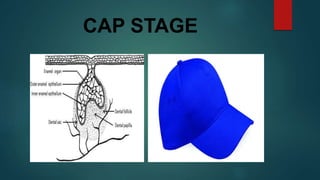
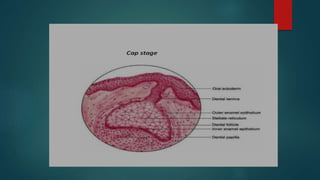
CAP STAGE
CAP STAGE
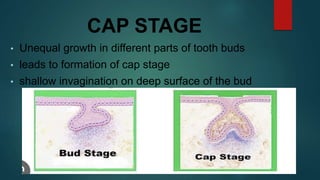
• Unequal growth in different parts of tooth buds
• leads to formation of cap stage
• shallow invagination on deep surface of the bud
HISTOLOGY OF CAP STAGE
• Enamel organ composed of three
different types of cells:
1) Inner Enamel Epithelium
2) Outer Enamel Epithelium
3) Stellate Reticulum
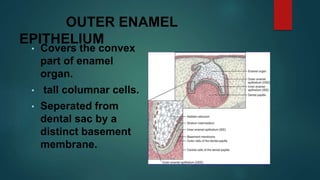
OUTER ENAMEL
EPITHELIUM
• Covers the convex
part of enamel
organ.
• tall columnar cells.
• Seperated from
dental sac by a
distinct basement
membrane.
INNER ENAMEL EPITHELIUM
• Covers the concave part
of enamel organ.
• These are cuboidal
cells.
• Seperated from dental
papillae by a distinct
basement membrane
STELLATE RETICULUM
• Polygonal shaped
cells located in the
center of enamel
organ of cap and bell
stage
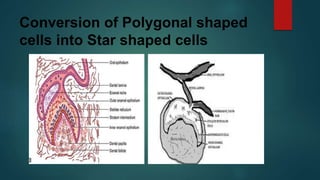
Conversion of Polygonal shaped cells
into Star shaped cells
Mechanism
• Stellate reticulum GLYCOSAMINOGLYCANS(GAGS)
into intercellular spaces between epithelial cells.
• GAGs being hydrophilic pulling of water into enamel organ
• forcing apart of cells results in the change of polyhedral cells into star-shaped
cells.
• Star shaped cells is refered to as stellate reticulum.
FUNCTION:
1) Shock absorber
2) Protects enamel forming cells.
Conversion of Polygonal shaped
cells into Star shaped cells
TRANSITORY STRUCTURES OF
ENAMEL ORGAN
1) ENAMEL KNOT
2) ENAMEL CORD
3) ENAMEL SEPTUM
3) ENAMEL NAVEL
4) ENAMEL NICHE
TRANSITORY STRUCTURES OF
ENAMEL ORGAN
ENAMEL KNOT
•Non-dividing ectodermal
cells at deepest part of
enamel organ which projects
into enamel organ.
FUNCTIONS
1. Signalling centre
2. Determines shape of
tooth
TRANSITORY STRUCTURES OF
ENAMEL ORGAN
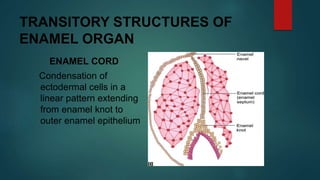
ENAMEL CORD
Condensation of
ectodermal cells in a
linear pattern extending
from enamel knot to
outer enamel epithelium
TRANSITORY STRUCTURES OF
ENAMEL ORGAN
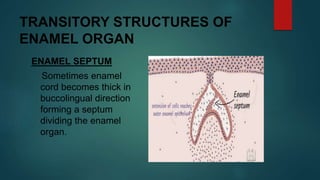
ENAMEL SEPTUM
Sometimes enamel
cord becomes thick in
buccolingual direction
forming a septum
dividing the enamel
organ.
TRANSITORY STRUCTURES OF
ENAMEL ORGAN
ENAMEL NAVEL
• Small depression seen in
the area where enamel cord
joins the outer enamel
epithelium
TRANSITORY STRUCTURES OF
ENAMEL ORGAN
ENAMEL NICHE:
 Enamel organ is attached to
oral epithelium by two dental
laminae;one buccal and one
lingual seprated by area
filled with mesenchymal
tissue referred to as enamel
niche.
Tooth development cap stage

Tooth development cap stage

  • 1.
    TOOTH DEVELOPMENT MARWA TARIQ FIRSTPROFESSIONAL BDS KHYBER COLLEGE OF DENTISTRY PESHAWAR
  • 2.
    3 stages: 1.Bud Stage 2.CapStage 3.Bell Stage TOOTH DEVELOPMENT
  • 3.
  • 4.
    CAP STAGE • Unequalgrowth in different parts of tooth buds • leads to formation of cap stage • shallow invagination on deep surface of the bud
  • 5.
    HISTOLOGY OF CAPSTAGE • Enamel organ composed of three different types of cells: 1) Inner Enamel Epithelium 2) Outer Enamel Epithelium 3) Stellate Reticulum
  • 7.
    OUTER ENAMEL EPITHELIUM • Coversthe convex part of enamel organ. • tall columnar cells. • Seperated from dental sac by a distinct basement membrane.
  • 8.
    INNER ENAMEL EPITHELIUM •Covers the concave part of enamel organ. • These are cuboidal cells. • Seperated from dental papillae by a distinct basement membrane
  • 9.
    STELLATE RETICULUM • Polygonalshaped cells located in the center of enamel organ of cap and bell stage
  • 10.
    Conversion of Polygonalshaped cells into Star shaped cells Mechanism • Stellate reticulum GLYCOSAMINOGLYCANS(GAGS) into intercellular spaces between epithelial cells. • GAGs being hydrophilic pulling of water into enamel organ • forcing apart of cells results in the change of polyhedral cells into star-shaped cells. • Star shaped cells is refered to as stellate reticulum. FUNCTION: 1) Shock absorber 2) Protects enamel forming cells.
  • 11.
    Conversion of Polygonalshaped cells into Star shaped cells
  • 12.
    TRANSITORY STRUCTURES OF ENAMELORGAN 1) ENAMEL KNOT 2) ENAMEL CORD 3) ENAMEL SEPTUM 3) ENAMEL NAVEL 4) ENAMEL NICHE
  • 13.
    TRANSITORY STRUCTURES OF ENAMELORGAN ENAMEL KNOT •Non-dividing ectodermal cells at deepest part of enamel organ which projects into enamel organ. FUNCTIONS 1. Signalling centre 2. Determines shape of tooth
  • 14.
    TRANSITORY STRUCTURES OF ENAMELORGAN ENAMEL CORD Condensation of ectodermal cells in a linear pattern extending from enamel knot to outer enamel epithelium
  • 15.
    TRANSITORY STRUCTURES OF ENAMELORGAN ENAMEL SEPTUM Sometimes enamel cord becomes thick in buccolingual direction forming a septum dividing the enamel organ.
  • 16.
    TRANSITORY STRUCTURES OF ENAMELORGAN ENAMEL NAVEL • Small depression seen in the area where enamel cord joins the outer enamel epithelium
  • 17.
    TRANSITORY STRUCTURES OF ENAMELORGAN ENAMEL NICHE:  Enamel organ is attached to oral epithelium by two dental laminae;one buccal and one lingual seprated by area filled with mesenchymal tissue referred to as enamel niche.