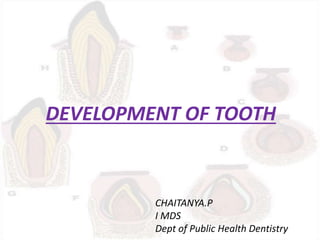
DEVELOPMENT OF TOOTH
CHAITANYA.P
I MDS
Dept of Public Health Dentistry
Previous questions
• Anodontia. (jun 14)
• Write in detail about development of tooth.
(may,08).
• Describe the theories of eruption of teeth.
2
CONTENTS
1. Introduction
2. Dental Lamina
3. Vestibular Lamina
4. Tooth development
5. Developmental stages
• Bud stage
• Cap stage
• Bell stage
• Advanced bell stage
6. Hertwig’s epithelial root sheath and root formation
7. Review of literature
8. Conclusion
9. References
3
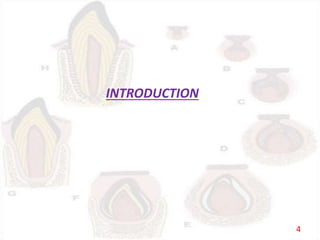
INTRODUCTION
4
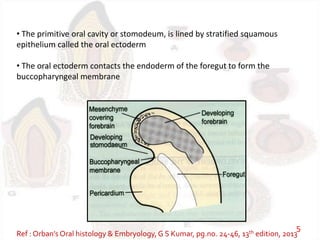
• The primitive oral cavity or stomodeum, is lined by stratified squamous
epithelium called the oral ectoderm
• The oral ectoderm contacts the endoderm of the foregut to form the
buccopharyngeal membrane
Ref : Orban’s Oral histology & Embryology,G S Kumar, pg.no. 24-46, 13th edition, 2013
5
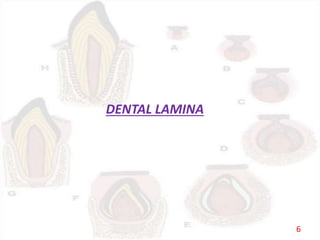
DENTAL LAMINA
6
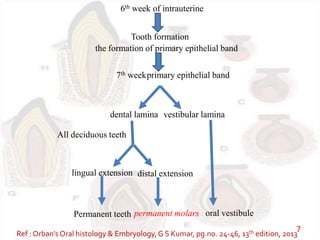
6th week of intrauterine
Tooth formation
the formation of primary epithelial band
7th weekprimary epithelial band
dental lamina vestibular lamina
lingual extension distal extension
All deciduous teeth
Permanent teeth permanent molars oral vestibule
Ref : Orban’s Oral histology & Embryology,G S Kumar, pg.no. 24-46, 13th edition, 2013
7
FATE OF DENTAL LAMINA
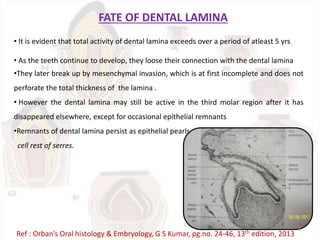
• It is evident that total activity of dental lamina exceeds over a period of atleast 5 yrs
• As the teeth continue to develop, they loose their connection with the dental lamina
•They later break up by mesenchymal invasion, which is at first incomplete and does not
perforate the total thickness of the lamina .
• However the dental lamina may still be active in the third molar region after it has
disappeared elsewhere, except for occasional epithelial remnants
•Remnants of dental lamina persist as epithelial pearls or
cell rest of serres.
Ref : Orban’s Oral histology & Embryology, G S Kumar, pg.no. 24-46, 13th edition, 2013
8
VESTIBULAR LAMINA
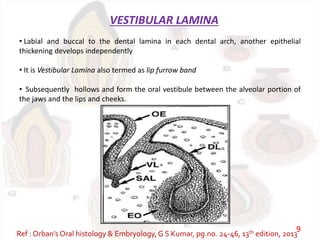
• Labial and buccal to the dental lamina in each dental arch, another epithelial
thickening develops independently
• It is Vestibular Lamina also termed as lip furrow band
• Subsequently hollows and form the oral vestibule between the alveolar portion of
the jaws and the lips and cheeks.
Ref : Orban’s Oral histology & Embryology,G S Kumar, pg.no. 24-46, 13th edition, 2013
9
CLINICAL CONSIDERATIONS
10
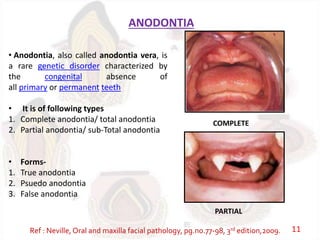
ANODONTIA
• Anodontia, also called anodontia vera, is
a rare genetic disorder characterized by
the congenital absence of
all primary or permanent teeth
• It is of following types
1. Complete anodontia/ total anodontia
2. Partial anodontia/ sub-Total anodontia
• Forms-
1. True anodontia
2. Psuedo anodontia
3. False anodontia
COMPLETE
PARTIAL
Ref : Neville, Oral and maxilla facial pathology, pg.no.77-98, 3rd edition,2009. 11
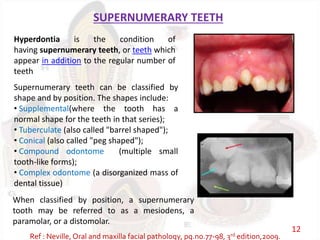
SUPERNUMERARY TEETH
Supernumerary teeth can be classified by
shape and by position. The shapes include:
• Supplemental(where the tooth has a
normal shape for the teeth in that series);
• Tuberculate (also called "barrel shaped");
• Conical (also called "peg shaped");
• Compound odontome (multiple small
tooth-like forms);
• Complex odontome (a disorganized mass of
dental tissue)
Hyperdontia is the condition of
having supernumerary teeth, or teeth which
appear in addition to the regular number of
teeth
When classified by position, a supernumerary
tooth may be referred to as a mesiodens, a
paramolar, or a distomolar.
Ref : Neville, Oral and maxilla facial pathology, pg.no.77-98, 3rd edition,2009.
12
13
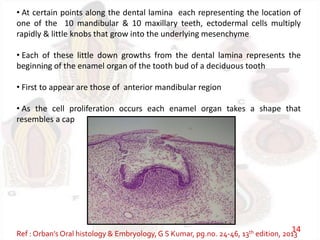
• At certain points along the dental lamina each representing the location of
one of the 10 mandibular & 10 maxillary teeth, ectodermal cells multiply
rapidly & little knobs that grow into the underlying mesenchyme
• Each of these little down growths from the dental lamina represents the
beginning of the enamel organ of the tooth bud of a deciduous tooth
• First to appear are those of anterior mandibular region
• As the cell proliferation occurs each enamel organ takes a shape that
resembles a cap
Ref : Orban’s Oral histology & Embryology,G S Kumar, pg.no. 24-46, 13th edition, 2013
14
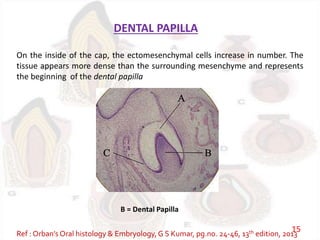
DENTAL PAPILLA
On the inside of the cap, the ectomesenchymal cells increase in number. The
tissue appears more dense than the surrounding mesenchyme and represents
the beginning of the dental papilla
B = Dental Papilla
Ref : Orban’s Oral histology & Embryology,G S Kumar, pg.no. 24-46, 13th edition, 2013
15
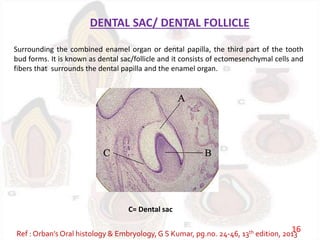
DENTAL SAC/ DENTAL FOLLICLE
Surrounding the combined enamel organ or dental papilla, the third part of the tooth
bud forms. It is known as dental sac/follicle and it consists of ectomesenchymal cells and
fibers that surrounds the dental papilla and the enamel organ.
C= Dental sac
Ref : Orban’s Oral histology & Embryology,G S Kumar, pg.no. 24-46, 13th edition, 2013
16
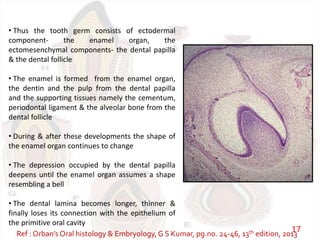
• Thus the tooth germ consists of ectodermal
component- the enamel organ, the
ectomesenchymal components- the dental papilla
& the dental follicle
• The enamel is formed from the enamel organ,
the dentin and the pulp from the dental papilla
and the supporting tissues namely the cementum,
periodontal ligament & the alveolar bone from the
dental follicle
• During & after these developments the shape of
the enamel organ continues to change
• The depression occupied by the dental papilla
deepens until the enamel organ assumes a shape
resembling a bell
• The dental lamina becomes longer, thinner &
finally loses its connection with the epithelium of
the primitive oral cavity
Ref : Orban’s Oral histology & Embryology,G S Kumar, pg.no. 24-46, 13th edition, 2013
17
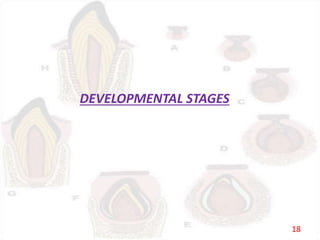
DEVELOPMENTAL STAGES
18
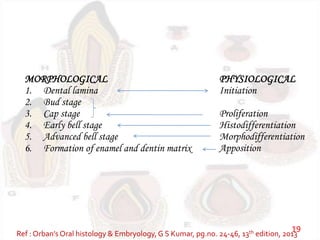
MORPHOLOGICAL
1. Dental lamina
2. Bud stage
3. Cap stage
4. Early bell stage
5. Advanced bell stage
6. Formation of enamel and dentin matrix
PHYSIOLOGICAL
Initiation
Proliferation
Histodifferentiation
Morphodifferentiation
Apposition
Ref : Orban’s Oral histology & Embryology,G S Kumar, pg.no. 24-46, 13th edition, 2013
19
BUD STAGE / PROLIFERATION
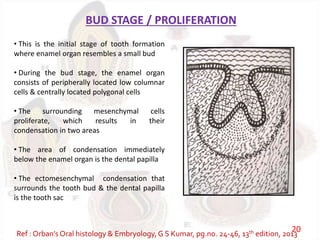
• This is the initial stage of tooth formation
where enamel organ resembles a small bud
• During the bud stage, the enamel organ
consists of peripherally located low columnar
cells & centrally located polygonal cells
• The surrounding mesenchymal cells
proliferate, which results in their
condensation in two areas
• The area of condensation immediately
below the enamel organ is the dental papilla
• The ectomesenchymal condensation that
surrounds the tooth bud & the dental papilla
is the tooth sac
Ref : Orban’s Oral histology & Embryology,G S Kumar, pg.no. 24-46, 13th edition, 2013
20
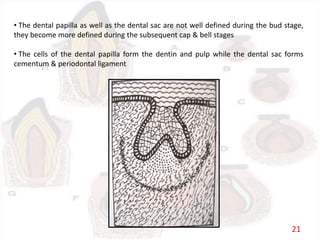
• The dental papilla as well as the dental sac are not well defined during the bud stage,
they become more defined during the subsequent cap & bell stages
• The cells of the dental papilla form the dentin and pulp while the dental sac forms
cementum & periodontal ligament
21
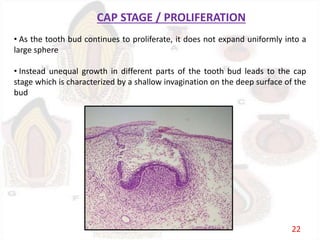
CAP STAGE / PROLIFERATION
• As the tooth bud continues to proliferate, it does not expand uniformly into a
large sphere
• Instead unequal growth in different parts of the tooth bud leads to the cap
stage which is characterized by a shallow invagination on the deep surface of the
bud
22
OUTER & INNER ENAMEL EPITHELIUM
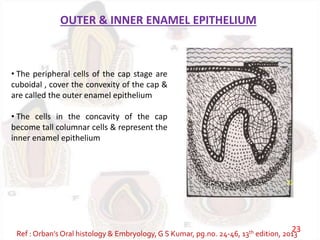
• The peripheral cells of the cap stage are
cuboidal , cover the convexity of the cap &
are called the outer enamel epithelium
• The cells in the concavity of the cap
become tall columnar cells & represent the
inner enamel epithelium
Ref : Orban’s Oral histology & Embryology,G S Kumar, pg.no. 24-46, 13th edition, 2013
23
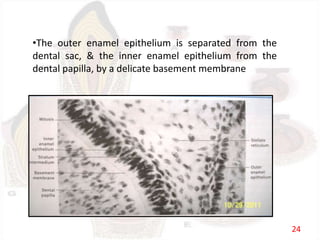
•The outer enamel epithelium is separated from the
dental sac, & the inner enamel epithelium from the
dental papilla, by a delicate basement membrane
24
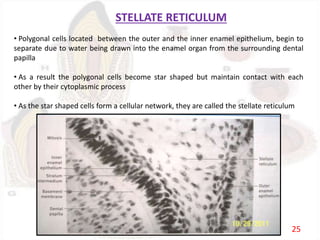
STELLATE RETICULUM
• Polygonal cells located between the outer and the inner enamel epithelium, begin to
separate due to water being drawn into the enamel organ from the surrounding dental
papilla
• As a result the polygonal cells become star shaped but maintain contact with each
other by their cytoplasmic process
• As the star shaped cells form a cellular network, they are called the stellate reticulum
25
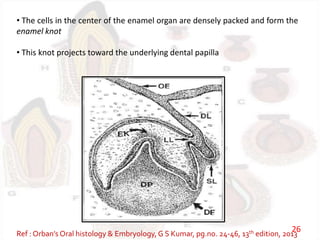
• The cells in the center of the enamel organ are densely packed and form the
enamel knot
• This knot projects toward the underlying dental papilla
Ref : Orban’s Oral histology & Embryology,G S Kumar, pg.no. 24-46, 13th edition, 2013
26
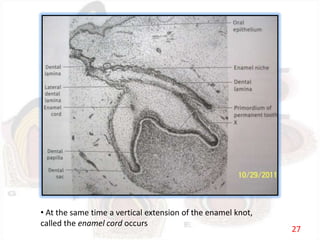
• At the same time a vertical extension of the enamel knot,
called the enamel cord occurs
27
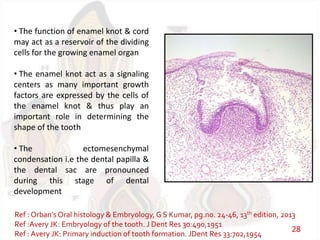
• The function of enamel knot & cord
may act as a reservoir of the dividing
cells for the growing enamel organ
• The enamel knot act as a signaling
centers as many important growth
factors are expressed by the cells of
the enamel knot & thus play an
important role in determining the
shape of the tooth
• The ectomesenchymal
condensation i.e the dental papilla &
the dental sac are pronounced
during this stage of dental
development
Ref : Orban’s Oral histology & Embryology, G S Kumar, pg.no. 24-46, 13th edition, 2013
Ref :Avery JK: Embryology of the tooth. J Dent Res 30:490,1951
Ref : Avery JK: Primary induction of tooth formation. JDent Res 33:702,1954
28
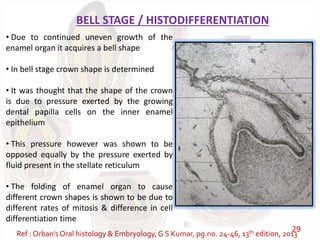
BELL STAGE / HISTODIFFERENTIATION
• Due to continued uneven growth of the
enamel organ it acquires a bell shape
• In bell stage crown shape is determined
• It was thought that the shape of the crown
is due to pressure exerted by the growing
dental papilla cells on the inner enamel
epithelium
• This pressure however was shown to be
opposed equally by the pressure exerted by
fluid present in the stellate reticulum
• The folding of enamel organ to cause
different crown shapes is shown to be due to
different rates of mitosis & difference in cell
differentiation time
Ref : Orban’s Oral histology & Embryology,G S Kumar, pg.no. 24-46, 13th edition, 2013
29
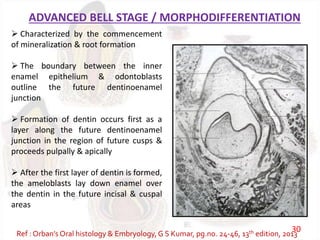
ADVANCED BELL STAGE / MORPHODIFFERENTIATION
 Characterized by the commencement
of mineralization & root formation
 The boundary between the inner
enamel epithelium & odontoblasts
outline the future dentinoenamel
junction
 Formation of dentin occurs first as a
layer along the future dentinoenamel
junction in the region of future cusps &
proceeds pulpally & apically
 After the first layer of dentin is formed,
the ameloblasts lay down enamel over
the dentin in the future incisal & cuspal
areas
Ref : Orban’s Oral histology & Embryology,G S Kumar, pg.no. 24-46, 13th edition, 2013
30
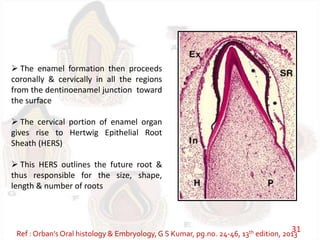
 The enamel formation then proceeds
coronally & cervically in all the regions
from the dentinoenamel junction toward
the surface
 The cervical portion of enamel organ
gives rise to Hertwig Epithelial Root
Sheath (HERS)
 This HERS outlines the future root &
thus responsible for the size, shape,
length & number of roots
Ref : Orban’s Oral histology & Embryology,G S Kumar, pg.no. 24-46, 13th edition, 2013
31
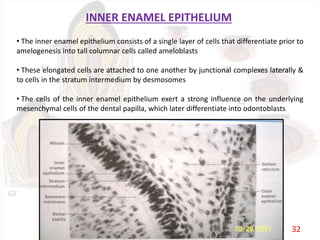
INNER ENAMEL EPITHELIUM
• The inner enamel epithelium consists of a single layer of cells that differentiate prior to
amelogenesis into tall columnar cells called ameloblasts
• These elongated cells are attached to one another by junctional complexes laterally &
to cells in the stratum intermedium by desmosomes
• The cells of the inner enamel epithelium exert a strong influence on the underlying
mesenchymal cells of the dental papilla, which later differentiate into odontoblasts
32
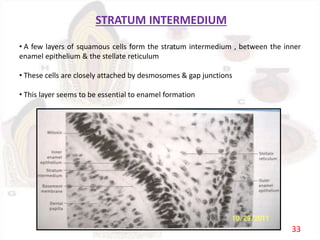
STRATUM INTERMEDIUM
• A few layers of squamous cells form the stratum intermedium , between the inner
enamel epithelium & the stellate reticulum
• These cells are closely attached by desmosomes & gap junctions
• This layer seems to be essential to enamel formation
33
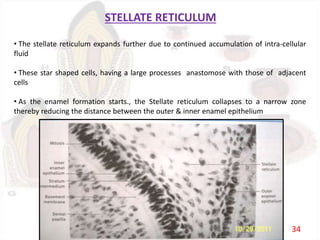
STELLATE RETICULUM
• The stellate reticulum expands further due to continued accumulation of intra-cellular
fluid
• These star shaped cells, having a large processes anastomose with those of adjacent
cells
• As the enamel formation starts., the Stellate reticulum collapses to a narrow zone
thereby reducing the distance between the outer & inner enamel epithelium
34
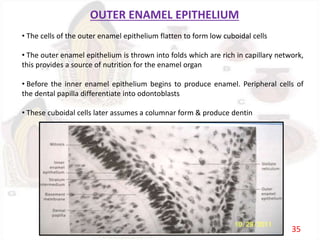
OUTER ENAMEL EPITHELIUM
• The cells of the outer enamel epithelium flatten to form low cuboidal cells
• The outer enamel epithelium is thrown into folds which are rich in capillary network,
this provides a source of nutrition for the enamel organ
• Before the inner enamel epithelium begins to produce enamel. Peripheral cells of
the dental papilla differentiate into odontoblasts
• These cuboidal cells later assumes a columnar form & produce dentin
35
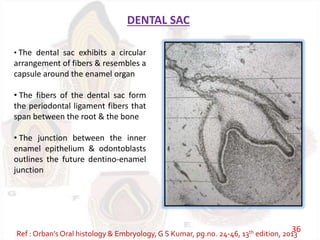
DENTAL SAC
• The dental sac exhibits a circular
arrangement of fibers & resembles a
capsule around the enamel organ
• The fibers of the dental sac form
the periodontal ligament fibers that
span between the root & the bone
• The junction between the inner
enamel epithelium & odontoblasts
outlines the future dentino-enamel
junction
Ref : Orban’s Oral histology & Embryology,G S Kumar, pg.no. 24-46, 13th edition, 2013
36
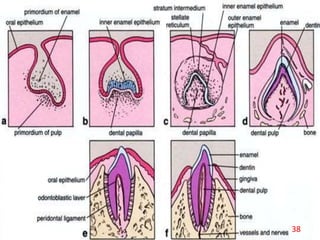
FORMATION OF ENAMEL & DENTIN MATIX
( APPOSITION)
• Apposition is the deposition of the matrix of the hard enamel
structures
• Appositional growth of the enamel & dentin is a layer like
deposition of an extracellular matrix. This type of growth is
therefore additive
• Appositional growth is characterised by regular & rhythmic
deposition of the extracellular matrix, which is of itself incapable of
further growth
Ref : Orban’s Oral histology & Embryology,G S Kumar, pg.no. 24-46, 13th edition, 201337
38
CLINICAL CONSIDERATIONS
39
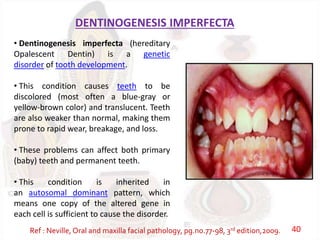
DENTINOGENESIS IMPERFECTA
• Dentinogenesis imperfecta (hereditary
Opalescent Dentin) is a genetic
disorder of tooth development.
• This condition causes teeth to be
discolored (most often a blue-gray or
yellow-brown color) and translucent. Teeth
are also weaker than normal, making them
prone to rapid wear, breakage, and loss.
• These problems can affect both primary
(baby) teeth and permanent teeth.
• This condition is inherited in
an autosomal dominant pattern, which
means one copy of the altered gene in
each cell is sufficient to cause the disorder.
Ref : Neville, Oral and maxilla facial pathology, pg.no.77-98, 3rd edition,2009. 40
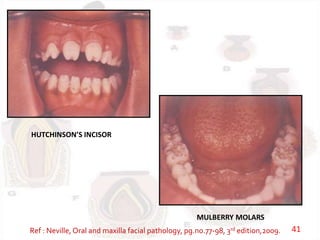
HUTCHINSON’S INCISOR
MULBERRY MOLARS
Ref : Neville, Oral and maxilla facial pathology, pg.no.77-98, 3rd edition,2009. 41
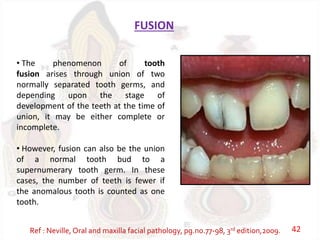
FUSION
• The phenomenon of tooth
fusion arises through union of two
normally separated tooth germs, and
depending upon the stage of
development of the teeth at the time of
union, it may be either complete or
incomplete.
• However, fusion can also be the union
of a normal tooth bud to a
supernumerary tooth germ. In these
cases, the number of teeth is fewer if
the anomalous tooth is counted as one
tooth.
Ref : Neville, Oral and maxilla facial pathology, pg.no.77-98, 3rd edition,2009. 42
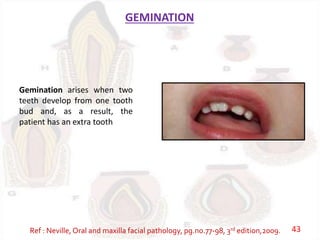
GEMINATION
Gemination arises when two
teeth develop from one tooth
bud and, as a result, the
patient has an extra tooth
Ref : Neville, Oral and maxilla facial pathology, pg.no.77-98, 3rd edition,2009. 43
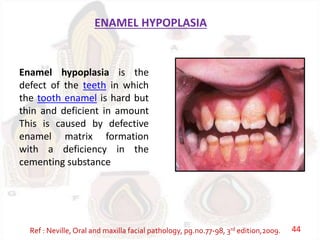
ENAMEL HYPOPLASIA
Enamel hypoplasia is the
defect of the teeth in which
the tooth enamel is hard but
thin and deficient in amount
This is caused by defective
enamel matrix formation
with a deficiency in the
cementing substance
Ref : Neville, Oral and maxilla facial pathology, pg.no.77-98, 3rd edition,2009. 44
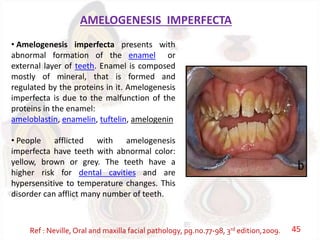
AMELOGENESIS IMPERFECTA
• Amelogenesis imperfecta presents with
abnormal formation of the enamel or
external layer of teeth. Enamel is composed
mostly of mineral, that is formed and
regulated by the proteins in it. Amelogenesis
imperfecta is due to the malfunction of the
proteins in the enamel:
ameloblastin, enamelin, tuftelin, amelogenin
• People afflicted with amelogenesis
imperfecta have teeth with abnormal color:
yellow, brown or grey. The teeth have a
higher risk for dental cavities and are
hypersensitive to temperature changes. This
disorder can afflict many number of teeth.
Ref : Neville, Oral and maxilla facial pathology, pg.no.77-98, 3rd edition,2009. 45
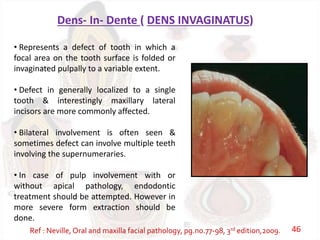
Dens- In- Dente ( DENS INVAGINATUS)
• Represents a defect of tooth in which a
focal area on the tooth surface is folded or
invaginated pulpally to a variable extent.
• Defect in generally localized to a single
tooth & interestingly maxillary lateral
incisors are more commonly affected.
• Bilateral involvement is often seen &
sometimes defect can involve multiple teeth
involving the supernumeraries.
• In case of pulp involvement with or
without apical pathology, endodontic
treatment should be attempted. However in
more severe form extraction should be
done.
Ref : Neville, Oral and maxilla facial pathology, pg.no.77-98, 3rd edition,2009. 46
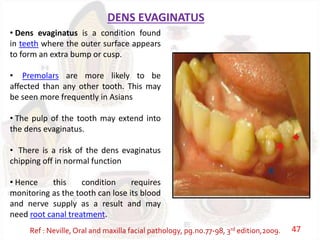
DENS EVAGINATUS
• Dens evaginatus is a condition found
in teeth where the outer surface appears
to form an extra bump or cusp.
• Premolars are more likely to be
affected than any other tooth. This may
be seen more frequently in Asians
• The pulp of the tooth may extend into
the dens evaginatus.
• There is a risk of the dens evaginatus
chipping off in normal function
• Hence this condition requires
monitoring as the tooth can lose its blood
and nerve supply as a result and may
need root canal treatment.
Ref : Neville, Oral and maxilla facial pathology, pg.no.77-98, 3rd edition,2009. 47
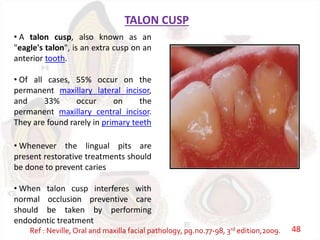
TALON CUSP
• A talon cusp, also known as an
"eagle's talon", is an extra cusp on an
anterior tooth.
• Of all cases, 55% occur on the
permanent maxillary lateral incisor,
and 33% occur on the
permanent maxillary central incisor.
They are found rarely in primary teeth
• Whenever the lingual pits are
present restorative treatments should
be done to prevent caries
• When talon cusp interferes with
normal occlusion preventive care
should be taken by performing
endodontic treatment
Ref : Neville, Oral and maxilla facial pathology, pg.no.77-98, 3rd edition,2009. 48
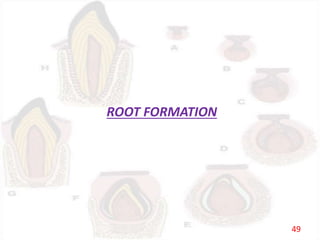
ROOT FORMATION
49
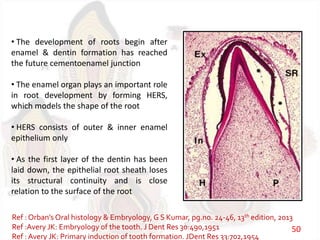
• The development of roots begin after
enamel & dentin formation has reached
the future cementoenamel junction
• The enamel organ plays an important role
in root development by forming HERS,
which models the shape of the root
• HERS consists of outer & inner enamel
epithelium only
• As the first layer of the dentin has been
laid down, the epithelial root sheath loses
its structural continuity and is close
relation to the surface of the root
Ref : Orban’s Oral histology & Embryology, G S Kumar, pg.no. 24-46, 13th edition, 2013
Ref :Avery JK: Embryology of the tooth. J Dent Res 30:490,1951
Ref : Avery JK: Primary induction of tooth formation. JDent Res 33:702,1954
50
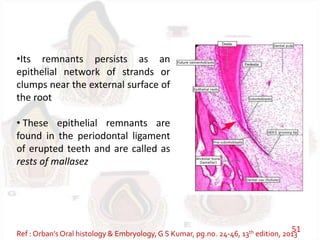
•Its remnants persists as an
epithelial network of strands or
clumps near the external surface of
the root
• These epithelial remnants are
found in the periodontal ligament
of erupted teeth and are called as
rests of mallasez
Ref : Orban’s Oral histology & Embryology,G S Kumar, pg.no. 24-46, 13th edition, 2013
51
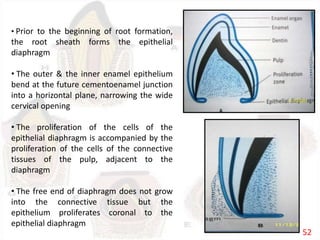
• Prior to the beginning of root formation,
the root sheath forms the epithelial
diaphragm
• The outer & the inner enamel epithelium
bend at the future cementoenamel junction
into a horizontal plane, narrowing the wide
cervical opening
• The proliferation of the cells of the
epithelial diaphragm is accompanied by the
proliferation of the cells of the connective
tissues of the pulp, adjacent to the
diaphragm
• The free end of diaphragm does not grow
into the connective tissue but the
epithelium proliferates coronal to the
epithelial diaphragm
52
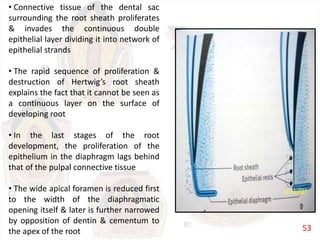
• Connective tissue of the dental sac
surrounding the root sheath proliferates
& invades the continuous double
epithelial layer dividing it into network of
epithelial strands
• The rapid sequence of proliferation &
destruction of Hertwig’s root sheath
explains the fact that it cannot be seen as
a continuous layer on the surface of
developing root
• In the last stages of the root
development, the proliferation of the
epithelium in the diaphragm lags behind
that of the pulpal connective tissue
• The wide apical foramen is reduced first
to the width of the diaphragmatic
opening itself & later is further narrowed
by opposition of dentin & cementum to
the apex of the root 53
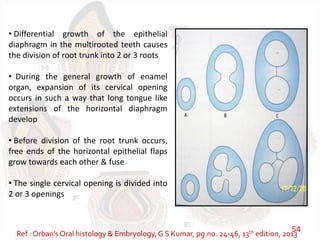
• Differential growth of the epithelial
diaphragm in the multirooted teeth causes
the division of root trunk into 2 or 3 roots
• During the general growth of enamel
organ, expansion of its cervical opening
occurs in such a way that long tongue like
extensions of the horizontal diaphragm
develop
• Before division of the root trunk occurs,
free ends of the horizontal epithelial flaps
grow towards each other & fuse
• The single cervical opening is divided into
2 or 3 openings
Ref : Orban’s Oral histology & Embryology,G S Kumar, pg.no. 24-46, 13th edition, 2013
54
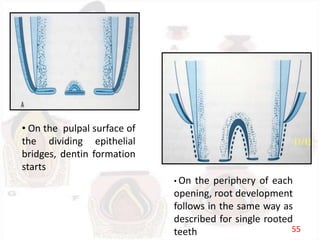
• On the pulpal surface of
the dividing epithelial
bridges, dentin formation
starts
• On the periphery of each
opening, root development
follows in the same way as
described for single rooted
teeth 55
CLINICAL CONSIDERATIONS
56
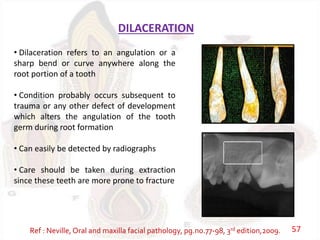
DILACERATION
• Dilaceration refers to an angulation or a
sharp bend or curve anywhere along the
root portion of a tooth
• Condition probably occurs subsequent to
trauma or any other defect of development
which alters the angulation of the tooth
germ during root formation
• Can easily be detected by radiographs
• Care should be taken during extraction
since these teeth are more prone to fracture
Ref : Neville, Oral and maxilla facial pathology, pg.no.77-98, 3rd edition,2009. 57
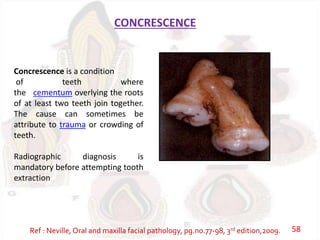
CONCRESCENCE
Concrescence is a condition
of teeth where
the cementum overlying the roots
of at least two teeth join together.
The cause can sometimes be
attribute to trauma or crowding of
teeth.
Radiographic diagnosis is
mandatory before attempting tooth
extraction
Ref : Neville, Oral and maxilla facial pathology, pg.no.77-98, 3rd edition,2009. 58
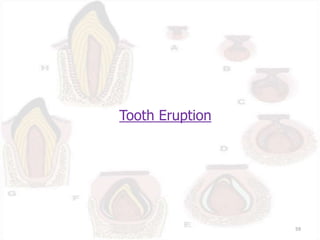
Tooth Eruption
59
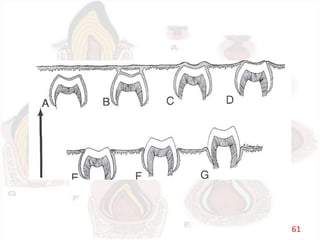
1 Phases of tooth eruption
Eruption is the movement of the developing teeth through the bone
and the overlying mucosa of the jaws to appear in the oral cavity
and reach the occlusal plane
Movements of teeth leading to eruption take place in three
phases
1. Preeruptive phase
2. Eruptive phase
3. Functional phase
Ref : Orban’s Oral histology & Embryology, G S Kumar, pg.no. 24-46, 13th edition, 2013
Ref :Avery JK: Embryology of the tooth. J Dent Res 30:490,1951
Ref : Avery JK: Primary induction of tooth formation. JDent Res 33:702,1954 60
61
1. Preeruptive phase
 The movements in preeruptive phase are the movements of the
developing tooth before the root begins to form.
 It consists of movements of the developing tooth within the
alveolar process.
 The tooth germs move outward and upward/downward with
the increasing length, width and height of the jaws.
62
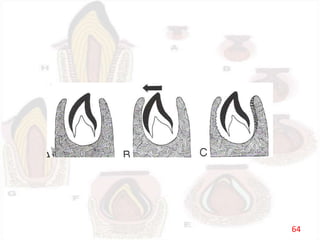
 Preeruptive movements involve bodily movement and eccentric
movement of the developing tooth germ.
 Bodily movement is the shift of the entire tooth germ.
 Eccentric movement is the relative growth in one part of the
tooth, leading to a change in the centre of the tooth germ.
Ref : Orban’s Oral histology & Embryology, G S Kumar, pg.no. 24-46, 13th edition, 2013
Ref :Avery JK: Embryology of the tooth. J Dent Res 30:490,1951
Ref : Avery JK: Primary induction of tooth formation. JDent Res 33:702,1954
63
64
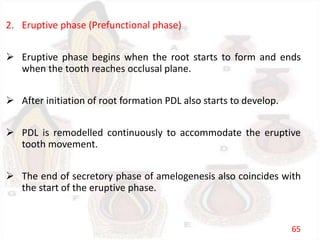
2. Eruptive phase (Prefunctional phase)
 Eruptive phase begins when the root starts to form and ends
when the tooth reaches occlusal plane.
 After initiation of root formation PDL also starts to develop.
 PDL is remodelled continuously to accommodate the eruptive
tooth movement.
 The end of secretory phase of amelogenesis also coincides with
the start of the eruptive phase.
65
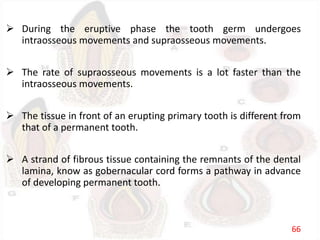
 During the eruptive phase the tooth germ undergoes
intraosseous movements and supraosseous movements.
 The rate of supraosseous movements is a lot faster than the
intraosseous movements.
 The tissue in front of an erupting primary tooth is different from
that of a permanent tooth.
 A strand of fibrous tissue containing the remnants of the dental
lamina, know as gobernacular cord forms a pathway in advance
of developing permanent tooth.
66
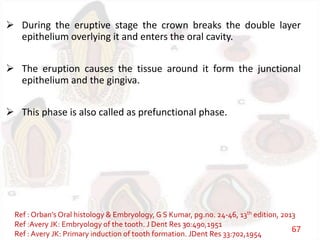
 During the eruptive stage the crown breaks the double layer
epithelium overlying it and enters the oral cavity.
 The eruption causes the tissue around it form the junctional
epithelium and the gingiva.
 This phase is also called as prefunctional phase.
Ref : Orban’s Oral histology & Embryology, G S Kumar, pg.no. 24-46, 13th edition, 2013
Ref :Avery JK: Embryology of the tooth. J Dent Res 30:490,1951
Ref : Avery JK: Primary induction of tooth formation. JDent Res 33:702,1954
67
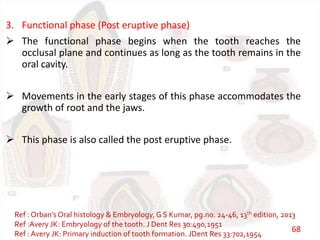
3. Functional phase (Post eruptive phase)
 The functional phase begins when the tooth reaches the
occlusal plane and continues as long as the tooth remains in the
oral cavity.
 Movements in the early stages of this phase accommodates the
growth of root and the jaws.
 This phase is also called the post eruptive phase.
Ref : Orban’s Oral histology & Embryology, G S Kumar, pg.no. 24-46, 13th edition, 2013
Ref :Avery JK: Embryology of the tooth. J Dent Res 30:490,1951
Ref : Avery JK: Primary induction of tooth formation. JDent Res 33:702,1954
68
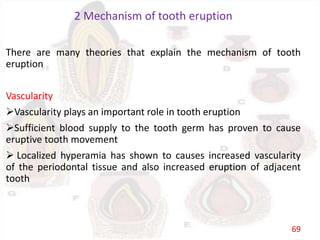
2 Mechanism of tooth eruption
There are many theories that explain the mechanism of tooth
eruption
Vascularity
Vascularity plays an important role in tooth eruption
Sufficient blood supply to the tooth germ has proven to cause
eruptive tooth movement
 Localized hyperamia has shown to causes increased vascularity
of the periodontal tissue and also increased eruption of adjacent
tooth
69
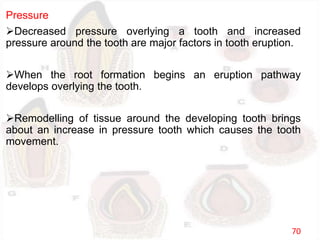
Pressure
Decreased pressure overlying a tooth and increased
pressure around the tooth are major factors in tooth eruption.
When the root formation begins an eruption pathway
develops overlying the tooth.
Remodelling of tissue around the developing tooth brings
about an increase in pressure tooth which causes the tooth
movement.
70
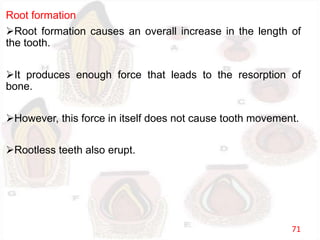
Root formation
Root formation causes an overall increase in the length of
the tooth.
It produces enough force that leads to the resorption of
bone.
However, this force in itself does not cause tooth movement.
Rootless teeth also erupt.
71
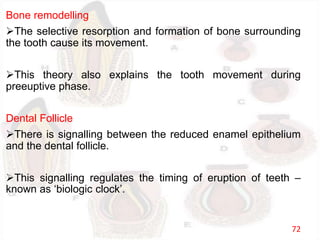
Bone remodelling
The selective resorption and formation of bone surrounding
the tooth cause its movement.
This theory also explains the tooth movement during
preeuptive phase.
Dental Follicle
There is signalling between the reduced enamel epithelium
and the dental follicle.
This signalling regulates the timing of eruption of teeth –
known as ‘biologic clock’.
72
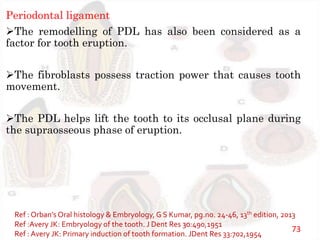
Periodontal ligament
The remodelling of PDL has also been considered as a
factor for tooth eruption.
The fibroblasts possess traction power that causes tooth
movement.
The PDL helps lift the tooth to its occlusal plane during
the supraosseous phase of eruption.
Ref : Orban’s Oral histology & Embryology, G S Kumar, pg.no. 24-46, 13th edition, 2013
Ref :Avery JK: Embryology of the tooth. J Dent Res 30:490,1951
Ref : Avery JK: Primary induction of tooth formation. JDent Res 33:702,1954
73
Review of literature
Ref. K. Heikinheimo Stage-specific Expression of Decapentaplegic-Vg-related Genes 2, 4, and 6 (Bone
Morphogenetic Proteins 2, 4,and 6) During HumanTooth Morphogenesis, J Dent Res 73(3): 590-597,74
K. Heikinheimo (1994) conducted a study on Stage-specific Expression of
Decapentaplegic-Vg-related Genes 2, 4, and 6 (Bone Morphogenetic Proteins 2, 4,and
6) During Human Tooth Morphogenesis.
Expression of DVR/bone morphogenetic
protein (BMP) 2, 4, and 6 was studied in human
fetal teeth. Sequential morphogenetic stage-
specific studies of DVR/BMP 2 and 4
mRNAexpression by in situ hybridization
revealed transcripts for
DVR/BMP4duringcompactionof the dental
mesenchyme.
Results suggest that DVR/BMP 4 is
involved in the early tooth morphogenesis.
DVR/BMP 6 may, in particular, be
implicated inepithelial-
mesenchymalinteractionscontrolling
cytodifferentiation. DVR/BMP2 and
6mayalso be involved in odontoblast
secretory function.
75
K. Heikinheimo and T. Salo (1995) conducted a study onExpression of Basement
Membrane Type IV Collagen and Type IV Collagenases (MMP-2 and MMP-9) in
Human Fetal Teeth .
During cap and bell stages, in situ
hybridization located transcripts for ccl type
IV collagen chain in the fibroblasts
surrounding the enamel organ. No oxl type IV
collagen chain mRNA was detected in tooth
germ epithelium or dental papilla.
Transcripts for MMP-2 were located mostly
in the cells of the dental papilla and follicle.
Transient expression of MMP-2 mRNA was
observed in the inner enamel epithelium of
late cap/early bell-stage teeth. During early
apposition, a high level of MMP-2 was
confined to secretory odontoblasts
Results suggest that dental BM, acl type
IV collagen chain may be of mesenchymal
cell origin. Further, MMP-2 but not MMP-
9 may participate in remodeling and
degradation of BM during human tooth
morphogenesis.
Ref:K. Heikinheimo and T. Salo, Expression of Basement Membrane Type IV Collagen and Type IV
Collagenases (MMP-2 and MMP-9) in Human Fetal Teeth, J Dent Res 74(5): 1226-1234, May, 1995
76
L. Ye et al (2006) conducted a study on Amelogenins in Human Developing and Mature
Dental Pulp.
Developing human tooth buds were
immunostained for amelogenin, and mRNA
was detected by in situ hybridization. The
effects of recombinant amelogenins on pulp
and papilla cell proliferation were measured by
Brd U immunoassay, and differentiation was
monitored by alkaline phosphatase expression.
Results suggest that odontoblasts actively
synthesize and secrete amelogenin protein
during human tooth development, and that
low-molecular-weight amelogenins can
enhance pulp cell proliferation.
Ref : L.Ye et al, Amelogenins in Human Developing and Mature Dental Pulp, J Dent Res
CONCLUSION
Since development of tooth forms the base of
dentistry, a thorough understanding and a sound
knowledge is required by a dentist regarding the
development stages of tooth & the anomalies related
to it, so as to identify & treat them in a proper fashion.
77
REFERENCES
1. Orban’s Oral histology & Embryology, G S Kumar, pg.no. 24-46, 13th edition,
2013.
2. Neville, Oral and maxilla facial pathology, pg.no.77-98, 3rd edition,2009
3. Avery JK: Embryology of the tooth. J Dent Res 30:490,1951
4. Avery JK: Primary induction of tooth formation. JDent Res 33:702,1954
5. L. Ye et al, Amelogenins in Human Developing and Mature Dental Pulp, J
Dent Res 85(9):814-818, 2006
6. K. Heikinheimo and T. Salo, Expression of Basement Membrane Type IV
Collagen and Type IV Collagenases (MMP-2 and MMP-9) in Human Fetal
Teeth, J Dent Res 74(5): 1226-1234, May, 1995
7. K. Heikinheimo Stage-specific Expression of Decapentaplegic-Vg-related
Genes 2, 4, and 6 (Bone Morphogenetic Proteins 2, 4,and 6) During Human
Tooth Morphogenesis, J Dent Res 73(3): 590-597, March, 1994
3. tooth development

3. tooth development

  • 1.
    DEVELOPMENT OF TOOTH CHAITANYA.P IMDS Dept of Public Health Dentistry
  • 2.
    Previous questions • Anodontia.(jun 14) • Write in detail about development of tooth. (may,08). • Describe the theories of eruption of teeth. 2
  • 3.
    CONTENTS 1. Introduction 2. DentalLamina 3. Vestibular Lamina 4. Tooth development 5. Developmental stages • Bud stage • Cap stage • Bell stage • Advanced bell stage 6. Hertwig’s epithelial root sheath and root formation 7. Review of literature 8. Conclusion 9. References 3
  • 4.
  • 5.
    • The primitiveoral cavity or stomodeum, is lined by stratified squamous epithelium called the oral ectoderm • The oral ectoderm contacts the endoderm of the foregut to form the buccopharyngeal membrane Ref : Orban’s Oral histology & Embryology,G S Kumar, pg.no. 24-46, 13th edition, 2013 5
  • 6.
  • 7.
    6th week ofintrauterine Tooth formation the formation of primary epithelial band 7th weekprimary epithelial band dental lamina vestibular lamina lingual extension distal extension All deciduous teeth Permanent teeth permanent molars oral vestibule Ref : Orban’s Oral histology & Embryology,G S Kumar, pg.no. 24-46, 13th edition, 2013 7
  • 8.
    FATE OF DENTALLAMINA • It is evident that total activity of dental lamina exceeds over a period of atleast 5 yrs • As the teeth continue to develop, they loose their connection with the dental lamina •They later break up by mesenchymal invasion, which is at first incomplete and does not perforate the total thickness of the lamina . • However the dental lamina may still be active in the third molar region after it has disappeared elsewhere, except for occasional epithelial remnants •Remnants of dental lamina persist as epithelial pearls or cell rest of serres. Ref : Orban’s Oral histology & Embryology, G S Kumar, pg.no. 24-46, 13th edition, 2013 8
  • 9.
    VESTIBULAR LAMINA • Labialand buccal to the dental lamina in each dental arch, another epithelial thickening develops independently • It is Vestibular Lamina also termed as lip furrow band • Subsequently hollows and form the oral vestibule between the alveolar portion of the jaws and the lips and cheeks. Ref : Orban’s Oral histology & Embryology,G S Kumar, pg.no. 24-46, 13th edition, 2013 9
  • 10.
  • 11.
    ANODONTIA • Anodontia, alsocalled anodontia vera, is a rare genetic disorder characterized by the congenital absence of all primary or permanent teeth • It is of following types 1. Complete anodontia/ total anodontia 2. Partial anodontia/ sub-Total anodontia • Forms- 1. True anodontia 2. Psuedo anodontia 3. False anodontia COMPLETE PARTIAL Ref : Neville, Oral and maxilla facial pathology, pg.no.77-98, 3rd edition,2009. 11
  • 12.
    SUPERNUMERARY TEETH Supernumerary teethcan be classified by shape and by position. The shapes include: • Supplemental(where the tooth has a normal shape for the teeth in that series); • Tuberculate (also called "barrel shaped"); • Conical (also called "peg shaped"); • Compound odontome (multiple small tooth-like forms); • Complex odontome (a disorganized mass of dental tissue) Hyperdontia is the condition of having supernumerary teeth, or teeth which appear in addition to the regular number of teeth When classified by position, a supernumerary tooth may be referred to as a mesiodens, a paramolar, or a distomolar. Ref : Neville, Oral and maxilla facial pathology, pg.no.77-98, 3rd edition,2009. 12
  • 13.
  • 14.
    • At certainpoints along the dental lamina each representing the location of one of the 10 mandibular & 10 maxillary teeth, ectodermal cells multiply rapidly & little knobs that grow into the underlying mesenchyme • Each of these little down growths from the dental lamina represents the beginning of the enamel organ of the tooth bud of a deciduous tooth • First to appear are those of anterior mandibular region • As the cell proliferation occurs each enamel organ takes a shape that resembles a cap Ref : Orban’s Oral histology & Embryology,G S Kumar, pg.no. 24-46, 13th edition, 2013 14
  • 15.
    DENTAL PAPILLA On theinside of the cap, the ectomesenchymal cells increase in number. The tissue appears more dense than the surrounding mesenchyme and represents the beginning of the dental papilla B = Dental Papilla Ref : Orban’s Oral histology & Embryology,G S Kumar, pg.no. 24-46, 13th edition, 2013 15
  • 16.
    DENTAL SAC/ DENTALFOLLICLE Surrounding the combined enamel organ or dental papilla, the third part of the tooth bud forms. It is known as dental sac/follicle and it consists of ectomesenchymal cells and fibers that surrounds the dental papilla and the enamel organ. C= Dental sac Ref : Orban’s Oral histology & Embryology,G S Kumar, pg.no. 24-46, 13th edition, 2013 16
  • 17.
    • Thus thetooth germ consists of ectodermal component- the enamel organ, the ectomesenchymal components- the dental papilla & the dental follicle • The enamel is formed from the enamel organ, the dentin and the pulp from the dental papilla and the supporting tissues namely the cementum, periodontal ligament & the alveolar bone from the dental follicle • During & after these developments the shape of the enamel organ continues to change • The depression occupied by the dental papilla deepens until the enamel organ assumes a shape resembling a bell • The dental lamina becomes longer, thinner & finally loses its connection with the epithelium of the primitive oral cavity Ref : Orban’s Oral histology & Embryology,G S Kumar, pg.no. 24-46, 13th edition, 2013 17
  • 18.
  • 19.
    MORPHOLOGICAL 1. Dental lamina 2.Bud stage 3. Cap stage 4. Early bell stage 5. Advanced bell stage 6. Formation of enamel and dentin matrix PHYSIOLOGICAL Initiation Proliferation Histodifferentiation Morphodifferentiation Apposition Ref : Orban’s Oral histology & Embryology,G S Kumar, pg.no. 24-46, 13th edition, 2013 19
  • 20.
    BUD STAGE /PROLIFERATION • This is the initial stage of tooth formation where enamel organ resembles a small bud • During the bud stage, the enamel organ consists of peripherally located low columnar cells & centrally located polygonal cells • The surrounding mesenchymal cells proliferate, which results in their condensation in two areas • The area of condensation immediately below the enamel organ is the dental papilla • The ectomesenchymal condensation that surrounds the tooth bud & the dental papilla is the tooth sac Ref : Orban’s Oral histology & Embryology,G S Kumar, pg.no. 24-46, 13th edition, 2013 20
  • 21.
    • The dentalpapilla as well as the dental sac are not well defined during the bud stage, they become more defined during the subsequent cap & bell stages • The cells of the dental papilla form the dentin and pulp while the dental sac forms cementum & periodontal ligament 21
  • 22.
    CAP STAGE /PROLIFERATION • As the tooth bud continues to proliferate, it does not expand uniformly into a large sphere • Instead unequal growth in different parts of the tooth bud leads to the cap stage which is characterized by a shallow invagination on the deep surface of the bud 22
  • 23.
    OUTER & INNERENAMEL EPITHELIUM • The peripheral cells of the cap stage are cuboidal , cover the convexity of the cap & are called the outer enamel epithelium • The cells in the concavity of the cap become tall columnar cells & represent the inner enamel epithelium Ref : Orban’s Oral histology & Embryology,G S Kumar, pg.no. 24-46, 13th edition, 2013 23
  • 24.
    •The outer enamelepithelium is separated from the dental sac, & the inner enamel epithelium from the dental papilla, by a delicate basement membrane 24
  • 25.
    STELLATE RETICULUM • Polygonalcells located between the outer and the inner enamel epithelium, begin to separate due to water being drawn into the enamel organ from the surrounding dental papilla • As a result the polygonal cells become star shaped but maintain contact with each other by their cytoplasmic process • As the star shaped cells form a cellular network, they are called the stellate reticulum 25
  • 26.
    • The cellsin the center of the enamel organ are densely packed and form the enamel knot • This knot projects toward the underlying dental papilla Ref : Orban’s Oral histology & Embryology,G S Kumar, pg.no. 24-46, 13th edition, 2013 26
  • 27.
    • At thesame time a vertical extension of the enamel knot, called the enamel cord occurs 27
  • 28.
    • The functionof enamel knot & cord may act as a reservoir of the dividing cells for the growing enamel organ • The enamel knot act as a signaling centers as many important growth factors are expressed by the cells of the enamel knot & thus play an important role in determining the shape of the tooth • The ectomesenchymal condensation i.e the dental papilla & the dental sac are pronounced during this stage of dental development Ref : Orban’s Oral histology & Embryology, G S Kumar, pg.no. 24-46, 13th edition, 2013 Ref :Avery JK: Embryology of the tooth. J Dent Res 30:490,1951 Ref : Avery JK: Primary induction of tooth formation. JDent Res 33:702,1954 28
  • 29.
    BELL STAGE /HISTODIFFERENTIATION • Due to continued uneven growth of the enamel organ it acquires a bell shape • In bell stage crown shape is determined • It was thought that the shape of the crown is due to pressure exerted by the growing dental papilla cells on the inner enamel epithelium • This pressure however was shown to be opposed equally by the pressure exerted by fluid present in the stellate reticulum • The folding of enamel organ to cause different crown shapes is shown to be due to different rates of mitosis & difference in cell differentiation time Ref : Orban’s Oral histology & Embryology,G S Kumar, pg.no. 24-46, 13th edition, 2013 29
  • 30.
    ADVANCED BELL STAGE/ MORPHODIFFERENTIATION  Characterized by the commencement of mineralization & root formation  The boundary between the inner enamel epithelium & odontoblasts outline the future dentinoenamel junction  Formation of dentin occurs first as a layer along the future dentinoenamel junction in the region of future cusps & proceeds pulpally & apically  After the first layer of dentin is formed, the ameloblasts lay down enamel over the dentin in the future incisal & cuspal areas Ref : Orban’s Oral histology & Embryology,G S Kumar, pg.no. 24-46, 13th edition, 2013 30
  • 31.
     The enamelformation then proceeds coronally & cervically in all the regions from the dentinoenamel junction toward the surface  The cervical portion of enamel organ gives rise to Hertwig Epithelial Root Sheath (HERS)  This HERS outlines the future root & thus responsible for the size, shape, length & number of roots Ref : Orban’s Oral histology & Embryology,G S Kumar, pg.no. 24-46, 13th edition, 2013 31
  • 32.
    INNER ENAMEL EPITHELIUM •The inner enamel epithelium consists of a single layer of cells that differentiate prior to amelogenesis into tall columnar cells called ameloblasts • These elongated cells are attached to one another by junctional complexes laterally & to cells in the stratum intermedium by desmosomes • The cells of the inner enamel epithelium exert a strong influence on the underlying mesenchymal cells of the dental papilla, which later differentiate into odontoblasts 32
  • 33.
    STRATUM INTERMEDIUM • Afew layers of squamous cells form the stratum intermedium , between the inner enamel epithelium & the stellate reticulum • These cells are closely attached by desmosomes & gap junctions • This layer seems to be essential to enamel formation 33
  • 34.
    STELLATE RETICULUM • Thestellate reticulum expands further due to continued accumulation of intra-cellular fluid • These star shaped cells, having a large processes anastomose with those of adjacent cells • As the enamel formation starts., the Stellate reticulum collapses to a narrow zone thereby reducing the distance between the outer & inner enamel epithelium 34
  • 35.
    OUTER ENAMEL EPITHELIUM •The cells of the outer enamel epithelium flatten to form low cuboidal cells • The outer enamel epithelium is thrown into folds which are rich in capillary network, this provides a source of nutrition for the enamel organ • Before the inner enamel epithelium begins to produce enamel. Peripheral cells of the dental papilla differentiate into odontoblasts • These cuboidal cells later assumes a columnar form & produce dentin 35
  • 36.
    DENTAL SAC • Thedental sac exhibits a circular arrangement of fibers & resembles a capsule around the enamel organ • The fibers of the dental sac form the periodontal ligament fibers that span between the root & the bone • The junction between the inner enamel epithelium & odontoblasts outlines the future dentino-enamel junction Ref : Orban’s Oral histology & Embryology,G S Kumar, pg.no. 24-46, 13th edition, 2013 36
  • 37.
    FORMATION OF ENAMEL& DENTIN MATIX ( APPOSITION) • Apposition is the deposition of the matrix of the hard enamel structures • Appositional growth of the enamel & dentin is a layer like deposition of an extracellular matrix. This type of growth is therefore additive • Appositional growth is characterised by regular & rhythmic deposition of the extracellular matrix, which is of itself incapable of further growth Ref : Orban’s Oral histology & Embryology,G S Kumar, pg.no. 24-46, 13th edition, 201337
  • 38.
  • 39.
  • 40.
    DENTINOGENESIS IMPERFECTA • Dentinogenesisimperfecta (hereditary Opalescent Dentin) is a genetic disorder of tooth development. • This condition causes teeth to be discolored (most often a blue-gray or yellow-brown color) and translucent. Teeth are also weaker than normal, making them prone to rapid wear, breakage, and loss. • These problems can affect both primary (baby) teeth and permanent teeth. • This condition is inherited in an autosomal dominant pattern, which means one copy of the altered gene in each cell is sufficient to cause the disorder. Ref : Neville, Oral and maxilla facial pathology, pg.no.77-98, 3rd edition,2009. 40
  • 41.
    HUTCHINSON’S INCISOR MULBERRY MOLARS Ref: Neville, Oral and maxilla facial pathology, pg.no.77-98, 3rd edition,2009. 41
  • 42.
    FUSION • The phenomenonof tooth fusion arises through union of two normally separated tooth germs, and depending upon the stage of development of the teeth at the time of union, it may be either complete or incomplete. • However, fusion can also be the union of a normal tooth bud to a supernumerary tooth germ. In these cases, the number of teeth is fewer if the anomalous tooth is counted as one tooth. Ref : Neville, Oral and maxilla facial pathology, pg.no.77-98, 3rd edition,2009. 42
  • 43.
    GEMINATION Gemination arises whentwo teeth develop from one tooth bud and, as a result, the patient has an extra tooth Ref : Neville, Oral and maxilla facial pathology, pg.no.77-98, 3rd edition,2009. 43
  • 44.
    ENAMEL HYPOPLASIA Enamel hypoplasiais the defect of the teeth in which the tooth enamel is hard but thin and deficient in amount This is caused by defective enamel matrix formation with a deficiency in the cementing substance Ref : Neville, Oral and maxilla facial pathology, pg.no.77-98, 3rd edition,2009. 44
  • 45.
    AMELOGENESIS IMPERFECTA • Amelogenesisimperfecta presents with abnormal formation of the enamel or external layer of teeth. Enamel is composed mostly of mineral, that is formed and regulated by the proteins in it. Amelogenesis imperfecta is due to the malfunction of the proteins in the enamel: ameloblastin, enamelin, tuftelin, amelogenin • People afflicted with amelogenesis imperfecta have teeth with abnormal color: yellow, brown or grey. The teeth have a higher risk for dental cavities and are hypersensitive to temperature changes. This disorder can afflict many number of teeth. Ref : Neville, Oral and maxilla facial pathology, pg.no.77-98, 3rd edition,2009. 45
  • 46.
    Dens- In- Dente( DENS INVAGINATUS) • Represents a defect of tooth in which a focal area on the tooth surface is folded or invaginated pulpally to a variable extent. • Defect in generally localized to a single tooth & interestingly maxillary lateral incisors are more commonly affected. • Bilateral involvement is often seen & sometimes defect can involve multiple teeth involving the supernumeraries. • In case of pulp involvement with or without apical pathology, endodontic treatment should be attempted. However in more severe form extraction should be done. Ref : Neville, Oral and maxilla facial pathology, pg.no.77-98, 3rd edition,2009. 46
  • 47.
    DENS EVAGINATUS • Densevaginatus is a condition found in teeth where the outer surface appears to form an extra bump or cusp. • Premolars are more likely to be affected than any other tooth. This may be seen more frequently in Asians • The pulp of the tooth may extend into the dens evaginatus. • There is a risk of the dens evaginatus chipping off in normal function • Hence this condition requires monitoring as the tooth can lose its blood and nerve supply as a result and may need root canal treatment. Ref : Neville, Oral and maxilla facial pathology, pg.no.77-98, 3rd edition,2009. 47
  • 48.
    TALON CUSP • Atalon cusp, also known as an "eagle's talon", is an extra cusp on an anterior tooth. • Of all cases, 55% occur on the permanent maxillary lateral incisor, and 33% occur on the permanent maxillary central incisor. They are found rarely in primary teeth • Whenever the lingual pits are present restorative treatments should be done to prevent caries • When talon cusp interferes with normal occlusion preventive care should be taken by performing endodontic treatment Ref : Neville, Oral and maxilla facial pathology, pg.no.77-98, 3rd edition,2009. 48
  • 49.
  • 50.
    • The developmentof roots begin after enamel & dentin formation has reached the future cementoenamel junction • The enamel organ plays an important role in root development by forming HERS, which models the shape of the root • HERS consists of outer & inner enamel epithelium only • As the first layer of the dentin has been laid down, the epithelial root sheath loses its structural continuity and is close relation to the surface of the root Ref : Orban’s Oral histology & Embryology, G S Kumar, pg.no. 24-46, 13th edition, 2013 Ref :Avery JK: Embryology of the tooth. J Dent Res 30:490,1951 Ref : Avery JK: Primary induction of tooth formation. JDent Res 33:702,1954 50
  • 51.
    •Its remnants persistsas an epithelial network of strands or clumps near the external surface of the root • These epithelial remnants are found in the periodontal ligament of erupted teeth and are called as rests of mallasez Ref : Orban’s Oral histology & Embryology,G S Kumar, pg.no. 24-46, 13th edition, 2013 51
  • 52.
    • Prior tothe beginning of root formation, the root sheath forms the epithelial diaphragm • The outer & the inner enamel epithelium bend at the future cementoenamel junction into a horizontal plane, narrowing the wide cervical opening • The proliferation of the cells of the epithelial diaphragm is accompanied by the proliferation of the cells of the connective tissues of the pulp, adjacent to the diaphragm • The free end of diaphragm does not grow into the connective tissue but the epithelium proliferates coronal to the epithelial diaphragm 52
  • 53.
    • Connective tissueof the dental sac surrounding the root sheath proliferates & invades the continuous double epithelial layer dividing it into network of epithelial strands • The rapid sequence of proliferation & destruction of Hertwig’s root sheath explains the fact that it cannot be seen as a continuous layer on the surface of developing root • In the last stages of the root development, the proliferation of the epithelium in the diaphragm lags behind that of the pulpal connective tissue • The wide apical foramen is reduced first to the width of the diaphragmatic opening itself & later is further narrowed by opposition of dentin & cementum to the apex of the root 53
  • 54.
    • Differential growthof the epithelial diaphragm in the multirooted teeth causes the division of root trunk into 2 or 3 roots • During the general growth of enamel organ, expansion of its cervical opening occurs in such a way that long tongue like extensions of the horizontal diaphragm develop • Before division of the root trunk occurs, free ends of the horizontal epithelial flaps grow towards each other & fuse • The single cervical opening is divided into 2 or 3 openings Ref : Orban’s Oral histology & Embryology,G S Kumar, pg.no. 24-46, 13th edition, 2013 54
  • 55.
    • On thepulpal surface of the dividing epithelial bridges, dentin formation starts • On the periphery of each opening, root development follows in the same way as described for single rooted teeth 55
  • 56.
  • 57.
    DILACERATION • Dilaceration refersto an angulation or a sharp bend or curve anywhere along the root portion of a tooth • Condition probably occurs subsequent to trauma or any other defect of development which alters the angulation of the tooth germ during root formation • Can easily be detected by radiographs • Care should be taken during extraction since these teeth are more prone to fracture Ref : Neville, Oral and maxilla facial pathology, pg.no.77-98, 3rd edition,2009. 57
  • 58.
    CONCRESCENCE Concrescence is acondition of teeth where the cementum overlying the roots of at least two teeth join together. The cause can sometimes be attribute to trauma or crowding of teeth. Radiographic diagnosis is mandatory before attempting tooth extraction Ref : Neville, Oral and maxilla facial pathology, pg.no.77-98, 3rd edition,2009. 58
  • 59.
  • 60.
    1 Phases oftooth eruption Eruption is the movement of the developing teeth through the bone and the overlying mucosa of the jaws to appear in the oral cavity and reach the occlusal plane Movements of teeth leading to eruption take place in three phases 1. Preeruptive phase 2. Eruptive phase 3. Functional phase Ref : Orban’s Oral histology & Embryology, G S Kumar, pg.no. 24-46, 13th edition, 2013 Ref :Avery JK: Embryology of the tooth. J Dent Res 30:490,1951 Ref : Avery JK: Primary induction of tooth formation. JDent Res 33:702,1954 60
  • 61.
  • 62.
    1. Preeruptive phase The movements in preeruptive phase are the movements of the developing tooth before the root begins to form.  It consists of movements of the developing tooth within the alveolar process.  The tooth germs move outward and upward/downward with the increasing length, width and height of the jaws. 62
  • 63.
     Preeruptive movementsinvolve bodily movement and eccentric movement of the developing tooth germ.  Bodily movement is the shift of the entire tooth germ.  Eccentric movement is the relative growth in one part of the tooth, leading to a change in the centre of the tooth germ. Ref : Orban’s Oral histology & Embryology, G S Kumar, pg.no. 24-46, 13th edition, 2013 Ref :Avery JK: Embryology of the tooth. J Dent Res 30:490,1951 Ref : Avery JK: Primary induction of tooth formation. JDent Res 33:702,1954 63
  • 64.
  • 65.
    2. Eruptive phase(Prefunctional phase)  Eruptive phase begins when the root starts to form and ends when the tooth reaches occlusal plane.  After initiation of root formation PDL also starts to develop.  PDL is remodelled continuously to accommodate the eruptive tooth movement.  The end of secretory phase of amelogenesis also coincides with the start of the eruptive phase. 65
  • 66.
     During theeruptive phase the tooth germ undergoes intraosseous movements and supraosseous movements.  The rate of supraosseous movements is a lot faster than the intraosseous movements.  The tissue in front of an erupting primary tooth is different from that of a permanent tooth.  A strand of fibrous tissue containing the remnants of the dental lamina, know as gobernacular cord forms a pathway in advance of developing permanent tooth. 66
  • 67.
     During theeruptive stage the crown breaks the double layer epithelium overlying it and enters the oral cavity.  The eruption causes the tissue around it form the junctional epithelium and the gingiva.  This phase is also called as prefunctional phase. Ref : Orban’s Oral histology & Embryology, G S Kumar, pg.no. 24-46, 13th edition, 2013 Ref :Avery JK: Embryology of the tooth. J Dent Res 30:490,1951 Ref : Avery JK: Primary induction of tooth formation. JDent Res 33:702,1954 67
  • 68.
    3. Functional phase(Post eruptive phase)  The functional phase begins when the tooth reaches the occlusal plane and continues as long as the tooth remains in the oral cavity.  Movements in the early stages of this phase accommodates the growth of root and the jaws.  This phase is also called the post eruptive phase. Ref : Orban’s Oral histology & Embryology, G S Kumar, pg.no. 24-46, 13th edition, 2013 Ref :Avery JK: Embryology of the tooth. J Dent Res 30:490,1951 Ref : Avery JK: Primary induction of tooth formation. JDent Res 33:702,1954 68
  • 69.
    2 Mechanism oftooth eruption There are many theories that explain the mechanism of tooth eruption Vascularity Vascularity plays an important role in tooth eruption Sufficient blood supply to the tooth germ has proven to cause eruptive tooth movement  Localized hyperamia has shown to causes increased vascularity of the periodontal tissue and also increased eruption of adjacent tooth 69
  • 70.
    Pressure Decreased pressure overlyinga tooth and increased pressure around the tooth are major factors in tooth eruption. When the root formation begins an eruption pathway develops overlying the tooth. Remodelling of tissue around the developing tooth brings about an increase in pressure tooth which causes the tooth movement. 70
  • 71.
    Root formation Root formationcauses an overall increase in the length of the tooth. It produces enough force that leads to the resorption of bone. However, this force in itself does not cause tooth movement. Rootless teeth also erupt. 71
  • 72.
    Bone remodelling The selectiveresorption and formation of bone surrounding the tooth cause its movement. This theory also explains the tooth movement during preeuptive phase. Dental Follicle There is signalling between the reduced enamel epithelium and the dental follicle. This signalling regulates the timing of eruption of teeth – known as ‘biologic clock’. 72
  • 73.
    Periodontal ligament The remodellingof PDL has also been considered as a factor for tooth eruption. The fibroblasts possess traction power that causes tooth movement. The PDL helps lift the tooth to its occlusal plane during the supraosseous phase of eruption. Ref : Orban’s Oral histology & Embryology, G S Kumar, pg.no. 24-46, 13th edition, 2013 Ref :Avery JK: Embryology of the tooth. J Dent Res 30:490,1951 Ref : Avery JK: Primary induction of tooth formation. JDent Res 33:702,1954 73
  • 74.
    Review of literature Ref.K. Heikinheimo Stage-specific Expression of Decapentaplegic-Vg-related Genes 2, 4, and 6 (Bone Morphogenetic Proteins 2, 4,and 6) During HumanTooth Morphogenesis, J Dent Res 73(3): 590-597,74 K. Heikinheimo (1994) conducted a study on Stage-specific Expression of Decapentaplegic-Vg-related Genes 2, 4, and 6 (Bone Morphogenetic Proteins 2, 4,and 6) During Human Tooth Morphogenesis. Expression of DVR/bone morphogenetic protein (BMP) 2, 4, and 6 was studied in human fetal teeth. Sequential morphogenetic stage- specific studies of DVR/BMP 2 and 4 mRNAexpression by in situ hybridization revealed transcripts for DVR/BMP4duringcompactionof the dental mesenchyme. Results suggest that DVR/BMP 4 is involved in the early tooth morphogenesis. DVR/BMP 6 may, in particular, be implicated inepithelial- mesenchymalinteractionscontrolling cytodifferentiation. DVR/BMP2 and 6mayalso be involved in odontoblast secretory function.
  • 75.
    75 K. Heikinheimo andT. Salo (1995) conducted a study onExpression of Basement Membrane Type IV Collagen and Type IV Collagenases (MMP-2 and MMP-9) in Human Fetal Teeth . During cap and bell stages, in situ hybridization located transcripts for ccl type IV collagen chain in the fibroblasts surrounding the enamel organ. No oxl type IV collagen chain mRNA was detected in tooth germ epithelium or dental papilla. Transcripts for MMP-2 were located mostly in the cells of the dental papilla and follicle. Transient expression of MMP-2 mRNA was observed in the inner enamel epithelium of late cap/early bell-stage teeth. During early apposition, a high level of MMP-2 was confined to secretory odontoblasts Results suggest that dental BM, acl type IV collagen chain may be of mesenchymal cell origin. Further, MMP-2 but not MMP- 9 may participate in remodeling and degradation of BM during human tooth morphogenesis. Ref:K. Heikinheimo and T. Salo, Expression of Basement Membrane Type IV Collagen and Type IV Collagenases (MMP-2 and MMP-9) in Human Fetal Teeth, J Dent Res 74(5): 1226-1234, May, 1995
  • 76.
    76 L. Ye etal (2006) conducted a study on Amelogenins in Human Developing and Mature Dental Pulp. Developing human tooth buds were immunostained for amelogenin, and mRNA was detected by in situ hybridization. The effects of recombinant amelogenins on pulp and papilla cell proliferation were measured by Brd U immunoassay, and differentiation was monitored by alkaline phosphatase expression. Results suggest that odontoblasts actively synthesize and secrete amelogenin protein during human tooth development, and that low-molecular-weight amelogenins can enhance pulp cell proliferation. Ref : L.Ye et al, Amelogenins in Human Developing and Mature Dental Pulp, J Dent Res
  • 77.
    CONCLUSION Since development oftooth forms the base of dentistry, a thorough understanding and a sound knowledge is required by a dentist regarding the development stages of tooth & the anomalies related to it, so as to identify & treat them in a proper fashion. 77
  • 78.
    REFERENCES 1. Orban’s Oralhistology & Embryology, G S Kumar, pg.no. 24-46, 13th edition, 2013. 2. Neville, Oral and maxilla facial pathology, pg.no.77-98, 3rd edition,2009 3. Avery JK: Embryology of the tooth. J Dent Res 30:490,1951 4. Avery JK: Primary induction of tooth formation. JDent Res 33:702,1954 5. L. Ye et al, Amelogenins in Human Developing and Mature Dental Pulp, J Dent Res 85(9):814-818, 2006 6. K. Heikinheimo and T. Salo, Expression of Basement Membrane Type IV Collagen and Type IV Collagenases (MMP-2 and MMP-9) in Human Fetal Teeth, J Dent Res 74(5): 1226-1234, May, 1995 7. K. Heikinheimo Stage-specific Expression of Decapentaplegic-Vg-related Genes 2, 4, and 6 (Bone Morphogenetic Proteins 2, 4,and 6) During Human Tooth Morphogenesis, J Dent Res 73(3): 590-597, March, 1994