PRESENTED BY-DR.TANYA ATTRE
( MDS 1ST
YR)
GUIDED BY -DR.VIDYA SEKHAR
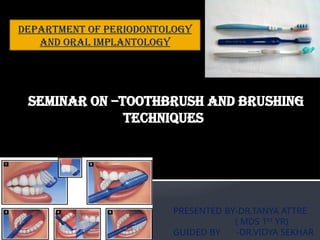
SEMINAR ON –TOOTHBRUSH AND BRUsHING
TECHNIQUES
DEPARTMENT OF PERIODONTOLOGY
AND ORAL IMPLANTOLOGY
CONTENT
 INTRODUCTION
 HISTORY
 OBJECTIVES OF TOOTH BRUSHING
 PARTS OF TOOTH BRUSHES
 TYPES OF TOOTH BRUSHES
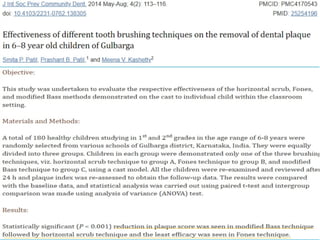
 METHODS OF TOOTH BRUSHING
 CARE OF TOOTHBRUSHES
 RECENT ADVANCEMENTS
INTRODUCTION
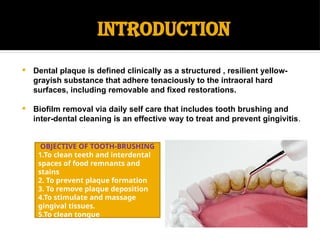
 Dental plaque is defined clinically as a structured , resilient yellow-
grayish substance that adhere tenaciously to the intraoral hard
surfaces, including removable and fixed restorations.
 Biofilm removal via daily self care that includes tooth brushing and
inter-dental cleaning is an effective way to treat and prevent gingivitis.
OBJECTIVE OF TOOTH-BRUSHING
1.To clean teeth and interdental
spaces of food remnants and
stains
2. To prevent plaque formation
3. To remove plaque deposition
4.To stimulate and massage
gingival tissues.
5.To clean tongue
DEVELOPMENT OF TOOTHBRUSH
HISTORY
 First toothbrush-In china(1600 century)-western
countries(1640 century)-In 1900 craftsmen
constructed handles of gold, ivory or ebony in which
replaceable brush head could be fitted.
 Nylon toothbrush -1938
 First electric toothbrush-1960
 1987-First Rotatory action electric toothbrushes
PARTS OF TOOTH BRUSH
T0oth brush consist of a head of
tightly clustered bristles mounted
on a handle, which facilitates the
cleansing of hard to reach areas
of the mouth
TOOTHBRUSH DESIGN
According to ADA-
Length-1 to 1.25 inches
Width-5/16 to 3/8 inches
Surface area-2.54 to 3.2 cm
No. of rows- 2 to 4 rows of brushes
No. of bristles-80 to 85 per tufts
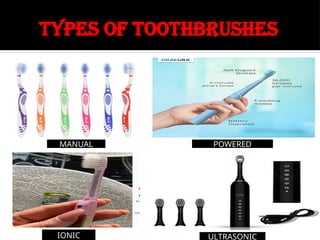
TYPES OF TOOTHBRUSHES
MANUAL POWERED
ULTRASONIC
IONIC
SHAPE OF TOOTH BRUSHING HEAD
1.There are variety of
shapes such as
rectangular ,oval and
diamond shape.
2.Every tooth surface
can be cleaned
effectively with the
conventional tooth
brush head design.
3.Diamond shape is
mostly
recommended for
posterior teeth.
4.Round shape is
recommended with
wire and brackets
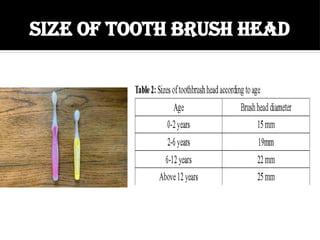
SIZE OF TOOTH BRUSH HEAD
BRISTLE PATTERN
BLOCK PATTERN
Bristle are of same length and
are arranged neatly like a
block.
WAVY OR V-SHAPE PATTERN
The bristles form v- shape.
This is intended to give the
bristle a better contact with
the area around the adjacent
teeth.
MULTILEVEL TRIM PATTERN
It enables the brush to reach
difficult to clean areas.
BRISTLE PATTERN
CRISS-CROSS PATTERN
According to manufacturer ,
this design can lift up the
plaque effectively
POLISHING –CUP BRISTLE
It is claimed that the bristles
can clean the surface stains
effectively
BRISTLES
 Bristle hardness is proportional to
square of diameter and inversely
proportional to square of bristle length.
 Diameter of bristle
Soft brush=0.2mm
Medium brush=0.3mm
Hard brush =0.4mm
Ultra soft=0.075mm
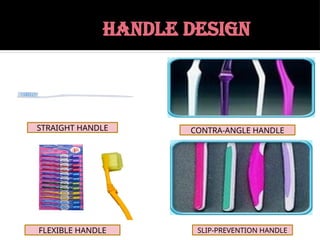
HANDLE DESIGN
STRAIGHT HANDLE CONTRA-ANGLE HANDLE
FLEXIBLE HANDLE SLIP-PREVENTION HANDLE
SEQUENCE OF TOOTH BRUSHING
AMOUNT and frequency OF
BRUSHING
 1.THE COUNT SYSTEM
Count 6 strokes in each area
 2.THE CLOCK SYSTEM
Time procedure cannot guarantee thorough
coverage ,as the most accessible area may get
more time.
 3.COMBINATION
 4.BUILT-IN TIMER
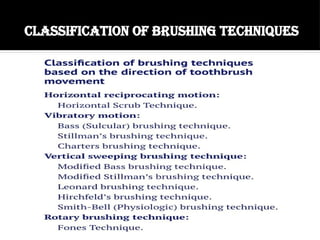
CLASSIFICATION OF BRUSHING TECHNIQUES
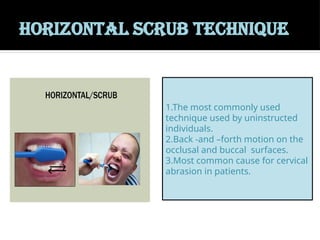
HORIZONTAL SCRUB TECHNIQUE
1.The most commonly used
technique used by uninstructed
individuals.
2.Back -and –forth motion on the
occlusal and buccal surfaces.
3.Most common cause for cervical
abrasion in patients.
THE BASS METHOD OR SULCULAR CLEANING
METHOD
INTRODUCTION
It is most widely accepted method for removal of
dental plaque present adjacent to and directly
underneath the gingival margin.
INDICATIONS:
Open inter proximal areas ,cervical area beneath the
height of contour of the enamel and exposed root
surface.
TECHNIQUE
ADVANTAGES AND DISADVANTAGES
ADVANTAGES
1.Effective method of removing plaque.
2.Provide good gingival stimulation.
3.Easy to learn.
DISADVANTAGES
1.Overzealous brushing may convert the very short
strokes into scrub brushing technique and cause
injury to gingival margin.
2.Time consuming.
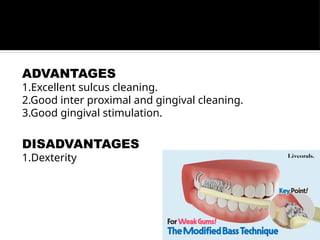
MODIFIED BASS TECHNIQUE
INDICATIONS
 1.As s routine oral hygiene measures
 2.Intrasulcular cleansing
TECHNIQUE
ADVANTAGES
1.Excellent sulcus cleaning.
2.Good inter proximal and gingival cleaning.
3.Good gingival stimulation.
DISADVANTAGES
1.Dexterity
MODIFIED STILLMAN
INDICATIONS
1.Dental plaque removal.
2.Cervical area below the height of contour , gingival recession
and exposed root surface.
TECHNIQUE 1.Bristles are positioned
apically with an oblique angle
to the long axis of the tooth.
2.Bristles are positioned on the
cervical aspect of the tooth.
3.Short back and forth motion
moved in the coronal direction.
DISADVANTAGES
1.Time consuming
2.Damage epithelial
attachment
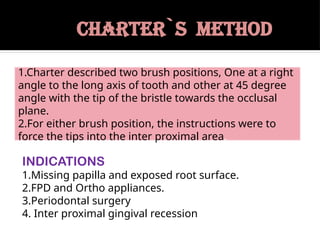
CHARTER`S METHOD
INDICATIONS
1.Missing papilla and exposed root surface.
2.FPD and Ortho appliances.
3.Periodontal surgery
4. Inter proximal gingival recession
1.Charter described two brush positions, One at a right
angle to the long axis of tooth and other at 45 degree
angle with the tip of the bristle towards the occlusal
plane.
2.For either brush position, the instructions were to
force the tips into the inter proximal area.
PROCEDURE
 1.Apply the Rolling stroke procedure
 2.Position the brush –Bristle are placed at an angle of
45 degree to the gingiva with the bristle directed
coronally
 3.Strokes-Press lightly to flex filaments and force the
tips between the teeth. Later, give the vibratory
strokes
DISADVANTAGE
A. Brush ends don’t
engage the gingival
sulcus to remove
subgingival bacterial
accumulation.
ROLL METHOD
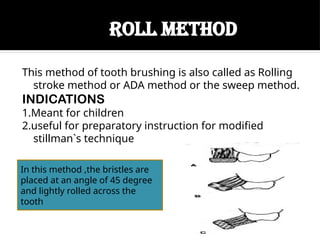
This method of tooth brushing is also called as Rolling
stroke method or ADA method or the sweep method.
INDICATIONS
1.Meant for children
2.useful for preparatory instruction for modified
stillman`s technique
In this method ,the bristles are
placed at an angle of 45 degree
and lightly rolled across the
tooth
CIRCULAR :THE FONES METHOD
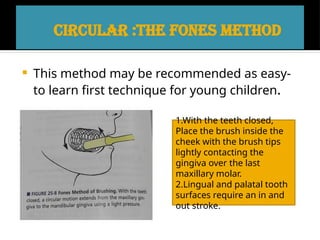
 This method may be recommended as easy-
to learn first technique for young children.
1.With the teeth closed,
Place the brush inside the
cheek with the brush tips
lightly contacting the
gingiva over the last
maxillary molar.
2.Lingual and palatal tooth
surfaces require an in and
out stroke.
VERTICAL:LEONARD METHOD
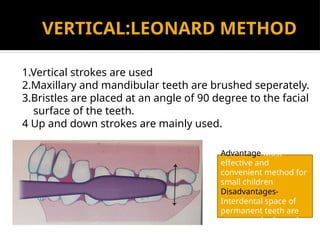
1.Vertical strokes are used
2.Maxillary and mandibular teeth are brushed seperately.
3.Bristles are placed at an angle of 90 degree to the facial
surface of the teeth.
4 Up and down strokes are mainly used.
Advantage-Most
effective and
convenient method for
small children
Disadvantages-
Interdental space of
permanent teeth are
not properly cleaned
PHYSIOLOGIC:SMITH METHOD
Based on the principle that toothbrush should follow
the physiologic pathway that is followed by the food
when it traverses over the tissue during mastication.
ADVANTAGE-natural self cleansing mechanism
DISADVANTAGE-Inter dental spaces and sulcular areas
of teeth are not properly cleaned.
SCRUB BRUSH METHOD
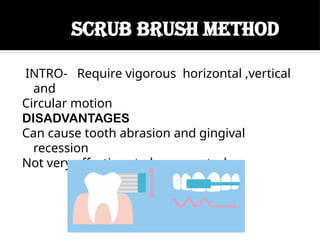
INTRO- Require vigorous horizontal ,vertical
and
Circular motion
DISADVANTAGES
Can cause tooth abrasion and gingival
recession
Not very effective at plaque control
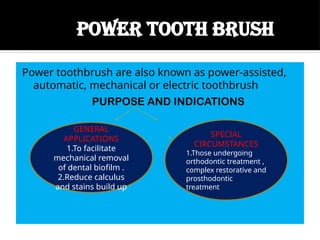
POWER TOOTH BRUSH
Power toothbrush are also known as power-assisted,
automatic, mechanical or electric toothbrush
PURPOSE AND INDICATIONS
GENERAL
APPLICATIONS
1.To facilitate
mechanical removal
of dental biofilm .
2.Reduce calculus
and stains build up
SPECIAL
CIRCUMSTANCES
1.Those undergoing
orthodontic treatment ,
complex restorative and
prosthodontic
treatment
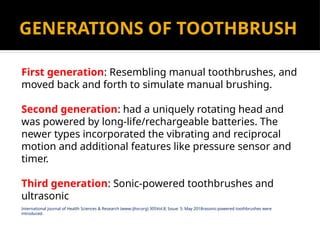
GENERATIONS OF TOOTHBRUSH
First generation: Resembling manual toothbrushes, and
moved back and forth to simulate manual brushing.
Second generation: had a uniquely rotating head and
was powered by long-life/rechargeable batteries. The
newer types incorporated the vibrating and reciprocal
motion and additional features like pressure sensor and
timer.
Third generation: Sonic-powered toothbrushes and
ultrasonic
International Journal of Health Sciences & Research (www.ijhsr.org) 305Vol.8; Issue: 5; May 2018rasonic-powered toothbrushes were
introduced.
CLASSIFICATION OF POWERED TOOTHBRUSH
Powered toothbrushes are divided into
six groups
1. Side to side action
2. Counter oscillation
3. Rotation oscillation
4. Circular
5. Ultrasonic
6. Ionic
DESCRIPTION
MOTION
 The entire brush head
moves as a unit in one
type of motion.
 The entire brush head
moves as a unit ,but in
different yet
simultaneous motions.
 Different shaped brush
head moves separately.
 Group of tufts may
move differently.
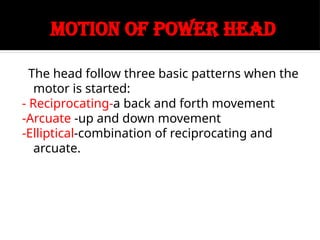
MOTION OF POWER HEAD
The head follow three basic patterns when the
motor is started:
- Reciprocating-a back and forth movement
-Arcuate -up and down movement
-Elliptical-combination of reciprocating and
arcuate.
POWER SOURCE
 Direct
 Replaceable batteries
 Rechargeable
 Disposable
 Switches
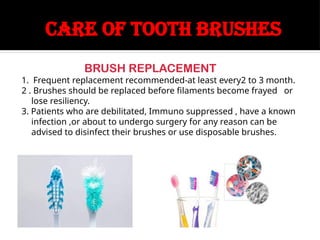
CARE OF TOOTH BRUSHES
BRUSH REPLACEMENT
1. Frequent replacement recommended-at least every2 to 3 month.
2 . Brushes should be replaced before filaments become frayed or
lose resiliency.
3. Patients who are debilitated, Immuno suppressed , have a known
infection ,or about to undergo surgery for any reason can be
advised to disinfect their brushes or use disposable brushes.
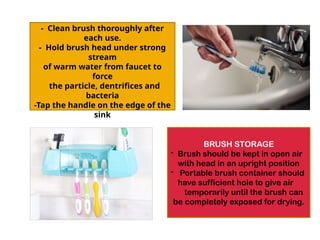
CLEANING THE TOOTH BRUSH
- Clean brush thoroughly after
each use.
- Hold brush head under strong
stream
of warm water from faucet to
force
the particle, dentrifices and
bacteria
-Tap the handle on the edge of the
sink
BRUSH STORAGE
- Brush should be kept in open air
with head in an upright position
- Portable brush container should
have sufficient hole to give air
temporarily until the brush can
be completely exposed for drying.
NEWER
ADVANCEMENTS
 SONIC TOOTH BRUSHES
- These types of toothbrushes produce high
frequency vibrations which leads to the
phenomenon of Cavitation and acoustic
Microstreaming . This phenomenon aids in
stain removal as well as disruption of
bacterial cell wall
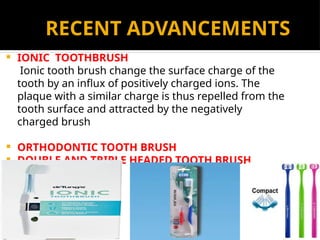
RECENT ADVANCEMENTS
 IONIC TOOTHBRUSH
Ionic tooth brush change the surface charge of the
tooth by an influx of positively charged ions. The
plaque with a similar charge is thus repelled from the
tooth surface and attracted by the negatively
charged brush
 ORTHODONTIC TOOTH BRUSH
 DOUBLE AND TRIPLE HEADED TOOTH BRUSH
BIODEGRADABLE TOOTHBRUSH
CONCLUSION
 Tooth brushing is the most commonly
employed method of plaque removal.
 Advancements in toothbrush designs
combined with newer technology have
made plaque control easy , less time
consuming and effective.
 Regardless of the design , the best plaque
control is achieved when the patient is
well motivated and instructed in its proper
use.
REFRENCES
1.CARRANZA`S CLINICAL PERIODONTOLOGY,14TH
EDITION
2.CLINICAL PRACTICE OF THE DENTAL HYGIENIST,ESTHER M.
WILKINS
3.ESSENTIALS OF PREVENTIVE AND COMMUNITY
DENTISTRY,SOBEN PETER
4.LINDHE’S CLINICAL PERIODONTOLOGY AND IMPLANT
DENTISTRY
5.International Journal of Health Sciences & Research
(www.ijhsr.org) 305Vol.8; Issue: 5; May 2018rasonic-powered
toothbrushes were
introduced
https://www.researchgate.net/publication/266151588_Effectiven
ess_of_different_tooth_brushing_techniques_on_the_removal_of
_dental_plaque_in_6-8_year_old_children_of_Gulbarga
Tooth brushing techniques and tooth brush types

Tooth brushing techniques and tooth brush types

  • 1.
    PRESENTED BY-DR.TANYA ATTRE (MDS 1ST YR) GUIDED BY -DR.VIDYA SEKHAR SEMINAR ON –TOOTHBRUSH AND BRUsHING TECHNIQUES DEPARTMENT OF PERIODONTOLOGY AND ORAL IMPLANTOLOGY
  • 2.
    CONTENT  INTRODUCTION  HISTORY OBJECTIVES OF TOOTH BRUSHING  PARTS OF TOOTH BRUSHES  TYPES OF TOOTH BRUSHES  METHODS OF TOOTH BRUSHING  CARE OF TOOTHBRUSHES  RECENT ADVANCEMENTS
  • 3.
    INTRODUCTION  Dental plaqueis defined clinically as a structured , resilient yellow- grayish substance that adhere tenaciously to the intraoral hard surfaces, including removable and fixed restorations.  Biofilm removal via daily self care that includes tooth brushing and inter-dental cleaning is an effective way to treat and prevent gingivitis. OBJECTIVE OF TOOTH-BRUSHING 1.To clean teeth and interdental spaces of food remnants and stains 2. To prevent plaque formation 3. To remove plaque deposition 4.To stimulate and massage gingival tissues. 5.To clean tongue
  • 4.
    DEVELOPMENT OF TOOTHBRUSH HISTORY First toothbrush-In china(1600 century)-western countries(1640 century)-In 1900 craftsmen constructed handles of gold, ivory or ebony in which replaceable brush head could be fitted.  Nylon toothbrush -1938  First electric toothbrush-1960  1987-First Rotatory action electric toothbrushes
  • 5.
    PARTS OF TOOTHBRUSH T0oth brush consist of a head of tightly clustered bristles mounted on a handle, which facilitates the cleansing of hard to reach areas of the mouth
  • 6.
    TOOTHBRUSH DESIGN According toADA- Length-1 to 1.25 inches Width-5/16 to 3/8 inches Surface area-2.54 to 3.2 cm No. of rows- 2 to 4 rows of brushes No. of bristles-80 to 85 per tufts
  • 7.
    TYPES OF TOOTHBRUSHES MANUALPOWERED ULTRASONIC IONIC
  • 8.
    SHAPE OF TOOTHBRUSHING HEAD 1.There are variety of shapes such as rectangular ,oval and diamond shape. 2.Every tooth surface can be cleaned effectively with the conventional tooth brush head design. 3.Diamond shape is mostly recommended for posterior teeth. 4.Round shape is recommended with wire and brackets
  • 9.
    SIZE OF TOOTHBRUSH HEAD
  • 10.
    BRISTLE PATTERN BLOCK PATTERN Bristleare of same length and are arranged neatly like a block. WAVY OR V-SHAPE PATTERN The bristles form v- shape. This is intended to give the bristle a better contact with the area around the adjacent teeth. MULTILEVEL TRIM PATTERN It enables the brush to reach difficult to clean areas.
  • 11.
    BRISTLE PATTERN CRISS-CROSS PATTERN Accordingto manufacturer , this design can lift up the plaque effectively POLISHING –CUP BRISTLE It is claimed that the bristles can clean the surface stains effectively
  • 12.
    BRISTLES  Bristle hardnessis proportional to square of diameter and inversely proportional to square of bristle length.  Diameter of bristle Soft brush=0.2mm Medium brush=0.3mm Hard brush =0.4mm Ultra soft=0.075mm
  • 13.
    HANDLE DESIGN STRAIGHT HANDLECONTRA-ANGLE HANDLE FLEXIBLE HANDLE SLIP-PREVENTION HANDLE
  • 14.
  • 15.
    AMOUNT and frequencyOF BRUSHING  1.THE COUNT SYSTEM Count 6 strokes in each area  2.THE CLOCK SYSTEM Time procedure cannot guarantee thorough coverage ,as the most accessible area may get more time.  3.COMBINATION  4.BUILT-IN TIMER
  • 16.
  • 17.
    HORIZONTAL SCRUB TECHNIQUE 1.Themost commonly used technique used by uninstructed individuals. 2.Back -and –forth motion on the occlusal and buccal surfaces. 3.Most common cause for cervical abrasion in patients.
  • 18.
    THE BASS METHODOR SULCULAR CLEANING METHOD INTRODUCTION It is most widely accepted method for removal of dental plaque present adjacent to and directly underneath the gingival margin. INDICATIONS: Open inter proximal areas ,cervical area beneath the height of contour of the enamel and exposed root surface.
  • 19.
  • 20.
    ADVANTAGES AND DISADVANTAGES ADVANTAGES 1.Effectivemethod of removing plaque. 2.Provide good gingival stimulation. 3.Easy to learn. DISADVANTAGES 1.Overzealous brushing may convert the very short strokes into scrub brushing technique and cause injury to gingival margin. 2.Time consuming.
  • 21.
    MODIFIED BASS TECHNIQUE INDICATIONS 1.As s routine oral hygiene measures  2.Intrasulcular cleansing TECHNIQUE
  • 22.
    ADVANTAGES 1.Excellent sulcus cleaning. 2.Goodinter proximal and gingival cleaning. 3.Good gingival stimulation. DISADVANTAGES 1.Dexterity
  • 24.
    MODIFIED STILLMAN INDICATIONS 1.Dental plaqueremoval. 2.Cervical area below the height of contour , gingival recession and exposed root surface. TECHNIQUE 1.Bristles are positioned apically with an oblique angle to the long axis of the tooth. 2.Bristles are positioned on the cervical aspect of the tooth. 3.Short back and forth motion moved in the coronal direction. DISADVANTAGES 1.Time consuming 2.Damage epithelial attachment
  • 25.
    CHARTER`S METHOD INDICATIONS 1.Missing papillaand exposed root surface. 2.FPD and Ortho appliances. 3.Periodontal surgery 4. Inter proximal gingival recession 1.Charter described two brush positions, One at a right angle to the long axis of tooth and other at 45 degree angle with the tip of the bristle towards the occlusal plane. 2.For either brush position, the instructions were to force the tips into the inter proximal area.
  • 26.
    PROCEDURE  1.Apply theRolling stroke procedure  2.Position the brush –Bristle are placed at an angle of 45 degree to the gingiva with the bristle directed coronally  3.Strokes-Press lightly to flex filaments and force the tips between the teeth. Later, give the vibratory strokes DISADVANTAGE A. Brush ends don’t engage the gingival sulcus to remove subgingival bacterial accumulation.
  • 27.
    ROLL METHOD This methodof tooth brushing is also called as Rolling stroke method or ADA method or the sweep method. INDICATIONS 1.Meant for children 2.useful for preparatory instruction for modified stillman`s technique In this method ,the bristles are placed at an angle of 45 degree and lightly rolled across the tooth
  • 28.
    CIRCULAR :THE FONESMETHOD  This method may be recommended as easy- to learn first technique for young children. 1.With the teeth closed, Place the brush inside the cheek with the brush tips lightly contacting the gingiva over the last maxillary molar. 2.Lingual and palatal tooth surfaces require an in and out stroke.
  • 29.
    VERTICAL:LEONARD METHOD 1.Vertical strokesare used 2.Maxillary and mandibular teeth are brushed seperately. 3.Bristles are placed at an angle of 90 degree to the facial surface of the teeth. 4 Up and down strokes are mainly used. Advantage-Most effective and convenient method for small children Disadvantages- Interdental space of permanent teeth are not properly cleaned
  • 30.
    PHYSIOLOGIC:SMITH METHOD Based onthe principle that toothbrush should follow the physiologic pathway that is followed by the food when it traverses over the tissue during mastication. ADVANTAGE-natural self cleansing mechanism DISADVANTAGE-Inter dental spaces and sulcular areas of teeth are not properly cleaned.
  • 31.
    SCRUB BRUSH METHOD INTRO-Require vigorous horizontal ,vertical and Circular motion DISADVANTAGES Can cause tooth abrasion and gingival recession Not very effective at plaque control
  • 32.
    POWER TOOTH BRUSH Powertoothbrush are also known as power-assisted, automatic, mechanical or electric toothbrush PURPOSE AND INDICATIONS GENERAL APPLICATIONS 1.To facilitate mechanical removal of dental biofilm . 2.Reduce calculus and stains build up SPECIAL CIRCUMSTANCES 1.Those undergoing orthodontic treatment , complex restorative and prosthodontic treatment
  • 33.
    GENERATIONS OF TOOTHBRUSH Firstgeneration: Resembling manual toothbrushes, and moved back and forth to simulate manual brushing. Second generation: had a uniquely rotating head and was powered by long-life/rechargeable batteries. The newer types incorporated the vibrating and reciprocal motion and additional features like pressure sensor and timer. Third generation: Sonic-powered toothbrushes and ultrasonic International Journal of Health Sciences & Research (www.ijhsr.org) 305Vol.8; Issue: 5; May 2018rasonic-powered toothbrushes were introduced.
  • 34.
    CLASSIFICATION OF POWEREDTOOTHBRUSH Powered toothbrushes are divided into six groups 1. Side to side action 2. Counter oscillation 3. Rotation oscillation 4. Circular 5. Ultrasonic 6. Ionic
  • 35.
    DESCRIPTION MOTION  The entirebrush head moves as a unit in one type of motion.  The entire brush head moves as a unit ,but in different yet simultaneous motions.  Different shaped brush head moves separately.  Group of tufts may move differently.
  • 36.
    MOTION OF POWERHEAD The head follow three basic patterns when the motor is started: - Reciprocating-a back and forth movement -Arcuate -up and down movement -Elliptical-combination of reciprocating and arcuate.
  • 37.
    POWER SOURCE  Direct Replaceable batteries  Rechargeable  Disposable  Switches
  • 38.
    CARE OF TOOTHBRUSHES BRUSH REPLACEMENT 1. Frequent replacement recommended-at least every2 to 3 month. 2 . Brushes should be replaced before filaments become frayed or lose resiliency. 3. Patients who are debilitated, Immuno suppressed , have a known infection ,or about to undergo surgery for any reason can be advised to disinfect their brushes or use disposable brushes.
  • 39.
    CLEANING THE TOOTHBRUSH - Clean brush thoroughly after each use. - Hold brush head under strong stream of warm water from faucet to force the particle, dentrifices and bacteria -Tap the handle on the edge of the sink BRUSH STORAGE - Brush should be kept in open air with head in an upright position - Portable brush container should have sufficient hole to give air temporarily until the brush can be completely exposed for drying.
  • 40.
    NEWER ADVANCEMENTS  SONIC TOOTHBRUSHES - These types of toothbrushes produce high frequency vibrations which leads to the phenomenon of Cavitation and acoustic Microstreaming . This phenomenon aids in stain removal as well as disruption of bacterial cell wall
  • 42.
    RECENT ADVANCEMENTS  IONICTOOTHBRUSH Ionic tooth brush change the surface charge of the tooth by an influx of positively charged ions. The plaque with a similar charge is thus repelled from the tooth surface and attracted by the negatively charged brush  ORTHODONTIC TOOTH BRUSH  DOUBLE AND TRIPLE HEADED TOOTH BRUSH
  • 43.
  • 46.
    CONCLUSION  Tooth brushingis the most commonly employed method of plaque removal.  Advancements in toothbrush designs combined with newer technology have made plaque control easy , less time consuming and effective.  Regardless of the design , the best plaque control is achieved when the patient is well motivated and instructed in its proper use.
  • 47.
    REFRENCES 1.CARRANZA`S CLINICAL PERIODONTOLOGY,14TH EDITION 2.CLINICALPRACTICE OF THE DENTAL HYGIENIST,ESTHER M. WILKINS 3.ESSENTIALS OF PREVENTIVE AND COMMUNITY DENTISTRY,SOBEN PETER 4.LINDHE’S CLINICAL PERIODONTOLOGY AND IMPLANT DENTISTRY 5.International Journal of Health Sciences & Research (www.ijhsr.org) 305Vol.8; Issue: 5; May 2018rasonic-powered toothbrushes were introduced https://www.researchgate.net/publication/266151588_Effectiven ess_of_different_tooth_brushing_techniques_on_the_removal_of _dental_plaque_in_6-8_year_old_children_of_Gulbarga