THE TOOTHBRUSH
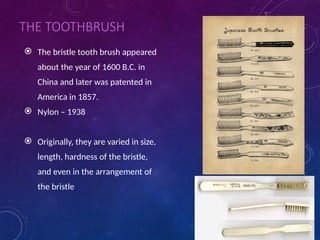
 The bristle tooth brush appeared
about the year of 1600 B.C. in
China and later was patented in
America in 1857.
 Nylon – 1938
 Originally, they are varied in size,
length, hardness of the bristle,
and even in the arrangement of
the bristle
THE TOOTHBRUSH
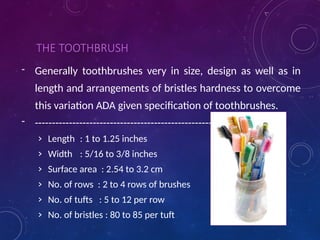
- Generally toothbrushes very in size, design as well as in
length and arrangements of bristles hardness to overcome
this variation ADA given specification of toothbrushes.
- ----------------------------------------------------------
› Length : 1 to 1.25 inches
› Width : 5/16 to 3/8 inches
› Surface area : 2.54 to 3.2 cm
› No. of rows : 2 to 4 rows of brushes
› No. of tufts : 5 to 12 per row
› No. of bristles : 80 to 85 per tuft
OBJECTIVES OF TOOTH BRUSHING
• To clean teeth and interdental spaces of food remnants,
debris and stain etc.
• To prevent plaque formation
• To disturb and remove plaque
• To stimulate and massage gingival tissue
• To clean the tongue.
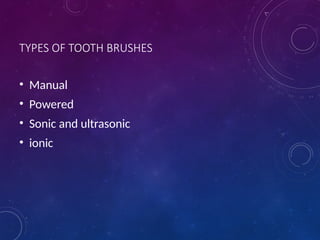
TYPES OF TOOTH BRUSHES
• Manual
• Powered
• Sonic and ultrasonic
• ionic
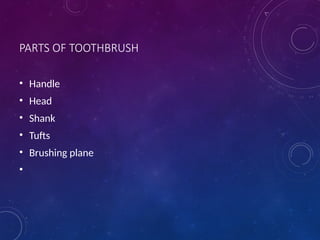
PARTS OF TOOTHBRUSH
• Handle
• Head
• Shank
• Tufts
• Brushing plane
•
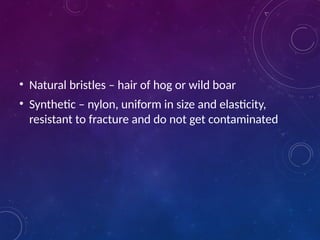
• Natural bristles – hair of hog or wild boar
• Synthetic – nylon, uniform in size and elasticity,
resistant to fracture and do not get contaminated
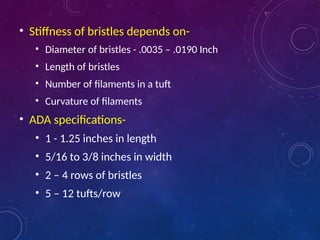
• Stiffness of bristles depends on-
• Diameter of bristles - .0035 – .0190 Inch
• Length of bristles
• Number of filaments in a tuft
• Curvature of filaments
• ADA specifications-
• 1 - 1.25 inches in length
• 5/16 to 3/8 inches in width
• 2 – 4 rows of bristles
• 5 – 12 tufts/row
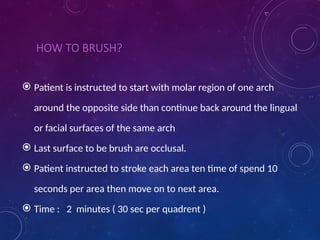
HOW TO BRUSH?
 Patient is instructed to start with molar region of one arch
around the opposite side than continue back around the lingual
or facial surfaces of the same arch
 Last surface to be brush are occlusal.
 Patient instructed to stroke each area ten time of spend 10
seconds per area then move on to next area.
 Time : 2 minutes ( 30 sec per quadrent )
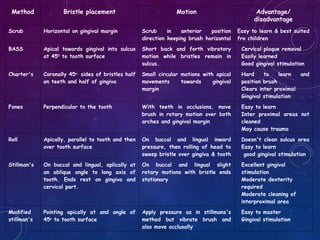
Method Bristle placement Motion Advantage/
disadvantage
Scrub Horizontal on gingival margin Scrub in anterior position
direction keeping brush horizontal
Easy to learn & best suited
fro children
BASS Apical towards gingival into sulcus
at 450
to tooth surface
Short back and forth vibratory
motion while bristles remain in
sulcus.
Cervical plaque removal
Easily learned
Good gingival stimulation
Charter's Coronally 45o,
sides of bristles half
on teeth and half of gingiva
Small circular motions with apical
movements towards gingival
margin
Hard to learn and
position brush
Clears inter proximal
Gingival stimulation
Fones Perpendicular to the tooth With teeth in occlusions, move
brush in rotary motion over both
arches and gingival margin
Easy to learn
Inter proximal areas not
cleaned
May cause trauma
Roll Apically, parallel to tooth and then
over tooth surface
On buccal and lingual inward
pressure, then rolling of head to
sweep bristle over gingiva & tooth
Doesn't clean sulcus area
Easy to learn
good gingival stimulation
Stillman's On buccal and lingual, aplically at
an ablique angle to long axis of
tooth. Ends rest on gingiva and
cervical part.
On buccal and lingual slight
rotary motions with bristle ends
stationary
Excellent gingival
stimulation
Moderate dexterity
required
Moderate cleaning of
interproximal area
Modified
stillman's
Pointing apically at and angle of
45o
to tooth surface
Apply pressure as in stillmans's
method but vibrate brush and
also move occlusally
Easy to master
Gingival stimulation
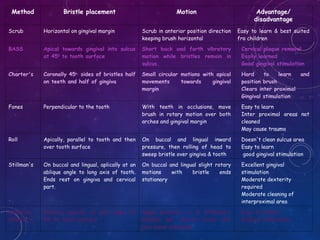
Method Bristle placement Motion Advantage/
disadvantage
Scrub Horizontal on gingival margin Scrub in anterior position direction
keeping brush horizontal
Easy to learn & best suited
fro children
BASS Apical towards gingival into sulcus
at 450
to tooth surface
Short back and forth vibratory
motion while bristles remain in
sulcus.
Cervical plaque removal
Easily learned
Good gingival stimulation
Charter's Coronally 45o,
sides of bristles half
on teeth and half of gingiva
Small circular motions with apical
movements towards gingival
margin
Hard to learn and
position brush
Clears inter proximal
Gingival stimulation
Fones Perpendicular to the tooth With teeth in occlusions, move
brush in rotary motion over both
arches and gingival margin
Easy to learn
Inter proximal areas not
cleaned
May cause trauma
Roll Apically, parallel to tooth and then
over tooth surface
On buccal and lingual inward
pressure, then rolling of head to
sweep bristle over gingiva & tooth
Doesn't clean sulcus area
Easy to learn
good gingival stimulation
Stillman's On buccal and lingual, aplically at an
ablique angle to long axis of tooth.
Ends rest on gingiva and cervical
part.
On buccal and lingual slight rotary
motions with bristle ends
stationary
Excellent gingival
stimulation
Moderate dexterity
required
Moderate cleaning of
interproximal area
Modified
stillman's
Pointing apically at and angle of
45o
to tooth surface
Apply pressure as in stillmans's
method but vibrate brush and
also move occlusally
Easy to master
Gingival stimulation
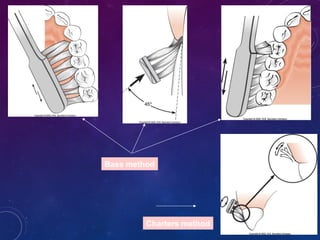
Charters method
Bass method
ELECTRIC TOOTHBRUSH ( POWERED)
• In 1939 powered tooth brush invented to make plaque control easier.
• Its mainly recommended for
(a) Individual lacking motor skills
(b) Hospitalized patients whose teeth are cleaned by the caregivers.
(c) Special needs patient ( physical and mental disability)
(d) Patient with orthodontic appliances
(e) Whosoever wants to use
 There are many powered tooth brushes some with reciprocal of back
and forth motions and some with combination of both some are
circular and elliptical motion.
 Powered tooth cleaner resembles a dental prophylaxis and hand piece
with rotary rubber cap.
 Patient should be illustrated for proper use.
DENTRIFICES
• Substance used with a toothbrush for the purpose of
cleaning the accessible surfaces of teeth.
• Function
• Minimize plaque build up
• Anticaries action
• Removal of stains
• Mouth freshener
INTERDENTAL CLEANING AIDS
 Any tooth brush , regardless of the brushing method, does not
completely remove interdental plaque. Even for patients with
wide-open dental embrasures. ( Gjermo, 1970, Schmid 1976).
 The majority of dental and periodontal disease's originate in
interproximal area, interdental plaque removal is necessary
 Tissue destruction associated with PDL Disease often leave
large ,open spaces, between teeth and exposed roots with
anatomic concavities and furcations which are difficult to clean
and access with the toothbrush.
 The purpose of Interdental cleaning aids is to remove plaque,
not to dislodge food wedged between teeth.
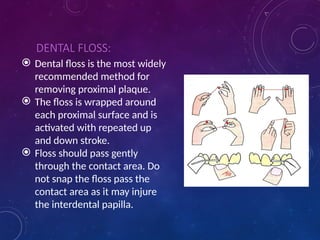
DENTAL FLOSS:
 Dental floss is the most widely
recommended method for
removing proximal plaque.
 The floss is wrapped around
each proximal surface and is
activated with repeated up
and down stroke.
 Floss should pass gently
through the contact area. Do
not snap the floss pass the
contact area as it may injure
the interdental papilla.
DENTAL FLOSS
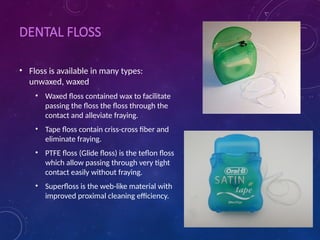
• Floss is available in many types:
unwaxed, waxed
• Waxed floss contained wax to facilitate
passing the floss the floss through the
contact and alleviate fraying.
• Tape floss contain criss-cross fiber and
eliminate fraying.
• PTFE floss (Glide floss) is the teflon floss
which allow passing through very tight
contact easily without fraying.
• Superfloss is the web-like material with
improved proximal cleaning efficiency.
FYI
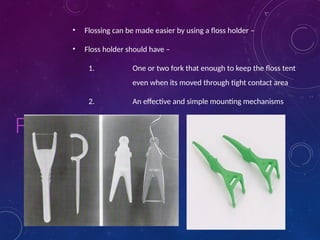
• Flossing can be made easier by using a floss holder –
• Floss holder should have –
1. One or two fork that enough to keep the floss tent
even when its moved through tight contact area
2. An effective and simple mounting mechanisms
INTERDENTAL BRUSH (PROXA BRUSH):
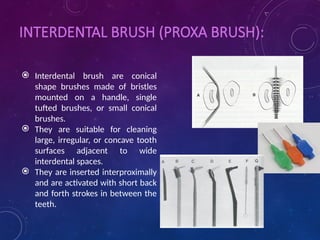
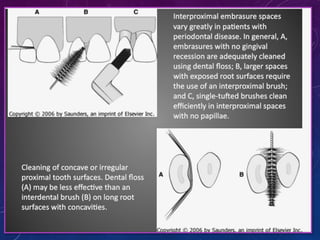
 Interdental brush are conical
shape brushes made of bristles
mounted on a handle, single
tufted brushes, or small conical
brushes.
 They are suitable for cleaning
large, irregular, or concave tooth
surfaces adjacent to wide
interdental spaces.
 They are inserted interproximally
and are activated with short back
and forth strokes in between the
teeth.
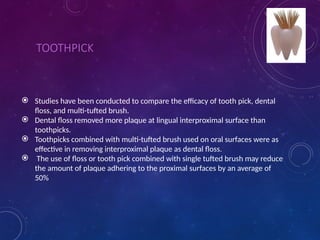
TOOTHPICK
 Studies have been conducted to compare the efficacy of tooth pick, dental
floss, and multi-tufted brush.
 Dental floss removed more plaque at lingual interproximal surface than
toothpicks.
 Toothpicks combined with multi-tufted brush used on oral surfaces were as
effective in removing interproximal plaque as dental floss.
 The use of floss or tooth pick combined with single tufted brush may reduce
the amount of plaque adhering to the proximal surfaces by an average of
50%
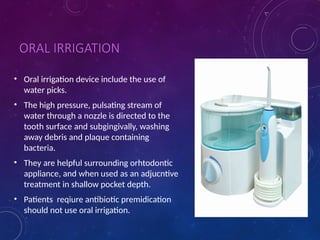
ORAL IRRIGATION
• Oral irrigation device include the use of
water picks.
• The high pressure, pulsating stream of
water through a nozzle is directed to the
tooth surface and subgingivally, washing
away debris and plaque containing
bacteria.
• They are helpful surrounding orhtodontic
appliance, and when used as an adjucntive
treatment in shallow pocket depth.
• Patients reqiure antibiotic premidication
should not use oral irrigation.
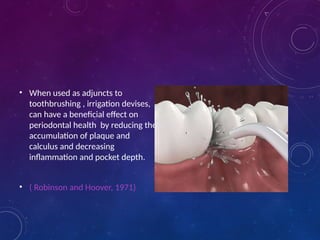
• When used as adjuncts to
toothbrushing , irrigation devises,
can have a beneficial effect on
periodontal health by reducing the
accumulation of plaque and
calculus and decreasing
inflammation and pocket depth.
• ( Robinson and Hoover, 1971)
THE END
QUESTIONS ?

mechanicalplaquecontrol-120604132850-phpapp02.ppt

  • 2.
    THE TOOTHBRUSH  Thebristle tooth brush appeared about the year of 1600 B.C. in China and later was patented in America in 1857.  Nylon – 1938  Originally, they are varied in size, length, hardness of the bristle, and even in the arrangement of the bristle
  • 3.
    THE TOOTHBRUSH - Generallytoothbrushes very in size, design as well as in length and arrangements of bristles hardness to overcome this variation ADA given specification of toothbrushes. - ---------------------------------------------------------- › Length : 1 to 1.25 inches › Width : 5/16 to 3/8 inches › Surface area : 2.54 to 3.2 cm › No. of rows : 2 to 4 rows of brushes › No. of tufts : 5 to 12 per row › No. of bristles : 80 to 85 per tuft
  • 4.
    OBJECTIVES OF TOOTHBRUSHING • To clean teeth and interdental spaces of food remnants, debris and stain etc. • To prevent plaque formation • To disturb and remove plaque • To stimulate and massage gingival tissue • To clean the tongue.
  • 5.
    TYPES OF TOOTHBRUSHES • Manual • Powered • Sonic and ultrasonic • ionic
  • 6.
    PARTS OF TOOTHBRUSH •Handle • Head • Shank • Tufts • Brushing plane •
  • 7.
    • Natural bristles– hair of hog or wild boar • Synthetic – nylon, uniform in size and elasticity, resistant to fracture and do not get contaminated
  • 8.
    • Stiffness ofbristles depends on- • Diameter of bristles - .0035 – .0190 Inch • Length of bristles • Number of filaments in a tuft • Curvature of filaments • ADA specifications- • 1 - 1.25 inches in length • 5/16 to 3/8 inches in width • 2 – 4 rows of bristles • 5 – 12 tufts/row
  • 9.
    HOW TO BRUSH? Patient is instructed to start with molar region of one arch around the opposite side than continue back around the lingual or facial surfaces of the same arch  Last surface to be brush are occlusal.  Patient instructed to stroke each area ten time of spend 10 seconds per area then move on to next area.  Time : 2 minutes ( 30 sec per quadrent )
  • 10.
    Method Bristle placementMotion Advantage/ disadvantage Scrub Horizontal on gingival margin Scrub in anterior position direction keeping brush horizontal Easy to learn & best suited fro children BASS Apical towards gingival into sulcus at 450 to tooth surface Short back and forth vibratory motion while bristles remain in sulcus. Cervical plaque removal Easily learned Good gingival stimulation Charter's Coronally 45o, sides of bristles half on teeth and half of gingiva Small circular motions with apical movements towards gingival margin Hard to learn and position brush Clears inter proximal Gingival stimulation Fones Perpendicular to the tooth With teeth in occlusions, move brush in rotary motion over both arches and gingival margin Easy to learn Inter proximal areas not cleaned May cause trauma Roll Apically, parallel to tooth and then over tooth surface On buccal and lingual inward pressure, then rolling of head to sweep bristle over gingiva & tooth Doesn't clean sulcus area Easy to learn good gingival stimulation Stillman's On buccal and lingual, aplically at an ablique angle to long axis of tooth. Ends rest on gingiva and cervical part. On buccal and lingual slight rotary motions with bristle ends stationary Excellent gingival stimulation Moderate dexterity required Moderate cleaning of interproximal area Modified stillman's Pointing apically at and angle of 45o to tooth surface Apply pressure as in stillmans's method but vibrate brush and also move occlusally Easy to master Gingival stimulation
  • 11.
    Method Bristle placementMotion Advantage/ disadvantage Scrub Horizontal on gingival margin Scrub in anterior position direction keeping brush horizontal Easy to learn & best suited fro children BASS Apical towards gingival into sulcus at 450 to tooth surface Short back and forth vibratory motion while bristles remain in sulcus. Cervical plaque removal Easily learned Good gingival stimulation Charter's Coronally 45o, sides of bristles half on teeth and half of gingiva Small circular motions with apical movements towards gingival margin Hard to learn and position brush Clears inter proximal Gingival stimulation Fones Perpendicular to the tooth With teeth in occlusions, move brush in rotary motion over both arches and gingival margin Easy to learn Inter proximal areas not cleaned May cause trauma Roll Apically, parallel to tooth and then over tooth surface On buccal and lingual inward pressure, then rolling of head to sweep bristle over gingiva & tooth Doesn't clean sulcus area Easy to learn good gingival stimulation Stillman's On buccal and lingual, aplically at an ablique angle to long axis of tooth. Ends rest on gingiva and cervical part. On buccal and lingual slight rotary motions with bristle ends stationary Excellent gingival stimulation Moderate dexterity required Moderate cleaning of interproximal area Modified stillman's Pointing apically at and angle of 45o to tooth surface Apply pressure as in stillmans's method but vibrate brush and also move occlusally Easy to master Gingival stimulation
  • 12.
  • 13.
    ELECTRIC TOOTHBRUSH (POWERED) • In 1939 powered tooth brush invented to make plaque control easier. • Its mainly recommended for (a) Individual lacking motor skills (b) Hospitalized patients whose teeth are cleaned by the caregivers. (c) Special needs patient ( physical and mental disability) (d) Patient with orthodontic appliances (e) Whosoever wants to use  There are many powered tooth brushes some with reciprocal of back and forth motions and some with combination of both some are circular and elliptical motion.  Powered tooth cleaner resembles a dental prophylaxis and hand piece with rotary rubber cap.  Patient should be illustrated for proper use.
  • 14.
    DENTRIFICES • Substance usedwith a toothbrush for the purpose of cleaning the accessible surfaces of teeth. • Function • Minimize plaque build up • Anticaries action • Removal of stains • Mouth freshener
  • 15.
    INTERDENTAL CLEANING AIDS Any tooth brush , regardless of the brushing method, does not completely remove interdental plaque. Even for patients with wide-open dental embrasures. ( Gjermo, 1970, Schmid 1976).  The majority of dental and periodontal disease's originate in interproximal area, interdental plaque removal is necessary  Tissue destruction associated with PDL Disease often leave large ,open spaces, between teeth and exposed roots with anatomic concavities and furcations which are difficult to clean and access with the toothbrush.  The purpose of Interdental cleaning aids is to remove plaque, not to dislodge food wedged between teeth.
  • 16.
    DENTAL FLOSS:  Dentalfloss is the most widely recommended method for removing proximal plaque.  The floss is wrapped around each proximal surface and is activated with repeated up and down stroke.  Floss should pass gently through the contact area. Do not snap the floss pass the contact area as it may injure the interdental papilla.
  • 17.
    DENTAL FLOSS • Flossis available in many types: unwaxed, waxed • Waxed floss contained wax to facilitate passing the floss the floss through the contact and alleviate fraying. • Tape floss contain criss-cross fiber and eliminate fraying. • PTFE floss (Glide floss) is the teflon floss which allow passing through very tight contact easily without fraying. • Superfloss is the web-like material with improved proximal cleaning efficiency.
  • 18.
    FYI • Flossing canbe made easier by using a floss holder – • Floss holder should have – 1. One or two fork that enough to keep the floss tent even when its moved through tight contact area 2. An effective and simple mounting mechanisms
  • 19.
    INTERDENTAL BRUSH (PROXABRUSH):  Interdental brush are conical shape brushes made of bristles mounted on a handle, single tufted brushes, or small conical brushes.  They are suitable for cleaning large, irregular, or concave tooth surfaces adjacent to wide interdental spaces.  They are inserted interproximally and are activated with short back and forth strokes in between the teeth.
  • 21.
    TOOTHPICK  Studies havebeen conducted to compare the efficacy of tooth pick, dental floss, and multi-tufted brush.  Dental floss removed more plaque at lingual interproximal surface than toothpicks.  Toothpicks combined with multi-tufted brush used on oral surfaces were as effective in removing interproximal plaque as dental floss.  The use of floss or tooth pick combined with single tufted brush may reduce the amount of plaque adhering to the proximal surfaces by an average of 50%
  • 22.
    ORAL IRRIGATION • Oralirrigation device include the use of water picks. • The high pressure, pulsating stream of water through a nozzle is directed to the tooth surface and subgingivally, washing away debris and plaque containing bacteria. • They are helpful surrounding orhtodontic appliance, and when used as an adjucntive treatment in shallow pocket depth. • Patients reqiure antibiotic premidication should not use oral irrigation.
  • 23.
    • When usedas adjuncts to toothbrushing , irrigation devises, can have a beneficial effect on periodontal health by reducing the accumulation of plaque and calculus and decreasing inflammation and pocket depth. • ( Robinson and Hoover, 1971)
  • 24.