Presented by
Dr. Janaki K T
MDS Sr. Lecturer
DEFINITION
Removal of dental plaque on a regular basis and
prevention of its accumulation on the teeth and
adjacent gingival surfaces
TOOTH BRUSH
First bristle tooth brush appeared - 1600 in china
ADA -- dimensions of Brushes
brushing surface : 1 - 1.25 inches long
5/16 - 3/8 inch wide
2 - 4 rows of bristles
5 - 12 tufts per row
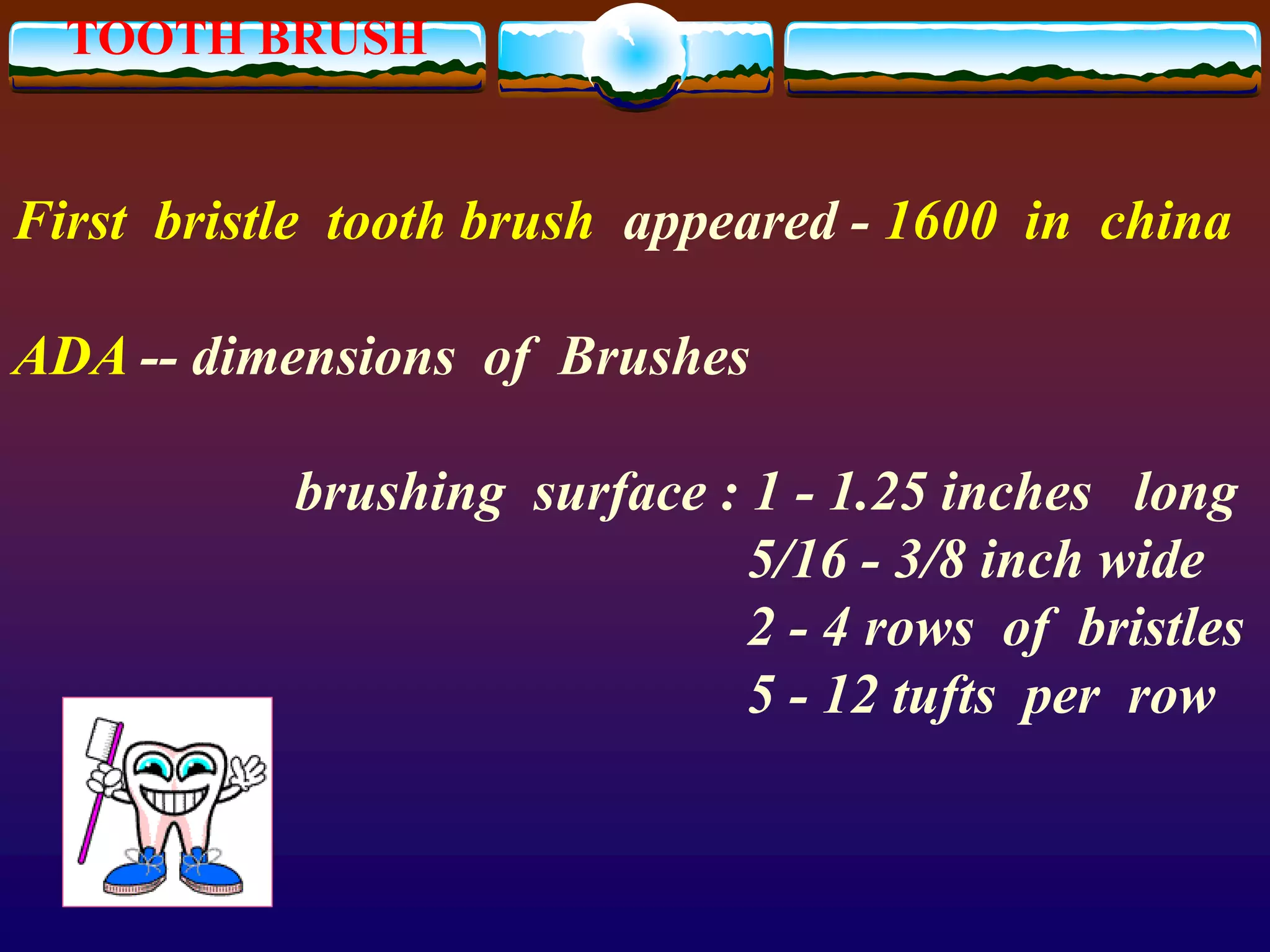
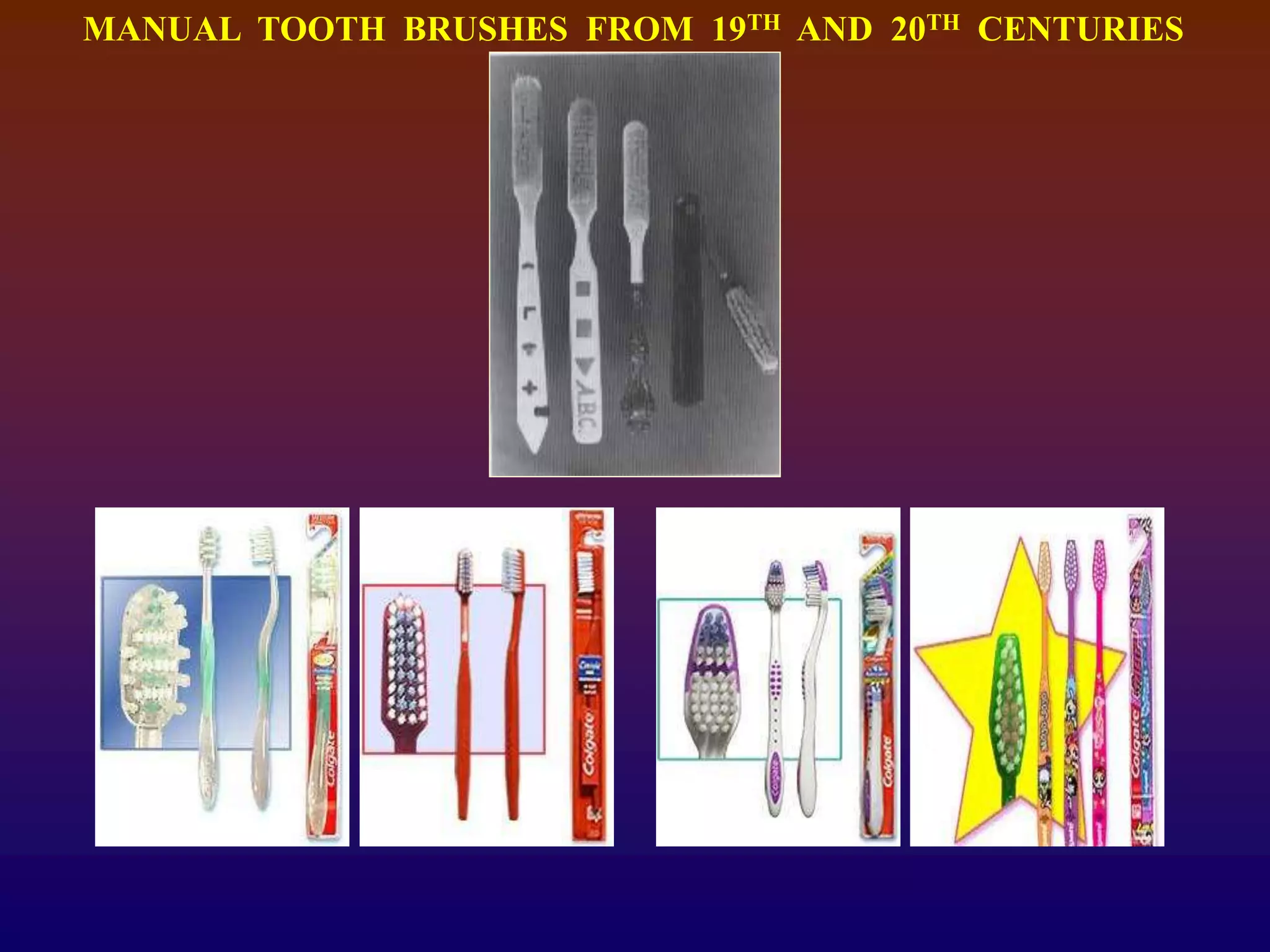
MANUAL TOOTH BRUSHES FROM 19TH AND 20TH CENTURIES
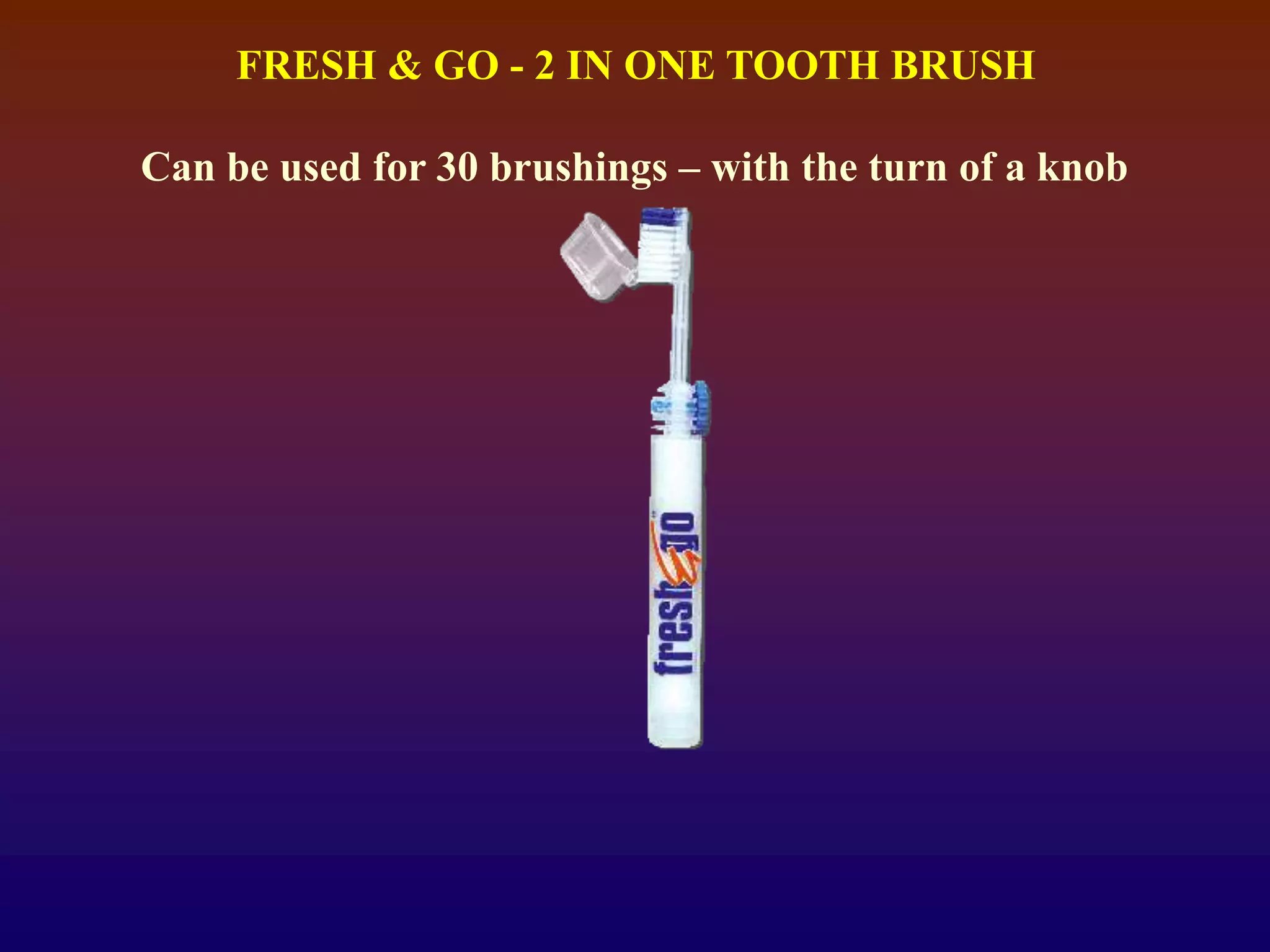
FRESH & GO - 2 IN ONE TOOTH BRUSH
Can be used for 30 brushings – with the turn of a knob
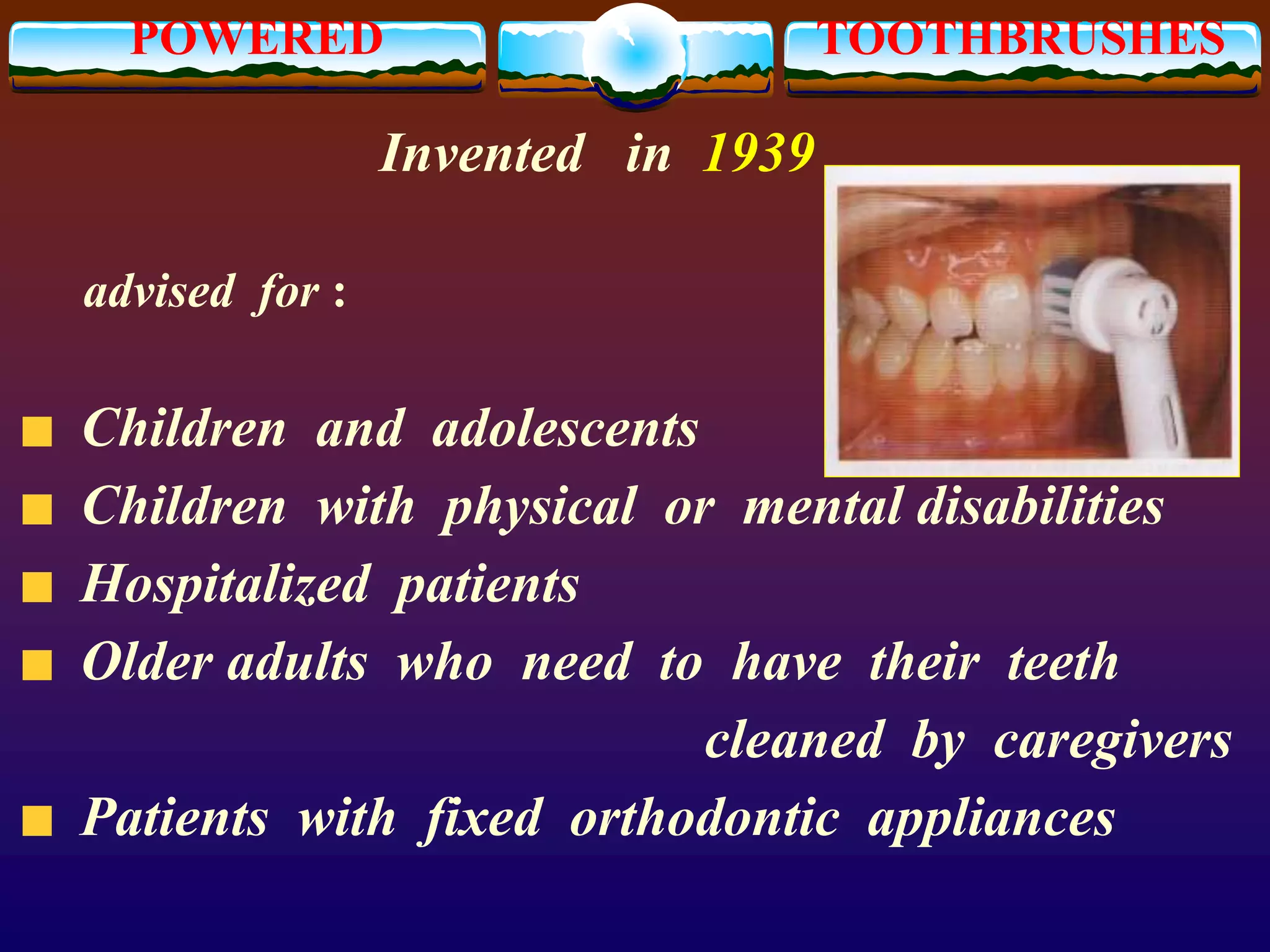
POWERED TOOTHBRUSHES
Invented in 1939
advised for :
Children and adolescents
Children with physical or mental disabilities
Hospitalized patients
Older adults who need to have their teeth
cleaned by caregivers
Patients with fixed orthodontic appliances
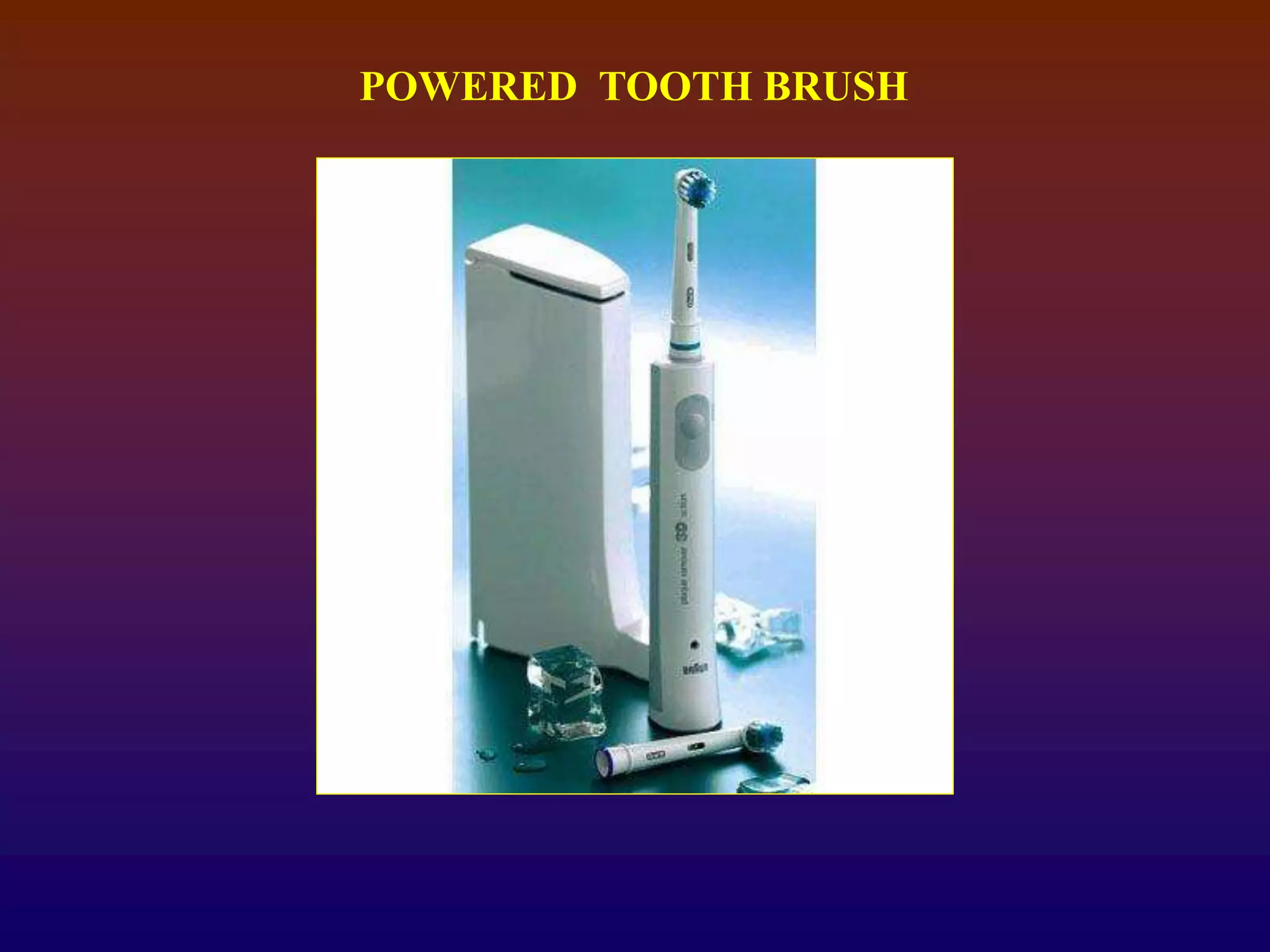
POWERED TOOTH BRUSH
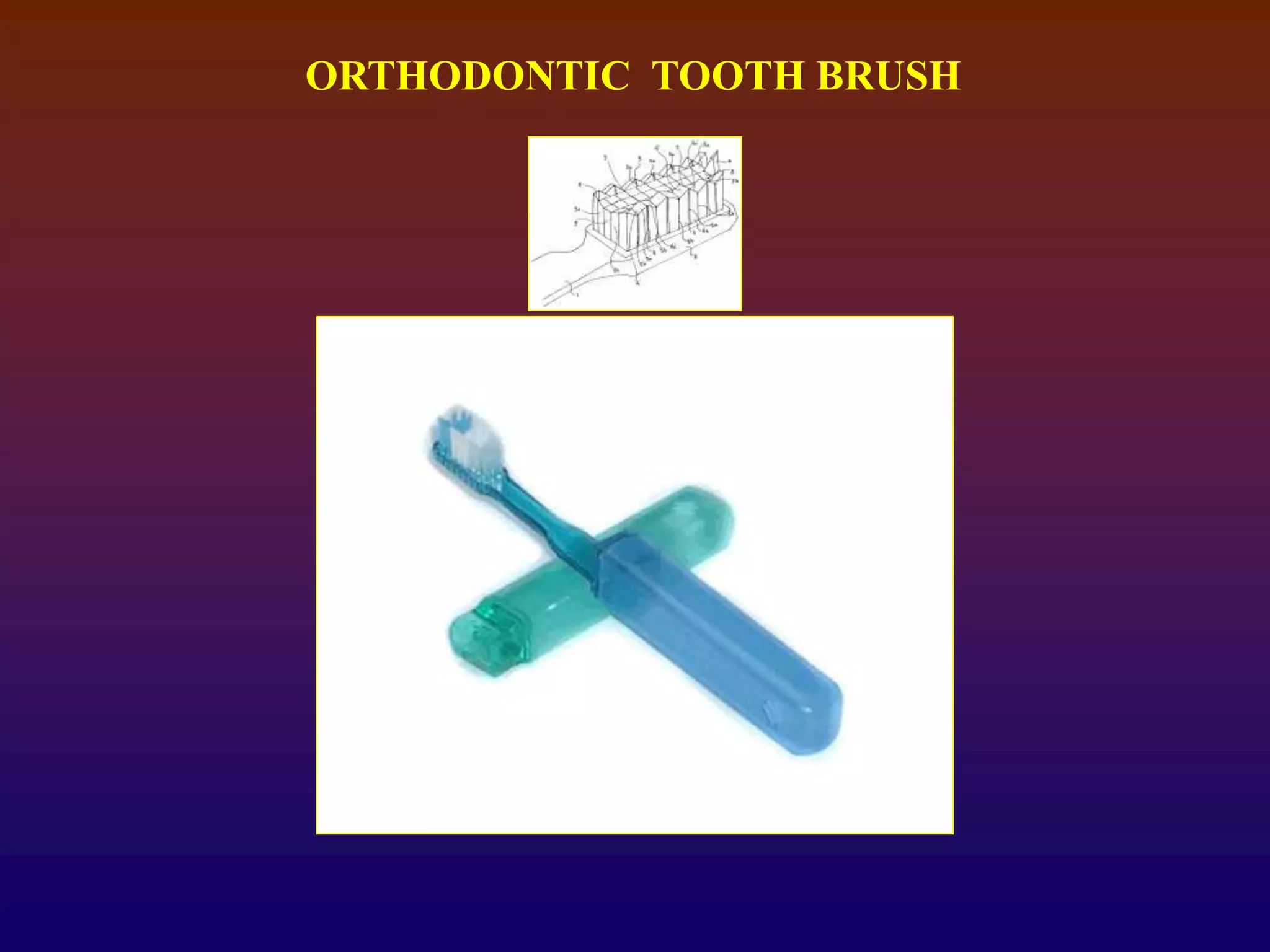
ORTHODONTIC TOOTH BRUSH
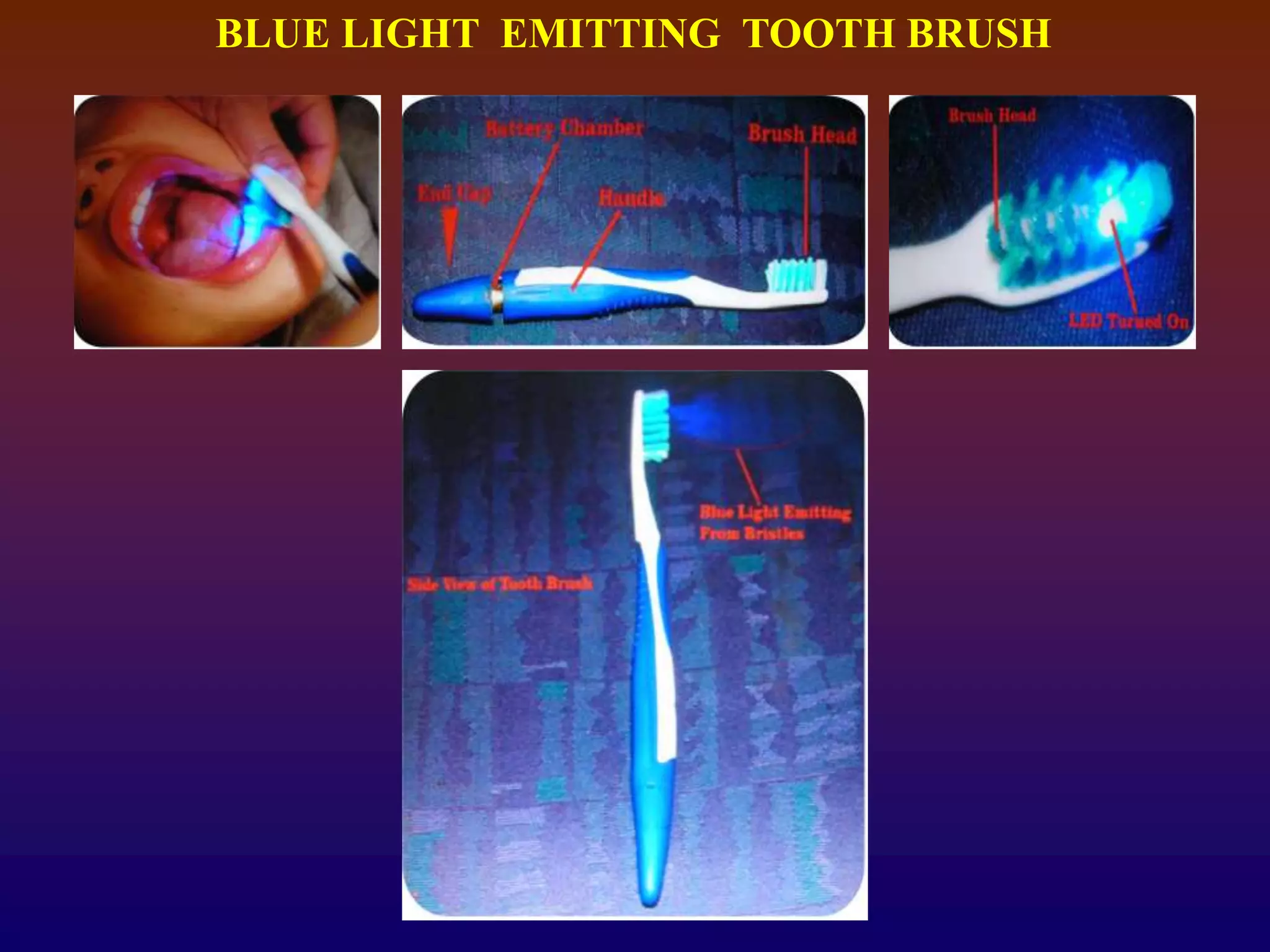
BLUE LIGHT EMITTING TOOTH BRUSH
BRISTLE MATERIAL : TWO
NATURAL -- HOG ARTIFICIAL -- NYLON
In terms of –
Homogeneity of material
Uniformity of bristle size
Elasticity
Resistance to fracture
Repulsion of water and debris
nylon filaments are superior
Because of tubular form, natural bristles are :
susceptible to fraying
breaking
contamination with diluted microbial debris
softening
loss of elasticity
Diameters of bristles
Soft brushes -- 0.2 mm
Medium brushes -- 0.3 mm
Hard brushes -- 0.4 mm
BASS recommended :
-- a straight handle and
-- nylon bristles 0.2mm in diameter and
-- 10.3mm long with
-- rounded ends arranged in
-- three rows of tufts
-- Six evenly spaced tufts per row with
-- 80 to 86 bristles per tuft
For children the brush is smaller with
thinner [0.1mm ] and shorter [8.7mm] bristles
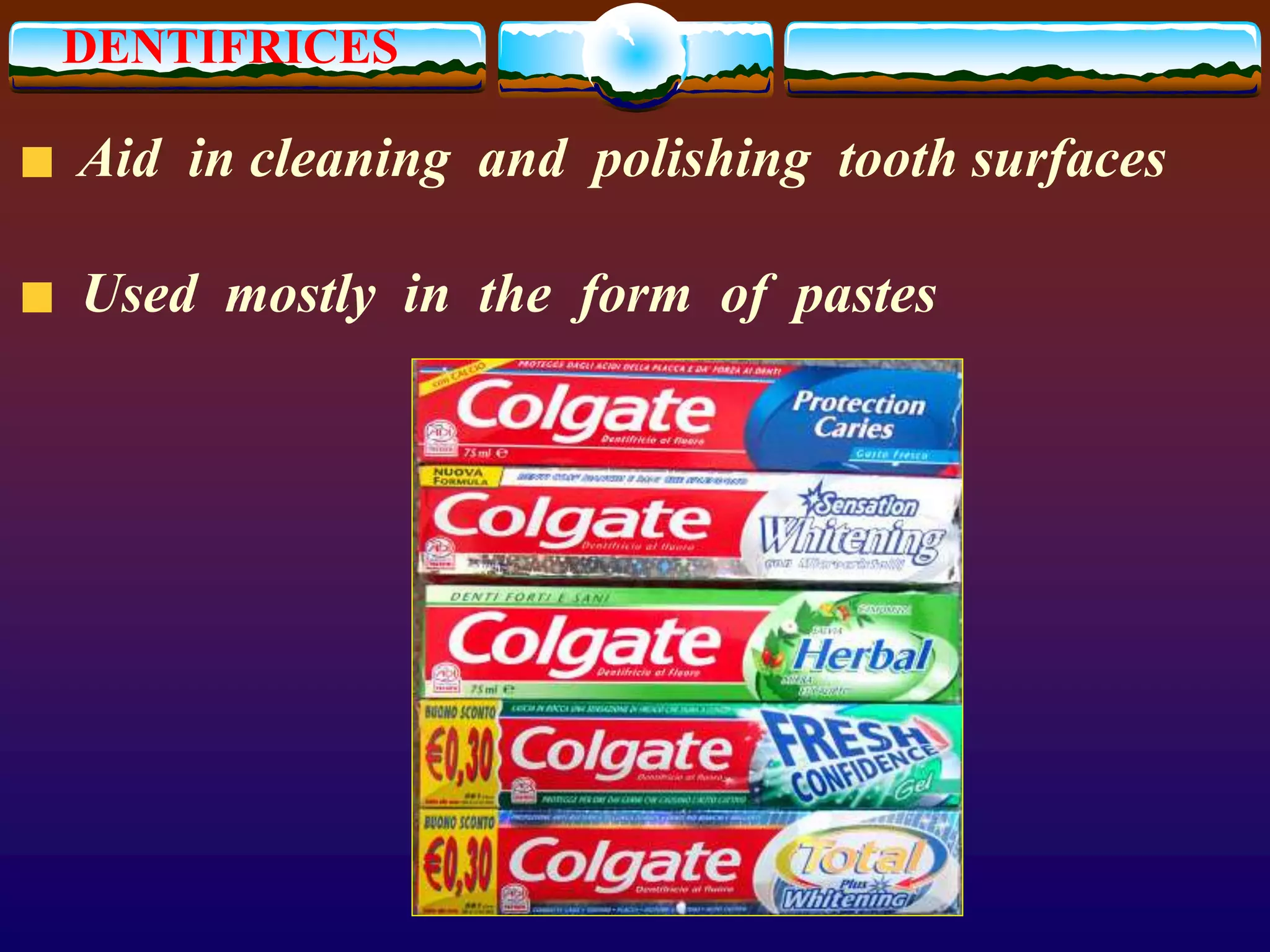
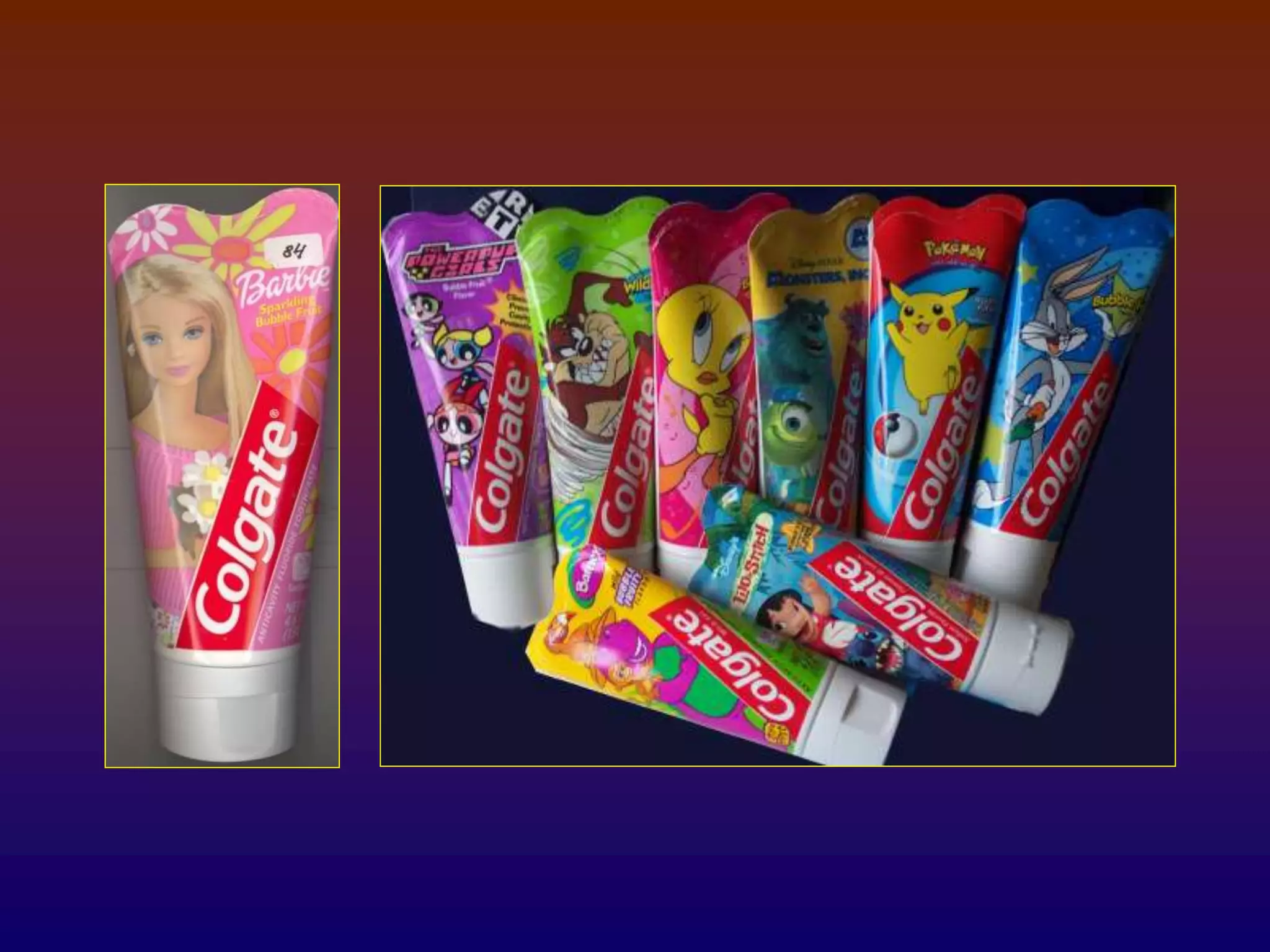
DENTIFRICES
Aid in cleaning and polishing tooth surfaces
Used mostly in the form of pastes
COMPOSITION
Abrasives -- silicon oxides
-- aluminum oxides
-- granular polyvinyl chlorides
Humectants
Soap or detergent
Flavoring agents
Sweetening agents
Therapeutic agents -- fluorides
-- pyrophosphates
Coloring agents
Preservatives
The proper use of dentifrice can enhance the
abrasive action of toothbrush by 40 times
Tooth powders contain about 95% abrasives
and are 5 times more abrasive than pastes
Used as chemotherapeutic agents to inhibit
-- plaque
-- calculus
-- caries
Tartar control toothpastes which contain
pyrophosphate reduced the formation of
new supra gingival calculus by more than 30%
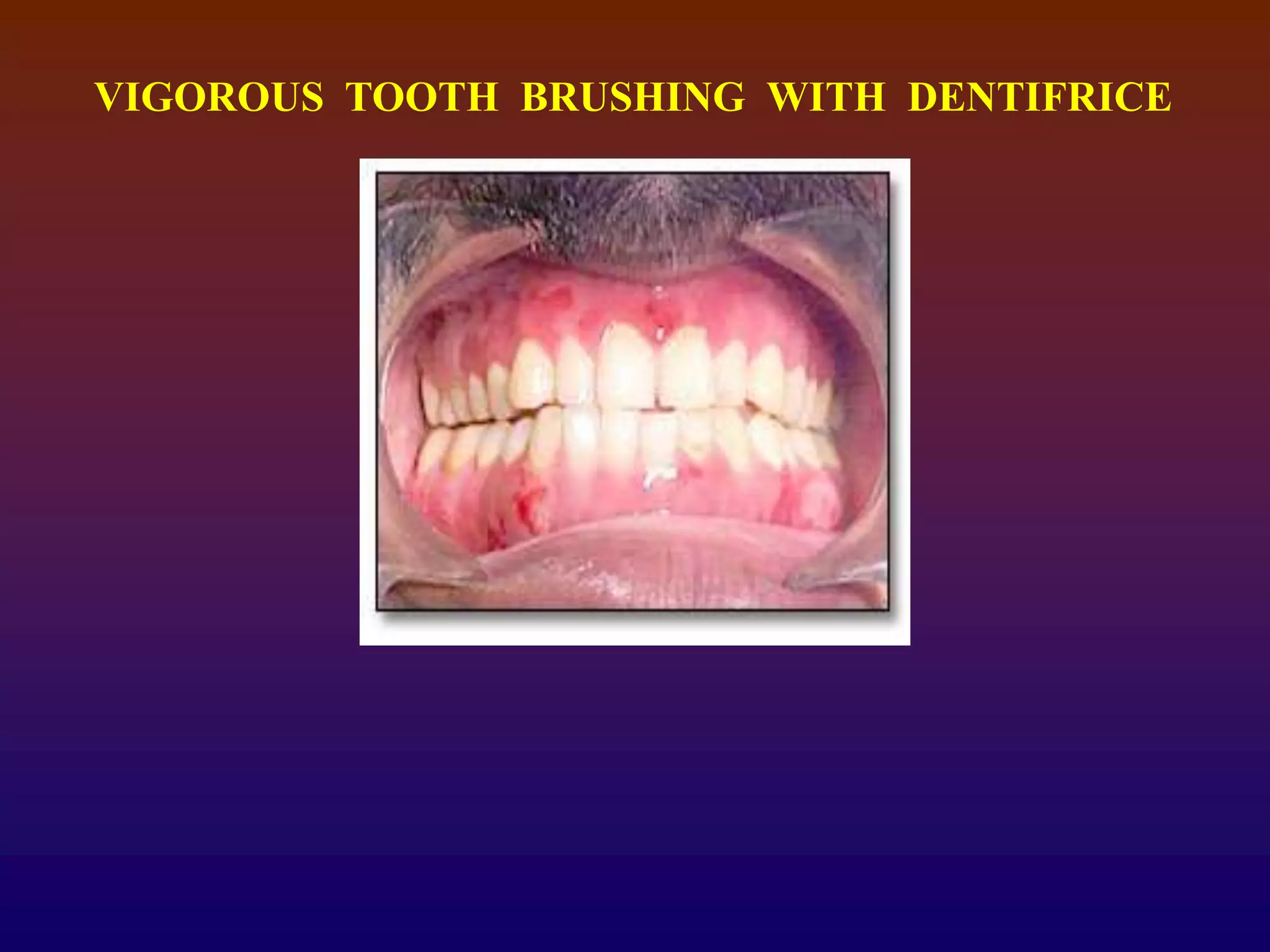
VIGOROUS TOOTH BRUSHING WITH DENTIFRICE
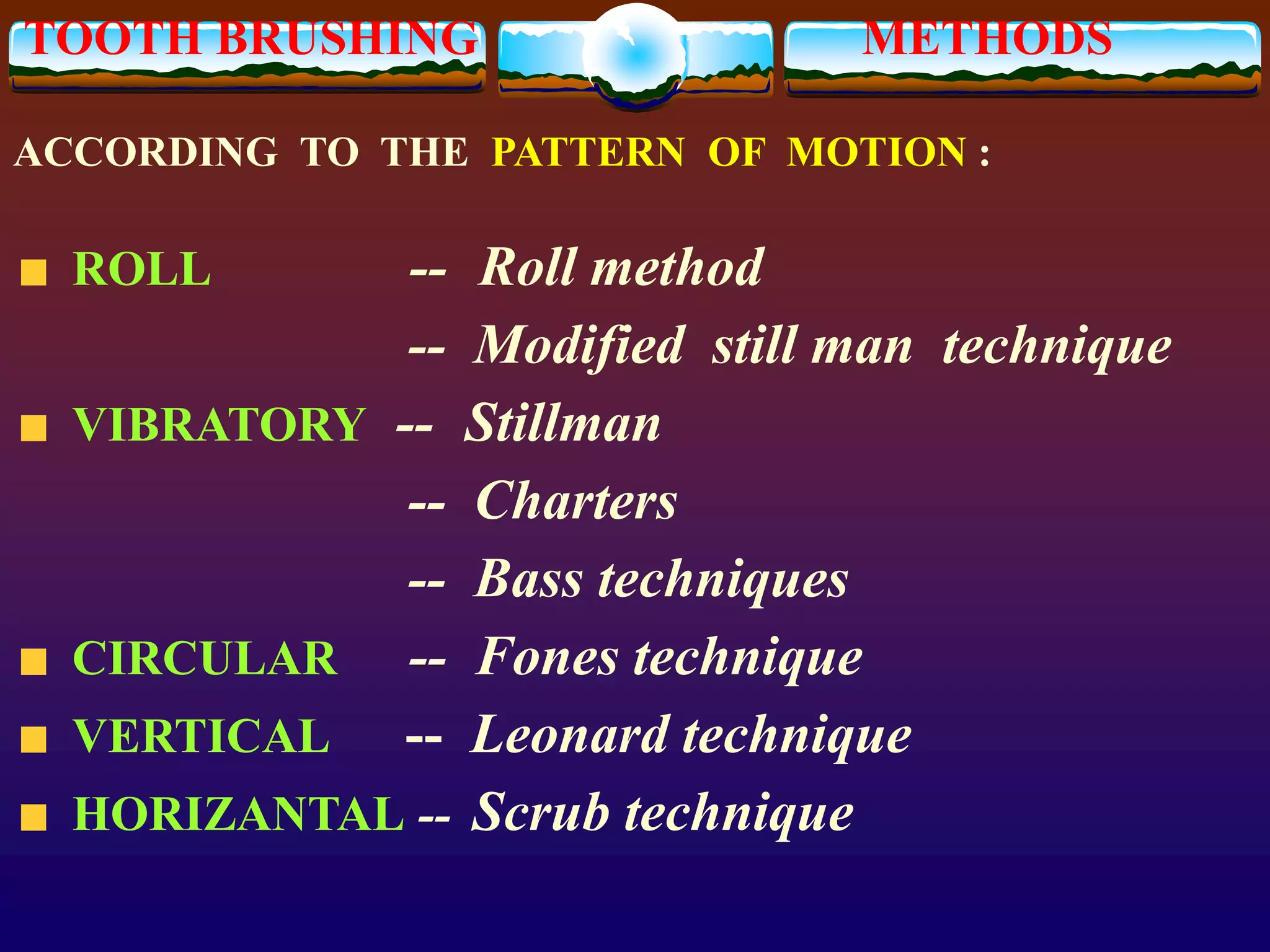
TOOTH BRUSHING METHODS
ACCORDING TO THE PATTERN OF MOTION :
ROLL -- Roll method
-- Modified still man technique
VIBRATORY -- Stillman
-- Charters
-- Bass techniques
CIRCULAR -- Fones technique
VERTICAL -- Leonard technique
HORIZANTAL -- Scrub technique
The scrub technique is probably the simplest
and most common method of brushing
The sulcus cleansing technique is most
frequently taught to the patient with periodontal
disease using a vibratory motion to improve
access in the gingival areas
COMMON METHODS OF BRUSHING
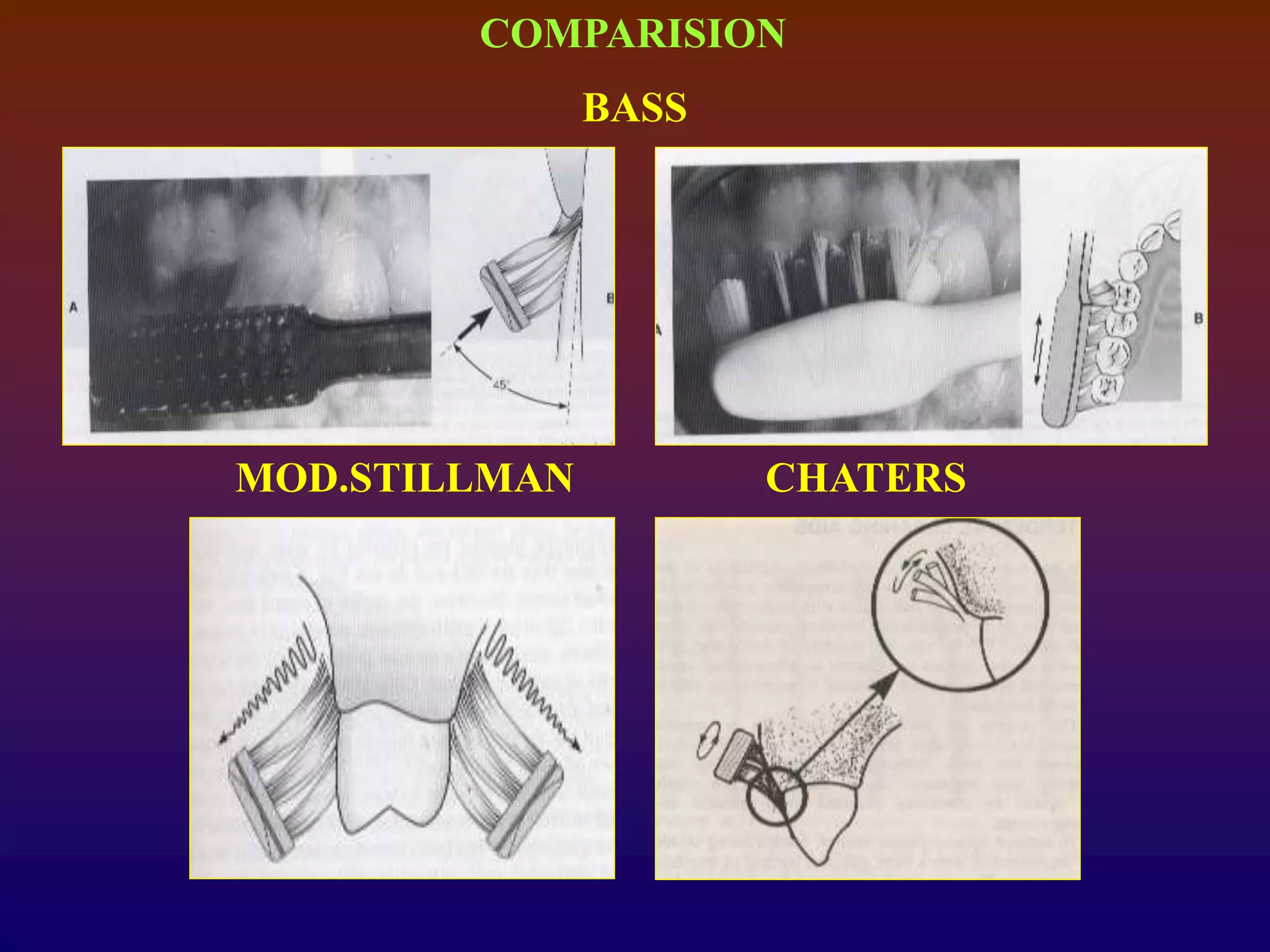
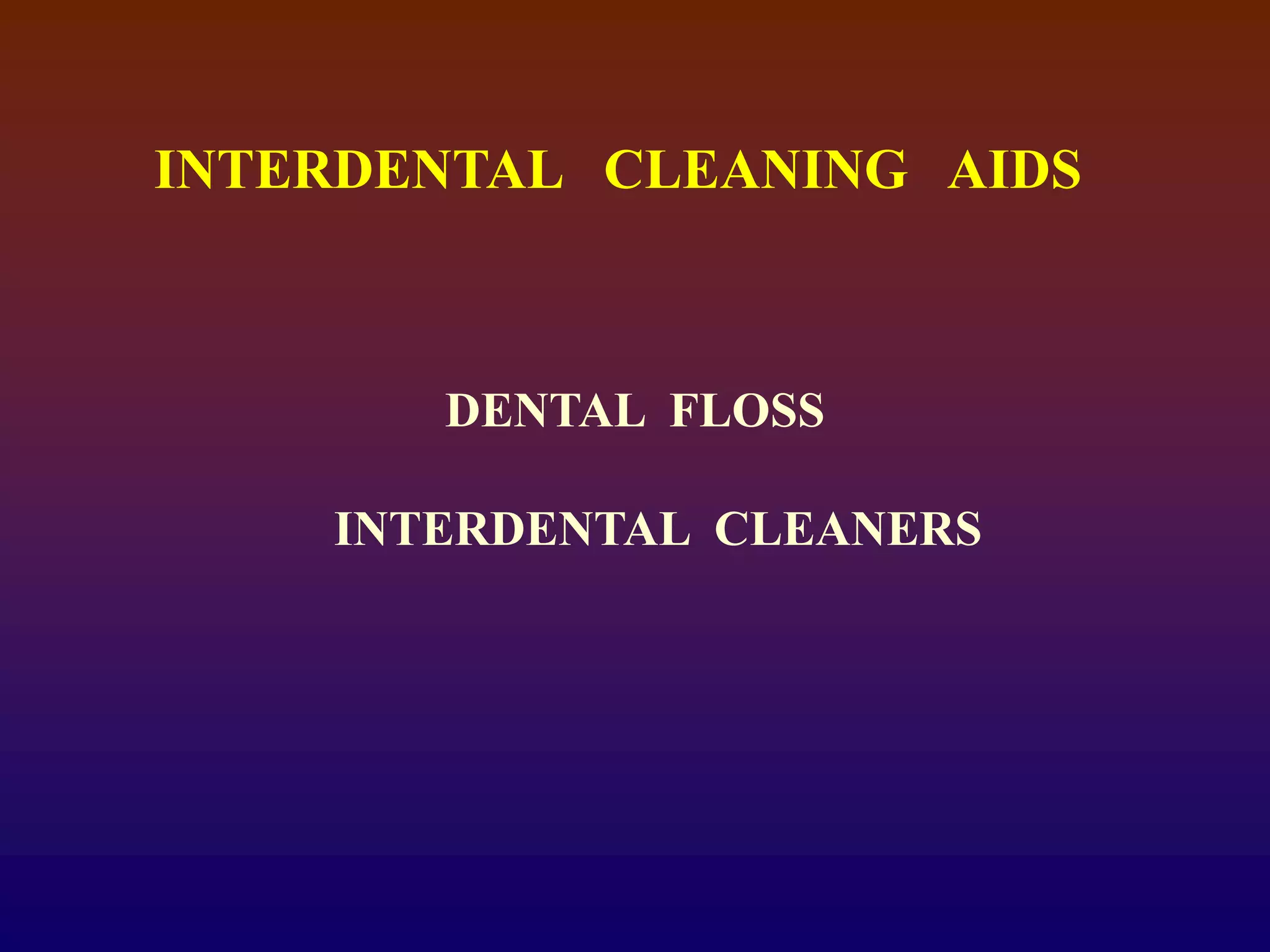
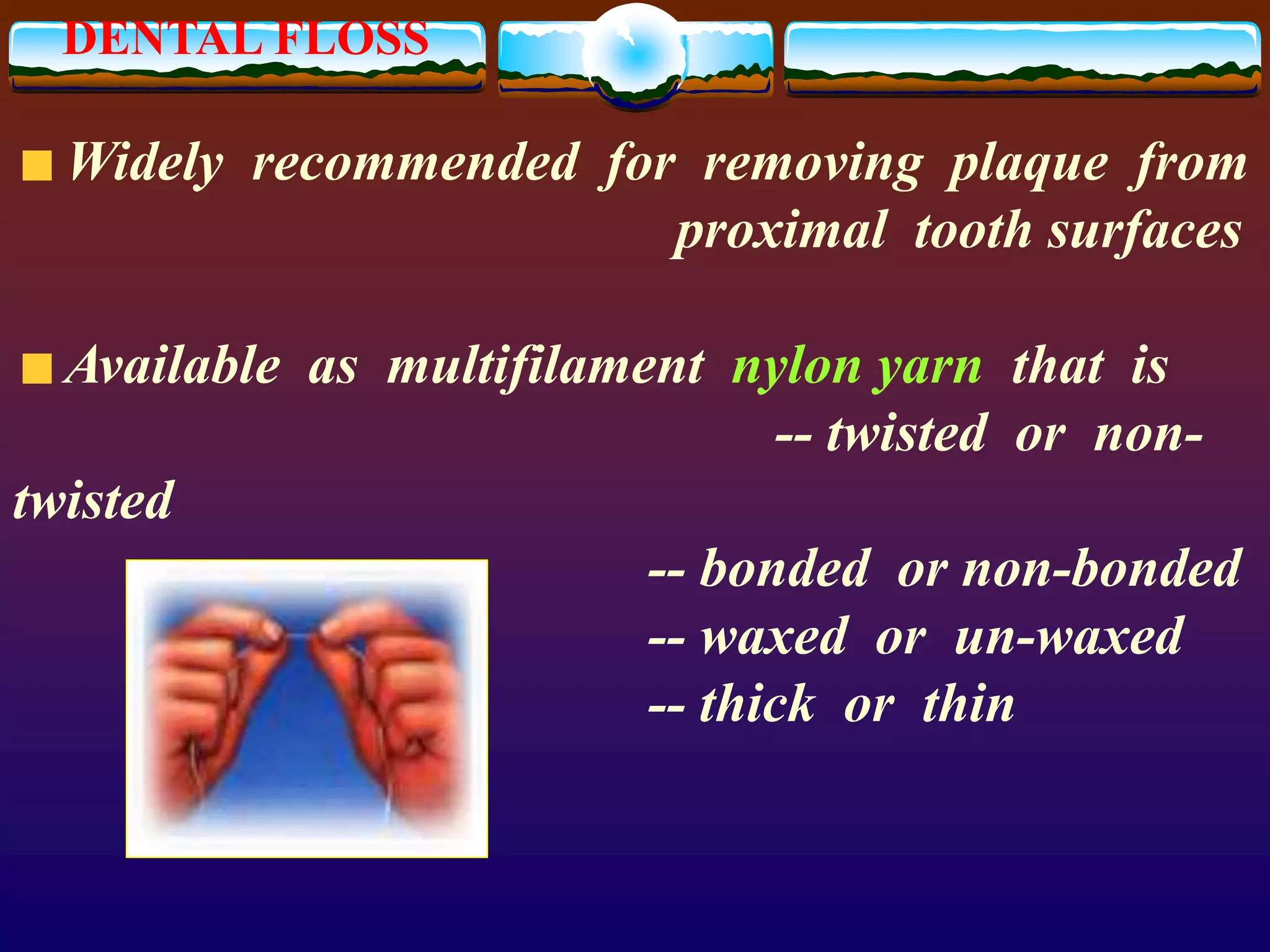
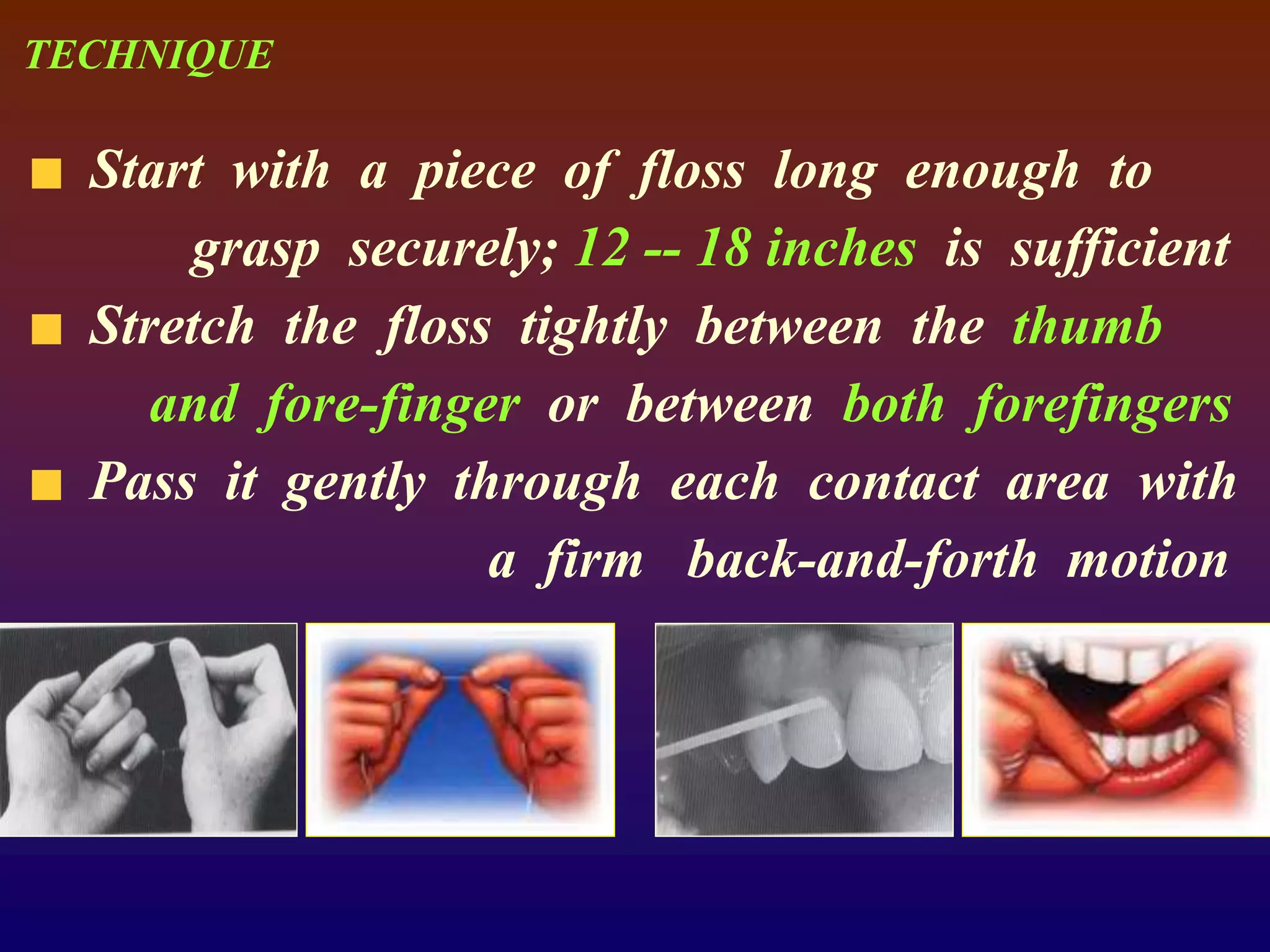
BASS
MODIFIED STILLMAN
CHARTERS
BASS METHOD : sulcus cleansing method
TECHNIQUE
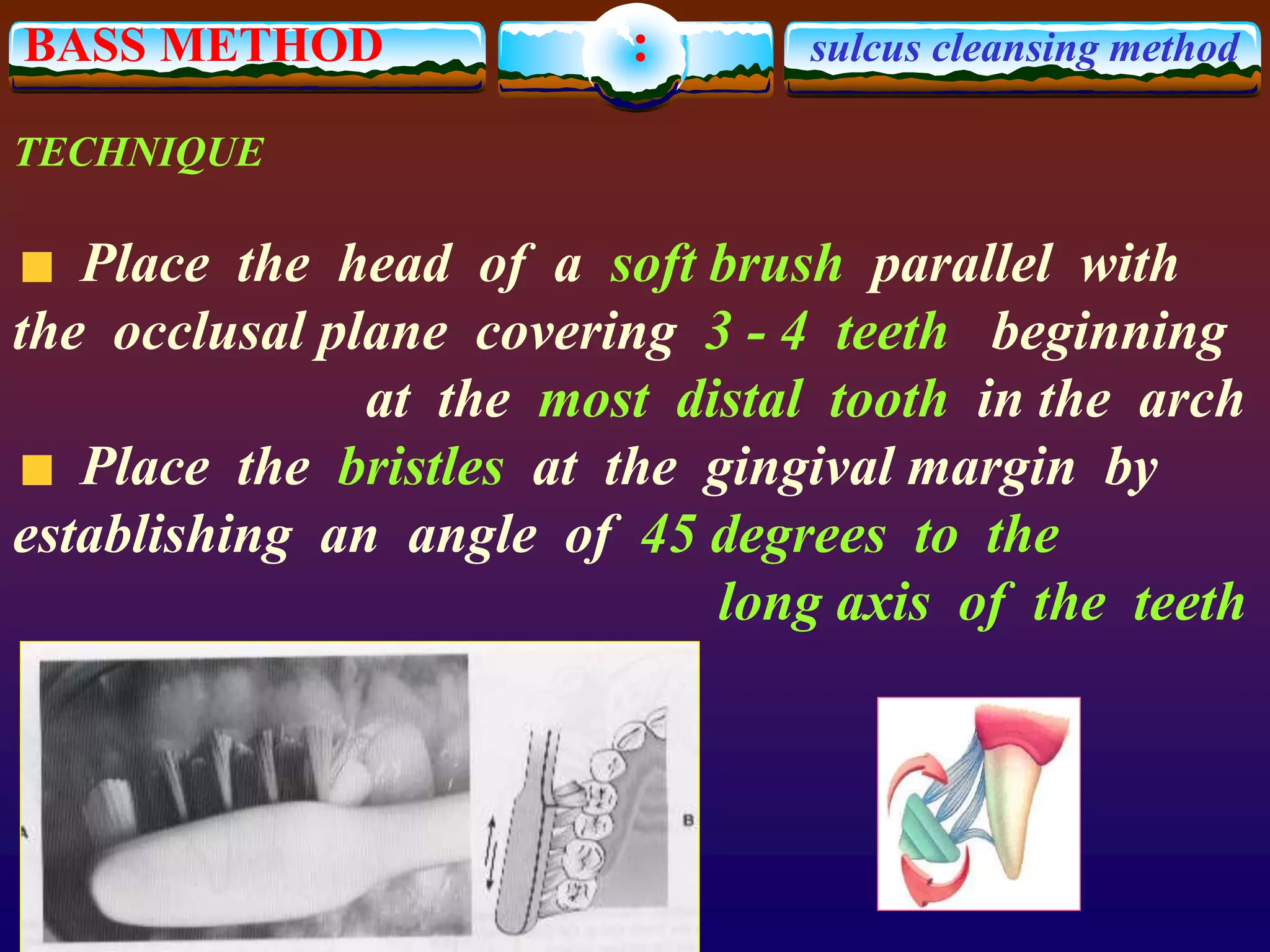
Place the head of a soft brush parallel with
the occlusal plane covering 3 - 4 teeth beginning
at the most distal tooth in the arch
Place the bristles at the gingival margin by
establishing an angle of 45 degrees to the
long axis of the teeth
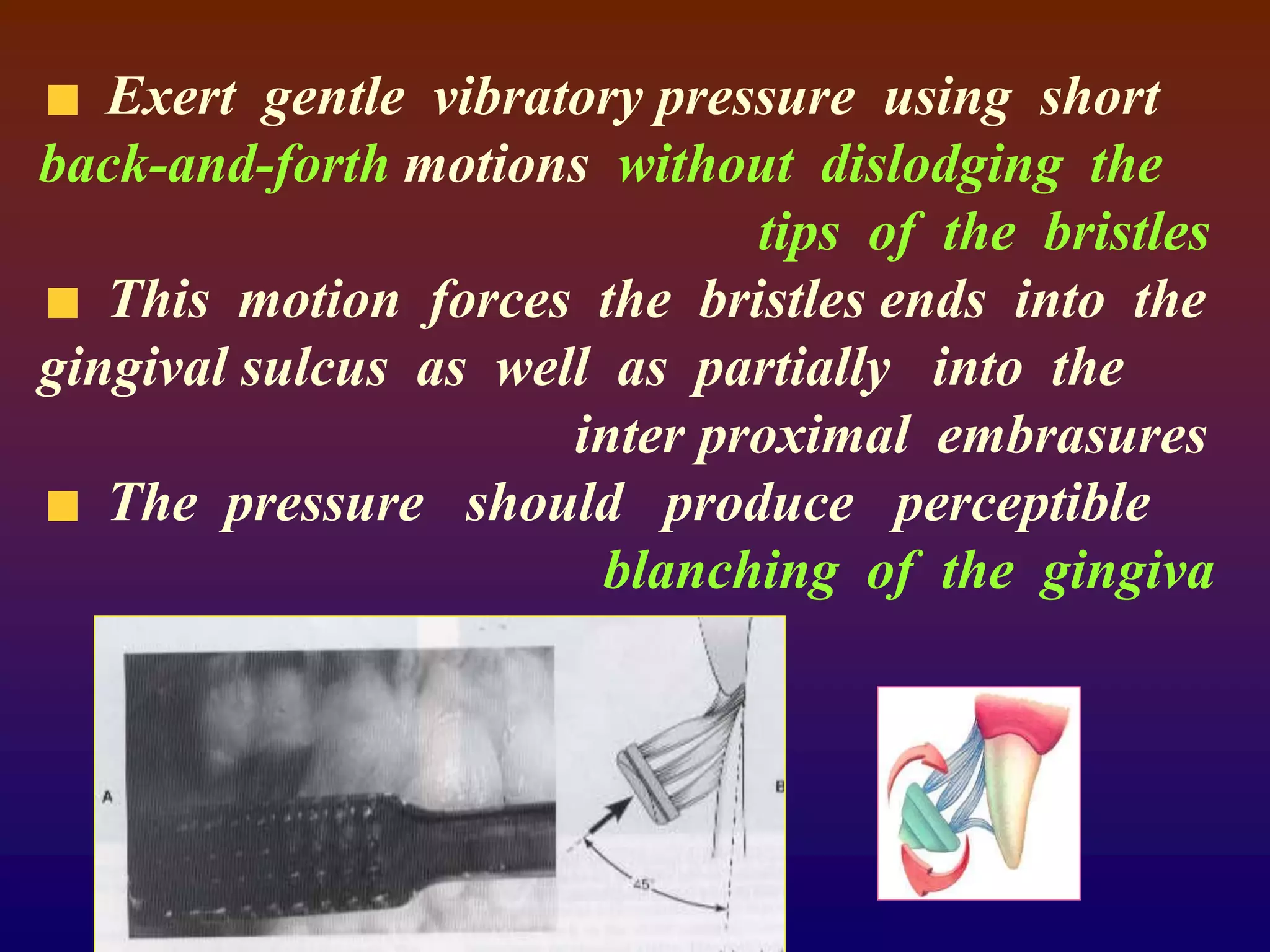
Exert gentle vibratory pressure using short
back-and-forth motions without dislodging the
tips of the bristles
This motion forces the bristles ends into the
gingival sulcus as well as partially into the
inter proximal embrasures
The pressure should produce perceptible
blanching of the gingiva
Complete approx 20 strokes in the same position
Lift the brush move it to the adjacent teeth
and repeat the process for the next 3-4 teeth
Continue around the arch brushing 3 teeth at a time
Use the same method to brush the lingual surfaces
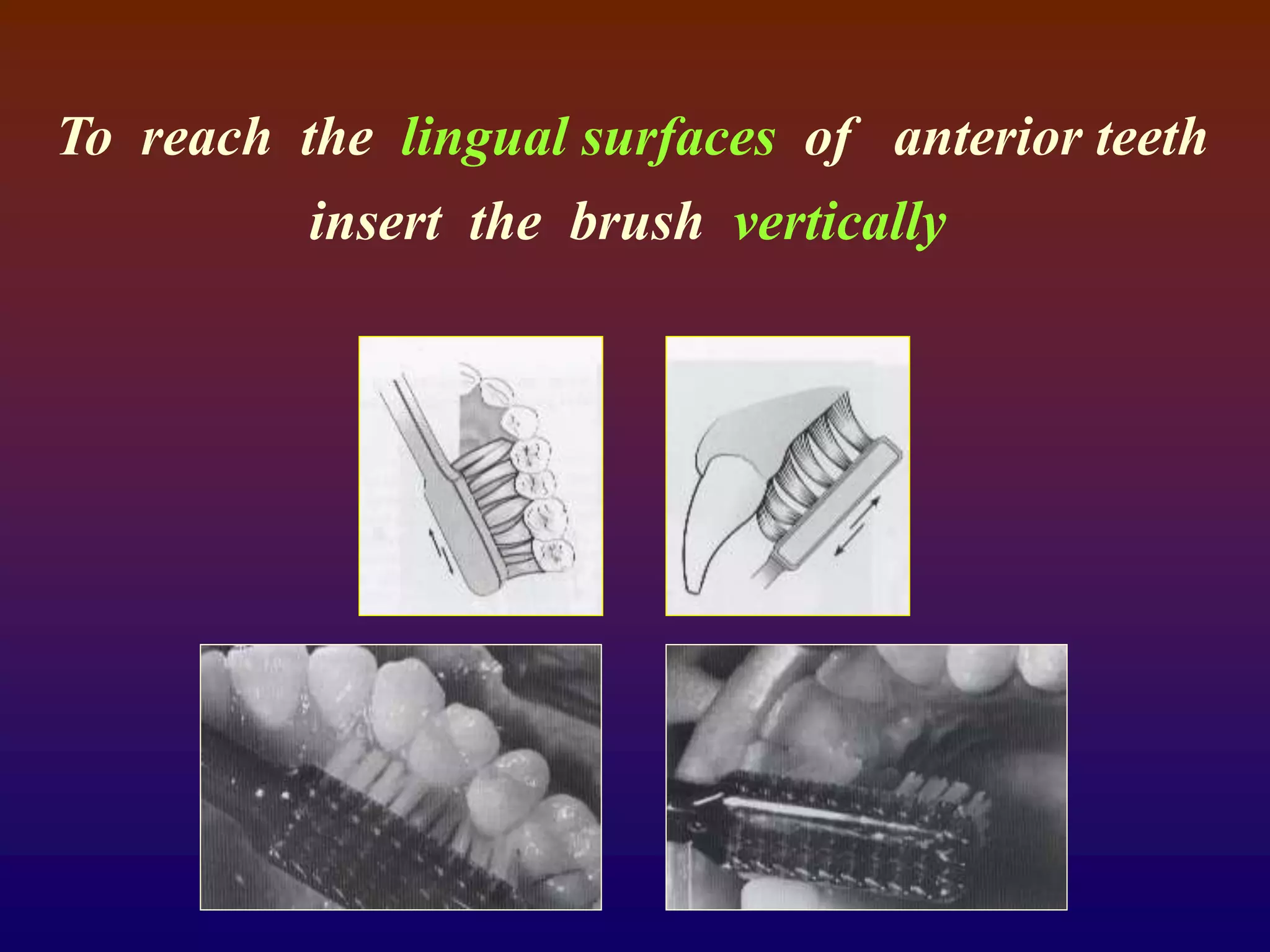
To reach the lingual surfaces of anterior teeth
insert the brush vertically
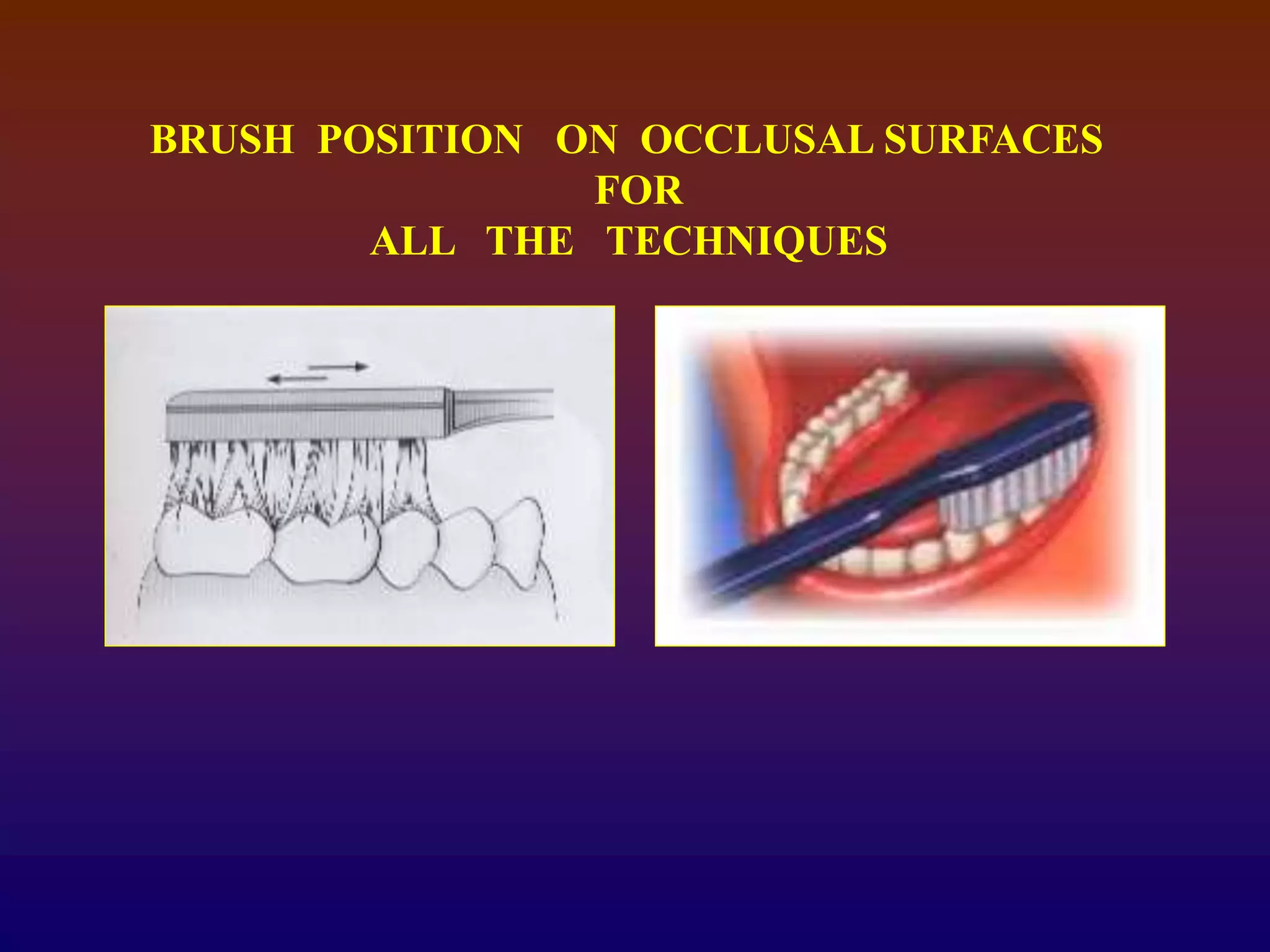
BRUSH POSITION ON OCCLUSAL SURFACES
FOR
ALL THE TECHNIQUES
Advantages :
Easy to master because it is a simple
movement familiar to most patients who brush
using a scrub technique
It concentrates the cleaning action of the teeth
where microbial plaque is most likely to have
accumulated
Recommended for :
Patient with or without periodontal diseases
MODIFIED STILLMAN METHOD
TECHNIQUE
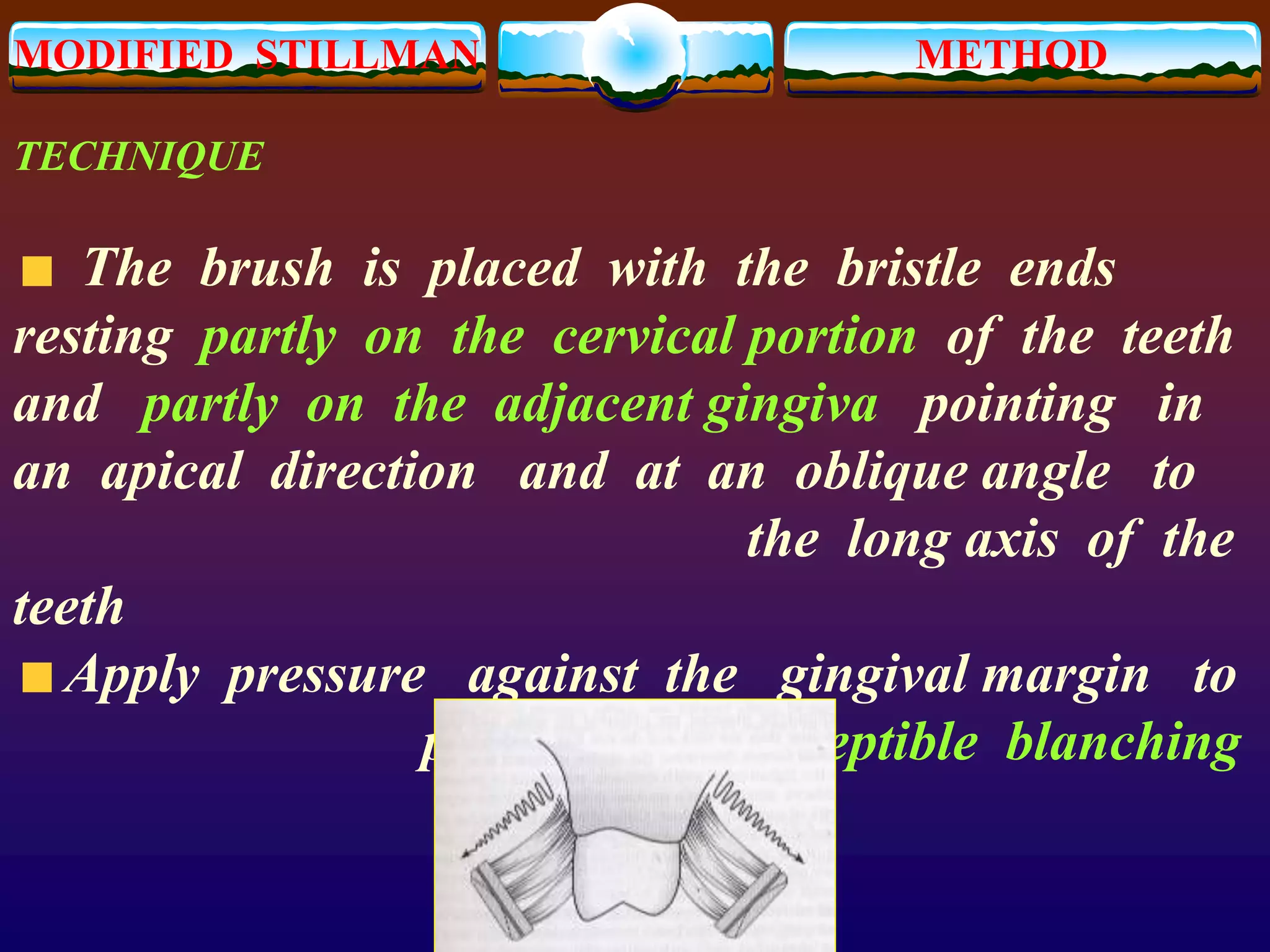
The brush is placed with the bristle ends
resting partly on the cervical portion of the teeth
and partly on the adjacent gingiva pointing in
an apical direction and at an oblique angle to
the long axis of the
teeth
Apply pressure against the gingival margin to
produce a perceptible blanching
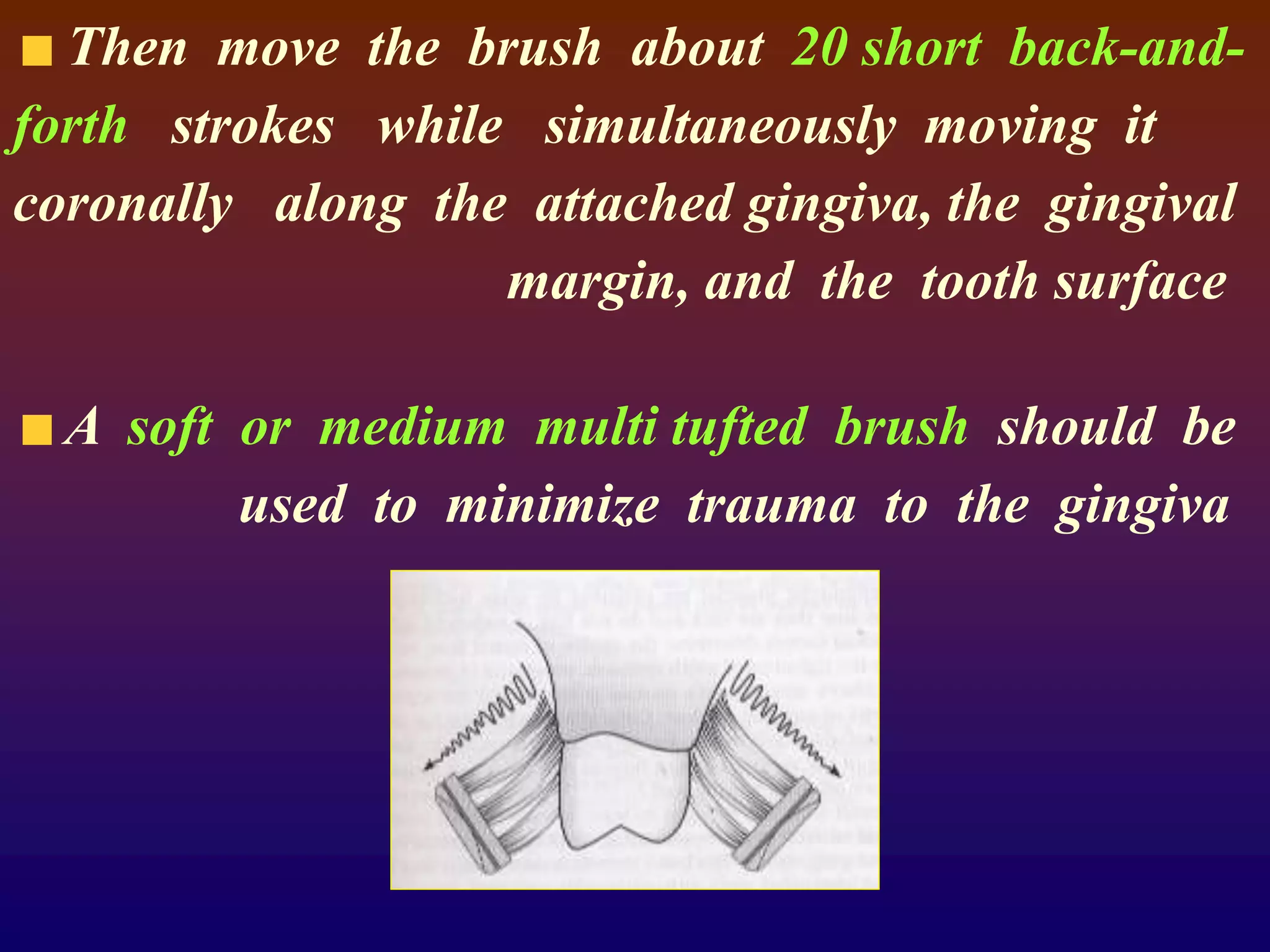
Then move the brush about 20 short back-and-
forth strokes while simultaneously moving it
coronally along the attached gingiva, the gingival
margin, and the tooth surface
A soft or medium multi tufted brush should be
used to minimize trauma to the gingiva
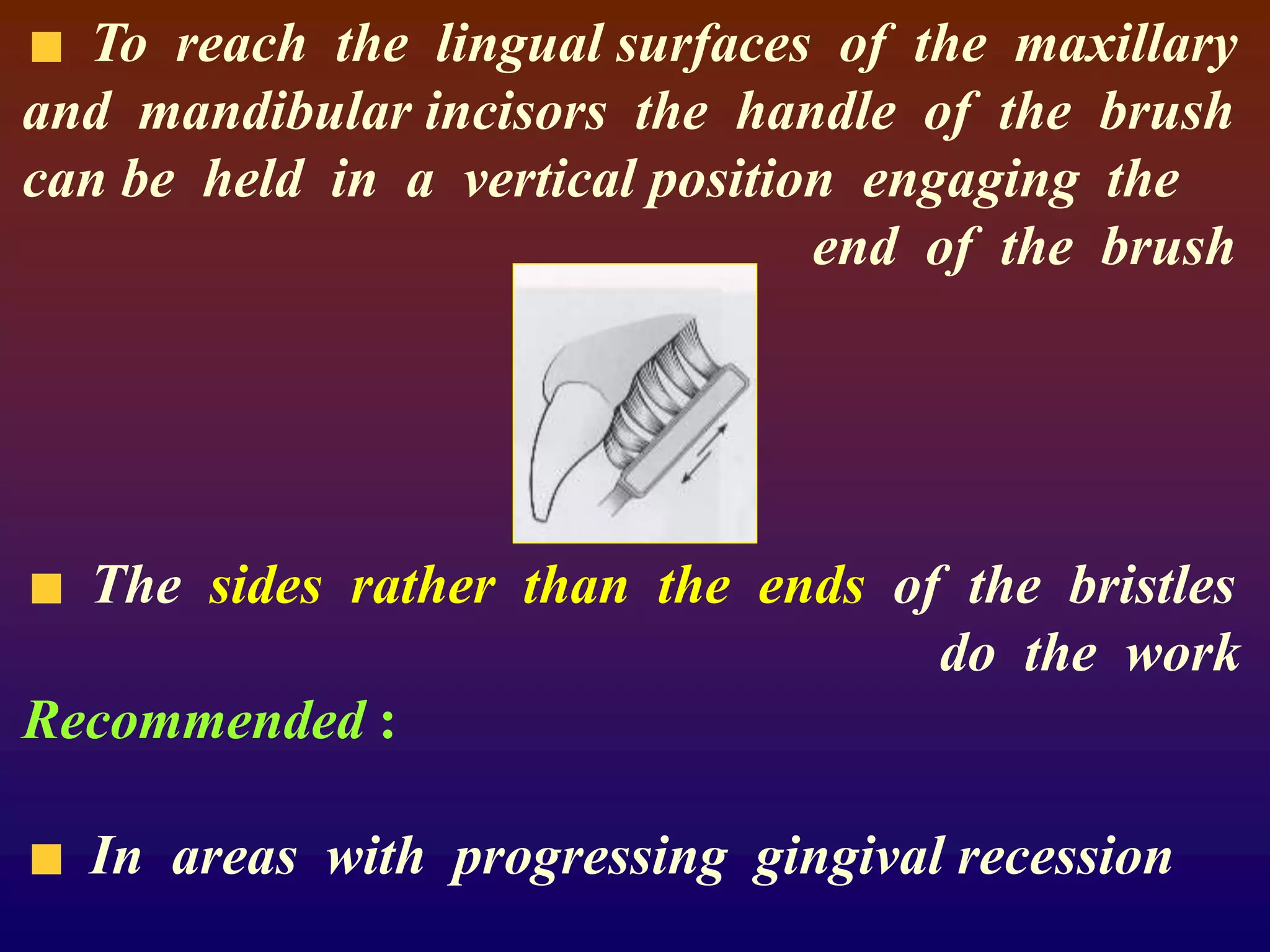
To reach the lingual surfaces of the maxillary
and mandibular incisors the handle of the brush
can be held in a vertical position engaging the
end of the brush
The sides rather than the ends of the bristles
do the work
Recommended :
In areas with progressing gingival recession
CHARTERS METHOD
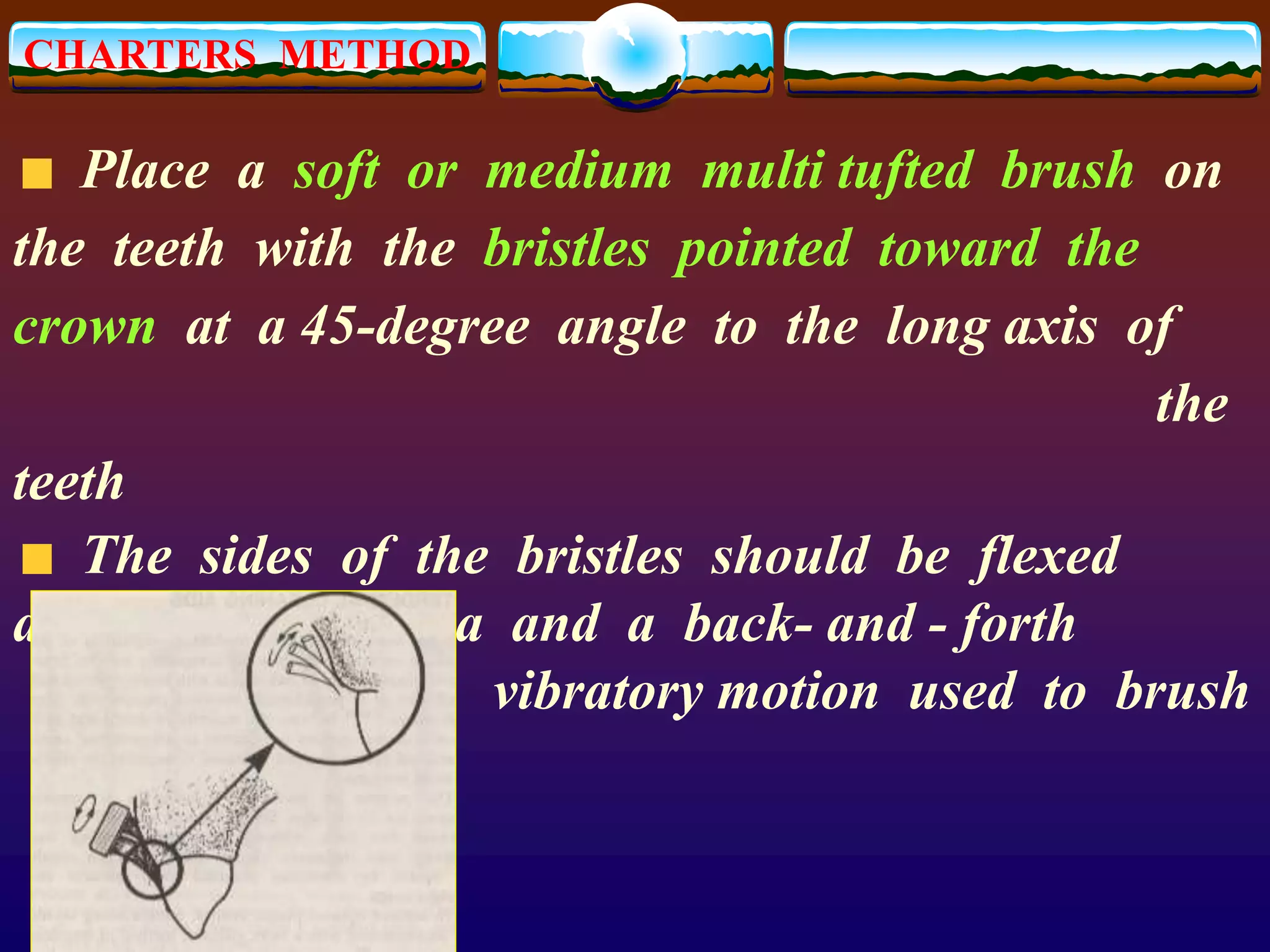
Place a soft or medium multi tufted brush on
the teeth with the bristles pointed toward the
crown at a 45-degree angle to the long axis of
the
teeth
The sides of the bristles should be flexed
against the gingiva and a back- and - forth
vibratory motion used to brush
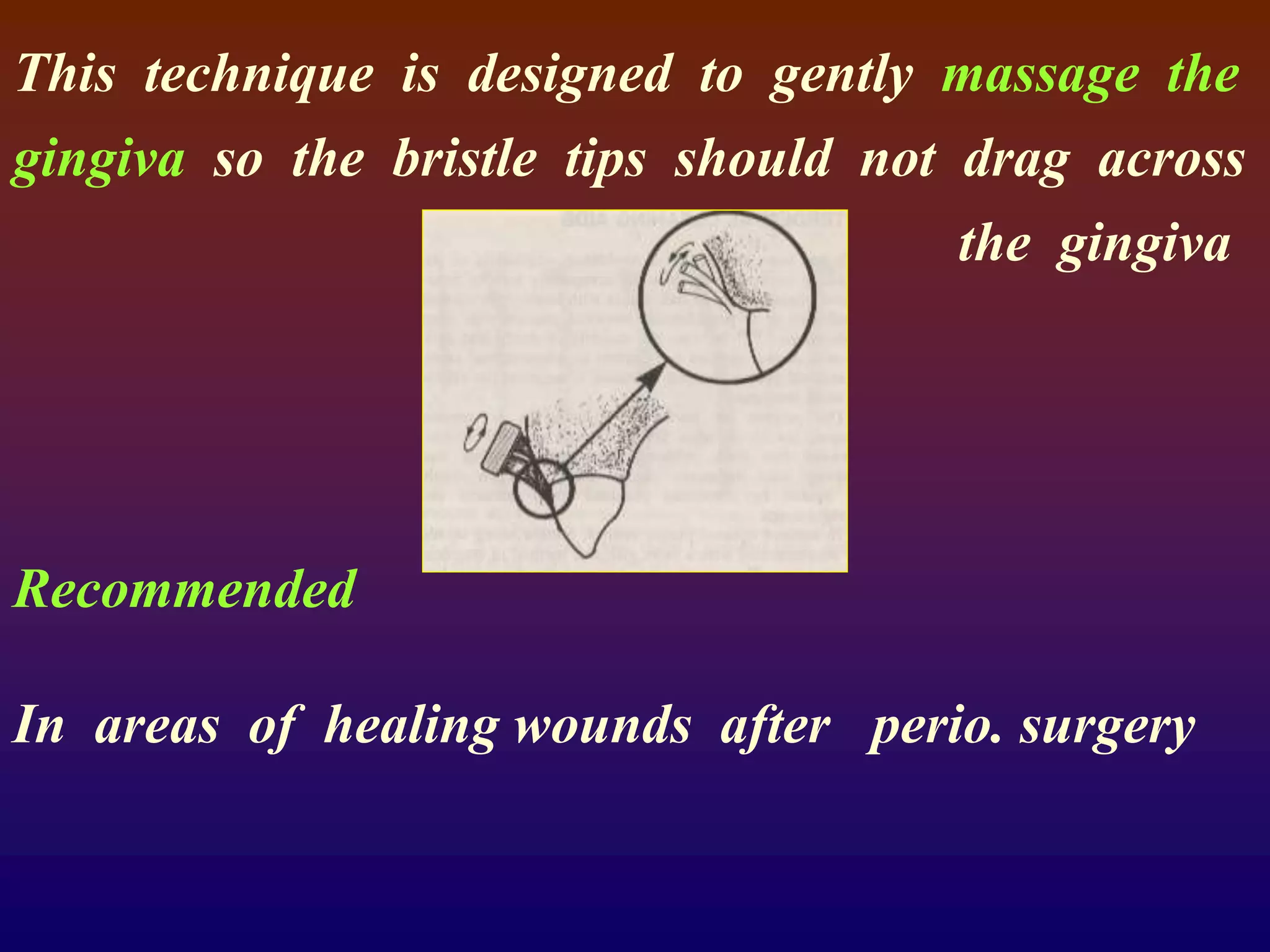
This technique is designed to gently massage the
gingiva so the bristle tips should not drag across
the gingiva
Recommended
In areas of healing wounds after perio. surgery
COMPARISION
BASS
MOD.STILLMAN CHATERS
INTERDENTAL CLEANING AIDS
DENTAL FLOSS
INTERDENTAL CLEANERS
DENTAL FLOSS
Widely recommended for removing plaque from
proximal tooth surfaces
Available as multifilament nylon yarn that is
-- twisted or non-
twisted
-- bonded or non-bonded
-- waxed or un-waxed
-- thick or thin
TECHNIQUE
Start with a piece of floss long enough to
grasp securely; 12 -- 18 inches is sufficient
Stretch the floss tightly between the thumb
and fore-finger or between both forefingers
Pass it gently through each contact area with
a firm back-and-forth motion
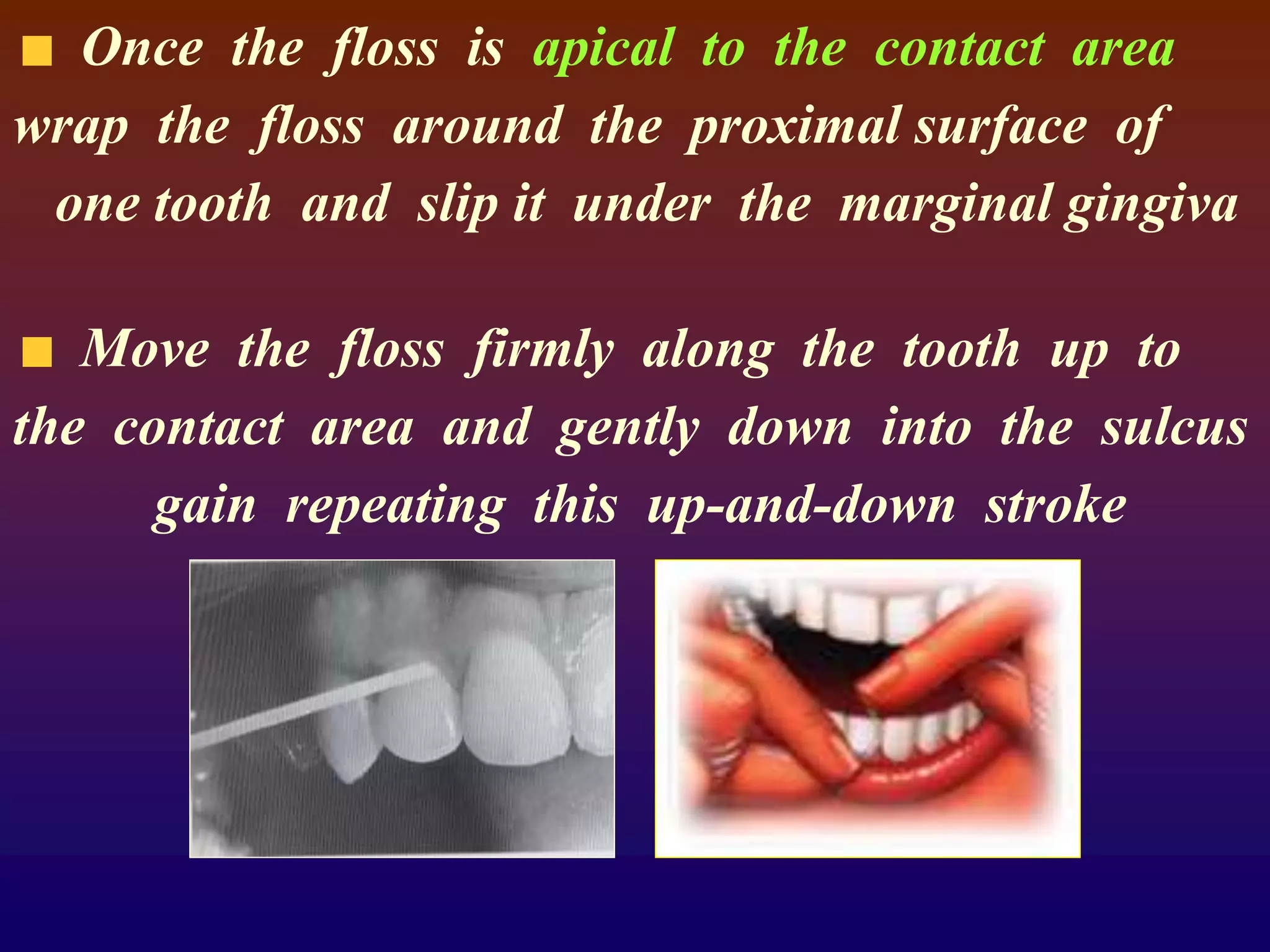
Once the floss is apical to the contact area
wrap the floss around the proximal surface of
one tooth and slip it under the marginal gingiva
Move the floss firmly along the tooth up to
the contact area and gently down into the sulcus
gain repeating this up-and-down stroke
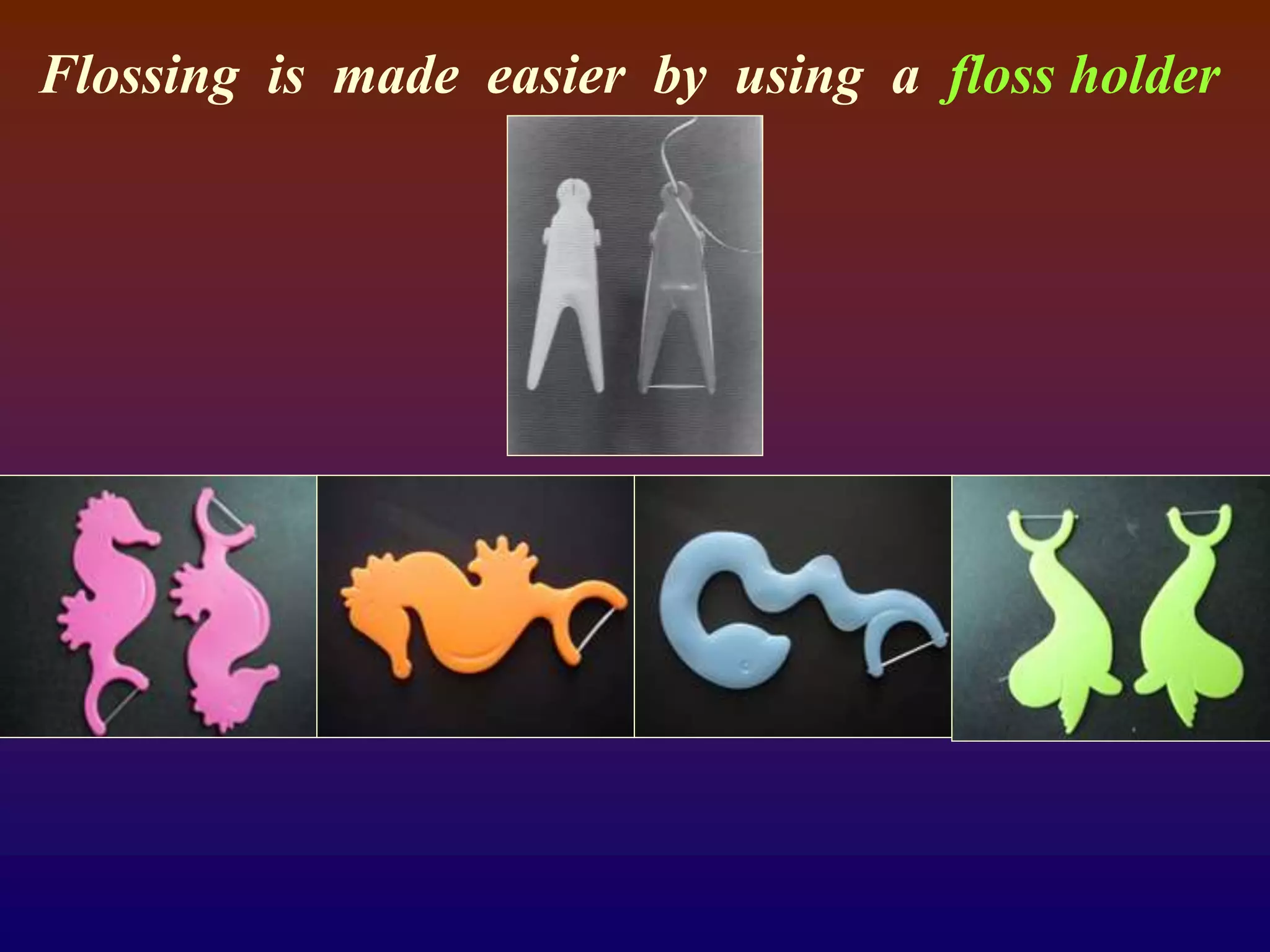
Flossing is made easier by using a floss holder
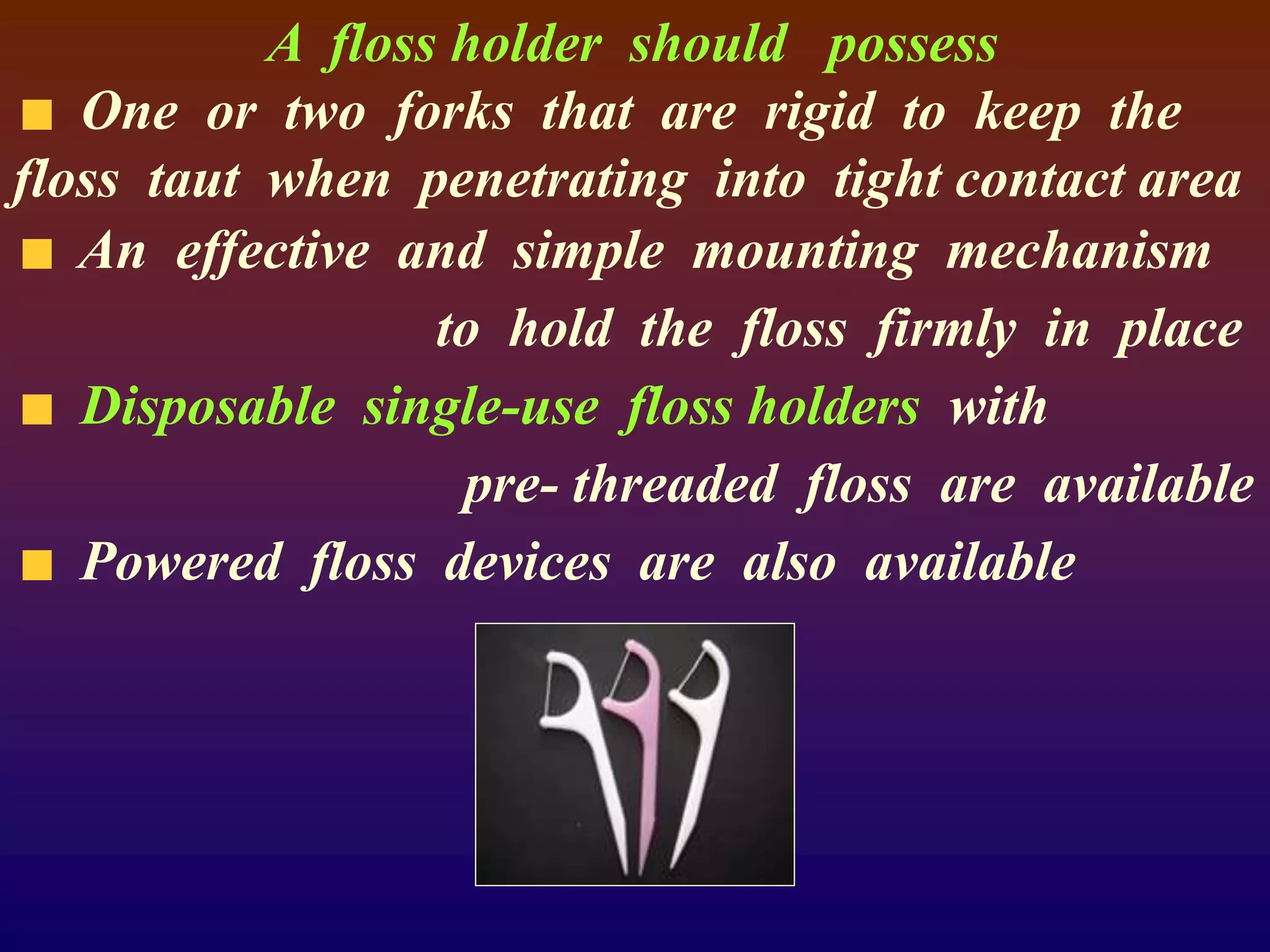
A floss holder should possess
One or two forks that are rigid to keep the
floss taut when penetrating into tight contact area
An effective and simple mounting mechanism
to hold the floss firmly in place
Disposable single-use floss holders with
pre- threaded floss are available
Powered floss devices are also available
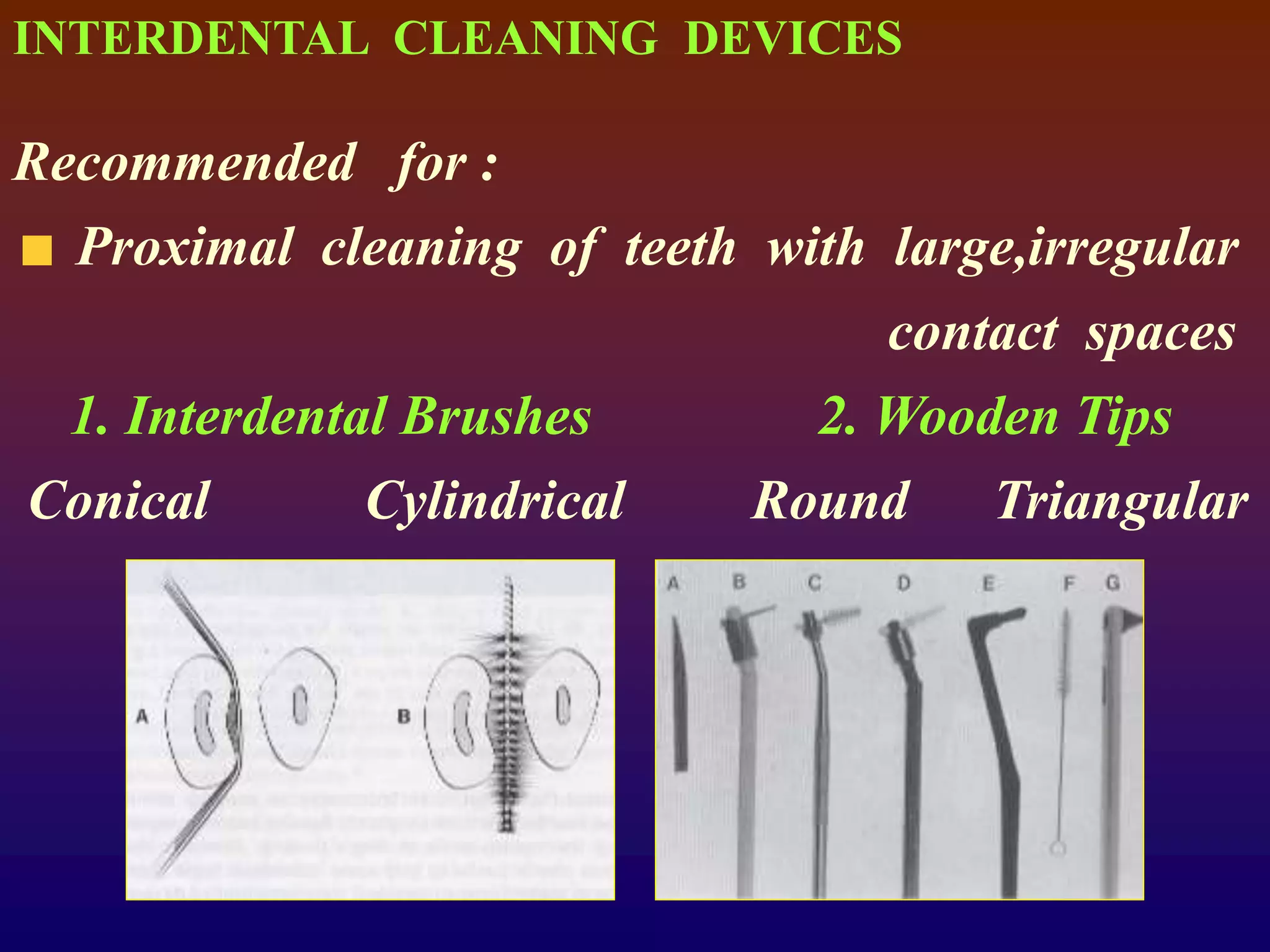
INTERDENTAL CLEANING DEVICES
Recommended for :
Proximal cleaning of teeth with large,irregular
contact spaces
1. Interdental Brushes 2. Wooden Tips
Conical Cylindrical Round Triangular
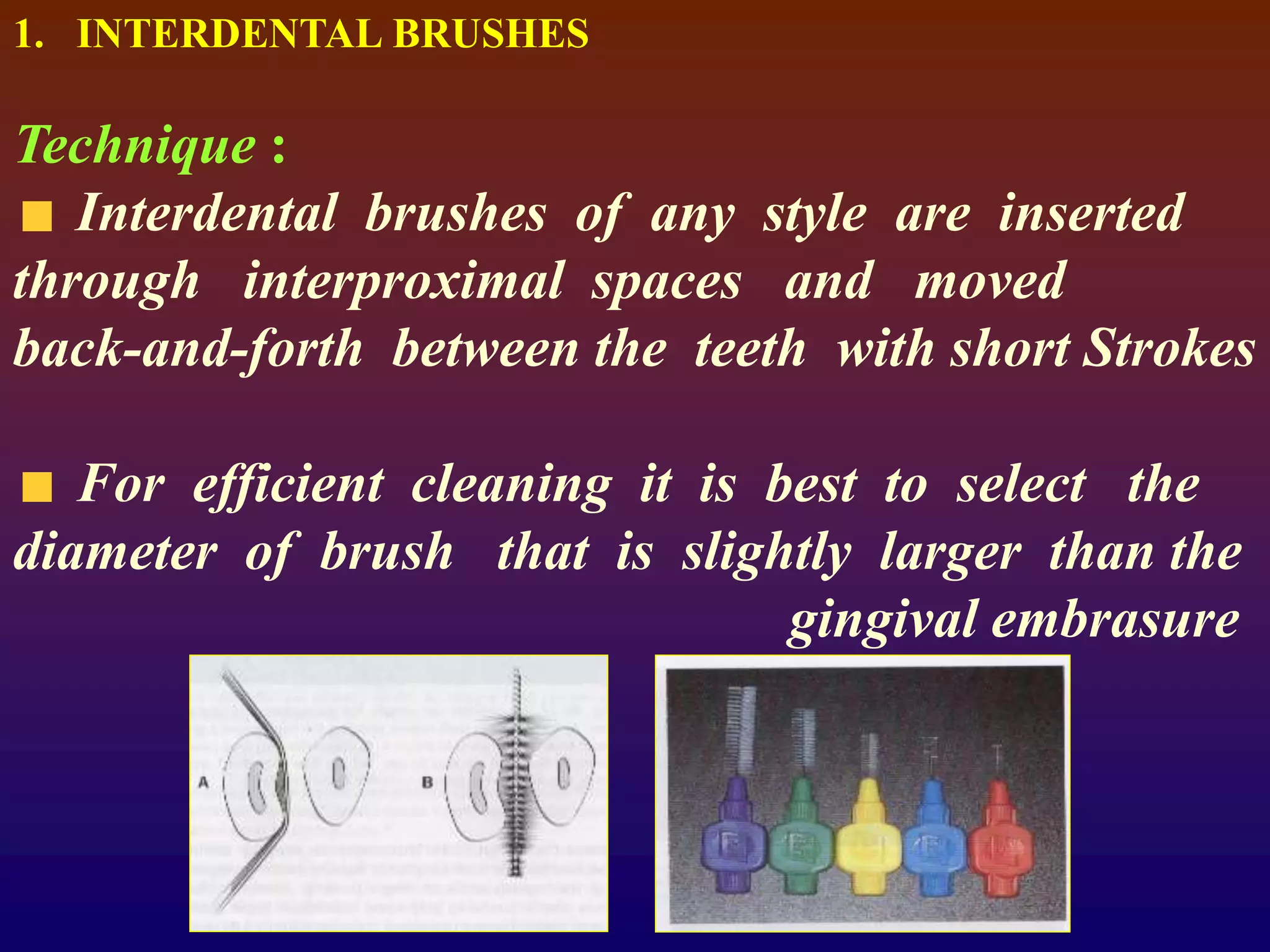
1. INTERDENTAL BRUSHES
Technique :
Interdental brushes of any style are inserted
through interproximal spaces and moved
back-and-forth between the teeth with short Strokes
For efficient cleaning it is best to select the
diameter of brush that is slightly larger than the
gingival embrasure
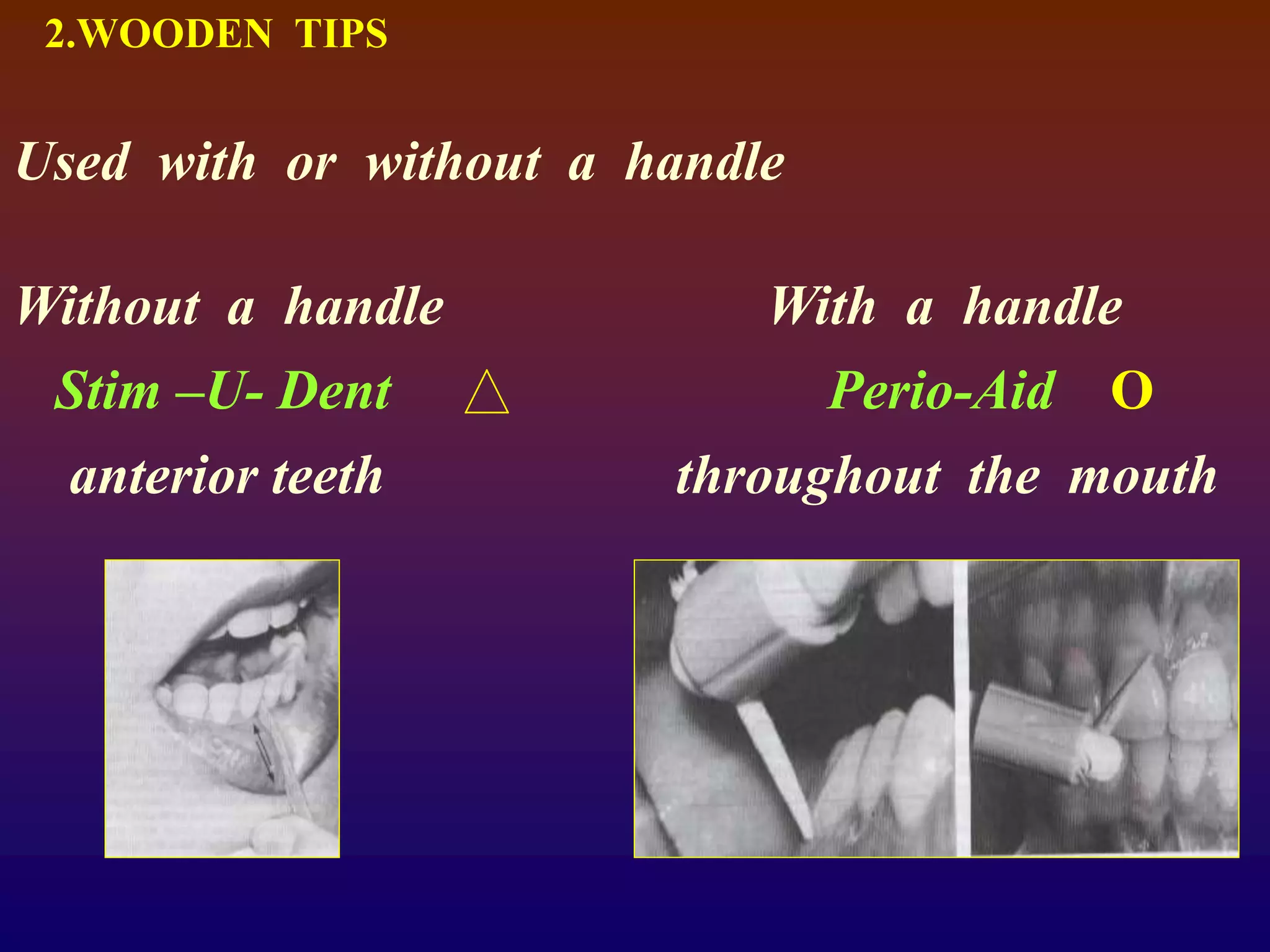
2.WOODEN TIPS
Used with or without a handle
Without a handle With a handle
Stim –U- Dent Perio-Aid O
anterior teeth throughout the mouth
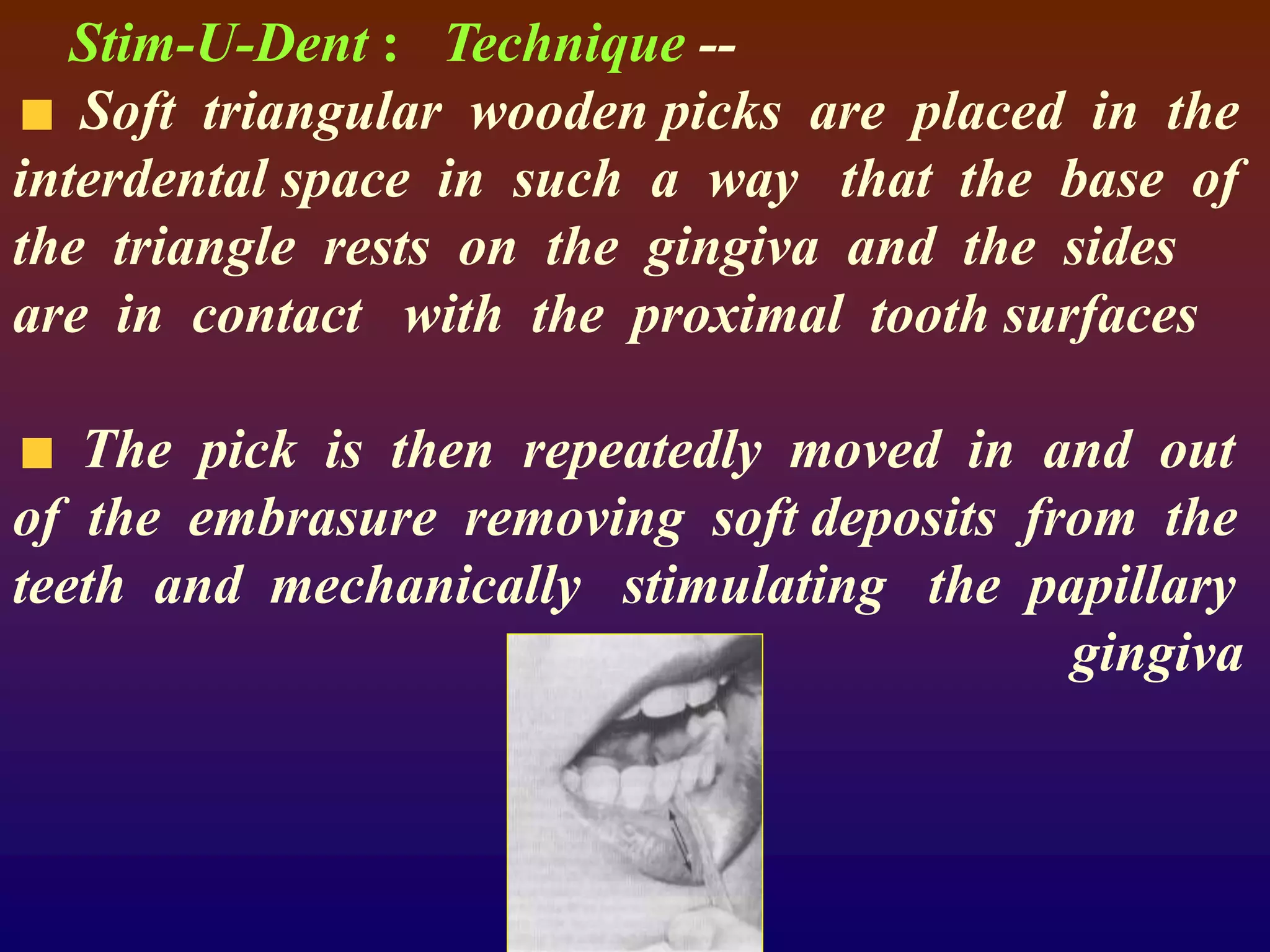
Stim-U-Dent : Technique --
Soft triangular wooden picks are placed in the
interdental space in such a way that the base of
the triangle rests on the gingiva and the sides
are in contact with the proximal tooth surfaces
The pick is then repeatedly moved in and out
of the embrasure removing soft deposits from the
teeth and mechanically stimulating the papillary
gingiva
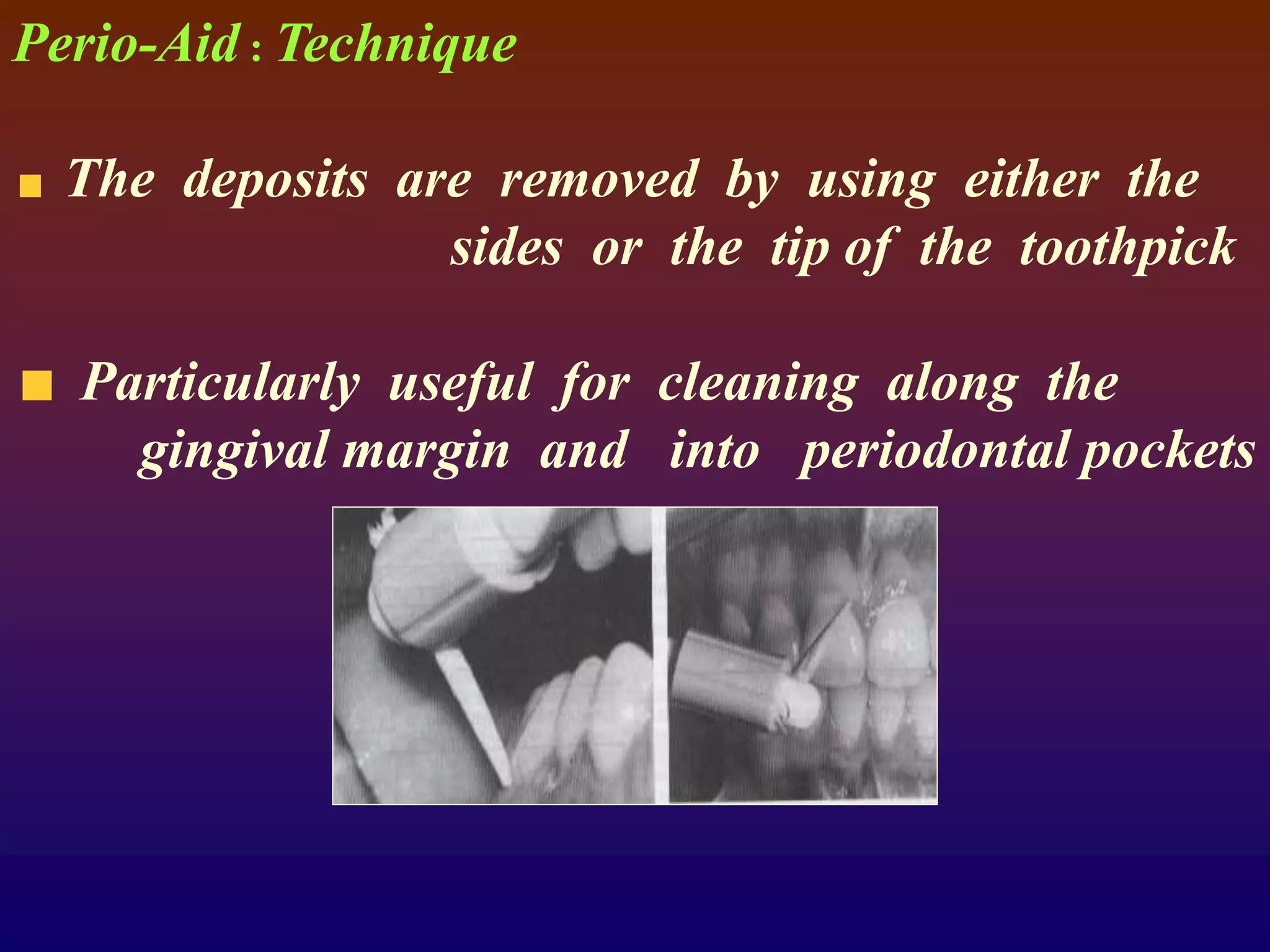
Perio-Aid : Technique
The deposits are removed by using either the
sides or the tip of the toothpick
Particularly useful for cleaning along the
gingival margin and into periodontal pockets
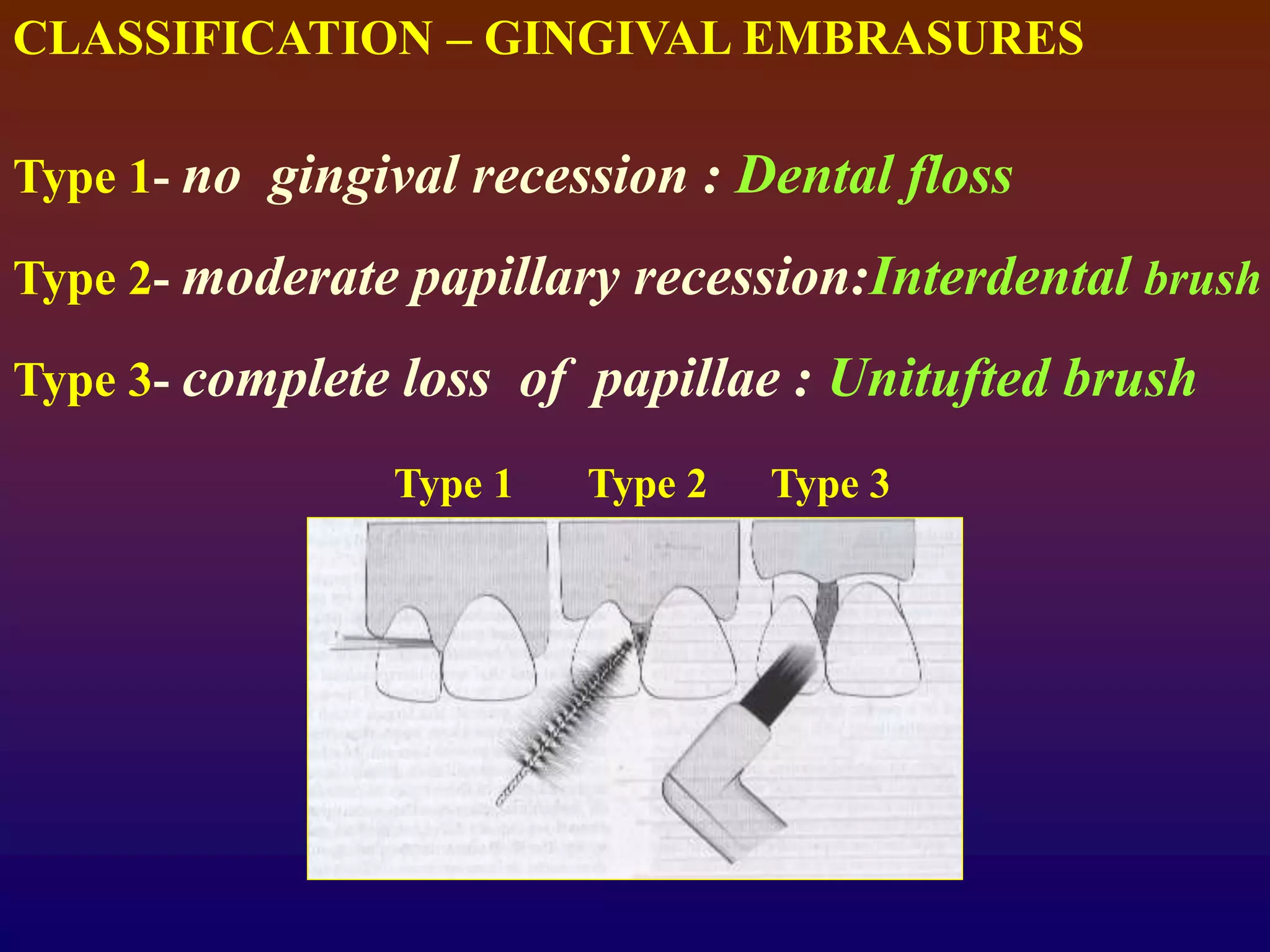
CLASSIFICATION – GINGIVAL EMBRASURES
Type 1- no gingival recession : Dental floss
Type 2- moderate papillary recession:Interdental brush
Type 3- complete loss of papillae : Unitufted brush
Type 1 Type 2 Type 3
GINGIVAL MASSAGE
Produces:
Epithelial thickening
Increased keratinization
Increased mitotic activity
The improved gingival health associated with
interdental stimulation is more likely the result of
plaque removal rather than gingival massage
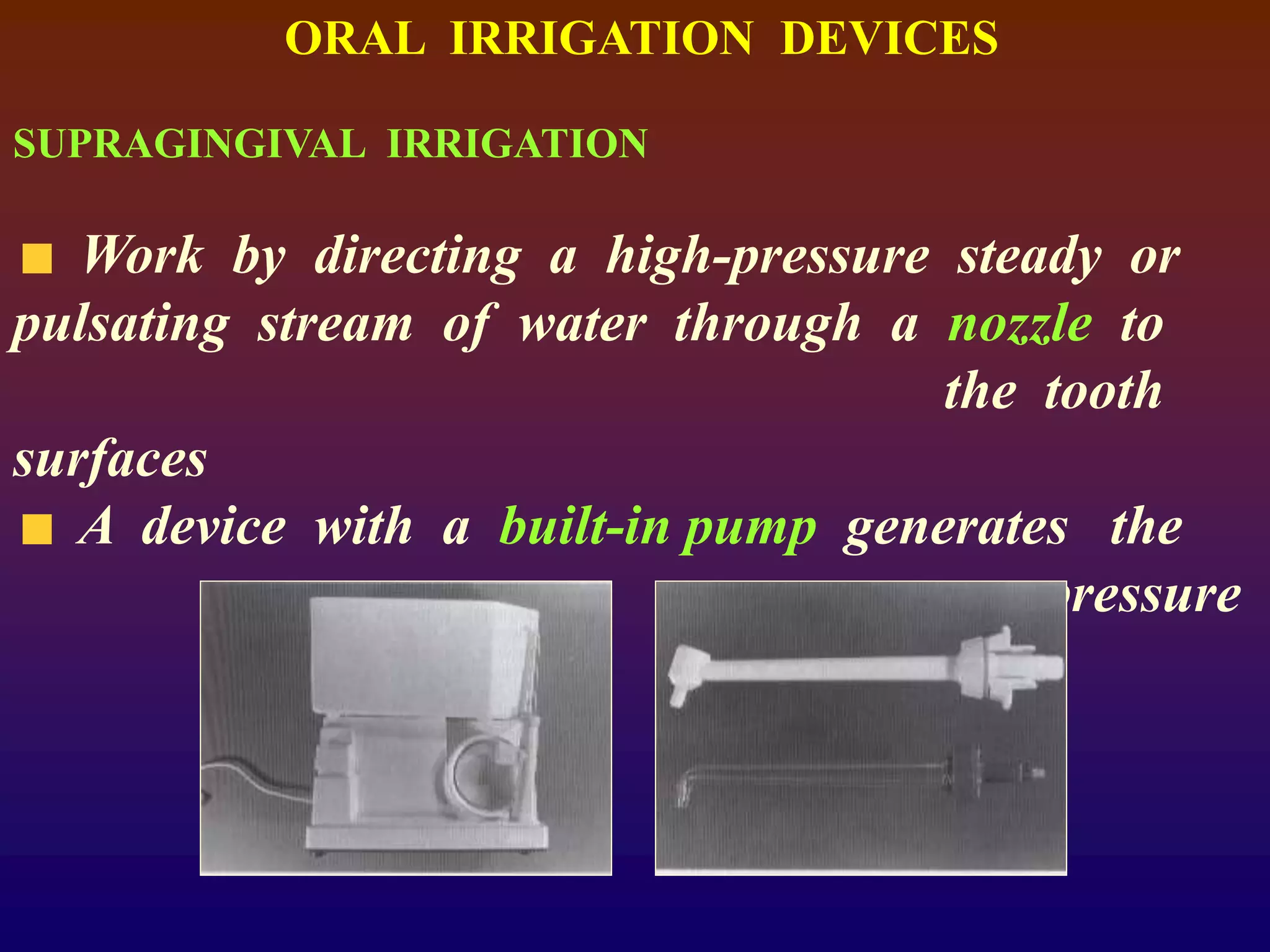
ORAL IRRIGATION DEVICES
SUPRAGINGIVAL IRRIGATION
Work by directing a high-pressure steady or
pulsating stream of water through a nozzle to
the tooth
surfaces
A device with a built-in pump generates the
pressure
Uses :
Clean non-adherent bacteria and debris from
inaccessible areas around orthodontic appliances
and fixed prostheses
Useful in delivering antimicrobial agents into
periodontal pockets
Technique :
The common home-use irrigator tip is a plastic
nozzle with a 90degree bend at the tip attached
to a pump providing pulsating beads of water
at speeds regulated by a dial
Patients should be instructed to aim the
pulsating jet across the proximal papilla, hold it
there for 10-15seconds, then trace along the
gingival margin to the next proximal space
The irrigator should be used from both the
buccal surface and lingual surface
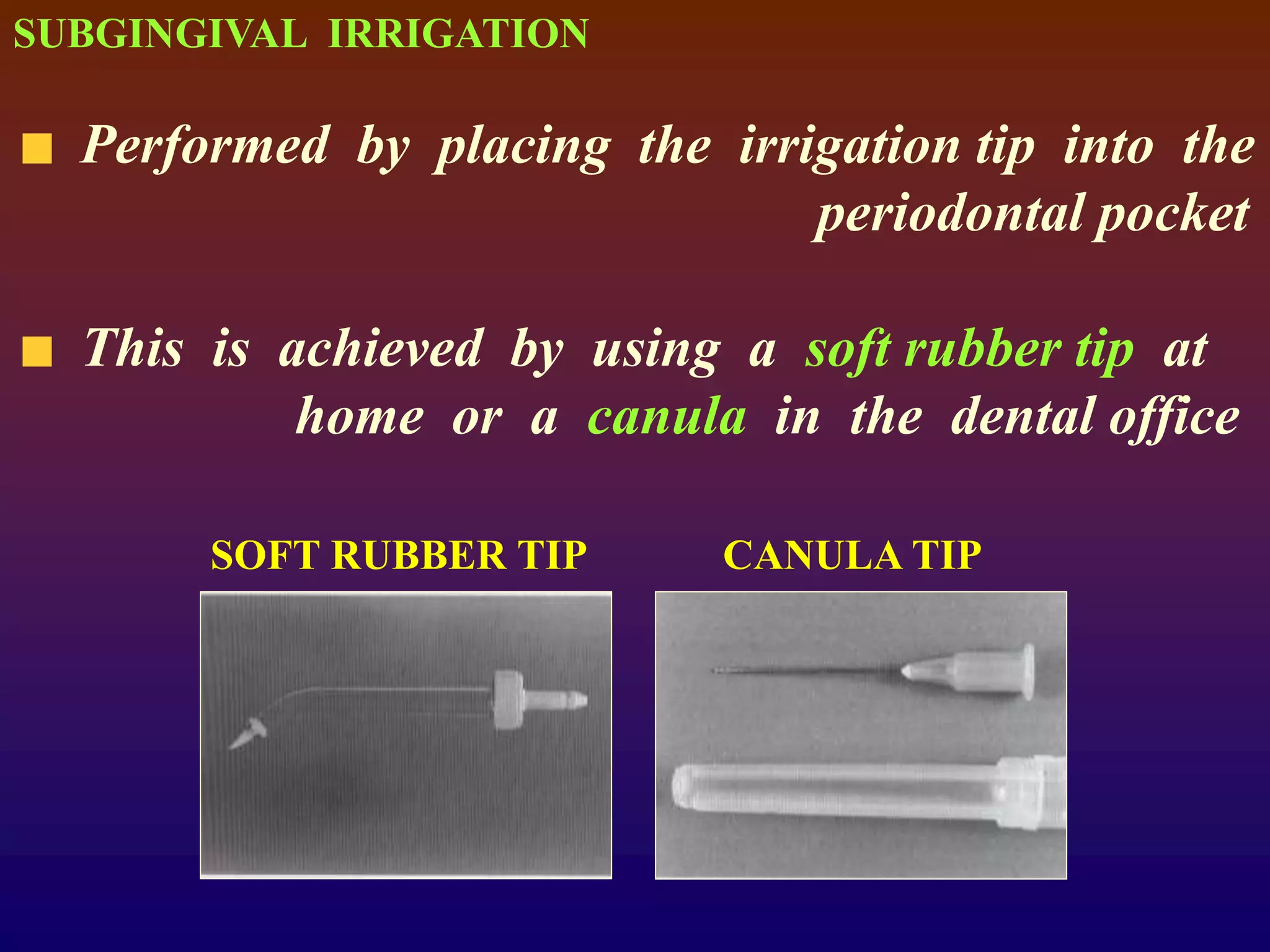
SUBGINGIVAL IRRIGATION
Performed by placing the irrigation tip into the
periodontal pocket
This is achieved by using a soft rubber tip at
home or a canula in the dental office
SOFT RUBBER TIP CANULA TIP
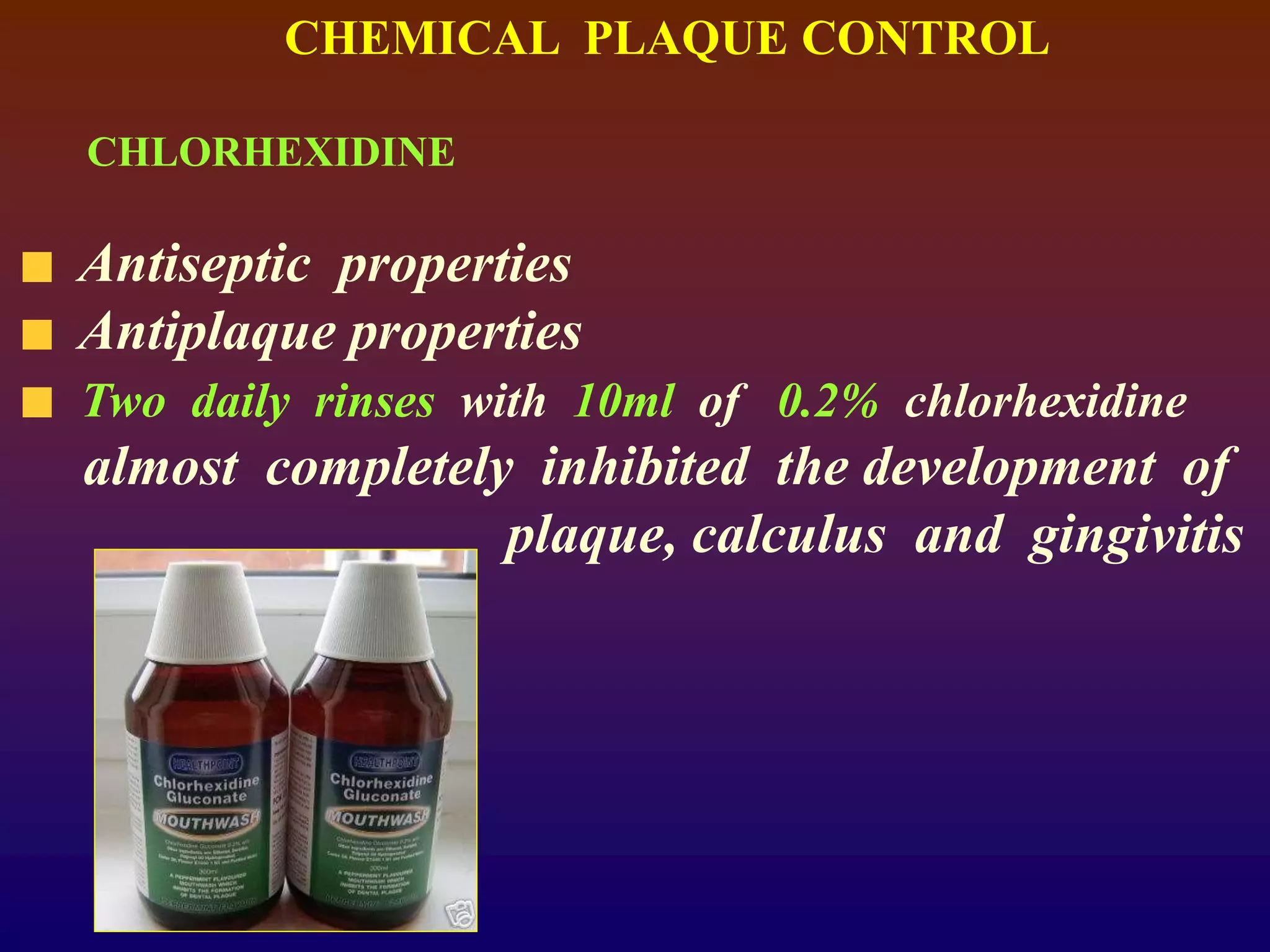
CHEMICAL PLAQUE CONTROL
CHLORHEXIDINE
Antiseptic properties
Antiplaque properties
Two daily rinses with 10ml of 0.2% chlorhexidine
almost completely inhibited the development of
plaque, calculus and gingivitis
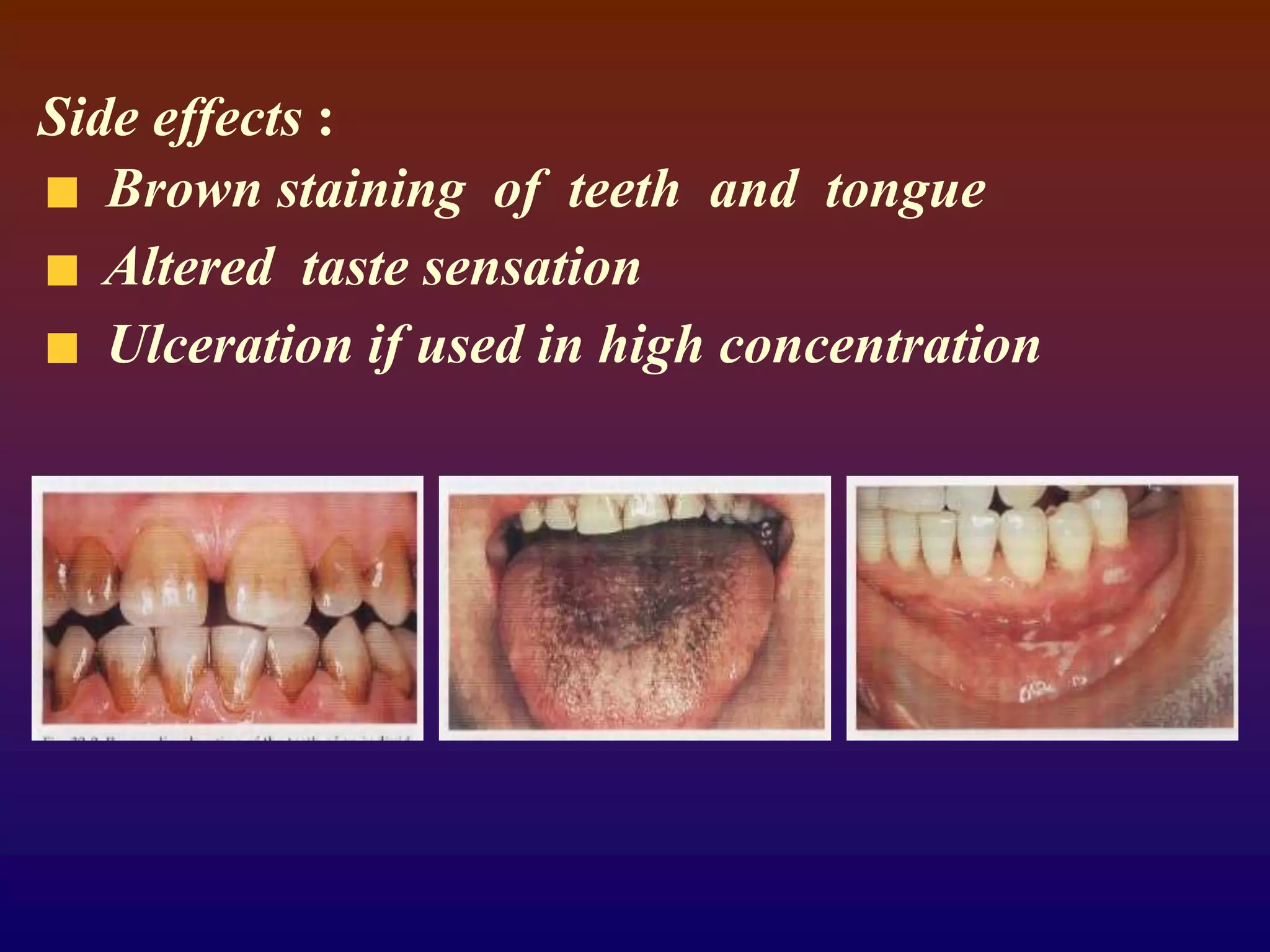
Side effects :
Brown staining of teeth and tongue
Altered taste sensation
Ulceration if used in high concentration

PLAQUE CONTROL.ppt [Recovered].ppt

  • 1.
    Presented by Dr. JanakiK T MDS Sr. Lecturer
  • 2.
    DEFINITION Removal of dentalplaque on a regular basis and prevention of its accumulation on the teeth and adjacent gingival surfaces
  • 3.
    TOOTH BRUSH First bristletooth brush appeared - 1600 in china ADA -- dimensions of Brushes brushing surface : 1 - 1.25 inches long 5/16 - 3/8 inch wide 2 - 4 rows of bristles 5 - 12 tufts per row
  • 4.
    MANUAL TOOTH BRUSHESFROM 19TH AND 20TH CENTURIES
  • 5.
    FRESH & GO- 2 IN ONE TOOTH BRUSH Can be used for 30 brushings – with the turn of a knob
  • 6.
    POWERED TOOTHBRUSHES Invented in1939 advised for : Children and adolescents Children with physical or mental disabilities Hospitalized patients Older adults who need to have their teeth cleaned by caregivers Patients with fixed orthodontic appliances
  • 7.
  • 8.
  • 9.
  • 10.
    BRISTLE MATERIAL :TWO NATURAL -- HOG ARTIFICIAL -- NYLON In terms of – Homogeneity of material Uniformity of bristle size Elasticity Resistance to fracture Repulsion of water and debris nylon filaments are superior
  • 11.
    Because of tubularform, natural bristles are : susceptible to fraying breaking contamination with diluted microbial debris softening loss of elasticity
  • 12.
    Diameters of bristles Softbrushes -- 0.2 mm Medium brushes -- 0.3 mm Hard brushes -- 0.4 mm
  • 13.
    BASS recommended : --a straight handle and -- nylon bristles 0.2mm in diameter and -- 10.3mm long with -- rounded ends arranged in -- three rows of tufts -- Six evenly spaced tufts per row with -- 80 to 86 bristles per tuft For children the brush is smaller with thinner [0.1mm ] and shorter [8.7mm] bristles
  • 14.
    DENTIFRICES Aid in cleaningand polishing tooth surfaces Used mostly in the form of pastes
  • 16.
    COMPOSITION Abrasives -- siliconoxides -- aluminum oxides -- granular polyvinyl chlorides Humectants Soap or detergent Flavoring agents Sweetening agents Therapeutic agents -- fluorides -- pyrophosphates Coloring agents Preservatives
  • 17.
    The proper useof dentifrice can enhance the abrasive action of toothbrush by 40 times Tooth powders contain about 95% abrasives and are 5 times more abrasive than pastes
  • 18.
    Used as chemotherapeuticagents to inhibit -- plaque -- calculus -- caries Tartar control toothpastes which contain pyrophosphate reduced the formation of new supra gingival calculus by more than 30%
  • 19.
    VIGOROUS TOOTH BRUSHINGWITH DENTIFRICE
  • 20.
    TOOTH BRUSHING METHODS ACCORDINGTO THE PATTERN OF MOTION : ROLL -- Roll method -- Modified still man technique VIBRATORY -- Stillman -- Charters -- Bass techniques CIRCULAR -- Fones technique VERTICAL -- Leonard technique HORIZANTAL -- Scrub technique
  • 21.
    The scrub techniqueis probably the simplest and most common method of brushing The sulcus cleansing technique is most frequently taught to the patient with periodontal disease using a vibratory motion to improve access in the gingival areas
  • 22.
    COMMON METHODS OFBRUSHING BASS MODIFIED STILLMAN CHARTERS
  • 23.
    BASS METHOD :sulcus cleansing method TECHNIQUE Place the head of a soft brush parallel with the occlusal plane covering 3 - 4 teeth beginning at the most distal tooth in the arch Place the bristles at the gingival margin by establishing an angle of 45 degrees to the long axis of the teeth
  • 24.
    Exert gentle vibratorypressure using short back-and-forth motions without dislodging the tips of the bristles This motion forces the bristles ends into the gingival sulcus as well as partially into the inter proximal embrasures The pressure should produce perceptible blanching of the gingiva
  • 25.
    Complete approx 20strokes in the same position Lift the brush move it to the adjacent teeth and repeat the process for the next 3-4 teeth Continue around the arch brushing 3 teeth at a time Use the same method to brush the lingual surfaces
  • 26.
    To reach thelingual surfaces of anterior teeth insert the brush vertically
  • 27.
    BRUSH POSITION ONOCCLUSAL SURFACES FOR ALL THE TECHNIQUES
  • 28.
    Advantages : Easy tomaster because it is a simple movement familiar to most patients who brush using a scrub technique It concentrates the cleaning action of the teeth where microbial plaque is most likely to have accumulated Recommended for : Patient with or without periodontal diseases
  • 29.
    MODIFIED STILLMAN METHOD TECHNIQUE Thebrush is placed with the bristle ends resting partly on the cervical portion of the teeth and partly on the adjacent gingiva pointing in an apical direction and at an oblique angle to the long axis of the teeth Apply pressure against the gingival margin to produce a perceptible blanching
  • 30.
    Then move thebrush about 20 short back-and- forth strokes while simultaneously moving it coronally along the attached gingiva, the gingival margin, and the tooth surface A soft or medium multi tufted brush should be used to minimize trauma to the gingiva
  • 31.
    To reach thelingual surfaces of the maxillary and mandibular incisors the handle of the brush can be held in a vertical position engaging the end of the brush The sides rather than the ends of the bristles do the work Recommended : In areas with progressing gingival recession
  • 32.
    CHARTERS METHOD Place asoft or medium multi tufted brush on the teeth with the bristles pointed toward the crown at a 45-degree angle to the long axis of the teeth The sides of the bristles should be flexed against the gingiva and a back- and - forth vibratory motion used to brush
  • 33.
    This technique isdesigned to gently massage the gingiva so the bristle tips should not drag across the gingiva Recommended In areas of healing wounds after perio. surgery
  • 34.
  • 35.
    INTERDENTAL CLEANING AIDS DENTALFLOSS INTERDENTAL CLEANERS
  • 36.
    DENTAL FLOSS Widely recommendedfor removing plaque from proximal tooth surfaces Available as multifilament nylon yarn that is -- twisted or non- twisted -- bonded or non-bonded -- waxed or un-waxed -- thick or thin
  • 37.
    TECHNIQUE Start with apiece of floss long enough to grasp securely; 12 -- 18 inches is sufficient Stretch the floss tightly between the thumb and fore-finger or between both forefingers Pass it gently through each contact area with a firm back-and-forth motion
  • 38.
    Once the flossis apical to the contact area wrap the floss around the proximal surface of one tooth and slip it under the marginal gingiva Move the floss firmly along the tooth up to the contact area and gently down into the sulcus gain repeating this up-and-down stroke
  • 39.
    Flossing is madeeasier by using a floss holder
  • 40.
    A floss holdershould possess One or two forks that are rigid to keep the floss taut when penetrating into tight contact area An effective and simple mounting mechanism to hold the floss firmly in place Disposable single-use floss holders with pre- threaded floss are available Powered floss devices are also available
  • 41.
    INTERDENTAL CLEANING DEVICES Recommendedfor : Proximal cleaning of teeth with large,irregular contact spaces 1. Interdental Brushes 2. Wooden Tips Conical Cylindrical Round Triangular
  • 42.
    1. INTERDENTAL BRUSHES Technique: Interdental brushes of any style are inserted through interproximal spaces and moved back-and-forth between the teeth with short Strokes For efficient cleaning it is best to select the diameter of brush that is slightly larger than the gingival embrasure
  • 43.
    2.WOODEN TIPS Used withor without a handle Without a handle With a handle Stim –U- Dent Perio-Aid O anterior teeth throughout the mouth
  • 44.
    Stim-U-Dent : Technique-- Soft triangular wooden picks are placed in the interdental space in such a way that the base of the triangle rests on the gingiva and the sides are in contact with the proximal tooth surfaces The pick is then repeatedly moved in and out of the embrasure removing soft deposits from the teeth and mechanically stimulating the papillary gingiva
  • 45.
    Perio-Aid : Technique Thedeposits are removed by using either the sides or the tip of the toothpick Particularly useful for cleaning along the gingival margin and into periodontal pockets
  • 46.
    CLASSIFICATION – GINGIVALEMBRASURES Type 1- no gingival recession : Dental floss Type 2- moderate papillary recession:Interdental brush Type 3- complete loss of papillae : Unitufted brush Type 1 Type 2 Type 3
  • 47.
    GINGIVAL MASSAGE Produces: Epithelial thickening Increasedkeratinization Increased mitotic activity The improved gingival health associated with interdental stimulation is more likely the result of plaque removal rather than gingival massage
  • 48.
    ORAL IRRIGATION DEVICES SUPRAGINGIVALIRRIGATION Work by directing a high-pressure steady or pulsating stream of water through a nozzle to the tooth surfaces A device with a built-in pump generates the pressure
  • 49.
    Uses : Clean non-adherentbacteria and debris from inaccessible areas around orthodontic appliances and fixed prostheses Useful in delivering antimicrobial agents into periodontal pockets
  • 50.
    Technique : The commonhome-use irrigator tip is a plastic nozzle with a 90degree bend at the tip attached to a pump providing pulsating beads of water at speeds regulated by a dial Patients should be instructed to aim the pulsating jet across the proximal papilla, hold it there for 10-15seconds, then trace along the gingival margin to the next proximal space The irrigator should be used from both the buccal surface and lingual surface
  • 51.
    SUBGINGIVAL IRRIGATION Performed byplacing the irrigation tip into the periodontal pocket This is achieved by using a soft rubber tip at home or a canula in the dental office SOFT RUBBER TIP CANULA TIP
  • 52.
    CHEMICAL PLAQUE CONTROL CHLORHEXIDINE Antisepticproperties Antiplaque properties Two daily rinses with 10ml of 0.2% chlorhexidine almost completely inhibited the development of plaque, calculus and gingivitis
  • 53.
    Side effects : Brownstaining of teeth and tongue Altered taste sensation Ulceration if used in high concentration