Dr. Hina Barkaat
Assistant Professor
University Medical & Dental College
Faisalabad
Tooth brush
Tooth paste
Tooth brushing techniques
Tooth Brush
 The toothbrush is an instrument consisting of a small
brush on a handle used to clean teeth through tooth
brushing
 Act of cleaning your teeth with the tooth brush is
called Tooth Brushing
Tooth paste
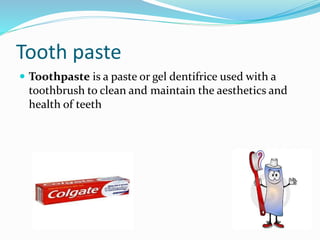
 Toothpaste is a paste or gel dentifrice used with a
toothbrush to clean and maintain the aesthetics and
health of teeth
Functions of Tooth brush
 Used to promote oral hygiene
 Aid in the removal of dental plaque and food from the
teeth on all the surfaces
 Elimination and/or masking of halitosis
 Deliver active ingredients such as fluoride or xylitol to
prevent tooth and gum disease (gingivitis)
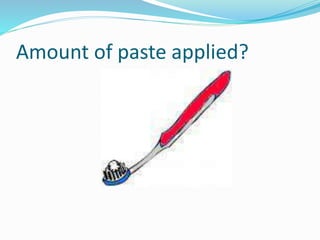
Amount of paste applied?
Introduction
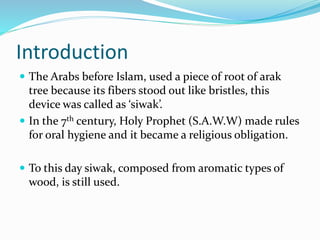
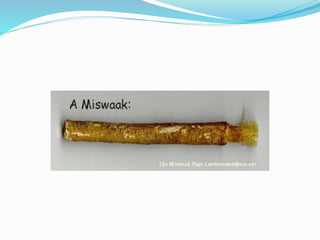
 The Arabs before Islam, used a piece of root of arak
tree because its fibers stood out like bristles, this
device was called as ‘siwak’.
 In the 7th century, Holy Prophet (S.A.W.W) made rules
for oral hygiene and it became a religious obligation.
 To this day siwak, composed from aromatic types of
wood, is still used.
 Chewing sticks not only help to physically clean teeth
but also they contain antibacterial oils & tannins, that
may help to prevent or remove plaque
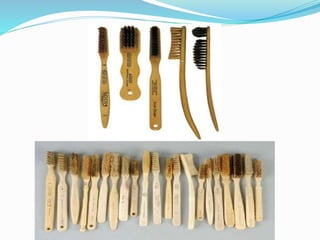
 The bristle tooth brush appeared 1st in china in 1600
 They vary in size, design, length, hardness and
arrangement of bristles
 Hence recommending a particular tooth brush, the
ease of use by a patient as well as the perception that
the brush works well are important
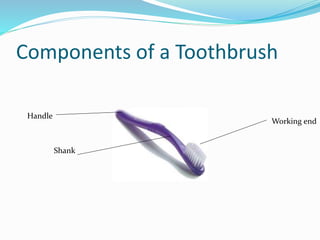
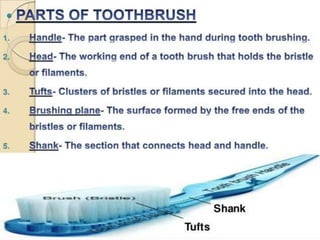
 Each brush has a Handle, a Shank and a Working end
Components of a Toothbrush
Shank
Handle
Working end
Ideal Properties of a Tooth Brush
 Should remove all the plaque
 Should access all the surfaces of the tooth
 Should not injure the Gingiva
 The bristles should be soft
 The bristles should not deteriorate/ or should have
long working life
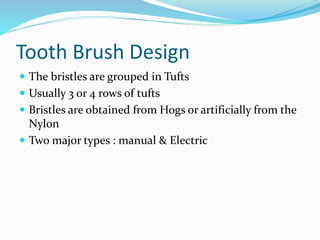
Tooth Brush Design
 The bristles are grouped in Tufts
 Usually 3 or 4 rows of tufts
 Bristles are obtained from Hogs or artificially from the
Nylon
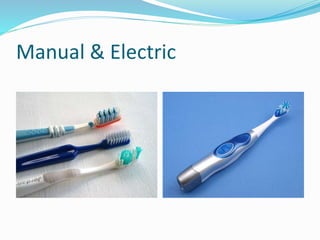
 Two major types : manual & Electric
Manual & Electric
Soft and Hard Bristles
Which is the better one?
Force for Brushing
 The amount of force used is not critical for effective
tooth brushing
 vigorous brushing can lead to
-Gingival recession
-Bacteremia
-Wedge shaped defects in the cervical
area of the root surface
 When brushing force is increased, more plaque is
removed. Numerous studies have reported brushing
forces. Some of these previously reported tooth
brushing forces were 2.95 N , 2.61 N , 2.96 N , 3.23. N,
2.3 N .
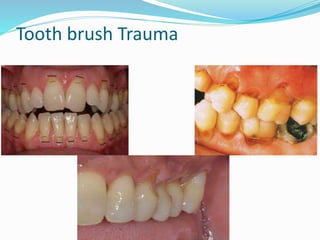
Tooth brush Trauma
Techniques
 Stillman , Charters & Bass
 Modified Stillman & Bass technique
 Fones technique
 Leonard technique
 Scrub technique
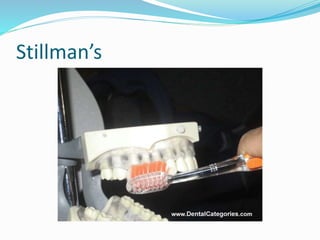
Stillman Method
 A toothbrushing technique that incorporates gingival
stimulation and dental cleansing, in which the
toothbrush is held against both the gingival and the
dental surfaces and manually vibrated
Stillman’s
Cont……
 The bristles ends are placed at 45 degree with the
bristles directed apically on the gingiva and partly on
the cervical portion of the tooth
 when the bristles are in position a gentle but firm
vibratory motion is applied to the brush with the
bristles remaining in the same position
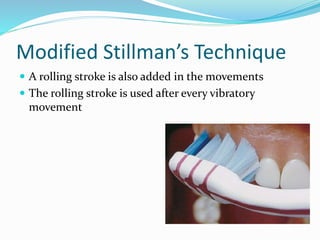
Modified Stillman’s Technique
 A rolling stroke is also added in the movements
 The rolling stroke is used after every vibratory
movement
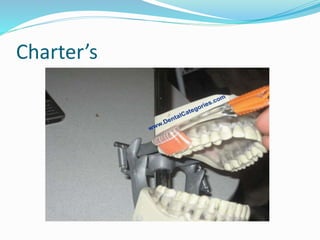
Charter’s Method
 A method of toothbrushing utilizing a restricted
vibratory motion with the bristles inclined coronally at
a 45 degree angle.
 Used when the interdental gingiva does not fill the
embrasure spaces
Charter’s
Cont……
 The bristles are placed at 90 degree towards the
occlusal surface
 The bristles are placed interproximally and then
vibratory movement is used while keeping the bristles
in the position
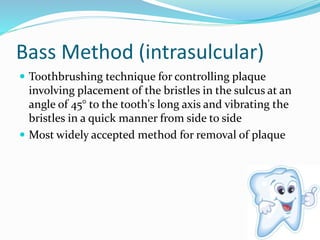
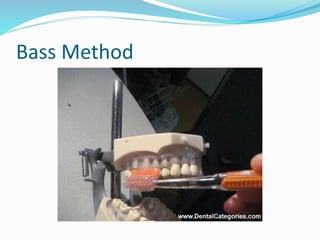
Bass Method (intrasulcular)
 Toothbrushing technique for controlling plaque
involving placement of the bristles in the sulcus at an
angle of 45° to the tooth's long axis and vibrating the
bristles in a quick manner from side to side
 Most widely accepted method for removal of plaque
Bass Method
Cont……
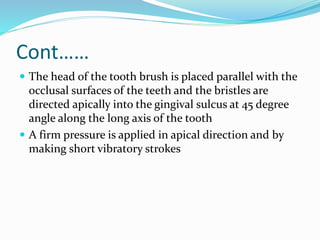
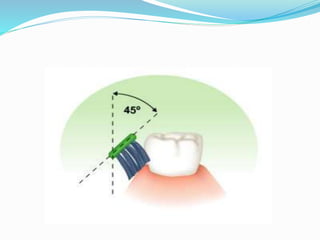
 The head of the tooth brush is placed parallel with the
occlusal surfaces of the teeth and the bristles are
directed apically into the gingival sulcus at 45 degree
angle along the long axis of the tooth
 A firm pressure is applied in apical direction and by
making short vibratory strokes
Modified Bass Method
 The modification consists of sweeping the bristles
downward over the tooth surface occlusally
Fone’s Technique (circular Method)
 A toothbrushing technique in which, with the teeth
occluded and with the brush at more or less right
angles to the teeth, large sweeping, scrubbing circles
are described. With the jaws parted, the palatal and
lingual surfaces of the teeth are scrubbed using
smaller circles. Occlusal surfaces are brushed in an
anteroposterior direction.
Cont……
 Brush is placed perpendicular to the tooth
 Teeth are clenched and large circular movements are
given with the toothbrush
 Not recommended now because injury to gingiva
usually occurs
Leonard’s Technique
 a method of teeth cleaning that advocates a vigorous
drawing of the toothbrush up and down across the
teeth. The teeth are held apart, so that each section is
brushed separately.
 Also known as vertical toothbrushing.
Roll Method
 Brush is placed over the gingiva with the bristles
placed apically
 The jaws are separated
 The bristles are pressed against the gingiva and with
continued pressure the brush is slowly rolled down
over the surface of gingiva and tooth by rotating the
wrist
Cont……
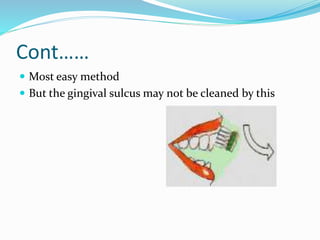
 Most easy method
 But the gingival sulcus may not be cleaned by this
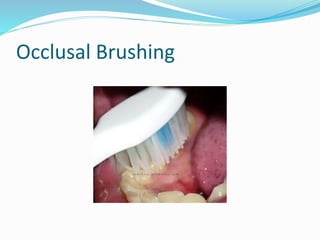
Brushing the Occlusal Surface
 The bristles are placed at right angle on the occlusal
surface with the ends of the bristles deep into the pits
and fissures
 Vibrate the brush while keeping in the same area
 Next give it the circular movements
Occlusal Brushing
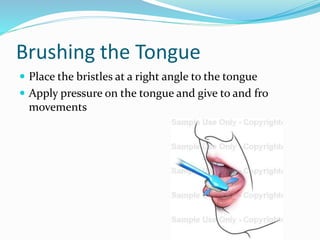
Brushing the Tongue
 Place the bristles at a right angle to the tongue
 Apply pressure on the tongue and give to and fro
movements
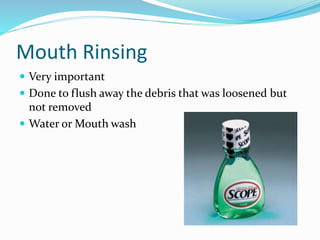
Mouth Rinsing
 Very important
 Done to flush away the debris that was loosened but
not removed
 Water or Mouth wash
Introduction
 Simple toothbrushing cannot clean all the surfaces
 For ideal plaque removal certain aids must be
supplemented which assist in cleaning the remaining
portions
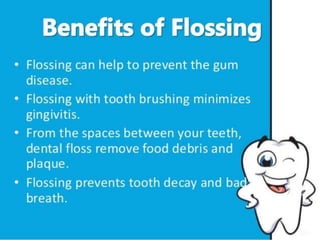
 Dental floss
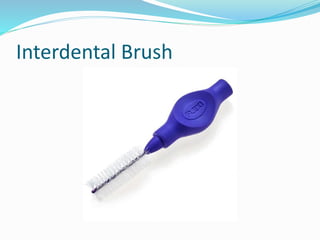
 Interdental toothbrushes
 Mouth washes
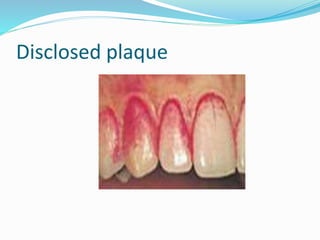
 Disclosing tablets and solutions
 Dentifrices
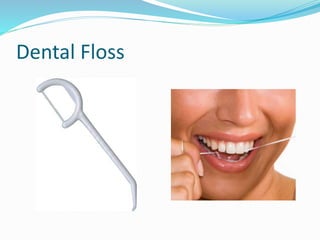
Dental Floss
 Effective use of dental floss accomplishes the following
objectives :
i. Removes plaque and debris that adheres to the
teeth, restorations, orthodontic appliances, fixed
prosthesis and around implants.
ii. Aids clinician in identifying the presence of
interproximal calculus deposits, overhanging
restorations, or interproximal carious lesions.
 Reduces gingival bleeding
Types of dental floss
 Not all interproximal contact areas, whether natural
or restored have the same configuration.
 Consequently, several types of floss are available to
accommodate for these differences.
 They vary from thin unwaxed varieties to thicker
waxed types and include variable thickness.
 Waxed floss
 Unwaxed floss
 Clinical trials have shown no significant difference in
the cleaning ability between waxed and non waxed
floss.
 Wax residue has not been found on tooth surfaces
cleaned with waxed floss.
 Unwaxed floss is frequently recommended because it
is thin and slips easily through tight contact areas
 However, unwaxed floss can fray and tear when
contacting rotated teeth, heavy calculus deposits, or
defective and overhang restorations.
 For such conditions, waxed, lightly waxed resistant
floss are recommended.
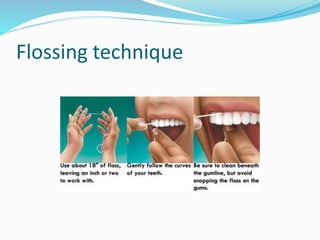
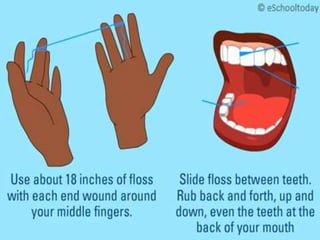
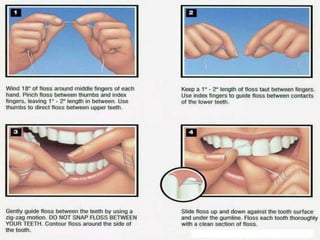
Flossing technique
Interdental Brush
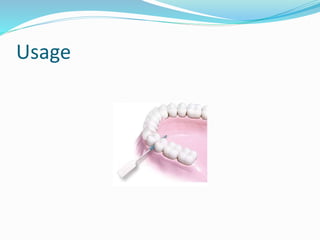
Usage
Disclosing tablets & Solutions
Disclosed plaque
Tooth Brushing.pptx
Tooth Brushing.pptx

Tooth Brushing.pptx

  • 1.
    Dr. Hina Barkaat AssistantProfessor University Medical & Dental College Faisalabad
  • 2.
    Tooth brush Tooth paste Toothbrushing techniques
  • 4.
    Tooth Brush  Thetoothbrush is an instrument consisting of a small brush on a handle used to clean teeth through tooth brushing  Act of cleaning your teeth with the tooth brush is called Tooth Brushing
  • 5.
    Tooth paste  Toothpasteis a paste or gel dentifrice used with a toothbrush to clean and maintain the aesthetics and health of teeth
  • 6.
    Functions of Toothbrush  Used to promote oral hygiene  Aid in the removal of dental plaque and food from the teeth on all the surfaces  Elimination and/or masking of halitosis  Deliver active ingredients such as fluoride or xylitol to prevent tooth and gum disease (gingivitis)
  • 7.
  • 9.
    Introduction  The Arabsbefore Islam, used a piece of root of arak tree because its fibers stood out like bristles, this device was called as ‘siwak’.  In the 7th century, Holy Prophet (S.A.W.W) made rules for oral hygiene and it became a religious obligation.  To this day siwak, composed from aromatic types of wood, is still used.
  • 11.
     Chewing sticksnot only help to physically clean teeth but also they contain antibacterial oils & tannins, that may help to prevent or remove plaque
  • 13.
     The bristletooth brush appeared 1st in china in 1600  They vary in size, design, length, hardness and arrangement of bristles  Hence recommending a particular tooth brush, the ease of use by a patient as well as the perception that the brush works well are important  Each brush has a Handle, a Shank and a Working end
  • 15.
    Components of aToothbrush Shank Handle Working end
  • 16.
    Ideal Properties ofa Tooth Brush  Should remove all the plaque  Should access all the surfaces of the tooth  Should not injure the Gingiva  The bristles should be soft  The bristles should not deteriorate/ or should have long working life
  • 17.
    Tooth Brush Design The bristles are grouped in Tufts  Usually 3 or 4 rows of tufts  Bristles are obtained from Hogs or artificially from the Nylon  Two major types : manual & Electric
  • 19.
  • 20.
    Soft and HardBristles Which is the better one?
  • 21.
    Force for Brushing The amount of force used is not critical for effective tooth brushing  vigorous brushing can lead to -Gingival recession -Bacteremia -Wedge shaped defects in the cervical area of the root surface
  • 22.
     When brushingforce is increased, more plaque is removed. Numerous studies have reported brushing forces. Some of these previously reported tooth brushing forces were 2.95 N , 2.61 N , 2.96 N , 3.23. N, 2.3 N .
  • 23.
  • 25.
    Techniques  Stillman ,Charters & Bass  Modified Stillman & Bass technique  Fones technique  Leonard technique  Scrub technique
  • 26.
    Stillman Method  Atoothbrushing technique that incorporates gingival stimulation and dental cleansing, in which the toothbrush is held against both the gingival and the dental surfaces and manually vibrated
  • 27.
  • 28.
    Cont……  The bristlesends are placed at 45 degree with the bristles directed apically on the gingiva and partly on the cervical portion of the tooth  when the bristles are in position a gentle but firm vibratory motion is applied to the brush with the bristles remaining in the same position
  • 29.
    Modified Stillman’s Technique A rolling stroke is also added in the movements  The rolling stroke is used after every vibratory movement
  • 30.
    Charter’s Method  Amethod of toothbrushing utilizing a restricted vibratory motion with the bristles inclined coronally at a 45 degree angle.  Used when the interdental gingiva does not fill the embrasure spaces
  • 31.
  • 32.
    Cont……  The bristlesare placed at 90 degree towards the occlusal surface  The bristles are placed interproximally and then vibratory movement is used while keeping the bristles in the position
  • 33.
    Bass Method (intrasulcular) Toothbrushing technique for controlling plaque involving placement of the bristles in the sulcus at an angle of 45° to the tooth's long axis and vibrating the bristles in a quick manner from side to side  Most widely accepted method for removal of plaque
  • 34.
  • 35.
    Cont……  The headof the tooth brush is placed parallel with the occlusal surfaces of the teeth and the bristles are directed apically into the gingival sulcus at 45 degree angle along the long axis of the tooth  A firm pressure is applied in apical direction and by making short vibratory strokes
  • 37.
    Modified Bass Method The modification consists of sweeping the bristles downward over the tooth surface occlusally
  • 38.
    Fone’s Technique (circularMethod)  A toothbrushing technique in which, with the teeth occluded and with the brush at more or less right angles to the teeth, large sweeping, scrubbing circles are described. With the jaws parted, the palatal and lingual surfaces of the teeth are scrubbed using smaller circles. Occlusal surfaces are brushed in an anteroposterior direction.
  • 39.
    Cont……  Brush isplaced perpendicular to the tooth  Teeth are clenched and large circular movements are given with the toothbrush  Not recommended now because injury to gingiva usually occurs
  • 40.
    Leonard’s Technique  amethod of teeth cleaning that advocates a vigorous drawing of the toothbrush up and down across the teeth. The teeth are held apart, so that each section is brushed separately.  Also known as vertical toothbrushing.
  • 41.
    Roll Method  Brushis placed over the gingiva with the bristles placed apically  The jaws are separated  The bristles are pressed against the gingiva and with continued pressure the brush is slowly rolled down over the surface of gingiva and tooth by rotating the wrist
  • 42.
    Cont……  Most easymethod  But the gingival sulcus may not be cleaned by this
  • 43.
    Brushing the OcclusalSurface  The bristles are placed at right angle on the occlusal surface with the ends of the bristles deep into the pits and fissures  Vibrate the brush while keeping in the same area  Next give it the circular movements
  • 44.
  • 45.
    Brushing the Tongue Place the bristles at a right angle to the tongue  Apply pressure on the tongue and give to and fro movements
  • 46.
    Mouth Rinsing  Veryimportant  Done to flush away the debris that was loosened but not removed  Water or Mouth wash
  • 48.
    Introduction  Simple toothbrushingcannot clean all the surfaces  For ideal plaque removal certain aids must be supplemented which assist in cleaning the remaining portions  Dental floss  Interdental toothbrushes  Mouth washes  Disclosing tablets and solutions  Dentifrices
  • 49.
  • 50.
     Effective useof dental floss accomplishes the following objectives : i. Removes plaque and debris that adheres to the teeth, restorations, orthodontic appliances, fixed prosthesis and around implants. ii. Aids clinician in identifying the presence of interproximal calculus deposits, overhanging restorations, or interproximal carious lesions.
  • 51.
  • 52.
    Types of dentalfloss  Not all interproximal contact areas, whether natural or restored have the same configuration.  Consequently, several types of floss are available to accommodate for these differences.  They vary from thin unwaxed varieties to thicker waxed types and include variable thickness.
  • 53.
     Waxed floss Unwaxed floss
  • 54.
     Clinical trialshave shown no significant difference in the cleaning ability between waxed and non waxed floss.  Wax residue has not been found on tooth surfaces cleaned with waxed floss.  Unwaxed floss is frequently recommended because it is thin and slips easily through tight contact areas
  • 55.
     However, unwaxedfloss can fray and tear when contacting rotated teeth, heavy calculus deposits, or defective and overhang restorations.  For such conditions, waxed, lightly waxed resistant floss are recommended.
  • 56.
  • 60.
  • 61.
  • 62.
  • 63.

Editor's Notes

  • #6 Dentifrice……..aid in polishing and cleaning of tooth surfaces.
  • #18 Hog is pig
  • #21 Soft toothbrush is .007 inch ( diameter of bristle ) Medium 0.009 inch Hard ( 0.012 inch )
  • #22 Presence of bacteria in blood