NON CARIOUS
TOOTH SURFACE
LOSS
DR. LAMISA RAHMAN
INTERN DOCTOR , BANGLADESH DENTAL COLLEGE
INTERN ID NO. – 865
T. REG.-12709
CONTENT-
 CERVICAL LESION
 TYPES
 EROSION
 ABRASION
 ABFRACTION
 ATTRITION
CERVICAL LESION
 Cervical lesions are the loss of hard tooth tissue at
the cemento-enamel junction or in its adjoining one
third portion of the tooth crown / root.
These can affect any surface of the tooth like-
Facial surface , Lingual surface, Proximal surface.
TYPES OF CERVICAL LESIONS
 Non – carious lesions :
1. Erosion
2. Abrasion
3. Abfraction
 Carious lesions
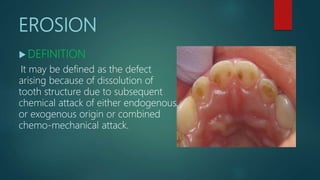
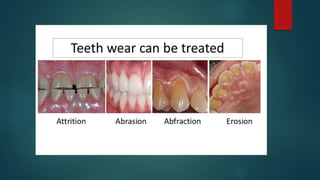
EROSION
 DEFINITION
It may be defined as the defect
arising because of dissolution of
tooth structure due to subsequent
chemical attack of either endogenous
or exogenous origin or combined
chemo-mechanical attack.
 Types
1. Regurgitation erosion:
 caused by frequent exposure of gastric
acid to teeth
Site: palatal surface of maxillary anterior,
occlusal & buccal surface of mandibular
teeth
2.Dietary erosion:
Caused by intake of acidic food & drinks
Site: labial surface of maxillary teeth
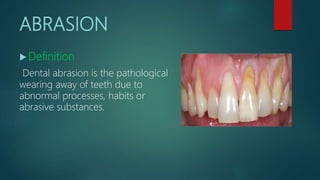
ABRASION
 Definition
Dental abrasion is the pathological
wearing away of teeth due to
abnormal processes, habits or
abrasive substances.
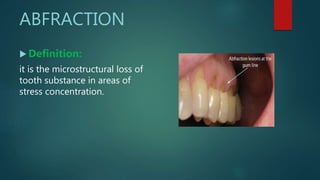
ABFRACTION
 Definition:
it is the microstructural loss of
tooth substance in areas of
stress concentration.
ETIOLOGY
EROSION
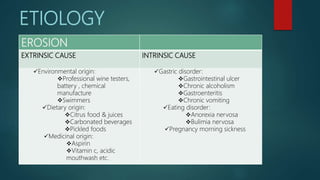
EXTRINSIC CAUSE INTRINSIC CAUSE
Environmental origin:
Professional wine testers,
battery , chemical
manufacture
Swimmers
Dietary origin:
Citrus food & juices
Carbonated beverages
Pickled foods
Medicinal origin:
Aspirin
Vitamin c, acidic
mouthwash etc.
Gastric disorder:
Gastrointestinal ulcer
Chronic alcoholism
Gastroenteritis
Chronic vomiting
Eating disorder:
Anorexia nervosa
Bulimia nervosa
Pregnancy morning sickness
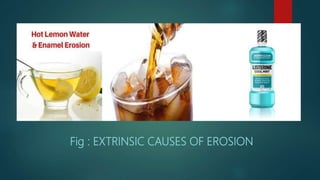
Fig : EXTRINSIC CAUSES OF EROSION
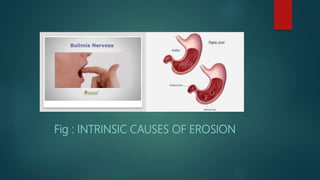
Fig : INTRINSIC CAUSES OF EROSION
ABRASION
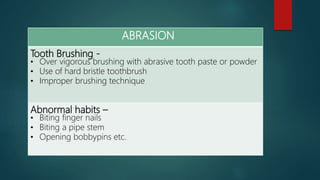
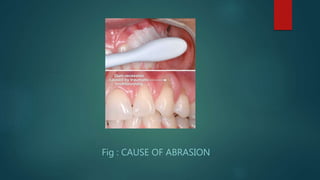
Tooth Brushing -
• Over vigorous brushing with abrasive tooth paste or powder
• Use of hard bristle toothbrush
• Improper brushing technique
Abnormal habits –
• Biting finger nails
• Biting a pipe stem
• Opening bobbypins etc.
Fig : CAUSE OF ABRASION
ABFRACTION
Excessive occlusal stresses
Parafunctional habits-
• Bruxism
• Clenching
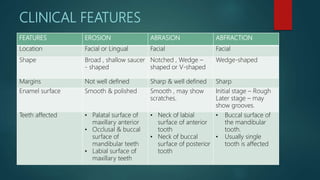
CLINICAL FEATURES
FEATURES EROSION ABRASION ABFRACTION
Location Facial or Lingual Facial Facial
Shape Broad , shallow saucer
- shaped
Notched , Wedge –
shaped or V-shaped
Wedge-shaped
Margins Not well defined Sharp & well defined Sharp
Enamel surface Smooth & polished Smooth , may show
scratches.
Initial stage – Rough
Later stage – may
show grooves.
Teeth affected • Palatal surface of
maxillary anterior
• Occlusal & buccal
surface of
mandibular teeth
• Labial surface of
maxillary teeth
• Neck of labial
surface of anterior
tooth
• Neck of buccal
surface of posterior
tooth
• Buccal surface of
the mandibular
tooth.
• Usually single
tooth is affected
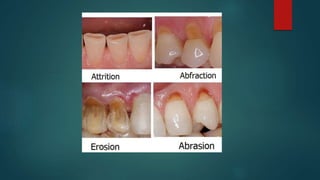
OTHER NON-CARIOUS LESION
OF TOOTH
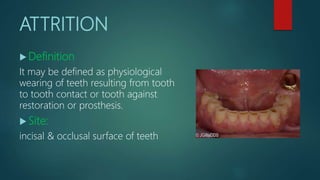
ATTRITION
 Definition
It may be defined as physiological
wearing of teeth resulting from tooth
to tooth contact or tooth against
restoration or prosthesis.
 Site:
incisal & occlusal surface of teeth
 Causes:
 Parafunctional habit like – Bruxism
 Developmental dental defect
 Coarse diet
 Associated with betel nut & pan chewing
 Associated with hypersensitive patients
 Associated with poor restorations
 Natural teeth opposing coarse porcelain
 Attrition of anterior tooth due to lack of posterior
support
 CLINICAL FEATURES :
The first manifestation is the appearance of a small
polished facet on a cusp tip or ridge or an incisal
Severe attrition can result in dentinal exposure , which
may increase the rate of wear.
DIAGNOSIS
 HISTORY-
Before any intervention or any restorative treatment the nature
& duration of patient’s chief complain & expectations must be
ascertained.
Apart from using a routine medical questionnaire , emphasis
may be placed on medical conditions predisposing to erosion
due to gastro-esophageal reflux or reduced salivary flow.
Evalualtion of the family & social history can reveal if the patient
is under unusal stress , which may be related to bruxism ,
changes of diet etc.
 CLINICAL EXAMINATION –
Clinical signs of occlusal problems-
• Tooth mobility
• Open contacts
• Tilted or drifted teeth
• Atypical occlusal wear
• Overerupted teeth
• Cross bites , deep bites & open bites
• Fewer number of occluding teeth
Other signs –
• Tooth sensitivity
• Compromised esthetics
• Risk of tooth fracture
• Pulpal damage
• Poor periodontal health
 Radiographic Findings-
They may be useful in identifying the following
changes-
• Altered lamina dura & periodontal space
• Evidence of resorption
• Pulpal calcification
TREATMENT
 Dentine desensitization:
 Fluoride varnishes or fluoride iontophoresis
 Dentine bonding agents
 Use of desensitizing tooth paste
 Restoration:
 Light cure composite filling
 Glass ionomer cements
 Endodontic therapy
 Periodontal therapy
• Appearance is satisfactory-
 Counselling is required to patients with parafunctional habit.
 Conventional treatment like- exposed pits are filled, occlusal disharmony is
corrected etc.
• Appearance is unsatisfactory but no need to raise the vertical height-
 Teeth are restored preferably with all ceramic crowns or laminates
 Occlusal guard for protection against nocturnal clenching
• Appearance is unsatisfactory & need to raise vertical height-
 Orthodontic tooth movement can be used for over eruption of posterior teeth
creating space for anterior teeth
ATTRITION
• Normal attrition –
Requires no treatment because of formation of secondary dentin, tooth
eruption & alveolar bone growth compensates for occlusal attrition.
• Severe attrition –
Treatment options include use of adhesive materials to replace lost
tooth structure or extraction of affected teeth & replacement with
conventional dentures , overdentures , overlay prosthesis , amalgam or
composite buildups & fixed or removable prosthesis.
• Pathological attrition –
Occlusal adjustment & splint therapy may be indicated for the
dentition.
PREVENTIVE MEASURES
EROSION
1. Diet counselling –
• Advice patients to reduce intake of erosive products such as acidic food &
• Always finish meal by food that are alkaline in nature like cheese
• Forbade them to brush their teeth immediately after taking any citrus food
2. Psychiatric counselling-
For suspected anorectics & bulimics.
3. Use of sodium bicarbonate mouthrinse –
In patients with gastric acid regurgitation sodium bicarbonate mouth rinse should be
prescribed to neutralize the effect of the acid.
4. Use of fluoride mouthrinse & xylitol-
Gum exposed to fluorides will reduce the softening effect of acids.
ABRASION
1. Correct brushing technique-
Advice patients to modify their brushing technique &
recommend use of soft bristle toothbrush & less
abrasive toothpaste or toothpowder.
2. Correct abnormal oral habit-
Abnormal oral habits like nailbiting, holding objects
pins , pipes etc. in the mouth should be corrected .
ABFRACTION
1. Correct occlusal stresses-
In patients with traumatic occlusion or abnormal
occlusal stresses , correction of these occlusal
should be done by occlusal adjustments.
2.Provide mouthguard-
In patients with clenching & bruxism provide
mouthguard to prevent tooth flexure
NON CARIOUS TOOTH SURFACE LOSS

NON CARIOUS TOOTH SURFACE LOSS

  • 1.
    NON CARIOUS TOOTH SURFACE LOSS DR.LAMISA RAHMAN INTERN DOCTOR , BANGLADESH DENTAL COLLEGE INTERN ID NO. – 865 T. REG.-12709
  • 2.
    CONTENT-  CERVICAL LESION TYPES  EROSION  ABRASION  ABFRACTION  ATTRITION
  • 3.
    CERVICAL LESION  Cervicallesions are the loss of hard tooth tissue at the cemento-enamel junction or in its adjoining one third portion of the tooth crown / root. These can affect any surface of the tooth like- Facial surface , Lingual surface, Proximal surface.
  • 4.
    TYPES OF CERVICALLESIONS  Non – carious lesions : 1. Erosion 2. Abrasion 3. Abfraction  Carious lesions
  • 5.
    EROSION  DEFINITION It maybe defined as the defect arising because of dissolution of tooth structure due to subsequent chemical attack of either endogenous or exogenous origin or combined chemo-mechanical attack.
  • 6.
     Types 1. Regurgitationerosion:  caused by frequent exposure of gastric acid to teeth Site: palatal surface of maxillary anterior, occlusal & buccal surface of mandibular teeth 2.Dietary erosion: Caused by intake of acidic food & drinks Site: labial surface of maxillary teeth
  • 7.
    ABRASION  Definition Dental abrasionis the pathological wearing away of teeth due to abnormal processes, habits or abrasive substances.
  • 8.
    ABFRACTION  Definition: it isthe microstructural loss of tooth substance in areas of stress concentration.
  • 9.
    ETIOLOGY EROSION EXTRINSIC CAUSE INTRINSICCAUSE Environmental origin: Professional wine testers, battery , chemical manufacture Swimmers Dietary origin: Citrus food & juices Carbonated beverages Pickled foods Medicinal origin: Aspirin Vitamin c, acidic mouthwash etc. Gastric disorder: Gastrointestinal ulcer Chronic alcoholism Gastroenteritis Chronic vomiting Eating disorder: Anorexia nervosa Bulimia nervosa Pregnancy morning sickness
  • 10.
    Fig : EXTRINSICCAUSES OF EROSION
  • 11.
    Fig : INTRINSICCAUSES OF EROSION
  • 12.
    ABRASION Tooth Brushing - •Over vigorous brushing with abrasive tooth paste or powder • Use of hard bristle toothbrush • Improper brushing technique Abnormal habits – • Biting finger nails • Biting a pipe stem • Opening bobbypins etc.
  • 13.
    Fig : CAUSEOF ABRASION
  • 14.
  • 15.
    CLINICAL FEATURES FEATURES EROSIONABRASION ABFRACTION Location Facial or Lingual Facial Facial Shape Broad , shallow saucer - shaped Notched , Wedge – shaped or V-shaped Wedge-shaped Margins Not well defined Sharp & well defined Sharp Enamel surface Smooth & polished Smooth , may show scratches. Initial stage – Rough Later stage – may show grooves. Teeth affected • Palatal surface of maxillary anterior • Occlusal & buccal surface of mandibular teeth • Labial surface of maxillary teeth • Neck of labial surface of anterior tooth • Neck of buccal surface of posterior tooth • Buccal surface of the mandibular tooth. • Usually single tooth is affected
  • 17.
  • 18.
    ATTRITION  Definition It maybe defined as physiological wearing of teeth resulting from tooth to tooth contact or tooth against restoration or prosthesis.  Site: incisal & occlusal surface of teeth
  • 19.
     Causes:  Parafunctionalhabit like – Bruxism  Developmental dental defect  Coarse diet  Associated with betel nut & pan chewing  Associated with hypersensitive patients  Associated with poor restorations  Natural teeth opposing coarse porcelain  Attrition of anterior tooth due to lack of posterior support
  • 20.
     CLINICAL FEATURES: The first manifestation is the appearance of a small polished facet on a cusp tip or ridge or an incisal Severe attrition can result in dentinal exposure , which may increase the rate of wear.
  • 22.
    DIAGNOSIS  HISTORY- Before anyintervention or any restorative treatment the nature & duration of patient’s chief complain & expectations must be ascertained. Apart from using a routine medical questionnaire , emphasis may be placed on medical conditions predisposing to erosion due to gastro-esophageal reflux or reduced salivary flow. Evalualtion of the family & social history can reveal if the patient is under unusal stress , which may be related to bruxism , changes of diet etc.
  • 23.
     CLINICAL EXAMINATION– Clinical signs of occlusal problems- • Tooth mobility • Open contacts • Tilted or drifted teeth • Atypical occlusal wear • Overerupted teeth • Cross bites , deep bites & open bites • Fewer number of occluding teeth
  • 24.
    Other signs – •Tooth sensitivity • Compromised esthetics • Risk of tooth fracture • Pulpal damage • Poor periodontal health
  • 25.
     Radiographic Findings- Theymay be useful in identifying the following changes- • Altered lamina dura & periodontal space • Evidence of resorption • Pulpal calcification
  • 26.
    TREATMENT  Dentine desensitization: Fluoride varnishes or fluoride iontophoresis  Dentine bonding agents  Use of desensitizing tooth paste  Restoration:  Light cure composite filling  Glass ionomer cements  Endodontic therapy  Periodontal therapy
  • 27.
    • Appearance issatisfactory-  Counselling is required to patients with parafunctional habit.  Conventional treatment like- exposed pits are filled, occlusal disharmony is corrected etc. • Appearance is unsatisfactory but no need to raise the vertical height-  Teeth are restored preferably with all ceramic crowns or laminates  Occlusal guard for protection against nocturnal clenching • Appearance is unsatisfactory & need to raise vertical height-  Orthodontic tooth movement can be used for over eruption of posterior teeth creating space for anterior teeth
  • 28.
    ATTRITION • Normal attrition– Requires no treatment because of formation of secondary dentin, tooth eruption & alveolar bone growth compensates for occlusal attrition. • Severe attrition – Treatment options include use of adhesive materials to replace lost tooth structure or extraction of affected teeth & replacement with conventional dentures , overdentures , overlay prosthesis , amalgam or composite buildups & fixed or removable prosthesis. • Pathological attrition – Occlusal adjustment & splint therapy may be indicated for the dentition.
  • 29.
    PREVENTIVE MEASURES EROSION 1. Dietcounselling – • Advice patients to reduce intake of erosive products such as acidic food & • Always finish meal by food that are alkaline in nature like cheese • Forbade them to brush their teeth immediately after taking any citrus food 2. Psychiatric counselling- For suspected anorectics & bulimics. 3. Use of sodium bicarbonate mouthrinse – In patients with gastric acid regurgitation sodium bicarbonate mouth rinse should be prescribed to neutralize the effect of the acid. 4. Use of fluoride mouthrinse & xylitol- Gum exposed to fluorides will reduce the softening effect of acids.
  • 30.
    ABRASION 1. Correct brushingtechnique- Advice patients to modify their brushing technique & recommend use of soft bristle toothbrush & less abrasive toothpaste or toothpowder. 2. Correct abnormal oral habit- Abnormal oral habits like nailbiting, holding objects pins , pipes etc. in the mouth should be corrected .
  • 31.
    ABFRACTION 1. Correct occlusalstresses- In patients with traumatic occlusion or abnormal occlusal stresses , correction of these occlusal should be done by occlusal adjustments. 2.Provide mouthguard- In patients with clenching & bruxism provide mouthguard to prevent tooth flexure