Regional Anaesthesia
-Aryan Panjoria
-Final Proff.
23
Definition
Any technique to induce the absence of
sensation in part of the body
Why Regional Anaesthesia?
• Cheap
• High Patient Satisfaction
• Maintain Patent Airway
• Decreased Blood Loss
• Selective Muscle Relaxation
•Decreased Incidence of
DVT & PE
Why Not Regional Anaesthesia
• Hypotension
• Risk of toxicity
• Many patients prefer to be asleep
• Skills are required
• Patient Can Talk
• Patient Anxiety
• Not Reliable for Surgery > 2 hours
Regional anesthesia - Types
• Topical
• Intravenous (Bier’s) block
• Peripheral nerve block
• Plexus: brachial, lumbar
• Neuro-axial block
Regional anesthesia - Uses
• Provide anesthesia for a surgical
procedure.
• Provide analgesia post-operatively or
during labor and delivery.
• Therapy for patients with chronic pain
syndromes, cancer.
Spread of Local Anaesthesia
• Baricity of Local Anaesthetic
• Concentration of Local Anaesthetic
• Position of Patient
• Volume Injected
• Level of Injection
• Speed of Injection
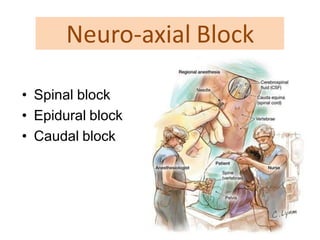
Neuro-axial Block
• Spinal block
• Epidural block
• Caudal block
Pre-Procedure Preparation
• Patient’s assessment
• Explain the procedure & Obtain consent
• Patient is fasting
• Equipments for resuscitation & GA
• IV line insertion & start fluid load
• Ensure the asepsis.
Spinal Anaesthesia
• Local anaesthetic injected into the CSF in sub-
arachanoid space. Between L3-L4
• Patient’s postion : Lateral or Sitting position
• Approach : Midline or Para-median
• Anaesthetic used : Heavy Bupivacaine
• Indication : can be used in the surgeries below
the umblicus
• 23-29 G needles used
• Single dose required
Complications
• Hypotension
• Bradycardia
• Postdural puncture headache(PDPH)
• Respiratory depression
• Meningitis
• Cauda equina syndrome
Epidural Anaesthesia
• The local anaesthetic is injected in the
epidural space to block the nerves emerging
from the spinal cord.
• Position : lateral or sitting position
• Approach : Midline or para median
• Anaesthetic used: bupivacaine
• 16-20G needles used. A catheter is attached
• Larger amount of LA in multiple doses
required
Complications of Epidural Anesthesia
• Anaphylaxis
• Pain
• Post-spinal headache
• Hypotension & Bradycardia
• Nerve damage
• Respiratory failure
• Epidural or intra-thecal bleed
• Spinal cord hematoma
• Infection
• Urinary retention
Absolute Contraindications
• Patient’s refusal
• Coagulopathy
• Skin infection at site of insertion
• Increased ICP
• Hypovolemia
Relative Contraindications
• Uncooperative patient.
• Pre-existing neurological disorder.
• Fixed cardiac output states (AS, MS,
HOCM, 3rddegree heart block).
• Anatomic abnormalities.
• Prophylactic low dose heparin use.
Peripheral Nerve Blocks
• Regional anaesthesia is induced by injecting
the LA around the Nerve Plexus or individual
nerves.
• Example :
-Brachial plexus block for upper limb surgeries.
- nerve block
- wrist block
• Ultrasound may be used
Bier Block
• It is a type of Intravenous block where the LA is
injected into the vein via a cannuala to achieve
Regional anaesthesia.
• Indication : surgical procedures below the elbow
and below the knee.
• 22G catheter is used with a double cuff
tourniquet
• LA used : 30ml of 0.5% Ligno
• Cuff pressure should be 50mm of hg above
systolic BP
• Can be used only for short procedures
Contraindications
• Raynauld’s disease
• Sickle cell anemia
• Young children
• Shock
• Multiple trauma
• Seizure disorder
Complication
• Tourniquet pain
• Erythema at the IV site
• If Tourniquet fails
1. Headache
2. Cardiovascular collapse
3. Seizure
4. bradycardia
EMLA
• Eutectic Mixture of Local Anesthetics
• Contains : Lidocaine 2.5% & Prilocaine 2.5%
• Applied topically on the intact skin and
mucous membranes
• Given 1hr before procedure
• Numbness lasts upto a depth a 5mm for 1-2
hrs
Thank you

Regional Anaesthesia.pptx

  • 1.
  • 2.
    Definition Any technique toinduce the absence of sensation in part of the body
  • 3.
    Why Regional Anaesthesia? •Cheap • High Patient Satisfaction • Maintain Patent Airway • Decreased Blood Loss • Selective Muscle Relaxation •Decreased Incidence of DVT & PE
  • 4.
    Why Not RegionalAnaesthesia • Hypotension • Risk of toxicity • Many patients prefer to be asleep • Skills are required • Patient Can Talk • Patient Anxiety • Not Reliable for Surgery > 2 hours
  • 5.
    Regional anesthesia -Types • Topical • Intravenous (Bier’s) block • Peripheral nerve block • Plexus: brachial, lumbar • Neuro-axial block
  • 6.
    Regional anesthesia -Uses • Provide anesthesia for a surgical procedure. • Provide analgesia post-operatively or during labor and delivery. • Therapy for patients with chronic pain syndromes, cancer.
  • 7.
    Spread of LocalAnaesthesia • Baricity of Local Anaesthetic • Concentration of Local Anaesthetic • Position of Patient • Volume Injected • Level of Injection • Speed of Injection
  • 8.
    Neuro-axial Block • Spinalblock • Epidural block • Caudal block
  • 9.
    Pre-Procedure Preparation • Patient’sassessment • Explain the procedure & Obtain consent • Patient is fasting • Equipments for resuscitation & GA • IV line insertion & start fluid load • Ensure the asepsis.
  • 10.
    Spinal Anaesthesia • Localanaesthetic injected into the CSF in sub- arachanoid space. Between L3-L4 • Patient’s postion : Lateral or Sitting position • Approach : Midline or Para-median • Anaesthetic used : Heavy Bupivacaine • Indication : can be used in the surgeries below the umblicus • 23-29 G needles used • Single dose required
  • 13.
    Complications • Hypotension • Bradycardia •Postdural puncture headache(PDPH) • Respiratory depression • Meningitis • Cauda equina syndrome
  • 14.
    Epidural Anaesthesia • Thelocal anaesthetic is injected in the epidural space to block the nerves emerging from the spinal cord. • Position : lateral or sitting position • Approach : Midline or para median • Anaesthetic used: bupivacaine • 16-20G needles used. A catheter is attached • Larger amount of LA in multiple doses required
  • 18.
    Complications of EpiduralAnesthesia • Anaphylaxis • Pain • Post-spinal headache • Hypotension & Bradycardia • Nerve damage • Respiratory failure • Epidural or intra-thecal bleed • Spinal cord hematoma • Infection • Urinary retention
  • 19.
    Absolute Contraindications • Patient’srefusal • Coagulopathy • Skin infection at site of insertion • Increased ICP • Hypovolemia
  • 20.
    Relative Contraindications • Uncooperativepatient. • Pre-existing neurological disorder. • Fixed cardiac output states (AS, MS, HOCM, 3rddegree heart block). • Anatomic abnormalities. • Prophylactic low dose heparin use.
  • 21.
    Peripheral Nerve Blocks •Regional anaesthesia is induced by injecting the LA around the Nerve Plexus or individual nerves. • Example : -Brachial plexus block for upper limb surgeries. - nerve block - wrist block • Ultrasound may be used
  • 23.
    Bier Block • Itis a type of Intravenous block where the LA is injected into the vein via a cannuala to achieve Regional anaesthesia. • Indication : surgical procedures below the elbow and below the knee. • 22G catheter is used with a double cuff tourniquet • LA used : 30ml of 0.5% Ligno • Cuff pressure should be 50mm of hg above systolic BP • Can be used only for short procedures
  • 25.
    Contraindications • Raynauld’s disease •Sickle cell anemia • Young children • Shock • Multiple trauma • Seizure disorder
  • 26.
    Complication • Tourniquet pain •Erythema at the IV site • If Tourniquet fails 1. Headache 2. Cardiovascular collapse 3. Seizure 4. bradycardia
  • 27.
    EMLA • Eutectic Mixtureof Local Anesthetics • Contains : Lidocaine 2.5% & Prilocaine 2.5% • Applied topically on the intact skin and mucous membranes • Given 1hr before procedure • Numbness lasts upto a depth a 5mm for 1-2 hrs
  • 28.