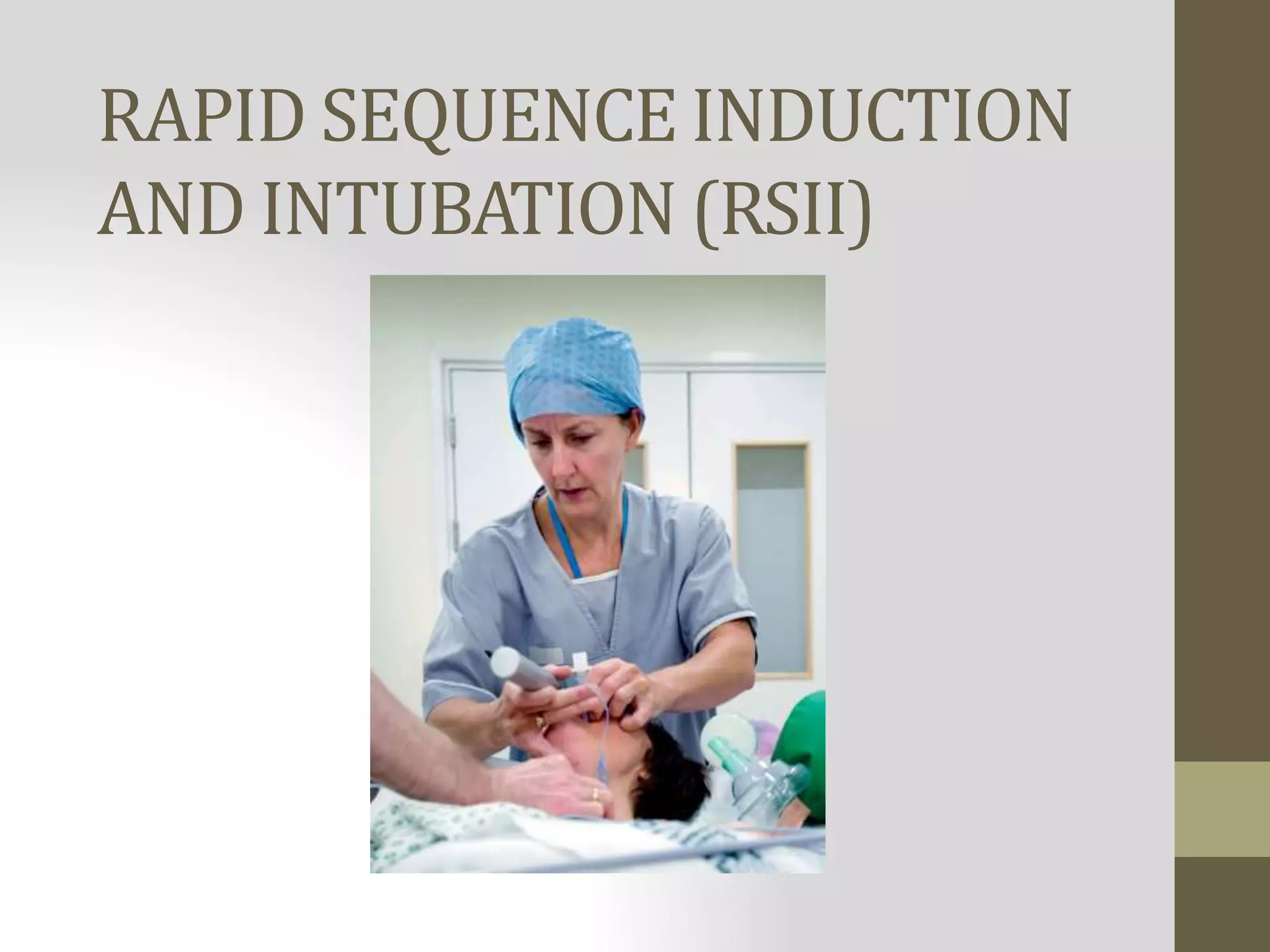
RAPID SEQUENCE INDUCTION
AND INTUBATION (RSII)
RSII
• Rapid sequence induction (RSI) is a method of achieving
rapid control of the airway whilst minimising the risk of
regurgitation and aspiration of gastric contents.
• It includes Intravenous induction of anaesthesia, with
the application of cricoid pressure, is swiftly followed by
the placement of an endotracheal tube (ETT).
CLASSICAL RSI
RSI was originally described in 1961 by Sellick as:
• Emptying of the stomach via a gastric tube which is then
removed
• Pre-oxygenation
• Positioning the patient supine with a head-down tilt
• Induction of anaesthesia with a barbiturate (e.g.
thiopentone) or volatile and a rapid-acting muscle relaxant
(e.g. suxamethonium)
• Application of cricoid pressure
• Laryngoscopy and intubation of the trachea with a cuffed
tube immediately following fasciculation
The above classic method is now very rarely followed in
full.
MODIFIED RSII
COMMON MODIFICATIONS
• Omitting the placement of an OG/NG tube
• Supine or ramped positioning
• Titrating the dose of induction agent to loss of consciousness
• Use of propofol, ketamine, midazolam or etomidate to induce
anaesthesia
• Use of high-dose rocuronium as a NMBA
• Omitting cricoid pressure
• BVM before intubation ( <20 cmH2O)
General indications
• Unfasted patient or unknown fasting status e.g.
trauma patients, emergency surgery, resuscitation
situations and in patients with a reduced conscious
levels
• Patients with gastrointestinal pathology:
 Gastroparesis(DIABETES,CKD,PARKINSONS)
 Small bowel obstruction
 Gastric outlet obstruction
 Esophageal stricture
 GERD
 history of gastric banding surgery.
• Patients with increased intraabdominal pressure,
 Morbid obesity
 Ascites
 Pregnancy after 20 weeks gestation.
Contraindications to RSI are few and relative.
The anticipation of the difficult airway For example, in cases of
facial trauma with severe anatomical disruption may lead to
difficult or improperly placed endotracheal tubes.
patients who might not tolerate apnea very well, because of
profound hypoxemia or metabolic acidosis consider an “awake”
intubation
CONTRAINDICATIONS
PREPARATION
It includes
• Preparation of patient
• Preparation of equipment
• Preparation of drugs
• Preparation of team
PREPARATION
Preparation of patient
• Explain patient about the planned technique including cricoid
pressure. Their cooperation for effective preoxygenation (or
denitrogenation) will also be required.
• An alert patient may be offered a non-particulate antacid
beforehand, such as 30mL of sodium citrate 0.3 molar: this is most
commonly used in the obstetric population.
PREPARATION
Preparation of equipment
Suggested equipment
(** optional)
• Oxygen supply (machine)
• Oxygen delivery device
 Self-inflating bag with one-way valve
 Nasal prongs**
• Standard airway equipment
 Face mask
 Laryngoscope handle x 2
 Range of laryngoscope blades
 Cuffed oral endotracheal tubes of appropriate
sizing, with a range of alternative sizes
available
 ET tube tie or tape contd
PREPARATION
preparation of equipment
Suggested equipment
(** optional)
• Difficult airway equipment,
 Oro- and naso-pharyngeal airways
 Bougie
 Video laryngoscope (**)
• Supraglottic rescue device: Laryngeal mask airway or
alternative supraglottic airway
• Suction
• Monitoring
 Pulse oximeter
 Waveform capnograph
 Blood pressure sphygmomanometer, or arterial line
 Electrocardiograph contd
PREPARATION
preparation of equipment
Suggested equipment
(** optional)
• Drugs
 Induction agent
 Agent for maintenance of anaesthesia
 Fast-acting neuromuscular blocking agent
 Emergency drugs (vasopressor and adrenaline,
atropine)
 Fluids running to act as flush for rapidly delivering
drugs to circulation.
PREPARATION
Preparation of DRUGS
HYPNOTICS
Five drugs are commonly used to induction anaesthesia:
Propofol (1-3 mg/kg) is commonly used in the operating theatre for patients who
are haemodynamically stable. In elderly or hypovolaemic patients, the dose is 0.5-
1mg/kg.
Ketamine (1-2mg/kg) is used in pre-hospital settings and in unstable patients. S/E
elevation in heart rate and blood pressure changes. It increases Secretions,
suctioning or premedication with atropine or glycopyrrolate necessary.
Etomidate (0.3mg/kg) also has very limited haemodynamic effects. Use has been
limited by concerns of adrenal suppression.
Thiopentone (3-5mg/kg) has the most rapid and predictable effect, with less
haemodynamic instability than propofol. However, Issues with poor availability and
the harmful sequelae following extravasation or intra-arterial injection.
Midazolam (0.1-0.2mg/kg) It is most suitable in patients who are already obtunded
and require amnesia rather than true anaesthesia.
PREPARATION
Preparation of DRUGS
Neuromuscular blocking agents.
suxamethonium (sch) (1-2mg/kg) it produces fasciculations, paralysis, and
excellent intubating conditions within one circulation time (15-45 seconds).
S/E Myalgia, bradycardia, hyperkalaemia-induced cardiac arrest, anaphylaxis,
and triggering of malignant hyperthermia. C/I recent burns, spinal cord injury or
a history of muscular dystrophy.
Rocuronium is an alternative agent. In high dose (a range of 0.9-1.6mg/kg)
profound relaxation within 45-60 seconds.The prolonged duration of action
avoid if the airway is likely to be difficult and if the specific reversal
agent(sugammadex) is not available.
Sugammadex(16mg/kg) binds avidly to rocuronium, making it unavailable to
bind at the neuromuscular junction and reversing the effect. This is useful for
difficult airway plan. But limited use due to its high cost.Side effects include
interaction with hormonal contraceptive drugs.
PREPARATION
Preparation of DRUGS
Pharmacological adjuncts
In shocked patients, no adjuncts may be required. However, in
systemically well patients, or patients at risk of severe hypertension
during induction (for example pre-eclampsia, head injury or an
unprotected intracranial aneurysm), ablating the pressor response
to laryngoscopy is required.
Opioids are commonly used: fentanyl (1-2mcg/kg), remifentanil
(0.5-1 mcg/kg)
Lidocaine (lignocaine) (1-1.5 mg/kg) is also effective at reducing
cough and bronchospasm, solely or in combination with an opioid.
PREPARATION
preparation of TEAM
Teamwork Teams that provide RSI should comprise
at least three practitioners:
■An intubator and team leader.
■An airway assistant who is responsible for the
equipment and, usually, drugs administration.
■ A practitioner who applies cricoid pressure,
watches the monitor.
Where necessary, teams also include a fourth
practitioner who is dedicated to providing MILS.
RSI TECHNIQUE
The patient should be positioned appropriately for pre-
oxygenation and intubation.
A reliable intravenous cannula should be placed, and a
fluid should run freely to maximise drug delivery to the
central circulation.
POSITIONING
• Sniffing position( Extension at atlanto-occipital joint Flexion at
neck with head elevation of 10cm).
• Obese patients may require a ramped position.
• 20 degrees head up to prevent passive regurgitation
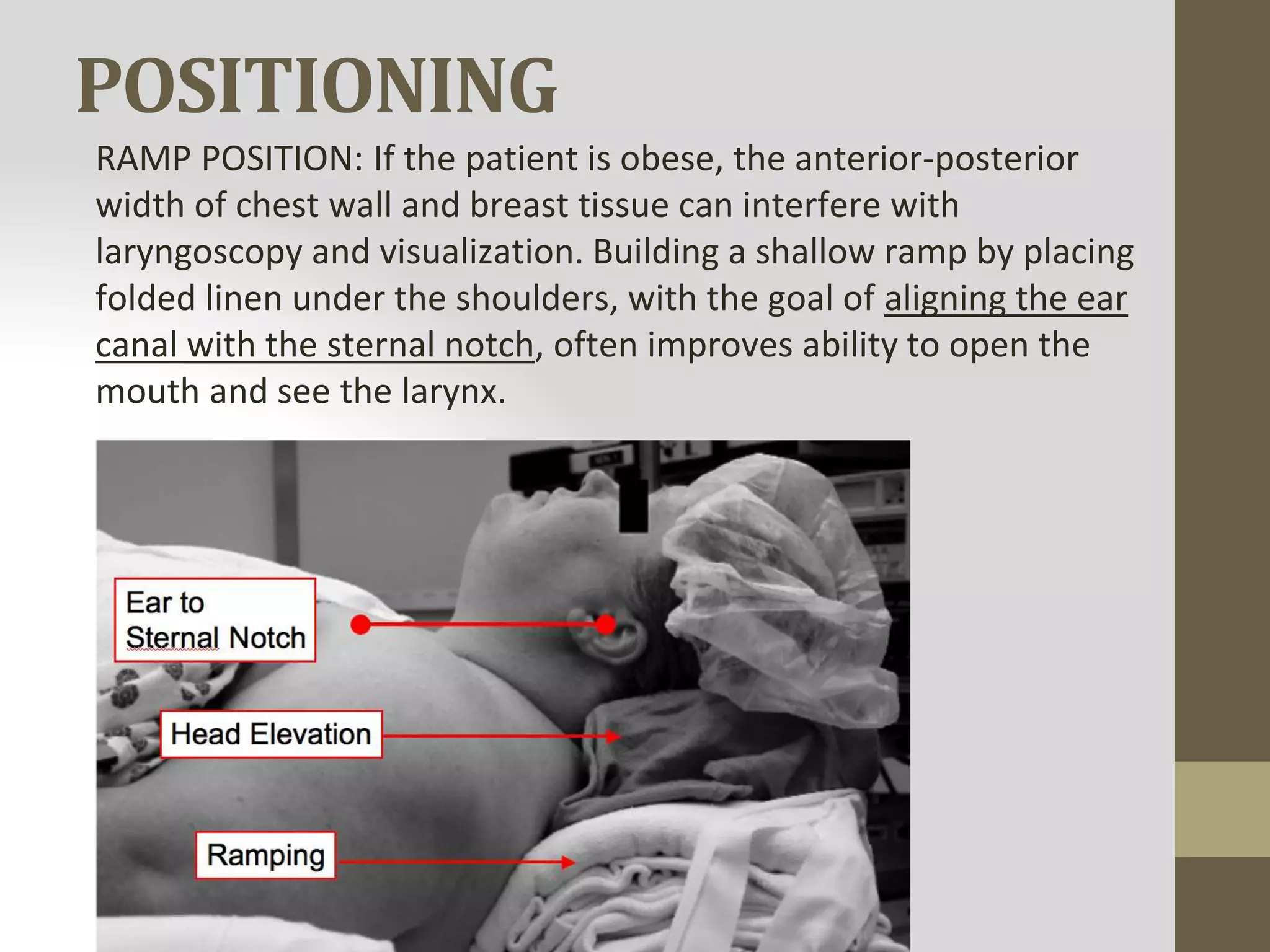
Ramp position
Ear --- sternal notch in straight line
POSITIONING
RAMP POSITION: If the patient is obese, the anterior-posterior
width of chest wall and breast tissue can interfere with
laryngoscopy and visualization. Building a shallow ramp by placing
folded linen under the shoulders, with the goal of aligning the ear
canal with the sternal notch, often improves ability to open the
mouth and see the larynx.
PREOXYGENATION
Replace nitrogen that forms the majority of the functional
residual capacity( FRC) with oxygen
“Nitrogen washout oxygen wash in”
Goals:
The main goal is to extend the ‘safe apnoea time.
Safe apnoea time is the duration of time until critical arterial desaturation
(SaO2 88% to 90%) occurs following cessation of breathing/ventilation.
an alternative term in use is ‘duration of apnoea without desaturation’
(DAWD)
In a healthy preoxygenated patient the safe apnea time is up to 8
minutes, compared to ~1 min if they were breathing room air
METHODS :
At a minimum, three minutes of tidal breathing, or eight vital capacity
breaths in one minute should be performed with an inspired oxygen
concentration of 100%.
Alternatively, if a gas analyser is available, the end-tidal oxygen fraction
should reach at least 0.8.
CRICOID PRESSURE DURING RSII
(Sellick's maneuver)
• Cricoid pressure is the application of force to the cricoid
cartilage . The rationale is that the upper oesophagus is
occluded by being compressed between the between the
posterior aspect of the cricoid and the vertebral body of C5-
6 preventing passive reflux of gastric contents and
subsequent development of aspiration pneumonitis.
• 10N of force is applied by the thumb and index finger of an
assistant increasing to 30N once consciousness is lost. This
pressure is maintained until endotracheal tube cuff inflated
& placement is confirmed.
• Cricoid pressure should be reduced or released if
laryngoscopy is difficult, or if vomiting occurs (to reduce the
chance of oesophageal rupture from active vomiting).
Controversies
• The application of cricoid pressure displaced the esophagus
laterally in 90 percent of subjects
• Worsened Cormack Lehane grade view during laryngoscopy
• No difference in the incidence of aspiration
• Reduced lower oesophageal sphincter tone and therefore
increasing reflux risk
• Median intubation time was longer in patients who had
cricoid pressure applied
In most situations, “it is not harmful and may be beneficial”.
.
C/I :
C-spine injury
ant. neck trauma(cricotracheal injuries)
active vomiting.
inadequate view of the cords on laryngoscopy
PLACEMENT (INTUBATION)
• Cuffed tube of appropriate size
• Cricoid pressure continued ,released if view is obscured
• Placement of tube is confirmed ,and fixed
• Cricoid pressure released after inflation of ET tube’s cuff
•
Confirmation of placement of ET tube:
• Direct visualization of ETT passing through vocal cords
• Chest rise/fall with each ventilation (bilateral)
• Five-point auscultation
• ET CO2 measurement (The gold standard is the
appearance of a 4 phase capnography waveform for 5
breaths, although this is reliant on cardiac output)
• Monitor O2 saturation
• Condensation of tube
• Radiological : CXR , USG
Failed intubation
• Inability to intubate the patient during an RSI should
prompt the usual approach to a difficult intubation.
• If the initial intubation attempt is unsuccessful, a best
attempt at face-mask ventilation should be performed
while preparing either a supraglottic airway, a
different laryngoscopy technique or a new operator.
• Rarely, a surgical airway may be required and
equipment for this should be available at every RSI.
• Several algorithms for managing failed intubation
have been produced, including the Difficult Airway
Society guidelines.
REFERENCES
• Uptodate
• PubMed : Cricoid pressure and the pressor response to tracheal
intubation.Mills P
, Poole T
, Curran J Anaesthesia. 1988;43(9):788
• Effect of Cricoid Pressure Compared With a Sham Procedure in the Rapid
Sequence Induction of Anesthesia: The IRIS Randomized Clinical
Trial.Birenbaum A, Hajage D, Roche S, Ntouba A, Eurin M, Cuvillon P, Rohn A,
Compere V, Benhamou D, Biais M, Menut R, Benachi S, Lenfant F, Riou
B JAMA Surg. 2018
• Preoxygenation, reoxygenation, and delayed sequence intubation in the
emergency department.J Emerg Med. 2011; 40(6):661-7(ISSN: 0736-4679)
• Should the routine use of atropine before succinylcholine in children be
reconsidered?Can J Anaesth. 1995; 42(8):724-9 (ISSN: 0832-610X)
THANK YOU
# 10 years challenge

RSI 2023.pptx

  • 1.
  • 2.
    RSII • Rapid sequenceinduction (RSI) is a method of achieving rapid control of the airway whilst minimising the risk of regurgitation and aspiration of gastric contents. • It includes Intravenous induction of anaesthesia, with the application of cricoid pressure, is swiftly followed by the placement of an endotracheal tube (ETT).
  • 3.
    CLASSICAL RSI RSI wasoriginally described in 1961 by Sellick as: • Emptying of the stomach via a gastric tube which is then removed • Pre-oxygenation • Positioning the patient supine with a head-down tilt • Induction of anaesthesia with a barbiturate (e.g. thiopentone) or volatile and a rapid-acting muscle relaxant (e.g. suxamethonium) • Application of cricoid pressure • Laryngoscopy and intubation of the trachea with a cuffed tube immediately following fasciculation The above classic method is now very rarely followed in full.
  • 4.
    MODIFIED RSII COMMON MODIFICATIONS •Omitting the placement of an OG/NG tube • Supine or ramped positioning • Titrating the dose of induction agent to loss of consciousness • Use of propofol, ketamine, midazolam or etomidate to induce anaesthesia • Use of high-dose rocuronium as a NMBA • Omitting cricoid pressure • BVM before intubation ( <20 cmH2O)
  • 5.
    General indications • Unfastedpatient or unknown fasting status e.g. trauma patients, emergency surgery, resuscitation situations and in patients with a reduced conscious levels • Patients with gastrointestinal pathology:  Gastroparesis(DIABETES,CKD,PARKINSONS)  Small bowel obstruction  Gastric outlet obstruction  Esophageal stricture  GERD  history of gastric banding surgery. • Patients with increased intraabdominal pressure,  Morbid obesity  Ascites  Pregnancy after 20 weeks gestation.
  • 6.
    Contraindications to RSIare few and relative. The anticipation of the difficult airway For example, in cases of facial trauma with severe anatomical disruption may lead to difficult or improperly placed endotracheal tubes. patients who might not tolerate apnea very well, because of profound hypoxemia or metabolic acidosis consider an “awake” intubation CONTRAINDICATIONS
  • 7.
    PREPARATION It includes • Preparationof patient • Preparation of equipment • Preparation of drugs • Preparation of team
  • 8.
    PREPARATION Preparation of patient •Explain patient about the planned technique including cricoid pressure. Their cooperation for effective preoxygenation (or denitrogenation) will also be required. • An alert patient may be offered a non-particulate antacid beforehand, such as 30mL of sodium citrate 0.3 molar: this is most commonly used in the obstetric population.
  • 9.
    PREPARATION Preparation of equipment Suggestedequipment (** optional) • Oxygen supply (machine) • Oxygen delivery device  Self-inflating bag with one-way valve  Nasal prongs** • Standard airway equipment  Face mask  Laryngoscope handle x 2  Range of laryngoscope blades  Cuffed oral endotracheal tubes of appropriate sizing, with a range of alternative sizes available  ET tube tie or tape contd
  • 10.
    PREPARATION preparation of equipment Suggestedequipment (** optional) • Difficult airway equipment,  Oro- and naso-pharyngeal airways  Bougie  Video laryngoscope (**) • Supraglottic rescue device: Laryngeal mask airway or alternative supraglottic airway • Suction • Monitoring  Pulse oximeter  Waveform capnograph  Blood pressure sphygmomanometer, or arterial line  Electrocardiograph contd
  • 11.
    PREPARATION preparation of equipment Suggestedequipment (** optional) • Drugs  Induction agent  Agent for maintenance of anaesthesia  Fast-acting neuromuscular blocking agent  Emergency drugs (vasopressor and adrenaline, atropine)  Fluids running to act as flush for rapidly delivering drugs to circulation.
  • 12.
    PREPARATION Preparation of DRUGS HYPNOTICS Fivedrugs are commonly used to induction anaesthesia: Propofol (1-3 mg/kg) is commonly used in the operating theatre for patients who are haemodynamically stable. In elderly or hypovolaemic patients, the dose is 0.5- 1mg/kg. Ketamine (1-2mg/kg) is used in pre-hospital settings and in unstable patients. S/E elevation in heart rate and blood pressure changes. It increases Secretions, suctioning or premedication with atropine or glycopyrrolate necessary. Etomidate (0.3mg/kg) also has very limited haemodynamic effects. Use has been limited by concerns of adrenal suppression. Thiopentone (3-5mg/kg) has the most rapid and predictable effect, with less haemodynamic instability than propofol. However, Issues with poor availability and the harmful sequelae following extravasation or intra-arterial injection. Midazolam (0.1-0.2mg/kg) It is most suitable in patients who are already obtunded and require amnesia rather than true anaesthesia.
  • 13.
    PREPARATION Preparation of DRUGS Neuromuscularblocking agents. suxamethonium (sch) (1-2mg/kg) it produces fasciculations, paralysis, and excellent intubating conditions within one circulation time (15-45 seconds). S/E Myalgia, bradycardia, hyperkalaemia-induced cardiac arrest, anaphylaxis, and triggering of malignant hyperthermia. C/I recent burns, spinal cord injury or a history of muscular dystrophy. Rocuronium is an alternative agent. In high dose (a range of 0.9-1.6mg/kg) profound relaxation within 45-60 seconds.The prolonged duration of action avoid if the airway is likely to be difficult and if the specific reversal agent(sugammadex) is not available. Sugammadex(16mg/kg) binds avidly to rocuronium, making it unavailable to bind at the neuromuscular junction and reversing the effect. This is useful for difficult airway plan. But limited use due to its high cost.Side effects include interaction with hormonal contraceptive drugs.
  • 14.
    PREPARATION Preparation of DRUGS Pharmacologicaladjuncts In shocked patients, no adjuncts may be required. However, in systemically well patients, or patients at risk of severe hypertension during induction (for example pre-eclampsia, head injury or an unprotected intracranial aneurysm), ablating the pressor response to laryngoscopy is required. Opioids are commonly used: fentanyl (1-2mcg/kg), remifentanil (0.5-1 mcg/kg) Lidocaine (lignocaine) (1-1.5 mg/kg) is also effective at reducing cough and bronchospasm, solely or in combination with an opioid.
  • 15.
    PREPARATION preparation of TEAM TeamworkTeams that provide RSI should comprise at least three practitioners: ■An intubator and team leader. ■An airway assistant who is responsible for the equipment and, usually, drugs administration. ■ A practitioner who applies cricoid pressure, watches the monitor. Where necessary, teams also include a fourth practitioner who is dedicated to providing MILS.
  • 16.
    RSI TECHNIQUE The patientshould be positioned appropriately for pre- oxygenation and intubation. A reliable intravenous cannula should be placed, and a fluid should run freely to maximise drug delivery to the central circulation.
  • 17.
    POSITIONING • Sniffing position(Extension at atlanto-occipital joint Flexion at neck with head elevation of 10cm). • Obese patients may require a ramped position. • 20 degrees head up to prevent passive regurgitation Ramp position Ear --- sternal notch in straight line
  • 18.
    POSITIONING RAMP POSITION: Ifthe patient is obese, the anterior-posterior width of chest wall and breast tissue can interfere with laryngoscopy and visualization. Building a shallow ramp by placing folded linen under the shoulders, with the goal of aligning the ear canal with the sternal notch, often improves ability to open the mouth and see the larynx.
  • 19.
    PREOXYGENATION Replace nitrogen thatforms the majority of the functional residual capacity( FRC) with oxygen “Nitrogen washout oxygen wash in” Goals: The main goal is to extend the ‘safe apnoea time. Safe apnoea time is the duration of time until critical arterial desaturation (SaO2 88% to 90%) occurs following cessation of breathing/ventilation. an alternative term in use is ‘duration of apnoea without desaturation’ (DAWD) In a healthy preoxygenated patient the safe apnea time is up to 8 minutes, compared to ~1 min if they were breathing room air METHODS : At a minimum, three minutes of tidal breathing, or eight vital capacity breaths in one minute should be performed with an inspired oxygen concentration of 100%. Alternatively, if a gas analyser is available, the end-tidal oxygen fraction should reach at least 0.8.
  • 20.
    CRICOID PRESSURE DURINGRSII (Sellick's maneuver)
  • 21.
    • Cricoid pressureis the application of force to the cricoid cartilage . The rationale is that the upper oesophagus is occluded by being compressed between the between the posterior aspect of the cricoid and the vertebral body of C5- 6 preventing passive reflux of gastric contents and subsequent development of aspiration pneumonitis. • 10N of force is applied by the thumb and index finger of an assistant increasing to 30N once consciousness is lost. This pressure is maintained until endotracheal tube cuff inflated & placement is confirmed. • Cricoid pressure should be reduced or released if laryngoscopy is difficult, or if vomiting occurs (to reduce the chance of oesophageal rupture from active vomiting).
  • 22.
    Controversies • The applicationof cricoid pressure displaced the esophagus laterally in 90 percent of subjects • Worsened Cormack Lehane grade view during laryngoscopy • No difference in the incidence of aspiration • Reduced lower oesophageal sphincter tone and therefore increasing reflux risk • Median intubation time was longer in patients who had cricoid pressure applied In most situations, “it is not harmful and may be beneficial”.
  • 23.
    . C/I : C-spine injury ant.neck trauma(cricotracheal injuries) active vomiting. inadequate view of the cords on laryngoscopy
  • 24.
    PLACEMENT (INTUBATION) • Cuffedtube of appropriate size • Cricoid pressure continued ,released if view is obscured • Placement of tube is confirmed ,and fixed • Cricoid pressure released after inflation of ET tube’s cuff •
  • 25.
    Confirmation of placementof ET tube: • Direct visualization of ETT passing through vocal cords • Chest rise/fall with each ventilation (bilateral) • Five-point auscultation • ET CO2 measurement (The gold standard is the appearance of a 4 phase capnography waveform for 5 breaths, although this is reliant on cardiac output) • Monitor O2 saturation • Condensation of tube • Radiological : CXR , USG
  • 26.
    Failed intubation • Inabilityto intubate the patient during an RSI should prompt the usual approach to a difficult intubation. • If the initial intubation attempt is unsuccessful, a best attempt at face-mask ventilation should be performed while preparing either a supraglottic airway, a different laryngoscopy technique or a new operator. • Rarely, a surgical airway may be required and equipment for this should be available at every RSI. • Several algorithms for managing failed intubation have been produced, including the Difficult Airway Society guidelines.
  • 28.
    REFERENCES • Uptodate • PubMed: Cricoid pressure and the pressor response to tracheal intubation.Mills P , Poole T , Curran J Anaesthesia. 1988;43(9):788 • Effect of Cricoid Pressure Compared With a Sham Procedure in the Rapid Sequence Induction of Anesthesia: The IRIS Randomized Clinical Trial.Birenbaum A, Hajage D, Roche S, Ntouba A, Eurin M, Cuvillon P, Rohn A, Compere V, Benhamou D, Biais M, Menut R, Benachi S, Lenfant F, Riou B JAMA Surg. 2018 • Preoxygenation, reoxygenation, and delayed sequence intubation in the emergency department.J Emerg Med. 2011; 40(6):661-7(ISSN: 0736-4679) • Should the routine use of atropine before succinylcholine in children be reconsidered?Can J Anaesth. 1995; 42(8):724-9 (ISSN: 0832-610X)
  • 29.
    THANK YOU # 10years challenge