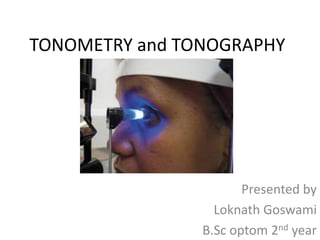


TONOMETRY and TONOGRAPHY
Presented by
Loknath Goswami
B.Sc optom 2nd year
Important terms
• IOP : The pressure exerted by intraocular
fluids on the coats of the eyeball
• Unit : mm of Hg
• Range : 10 to 21 mm of Hg
• Indentation : Depression
• Applanate : Flatten
Tonometer and Tonometry
Tonometer
• Instrument that exploits the
physical properties of the
eye to permit measurement
of pressure without the
need to cannulate the eye
TONOMETRY
• The procedure eye care
professionals perform to
determine the intraocular
pressure, the fluid pressure
inside the eye
• It is a non invasive
measurement of measuring
the IOP
History
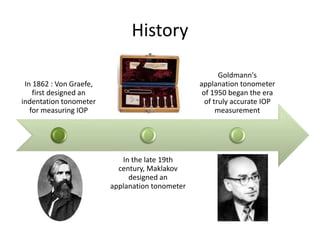
In 1862 : Von Graefe,
first designed an
indentation tonometer
for measuring IOP
In the late 19th
century, Maklakov
designed an
applanation tonometer
Goldmann's
applanation tonometer
of 1950 began the era
of truly accurate IOP
measurement
History
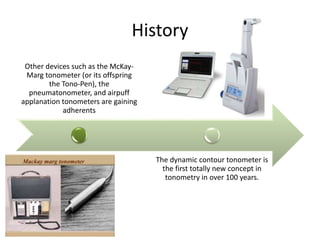
Other devices such as the McKay-
Marg tonometer (or its offspring
the Tono-Pen), the
pneumatonometer, and airpuff
applanation tonometers are gaining
adherents
The dynamic contour tonometer is
the first totally new concept in
tonometry in over 100 years.
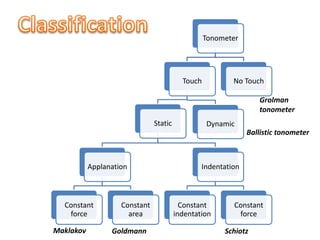
Tonometer
No TouchTouch
DynamicStatic
Indentation
Constant
force
Constant
indentation
Applanation
Constant
area
Constant
force
Grolman
tonometer
Ballistic tonometer
Maklakov Goldmann Schiotz
Maklakov tonometer
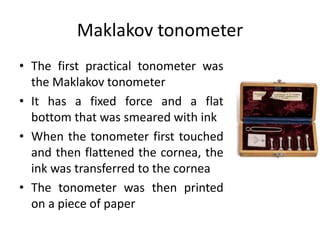
• The first practical tonometer was
the Maklakov tonometer
• It has a fixed force and a flat
bottom that was smeared with ink
• When the tonometer first touched
and then flattened the cornea, the
ink was transferred to the cornea
• The tonometer was then printed
on a piece of paper
Maklakov tonometer
• The area (as determined by the
diameter) in the center of the
inkblot that was devoid of ink was
proportional to the IOP
• If the eye moved during the time tonometer
was on the eye, more ink was transferred to
the cornea than was necessary due to
applanation alone and the IOP was
underestimated
Applanation tonometry
• The theory of applanation tonometry comes
from the Imbert-Fick law which states for an
ideal sphere the internal pressure of a very
thin-walled sphere can be obtained by
knowing the force required to flatten a known
sphere
• The formula is : P = F/A or F = PA
 P = Pressure inside the sphere
 F = Force required to applanate its surface
 A = Area of flattening
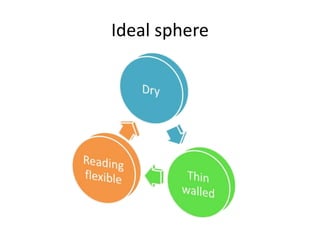
Ideal sphere
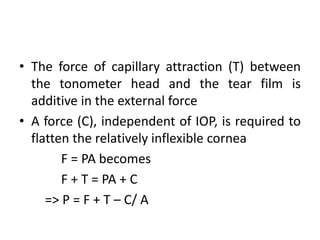
• The force of capillary attraction (T) between
the tonometer head and the tear film is
additive in the external force
• A force (C), independent of IOP, is required to
flatten the relatively inflexible cornea
F = PA becomes
F + T = PA + C
=> P = F + T – C/ A
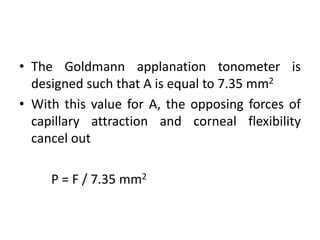
• The Goldmann applanation tonometer is
designed such that A is equal to 7.35 mm2
• With this value for A, the opposing forces of
capillary attraction and corneal flexibility
cancel out
P = F / 7.35 mm2
Goldmann tonometer
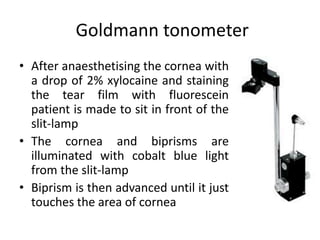
• After anaesthetising the cornea with
a drop of 2% xylocaine and staining
the tear film with fluorescein
patient is made to sit in front of the
slit-lamp
• The cornea and biprisms are
illuminated with cobalt blue light
from the slit-lamp
• Biprism is then advanced until it just
touches the area of cornea
Goldmann tonometer
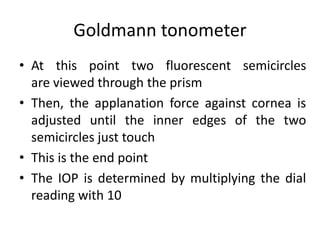
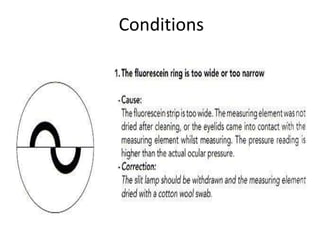
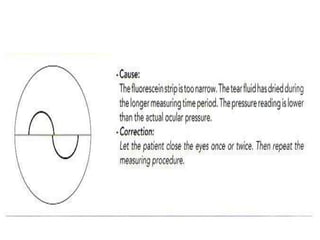
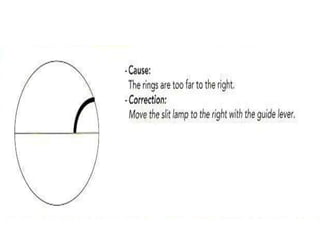
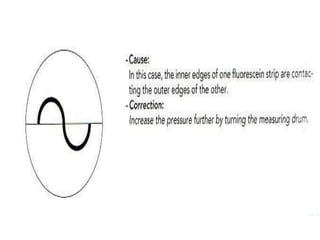
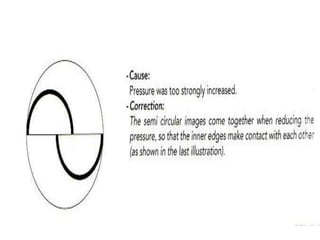
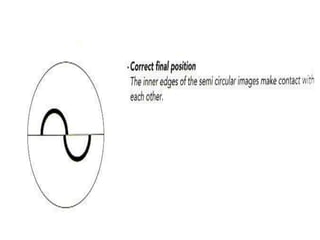
• At this point two fluorescent semicircles
are viewed through the prism
• Then, the applanation force against cornea is
adjusted until the inner edges of the two
semicircles just touch
• This is the end point
• The IOP is determined by multiplying the dial
reading with 10
Conditions
SCHIOTZ TONOMETER
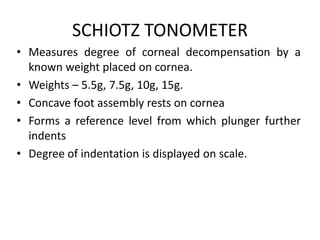
• Measures degree of corneal decompensation by a
known weight placed on cornea.
• Weights – 5.5g, 7.5g, 10g, 15g.
• Concave foot assembly rests on cornea
• Forms a reference level from which plunger further
indents
• Degree of indentation is displayed on scale.
SCHIOTZ TONOMETER
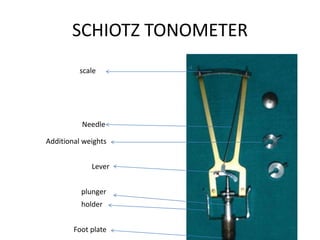
scale
Needle
plunger
holder
Foot plate
Lever
Additional weights
Procedure
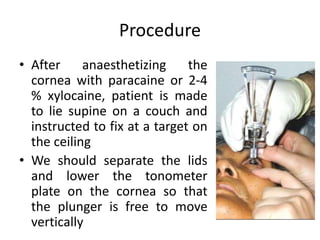
• After anaesthetizing the
cornea with paracaine or 2-4
% xylocaine, patient is made
to lie supine on a couch and
instructed to fix at a target on
the ceiling
• We should separate the lids
and lower the tonometer
plate on the cornea so that
the plunger is free to move
vertically
Procedure
• The reading on scale is recorded as soon as
the needle becomes steady
• It is customary to start with 5.5 gm weight
• If the scale reading is less than 3, additional
weight should be added to the plunger to
make it 7.5 gm or 10 gm, as indicated; since
with Schiotz tonometer the greatest accuracy
is attained if the deflection of lever is between
3 and 4
Procedure
• In end, tonometer is lifted and a drop of
antibiotic is instilled
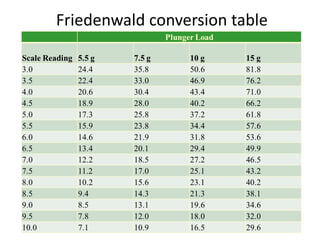
• A conversion table is then used to derive the
IOP in mmHg from the scale reading and the
plunger weight
Friedenwald conversion table
Dynamic contour tonometry
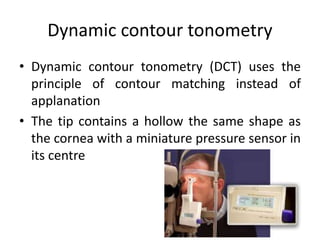
• Dynamic contour tonometry (DCT) uses the
principle of contour matching instead of
applanation
• The tip contains a hollow the same shape as
the cornea with a miniature pressure sensor in
its centre
Dynamic contour tonometry
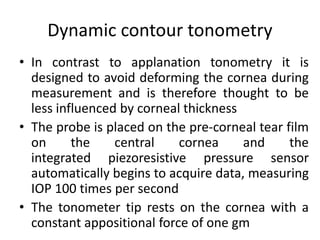
• In contrast to applanation tonometry it is
designed to avoid deforming the cornea during
measurement and is therefore thought to be
less influenced by corneal thickness
• The probe is placed on the pre-corneal tear film
on the central cornea and the
integrated piezoresistive pressure sensor
automatically begins to acquire data, measuring
IOP 100 times per second
• The tonometer tip rests on the cornea with a
constant appositional force of one gm
Dynamic contour tonometry
• When the sensor is subjected to a change in
pressure, the electrical resistance is altered
and the tonometer's computer calculates a
change in pressure according to the change in
resistance
• A complete measurement cycle requires about
eight seconds of contact time
• The device also measures the variation in
pressure that occurs with the cardiac cycle
Tonography
• Tonography is a clinical test
of aqueous humor dynamics
that was introduced by W.
Morton Grant in 1950
• Grant showed that analysis
of a continuous recording
from an electronic Schiotz
tonometer yielded estimates
the rate of aqueous flow
• Grant recorded the output of an electronic
tonometer on a strip-chart recorder and showed
that this data combined with the tonometer
calibration of Friedenwald could be used to
provide a quantitative expression relating the
outflow of aqueous humor to the driving
pressure.
• Grant called this value “the coefficient of aqueous
outflow facility”(C)
• The C-value is expressed as aqueous outflow in
microlitres per minute per millimeter of mercury
• For a graphic record the electronic Schiotz
tonometer is used by placing it on the eye for 4
minutes
• C-value is calculated from special tonographic
tables taking into consideration the initial IOP (Po)
and the change in scale reading over the 4
minutes
• Although in general, C-values more than 0.20 are
considered normal, between 0.2 and 0.11 border
line, and those below 0.11 abnormal
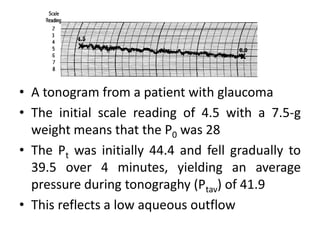
• A tonogram from a patient with glaucoma
• The initial scale reading of 4.5 with a 7.5-g
weight means that the P0 was 28
• The Pt was initially 44.4 and fell gradually to
39.5 over 4 minutes, yielding an average
pressure during tonograghy (Ptav) of 41.9
• This reflects a low aqueous outflow
References
• Pearls of glaucoma management, 2nd edition,
JoAnn A. Giaconi, pg no. 92
• https://www.ncbi.nlm.nih.gov/pubmed/2115
0677
• https://en.wikipedia.org/wiki/Ocular_tonome
try
• http://eyewiki.aao.org/IOP_and_Tonometry
• http://www.oculist.net/downaton502/prof/eb
ook/duanes/pages/v3/v3c046.html
Tonometry and tonography

Tonometry and tonography

  • 1.
    TONOMETRY and TONOGRAPHY Presentedby Loknath Goswami B.Sc optom 2nd year
  • 2.
    Important terms • IOP: The pressure exerted by intraocular fluids on the coats of the eyeball • Unit : mm of Hg • Range : 10 to 21 mm of Hg • Indentation : Depression • Applanate : Flatten
  • 3.
    Tonometer and Tonometry Tonometer •Instrument that exploits the physical properties of the eye to permit measurement of pressure without the need to cannulate the eye TONOMETRY • The procedure eye care professionals perform to determine the intraocular pressure, the fluid pressure inside the eye • It is a non invasive measurement of measuring the IOP
  • 4.
    History In 1862 :Von Graefe, first designed an indentation tonometer for measuring IOP In the late 19th century, Maklakov designed an applanation tonometer Goldmann's applanation tonometer of 1950 began the era of truly accurate IOP measurement
  • 5.
    History Other devices suchas the McKay- Marg tonometer (or its offspring the Tono-Pen), the pneumatonometer, and airpuff applanation tonometers are gaining adherents The dynamic contour tonometer is the first totally new concept in tonometry in over 100 years.
  • 6.
  • 7.
    Maklakov tonometer • Thefirst practical tonometer was the Maklakov tonometer • It has a fixed force and a flat bottom that was smeared with ink • When the tonometer first touched and then flattened the cornea, the ink was transferred to the cornea • The tonometer was then printed on a piece of paper
  • 8.
    Maklakov tonometer • Thearea (as determined by the diameter) in the center of the inkblot that was devoid of ink was proportional to the IOP • If the eye moved during the time tonometer was on the eye, more ink was transferred to the cornea than was necessary due to applanation alone and the IOP was underestimated
  • 9.
    Applanation tonometry • Thetheory of applanation tonometry comes from the Imbert-Fick law which states for an ideal sphere the internal pressure of a very thin-walled sphere can be obtained by knowing the force required to flatten a known sphere • The formula is : P = F/A or F = PA  P = Pressure inside the sphere  F = Force required to applanate its surface  A = Area of flattening
  • 10.
  • 11.
    • The forceof capillary attraction (T) between the tonometer head and the tear film is additive in the external force • A force (C), independent of IOP, is required to flatten the relatively inflexible cornea F = PA becomes F + T = PA + C => P = F + T – C/ A
  • 12.
    • The Goldmannapplanation tonometer is designed such that A is equal to 7.35 mm2 • With this value for A, the opposing forces of capillary attraction and corneal flexibility cancel out P = F / 7.35 mm2
  • 13.
    Goldmann tonometer • Afteranaesthetising the cornea with a drop of 2% xylocaine and staining the tear film with fluorescein patient is made to sit in front of the slit-lamp • The cornea and biprisms are illuminated with cobalt blue light from the slit-lamp • Biprism is then advanced until it just touches the area of cornea
  • 14.
    Goldmann tonometer • Atthis point two fluorescent semicircles are viewed through the prism • Then, the applanation force against cornea is adjusted until the inner edges of the two semicircles just touch • This is the end point • The IOP is determined by multiplying the dial reading with 10
  • 15.
  • 21.
    SCHIOTZ TONOMETER • Measuresdegree of corneal decompensation by a known weight placed on cornea. • Weights – 5.5g, 7.5g, 10g, 15g. • Concave foot assembly rests on cornea • Forms a reference level from which plunger further indents • Degree of indentation is displayed on scale.
  • 22.
  • 23.
    Procedure • After anaesthetizingthe cornea with paracaine or 2-4 % xylocaine, patient is made to lie supine on a couch and instructed to fix at a target on the ceiling • We should separate the lids and lower the tonometer plate on the cornea so that the plunger is free to move vertically
  • 24.
    Procedure • The readingon scale is recorded as soon as the needle becomes steady • It is customary to start with 5.5 gm weight • If the scale reading is less than 3, additional weight should be added to the plunger to make it 7.5 gm or 10 gm, as indicated; since with Schiotz tonometer the greatest accuracy is attained if the deflection of lever is between 3 and 4
  • 25.
    Procedure • In end,tonometer is lifted and a drop of antibiotic is instilled • A conversion table is then used to derive the IOP in mmHg from the scale reading and the plunger weight
  • 26.
  • 27.
    Dynamic contour tonometry •Dynamic contour tonometry (DCT) uses the principle of contour matching instead of applanation • The tip contains a hollow the same shape as the cornea with a miniature pressure sensor in its centre
  • 28.
    Dynamic contour tonometry •In contrast to applanation tonometry it is designed to avoid deforming the cornea during measurement and is therefore thought to be less influenced by corneal thickness • The probe is placed on the pre-corneal tear film on the central cornea and the integrated piezoresistive pressure sensor automatically begins to acquire data, measuring IOP 100 times per second • The tonometer tip rests on the cornea with a constant appositional force of one gm
  • 29.
    Dynamic contour tonometry •When the sensor is subjected to a change in pressure, the electrical resistance is altered and the tonometer's computer calculates a change in pressure according to the change in resistance • A complete measurement cycle requires about eight seconds of contact time • The device also measures the variation in pressure that occurs with the cardiac cycle
  • 31.
    Tonography • Tonography isa clinical test of aqueous humor dynamics that was introduced by W. Morton Grant in 1950 • Grant showed that analysis of a continuous recording from an electronic Schiotz tonometer yielded estimates the rate of aqueous flow
  • 32.
    • Grant recordedthe output of an electronic tonometer on a strip-chart recorder and showed that this data combined with the tonometer calibration of Friedenwald could be used to provide a quantitative expression relating the outflow of aqueous humor to the driving pressure. • Grant called this value “the coefficient of aqueous outflow facility”(C) • The C-value is expressed as aqueous outflow in microlitres per minute per millimeter of mercury
  • 33.
    • For agraphic record the electronic Schiotz tonometer is used by placing it on the eye for 4 minutes • C-value is calculated from special tonographic tables taking into consideration the initial IOP (Po) and the change in scale reading over the 4 minutes • Although in general, C-values more than 0.20 are considered normal, between 0.2 and 0.11 border line, and those below 0.11 abnormal
  • 34.
    • A tonogramfrom a patient with glaucoma • The initial scale reading of 4.5 with a 7.5-g weight means that the P0 was 28 • The Pt was initially 44.4 and fell gradually to 39.5 over 4 minutes, yielding an average pressure during tonograghy (Ptav) of 41.9 • This reflects a low aqueous outflow
  • 35.
    References • Pearls ofglaucoma management, 2nd edition, JoAnn A. Giaconi, pg no. 92 • https://www.ncbi.nlm.nih.gov/pubmed/2115 0677 • https://en.wikipedia.org/wiki/Ocular_tonome try • http://eyewiki.aao.org/IOP_and_Tonometry • http://www.oculist.net/downaton502/prof/eb ook/duanes/pages/v3/v3c046.html

Editor's Notes

  • #29 The piezoresistive effect is a change in the electrical resistivity of a semiconductor or metal when mechanical strain is applied. Apposition: the act of placing together