Pavel Drobintsev, Vsevolod Kotlyarov, Ivan Selin, Alexey Tolstoles, Nikita
Voinov
Peter the Great Saint Petersburg Polytechnic University
Saint Petersburg, Russia
Scalable testing process
based on formal models
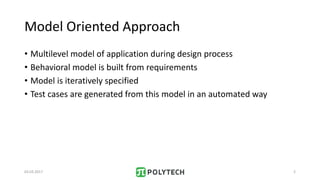
Model Oriented Approach
• Multilevel model of application during design process
• Behavioral model is built from requirements
• Model is iteratively specified
• Test cases are generated from this model in an automated way
03.03.2017 2
VRS/TAT
• Software verification and testing toolset
• Requirements are formalized in UCM language
• VRS verifier runs reachability and consistency checks
• Iterative process of model modification until all checks are passed
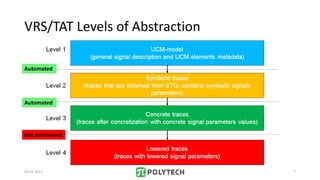
• Generation of symbolic traces
• Concretization (symbolic traces – traces with specific values)
• Adapting tests to run them on real system
• Testing
03.03.2017 3
Use Case Maps (UCM)
• High-level graphical language
for requirements modelling
• ITU Z.151
• Can be used for creating
structured behavioral diagrams
of interacting agents
• UCM notation doesn’t provide
enough information to
generate traces
03.03.2017 4
UCM Metadata
• Auxiliary text field linked to a
UCM responsibility
• Stores information about
variables and signals
• Signal is a way of message
transfer between agents
03.03.2017 5
VRS Verifier
• During the initial model development:
• Reachability and consistency checks
• During testing process:
• Generation of symbolic traces based on UCM model control flow
• Concretization (substitution of left, right and middle values from tolerance
range)
03.03.2017 6
VRS/TAT Levels of Abstraction
03.03.2017 7
Automated
Automated
Not automated
Challenges
• Data mapping problem:
• Abstract models which need to be extended in order to run against real
system
• Extension may require additional information
• New information must comply with what’s already in the model
• Amount of generated test cases may be too big to run using common
methods
03.03.2017 8
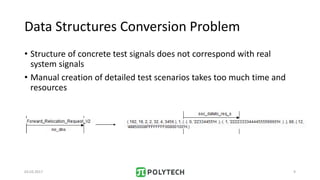
Data Structures Conversion Problem
• Structure of concrete test signals does not correspond with real
system signals
• Manual creation of detailed test scenarios takes too much time and
resources
03.03.2017 9
Data Structures Conversion. Approach
• Process called “Lowering”
• The name comes from descending on lower
levels of abstraction
• In general, “Lowering” can be described as
creating processing rules for each signal and
application of these rules to concrete
scenarios
• An editor was made to restrict user from
making incorrect structures
03.03.2017 10
Data Structures Conversion. Restrictions
• There are several restrictions to ensure the correctness of test
scenarios:
• If you separate concrete value into several independent parts, it is prohibited
to change them in a way, when joining them back together will give another
result than it was before separation
• Only structures similar to SUT interfaces could be used
• Only constant values from concretization and templates values are allowed
03.03.2017 11
Data Structures Conversion. Results
• Before introduction of “lowering”, test mapping was made by hand
after each tests generation
• After automating the tests mapping there are only 2 manual steps left
in VRS/TAT process:
• UCM model development
• Specifying “lowering” rules
• Both of them only needed to be done once
03.03.2017 12
UPD: VRS/TAT Levels of Abstraction
03.03.2017 13
Automated
Automated
Automated
Huge amount
Execution problem
• Huge test amount
• A lot of time needed for execution
• Costs increase
• Run tools in parallel
03.03.2017 14
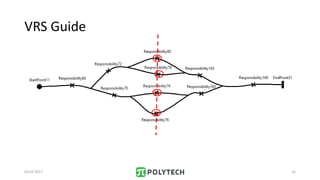
VRS Guided Search
• VRS has an option to perform guided search
• Guide is a marked sequence on a model, which must be traversed
• All traces that don’t apply the criteria to travel through guide are cut
off by VRS during traces generation
• The idea is to set guides on UCM model and launch several VRS
instances with corresponding guides
03.03.2017 15
VRS Guide
03.03.2017 16
Execution process
• User sets guides in the most “thick” places of UCM model
• Several VRS instances run, each on a different compute node with a
unique set of guides
• As a result, whole test suite is divided into several parts
• Each part can be processed independently in an isolated container
(node, VM, etc.)
03.03.2017 17
Scalability
• Theoretically, scalability is linear
• In real life, it is not achievable because of irregular test distribution
and different execution complexity of test cases
03.03.2017 18
Conclusion
• Tests are generated from the verified model and can be ran against
real systems
• Presented approach allows to speed up the testing process
• It speeds up both tests generation and tests execution
• Scalable process, performance increase is limited by the model
and/or available computational resources
03.03.2017 19
Thanks for your attention!
03.03.2017 20
Backup 1. New features in lowering. TDL
• There is an ability to use SUT interfaces files (*.tdl) in Lowering Editor
to obtain parameters signal structure
03.03.2017 21
Backup 2. Few words on VRS
• VRS works with inner model
in basic protocols (Hoare
triples)
• Each one has:
• Pre-condition
• Process
• Post-condition
03.03.2017 22
Backup 2. Few words on VRS
• UCM model is converted into basic
protocols model using UCM
elements location and UCM
metadata (and inverse)
• VRS matches pre and post
conditions of different elements
and checks tolerance ranges to find
all possible traces
• Guided search builds traces from
guide forward and backward
03.03.2017 23

TMPA-2017: Technology and Tools for Developing Industrial Software Test Suites Based on Formal Models and Implementing Scalable Testing Process on Supercomputer

  • 1.
    Pavel Drobintsev, VsevolodKotlyarov, Ivan Selin, Alexey Tolstoles, Nikita Voinov Peter the Great Saint Petersburg Polytechnic University Saint Petersburg, Russia Scalable testing process based on formal models
  • 2.
    Model Oriented Approach •Multilevel model of application during design process • Behavioral model is built from requirements • Model is iteratively specified • Test cases are generated from this model in an automated way 03.03.2017 2
  • 3.
    VRS/TAT • Software verificationand testing toolset • Requirements are formalized in UCM language • VRS verifier runs reachability and consistency checks • Iterative process of model modification until all checks are passed • Generation of symbolic traces • Concretization (symbolic traces – traces with specific values) • Adapting tests to run them on real system • Testing 03.03.2017 3
  • 4.
    Use Case Maps(UCM) • High-level graphical language for requirements modelling • ITU Z.151 • Can be used for creating structured behavioral diagrams of interacting agents • UCM notation doesn’t provide enough information to generate traces 03.03.2017 4
  • 5.
    UCM Metadata • Auxiliarytext field linked to a UCM responsibility • Stores information about variables and signals • Signal is a way of message transfer between agents 03.03.2017 5
  • 6.
    VRS Verifier • Duringthe initial model development: • Reachability and consistency checks • During testing process: • Generation of symbolic traces based on UCM model control flow • Concretization (substitution of left, right and middle values from tolerance range) 03.03.2017 6
  • 7.
    VRS/TAT Levels ofAbstraction 03.03.2017 7 Automated Automated Not automated
  • 8.
    Challenges • Data mappingproblem: • Abstract models which need to be extended in order to run against real system • Extension may require additional information • New information must comply with what’s already in the model • Amount of generated test cases may be too big to run using common methods 03.03.2017 8
  • 9.
    Data Structures ConversionProblem • Structure of concrete test signals does not correspond with real system signals • Manual creation of detailed test scenarios takes too much time and resources 03.03.2017 9
  • 10.
    Data Structures Conversion.Approach • Process called “Lowering” • The name comes from descending on lower levels of abstraction • In general, “Lowering” can be described as creating processing rules for each signal and application of these rules to concrete scenarios • An editor was made to restrict user from making incorrect structures 03.03.2017 10
  • 11.
    Data Structures Conversion.Restrictions • There are several restrictions to ensure the correctness of test scenarios: • If you separate concrete value into several independent parts, it is prohibited to change them in a way, when joining them back together will give another result than it was before separation • Only structures similar to SUT interfaces could be used • Only constant values from concretization and templates values are allowed 03.03.2017 11
  • 12.
    Data Structures Conversion.Results • Before introduction of “lowering”, test mapping was made by hand after each tests generation • After automating the tests mapping there are only 2 manual steps left in VRS/TAT process: • UCM model development • Specifying “lowering” rules • Both of them only needed to be done once 03.03.2017 12
  • 13.
    UPD: VRS/TAT Levelsof Abstraction 03.03.2017 13 Automated Automated Automated Huge amount
  • 14.
    Execution problem • Hugetest amount • A lot of time needed for execution • Costs increase • Run tools in parallel 03.03.2017 14
  • 15.
    VRS Guided Search •VRS has an option to perform guided search • Guide is a marked sequence on a model, which must be traversed • All traces that don’t apply the criteria to travel through guide are cut off by VRS during traces generation • The idea is to set guides on UCM model and launch several VRS instances with corresponding guides 03.03.2017 15
  • 16.
  • 17.
    Execution process • Usersets guides in the most “thick” places of UCM model • Several VRS instances run, each on a different compute node with a unique set of guides • As a result, whole test suite is divided into several parts • Each part can be processed independently in an isolated container (node, VM, etc.) 03.03.2017 17
  • 18.
    Scalability • Theoretically, scalabilityis linear • In real life, it is not achievable because of irregular test distribution and different execution complexity of test cases 03.03.2017 18
  • 19.
    Conclusion • Tests aregenerated from the verified model and can be ran against real systems • Presented approach allows to speed up the testing process • It speeds up both tests generation and tests execution • Scalable process, performance increase is limited by the model and/or available computational resources 03.03.2017 19
  • 20.
    Thanks for yourattention! 03.03.2017 20
  • 21.
    Backup 1. Newfeatures in lowering. TDL • There is an ability to use SUT interfaces files (*.tdl) in Lowering Editor to obtain parameters signal structure 03.03.2017 21
  • 22.
    Backup 2. Fewwords on VRS • VRS works with inner model in basic protocols (Hoare triples) • Each one has: • Pre-condition • Process • Post-condition 03.03.2017 22
  • 23.
    Backup 2. Fewwords on VRS • UCM model is converted into basic protocols model using UCM elements location and UCM metadata (and inverse) • VRS matches pre and post conditions of different elements and checks tolerance ranges to find all possible traces • Guided search builds traces from guide forward and backward 03.03.2017 23