



.lusoftware verification & validation
VVS
Automated Vulnerability Testing
Using Machine Learning and
Metaheuristic Search
PI: Lionel Briand
Researchers: Annibale Panichella, Cu Nguyen, Nadia Alshahwan
PhD Students: Dennis Appelt, Sadeeq Jan
1
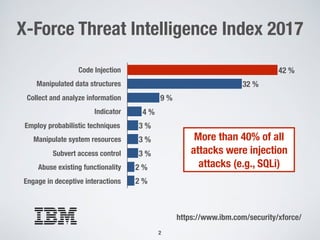
Code Injection
Manipulated data structures
Collect and analyze information
Indicator
Employ probabilistic techniques
Manipulate system resources
Subvert access control
Abuse existing functionality
Engage in deceptive interactions 2 %
2 %
3 %
3 %
3 %
4 %
9 %
32 %
42 %
X-Force Threat Intelligence Index 2017
2
https://www.ibm.com/security/xforce/
More than 40% of all
attacks were injection
attacks (e.g., SQLi)
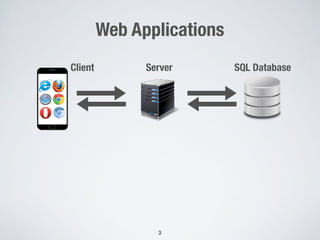
Web Applications
3
Server SQL DatabaseClient
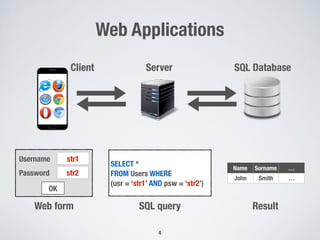
Web Applications
4
Web form
str1
str2
Username
Password
OK
SQL query
SELECT *
FROM Users WHERE
(usr = ‘str1’ AND psw = ‘str2’)
Name Surname …
John Smith …
Result
Server SQL DatabaseClient
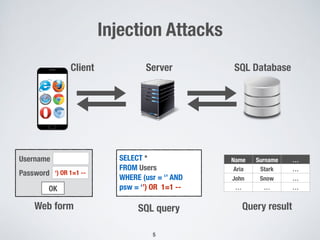
Injection Attacks
5
SQL query
Name Surname …
Aria Stark …
John Snow …
… … …
Query result
SELECT *
FROM Users
WHERE (usr = ‘’ AND
psw = ‘’) OR 1=1 --
Server SQL DatabaseClient
Web form
‘) OR 1=1 --
Username
Password
OK
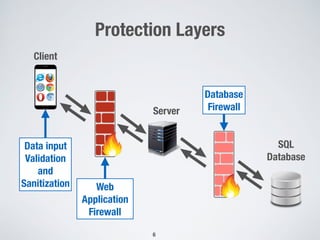
Protection Layers
Server
SQL
Database
Client
Data input
Validation
and
Sanitization
Database
Firewall
Web
Application
Firewall
6
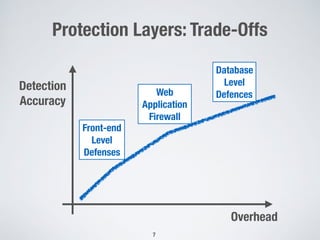
Protection Layers: Trade-Offs
7
Overhead
Detection
Accuracy
Front-end
Level
Defenses
Web
Application
Firewall
Database
Level
Defences
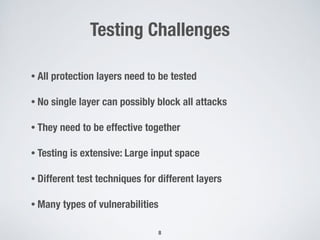
Testing Challenges
• All protection layers need to be tested
• No single layer can possibly block all attacks
• They need to be effective together
• Testing is extensive: Large input space
• Different test techniques for different layers
• Many types of vulnerabilities
8
Testing Front-end
Web Applications for XMLi
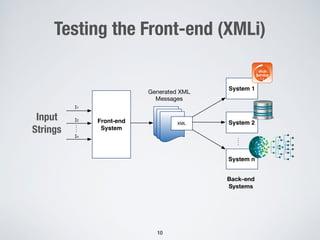
Testing the Front-end (XMLi)
10
Front-end
System
XML
I1
I2
In
Generated XML
Messages
Back-end
Systems
System 1
System 2
System n
Input
Strings
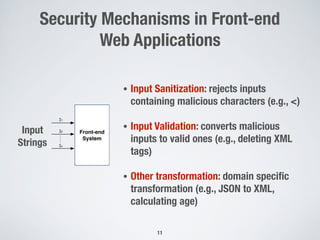
Security Mechanisms in Front-end
Web Applications
• Input Sanitization: rejects inputs
containing malicious characters (e.g., <)
• Input Validation: converts malicious
inputs to valid ones (e.g., deleting XML
tags)
• Other transformation: domain specific
transformation (e.g., JSON to XML,
calculating age)
11
Front-end
System
XML
I1
I2
In
Generated XML
Messages
Back-end
Systems
System 1
System 2
System n
Input
Strings
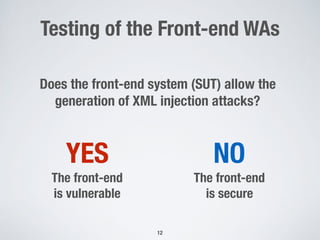
Testing of the Front-end WAs
12
Does the front-end system (SUT) allow the
generation of XML injection attacks?
YES
The front-end
is vulnerable
NO
The front-end
is secure
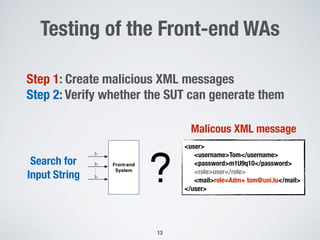
Testing of the Front-end WAs
13
Front-end
System
XML
I1
I2
In
Generated XML
Messages
Back-end
Systems
System 1
System 2
System n
<user>
<username>Tom</username>
<password>m1U9q10</password>
<role>user</role>
<mail>role=Adm+ tom@uni.lu</mail>
</user>
Step 1: Create malicious XML messages
Step 2: Verify whether the SUT can generate them
Malicous XML message
Search for
Input String
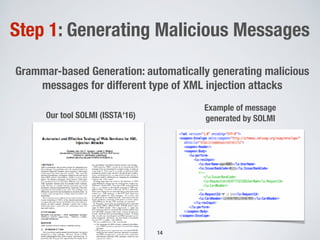
Step 1: Generating Malicious Messages
Grammar-based Generation: automatically generating malicious
messages for different type of XML injection attacks
14
Our tool SOLMI (ISSTA'16)
Example of message
generated by SOLMI
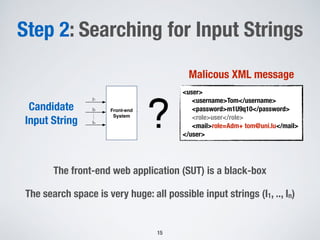
Step 2: Searching for Input Strings
15
Front-end
System
XML
I1
I2
In
Generated XML
Messages
Back-end
Systems
System 1
System 2
System n
<user>
<username>Tom</username>
<password>m1U9q10</password>
<role>user</role>
<mail>role=Adm+ tom@uni.lu</mail>
</user>
Malicous XML message
Candidate
Input String
The front-end web application (SUT) is a black-box
The search space is very huge: all possible input strings (I1, .., In)
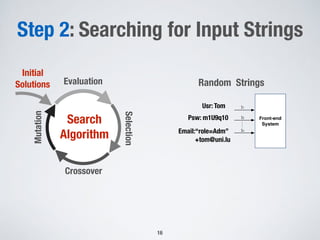
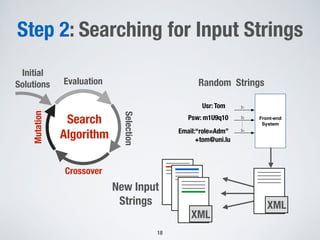
Step 2: Searching for Input Strings
16
Evaluation
Selection
Crossover
Mutation
Search
Algorithm
Initial
Solutions Random Strings
Front-end
System
I1
I2
In
Generated
Messag
Email:“role=Adm”
+tom@uni.lu
Usr: Tom
Psw: m1U9q10
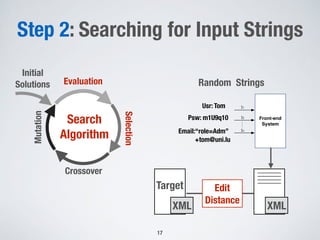
Step 2: Searching for Input Strings
17
Evaluation
Selection
Crossover
Mutation
Search
Algorithm
Initial
Solutions Random Strings
Front-end
System
I1
I2
In
Generated
Messag
Email:“role=Adm”
+tom@uni.lu
Usr: Tom
Psw: m1U9q10
Target Edit
Distance
XMLXML
Step 2: Searching for Input Strings
18
Evaluation
Selection
Crossover
Mutation
Search
Algorithm
Initial
Solutions Random Strings
Front-end
System
I1
I2
In
Generated
Messag
Email:“role=Adm”
+tom@uni.lu
Usr: Tom
Psw: m1U9q10
XML
XML
XML
XML
New Input
Strings
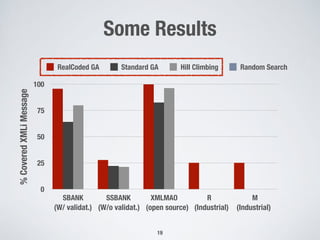
Some Results
19
(W/ validat.) (W/o validat.) (open source) (Industrial)
%CoveredXMLiMessage
0
25
50
75
100
SBANK SSBANK XMLMAO R M
RealCoded GA Standard GA Hill Climbing Random Search
(Industrial)
Testing Web Application
Firewalls (WAFs)
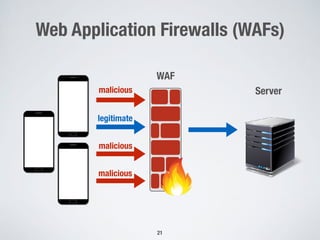
Web Application Firewalls (WAFs)
21
Servermalicious
malicious
malicious
legitimate
WAF
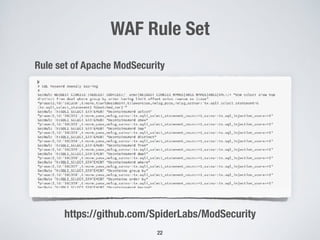
WAF Rule Set
22
Rule set of Apache ModSecurity
https://github.com/SpiderLabs/ModSecurity
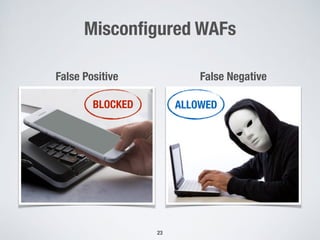
Misconfigured WAFs
23
BLOCKED
False Positive
ALLOWED
False Negative
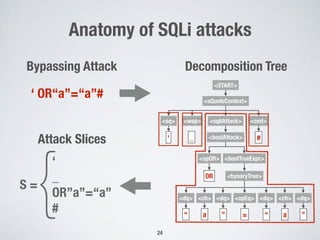
Anatomy of SQLi attacks
24
‘ OR“a”=“a”#
Bypassing Attack
<START>
<sq> <wsp> <sqliAttack> <cmt>
<boolAttack>
<opOR> <boolTrueExpr>
OR <bynaryTrue>
<dq> <ch> <dq> <opEq> <dq> <ch> <dq>
“ a ” = “ a ”
<sQuoteContext>
‘ #_
Decomposition Tree
‘
_
OR”a”=“a”
#
S =
{
Attack Slices
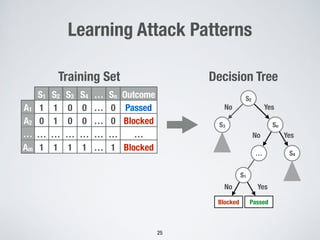
Learning Attack Patterns
25
S1 S2 S3 S4 … Sn Outcome
A1 1 1 0 0 … 0 Passed
A2 0 1 0 0 … 0 Blocked
… … … … … … … …
Am 1 1 1 1 … 1 Blocked
Training Set
Sn
PassedBlocked
S4
YesNo
YesNo
YesNo
S3
S1
S2
…
Decision Tree
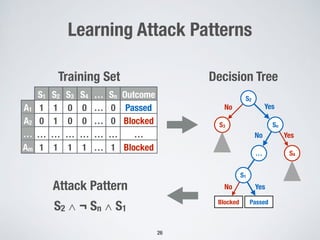
Learning Attack Patterns
26
S1 S2 S3 S4 … Sn Outcome
A1 1 1 0 0 … 0 Passed
A2 0 1 0 0 … 0 Blocked
… … … … … … … …
Am 1 1 1 1 … 1 Blocked
Sn
PassedBlocked
S4
YesNo
YesNo
YesNo
S3
S1
S2
…
Training Set Decision Tree
Attack Pattern
S2 ∧ ¬ Sn ∧ S1
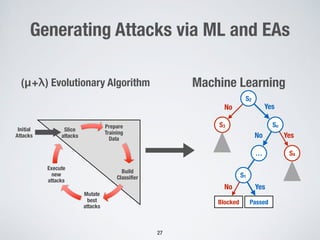
Machine Learning
Sn
PassedBlocked
S4
YesNo
YesNo
YesNo
S3
S1
S2
…
Generating Attacks via ML and EAs
27
Prepare
Training
Data
Build
Classifier
Mutate
best
attacks
Execute
new
attacks
Slice
attacks
Initial
Attacks
(μ+λ) Evolutionary Algorithm
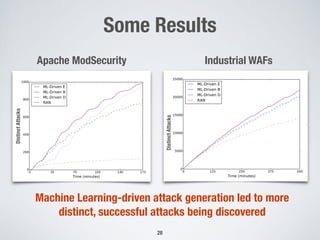
Some Results
Apache ModSecurity
28
Apache ModSecurity
• ML techniques outperform
random technique
• ML-Driven E superior to
other ML techniques
DistinctAttacks
Industrial Case
Industrial WAFs
DistinctAttacks
Machine Learning-driven attack generation led to more
distinct, successful attacks being discovered
Automated Repairing of
Vulnerable WAFs
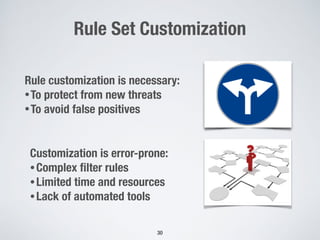
Rule Set Customization
30
Customization is error-prone:
•Complex filter rules
•Limited time and resources
•Lack of automated tools
Rule customization is necessary:
•To protect from new threats
•To avoid false positives
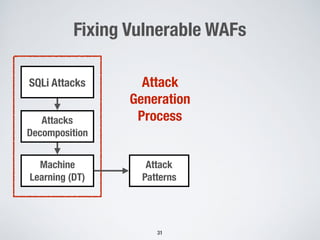
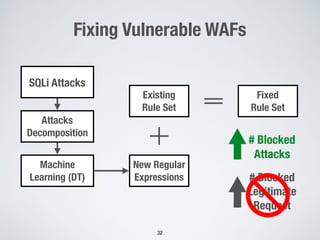
Fixing Vulnerable WAFs
31
SQLi Attacks
Attacks
Decomposition
Machine
Learning (DT)
Attack
Generation
Process
Attack
Patterns
Fixing Vulnerable WAFs
32
SQLi Attacks
Attacks
Decomposition
Machine
Learning (DT)
New Regular
Expressions
Existing
Rule Set
Fixed
Rule Set
# Blocked
Attacks
# Blocked
Legitimate
Request
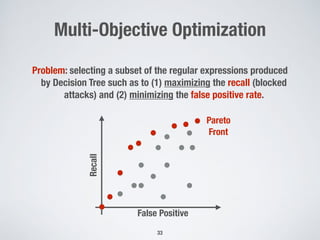
Multi-Objective Optimization
33
Problem: selecting a subset of the regular expressions produced
by Decision Tree such as to (1) maximizing the recall (blocked
attacks) and (2) minimizing the false positive rate.Recall
False Positive
Pareto
Front
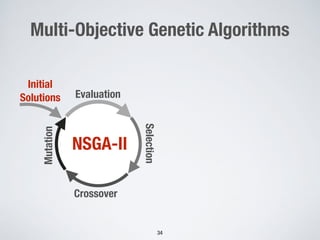
Multi-Objective Genetic Algorithms
34
Evaluation
Selection
Crossover
Mutation
NSGA-II
Initial
Solutions
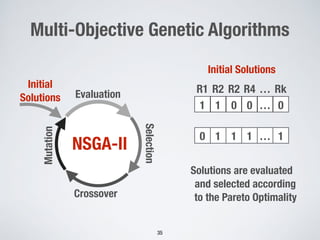
Multi-Objective Genetic Algorithms
35
R1 R2 R2 R4 … Rk
1 1 0 0 … 0
0 1 1 1 … 1
Initial Solutions
Evaluation
Selection
Crossover
Mutation
NSGA-II
Initial
Solutions
Solutions are evaluated
and selected according
to the Pareto Optimality
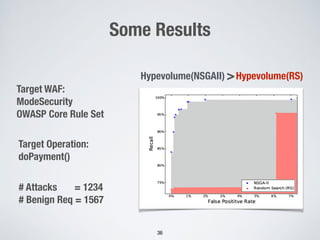
Some Results
36
Target WAF:
ModeSecurity
OWASP Core Rule Set
Target Operation:
doPayment()
# Attacks = 1234
# Benign Req = 1567
Hypevolume(NSGAII) >Hypevolume(RS)
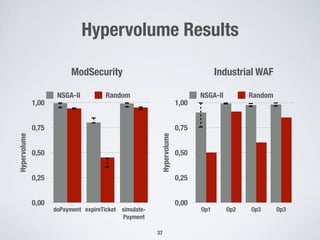
Hypervolume Results
37
Hypervolume
0,00
0,25
0,50
0,75
1,00
Op1 Op2 Op3 Op3
NSGA-II Random
Hypervolume
0,00
0,25
0,50
0,75
1,00
doPayment expireTicket simulate-

Payment
NSGA-II Random
ModSecurity Industrial WAF
Detecting Malicious SQL
Statements at Database Level
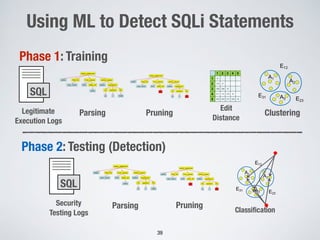
Using ML to Detect SQLi Statements
39
SQL
egitimate
cution Logs
Parsing Pruning
Edit distance
Training Phase
L
mate
n Logs
Parsing Pruning
Edit distance Clustering
Training Phase
QL
timate
ion Logs
Parsing Pruning
Edit distance Clustering
Training Phase
Parsing Pruning
Edit distance Clustering
ng Phase
Parsing Pruning
Edit
Distance
Clustering
SQL
Legitimate
Execution Logs
Phase 1: Training
SQL
Security
Testing Logs
Parsing Pruning
Testing Phase
Classification
SQL
Security
Testing Logs
SQL
Legitimate
Execution Logs
Parsing Pruning
Edit distan
Training Phase
SQL
Legitimate
Execution Logs
Parsing Pruning
Edit distance Clu
Training Phase
Parsing Pruning
Phase 2: Testing (Detection)
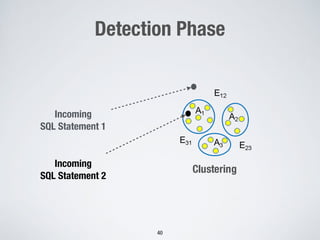
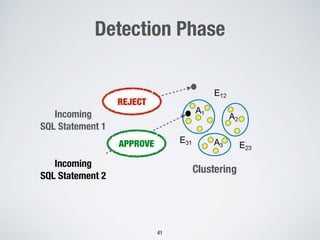
Detection Phase
40
Clustering
Incoming
SQL Statement 1
Incoming
SQL Statement 2
Detection Phase
41
Incoming
SQL Statement 1
Clustering
Incoming
SQL Statement 2
APPROVE
REJECT
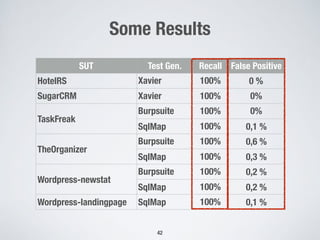
Some Results
42
SUT Test Gen. Recall False Positive
HotelRS Xavier 100% 0 %
SugarCRM Xavier 100% 0%
0%
TaskFreak
Burpsuite 100% 0%
0%SqlMap 100% 0,1 %
TheOrganizer
Burpsuite 100% 0,6 %
SqlMap 100% 0,3 %
Wordpress-newstat
Burpsuite 100% 0,2 %
SqlMap 100% 0,2 %
Wordpress-landingpage SqlMap 100% 0,1 %
Publications
Automatic Generation of Tests to Exploit XML Injection Vulnerabilities in Web Applications.
Jan, Sadeeq; Panichella, Annibale; Arcuri, Andrea; Briand, Lionel. To appear in IEEE Transaction on Software
Engineering (TSE), 2017
A Machine Learning-Driven Evolutionary Approach for Testing Web Application Firewalls.
Appelt, Dennis, Nguyen, Duy Cu, Panichella, Annibale, Briand, Lionel. To appear in IEEE Transaction on
Reliability (TR)
Automatically Repairing Web Application Firewalls Based on Successful SQL Injection Attacks.
Appelt, Dennis; Annibale Panichella; Briand, Lionel. In IEEE 28th International Symposium on Software
Reliability Engineering (ISSRE 2017) , Toulouse, France.

Search-based Testing Approach for XML Injection Vulnerabilities in Web Applications
Jan, Sadeeq; Nguyen, Duy Cu; Andrea, Arcuri; Briand, Lionel. Proc. of the 10th IEEE International
Conference on Software Testing, Verification and validation (ICST 2017), Tokyo, Japan

Automated and Effective Testing of Web Services for XML Injection Attacks
Jan, Sadeeq; Nguyen, Duy Cu; Briand, Lionel. In Proc. the International Symposium on Software Testing
and Analysis (ISSTA 2016), Saarbrücken, Germany

SOFIA: An Automated Security Oracle for Black-Box Testing of SQL-Injection Vulnerabilities
Ceccato, Mariano; Nguyen, Duy Cu; Appelt, Dennis; Briand, Lionel. In Proceedings of the 31th IEEE/ACM
International Conference on Automated Software Engineering (ASE 2016)
43
Publications
Known XML Vulnerabilities Are Still a Threat to Popular Parsers and Open Source Systems
Jan, Sadeeq; Nguyen, Duy Cu; Briand, Lionel. In The 2015 IEEE International Conference on
Software Quality, Reliability & Security (QSR 2015), Vancouver, Canada
Behind an Application Firewall, Are We Safe from SQL Injection Attacks?
Appelt, Dennis; Nguyen, Duy Cu; Briand, Lionel. In Proc. of the 8th International Conference on
Software Testing, Verification, and Validation (ICST 2015)

Automated Testing for SQL Injection Vulnerabilities: An Input Mutation Approach
Appelt, Dennis; Nguyen, Duy Cu; Briand, Lionel; Alshahwan, Nadia. In Proc. of the International
Symposium on Software Testing and Analysis (ISSTA 2014)
44
.lusoftware verification & validation
VVS
Automated Vulnerability Testing
Using Machine Learning and
Metaheuristic Search
PI: Lionel Briand
Researchers: Annibale Panichella, Cu Nguyen, Nadia Alshahwan
PhD Students: Dennis Appelt, Sadeeq Jan
45

Automated Vulnerability Testing Using Machine Learning and Metaheuristic Search

  • 1.
    .lusoftware verification &validation VVS Automated Vulnerability Testing Using Machine Learning and Metaheuristic Search PI: Lionel Briand Researchers: Annibale Panichella, Cu Nguyen, Nadia Alshahwan PhD Students: Dennis Appelt, Sadeeq Jan 1
  • 2.
    Code Injection Manipulated datastructures Collect and analyze information Indicator Employ probabilistic techniques Manipulate system resources Subvert access control Abuse existing functionality Engage in deceptive interactions 2 % 2 % 3 % 3 % 3 % 4 % 9 % 32 % 42 % X-Force Threat Intelligence Index 2017 2 https://www.ibm.com/security/xforce/ More than 40% of all attacks were injection attacks (e.g., SQLi)
  • 3.
  • 4.
    Web Applications 4 Web form str1 str2 Username Password OK SQLquery SELECT * FROM Users WHERE (usr = ‘str1’ AND psw = ‘str2’) Name Surname … John Smith … Result Server SQL DatabaseClient
  • 5.
    Injection Attacks 5 SQL query NameSurname … Aria Stark … John Snow … … … … Query result SELECT * FROM Users WHERE (usr = ‘’ AND psw = ‘’) OR 1=1 -- Server SQL DatabaseClient Web form ‘) OR 1=1 -- Username Password OK
  • 6.
  • 7.
  • 8.
    Testing Challenges • Allprotection layers need to be tested • No single layer can possibly block all attacks • They need to be effective together • Testing is extensive: Large input space • Different test techniques for different layers • Many types of vulnerabilities 8
  • 9.
  • 10.
    Testing the Front-end(XMLi) 10 Front-end System XML I1 I2 In Generated XML Messages Back-end Systems System 1 System 2 System n Input Strings
  • 11.
    Security Mechanisms inFront-end Web Applications • Input Sanitization: rejects inputs containing malicious characters (e.g., <) • Input Validation: converts malicious inputs to valid ones (e.g., deleting XML tags) • Other transformation: domain specific transformation (e.g., JSON to XML, calculating age) 11 Front-end System XML I1 I2 In Generated XML Messages Back-end Systems System 1 System 2 System n Input Strings
  • 12.
    Testing of theFront-end WAs 12 Does the front-end system (SUT) allow the generation of XML injection attacks? YES The front-end is vulnerable NO The front-end is secure
  • 13.
    Testing of theFront-end WAs 13 Front-end System XML I1 I2 In Generated XML Messages Back-end Systems System 1 System 2 System n <user> <username>Tom</username> <password>m1U9q10</password> <role>user</role> <mail>role=Adm+ tom@uni.lu</mail> </user> Step 1: Create malicious XML messages Step 2: Verify whether the SUT can generate them Malicous XML message Search for Input String
  • 14.
    Step 1: GeneratingMalicious Messages Grammar-based Generation: automatically generating malicious messages for different type of XML injection attacks 14 Our tool SOLMI (ISSTA'16) Example of message generated by SOLMI
  • 15.
    Step 2: Searchingfor Input Strings 15 Front-end System XML I1 I2 In Generated XML Messages Back-end Systems System 1 System 2 System n <user> <username>Tom</username> <password>m1U9q10</password> <role>user</role> <mail>role=Adm+ tom@uni.lu</mail> </user> Malicous XML message Candidate Input String The front-end web application (SUT) is a black-box The search space is very huge: all possible input strings (I1, .., In)
  • 16.
    Step 2: Searchingfor Input Strings 16 Evaluation Selection Crossover Mutation Search Algorithm Initial Solutions Random Strings Front-end System I1 I2 In Generated Messag Email:“role=Adm” +tom@uni.lu Usr: Tom Psw: m1U9q10
  • 17.
    Step 2: Searchingfor Input Strings 17 Evaluation Selection Crossover Mutation Search Algorithm Initial Solutions Random Strings Front-end System I1 I2 In Generated Messag Email:“role=Adm” +tom@uni.lu Usr: Tom Psw: m1U9q10 Target Edit Distance XMLXML
  • 18.
    Step 2: Searchingfor Input Strings 18 Evaluation Selection Crossover Mutation Search Algorithm Initial Solutions Random Strings Front-end System I1 I2 In Generated Messag Email:“role=Adm” +tom@uni.lu Usr: Tom Psw: m1U9q10 XML XML XML XML New Input Strings
  • 19.
    Some Results 19 (W/ validat.)(W/o validat.) (open source) (Industrial) %CoveredXMLiMessage 0 25 50 75 100 SBANK SSBANK XMLMAO R M RealCoded GA Standard GA Hill Climbing Random Search (Industrial)
  • 20.
  • 21.
    Web Application Firewalls(WAFs) 21 Servermalicious malicious malicious legitimate WAF
  • 22.
    WAF Rule Set 22 Ruleset of Apache ModSecurity https://github.com/SpiderLabs/ModSecurity
  • 23.
  • 24.
    Anatomy of SQLiattacks 24 ‘ OR“a”=“a”# Bypassing Attack <START> <sq> <wsp> <sqliAttack> <cmt> <boolAttack> <opOR> <boolTrueExpr> OR <bynaryTrue> <dq> <ch> <dq> <opEq> <dq> <ch> <dq> “ a ” = “ a ” <sQuoteContext> ‘ #_ Decomposition Tree ‘ _ OR”a”=“a” # S = { Attack Slices
  • 25.
    Learning Attack Patterns 25 S1S2 S3 S4 … Sn Outcome A1 1 1 0 0 … 0 Passed A2 0 1 0 0 … 0 Blocked … … … … … … … … Am 1 1 1 1 … 1 Blocked Training Set Sn PassedBlocked S4 YesNo YesNo YesNo S3 S1 S2 … Decision Tree
  • 26.
    Learning Attack Patterns 26 S1S2 S3 S4 … Sn Outcome A1 1 1 0 0 … 0 Passed A2 0 1 0 0 … 0 Blocked … … … … … … … … Am 1 1 1 1 … 1 Blocked Sn PassedBlocked S4 YesNo YesNo YesNo S3 S1 S2 … Training Set Decision Tree Attack Pattern S2 ∧ ¬ Sn ∧ S1
  • 27.
    Machine Learning Sn PassedBlocked S4 YesNo YesNo YesNo S3 S1 S2 … Generating Attacksvia ML and EAs 27 Prepare Training Data Build Classifier Mutate best attacks Execute new attacks Slice attacks Initial Attacks (μ+λ) Evolutionary Algorithm
  • 28.
    Some Results Apache ModSecurity 28 ApacheModSecurity • ML techniques outperform random technique • ML-Driven E superior to other ML techniques DistinctAttacks Industrial Case Industrial WAFs DistinctAttacks Machine Learning-driven attack generation led to more distinct, successful attacks being discovered
  • 29.
  • 30.
    Rule Set Customization 30 Customizationis error-prone: •Complex filter rules •Limited time and resources •Lack of automated tools Rule customization is necessary: •To protect from new threats •To avoid false positives
  • 31.
    Fixing Vulnerable WAFs 31 SQLiAttacks Attacks Decomposition Machine Learning (DT) Attack Generation Process Attack Patterns
  • 32.
    Fixing Vulnerable WAFs 32 SQLiAttacks Attacks Decomposition Machine Learning (DT) New Regular Expressions Existing Rule Set Fixed Rule Set # Blocked Attacks # Blocked Legitimate Request
  • 33.
    Multi-Objective Optimization 33 Problem: selectinga subset of the regular expressions produced by Decision Tree such as to (1) maximizing the recall (blocked attacks) and (2) minimizing the false positive rate.Recall False Positive Pareto Front
  • 34.
  • 35.
    Multi-Objective Genetic Algorithms 35 R1R2 R2 R4 … Rk 1 1 0 0 … 0 0 1 1 1 … 1 Initial Solutions Evaluation Selection Crossover Mutation NSGA-II Initial Solutions Solutions are evaluated and selected according to the Pareto Optimality
  • 36.
    Some Results 36 Target WAF: ModeSecurity OWASPCore Rule Set Target Operation: doPayment() # Attacks = 1234 # Benign Req = 1567 Hypevolume(NSGAII) >Hypevolume(RS)
  • 37.
    Hypervolume Results 37 Hypervolume 0,00 0,25 0,50 0,75 1,00 Op1 Op2Op3 Op3 NSGA-II Random Hypervolume 0,00 0,25 0,50 0,75 1,00 doPayment expireTicket simulate-
 Payment NSGA-II Random ModSecurity Industrial WAF
  • 38.
  • 39.
    Using ML toDetect SQLi Statements 39 SQL egitimate cution Logs Parsing Pruning Edit distance Training Phase L mate n Logs Parsing Pruning Edit distance Clustering Training Phase QL timate ion Logs Parsing Pruning Edit distance Clustering Training Phase Parsing Pruning Edit distance Clustering ng Phase Parsing Pruning Edit Distance Clustering SQL Legitimate Execution Logs Phase 1: Training SQL Security Testing Logs Parsing Pruning Testing Phase Classification SQL Security Testing Logs SQL Legitimate Execution Logs Parsing Pruning Edit distan Training Phase SQL Legitimate Execution Logs Parsing Pruning Edit distance Clu Training Phase Parsing Pruning Phase 2: Testing (Detection)
  • 40.
  • 41.
    Detection Phase 41 Incoming SQL Statement1 Clustering Incoming SQL Statement 2 APPROVE REJECT
  • 42.
    Some Results 42 SUT TestGen. Recall False Positive HotelRS Xavier 100% 0 % SugarCRM Xavier 100% 0% 0% TaskFreak Burpsuite 100% 0% 0%SqlMap 100% 0,1 % TheOrganizer Burpsuite 100% 0,6 % SqlMap 100% 0,3 % Wordpress-newstat Burpsuite 100% 0,2 % SqlMap 100% 0,2 % Wordpress-landingpage SqlMap 100% 0,1 %
  • 43.
    Publications Automatic Generation ofTests to Exploit XML Injection Vulnerabilities in Web Applications. Jan, Sadeeq; Panichella, Annibale; Arcuri, Andrea; Briand, Lionel. To appear in IEEE Transaction on Software Engineering (TSE), 2017 A Machine Learning-Driven Evolutionary Approach for Testing Web Application Firewalls. Appelt, Dennis, Nguyen, Duy Cu, Panichella, Annibale, Briand, Lionel. To appear in IEEE Transaction on Reliability (TR) Automatically Repairing Web Application Firewalls Based on Successful SQL Injection Attacks. Appelt, Dennis; Annibale Panichella; Briand, Lionel. In IEEE 28th International Symposium on Software Reliability Engineering (ISSRE 2017) , Toulouse, France. Search-based Testing Approach for XML Injection Vulnerabilities in Web Applications Jan, Sadeeq; Nguyen, Duy Cu; Andrea, Arcuri; Briand, Lionel. Proc. of the 10th IEEE International Conference on Software Testing, Verification and validation (ICST 2017), Tokyo, Japan Automated and Effective Testing of Web Services for XML Injection Attacks Jan, Sadeeq; Nguyen, Duy Cu; Briand, Lionel. In Proc. the International Symposium on Software Testing and Analysis (ISSTA 2016), Saarbrücken, Germany SOFIA: An Automated Security Oracle for Black-Box Testing of SQL-Injection Vulnerabilities Ceccato, Mariano; Nguyen, Duy Cu; Appelt, Dennis; Briand, Lionel. In Proceedings of the 31th IEEE/ACM International Conference on Automated Software Engineering (ASE 2016) 43
  • 44.
    Publications Known XML VulnerabilitiesAre Still a Threat to Popular Parsers and Open Source Systems Jan, Sadeeq; Nguyen, Duy Cu; Briand, Lionel. In The 2015 IEEE International Conference on Software Quality, Reliability & Security (QSR 2015), Vancouver, Canada Behind an Application Firewall, Are We Safe from SQL Injection Attacks? Appelt, Dennis; Nguyen, Duy Cu; Briand, Lionel. In Proc. of the 8th International Conference on Software Testing, Verification, and Validation (ICST 2015) Automated Testing for SQL Injection Vulnerabilities: An Input Mutation Approach Appelt, Dennis; Nguyen, Duy Cu; Briand, Lionel; Alshahwan, Nadia. In Proc. of the International Symposium on Software Testing and Analysis (ISSTA 2014) 44
  • 45.
    .lusoftware verification &validation VVS Automated Vulnerability Testing Using Machine Learning and Metaheuristic Search PI: Lionel Briand Researchers: Annibale Panichella, Cu Nguyen, Nadia Alshahwan PhD Students: Dennis Appelt, Sadeeq Jan 45