Safety Critical Java
for embedded systems
Bent Thomsen
CISS/Dept. Computing
InfinIT Embedded Systems Engineering interst group
meeting
30.3.2016
A typical safety critical embedded
hard-real-time control program
Cruise control:
Loop every X microseconds
Read the sensors;
Compute speed;
if speed too high
Compute pressure for brake pedal;
if speed too low
Compute pressure for accelerator;
Transmit the outputs to actuators;
wait for next period;
How hard can it be to program such systems?
Apparently hard enough
• Toyota's Accelerator Problem Probably Caused by
Embedded Software Bugs
• Software Bug Causes Toyota Recall of Almost Half a
Million New Hybrid Cars
• BMW recall: The company will replace defective high-
pressure fuel pump and update software in 150,000
vehicles.
• Not to mention The Arianne 5 or Airbus A330
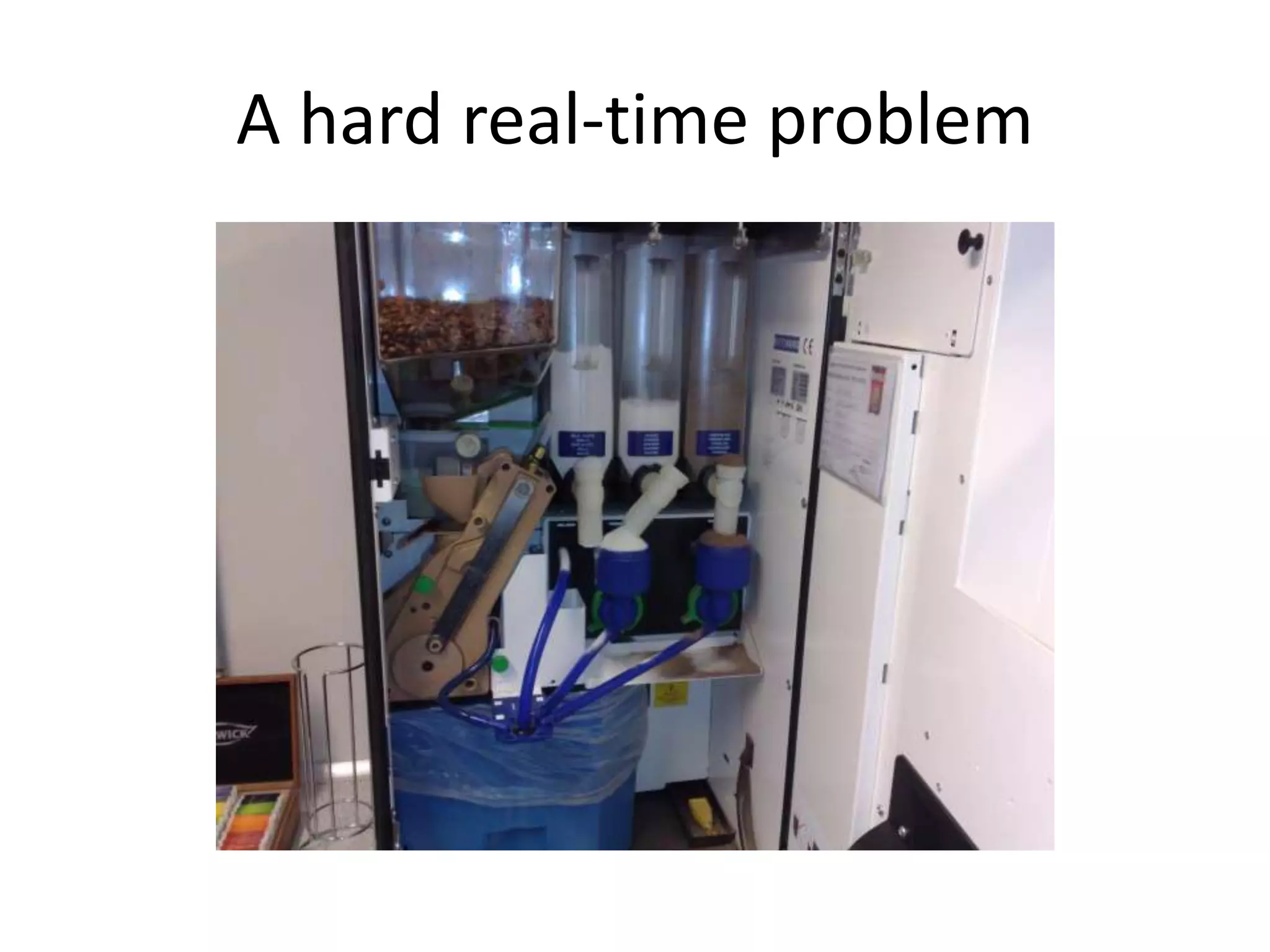
A hard real-time problem
Embedded Control Systems
• Over 90% of all microprocessors are used for real-
time and embedded systems
– Market growing 10% year on year
• Usually programmed in C or Assembler
– Hard, error prone, work
– But preferred choice
• Close to hardware
• No real alternatives
– Difficult to find new skilled programmers
• Jackson Structured Development (1975) still widely used
• EE Times calling for re-introducing C programming at US Uni
Well … ADA – 10th on the list of most wanted skills
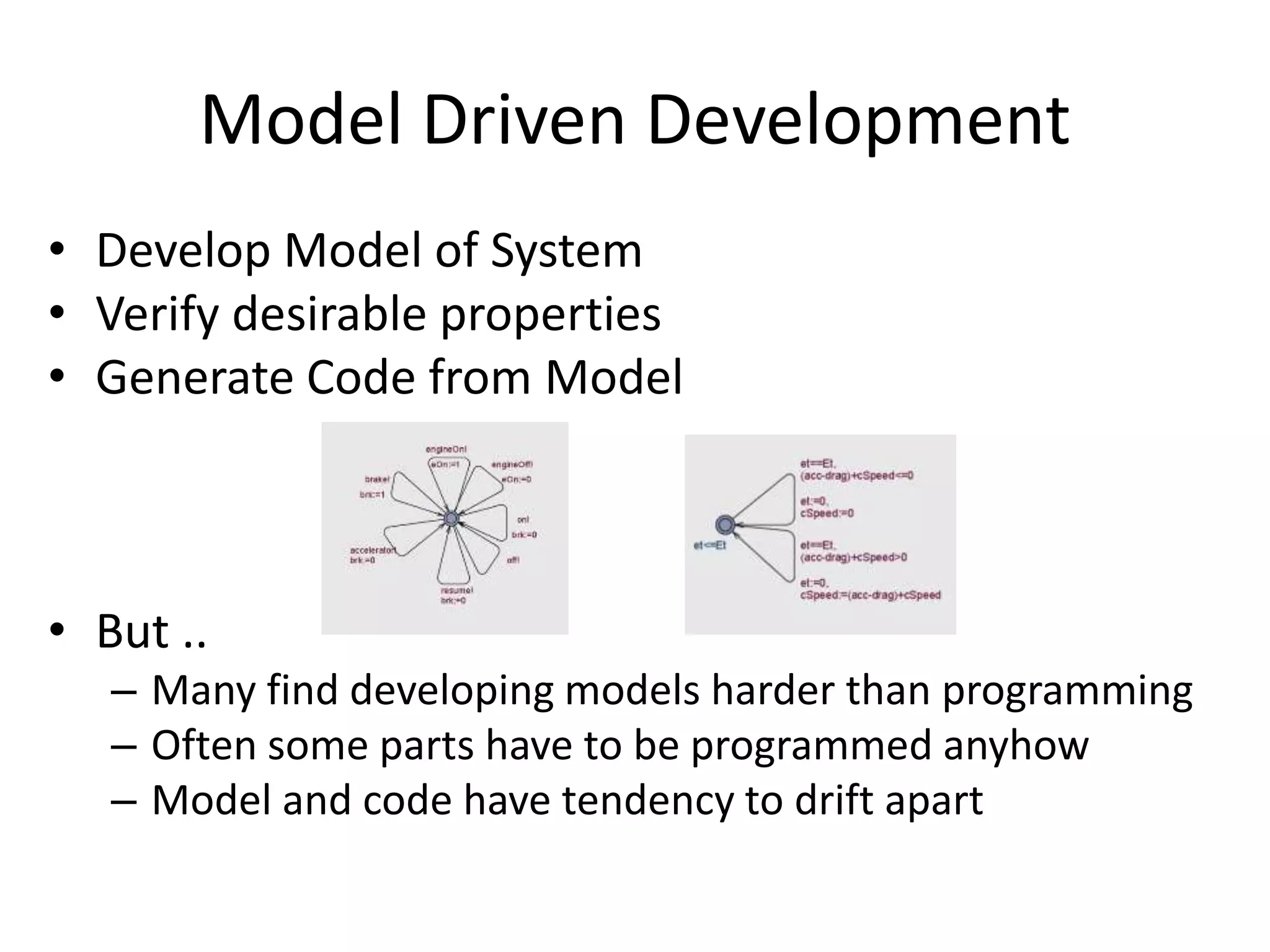
Model Driven Development
• Develop Model of System
• Verify desirable properties
• Generate Code from Model
• But ..
– Many find developing models harder than programming
– Often some parts have to be programmed anyhow
– Model and code have tendency to drift apart
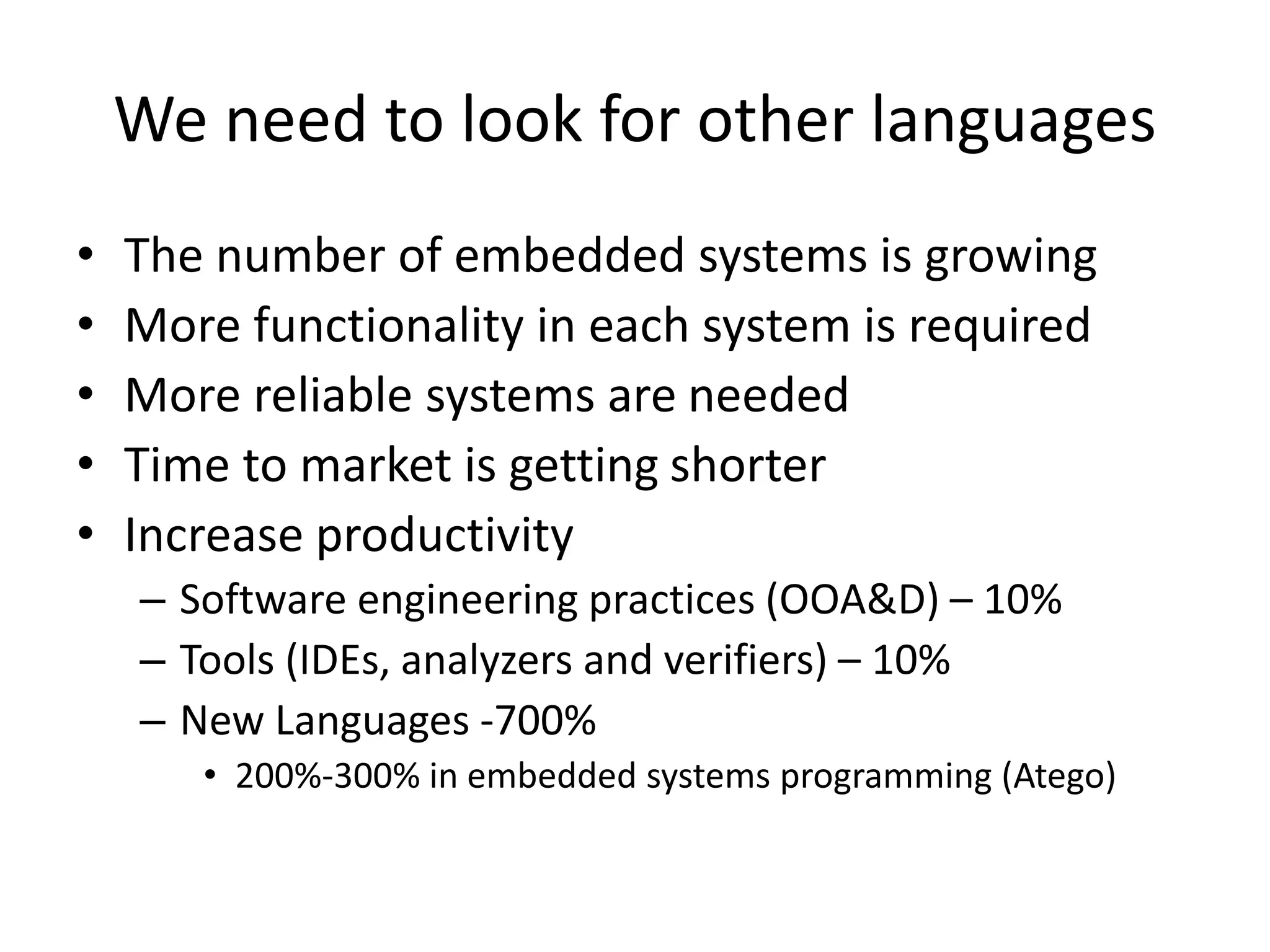
We need to look for other languages
• The number of embedded systems is growing
• More functionality in each system is required
• More reliable systems are needed
• Time to market is getting shorter
• Increase productivity
– Software engineering practices (OOA&D) – 10%
– Tools (IDEs, analyzers and verifiers) – 10%
– New Languages -700%
• 200%-300% in embedded systems programming (Atego)
Java
• Most popular programming language ever !
– In 2005 Sun estimated 4.5 million Java
programmers
– In 2010 Oracle estimated 9 million Java
programmers
– 61% of all programmers are Java programmers
• Originally designed for setop-boxes
• But propelled to popularity by the internet
– Write once, Run everywhere
http://jaxenter.com/how-many-java-developers-are-there-10462.html
9
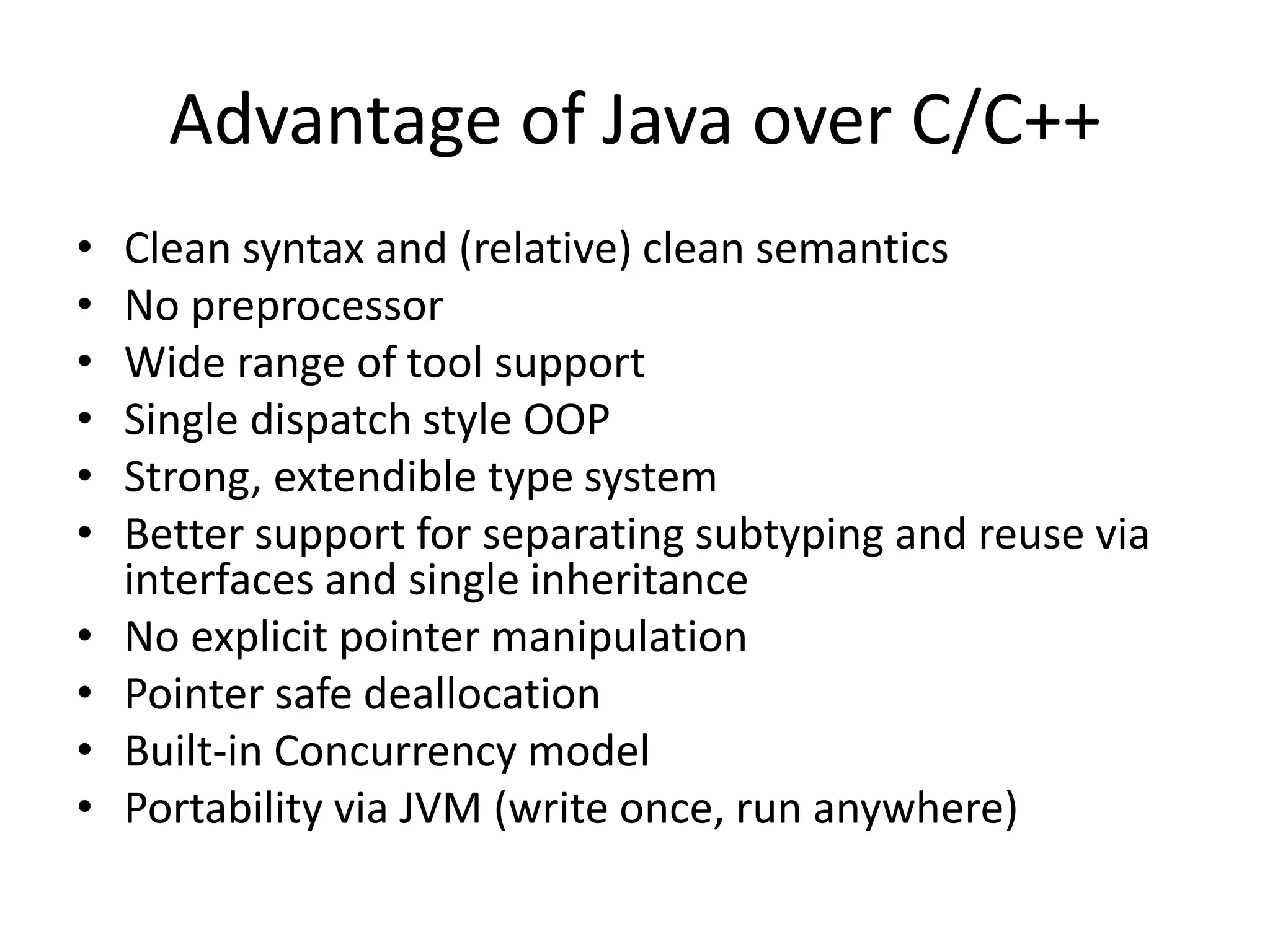
Advantage of Java over C/C++
• Clean syntax and (relative) clean semantics
• No preprocessor
• Wide range of tool support
• Single dispatch style OOP
• Strong, extendible type system
• Better support for separating subtyping and reuse via
interfaces and single inheritance
• No explicit pointer manipulation
• Pointer safe deallocation
• Built-in Concurrency model
• Portability via JVM (write once, run anywhere)
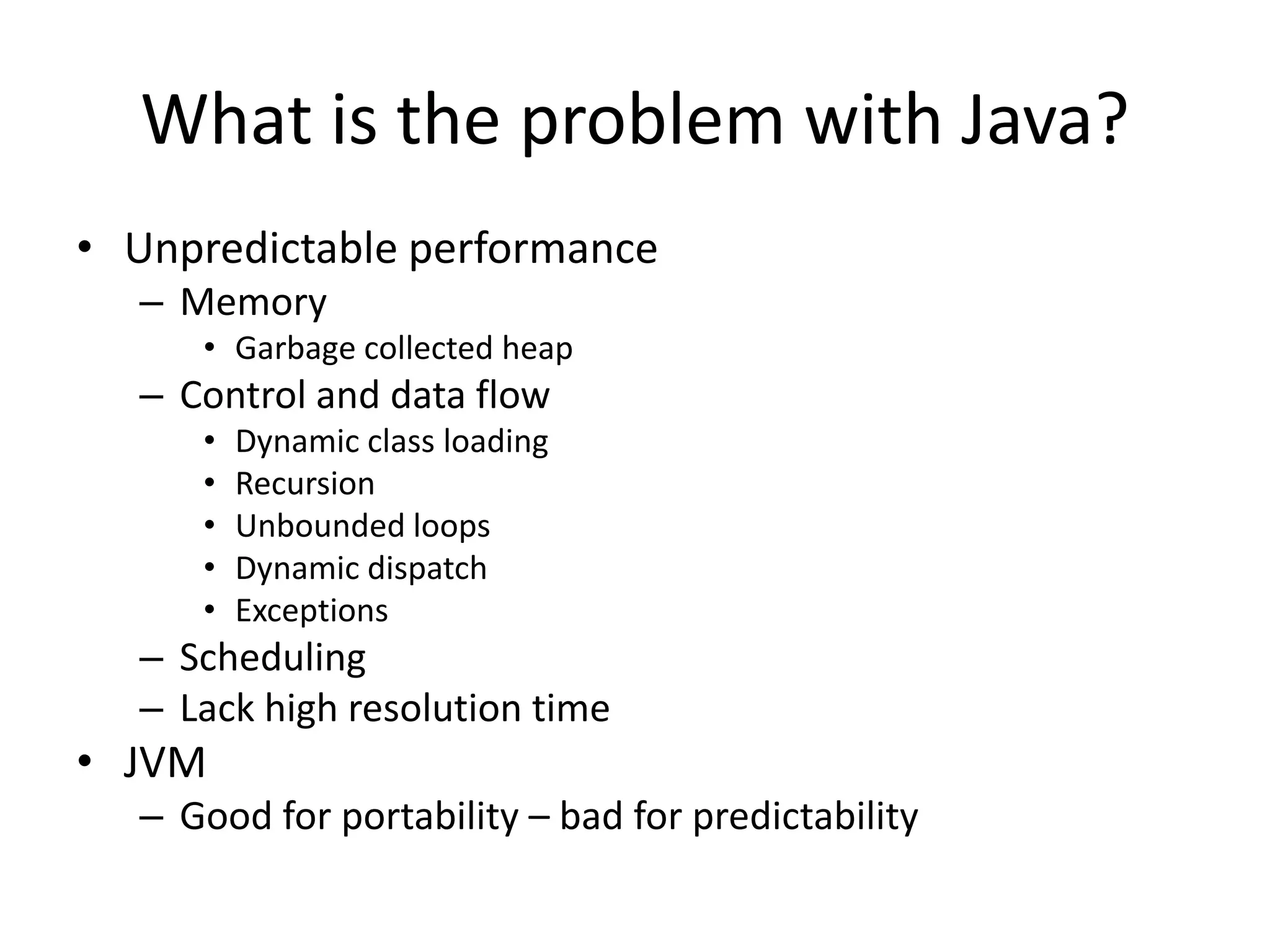
What is the problem with Java?
• Unpredictable performance
– Memory
• Garbage collected heap
– Control and data flow
• Dynamic class loading
• Recursion
• Unbounded loops
• Dynamic dispatch
• Exceptions
– Scheduling
– Lack high resolution time
• JVM
– Good for portability – bad for predictability
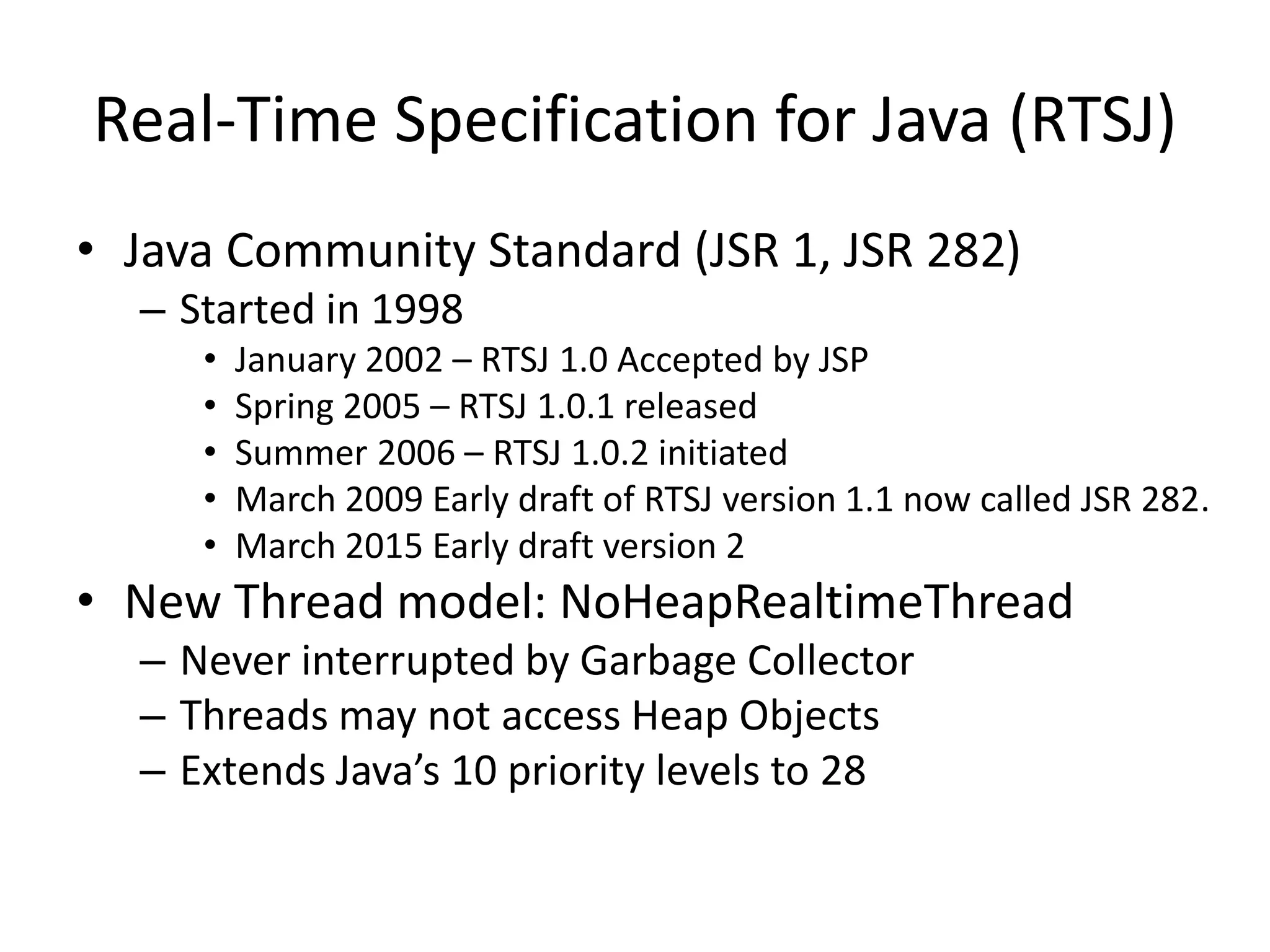
Real-Time Specification for Java (RTSJ)
• Java Community Standard (JSR 1, JSR 282)
– Started in 1998
• January 2002 – RTSJ 1.0 Accepted by JSP
• Spring 2005 – RTSJ 1.0.1 released
• Summer 2006 – RTSJ 1.0.2 initiated
• March 2009 Early draft of RTSJ version 1.1 now called JSR 282.
• March 2015 Early draft version 2
• New Thread model: NoHeapRealtimeThread
– Never interrupted by Garbage Collector
– Threads may not access Heap Objects
– Extends Java’s 10 priority levels to 28
13
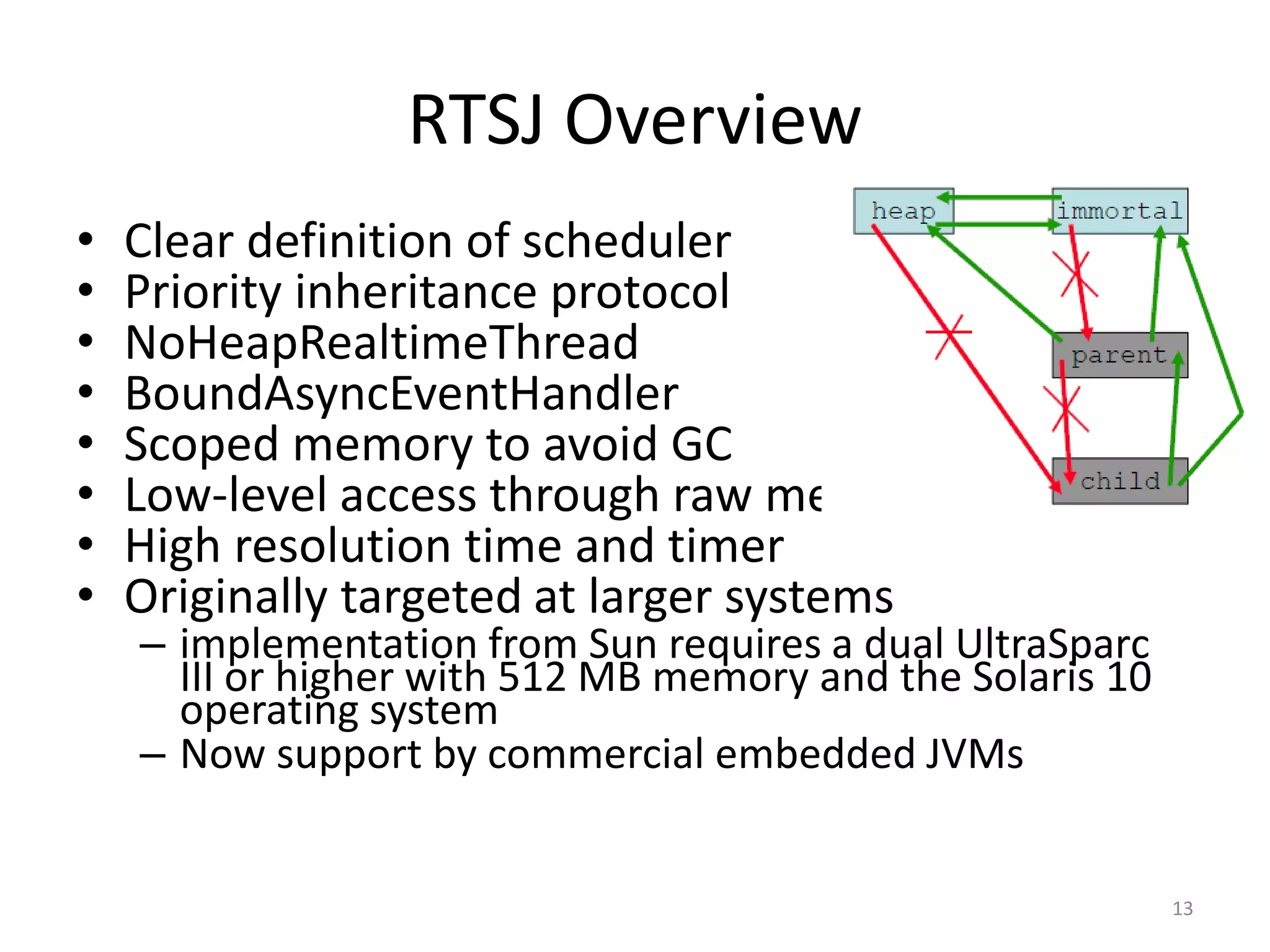
RTSJ Overview
• Clear definition of scheduler
• Priority inheritance protocol
• NoHeapRealtimeThread
• BoundAsyncEventHandler
• Scoped memory to avoid GC
• Low-level access through raw memory
• High resolution time and timer
• Originally targeted at larger systems
– implementation from Sun requires a dual UltraSparc
III or higher with 512 MB memory and the Solaris 10
operating system
– Now support by commercial embedded JVMs
14
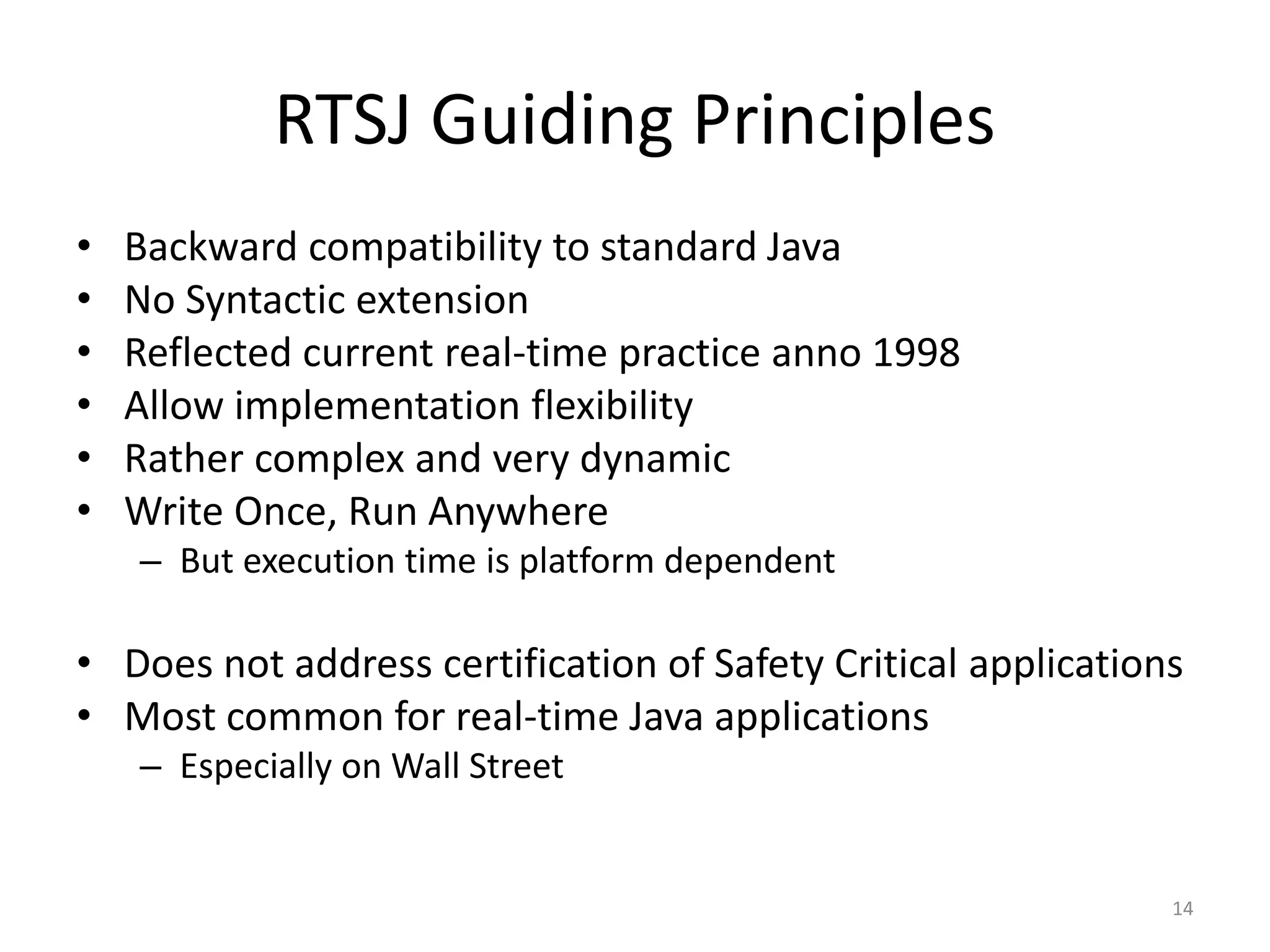
RTSJ Guiding Principles
• Backward compatibility to standard Java
• No Syntactic extension
• Reflected current real-time practice anno 1998
• Allow implementation flexibility
• Rather complex and very dynamic
• Write Once, Run Anywhere
– But execution time is platform dependent
• Does not address certification of Safety Critical applications
• Most common for real-time Java applications
– Especially on Wall Street
15
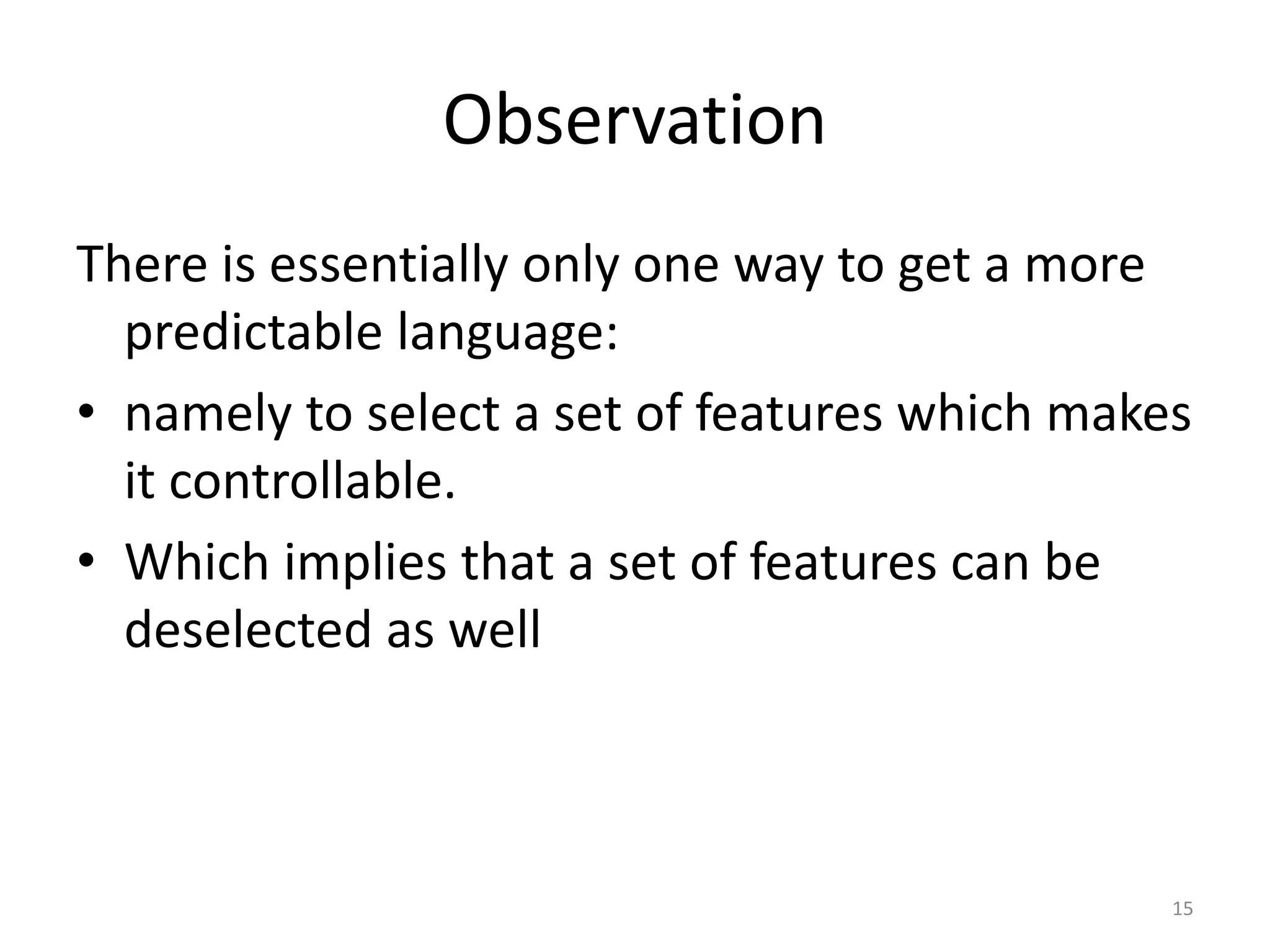
Observation
There is essentially only one way to get a more
predictable language:
• namely to select a set of features which makes
it controllable.
• Which implies that a set of features can be
deselected as well
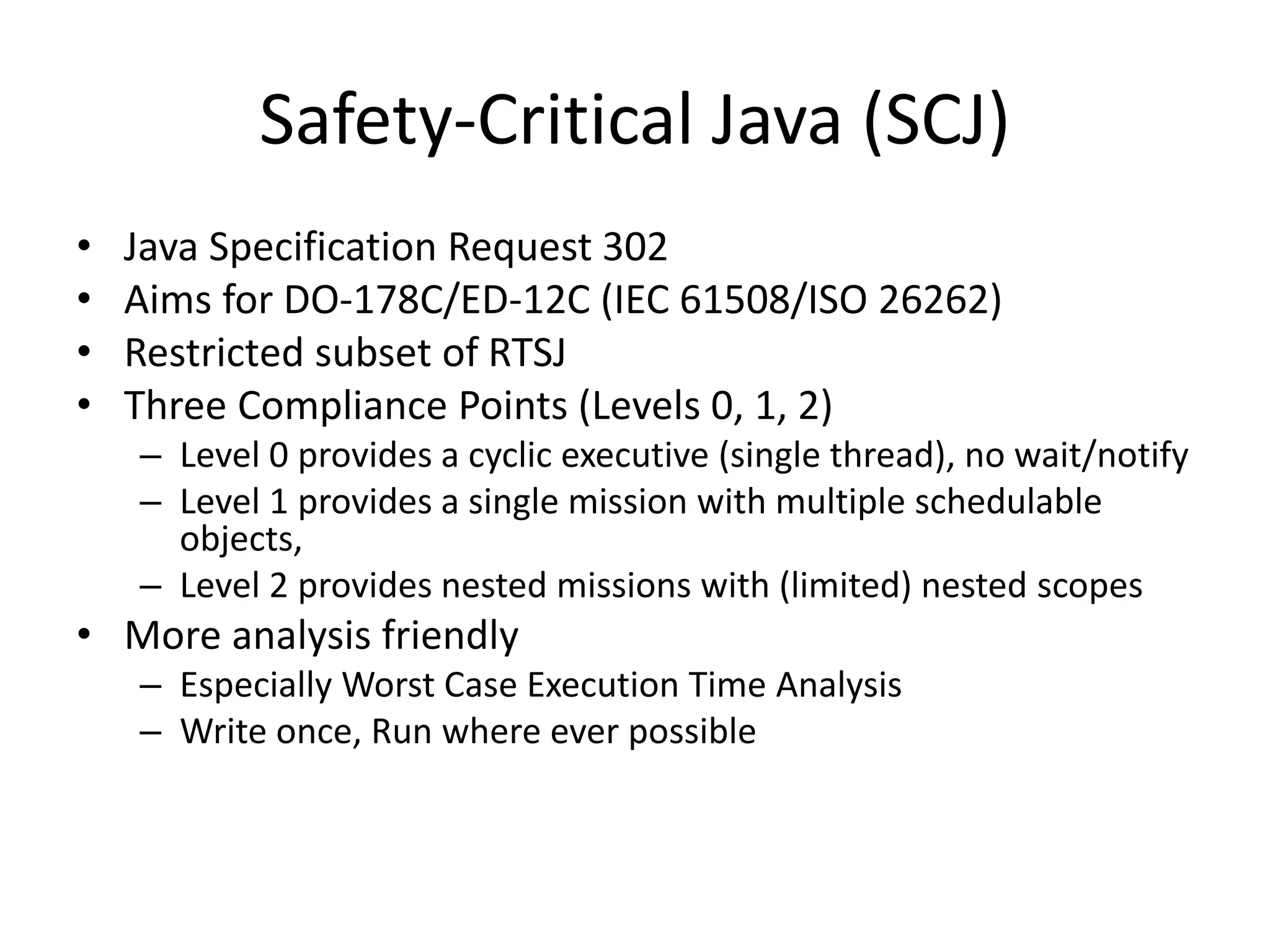
Safety-Critical Java (SCJ)
• Java Specification Request 302
• Aims for DO-178C/ED-12C (IEC 61508/ISO 26262)
• Restricted subset of RTSJ
• Three Compliance Points (Levels 0, 1, 2)
– Level 0 provides a cyclic executive (single thread), no wait/notify
– Level 1 provides a single mission with multiple schedulable
objects,
– Level 2 provides nested missions with (limited) nested scopes
• More analysis friendly
– Especially Worst Case Execution Time Analysis
– Write once, Run where ever possible
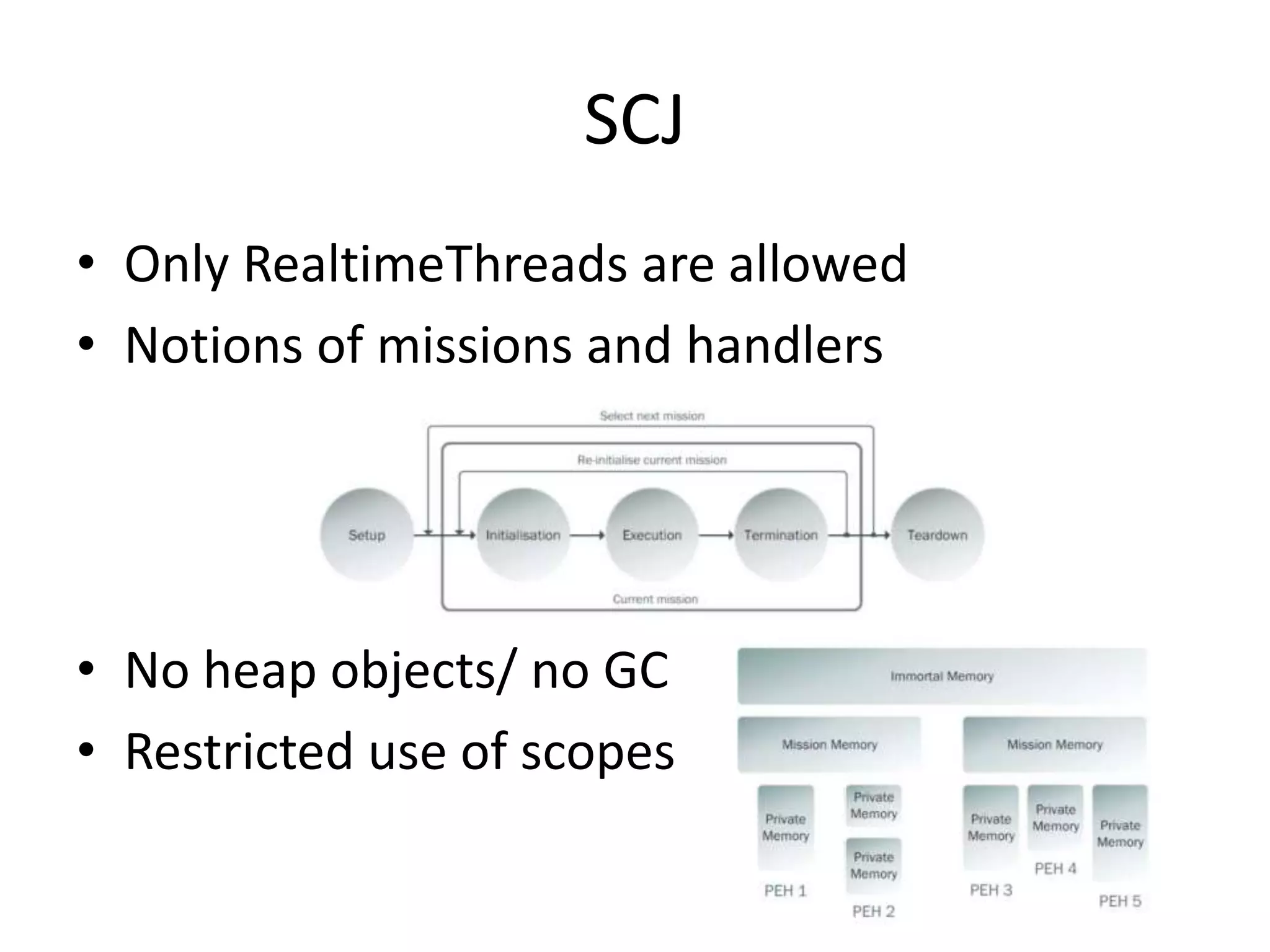
SCJ
• Only RealtimeThreads are allowed
• Notions of missions and handlers
• No heap objects/ no GC
• Restricted use of scopes
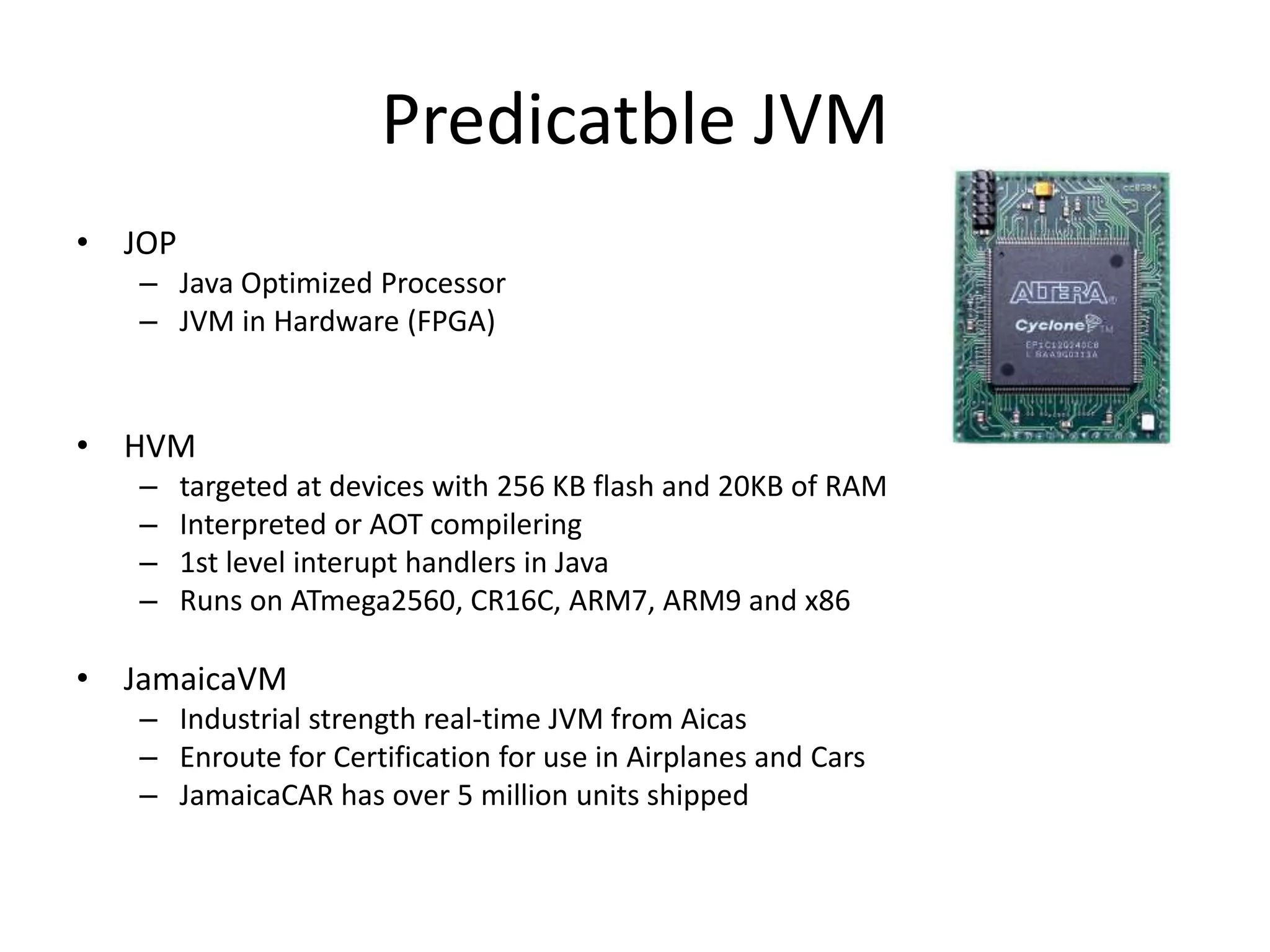
Predicatble JVM
• JOP
– Java Optimized Processor
– JVM in Hardware (FPGA)
• HVM
– targeted at devices with 256 KB flash and 20KB of RAM
– Interpreted or AOT compilering
– 1st level interupt handlers in Java
– Runs on ATmega2560, CR16C, ARM7, ARM9 and x86
• JamaicaVM
– Industrial strength real-time JVM from Aicas
– Enroute for Certification for use in Airplanes and Cars
– JamaicaCAR has over 5 million units shipped
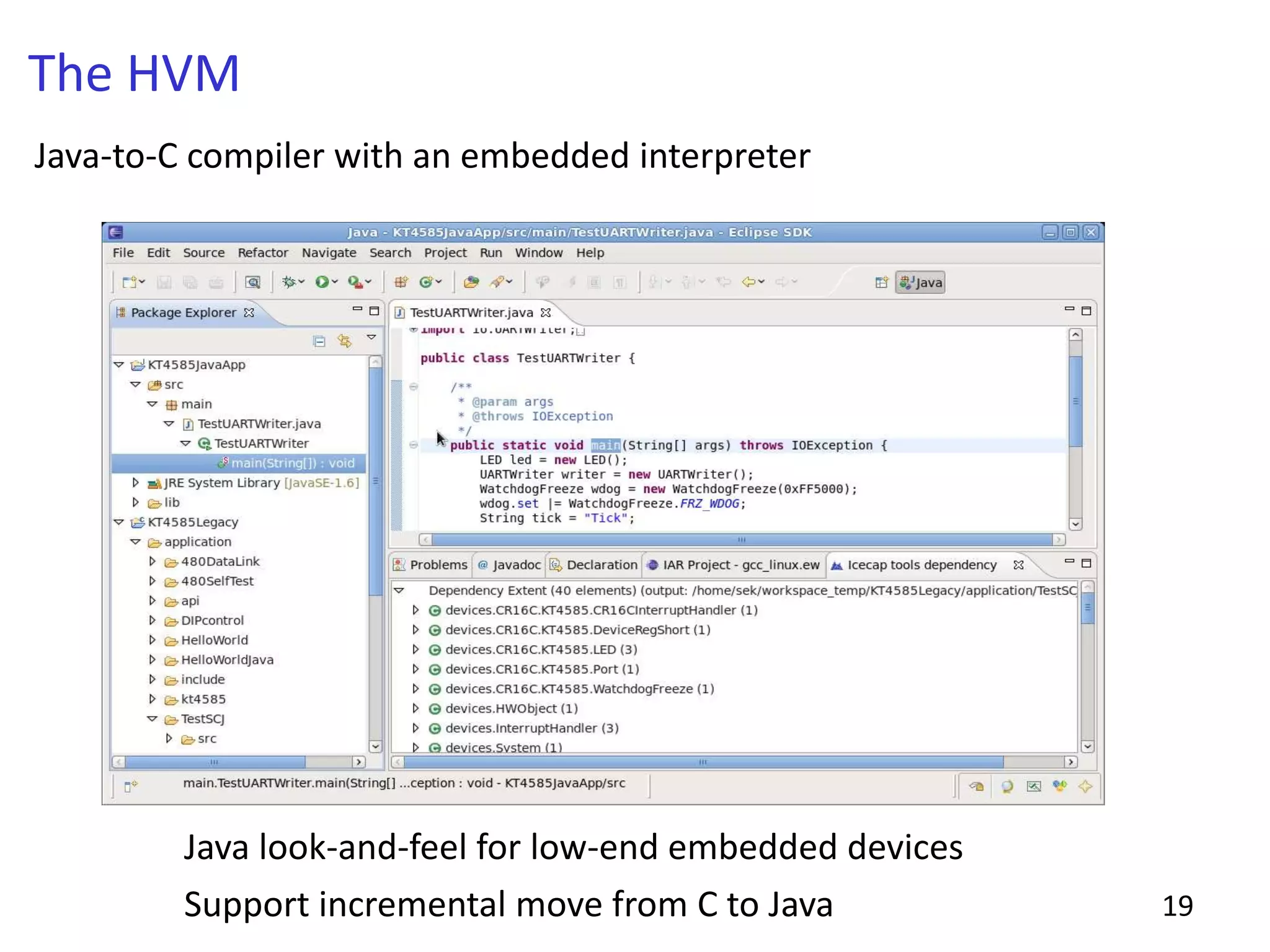
Java look-and-feel for low-end embedded devices
Support incremental move from C to Java 19
The HVM
Java-to-C compiler with an embedded interpreter
20
Features
- Java-to-C compiler with an embedded interpreter
- Execution on the bare metal
- Run in 256 KB ROM and 20 KB RAM
- First level interrupt handling & Hardware Objects
- Hybrid execution style (interpretation + AOT)
- Program specialization
* Classes & methods
* Interpreter
- Native variable support
- Portability
* No external dependencies
* Strict ANSI-C
* Support incremental move from C to Java
- Process switching & scoped memory
- Support for multi-core
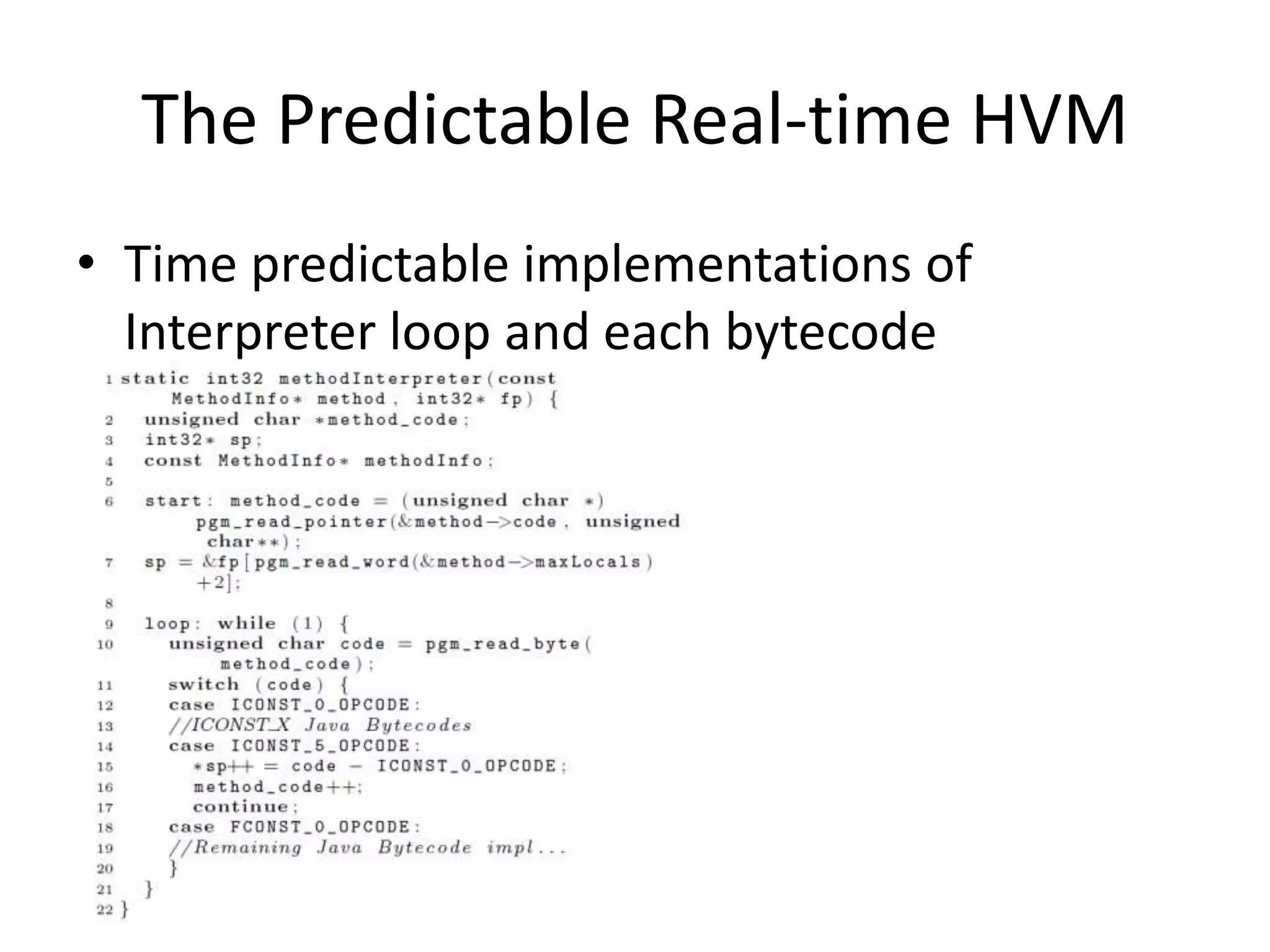
The Predictable Real-time HVM
• Time predictable implementations of
Interpreter loop and each bytecode
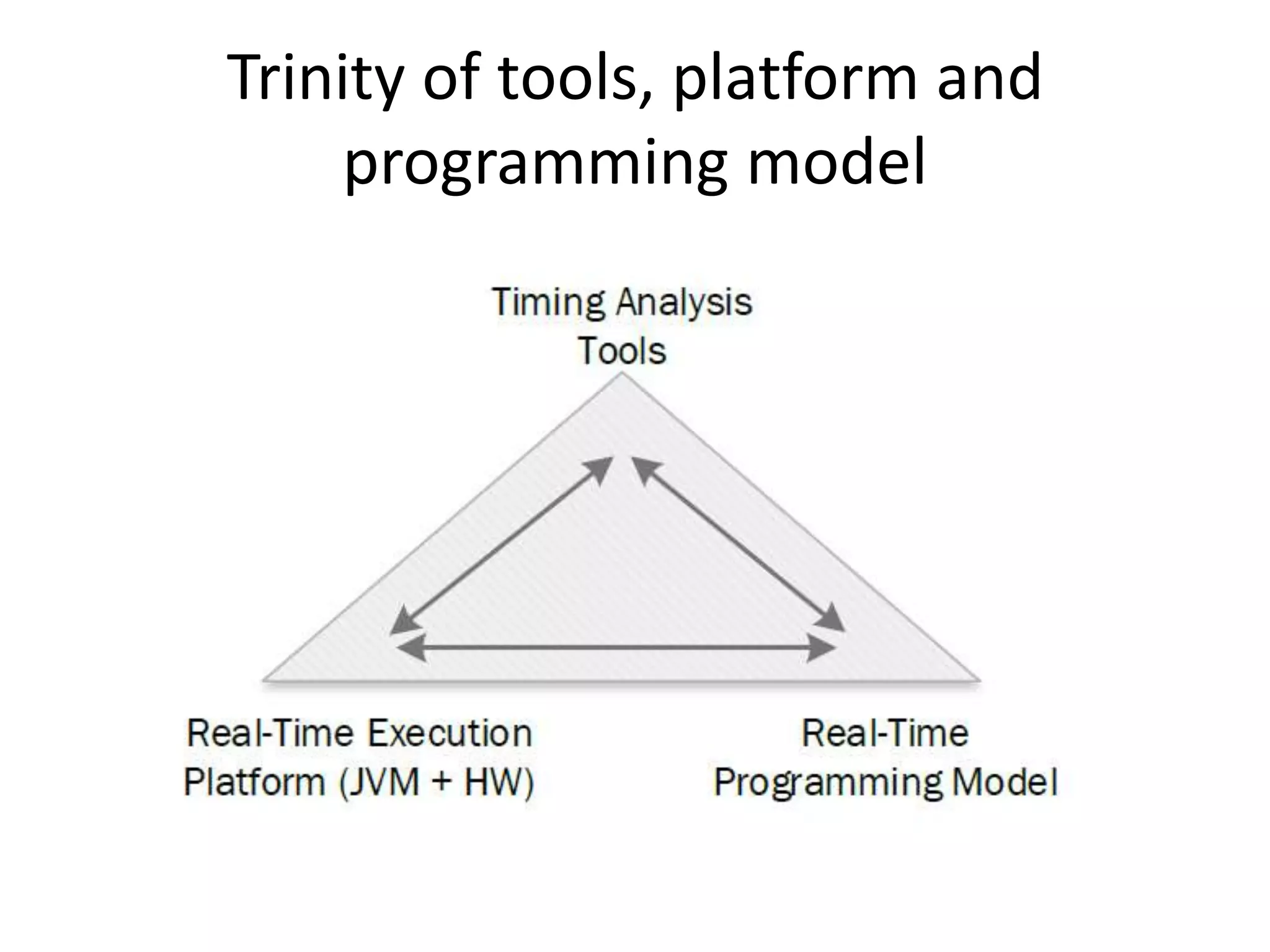
Trinity of tools, platform and
programming model
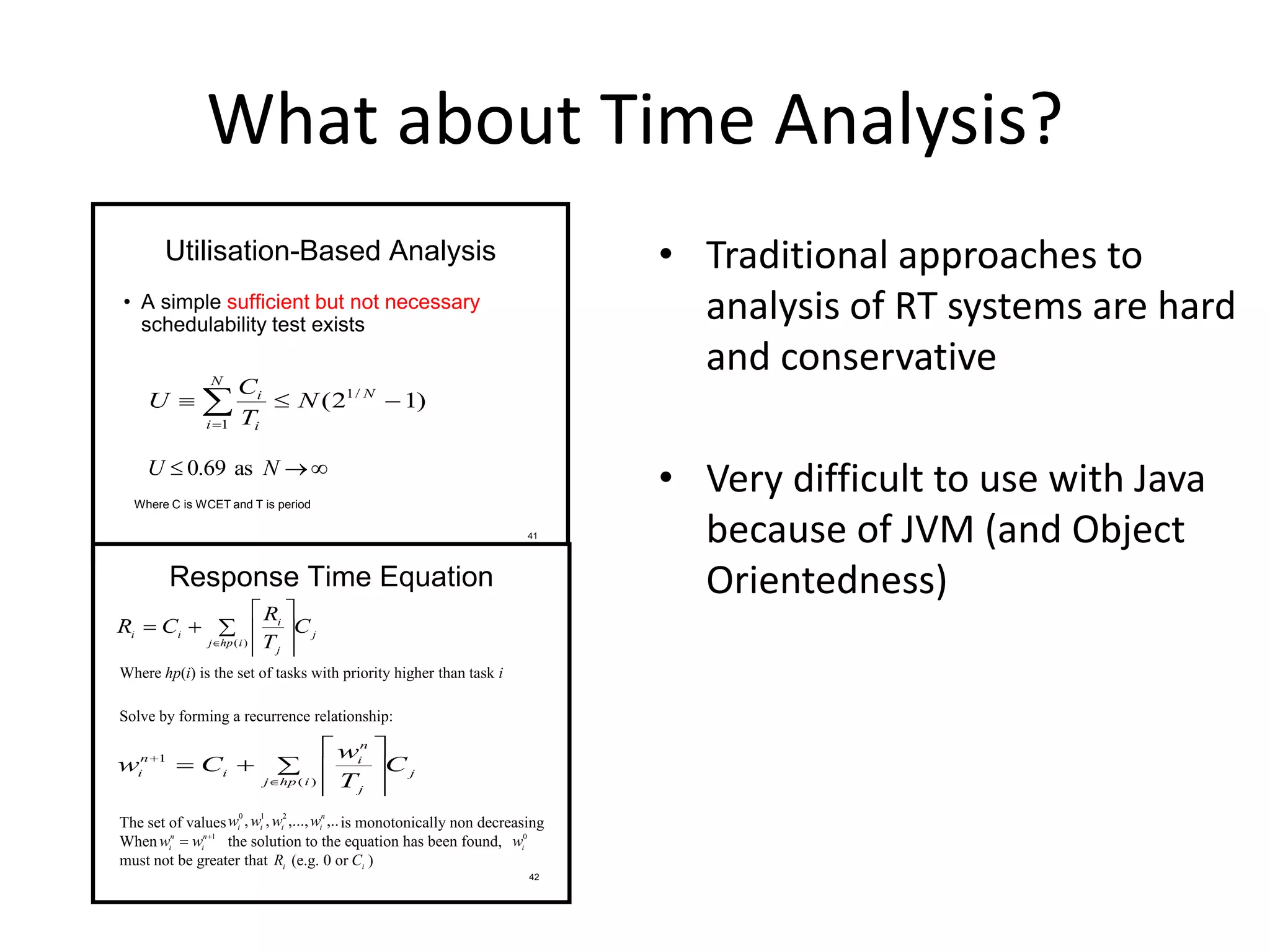
What about Time Analysis?
• Traditional approaches to
analysis of RT systems are hard
and conservative
• Very difficult to use with Java
because of JVM (and Object
Orientedness)
41
Utilisation-Based Analysis
• A simple sufficient but not necessary
schedulability test exists
)12( /1
1
 
N
N
i i
i
N
T
C
U
 NU as69.0
Where C is WCET and T is period
42
Response Time Equation
j
ihpj
j
i
ii C
T
R
CR  






 )(
Where hp(i) is the set of tasks with priority higher than task i
Solve by forming a recurrence relationship:
j
ihpj
j
n
i
i
n
i C
T
w
Cw  








)(
1
The set of values is monotonically non decreasing
When the solution to the equation has been found,
must not be greater that (e.g. 0 or )
1
 n
i
n
i
ww
,..,...,,, 210 n
iiii
wwww
0
i
w
iR iC
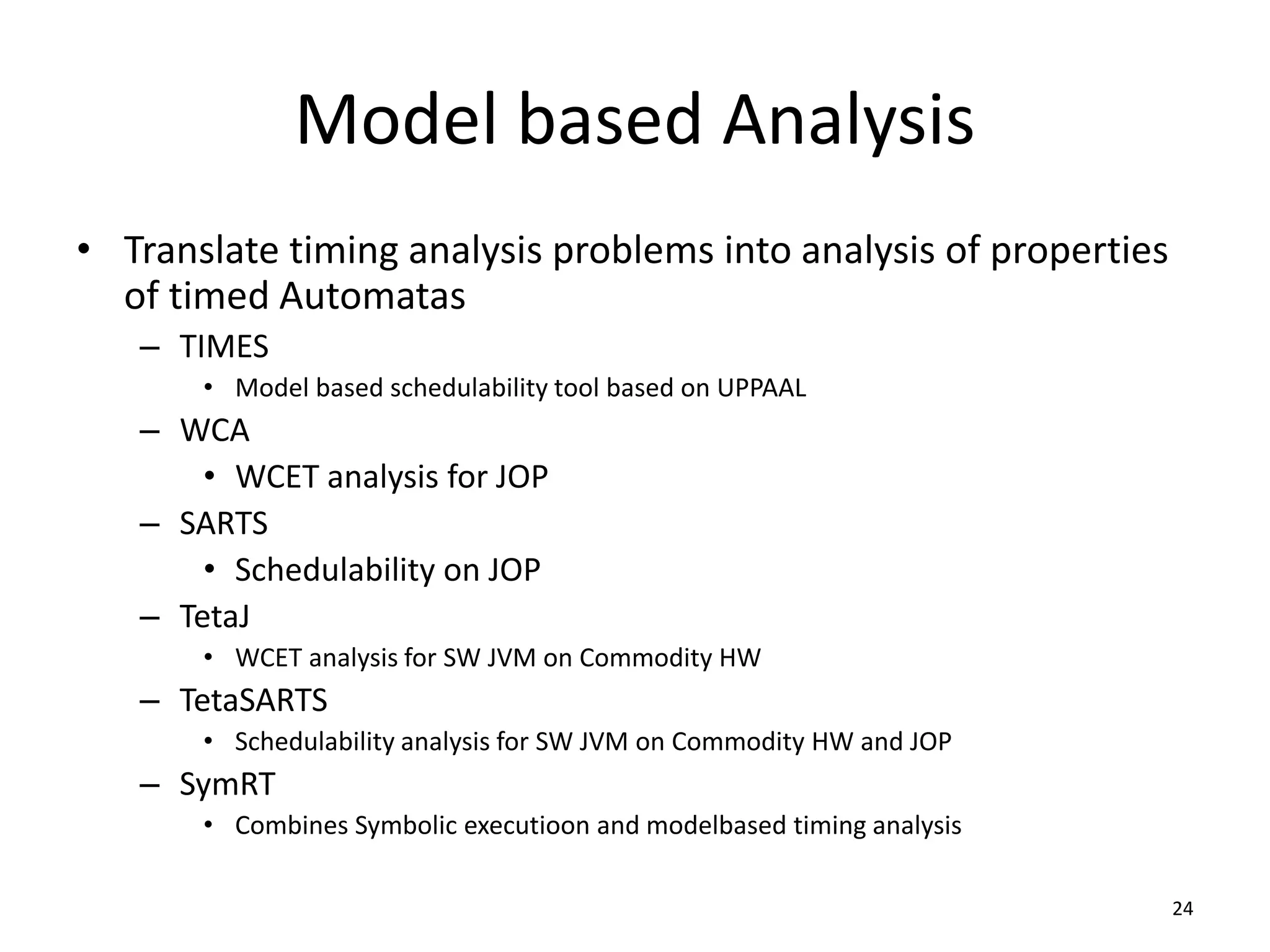
Model based Analysis
• Translate timing analysis problems into analysis of properties
of timed Automatas
– TIMES
• Model based schedulability tool based on UPPAAL
– WCA
• WCET analysis for JOP
– SARTS
• Schedulability on JOP
– TetaJ
• WCET analysis for SW JVM on Commodity HW
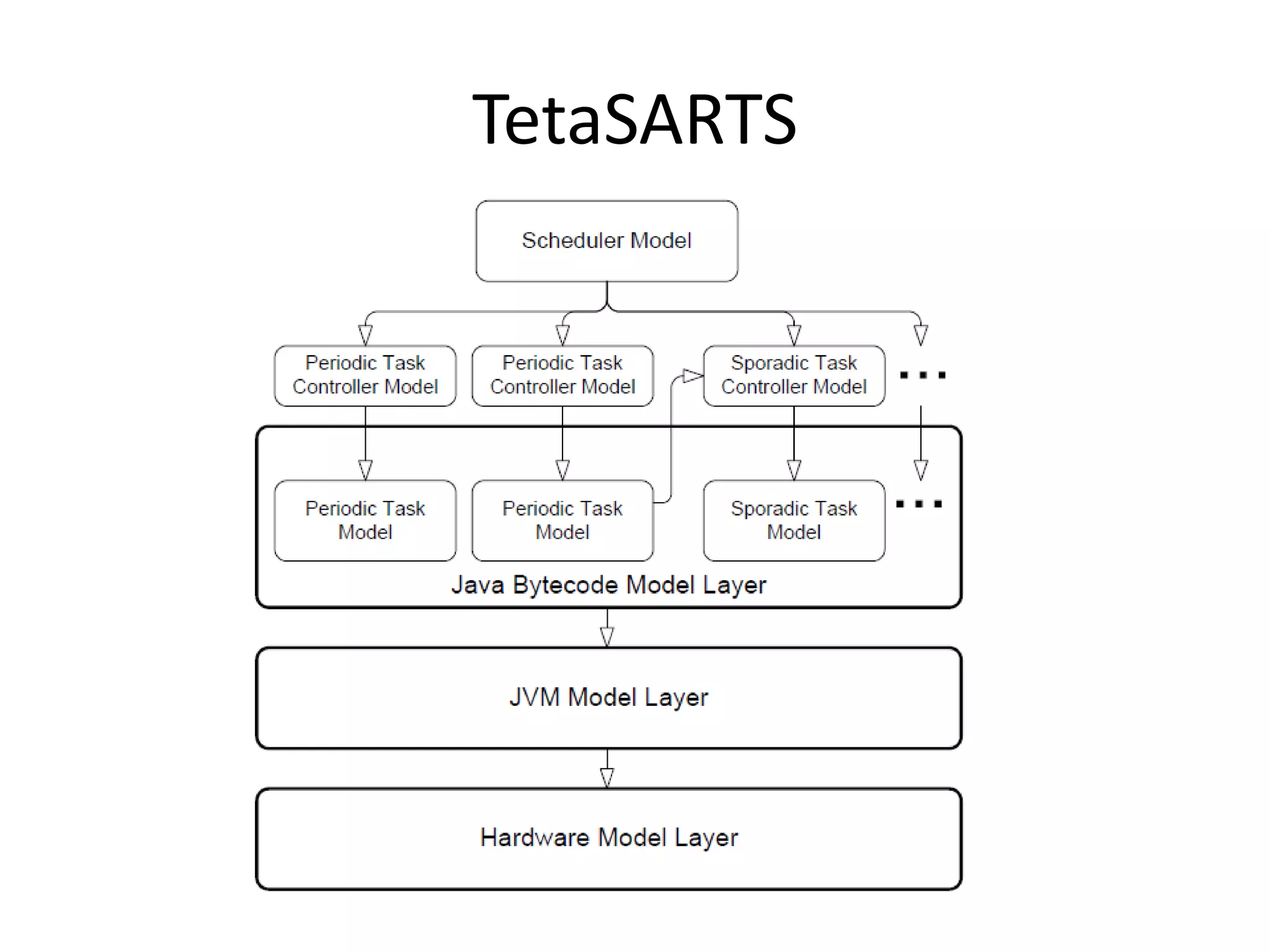
– TetaSARTS
• Schedulability analysis for SW JVM on Commodity HW and JOP
– SymRT
• Combines Symbolic executioon and modelbased timing analysis
24
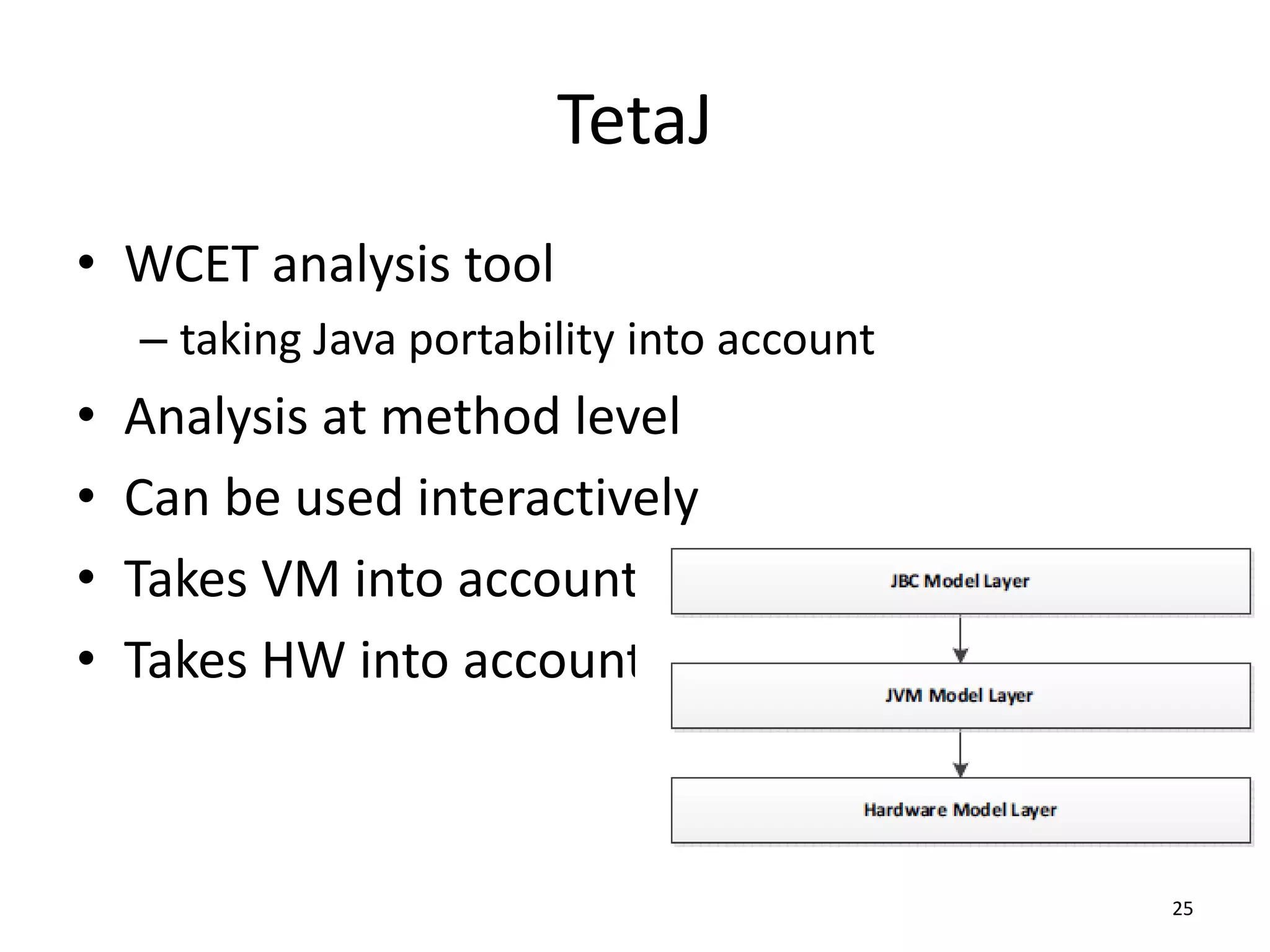
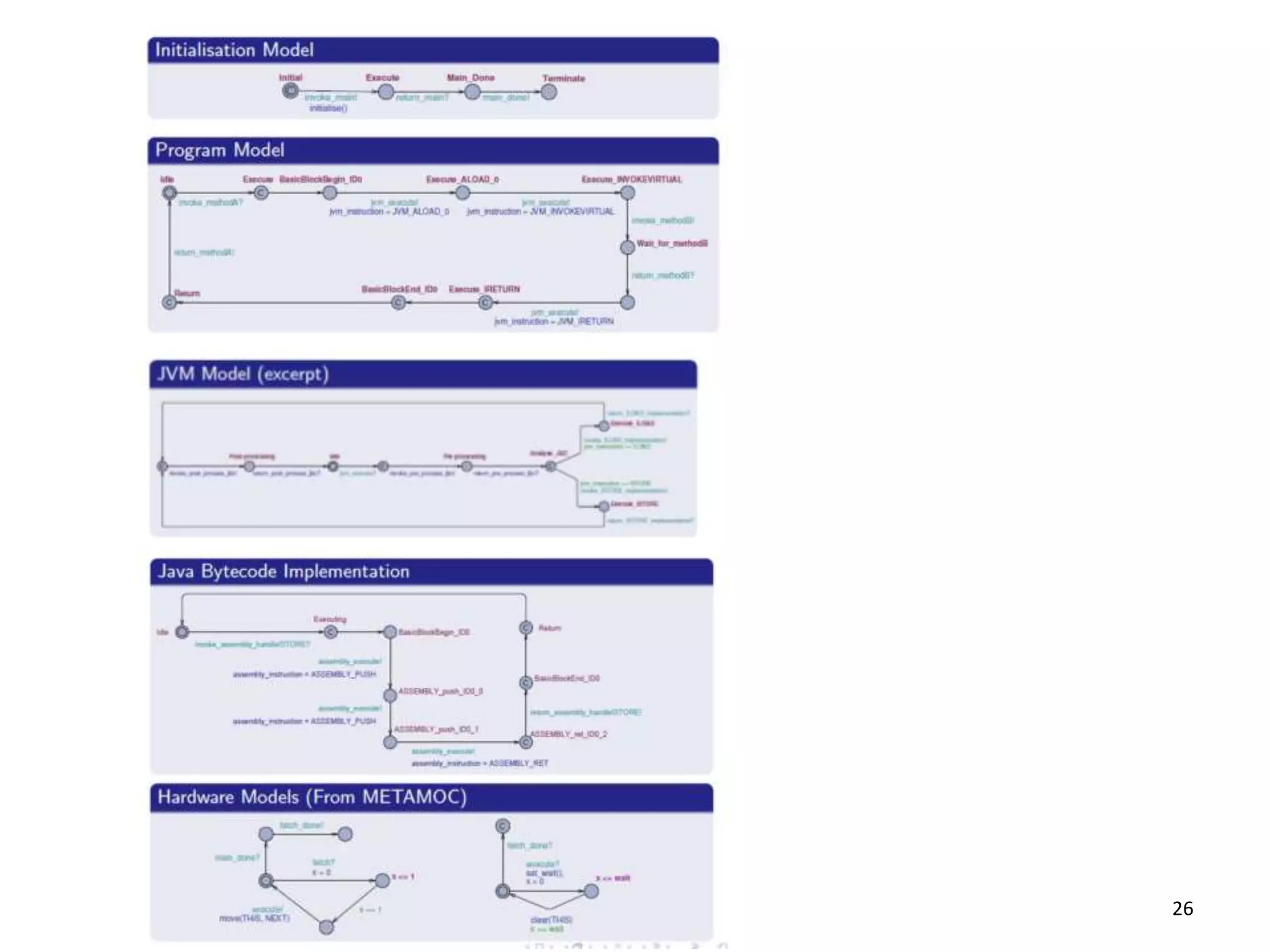
TetaJ
• WCET analysis tool
– taking Java portability into account
• Analysis at method level
• Can be used interactively
• Takes VM into account
• Takes HW into account
25
26
TetaSARTS
27
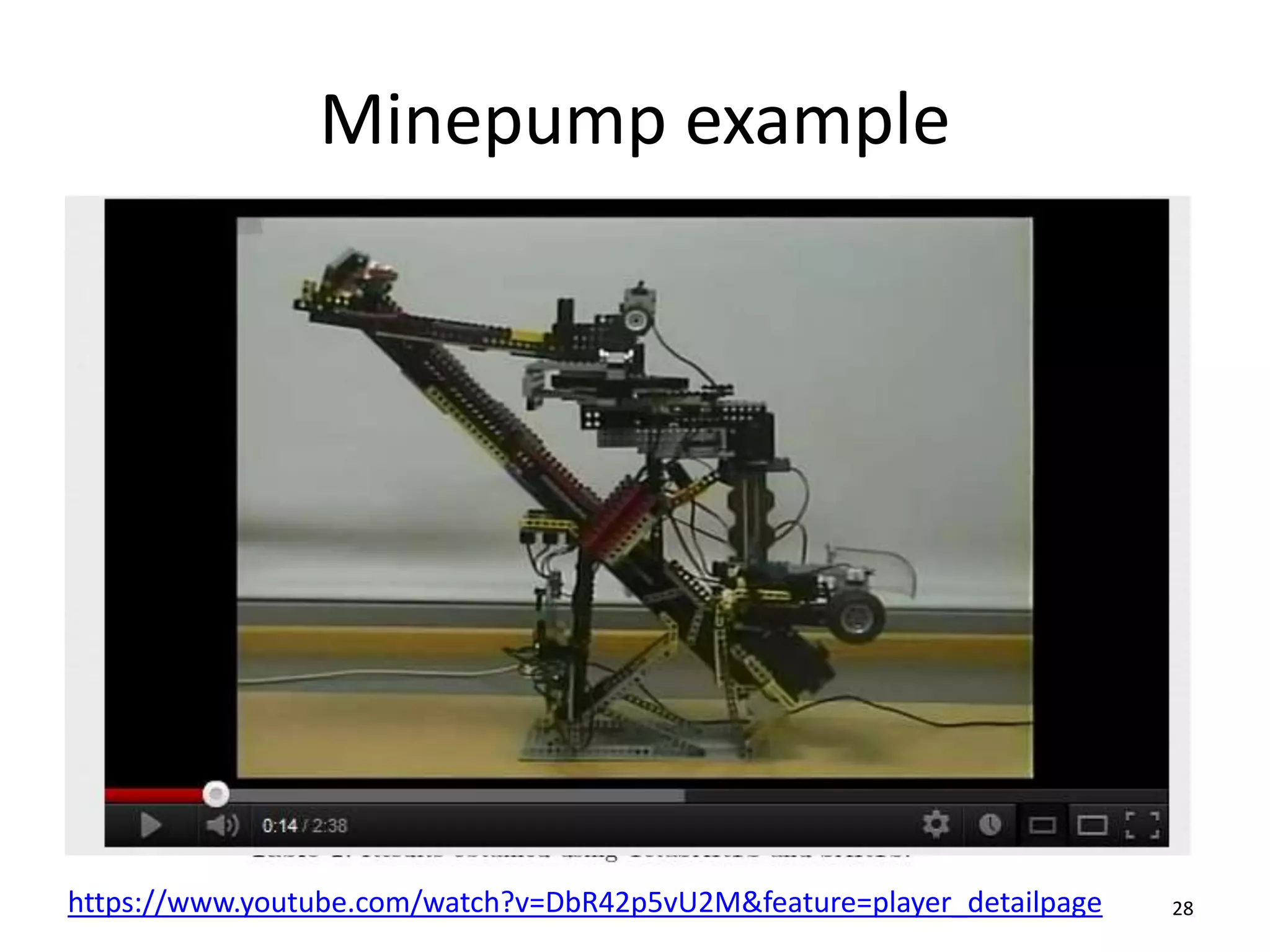
Minepump example
28https://www.youtube.com/watch?v=DbR42p5vU2M&feature=player_detailpage
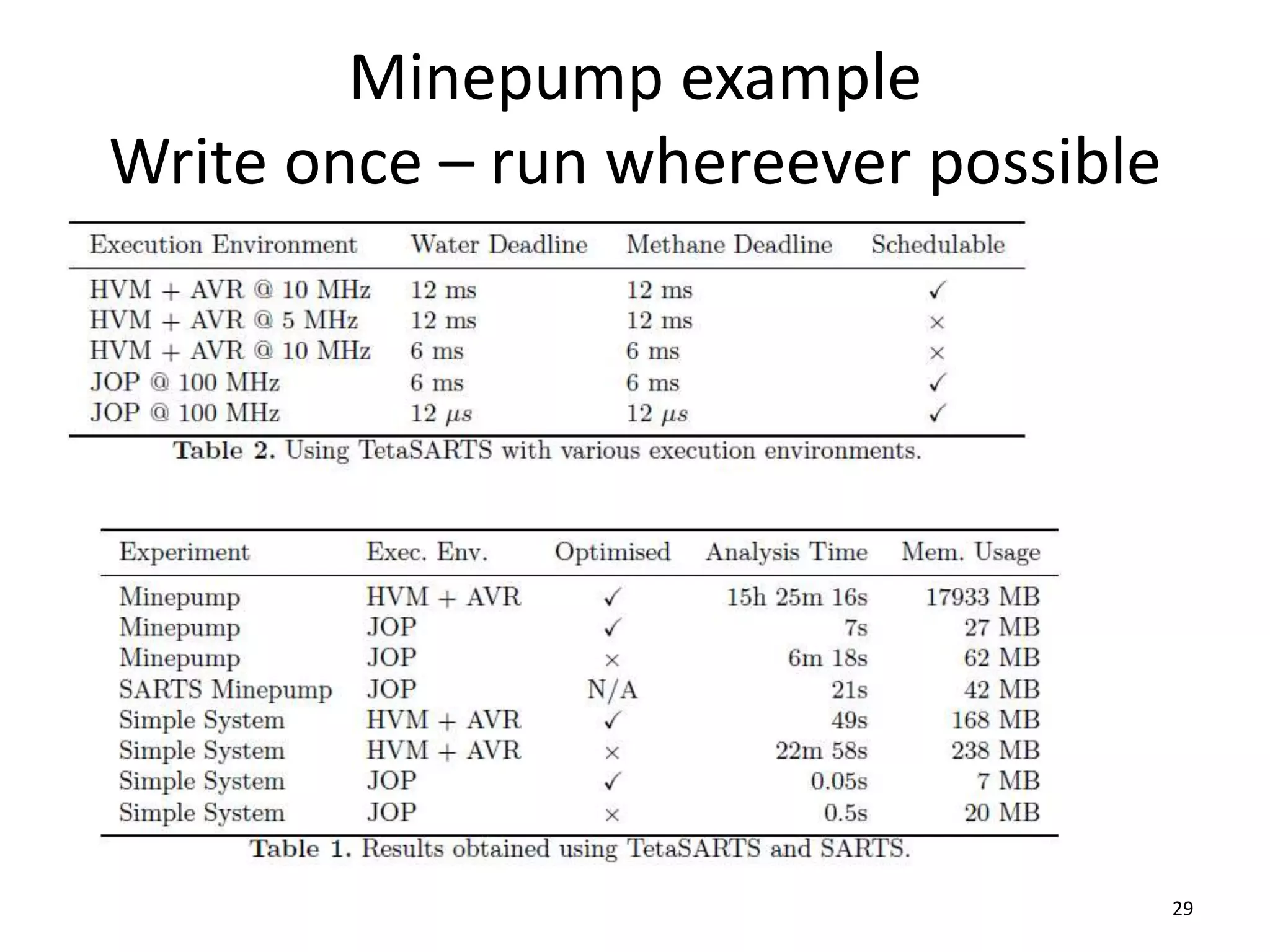
Minepump example
Write once – run whereever possible
29
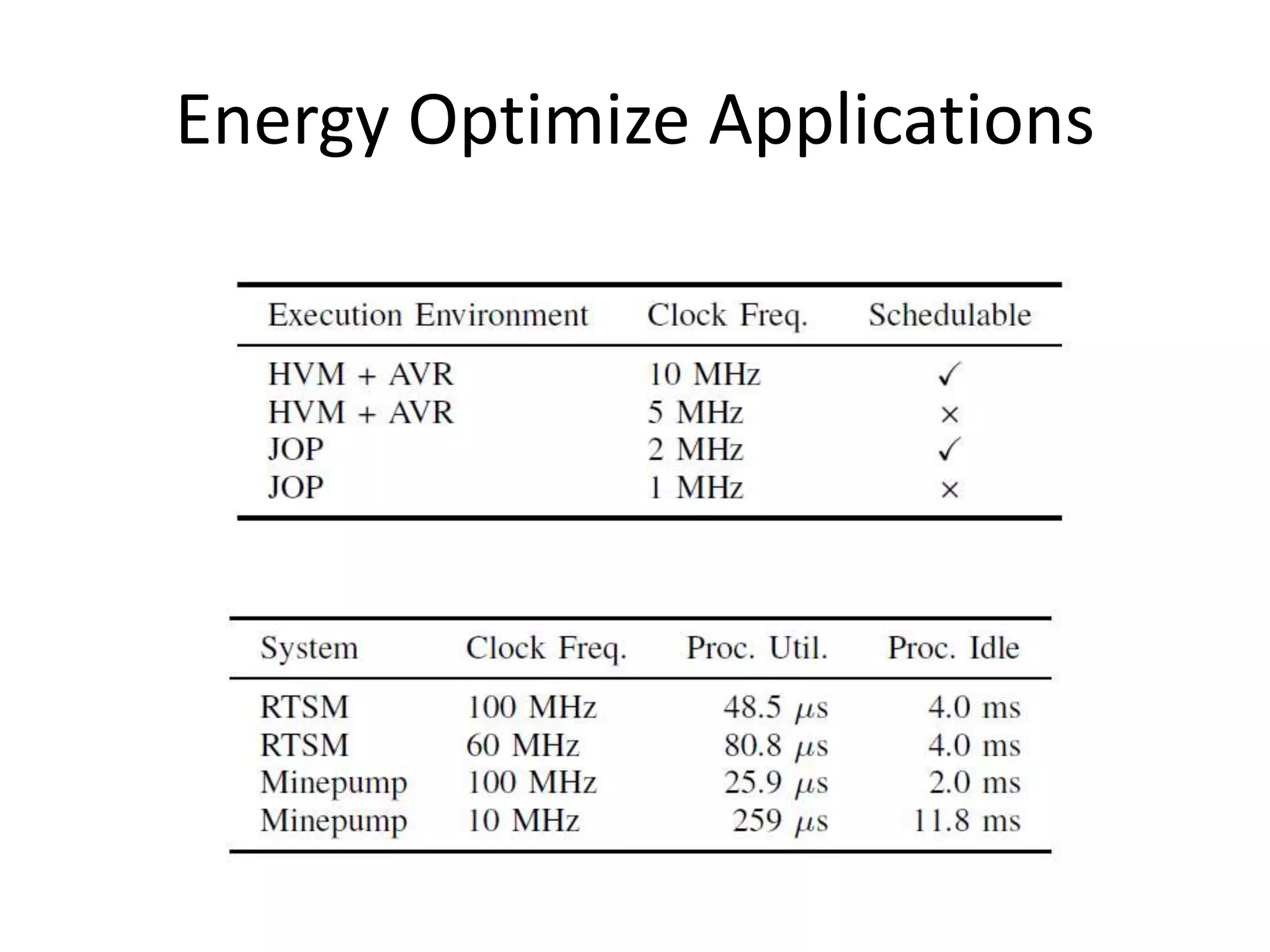
Energy Optimize Applications
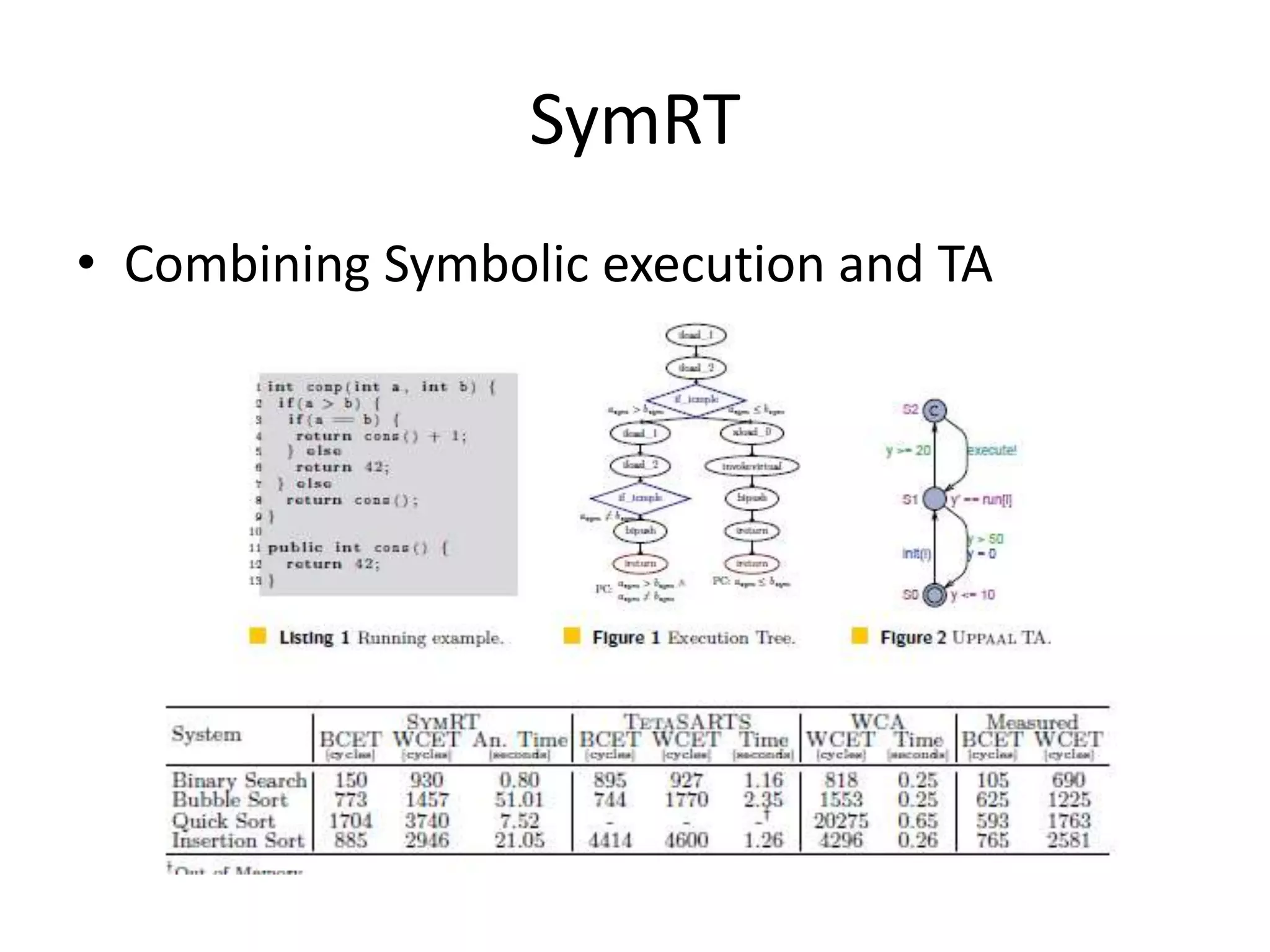
SymRT
• Combining Symbolic execution and TA
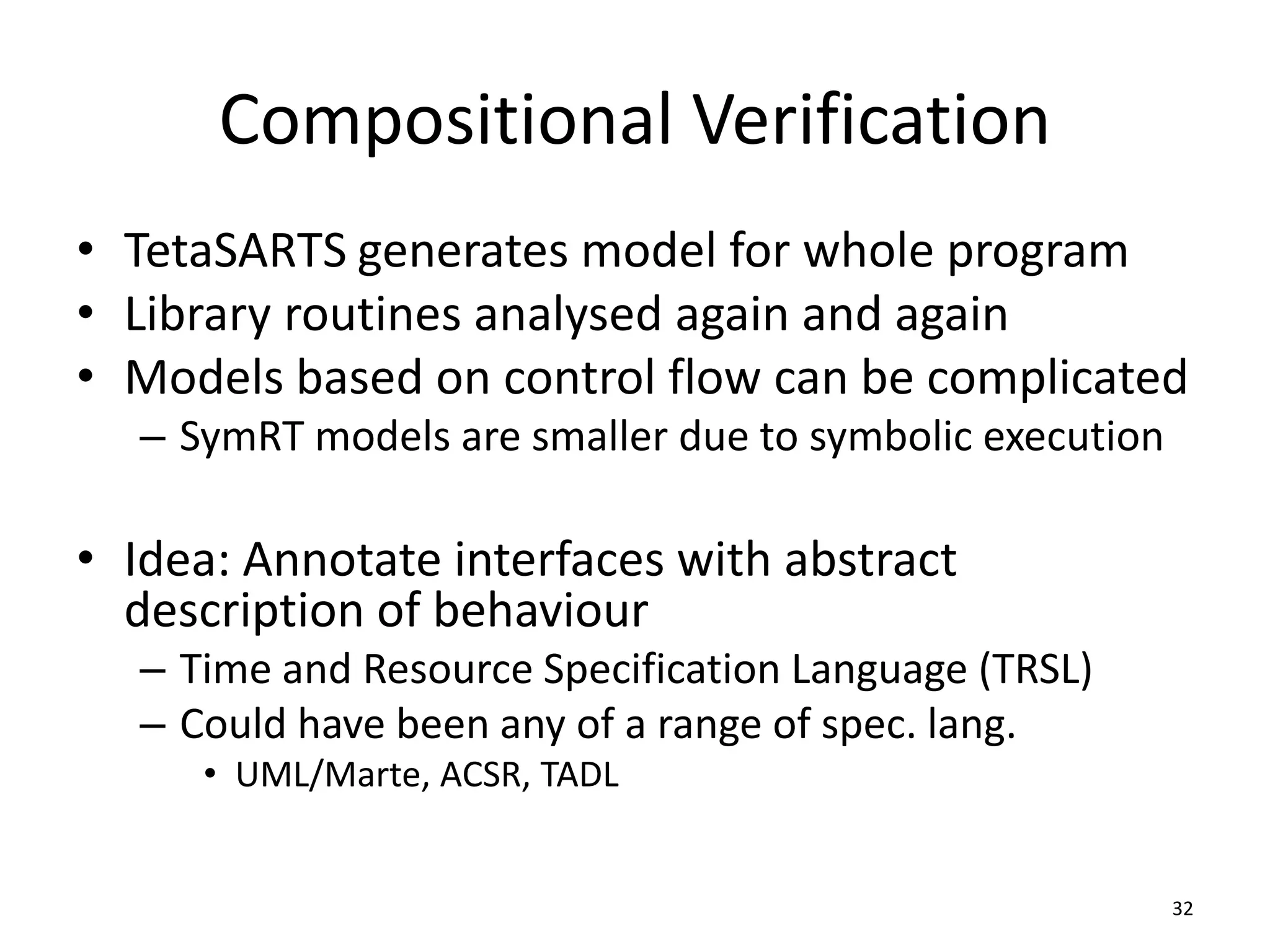
Compositional Verification
• TetaSARTS generates model for whole program
• Library routines analysed again and again
• Models based on control flow can be complicated
– SymRT models are smaller due to symbolic execution
• Idea: Annotate interfaces with abstract
description of behaviour
– Time and Resource Specification Language (TRSL)
– Could have been any of a range of spec. lang.
• UML/Marte, ACSR, TADL
32
Note – could have used [ 1..8 ; using(r)[2] ; 1 ] since
[ 1 ; 7? ; using(r)[2] ; 1 ] ≤ [ 1 ..8 ; using(r)[2] ; 1 ]
Further Analysis and tools
• Scope compliance analysis for SCJ
• SCJ compliance analyzer
• Eclipse plug-in
• Lot’s of work on (analyzable) Real-time GC
Future Work
• Hierarchical schedulability (mixed mode)
– Mixed Java and C systems
• Analyse non-SCJ programs
– Java 8, Groovy, Scala
– TetaSARTS/SymRT can analyze invoke virtual bytecode used for implementing lambdas
• Loadable Safelets and cloud verification
• Verifiable tool chain
– Formalized translation from JBC to TA
– Recent formal and mechanized specification of Java
– Use of CompCert C compiler
Future Applications
36
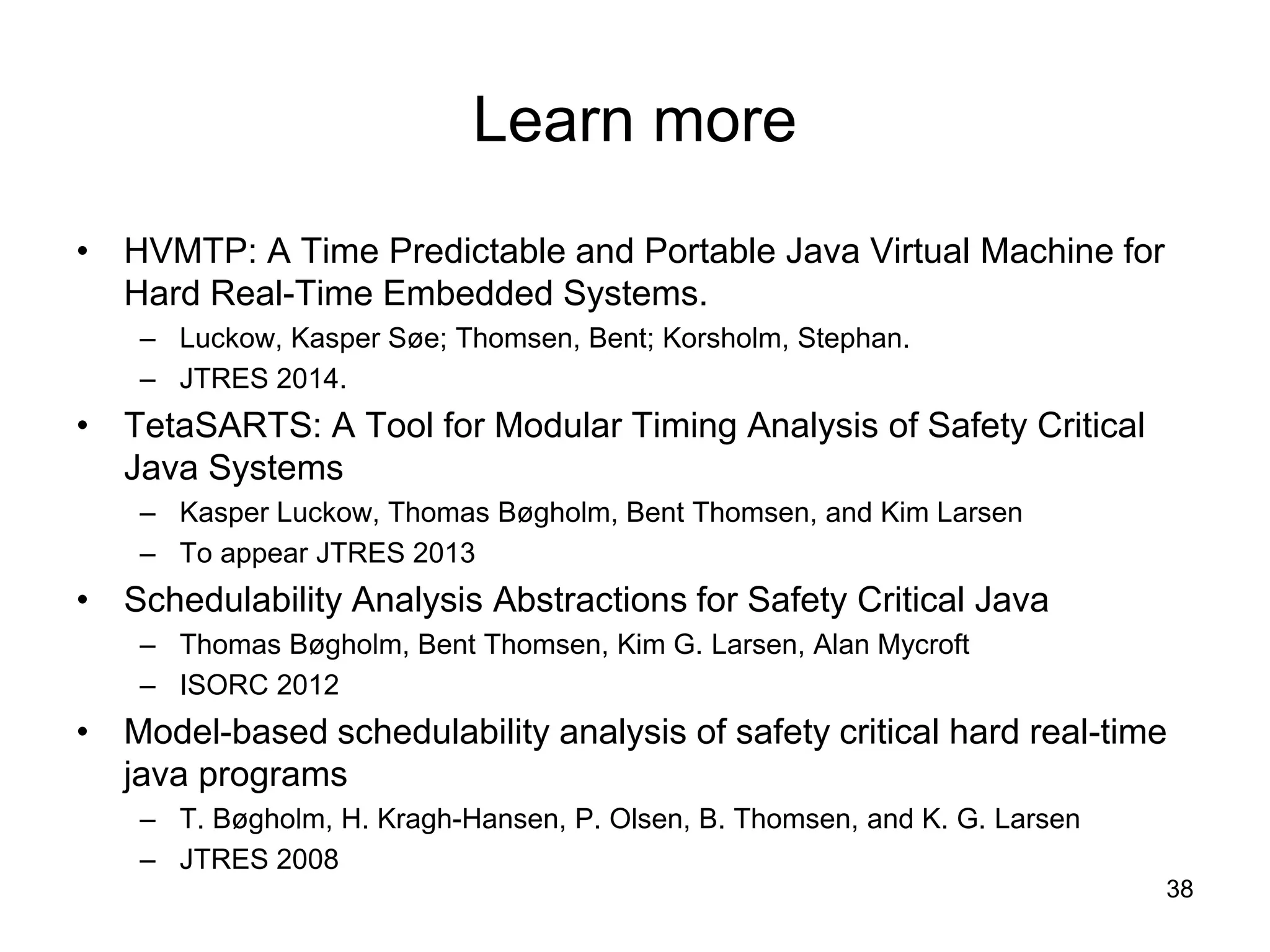
Learn more
• From Safety Critical Java Programs to Timed Process Models.
– Thomsen, Bent; Luckow, Kasper Søe; Thomsen, Lone Leth; Bøgholm, Thomas.
– Programming Languages with Applications to Biology and Security: Essays Dedicated to Pierpaolo
Degano on the Occasion of His 65th Birthday. red. / Chiara Bodei; Gian-Luigi Ferrari ; Corrado
Priami. Springer, 2015. s. 319-338 (Lecture Notes in Computer Science; Nr. 9465).
• Safety Critical Java for Robotics Programming.
– Thomsen, Bent; Luckow, Kasper Søe; Bøgholm, Thomas; Thomsen, Lone Leth; Korsholm,
Stephan.
– Proceedings of The 3rd AAU Workshop on Robotics. Aalborg Universitetsforlag, 2015.
• Symbolic execution and timed automata model checking for timing analysis of Java real-
time systems.
– Luckow, Kasper Søe; Păsăreanu, Corina; Thomsen, Bent.
– Eurasip Journal on Embedded Systems, Vol. 2015/2, 09.2015.
37
Learn more
• HVMTP: A Time Predictable and Portable Java Virtual Machine for
Hard Real-Time Embedded Systems.
– Luckow, Kasper Søe; Thomsen, Bent; Korsholm, Stephan.
– JTRES 2014.
• TetaSARTS: A Tool for Modular Timing Analysis of Safety Critical
Java Systems
– Kasper Luckow, Thomas Bøgholm, Bent Thomsen, and Kim Larsen
– To appear JTRES 2013
• Schedulability Analysis Abstractions for Safety Critical Java
– Thomas Bøgholm, Bent Thomsen, Kim G. Larsen, Alan Mycroft
– ISORC 2012
• Model-based schedulability analysis of safety critical hard real-time
java programs
– T. Bøgholm, H. Kragh-Hansen, P. Olsen, B. Thomsen, and K. G. Larsen
– JTRES 2008
38
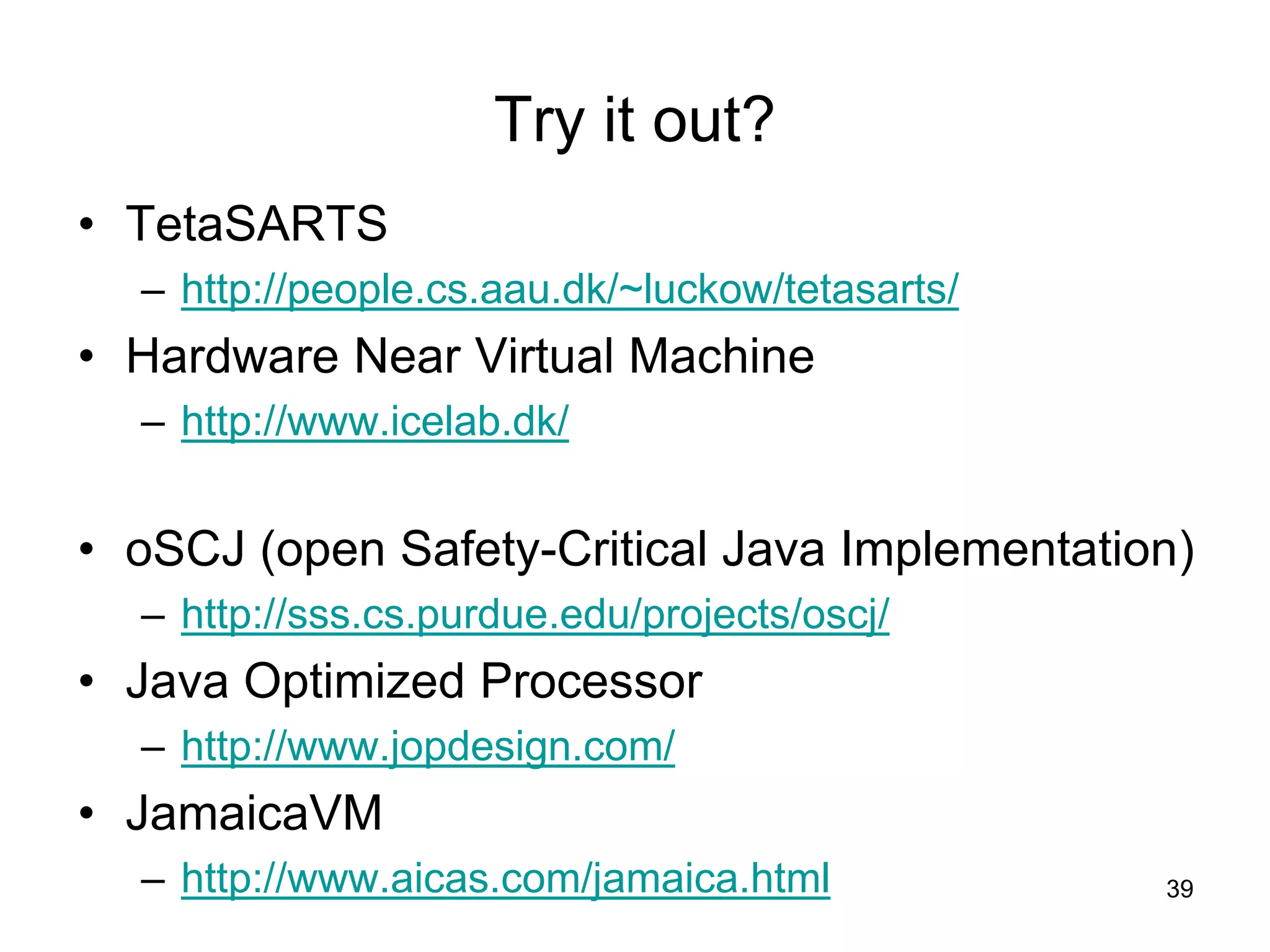
Try it out?
• TetaSARTS
– http://people.cs.aau.dk/~luckow/tetasarts/
• Hardware Near Virtual Machine
– http://www.icelab.dk/
• oSCJ (open Safety-Critical Java Implementation)
– http://sss.cs.purdue.edu/projects/oscj/
• Java Optimized Processor
– http://www.jopdesign.com/
• JamaicaVM
– http://www.aicas.com/jamaica.html 39
40
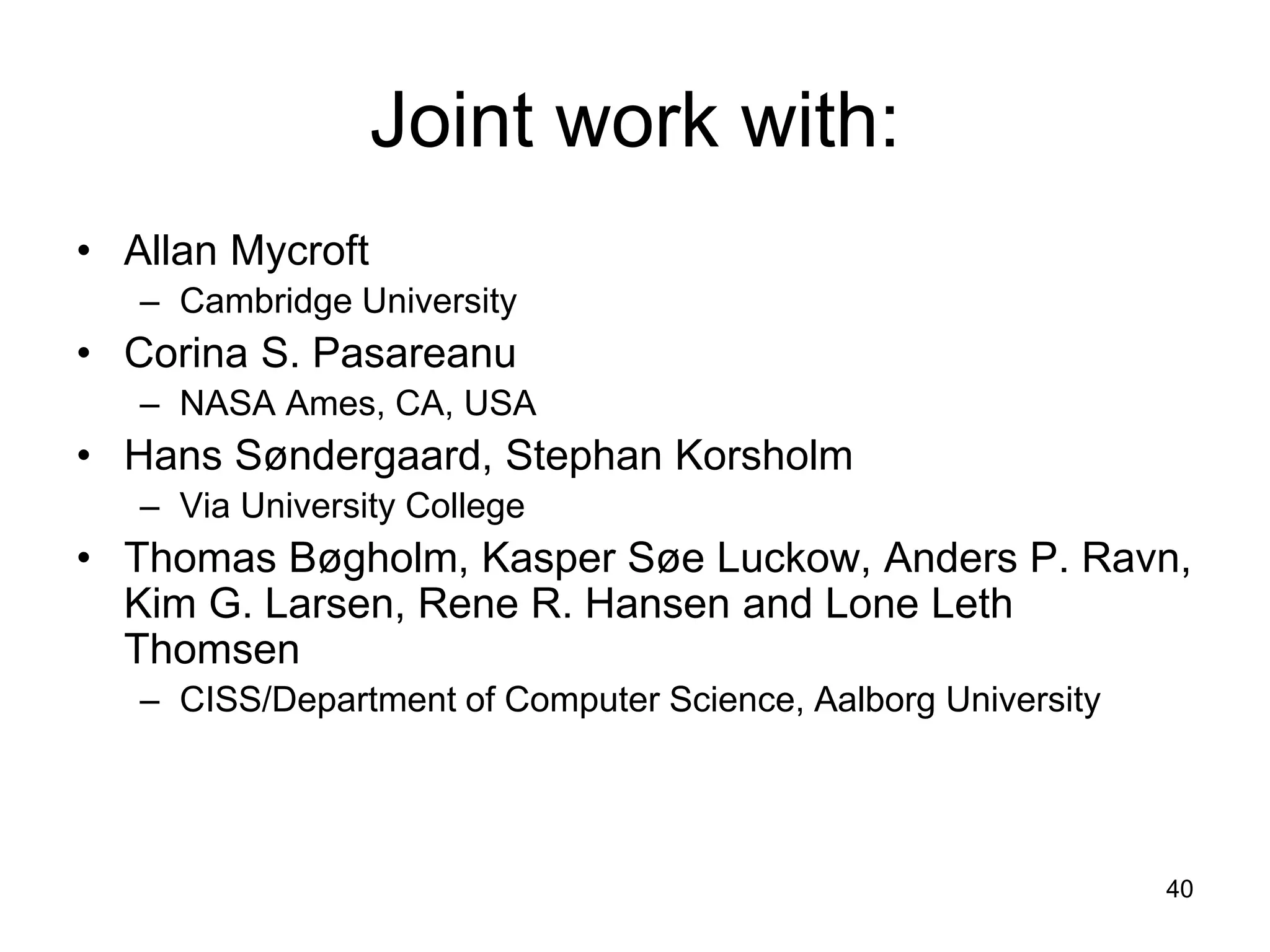
Joint work with:
• Allan Mycroft
– Cambridge University
• Corina S. Pasareanu
– NASA Ames, CA, USA
• Hans Søndergaard, Stephan Korsholm
– Via University College
• Thomas Bøgholm, Kasper Søe Luckow, Anders P. Ravn,
Kim G. Larsen, Rene R. Hansen and Lone Leth
Thomsen
– CISS/Department of Computer Science, Aalborg University
Thank You
41

Værktøjer udviklet på AAU til analyse af SCJ programmer

  • 1.
    Safety Critical Java forembedded systems Bent Thomsen CISS/Dept. Computing InfinIT Embedded Systems Engineering interst group meeting 30.3.2016
  • 2.
    A typical safetycritical embedded hard-real-time control program Cruise control: Loop every X microseconds Read the sensors; Compute speed; if speed too high Compute pressure for brake pedal; if speed too low Compute pressure for accelerator; Transmit the outputs to actuators; wait for next period; How hard can it be to program such systems?
  • 3.
    Apparently hard enough •Toyota's Accelerator Problem Probably Caused by Embedded Software Bugs • Software Bug Causes Toyota Recall of Almost Half a Million New Hybrid Cars • BMW recall: The company will replace defective high- pressure fuel pump and update software in 150,000 vehicles. • Not to mention The Arianne 5 or Airbus A330
  • 4.
  • 5.
    Embedded Control Systems •Over 90% of all microprocessors are used for real- time and embedded systems – Market growing 10% year on year • Usually programmed in C or Assembler – Hard, error prone, work – But preferred choice • Close to hardware • No real alternatives – Difficult to find new skilled programmers • Jackson Structured Development (1975) still widely used • EE Times calling for re-introducing C programming at US Uni Well … ADA – 10th on the list of most wanted skills
  • 6.
    Model Driven Development •Develop Model of System • Verify desirable properties • Generate Code from Model • But .. – Many find developing models harder than programming – Often some parts have to be programmed anyhow – Model and code have tendency to drift apart
  • 7.
    We need tolook for other languages • The number of embedded systems is growing • More functionality in each system is required • More reliable systems are needed • Time to market is getting shorter • Increase productivity – Software engineering practices (OOA&D) – 10% – Tools (IDEs, analyzers and verifiers) – 10% – New Languages -700% • 200%-300% in embedded systems programming (Atego)
  • 8.
    Java • Most popularprogramming language ever ! – In 2005 Sun estimated 4.5 million Java programmers – In 2010 Oracle estimated 9 million Java programmers – 61% of all programmers are Java programmers • Originally designed for setop-boxes • But propelled to popularity by the internet – Write once, Run everywhere http://jaxenter.com/how-many-java-developers-are-there-10462.html
  • 9.
  • 10.
    Advantage of Javaover C/C++ • Clean syntax and (relative) clean semantics • No preprocessor • Wide range of tool support • Single dispatch style OOP • Strong, extendible type system • Better support for separating subtyping and reuse via interfaces and single inheritance • No explicit pointer manipulation • Pointer safe deallocation • Built-in Concurrency model • Portability via JVM (write once, run anywhere)
  • 11.
    What is theproblem with Java? • Unpredictable performance – Memory • Garbage collected heap – Control and data flow • Dynamic class loading • Recursion • Unbounded loops • Dynamic dispatch • Exceptions – Scheduling – Lack high resolution time • JVM – Good for portability – bad for predictability
  • 12.
    Real-Time Specification forJava (RTSJ) • Java Community Standard (JSR 1, JSR 282) – Started in 1998 • January 2002 – RTSJ 1.0 Accepted by JSP • Spring 2005 – RTSJ 1.0.1 released • Summer 2006 – RTSJ 1.0.2 initiated • March 2009 Early draft of RTSJ version 1.1 now called JSR 282. • March 2015 Early draft version 2 • New Thread model: NoHeapRealtimeThread – Never interrupted by Garbage Collector – Threads may not access Heap Objects – Extends Java’s 10 priority levels to 28
  • 13.
    13 RTSJ Overview • Cleardefinition of scheduler • Priority inheritance protocol • NoHeapRealtimeThread • BoundAsyncEventHandler • Scoped memory to avoid GC • Low-level access through raw memory • High resolution time and timer • Originally targeted at larger systems – implementation from Sun requires a dual UltraSparc III or higher with 512 MB memory and the Solaris 10 operating system – Now support by commercial embedded JVMs
  • 14.
    14 RTSJ Guiding Principles •Backward compatibility to standard Java • No Syntactic extension • Reflected current real-time practice anno 1998 • Allow implementation flexibility • Rather complex and very dynamic • Write Once, Run Anywhere – But execution time is platform dependent • Does not address certification of Safety Critical applications • Most common for real-time Java applications – Especially on Wall Street
  • 15.
    15 Observation There is essentiallyonly one way to get a more predictable language: • namely to select a set of features which makes it controllable. • Which implies that a set of features can be deselected as well
  • 16.
    Safety-Critical Java (SCJ) •Java Specification Request 302 • Aims for DO-178C/ED-12C (IEC 61508/ISO 26262) • Restricted subset of RTSJ • Three Compliance Points (Levels 0, 1, 2) – Level 0 provides a cyclic executive (single thread), no wait/notify – Level 1 provides a single mission with multiple schedulable objects, – Level 2 provides nested missions with (limited) nested scopes • More analysis friendly – Especially Worst Case Execution Time Analysis – Write once, Run where ever possible
  • 17.
    SCJ • Only RealtimeThreadsare allowed • Notions of missions and handlers • No heap objects/ no GC • Restricted use of scopes
  • 18.
    Predicatble JVM • JOP –Java Optimized Processor – JVM in Hardware (FPGA) • HVM – targeted at devices with 256 KB flash and 20KB of RAM – Interpreted or AOT compilering – 1st level interupt handlers in Java – Runs on ATmega2560, CR16C, ARM7, ARM9 and x86 • JamaicaVM – Industrial strength real-time JVM from Aicas – Enroute for Certification for use in Airplanes and Cars – JamaicaCAR has over 5 million units shipped
  • 19.
    Java look-and-feel forlow-end embedded devices Support incremental move from C to Java 19 The HVM Java-to-C compiler with an embedded interpreter
  • 20.
    20 Features - Java-to-C compilerwith an embedded interpreter - Execution on the bare metal - Run in 256 KB ROM and 20 KB RAM - First level interrupt handling & Hardware Objects - Hybrid execution style (interpretation + AOT) - Program specialization * Classes & methods * Interpreter - Native variable support - Portability * No external dependencies * Strict ANSI-C * Support incremental move from C to Java - Process switching & scoped memory - Support for multi-core
  • 21.
    The Predictable Real-timeHVM • Time predictable implementations of Interpreter loop and each bytecode
  • 22.
    Trinity of tools,platform and programming model
  • 23.
    What about TimeAnalysis? • Traditional approaches to analysis of RT systems are hard and conservative • Very difficult to use with Java because of JVM (and Object Orientedness) 41 Utilisation-Based Analysis • A simple sufficient but not necessary schedulability test exists )12( /1 1   N N i i i N T C U  NU as69.0 Where C is WCET and T is period 42 Response Time Equation j ihpj j i ii C T R CR          )( Where hp(i) is the set of tasks with priority higher than task i Solve by forming a recurrence relationship: j ihpj j n i i n i C T w Cw           )( 1 The set of values is monotonically non decreasing When the solution to the equation has been found, must not be greater that (e.g. 0 or ) 1  n i n i ww ,..,...,,, 210 n iiii wwww 0 i w iR iC
  • 24.
    Model based Analysis •Translate timing analysis problems into analysis of properties of timed Automatas – TIMES • Model based schedulability tool based on UPPAAL – WCA • WCET analysis for JOP – SARTS • Schedulability on JOP – TetaJ • WCET analysis for SW JVM on Commodity HW – TetaSARTS • Schedulability analysis for SW JVM on Commodity HW and JOP – SymRT • Combines Symbolic executioon and modelbased timing analysis 24
  • 25.
    TetaJ • WCET analysistool – taking Java portability into account • Analysis at method level • Can be used interactively • Takes VM into account • Takes HW into account 25
  • 26.
  • 27.
  • 28.
  • 29.
    Minepump example Write once– run whereever possible 29
  • 30.
  • 31.
  • 32.
    Compositional Verification • TetaSARTSgenerates model for whole program • Library routines analysed again and again • Models based on control flow can be complicated – SymRT models are smaller due to symbolic execution • Idea: Annotate interfaces with abstract description of behaviour – Time and Resource Specification Language (TRSL) – Could have been any of a range of spec. lang. • UML/Marte, ACSR, TADL 32
  • 33.
    Note – couldhave used [ 1..8 ; using(r)[2] ; 1 ] since [ 1 ; 7? ; using(r)[2] ; 1 ] ≤ [ 1 ..8 ; using(r)[2] ; 1 ]
  • 34.
    Further Analysis andtools • Scope compliance analysis for SCJ • SCJ compliance analyzer • Eclipse plug-in • Lot’s of work on (analyzable) Real-time GC
  • 35.
    Future Work • Hierarchicalschedulability (mixed mode) – Mixed Java and C systems • Analyse non-SCJ programs – Java 8, Groovy, Scala – TetaSARTS/SymRT can analyze invoke virtual bytecode used for implementing lambdas • Loadable Safelets and cloud verification • Verifiable tool chain – Formalized translation from JBC to TA – Recent formal and mechanized specification of Java – Use of CompCert C compiler
  • 36.
  • 37.
    Learn more • FromSafety Critical Java Programs to Timed Process Models. – Thomsen, Bent; Luckow, Kasper Søe; Thomsen, Lone Leth; Bøgholm, Thomas. – Programming Languages with Applications to Biology and Security: Essays Dedicated to Pierpaolo Degano on the Occasion of His 65th Birthday. red. / Chiara Bodei; Gian-Luigi Ferrari ; Corrado Priami. Springer, 2015. s. 319-338 (Lecture Notes in Computer Science; Nr. 9465). • Safety Critical Java for Robotics Programming. – Thomsen, Bent; Luckow, Kasper Søe; Bøgholm, Thomas; Thomsen, Lone Leth; Korsholm, Stephan. – Proceedings of The 3rd AAU Workshop on Robotics. Aalborg Universitetsforlag, 2015. • Symbolic execution and timed automata model checking for timing analysis of Java real- time systems. – Luckow, Kasper Søe; Păsăreanu, Corina; Thomsen, Bent. – Eurasip Journal on Embedded Systems, Vol. 2015/2, 09.2015. 37
  • 38.
    Learn more • HVMTP:A Time Predictable and Portable Java Virtual Machine for Hard Real-Time Embedded Systems. – Luckow, Kasper Søe; Thomsen, Bent; Korsholm, Stephan. – JTRES 2014. • TetaSARTS: A Tool for Modular Timing Analysis of Safety Critical Java Systems – Kasper Luckow, Thomas Bøgholm, Bent Thomsen, and Kim Larsen – To appear JTRES 2013 • Schedulability Analysis Abstractions for Safety Critical Java – Thomas Bøgholm, Bent Thomsen, Kim G. Larsen, Alan Mycroft – ISORC 2012 • Model-based schedulability analysis of safety critical hard real-time java programs – T. Bøgholm, H. Kragh-Hansen, P. Olsen, B. Thomsen, and K. G. Larsen – JTRES 2008 38
  • 39.
    Try it out? •TetaSARTS – http://people.cs.aau.dk/~luckow/tetasarts/ • Hardware Near Virtual Machine – http://www.icelab.dk/ • oSCJ (open Safety-Critical Java Implementation) – http://sss.cs.purdue.edu/projects/oscj/ • Java Optimized Processor – http://www.jopdesign.com/ • JamaicaVM – http://www.aicas.com/jamaica.html 39
  • 40.
    40 Joint work with: •Allan Mycroft – Cambridge University • Corina S. Pasareanu – NASA Ames, CA, USA • Hans Søndergaard, Stephan Korsholm – Via University College • Thomas Bøgholm, Kasper Søe Luckow, Anders P. Ravn, Kim G. Larsen, Rene R. Hansen and Lone Leth Thomsen – CISS/Department of Computer Science, Aalborg University
  • 41.