.lusoftware verification & validation
VVS
Test Case Prioritization for Acceptance
Testing of Cyber Physical Systems:
A Multi-objective Search-based Approach
Seung Yeob Shin1, Shiva Nejati1, Mehrdad Sabetzadeh1,
Lionel C. Briand1, and Frank Zimmer2
1 SnT Centre / University of Luxembourg
2 SES Networks
ISSTA 2018
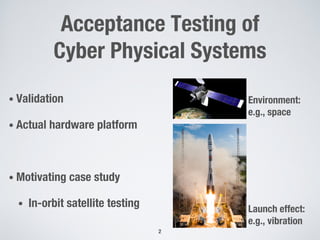
Acceptance Testing of
Cyber Physical Systems
• Validation
• Actual hardware platform
• Motivating case study
• In-orbit satellite testing
2
Launch effect:
e.g., vibration
Environment:
e.g., space
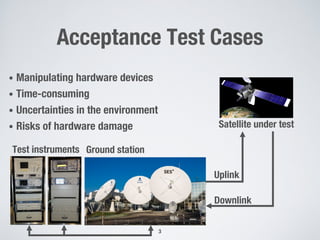
Acceptance Test Cases
• Manipulating hardware devices
• Time-consuming
• Uncertainties in the environment
• Risks of hardware damage
3
Test instruments Ground station
Satellite under test
Uplink
Downlink
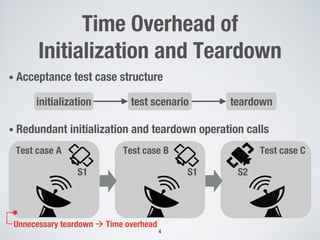
Time Overhead of
Initialization and Teardown
• Acceptance test case structure
• Redundant initialization and teardown operation calls
4
initialization test scenario teardown
Test case A Test case B Test case C
Unnecessary teardown à Time overhead
S1 S1 S2
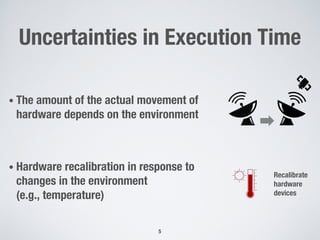
Uncertainties in Execution Time
• The amount of the actual movement of
hardware depends on the environment
• Hardware recalibration in response to
changes in the environment
(e.g., temperature)
5
Recalibrate
hardware
devices
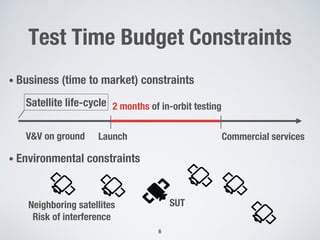
Test Time Budget Constraints
• Business (time to market) constraints
• Environmental constraints
6
Satellite life-cycle
V&V on ground Commercial services
2 months of in-orbit testing
SUTNeighboring satellites
Risk of interference
Launch
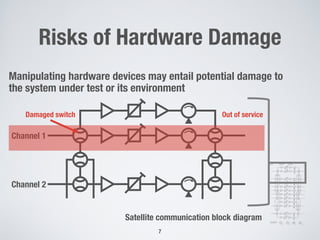
Risks of Hardware Damage
Manipulating hardware devices may entail potential damage to
the system under test or its environment
7
Satellite communication block diagram
Channel 1
Channel 2
Damaged switch Out of service
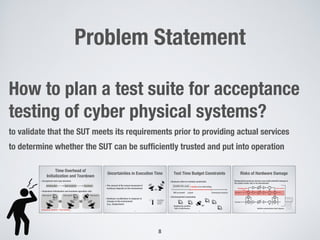
Problem Statement
How to plan a test suite for acceptance
testing of cyber physical systems?
to validate that the SUT meets its requirements prior to providing actual services
to determine whether the SUT can be sufficiently trusted and put into operation
8
Time Overhead of
Initialization and Teardown
• Acceptance test case structure
• Redundant initialization and teardown operation calls
4
initialization test scenario teardown
Test case A Test case B Test case C
Unnecessary teardown à Time overhead
Sat. 1 Sat. 1 Sat. 2
Uncertainties in Execution Time
• The amount of the actual movement of
hardware depends on the environment
• Hardware recalibration in response to
changes in the environment
(e.g., temperature)
5
Recalibrate
hardware
devices
Test Time Budget Constraints
• Business (time to market) constraints
• Environmental constraints
6
Satellite life-cycle
V&V on ground Commercial services
2 months of in-orbit testing
SUTNeighboring satellites
Risk of interference
Launch
Risks of Hardware Damage
Manipulating hardware devices may entail potential damage to
the system under test or its environment
7
Satellite communication block diagram
Channel 1
Channel 2
Damaged switch Out of service
A multi-objective approach for
minimizing and prioritizing
acceptance test cases in
cyber physical systems
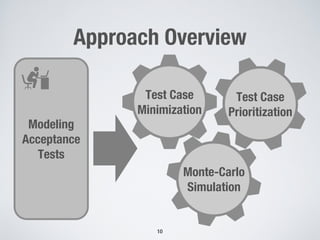
Approach Overview
10
Test Case
Minimization
Modeling
Acceptance
Tests
Test Case
Prioritization
Monte-Carlo
Simulation
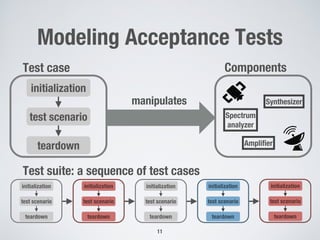
Modeling Acceptance Tests
11
initialization
test scenario
teardown
Test case Components
manipulates
Test suite: a sequence of test cases
initialization
test scenario
teardown
initialization
test scenario
teardown
Synthesizer
Spectrum
analyzer
Amplifier
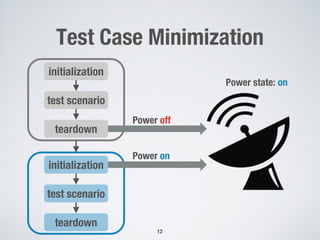
Test Case Minimization
12
initialization
test scenario
teardown
initialization
test scenario
teardown
Power off
Power on
Power state: on
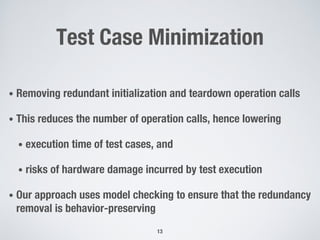
Test Case Minimization
• Removing redundant initialization and teardown operation calls
• This reduces the number of operation calls, hence lowering
• execution time of test cases, and
• risks of hardware damage incurred by test execution
• Our approach uses model checking to ensure that the redundancy
removal is behavior-preserving
13
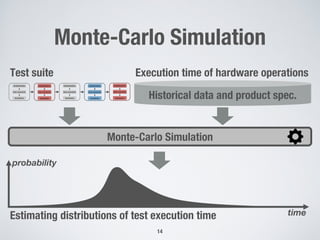
Monte-Carlo Simulation
14
Historical data and product spec.
Execution time of hardware operations
Monte-Carlo Simulation
Test suite
Estimating distributions of test execution time
initialization
test scenario
teardown
initialization
test scenario
teardown
time
probability
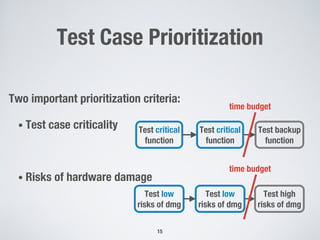
Two important prioritization criteria:
• Test case criticality
• Risks of hardware damage
Test Case Prioritization
15
Test critical
function
Test low
risks of dmg
Test backup
function
Test critical
function
Test high
risks of dmg
Test low
risks of dmg
time budget
time budget
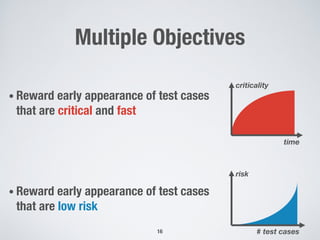
Multiple Objectives
• Reward early appearance of test cases
that are critical and fast
• Reward early appearance of test cases
that are low risk
16
time
criticality
# test cases
risk
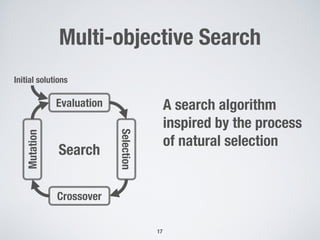
Multi-objective Search
17
Search
Evaluation
Crossover
Selection
Mutation
Initial solutions
A search algorithm
inspired by the process
of natural selection
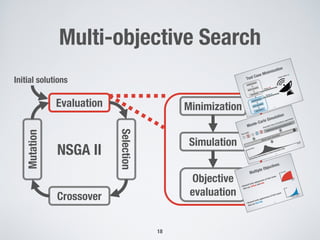
Minimization
Multi-objective Search
18
NSGA II
Evaluation
Crossover
Selection
Mutation
Initial solutions
Simulation
Objective
evaluation
Test Case Minimization
12
initialization
test scenario
teardown
initialization
test scenario
teardown
Power off
Power on
Power state: on
Multiple Objectives
• Reward early appearance of test cases
that are critical and fast
• Reward early appearance of test cases
that are low risk 18
time
criticality
# test cases
risk
Monte-Carlo Simulation
14
Historical data and product spec.
Execution time of hardware operations
Monte-Carlo SimulationTest suite
Estimating distributions of test execution time
initialization
test scenario
teardown
initialization
test scenario
teardown
time
probability
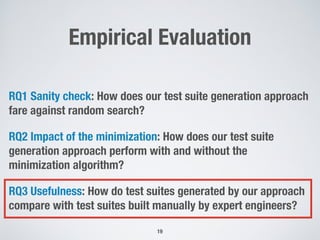
Empirical Evaluation
RQ1 Sanity check: How does our test suite generation approach
fare against random search?
RQ2 Impact of the minimization: How does our test suite
generation approach perform with and without the
minimization algorithm?
RQ3 Usefulness: How do test suites generated by our approach
compare with test suites built manually by expert engineers?
19
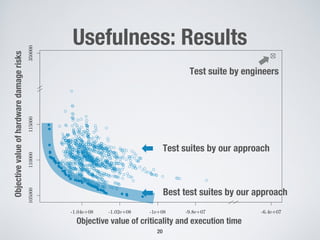
Usefulness: Results
20
Objective value of criticality and execution time
Objectivevalueofhardwaredamagerisks
-1.04e+08 -1.02e+08 -1e+08 -9.8e+07 -6.4e+07
105000110000115000350000
Test suite by engineers
Test suites by our approach
Best test suites by our approach
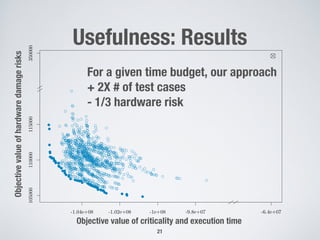
Usefulness: Results
21
Objective value of criticality and execution time
Objectivevalueofhardwaredamagerisks
-1.04e+08 -1.02e+08 -1e+08 -9.8e+07 -6.4e+07
105000110000115000350000
For a given time budget, our approach
+ 2X # of test cases
- 1/3 hardware risk
Conclusions
• Test suite optimization for acceptance testing of cyber physical systems
• Modeling acceptance tests
• Test case prioritization
• Test case minimization
• Monte-Carlo simulation
• Industrial case study
• In-orbit satellite testing
22
Usefulness: Results
23
Objective value of criticality and execution time
Objectivevalueofhardwaredamagerisks
-1.04e+08 -1.02e+08 -1e+08 -9.8e+07 -6.4e+07
105000110000115000350000
For a given time budget, our approach
+ 2X # of test cases
- 1/3 hardware risk
Modeling Acceptance Tests
11
initialization
test scenario
teardown
Test case Components
manipulates
Test suite: a sequence of test cases
initialization
test scenario
teardown
initialization
test scenario
teardown
Synthesizer
Examples
Spectrum
analyzer
Amplifier
Acceptance Testing of
Cyber Physical Systems
• Validation
• Actual hardware platform
• Motivating case study
• In-orbit satellite testing
2
Launch effect:
e.g., vibration
Environment:
e.g., space
Minimization
Multi-objective Search
18
NSGA II
Evaluation
Crossover
Selection
Mutation
Initial solutions
Simulation
Objective
evaluation
Test Case Minimization
12
initialization
test scenario
teardown
initialization
test scenario
teardown
Power off
Power on
Power state: on
Multiple Objectives
• Reward early appearance of test cases
that are critical and fast
• Reward early appearance of test cases
that are low risk 18
time
criti
cality
# test
cases
risk
Backup
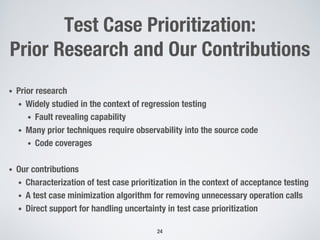
Test Case Prioritization:
Prior Research and Our Contributions
• Prior research
• Widely studied in the context of regression testing
• Fault revealing capability
• Many prior techniques require observability into the source code
• Code coverages
• Our contributions
• Characterization of test case prioritization in the context of acceptance testing
• A test case minimization algorithm for removing unnecessary operation calls
• Direct support for handling uncertainty in test case prioritization
24

Test Case Prioritization for Acceptance Testing of Cyber Physical Systems

  • 1.
    .lusoftware verification &validation VVS Test Case Prioritization for Acceptance Testing of Cyber Physical Systems: A Multi-objective Search-based Approach Seung Yeob Shin1, Shiva Nejati1, Mehrdad Sabetzadeh1, Lionel C. Briand1, and Frank Zimmer2 1 SnT Centre / University of Luxembourg 2 SES Networks ISSTA 2018
  • 2.
    Acceptance Testing of CyberPhysical Systems • Validation • Actual hardware platform • Motivating case study • In-orbit satellite testing 2 Launch effect: e.g., vibration Environment: e.g., space
  • 3.
    Acceptance Test Cases •Manipulating hardware devices • Time-consuming • Uncertainties in the environment • Risks of hardware damage 3 Test instruments Ground station Satellite under test Uplink Downlink
  • 4.
    Time Overhead of Initializationand Teardown • Acceptance test case structure • Redundant initialization and teardown operation calls 4 initialization test scenario teardown Test case A Test case B Test case C Unnecessary teardown à Time overhead S1 S1 S2
  • 5.
    Uncertainties in ExecutionTime • The amount of the actual movement of hardware depends on the environment • Hardware recalibration in response to changes in the environment (e.g., temperature) 5 Recalibrate hardware devices
  • 6.
    Test Time BudgetConstraints • Business (time to market) constraints • Environmental constraints 6 Satellite life-cycle V&V on ground Commercial services 2 months of in-orbit testing SUTNeighboring satellites Risk of interference Launch
  • 7.
    Risks of HardwareDamage Manipulating hardware devices may entail potential damage to the system under test or its environment 7 Satellite communication block diagram Channel 1 Channel 2 Damaged switch Out of service
  • 8.
    Problem Statement How toplan a test suite for acceptance testing of cyber physical systems? to validate that the SUT meets its requirements prior to providing actual services to determine whether the SUT can be sufficiently trusted and put into operation 8 Time Overhead of Initialization and Teardown • Acceptance test case structure • Redundant initialization and teardown operation calls 4 initialization test scenario teardown Test case A Test case B Test case C Unnecessary teardown à Time overhead Sat. 1 Sat. 1 Sat. 2 Uncertainties in Execution Time • The amount of the actual movement of hardware depends on the environment • Hardware recalibration in response to changes in the environment (e.g., temperature) 5 Recalibrate hardware devices Test Time Budget Constraints • Business (time to market) constraints • Environmental constraints 6 Satellite life-cycle V&V on ground Commercial services 2 months of in-orbit testing SUTNeighboring satellites Risk of interference Launch Risks of Hardware Damage Manipulating hardware devices may entail potential damage to the system under test or its environment 7 Satellite communication block diagram Channel 1 Channel 2 Damaged switch Out of service
  • 9.
    A multi-objective approachfor minimizing and prioritizing acceptance test cases in cyber physical systems
  • 10.
  • 11.
    Modeling Acceptance Tests 11 initialization testscenario teardown Test case Components manipulates Test suite: a sequence of test cases initialization test scenario teardown initialization test scenario teardown Synthesizer Spectrum analyzer Amplifier
  • 12.
    Test Case Minimization 12 initialization testscenario teardown initialization test scenario teardown Power off Power on Power state: on
  • 13.
    Test Case Minimization •Removing redundant initialization and teardown operation calls • This reduces the number of operation calls, hence lowering • execution time of test cases, and • risks of hardware damage incurred by test execution • Our approach uses model checking to ensure that the redundancy removal is behavior-preserving 13
  • 14.
    Monte-Carlo Simulation 14 Historical dataand product spec. Execution time of hardware operations Monte-Carlo Simulation Test suite Estimating distributions of test execution time initialization test scenario teardown initialization test scenario teardown time probability
  • 15.
    Two important prioritizationcriteria: • Test case criticality • Risks of hardware damage Test Case Prioritization 15 Test critical function Test low risks of dmg Test backup function Test critical function Test high risks of dmg Test low risks of dmg time budget time budget
  • 16.
    Multiple Objectives • Rewardearly appearance of test cases that are critical and fast • Reward early appearance of test cases that are low risk 16 time criticality # test cases risk
  • 17.
    Multi-objective Search 17 Search Evaluation Crossover Selection Mutation Initial solutions Asearch algorithm inspired by the process of natural selection
  • 18.
    Minimization Multi-objective Search 18 NSGA II Evaluation Crossover Selection Mutation Initialsolutions Simulation Objective evaluation Test Case Minimization 12 initialization test scenario teardown initialization test scenario teardown Power off Power on Power state: on Multiple Objectives • Reward early appearance of test cases that are critical and fast • Reward early appearance of test cases that are low risk 18 time criticality # test cases risk Monte-Carlo Simulation 14 Historical data and product spec. Execution time of hardware operations Monte-Carlo SimulationTest suite Estimating distributions of test execution time initialization test scenario teardown initialization test scenario teardown time probability
  • 19.
    Empirical Evaluation RQ1 Sanitycheck: How does our test suite generation approach fare against random search? RQ2 Impact of the minimization: How does our test suite generation approach perform with and without the minimization algorithm? RQ3 Usefulness: How do test suites generated by our approach compare with test suites built manually by expert engineers? 19
  • 20.
    Usefulness: Results 20 Objective valueof criticality and execution time Objectivevalueofhardwaredamagerisks -1.04e+08 -1.02e+08 -1e+08 -9.8e+07 -6.4e+07 105000110000115000350000 Test suite by engineers Test suites by our approach Best test suites by our approach
  • 21.
    Usefulness: Results 21 Objective valueof criticality and execution time Objectivevalueofhardwaredamagerisks -1.04e+08 -1.02e+08 -1e+08 -9.8e+07 -6.4e+07 105000110000115000350000 For a given time budget, our approach + 2X # of test cases - 1/3 hardware risk
  • 22.
    Conclusions • Test suiteoptimization for acceptance testing of cyber physical systems • Modeling acceptance tests • Test case prioritization • Test case minimization • Monte-Carlo simulation • Industrial case study • In-orbit satellite testing 22 Usefulness: Results 23 Objective value of criticality and execution time Objectivevalueofhardwaredamagerisks -1.04e+08 -1.02e+08 -1e+08 -9.8e+07 -6.4e+07 105000110000115000350000 For a given time budget, our approach + 2X # of test cases - 1/3 hardware risk Modeling Acceptance Tests 11 initialization test scenario teardown Test case Components manipulates Test suite: a sequence of test cases initialization test scenario teardown initialization test scenario teardown Synthesizer Examples Spectrum analyzer Amplifier Acceptance Testing of Cyber Physical Systems • Validation • Actual hardware platform • Motivating case study • In-orbit satellite testing 2 Launch effect: e.g., vibration Environment: e.g., space Minimization Multi-objective Search 18 NSGA II Evaluation Crossover Selection Mutation Initial solutions Simulation Objective evaluation Test Case Minimization 12 initialization test scenario teardown initialization test scenario teardown Power off Power on Power state: on Multiple Objectives • Reward early appearance of test cases that are critical and fast • Reward early appearance of test cases that are low risk 18 time criti cality # test cases risk
  • 23.
  • 24.
    Test Case Prioritization: PriorResearch and Our Contributions • Prior research • Widely studied in the context of regression testing • Fault revealing capability • Many prior techniques require observability into the source code • Code coverages • Our contributions • Characterization of test case prioritization in the context of acceptance testing • A test case minimization algorithm for removing unnecessary operation calls • Direct support for handling uncertainty in test case prioritization 24