SSL/TLS
~ARPIT
TABLE OF CONTENTS:
WHAT IS SSL/TLS
WHY IS IT USED
Encryption Methods
Basic idea of how SSL/TLS works
SSL/TLS HANDSHAKE
POODLE ATTACK
References
WHAT IS SSL/TLS
Transport Layer Security (TLS) – and its predecessor,
Secure Sockets Layer (SSL), which is now deprecated
by the Internet Engineering Task Force – are
cryptographic protocols that provide communications
security over a computer network. Several versions of
the protocols find widespread use in applications such
as web browsing, email, instant messaging, and voice
over IP (VoIP). Websites are able to use TLS to secure
all communications between their servers and web
browsers.
WHY IS IT USED ?
SSL/TLS is basically the secure connection that is put
up over http traffic. HTTP traffic if sniffed contain the
data in plain text. This can lead Eavesdroppers to
easily access all the login information and other
confidential information. Apart from that, there is an
integrity issue on the data as the man in the middle
attack can easily be performed. This is where the idea
to encrypt the data over network came into picture.
ENCRYPTION
METHODS
* SYMMETRIC-KEY ENCRYPTION
Symmetric-key algorithms[1] are algorithms for
cryptography that use the same cryptographic keys for
both encryption of plaintext and decryption of
ciphertext. The keys may be identical or there may be
a simple transformation to go between the two keys.
EG : DES(Data Encryption Standard), AES(Advanced
Encryption Standard), Triple DES
* ASYMMETRIC-KEY ENCRYPTION
Asymmetric cryptography, also known as public key
cryptography, uses public and private keys to encrypt
and decrypt data. The keys are simply large numbers
that have been paired together but are not identical
(asymmetric). One key in the pair can be shared with
everyone; it is called the public key.
EG : DSA, RSA, PGP, Elliptic curve techniques, PKCS
BASIC IDEA OF HOW SSL/TLS
WORKS
The basic idea of using a secure layer is to use an
establish the connection using asymmetric
encryption.
Then the client's browser would send the symmetric
key to the server using this secure layer.
This can be achieved by encrypting the symmetric
cipher with the server's public key. Now only the
server will be able to decrypt this with their private
key.
Since private key is not known to anyone except the
server, so no one else is able to decrypt the
symmetric key.
Now once both the server and the client has the
symmetric key(and no one else has it), they switch
to symmetric key encryption in order to further
make requests.
TLS HANDSHAKE
1) Client Hello
2) Server Hello
3) Client Key Exchange
4) Completing the Key Exchange
5) Change cipher spec
6) Server Change CipherSpec, and Server Finished
7) Application Data
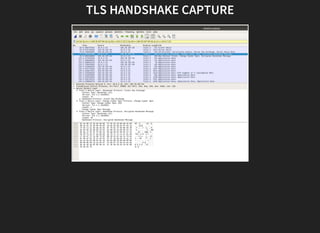
TLS HANDSHAKE CAPTURE
1) CLIENT HELLO
Whenever a client wants to communicate to the
server, it first establishes the TCP connection (by
performing TCP handshake). Once that is done, the
client sends the "Client Hello" request over the TLS
protocol. It means that the client is requesting the
server to communicate over secure layer.
Along with the request, the client send the "Cipher
Suites", that it can support, random numbers and
the session id.
Cipher Suite are set of various cryptographic
algorithms. This is sent in the highest to lowest
order of preference. And the server selects the
highest one which it can support. There has to be a
common agreement between both of them,
otherwise SSL handshake cannot occur.
The random numbers also called nonce are later
used to generate symmetric encryption keys on
both sides.
Session id is mentioned when the client wants to
resume a previous session, otherwise null. SSL/TLS
handshake consumes a lot of resource both in client
side as well as server side. So, it makes well use of
the handshake by pausing and resuming the same
connection whenever needed.
UNDERSTANDING THE CIPHER SUITES
key exchange algorithm - dictates the manner by
which symmetric keys will be exchanged;
authentication algorithm - dictates how server
authentication and (if needed) client authentication
will be carried out.
bulk encryption algorithm - dictates which
symmetric key algorithm will be used to encrypt the
actual data; and
Message Authentication Code (MAC) - dictates the
method the connection will use to carry out data
integrity checks.
Some key exchange algorithms: RSA, DH, ECDH,
ECDHE;
Some authentication algorithms: RSA, DSA, ECDSA;
Some bulk encryption algorithms: AES, 3DES,
CAMELLIA;
Some MAC algorithms: SHA, MD5
TLS_ECDHE_ECDSA_WITH_AES_256_CB
C_SHA384
Let's break that down.
TLS simply indicates the protocol;
ECDHE signifies the key exchange algorithm;
ECDSA signifies the authentication algorithm;
AES_256_CBC indicates the bulk encryption
algorithm; and
SHA384 indicates the MAC algorithm.
DHE_RSA_AES256_SHA
Again, breaking that down, we have:
DHE - the key exchange algorithm;
RSA - the authentication algorithm;
AES256 - the bulk encryption algorithm; and
SHA - the MAC algorithm
2) SERVER HELLO
The first is "Server Hello" message, that means the
server is ready to use the SSL/TLS connection. Along
with that, it sends the Cipher Suite that it wants to
communicate in, and some random numbers also.
There are other parameters as well depending upon
the Cipher Suite that has been chosen.
SERVER HELLO
Then the server send the certificate chain to the
client. Each certificate comes with information
about domains it supports, who it was issued by,
and the time period of its validity.
These certificates are issued by the Certificate
Authorities. They put up a digital signature (using
their private key). These certificates are by then
default trusted by the browser. (certificates
basically ensure that the server we are
communicating with is the genuine one, so I can
trust the public key provided to the browser by the
server).
SERVER CERTIFICATE
Next is the Certificate Status : Clients can consult
OSCP (Online Certificate Status Protocol) server to
check whether the server certificate has been
revoked. The OSCP server returns with the status
code whether it is valid or not.
Server Key Exchange : In this message, server
mentions the curve that it is going to use to
generate the public key. With knowledge of the
curve to be used, both the server and client will
know the crucial p and G values for ECDHE. The
server will choose a random private key 'a' and
compute [G^a mod p] as its public key and send this
is send to the client.
Server Hello Done : This simply mentions that the
client can further communicate with the server.
3) CLIENT KEY EXCHANGE
Now, the client must send its own ephemeral public
key (for DH). This is calculated by generating a random
private key 'b' and from there calculating [G^b mod p]
as its public key.
By doing this, both server and client can calculate a
common value [g^ab mod p]. Since a and b are
unknown to the attacker, thus this common value is
very difficult to calculate the pre-master secret key.
This becomes the pre-master key, which may be used
as session encryption keys.
CLIENT KEY EXCHANGE
4) COMPLETING THE KEY
EXCHANGE
CONVERTING THE PRE-MASTER SECRET INTO
MASTER KEY.
The master key is of a fixed length of 48 bytes. We
make use of PRF (Pseudo Random Functions) which
basically given an input will produce an output
computationally indistinguishable from a truly
random sequence.
Master key is computed as
ClientHello.random and ServerHello.random are the
values that were sent during the client hello and
server hello respectively.
master_secret = PRF(pre_master_secret, "master secret",
ClientHello.random + ServerHello.random) [0..47];
5) CHANGE CIPHER SPEC
The client change the cipher spec that was being used.
This message is the indication to the server that the
cipher that was being used is about to change. After
this is sent, all the messages are encrypted. The next
message from the client is the client handshake finish.
This contains the hash of a all the handshakes that has
taken place with the server. This is done in order to
ensure that there wasn't any tampering in the packets.
6) SERVER CHANGECIPHERSPEC,
AND SERVER FINISHED
On getting the client handshake finish, the server will
send its own handshake finish and verify the contents
of the handshake.
7) APPLICATION DATA
First, we generate a MAC(Message Authentication
Code), key, and IV (Initialization Vector) for both the
client and the server using our master secret and the
PRF definition from earlier.
Now the key data represents the following :
key_data = PRF(master_secret, "key expansion", server_random + client_random)
client_write_MAC_key = key_data[0..31]
server_write_MAC_key = key_data[32..63]
client_write_key = key_data[64..79]
server_write_key = key_data[80..95]
client_write_IV = key_data[96..99]
server_write_IV = key_data[100..103]
The MAC keys are for authentication and integrity. The
write keys are for the symmetric encryption. One key
per side (client and server) is maintained. This
segregates the keys. We also construct
additional_data and an 8-byte nonce, both of which
are sent with the encrypted data.
Finally, we can encrypt our data with AES GCM!
additional_data = sequence_num + record_type + tls_version + length
nonce = <random_8_bytes>
encrypted = AES_GCM(client_write_key, client_write_IV+nonce, <DATA>, additional_data)
And the server can read it with,
<DATA> = AES_GCM(client_write_key, client_write_IV+nonce, encrypted, additional_data)
POODLE ATTACK
This is one of the most famous vulnerability found in
the SSL/TLS connection that takes advantage of
Padding Oracle Attacks. POODLE stands for Padding
Oracle on Downgraded Legacy Encryption.
There are various cipher suites among which, many
are very weak, and have some common known
vulnerabilites. Suppose the best cipher suite that the
client can communicate is C. So it sends out that
cipher suite.
But the attacker in the middle poses as client, and
sends out cipher suite C', which maybe the worst
possible cipher suite. Server having no other option,
replies with the same cipher suite, and thus client and
server starts communicating in that cipher suite. They
specifically downgrade the suite to SSL 3.0, which has
got a vulnerability call padding oracle attack. With
this, the attacker will be able to sniff traffic very easily.
The simple patch to this is to completely stop using
SSL 3.0 and switch to TLS There are other mitigations
as well. Like there cannot be a sudden switch from
best to worst cipher in the available cipher suites.
They can only be downgraded one by one to match
the best cipher suite available.
More about padding oracle attack :
https://www.youtube.com/watch?v=BbwC8f_aBMQ
REFERENCES:
https://www.cryptologie.net/article/340/tls-pre-
master-secrets-and-master-secrets/
https://tlseminar.github.io/first-few-milliseconds/
http://www.moserware.com/2009/06/first-few-
milliseconds-of-https.html
http://blog.catchpoint.com/2017/05/12/dissecting-tls-
using-wireshark/ https://www.youtube.com/watch?
v=Rp3iZUvXWlM&t=922s
https://medium.facilelogin.com/nuts-and-bolts-of-
transport-layer-security-tls-2c5af298c4be

SSL/TLS Handshake

  • 2.
  • 3.
    TABLE OF CONTENTS: WHATIS SSL/TLS WHY IS IT USED Encryption Methods Basic idea of how SSL/TLS works SSL/TLS HANDSHAKE POODLE ATTACK References
  • 4.
    WHAT IS SSL/TLS TransportLayer Security (TLS) – and its predecessor, Secure Sockets Layer (SSL), which is now deprecated by the Internet Engineering Task Force – are cryptographic protocols that provide communications security over a computer network. Several versions of the protocols find widespread use in applications such as web browsing, email, instant messaging, and voice over IP (VoIP). Websites are able to use TLS to secure all communications between their servers and web browsers.
  • 5.
    WHY IS ITUSED ? SSL/TLS is basically the secure connection that is put up over http traffic. HTTP traffic if sniffed contain the data in plain text. This can lead Eavesdroppers to easily access all the login information and other confidential information. Apart from that, there is an integrity issue on the data as the man in the middle attack can easily be performed. This is where the idea to encrypt the data over network came into picture.
  • 6.
  • 7.
    * SYMMETRIC-KEY ENCRYPTION Symmetric-keyalgorithms[1] are algorithms for cryptography that use the same cryptographic keys for both encryption of plaintext and decryption of ciphertext. The keys may be identical or there may be a simple transformation to go between the two keys. EG : DES(Data Encryption Standard), AES(Advanced Encryption Standard), Triple DES
  • 8.
    * ASYMMETRIC-KEY ENCRYPTION Asymmetriccryptography, also known as public key cryptography, uses public and private keys to encrypt and decrypt data. The keys are simply large numbers that have been paired together but are not identical (asymmetric). One key in the pair can be shared with everyone; it is called the public key. EG : DSA, RSA, PGP, Elliptic curve techniques, PKCS
  • 9.
    BASIC IDEA OFHOW SSL/TLS WORKS The basic idea of using a secure layer is to use an establish the connection using asymmetric encryption. Then the client's browser would send the symmetric key to the server using this secure layer. This can be achieved by encrypting the symmetric cipher with the server's public key. Now only the server will be able to decrypt this with their private key.
  • 10.
    Since private keyis not known to anyone except the server, so no one else is able to decrypt the symmetric key. Now once both the server and the client has the symmetric key(and no one else has it), they switch to symmetric key encryption in order to further make requests.
  • 11.
    TLS HANDSHAKE 1) ClientHello 2) Server Hello 3) Client Key Exchange 4) Completing the Key Exchange 5) Change cipher spec 6) Server Change CipherSpec, and Server Finished 7) Application Data
  • 12.
  • 13.
    1) CLIENT HELLO Whenevera client wants to communicate to the server, it first establishes the TCP connection (by performing TCP handshake). Once that is done, the client sends the "Client Hello" request over the TLS protocol. It means that the client is requesting the server to communicate over secure layer. Along with the request, the client send the "Cipher Suites", that it can support, random numbers and the session id.
  • 14.
    Cipher Suite areset of various cryptographic algorithms. This is sent in the highest to lowest order of preference. And the server selects the highest one which it can support. There has to be a common agreement between both of them, otherwise SSL handshake cannot occur. The random numbers also called nonce are later used to generate symmetric encryption keys on both sides.
  • 15.
    Session id ismentioned when the client wants to resume a previous session, otherwise null. SSL/TLS handshake consumes a lot of resource both in client side as well as server side. So, it makes well use of the handshake by pausing and resuming the same connection whenever needed.
  • 17.
    UNDERSTANDING THE CIPHERSUITES key exchange algorithm - dictates the manner by which symmetric keys will be exchanged; authentication algorithm - dictates how server authentication and (if needed) client authentication will be carried out. bulk encryption algorithm - dictates which symmetric key algorithm will be used to encrypt the actual data; and Message Authentication Code (MAC) - dictates the method the connection will use to carry out data integrity checks.
  • 18.
    Some key exchangealgorithms: RSA, DH, ECDH, ECDHE; Some authentication algorithms: RSA, DSA, ECDSA; Some bulk encryption algorithms: AES, 3DES, CAMELLIA; Some MAC algorithms: SHA, MD5
  • 19.
    TLS_ECDHE_ECDSA_WITH_AES_256_CB C_SHA384 Let's break thatdown. TLS simply indicates the protocol; ECDHE signifies the key exchange algorithm; ECDSA signifies the authentication algorithm; AES_256_CBC indicates the bulk encryption algorithm; and SHA384 indicates the MAC algorithm.
  • 20.
    DHE_RSA_AES256_SHA Again, breaking thatdown, we have: DHE - the key exchange algorithm; RSA - the authentication algorithm; AES256 - the bulk encryption algorithm; and SHA - the MAC algorithm
  • 21.
    2) SERVER HELLO Thefirst is "Server Hello" message, that means the server is ready to use the SSL/TLS connection. Along with that, it sends the Cipher Suite that it wants to communicate in, and some random numbers also. There are other parameters as well depending upon the Cipher Suite that has been chosen.
  • 22.
  • 23.
    Then the serversend the certificate chain to the client. Each certificate comes with information about domains it supports, who it was issued by, and the time period of its validity. These certificates are issued by the Certificate Authorities. They put up a digital signature (using their private key). These certificates are by then default trusted by the browser. (certificates basically ensure that the server we are communicating with is the genuine one, so I can trust the public key provided to the browser by the server).
  • 24.
  • 25.
    Next is theCertificate Status : Clients can consult OSCP (Online Certificate Status Protocol) server to check whether the server certificate has been revoked. The OSCP server returns with the status code whether it is valid or not.
  • 26.
    Server Key Exchange: In this message, server mentions the curve that it is going to use to generate the public key. With knowledge of the curve to be used, both the server and client will know the crucial p and G values for ECDHE. The server will choose a random private key 'a' and compute [G^a mod p] as its public key and send this is send to the client. Server Hello Done : This simply mentions that the client can further communicate with the server.
  • 28.
    3) CLIENT KEYEXCHANGE Now, the client must send its own ephemeral public key (for DH). This is calculated by generating a random private key 'b' and from there calculating [G^b mod p] as its public key. By doing this, both server and client can calculate a common value [g^ab mod p]. Since a and b are unknown to the attacker, thus this common value is very difficult to calculate the pre-master secret key. This becomes the pre-master key, which may be used as session encryption keys.
  • 29.
  • 30.
    4) COMPLETING THEKEY EXCHANGE
  • 31.
    CONVERTING THE PRE-MASTERSECRET INTO MASTER KEY. The master key is of a fixed length of 48 bytes. We make use of PRF (Pseudo Random Functions) which basically given an input will produce an output computationally indistinguishable from a truly random sequence. Master key is computed as ClientHello.random and ServerHello.random are the values that were sent during the client hello and server hello respectively. master_secret = PRF(pre_master_secret, "master secret", ClientHello.random + ServerHello.random) [0..47];
  • 32.
    5) CHANGE CIPHERSPEC The client change the cipher spec that was being used. This message is the indication to the server that the cipher that was being used is about to change. After this is sent, all the messages are encrypted. The next message from the client is the client handshake finish. This contains the hash of a all the handshakes that has taken place with the server. This is done in order to ensure that there wasn't any tampering in the packets.
  • 33.
    6) SERVER CHANGECIPHERSPEC, ANDSERVER FINISHED On getting the client handshake finish, the server will send its own handshake finish and verify the contents of the handshake.
  • 35.
    7) APPLICATION DATA First,we generate a MAC(Message Authentication Code), key, and IV (Initialization Vector) for both the client and the server using our master secret and the PRF definition from earlier. Now the key data represents the following : key_data = PRF(master_secret, "key expansion", server_random + client_random) client_write_MAC_key = key_data[0..31] server_write_MAC_key = key_data[32..63] client_write_key = key_data[64..79] server_write_key = key_data[80..95] client_write_IV = key_data[96..99] server_write_IV = key_data[100..103]
  • 36.
    The MAC keysare for authentication and integrity. The write keys are for the symmetric encryption. One key per side (client and server) is maintained. This segregates the keys. We also construct additional_data and an 8-byte nonce, both of which are sent with the encrypted data. Finally, we can encrypt our data with AES GCM! additional_data = sequence_num + record_type + tls_version + length nonce = <random_8_bytes> encrypted = AES_GCM(client_write_key, client_write_IV+nonce, <DATA>, additional_data)
  • 37.
    And the servercan read it with, <DATA> = AES_GCM(client_write_key, client_write_IV+nonce, encrypted, additional_data)
  • 38.
    POODLE ATTACK This isone of the most famous vulnerability found in the SSL/TLS connection that takes advantage of Padding Oracle Attacks. POODLE stands for Padding Oracle on Downgraded Legacy Encryption. There are various cipher suites among which, many are very weak, and have some common known vulnerabilites. Suppose the best cipher suite that the client can communicate is C. So it sends out that cipher suite.
  • 39.
    But the attackerin the middle poses as client, and sends out cipher suite C', which maybe the worst possible cipher suite. Server having no other option, replies with the same cipher suite, and thus client and server starts communicating in that cipher suite. They specifically downgrade the suite to SSL 3.0, which has got a vulnerability call padding oracle attack. With this, the attacker will be able to sniff traffic very easily.
  • 40.
    The simple patchto this is to completely stop using SSL 3.0 and switch to TLS There are other mitigations as well. Like there cannot be a sudden switch from best to worst cipher in the available cipher suites. They can only be downgraded one by one to match the best cipher suite available. More about padding oracle attack : https://www.youtube.com/watch?v=BbwC8f_aBMQ
  • 41.