SSL/TLS 101
23 December 2015
Chul-Woong Yang 양철웅
cwyang@aranetworks.com
Agenda
• SSL and TLS
• Protection against Eavesdroppers
• Secure Key Exchange
• Authentication
• X.509 Certificates
• Reference
SSL and TLS
• SSL and TLS are the name of protocol, which implements
cryptography
• SSL: Secure Socket Layer
• TLS: Transport Layer Security, a new name for SSL
• Internet depends on HTTP, HTTPS, HTTP/2
• HTTPS and HTTP/2 depends on SSL/TLS for secure
transmission
• So, Internet depends on SSL/TLS
OSI Model Layer
# OSI Layer Description Example protocols
7 Application Application data HTTP, SMTP, IMAP
6 Presentation Data representation, conversion, encryption SSL/TLS
5 Session Management of multiple connection -
4 Transport Reliable delivery of packets and streams TCP, UDP
3 Network Routing and delivery of datagrams between
network nodes
IP, IPSec
2 Data link Reliable local data connection (LAN) Ethernet
1 Physical Direct physical data connection (cables) CAT5
[BPST] p3
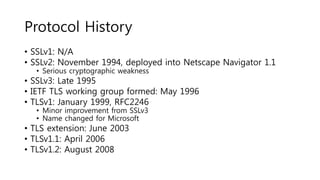
Protocol History
• SSLv1: N/A
• SSLv2: November 1994, deployed into Netscape Navigator 1.1
• Serious cryptographic weakness
• SSLv3: Late 1995
• IETF TLS working group formed: May 1996
• TLSv1: January 1999, RFC2246
• Minor improvement from SSLv3
• Name changed for Microsoft
• TLS extension: June 2003
• TLSv1.1: April 2006
• TLSv1.2: August 2008
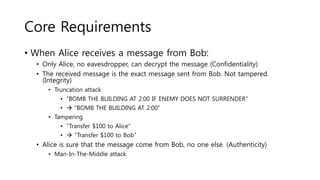
Core Requirements
• When Alice receives a message from Bob:
• Only Alice, no eavesdropper, can decrypt the message (Confidentiality)
• The received message is the exact message sent from Bob. Not tampered.
(Integrity)
• Truncation attack
• “BOMB THE BUILDING AT 2:00 IF ENEMY DOES NOT SURRENDER”
•  “BOMB THE BUILDING AT 2:00”
• Tampering
• “Transfer $100 to Alice”
•  “Transfer $100 to Bob”
• Alice is sure that the message come from Bob, no one else. (Authenticity)
• Man-In-The-Middle attack
Step 1: Protect Against Eavesdroppers
• Symmetric encryption (private/shared key)
• Algorithms are based on bit shifting and XORing
• Stream ciphers: RC4
• Block ciphers: DES, AES
• DES: Breaks input into 8-byte blocks and scrambles them in using 8-
byte keys (only 56 bit is used)
• weak
• 3DES: Use 56 * 3 = 168 bit key on 8 byte blocks
• Very slow in SW implementation
• AES: Defined for 128-, 192-, and 256-bit keys.
• Fast in SW/HW implementation
• RC4: Use 40 bits and 128 bits keys
• Straightforward to crack
Step 2: Secure Key Exchange
• Q)How can exchange a shared key over an insecure medium,
on which eavesdroppers can see the key?
• A) Public-key cryptography
• Public key can decrypt messages encrypted with private key
• Private key can decrypt messages encrypted with public key
• Algorithms are based on BIGNUM manipulation
• Most common algorithm: RSA
• Ron Rivest, Adi Shamir, and Leonard Adleman
RSA
• Three numbers: e, d, n
• (m^e)^d % n = m
• m = message
• d = private key
• (e, n) = public key
• d cannot be computed from (e, d) – computationally infeasible
• Break a message into blocks of length n or less and encrypt them
• Alice sends message m encrypted with Bob’s public key (e, n)
• C has sent to Bob. C = (m^e) % n
• Bob reclaims m = (C^d) % n
• Though Eve can eavesdrop C, she cannot decrypt C into m
without d.
RSA
• (m^e)^d % n = m
• Public key: (e=3, n=55) then
• d= 27
• n and d have to be enormous
• 512 (weak), 1024, 2048 bit number
• Should do numerical operation for 2048 bit number (617 decimal
digits)
• Very slow  practical use is only for key exchange, not for data encryption
Diffie-Hellman Key Exchange
• Eve has Bob’s private key somehow (compromised key)
• Alice send shared key encrypted with Bob’s public key
• Eve can eavesdrop the message and retrieve the shared key.
• Once Eve has the shared key of Alice and Bob, she can see all their
messages afterwards
• Diffie-Hellman key exchange: Perfect forward secrecy
• Public numbers (g, p) and ephemeral numbers a and b.
• g is usually 2
• a, b, p is large number (512, 1024, 2048 bit)
• Alice chooses a and sends Y(a) = (g^a % p)
• Bob chooses b and send Y(b) = (g^b % p)
• Alice computes Z = Y(b)^a % p = (g ^ ab % p)
• Bob computes Z = Y(a)^b % p = (g ^ ab % p)
• Z is shared key
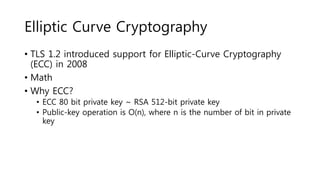
Elliptic Curve Cryptography
• TLS 1.2 introduced support for Elliptic-Curve Cryptography
(ECC) in 2008
• Math
• Why ECC?
• ECC 80 bit private key ~ RSA 512-bit private key
• Public-key operation is O(n), where n is the number of bit in private
key
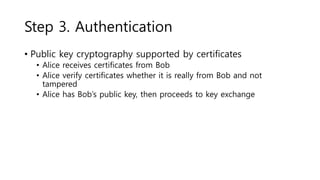
Step 3. Authentication
• Public key cryptography supported by certificates
• Alice receives certificates from Bob
• Alice verify certificates whether it is really from Bob and not
tampered
• Alice has Bob’s public key, then proceeds to key exchange
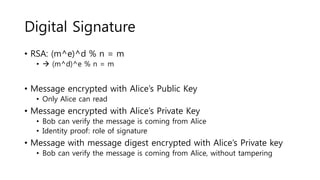
Digital Signature
• RSA: (m^e)^d % n = m
•  (m^d)^e % n = m
• Message encrypted with Alice’s Public Key
• Only Alice can read
• Message encrypted with Alice’s Private Key
• Bob can verify the message is coming from Alice
• Identity proof: role of signature
• Message with message digest encrypted with Alice’s Private key
• Bob can verify the message is coming from Alice, without tampering
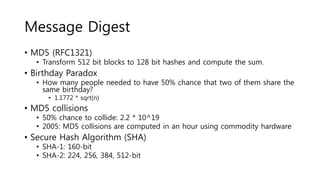
Message Digest
• MD5 (RFC1321)
• Transform 512 bit blocks to 128 bit hashes and compute the sum.
• Birthday Paradox
• How many people needed to have 50% chance that two of them share the
same birthday?
• 1.1772 * sqrt(n)
• MD5 collisions
• 50% chance to collide: 2.2 * 10^19
• 2005: MD5 collisions are computed in an hour using commodity hardware
• Secure Hash Algorithm (SHA)
• SHA-1: 160-bit
• SHA-2: 224, 256, 384, 512-bit
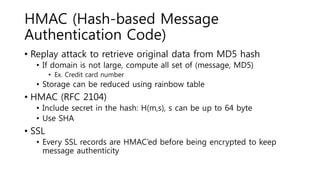
HMAC (Hash-based Message
Authentication Code)
• Replay attack to retrieve original data from MD5 hash
• If domain is not large, compute all set of (message, MD5)
• Ex. Credit card number
• Storage can be reduced using rainbow table
• HMAC (RFC 2104)
• Include secret in the hash: H(m,s), s can be up to 64 byte
• Use SHA
• SSL
• Every SSL records are HMAC’ed before being encrypted to keep
message authenticity
Digital Signature Algorithms (DSA)
• Federal Information Processing Standard (FIPS) for digital
signatures
• DSA vs RSA signature
• DSA is faster in signing, but much slower in verifying
• DSA generates smaller signature for same strength
• DSA requires 1024 bits key only to be compatible with standard
• ECDSA
• DSA with elliptic curve cryptography
• Smaller signature
Step 4. X.509 Certificates
• Alice receives a certificate from Bob
• How to verify the certificate is from Bob?
• SSL uses a “Trusted Intermediary”
• Trusted intermediary digitally signs Bob’s public key
• Alice must have access to the public key of the trusted intermediary to
verify the signature of Bob’s public key
• If Mallory does MITM and send to Alice her certificate, not Bob’s certificate?
• Other information, like Bob’s name, is included in addition to public key
• Certificate: a holder for public key and other information, which is
signed by trusted intermediary (CA)
• Certificate Authority: a trusted intermediary responsible for signing
certificates
Certificate Revocation
• When there is a problem with the certificate?
• Specified cryptography is outdated
•  Validity period
• The private key is compromised
•  Revocation
• CAs are responsible for keeping a list of revoked certificates
(CRL)
• The client should checks it periodically
• Key: serial ID
• Should be unique within a CA
X.509
• International
Telecommunication Union (ITU)
defines and maintains SSL/TLS
certificate format in a series of
documents
• X.509 : Information technology -
Open Systems Interconnection -
The Directory: Public-key and
attribute certificate frameworks
• RFC2459: Internet X.509 Public
Key Infrastructure Certificate
and CRL Profile
Certificate ::= SEQUENCE {
tbsCertificate TBSCertificate,
signatureAlgorithm AlgorithmIdentifier,
signatureValue BIT STRING }
TBSCertificate ::= SEQUENCE {
version [0] EXPLICIT Version DEFAULT v1,
serialNumber CertificateSerialNumber,
signature AlgorithmIdentifier,
issuer Name,
validity Validity,
subject Name,
subjectPublicKeyInfo SubjectPublicKeyInfo,
issuerUniqueID [1] IMPLICIT UniqueIdentifier OPTIONAL,
-- If present, version shall be v2 or v3
subjectUniqueID [2] IMPLICIT UniqueIdentifier OPTIONAL,
-- If present, version shall be v2 or v3
extensions [3] EXPLICIT Extensions OPTIONAL
-- If present, version shall be v3
}
Reference
• [BPST] Bulletproof SSL and TLS, Ivan Ristic, Feisty Duck
• [IST] Implementing SSL/TLS, Joshua Davies, Wiley

SSL/TLS 101

  • 1.
    SSL/TLS 101 23 December2015 Chul-Woong Yang 양철웅 cwyang@aranetworks.com
  • 2.
    Agenda • SSL andTLS • Protection against Eavesdroppers • Secure Key Exchange • Authentication • X.509 Certificates • Reference
  • 3.
    SSL and TLS •SSL and TLS are the name of protocol, which implements cryptography • SSL: Secure Socket Layer • TLS: Transport Layer Security, a new name for SSL • Internet depends on HTTP, HTTPS, HTTP/2 • HTTPS and HTTP/2 depends on SSL/TLS for secure transmission • So, Internet depends on SSL/TLS
  • 4.
    OSI Model Layer #OSI Layer Description Example protocols 7 Application Application data HTTP, SMTP, IMAP 6 Presentation Data representation, conversion, encryption SSL/TLS 5 Session Management of multiple connection - 4 Transport Reliable delivery of packets and streams TCP, UDP 3 Network Routing and delivery of datagrams between network nodes IP, IPSec 2 Data link Reliable local data connection (LAN) Ethernet 1 Physical Direct physical data connection (cables) CAT5 [BPST] p3
  • 5.
    Protocol History • SSLv1:N/A • SSLv2: November 1994, deployed into Netscape Navigator 1.1 • Serious cryptographic weakness • SSLv3: Late 1995 • IETF TLS working group formed: May 1996 • TLSv1: January 1999, RFC2246 • Minor improvement from SSLv3 • Name changed for Microsoft • TLS extension: June 2003 • TLSv1.1: April 2006 • TLSv1.2: August 2008
  • 6.
    Core Requirements • WhenAlice receives a message from Bob: • Only Alice, no eavesdropper, can decrypt the message (Confidentiality) • The received message is the exact message sent from Bob. Not tampered. (Integrity) • Truncation attack • “BOMB THE BUILDING AT 2:00 IF ENEMY DOES NOT SURRENDER” •  “BOMB THE BUILDING AT 2:00” • Tampering • “Transfer $100 to Alice” •  “Transfer $100 to Bob” • Alice is sure that the message come from Bob, no one else. (Authenticity) • Man-In-The-Middle attack
  • 7.
    Step 1: ProtectAgainst Eavesdroppers • Symmetric encryption (private/shared key) • Algorithms are based on bit shifting and XORing • Stream ciphers: RC4 • Block ciphers: DES, AES • DES: Breaks input into 8-byte blocks and scrambles them in using 8- byte keys (only 56 bit is used) • weak • 3DES: Use 56 * 3 = 168 bit key on 8 byte blocks • Very slow in SW implementation • AES: Defined for 128-, 192-, and 256-bit keys. • Fast in SW/HW implementation • RC4: Use 40 bits and 128 bits keys • Straightforward to crack
  • 8.
    Step 2: SecureKey Exchange • Q)How can exchange a shared key over an insecure medium, on which eavesdroppers can see the key? • A) Public-key cryptography • Public key can decrypt messages encrypted with private key • Private key can decrypt messages encrypted with public key • Algorithms are based on BIGNUM manipulation • Most common algorithm: RSA • Ron Rivest, Adi Shamir, and Leonard Adleman
  • 9.
    RSA • Three numbers:e, d, n • (m^e)^d % n = m • m = message • d = private key • (e, n) = public key • d cannot be computed from (e, d) – computationally infeasible • Break a message into blocks of length n or less and encrypt them • Alice sends message m encrypted with Bob’s public key (e, n) • C has sent to Bob. C = (m^e) % n • Bob reclaims m = (C^d) % n • Though Eve can eavesdrop C, she cannot decrypt C into m without d.
  • 10.
    RSA • (m^e)^d %n = m • Public key: (e=3, n=55) then • d= 27 • n and d have to be enormous • 512 (weak), 1024, 2048 bit number • Should do numerical operation for 2048 bit number (617 decimal digits) • Very slow  practical use is only for key exchange, not for data encryption
  • 11.
    Diffie-Hellman Key Exchange •Eve has Bob’s private key somehow (compromised key) • Alice send shared key encrypted with Bob’s public key • Eve can eavesdrop the message and retrieve the shared key. • Once Eve has the shared key of Alice and Bob, she can see all their messages afterwards • Diffie-Hellman key exchange: Perfect forward secrecy • Public numbers (g, p) and ephemeral numbers a and b. • g is usually 2 • a, b, p is large number (512, 1024, 2048 bit) • Alice chooses a and sends Y(a) = (g^a % p) • Bob chooses b and send Y(b) = (g^b % p) • Alice computes Z = Y(b)^a % p = (g ^ ab % p) • Bob computes Z = Y(a)^b % p = (g ^ ab % p) • Z is shared key
  • 12.
    Elliptic Curve Cryptography •TLS 1.2 introduced support for Elliptic-Curve Cryptography (ECC) in 2008 • Math • Why ECC? • ECC 80 bit private key ~ RSA 512-bit private key • Public-key operation is O(n), where n is the number of bit in private key
  • 13.
    Step 3. Authentication •Public key cryptography supported by certificates • Alice receives certificates from Bob • Alice verify certificates whether it is really from Bob and not tampered • Alice has Bob’s public key, then proceeds to key exchange
  • 14.
    Digital Signature • RSA:(m^e)^d % n = m •  (m^d)^e % n = m • Message encrypted with Alice’s Public Key • Only Alice can read • Message encrypted with Alice’s Private Key • Bob can verify the message is coming from Alice • Identity proof: role of signature • Message with message digest encrypted with Alice’s Private key • Bob can verify the message is coming from Alice, without tampering
  • 15.
    Message Digest • MD5(RFC1321) • Transform 512 bit blocks to 128 bit hashes and compute the sum. • Birthday Paradox • How many people needed to have 50% chance that two of them share the same birthday? • 1.1772 * sqrt(n) • MD5 collisions • 50% chance to collide: 2.2 * 10^19 • 2005: MD5 collisions are computed in an hour using commodity hardware • Secure Hash Algorithm (SHA) • SHA-1: 160-bit • SHA-2: 224, 256, 384, 512-bit
  • 16.
    HMAC (Hash-based Message AuthenticationCode) • Replay attack to retrieve original data from MD5 hash • If domain is not large, compute all set of (message, MD5) • Ex. Credit card number • Storage can be reduced using rainbow table • HMAC (RFC 2104) • Include secret in the hash: H(m,s), s can be up to 64 byte • Use SHA • SSL • Every SSL records are HMAC’ed before being encrypted to keep message authenticity
  • 17.
    Digital Signature Algorithms(DSA) • Federal Information Processing Standard (FIPS) for digital signatures • DSA vs RSA signature • DSA is faster in signing, but much slower in verifying • DSA generates smaller signature for same strength • DSA requires 1024 bits key only to be compatible with standard • ECDSA • DSA with elliptic curve cryptography • Smaller signature
  • 18.
    Step 4. X.509Certificates • Alice receives a certificate from Bob • How to verify the certificate is from Bob? • SSL uses a “Trusted Intermediary” • Trusted intermediary digitally signs Bob’s public key • Alice must have access to the public key of the trusted intermediary to verify the signature of Bob’s public key • If Mallory does MITM and send to Alice her certificate, not Bob’s certificate? • Other information, like Bob’s name, is included in addition to public key • Certificate: a holder for public key and other information, which is signed by trusted intermediary (CA) • Certificate Authority: a trusted intermediary responsible for signing certificates
  • 19.
    Certificate Revocation • Whenthere is a problem with the certificate? • Specified cryptography is outdated •  Validity period • The private key is compromised •  Revocation • CAs are responsible for keeping a list of revoked certificates (CRL) • The client should checks it periodically • Key: serial ID • Should be unique within a CA
  • 20.
    X.509 • International Telecommunication Union(ITU) defines and maintains SSL/TLS certificate format in a series of documents • X.509 : Information technology - Open Systems Interconnection - The Directory: Public-key and attribute certificate frameworks • RFC2459: Internet X.509 Public Key Infrastructure Certificate and CRL Profile Certificate ::= SEQUENCE { tbsCertificate TBSCertificate, signatureAlgorithm AlgorithmIdentifier, signatureValue BIT STRING } TBSCertificate ::= SEQUENCE { version [0] EXPLICIT Version DEFAULT v1, serialNumber CertificateSerialNumber, signature AlgorithmIdentifier, issuer Name, validity Validity, subject Name, subjectPublicKeyInfo SubjectPublicKeyInfo, issuerUniqueID [1] IMPLICIT UniqueIdentifier OPTIONAL, -- If present, version shall be v2 or v3 subjectUniqueID [2] IMPLICIT UniqueIdentifier OPTIONAL, -- If present, version shall be v2 or v3 extensions [3] EXPLICIT Extensions OPTIONAL -- If present, version shall be v3 }
  • 21.
    Reference • [BPST] BulletproofSSL and TLS, Ivan Ristic, Feisty Duck • [IST] Implementing SSL/TLS, Joshua Davies, Wiley