By: Felipe De la Garza
Titrations
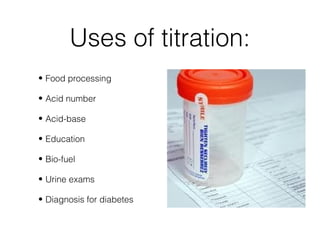
Uses of titration:
• Food processing
• Acid number
• Acid-base
• Education
• Bio-fuel
• Urine exams
• Diagnosis for diabetes
Av x Ac = Bv x Bc
Volume in the Erlenmeyer x Concentration (molarity)
in Erlenmeyer = Volume used up in Burette x
concentration of substance in Burette
Av x Ac = Bv x Bc
(Acid volume x acid concentration = base volume
x base concentration)
V1 x C1 = V2 x C2
Background knowledge
An acid-base titration is a neutralization reaction that is
performed in the lab in order to determine an unknown
concentration of acid or base. The moles of acid will equal
the moles of base at the equivalence point. Here's how to
perform the calculation to find your unknown.
For example, if you are titrating hydrochloric acid with
sodium hydroxide:
HCl + NaOH NaCl + H2O→
You can see from the equation there is a 1:1 molar ratio between HCl and
NaOH. If you know that titrating 50.00 ml of an HCl solution requires 25.00
ml of 1.00 M NaOH, you can calculate the concentration of hydrochloric
acid, [HCl]. Based on the molar ratio between HCl and NaOH you know
that at the equivalence point:
moles HCl = moles NaOH
MHCl x volumeHCl = MNaOH x volumeNaOH
MHCl = MNaOH x volumeNaOH / volumeHCl
MHCl = 25.00 ml x 1.00 M / 50.00 ml
MHCl = 0.50 M HCl
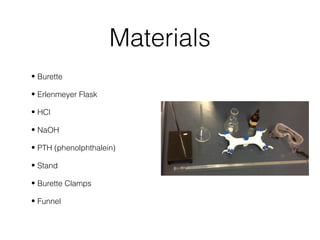
Materials
• Burette
• Erlenmeyer Flask
• HCl
• NaOH
• PTH (phenolphthalein)
• Stand
• Burette Clamps
• Funnel
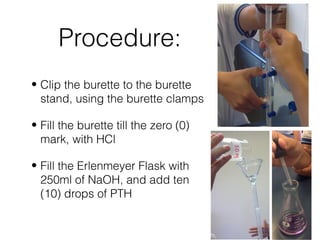
Procedure:
• Clip the burette to the burette
stand, using the burette clamps
• Fill the burette till the zero (0)
mark, with HCl
• Fill the Erlenmeyer Flask with
250ml of NaOH, and add ten
(10) drops of PTH
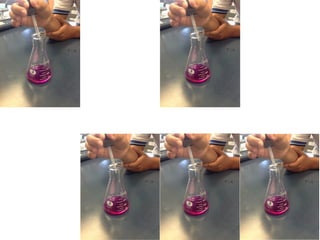
• Slowly, let the HCl from the
burette pour down into the
Erlenmeyer with the NaOH
• Stir constantly
• Drop by drop, wait until the
reaction turns transparent. 1
drop will change the
reaction.
• Stop the flow of the burette
V
I
D
E
O
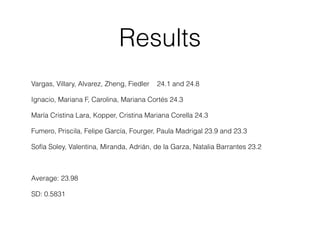
Results
Vargas, Villary, Alvarez, Zheng, Fiedler 24.1 and 24.8
Ignacio, Mariana F, Carolina, Mariana Cortés 24.3
María Cristina Lara, Kopper, Cristina Mariana Corella 24.3
Fumero, Priscila, Felipe García, Fourger, Paula Madrigal 23.9 and 23.3
Sofía Soley, Valentina, Miranda, Adrián, de la Garza, Natalia Barrantes 23.2
Average: 23.98
SD: 0.5831
Standard Deviation
How far where the results from the actual
answer? Standard deviation shows how much
variation exists from the average to the
expected value.
68% of the data collected fall one (1) SD from the mean
95% of the data collected fall two (2) SD from the mean
Av x Ac = Bv x Bc
23.98ml x 1.0m/L = 250ml x m/Lb
23.98/250 = Mb
0.09592 = Mb
Ratio:
HCl : NaOH
10.4253 : 1
Conclution:
The HCl is 10.4253 times stronger than NaOH
Titrations

Titrations

  • 1.
    By: Felipe Dela Garza Titrations
  • 2.
    Uses of titration: •Food processing • Acid number • Acid-base • Education • Bio-fuel • Urine exams • Diagnosis for diabetes
  • 3.
    Av x Ac= Bv x Bc Volume in the Erlenmeyer x Concentration (molarity) in Erlenmeyer = Volume used up in Burette x concentration of substance in Burette Av x Ac = Bv x Bc (Acid volume x acid concentration = base volume x base concentration) V1 x C1 = V2 x C2
  • 4.
    Background knowledge An acid-basetitration is a neutralization reaction that is performed in the lab in order to determine an unknown concentration of acid or base. The moles of acid will equal the moles of base at the equivalence point. Here's how to perform the calculation to find your unknown. For example, if you are titrating hydrochloric acid with sodium hydroxide: HCl + NaOH NaCl + H2O→
  • 5.
    You can seefrom the equation there is a 1:1 molar ratio between HCl and NaOH. If you know that titrating 50.00 ml of an HCl solution requires 25.00 ml of 1.00 M NaOH, you can calculate the concentration of hydrochloric acid, [HCl]. Based on the molar ratio between HCl and NaOH you know that at the equivalence point: moles HCl = moles NaOH MHCl x volumeHCl = MNaOH x volumeNaOH MHCl = MNaOH x volumeNaOH / volumeHCl MHCl = 25.00 ml x 1.00 M / 50.00 ml MHCl = 0.50 M HCl
  • 6.
    Materials • Burette • ErlenmeyerFlask • HCl • NaOH • PTH (phenolphthalein) • Stand • Burette Clamps • Funnel
  • 9.
    Procedure: • Clip theburette to the burette stand, using the burette clamps • Fill the burette till the zero (0) mark, with HCl • Fill the Erlenmeyer Flask with 250ml of NaOH, and add ten (10) drops of PTH
  • 10.
    • Slowly, letthe HCl from the burette pour down into the Erlenmeyer with the NaOH • Stir constantly • Drop by drop, wait until the reaction turns transparent. 1 drop will change the reaction. • Stop the flow of the burette
  • 19.
  • 20.
    Results Vargas, Villary, Alvarez,Zheng, Fiedler 24.1 and 24.8 Ignacio, Mariana F, Carolina, Mariana Cortés 24.3 María Cristina Lara, Kopper, Cristina Mariana Corella 24.3 Fumero, Priscila, Felipe García, Fourger, Paula Madrigal 23.9 and 23.3 Sofía Soley, Valentina, Miranda, Adrián, de la Garza, Natalia Barrantes 23.2 Average: 23.98 SD: 0.5831
  • 21.
    Standard Deviation How farwhere the results from the actual answer? Standard deviation shows how much variation exists from the average to the expected value.
  • 23.
    68% of thedata collected fall one (1) SD from the mean 95% of the data collected fall two (2) SD from the mean
  • 24.
    Av x Ac= Bv x Bc 23.98ml x 1.0m/L = 250ml x m/Lb 23.98/250 = Mb 0.09592 = Mb Ratio: HCl : NaOH 10.4253 : 1
  • 25.
    Conclution: The HCl is10.4253 times stronger than NaOH