Tissue engineering in heart and
valve failure management
Dr. Alexander Lyon
Senior Lecturer and Consultant Cardiologist
Royal Brompton Hospital and Imperial College, London
Declaration of interest
• Nothing to declare
Overview
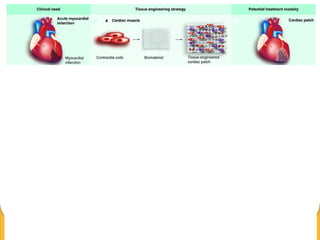
• Concepts for cardiovascular tissue engineering
• Making a cardiac patch
• Testing a cardiac patch in vivo
• Heart valve engineering
• Whole heart engineering
• Clinical perspective
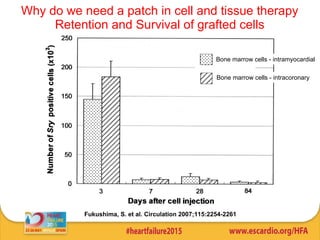
Fukushima, S. et al. Circulation 2007;115:2254-2261
Why do we need a patch in cell and tissue therapy
Retention and Survival of grafted cells
Bone marrow cells - intramyocardial
Bone marrow cells - intracoronary
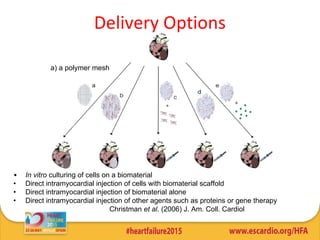
• In vitro culturing of cells on a biomaterial
• Direct intramyocardial injection of cells with biomaterial scaffold
• Direct intramyocardial injection of biomaterial alone
• Direct intramyocardial injection of other agents such as proteins or gene therapy
Christman et al. (2006) J. Am. Coll. Cardiol
Delivery Options
a) a polymer mesh
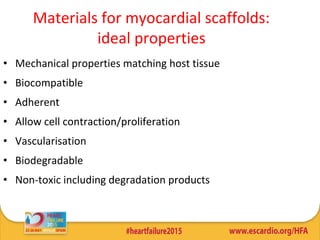
Materials for myocardial scaffolds:
ideal properties
• Mechanical properties matching host tissue
• Biocompatible
• Adherent
• Allow cell contraction/proliferation
• Vascularisation
• Biodegradable
• Non-toxic including degradation products
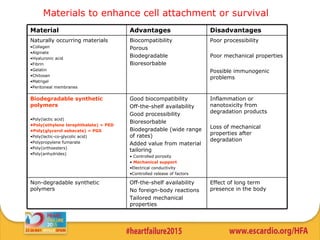
Materials to enhance cell attachment or survival
Material Advantages Disadvantages
Naturally occurring materials
•Collagen
•Alginate
•Hyaluronic acid
•Fibrin
•Gelatin
•Chitosan
•Matrigel
•Peritoneal membranes
Biocompatibility
Porous
Biodegradable
Bioresorbable
Poor processibility
Poor mechanical properties
Possible immunogenic
problems
Biodegradable synthetic
polymers
•Poly(lactic acid)
•Poly(ethylene terephthalate) = PED
•Poly(glycerol sebacate) = PGS
•Poly(lactic-co-glycolic acid)
•Polypropylene fumarate
•Poly(orthoesters)
•Poly(anhydrides)
Good biocompatibility
Off-the-shelf availability
Good processibility
Bioresorbable
Biodegradable (wide range
of rates)
Added value from material
tailoring
• Controlled porosity
• Mechanical support
•Electrical conductivity
•Controlled release of factors
Inflammation or
nanotoxicity from
degradation products
Loss of mechanical
properties after
degradation
Non-degradable synthetic
polymers
Off-the-shelf availability
No foreign-body reactions
Tailored mechanical
properties
Effect of long term
presence in the body
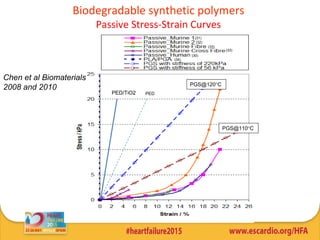
Biodegradable synthetic polymers
Passive Stress-Strain Curves
Chen et al Biomaterials
2008 and 2010
(31)
(34)
(30)
(33)
(33)
(32)
E = 0.056 MPa
E = 0.22 MPa
PED/TiO2
PGS@120C
PGS@110C
PED
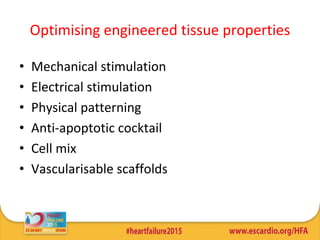
Optimising engineered tissue properties
• Mechanical stimulation
• Electrical stimulation
• Physical patterning
• Anti-apoptotic cocktail
• Cell mix
• Vascularisable scaffolds
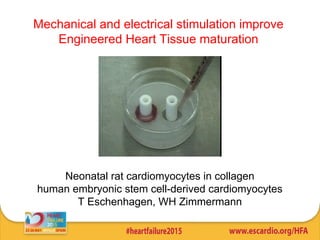
Mechanical and electrical stimulation improve
Engineered Heart Tissue maturation
Neonatal rat cardiomyocytes in collagen
human embryonic stem cell-derived cardiomyocytes
T Eschenhagen, WH Zimmermann
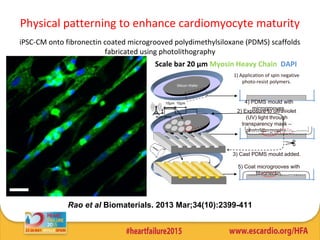
1) Application of spin negative
photo-resist polymers.
3) Cast PDMS mould added.
2) Exposure to ultraviolet
(UV) light through
transparency mask –
photolithography.
Silicon Wafer
Scale bar 20 µm Myosin Heavy Chain DAPI
10µm 4) PDMS mould with
microgrooves.
10µm
4µm deep
5) Coat microgrooves with
fibronectin.
Physical patterning to enhance cardiomyocyte maturity
iPSC-CM onto fibronectin coated microgrooved polydimethylsiloxane (PDMS) scaffolds
fabricated using photolithography
Rao et al Biomaterials. 2013 Mar;34(10):2399-411
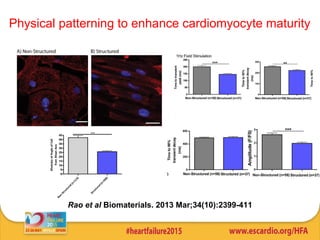
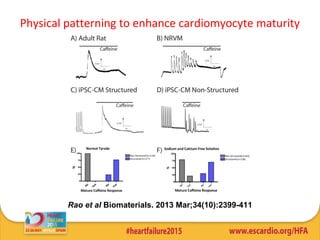
Physical patterning to enhance cardiomyocyte maturity
Rao et al Biomaterials. 2013 Mar;34(10):2399-411
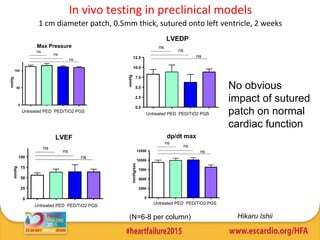
In vivo testing in preclinical models
1 cm diameter patch, 0.5mm thick, sutured onto left ventricle, 2 weeks
(N=6-8 per column)
Control SO ST Qizhi
0
50
100
Max Pressure
ns
ns
ns
mmHg
Untreated PED PED/TiO2 PGS
0
2500
5000
7500
10000
12500
dp/dt max
ns
ns
ns
mmHg/sec
Untreated PED PED/TiO2 PGS
0.0
2.5
5.0
7.5
10.0
12.5
ns
ns
ns
LVEDP
mmHg
Untreated PED PED/TiO2 PGS
0
25
50
75
100
ns
ns
ns
LVEF
mmHg
Untreated PED PED/TiO2 PGS
Hikaru Ishii
No obvious
impact of sutured
patch on normal
cardiac function
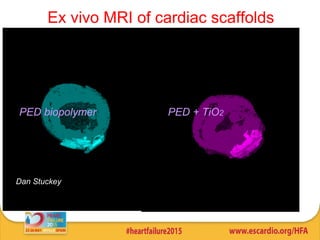
Ex vivo MRI of cardiac scaffolds
PED biopolymer PED + TiO2
Dan Stuckey
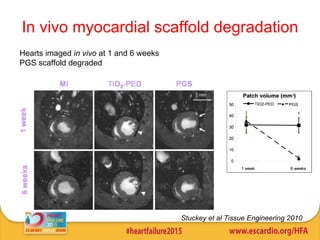
Hearts imaged in vivo at 1 and 6 weeks
PGS scaffold degraded
In vivo myocardial scaffold degradation
Stuckey et al Tissue Engineering 2010
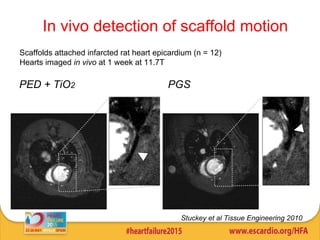
Scaffolds attached infarcted rat heart epicardium (n = 12)
Hearts imaged in vivo at 1 week at 11.7T
In vivo detection of scaffold motion
PED + TiO2 PGS
Stuckey et al Tissue Engineering 2010
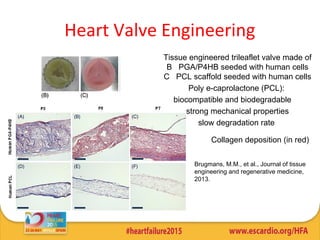
Tissue engineered trileaflet valve made of
B PGA/P4HB seeded with human cells
C PCL scaffold seeded with human cells
Poly e-caprolactone (PCL):
biocompatible and biodegradable
strong mechanical properties
slow degradation rate
Brugmans, M.M., et al., Journal of tissue
engineering and regenerative medicine,
2013.
Collagen deposition (in red)
Heart Valve Engineering
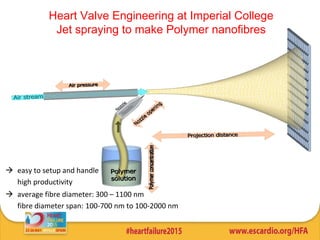
 easy to setup and handle
high productivity
 average fibre diameter: 300 – 1100 nm
fibre diameter span: 100-700 nm to 100-2000 nm
Heart Valve Engineering at Imperial College
Jet spraying to make Polymer nanofibres
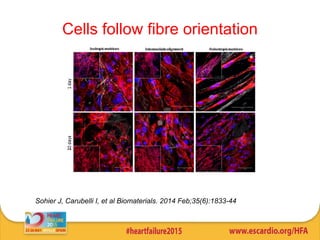
Cells follow fibre orientation
Sohier J, Carubelli I, et al Biomaterials. 2014 Feb;35(6):1833-44
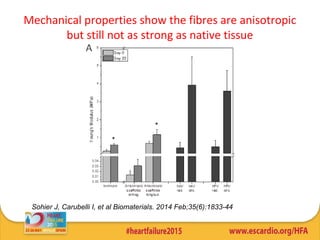
Mechanical properties show the fibres are anisotropic
but still not as strong as native tissue
Sohier J, Carubelli I, et al Biomaterials. 2014 Feb;35(6):1833-44
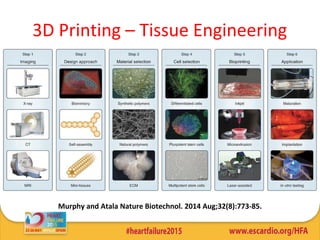
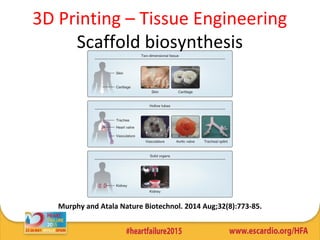
3D Printing – Tissue Engineering
Murphy and Atala Nature Biotechnol. 2014 Aug;32(8):773-85.
3D Printing – Tissue Engineering
Scaffold biosynthesis
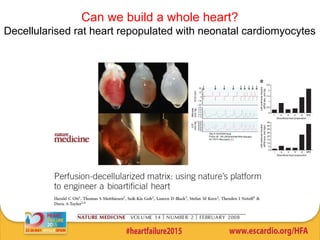
Can we build a whole heart?
Decellularised rat heart repopulated with neonatal cardiomyocytes
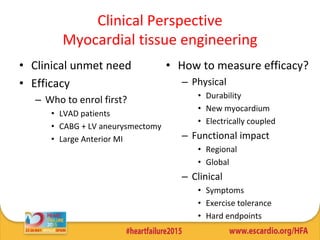
Clinical Perspective
Myocardial tissue engineering
• Clinical unmet need
• Efficacy
– Who to enrol first?
• LVAD patients
• CABG + LV aneurysmectomy
• Large Anterior MI
• How to measure efficacy?
– Physical
• Durability
• New myocardium
• Electrically coupled
– Functional impact
• Regional
• Global
– Clinical
• Symptoms
• Exercise tolerance
• Hard endpoints
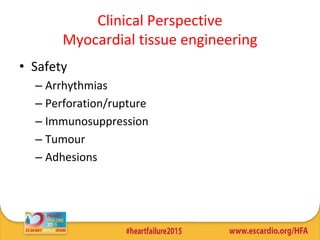
Clinical Perspective
Myocardial tissue engineering
• Safety
– Arrhythmias
– Perforation/rupture
– Immunosuppression
– Tumour
– Adhesions
Acknowledgements
• Professor Sian Harding
• Professor Cesare Terracciano
• Dr. Dan Stuckey (CMR)
• Dr. Hikaru Ishii (in vivo studies)
• Dr. Ivan Carubelli
(Valve studies)
• Dr. Adrain Chester
(Valve studies)

Tissue engineering in heart and valve failure management.

  • 1.
    Tissue engineering inheart and valve failure management Dr. Alexander Lyon Senior Lecturer and Consultant Cardiologist Royal Brompton Hospital and Imperial College, London
  • 2.
    Declaration of interest •Nothing to declare
  • 3.
    Overview • Concepts forcardiovascular tissue engineering • Making a cardiac patch • Testing a cardiac patch in vivo • Heart valve engineering • Whole heart engineering • Clinical perspective
  • 5.
    Fukushima, S. etal. Circulation 2007;115:2254-2261 Why do we need a patch in cell and tissue therapy Retention and Survival of grafted cells Bone marrow cells - intramyocardial Bone marrow cells - intracoronary
  • 6.
    • In vitroculturing of cells on a biomaterial • Direct intramyocardial injection of cells with biomaterial scaffold • Direct intramyocardial injection of biomaterial alone • Direct intramyocardial injection of other agents such as proteins or gene therapy Christman et al. (2006) J. Am. Coll. Cardiol Delivery Options a) a polymer mesh
  • 7.
    Materials for myocardialscaffolds: ideal properties • Mechanical properties matching host tissue • Biocompatible • Adherent • Allow cell contraction/proliferation • Vascularisation • Biodegradable • Non-toxic including degradation products
  • 8.
    Materials to enhancecell attachment or survival Material Advantages Disadvantages Naturally occurring materials •Collagen •Alginate •Hyaluronic acid •Fibrin •Gelatin •Chitosan •Matrigel •Peritoneal membranes Biocompatibility Porous Biodegradable Bioresorbable Poor processibility Poor mechanical properties Possible immunogenic problems Biodegradable synthetic polymers •Poly(lactic acid) •Poly(ethylene terephthalate) = PED •Poly(glycerol sebacate) = PGS •Poly(lactic-co-glycolic acid) •Polypropylene fumarate •Poly(orthoesters) •Poly(anhydrides) Good biocompatibility Off-the-shelf availability Good processibility Bioresorbable Biodegradable (wide range of rates) Added value from material tailoring • Controlled porosity • Mechanical support •Electrical conductivity •Controlled release of factors Inflammation or nanotoxicity from degradation products Loss of mechanical properties after degradation Non-degradable synthetic polymers Off-the-shelf availability No foreign-body reactions Tailored mechanical properties Effect of long term presence in the body
  • 9.
    Biodegradable synthetic polymers PassiveStress-Strain Curves Chen et al Biomaterials 2008 and 2010 (31) (34) (30) (33) (33) (32) E = 0.056 MPa E = 0.22 MPa PED/TiO2 PGS@120C PGS@110C PED
  • 10.
    Optimising engineered tissueproperties • Mechanical stimulation • Electrical stimulation • Physical patterning • Anti-apoptotic cocktail • Cell mix • Vascularisable scaffolds
  • 11.
    Mechanical and electricalstimulation improve Engineered Heart Tissue maturation Neonatal rat cardiomyocytes in collagen human embryonic stem cell-derived cardiomyocytes T Eschenhagen, WH Zimmermann
  • 12.
    1) Application ofspin negative photo-resist polymers. 3) Cast PDMS mould added. 2) Exposure to ultraviolet (UV) light through transparency mask – photolithography. Silicon Wafer Scale bar 20 µm Myosin Heavy Chain DAPI 10µm 4) PDMS mould with microgrooves. 10µm 4µm deep 5) Coat microgrooves with fibronectin. Physical patterning to enhance cardiomyocyte maturity iPSC-CM onto fibronectin coated microgrooved polydimethylsiloxane (PDMS) scaffolds fabricated using photolithography Rao et al Biomaterials. 2013 Mar;34(10):2399-411
  • 13.
    Rao et alBiomaterials. 2013 Mar;34(10):2399-411 Physical patterning to enhance cardiomyocyte maturity
  • 14.
    Physical patterning toenhance cardiomyocyte maturity Rao et al Biomaterials. 2013 Mar;34(10):2399-411
  • 15.
    In vivo testingin preclinical models 1 cm diameter patch, 0.5mm thick, sutured onto left ventricle, 2 weeks (N=6-8 per column) Control SO ST Qizhi 0 50 100 Max Pressure ns ns ns mmHg Untreated PED PED/TiO2 PGS 0 2500 5000 7500 10000 12500 dp/dt max ns ns ns mmHg/sec Untreated PED PED/TiO2 PGS 0.0 2.5 5.0 7.5 10.0 12.5 ns ns ns LVEDP mmHg Untreated PED PED/TiO2 PGS 0 25 50 75 100 ns ns ns LVEF mmHg Untreated PED PED/TiO2 PGS Hikaru Ishii No obvious impact of sutured patch on normal cardiac function
  • 16.
    Ex vivo MRIof cardiac scaffolds PED biopolymer PED + TiO2 Dan Stuckey
  • 17.
    Hearts imaged invivo at 1 and 6 weeks PGS scaffold degraded In vivo myocardial scaffold degradation Stuckey et al Tissue Engineering 2010
  • 18.
    Scaffolds attached infarctedrat heart epicardium (n = 12) Hearts imaged in vivo at 1 week at 11.7T In vivo detection of scaffold motion PED + TiO2 PGS Stuckey et al Tissue Engineering 2010
  • 19.
    Tissue engineered trileafletvalve made of B PGA/P4HB seeded with human cells C PCL scaffold seeded with human cells Poly e-caprolactone (PCL): biocompatible and biodegradable strong mechanical properties slow degradation rate Brugmans, M.M., et al., Journal of tissue engineering and regenerative medicine, 2013. Collagen deposition (in red) Heart Valve Engineering
  • 20.
     easy tosetup and handle high productivity  average fibre diameter: 300 – 1100 nm fibre diameter span: 100-700 nm to 100-2000 nm Heart Valve Engineering at Imperial College Jet spraying to make Polymer nanofibres
  • 21.
    Cells follow fibreorientation Sohier J, Carubelli I, et al Biomaterials. 2014 Feb;35(6):1833-44
  • 22.
    Mechanical properties showthe fibres are anisotropic but still not as strong as native tissue Sohier J, Carubelli I, et al Biomaterials. 2014 Feb;35(6):1833-44
  • 23.
    3D Printing –Tissue Engineering Murphy and Atala Nature Biotechnol. 2014 Aug;32(8):773-85.
  • 24.
    Murphy and AtalaNature Biotechnol. 2014 Aug;32(8):773-85. 3D Printing – Tissue Engineering Scaffold biosynthesis
  • 25.
    Can we builda whole heart? Decellularised rat heart repopulated with neonatal cardiomyocytes
  • 26.
    Clinical Perspective Myocardial tissueengineering • Clinical unmet need • Efficacy – Who to enrol first? • LVAD patients • CABG + LV aneurysmectomy • Large Anterior MI • How to measure efficacy? – Physical • Durability • New myocardium • Electrically coupled – Functional impact • Regional • Global – Clinical • Symptoms • Exercise tolerance • Hard endpoints
  • 27.
    Clinical Perspective Myocardial tissueengineering • Safety – Arrhythmias – Perforation/rupture – Immunosuppression – Tumour – Adhesions
  • 28.
    Acknowledgements • Professor SianHarding • Professor Cesare Terracciano • Dr. Dan Stuckey (CMR) • Dr. Hikaru Ishii (in vivo studies) • Dr. Ivan Carubelli (Valve studies) • Dr. Adrain Chester (Valve studies)