The conundrum of mitral regurgitation
in heart failure
Piotr Ponikowski, MD, PhD, FESC
Medical University, Centre for Heart Disease
Clinical Military Hospital
Wroclaw, Poland
The road ahead
Disclosure
Consultancy fees and speaker’s honoraria from:
ABBOTT VASCULAR
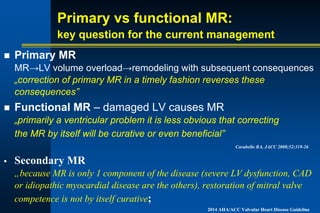
Primary vs functional MR:
key question for the current management
n Primary MR
MR→LV volume overload→remodeling with subsequent consequences
„correction of primary MR in a timely fashion reverses these
consequences”
n Functional MR – damaged LV causes MR
„primarily a ventricular problem it is less obvious that correcting
the MR by itself will be curative or even beneficial”
Carabello BA, JACC 2008;52:319-26
• Secondary MR
„because MR is only 1 component of the disease (severe LV dysfunction, CAD
or idiopathic myocardial disease are the others), restoration of mitral valve
competence is not by itself curative;
2014 AHA/ACC Valvular Heart Disease Guideline
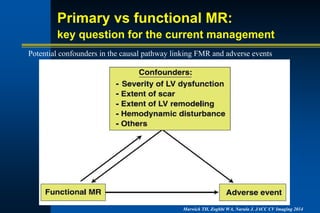
Primary vs functional MR:
key question for the current management
Marwick TH, Zoghbi WA, Narula J. JACC CV Imaging 2014
Potential confounders in the causal pathway linking FMR and adverse events
MR in Heart Failure
Management options: how / when to intervene ?
• Optimal medical therapy
• CRT
• Surgery
MV surgery
Surgical treatment of LV
• Percutaneous techniques
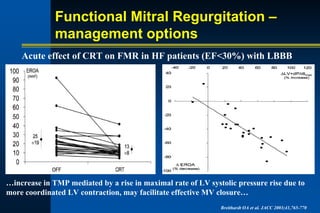
Functional Mitral Regurgitation –
management options
Acute effect of CRT on FMR in HF patients (EF<30%) with LBBB
Breithardt OA et al. JACC 2003;41,765-770
…increase in TMP mediated by a rise in maximal rate of LV systolic pressure rise due to
more coordinated LV contraction, may facilitate effective MV closure…
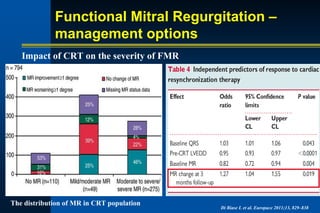
Functional Mitral Regurgitation –
management options
Impact of CRT on the severity of FMR
Di Biase L et al. Europace 2011;13, 829–838
The distribution of MR in CRT population
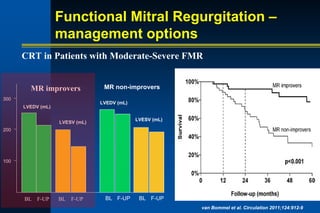
Functional Mitral Regurgitation –
management options
CRT in Patients with Moderate-Severe FMR
van Bommel et al. Circulation 2011;124:912-9
100
200
300
BL F-UP BL F-UP
LVEDV (mL)
LVESV (mL)
BL F-UP BL F-UP
LVEDV (mL)
LVESV (mL)
MR improvers MR non-improvers
MR in Heart Failure
Management options: how / when to intervene ?
• Optimal medical therapy
• CRT
• Surgery
MV surgery
Surgical treatment of LV
• Percutaneous techniques
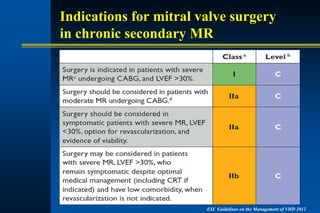
ESC Guidelines on the Management of VHD 2012
Indications for mitral valve surgery
in chronic secondary MR
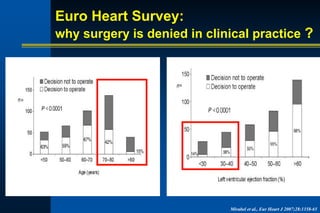
Euro Heart Survey:
why surgery is denied in clinical practice ?
Mirabel et al., Eur Heart J 2007;28:1358-65
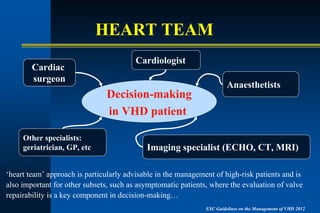
Cardiac
surgeon
Cardiologist
Anaesthetists
Other specialists:
geriatrician, GP, etc Imaging specialist (ECHO, CT, MRI)
Decision-making
in VHD patient
HEART TEAM
‘heart team’ approach is particularly advisable in the management of high-risk patients and is
also important for other subsets, such as asymptomatic patients, where the evaluation of valve
repairability is a key component in decision-making…
ESC Guidelines on the Management of VHD 2012
MR in Heart Failure
Management options: how / when to intervene ?
• Optimal medical therapy
• CRT
• Surgery
MV surgery
Surgical treatment of LV
• Percutaneous techniques
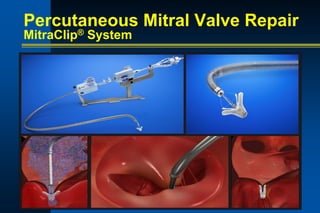
Percutaneous Mitral Valve Repair
MitraClip® System
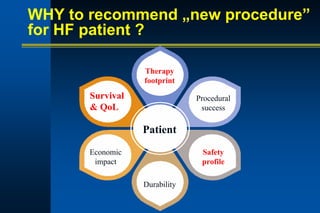
WHY to recommend „new procedure”
for HF patient ?
Therapy
footprint
Economic
impact
Patient
Durability
Procedural
success
Safety
profile
Survival
& QoL
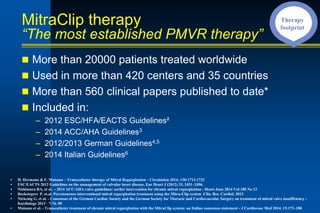
MitraClip therapy
“The most established PMVR therapy”
n More than 20000 patients treated worldwide
n Used in more than 420 centers and 35 countries
n More than 560 clinical papers published to date*
n Included in:
– 2012 ESC/HFA/EACTS Guidelines²
– 2014 ACC/AHA Guidelines3
– 2012/2013 German Guidelines4,5
– 2014 Italian Guidelines6
• H. Hermann & F. Maisano – Transcatheter therapy of Mitral Regurgitation – Circulation 2014; 130:1712-1722
• ESC/EACTS 2012 Guidelines on the management of valvular heart disease. Eur Heart J (2012) 33, 2451–2496.
• Nishimura RA, et al. - 2014 ACC/AHA valve guidelines: earlier intervention for chronic mitral regurgitation - Heart June 2014 Vol 100 No 12
• Boekstegers P. et.al. Percutaneous interventional mitral regurgitation treatment using the Mitra-Clip system Clin. Res. Cardiol. 2013
• Nickenig G. et al. - Consensus of the German Cardiac Society and the German Society for Thoracic and Cardiovascular Surgery on treatment of mitral valve insufficiency -
Kardiologe 2013 · 7:76–90
• Maisano et al. - Transcatheter treatment of chronic mitral regurgitation with the MitraClip system: an Italian consensus statement - J Cardiovasc Med 2014, 15:173–188
Therapy
footprint
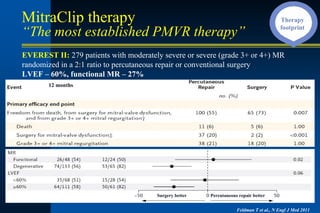
EVEREST II: 279 patients with moderately severe or severe (grade 3+ or 4+) MR
randomized in a 2:1 ratio to percutaneous repair or conventional surgery
LVEF – 60%, functional MR – 27%
12 months
Surgery better Percutaneous repair better
Feldman T et al., N Engl J Med 2011
MitraClip therapy
“The most established PMVR therapy”
Therapy
footprint
MitraClip therapy
Safety profile
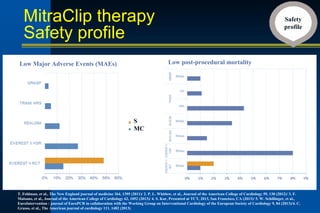
• T. Feldman, et al., The New England journal of medicine 364, 1395 (2011)/ 2. P. L. Whitlow, et al., Journal of the American College of Cardiology 59, 130 (2012)/ 3. F.
Maisano, et al., Journal of the American College of Cardiology 62, 1052 (2013)/ 4. S. Kar, Presented at TCT, 2013, San Francisco, CA (2013)/ 5. W. Schillinger, et al.,
EuroIntervention : journal of EuroPCR in collaboration with the Working Group on Interventional Cardiology of the European Society of Cardiology 9, 84 (2013)/4. C.
Grasso, et al., The American journal of cardiology 111, 1482 (2013)
Safety
profile
• Low Major Adverse Events (MAEs) • Low post-procedural mortality
Low Major Adverse Events (MAEs) Low post-procedural mortality
S
MC
MitraClip as therapeutic option for MR
first (and strong) evidence
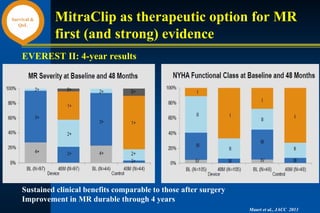
EVEREST II: 4-year results
Sustained clinical benefits comparable to those after surgery
Improvement in MR durable through 4 years
Mauri et al., JACC 2013
Survival &
QoL
MitraClip as therapeutic option for MR
first (and strong) evidence
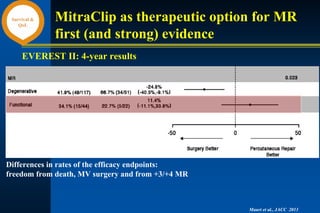
EVEREST II: 4-year results
Mauri et al., JACC 2013
Differences in rates of the efficacy endpoints:
freedom from death, MV surgery and from +3/+4 MR
Survival &
QoL
MitraClip as therapeutic option for MR
Real World Experience
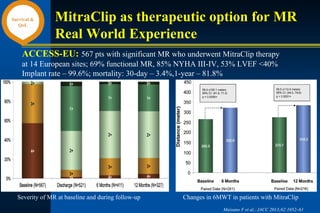
ACCESS-EU: 567 pts with significant MR who underwent MitraClip therapy
at 14 European sites; 69% functional MR, 85% NYHA III-IV, 53% LVEF <40%
Implant rate – 99.6%; mortality: 30-day – 3.4%,1-year – 81.8%
Maisano F et al., JACC 2013;62:1052–61
Severity of MR at baseline and during follow-up Changes in 6MWT in patients with MitraClip
Survival &
QoL
MitraClip as therapeutic option for MR
Real World Experience
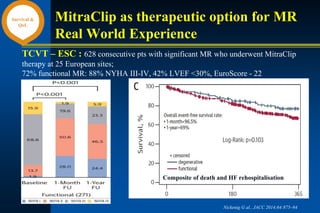
TCVT – ESC : 628 consecutive pts with significant MR who underwent MitraClip
therapy at 25 European sites;
72% functional MR: 88% NYHA III-IV, 42% LVEF <30%, EuroScore - 22
Nickenig G al., JACC 2014;64:875–84
Survival &
QoL
Composite of death and HF rehospitalisation
MitraClip as therapeutic option for MR
Real World Experience
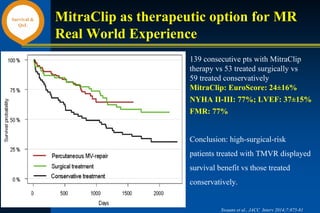
139 consecutive pts with MitraClip
therapy vs 53 treated surgically vs
59 treated conservatively
MitraClip: EuroScore: 24±16%
NYHA II-III: 77%; LVEF: 37±15%
FMR: 77%
Swaans et al., JACC Interv 2014;7:875-81
Conclusion: high-surgical-risk
patients treated with TMVR displayed
survival benefit vs those treated
conservatively.
Survival &
QoL
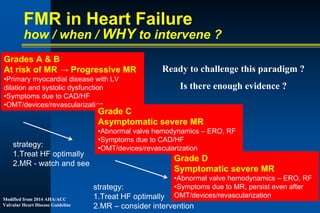
Grades A & B
At risk of MR → Progressive MR
•Primary myocardial disease with LV
dilation and systolic dysfunction
•Symptoms due to CAD/HF
•OMT/devices/revascularization
Grade C
Asymptomatic severe MR
•Abnormal valve hemodynamics – ERO, RF
•Symptoms due to CAD/HF
•OMT/devices/revascularization
Grade D
Symptomatic severe MR
•Abnormal valve hemodynamics – ERO, RF
•Symptoms due to MR, persist even after
OMT/devices/revascularizationModified from 2014 AHA/ACC
Valvular Heart Disease Guideline
strategy:
1.Treat HF optimally
2.MR - watch and see
strategy:
1.Treat HF optimally
2.MR – consider intervention
Ready to challenge this paradigm ?
Is there enough evidence ?
FMR in Heart Failure
how / when / WHY to intervene ?

The road ahead.

  • 1.
    The conundrum ofmitral regurgitation in heart failure Piotr Ponikowski, MD, PhD, FESC Medical University, Centre for Heart Disease Clinical Military Hospital Wroclaw, Poland The road ahead
  • 2.
    Disclosure Consultancy fees andspeaker’s honoraria from: ABBOTT VASCULAR
  • 3.
    Primary vs functionalMR: key question for the current management n Primary MR MR→LV volume overload→remodeling with subsequent consequences „correction of primary MR in a timely fashion reverses these consequences” n Functional MR – damaged LV causes MR „primarily a ventricular problem it is less obvious that correcting the MR by itself will be curative or even beneficial” Carabello BA, JACC 2008;52:319-26 • Secondary MR „because MR is only 1 component of the disease (severe LV dysfunction, CAD or idiopathic myocardial disease are the others), restoration of mitral valve competence is not by itself curative; 2014 AHA/ACC Valvular Heart Disease Guideline
  • 4.
    Primary vs functionalMR: key question for the current management Marwick TH, Zoghbi WA, Narula J. JACC CV Imaging 2014 Potential confounders in the causal pathway linking FMR and adverse events
  • 5.
    MR in HeartFailure Management options: how / when to intervene ? • Optimal medical therapy • CRT • Surgery MV surgery Surgical treatment of LV • Percutaneous techniques
  • 6.
    Functional Mitral Regurgitation– management options Acute effect of CRT on FMR in HF patients (EF<30%) with LBBB Breithardt OA et al. JACC 2003;41,765-770 …increase in TMP mediated by a rise in maximal rate of LV systolic pressure rise due to more coordinated LV contraction, may facilitate effective MV closure…
  • 7.
    Functional Mitral Regurgitation– management options Impact of CRT on the severity of FMR Di Biase L et al. Europace 2011;13, 829–838 The distribution of MR in CRT population
  • 8.
    Functional Mitral Regurgitation– management options CRT in Patients with Moderate-Severe FMR van Bommel et al. Circulation 2011;124:912-9 100 200 300 BL F-UP BL F-UP LVEDV (mL) LVESV (mL) BL F-UP BL F-UP LVEDV (mL) LVESV (mL) MR improvers MR non-improvers
  • 9.
    MR in HeartFailure Management options: how / when to intervene ? • Optimal medical therapy • CRT • Surgery MV surgery Surgical treatment of LV • Percutaneous techniques
  • 10.
    ESC Guidelines onthe Management of VHD 2012 Indications for mitral valve surgery in chronic secondary MR
  • 11.
    Euro Heart Survey: whysurgery is denied in clinical practice ? Mirabel et al., Eur Heart J 2007;28:1358-65
  • 12.
    Cardiac surgeon Cardiologist Anaesthetists Other specialists: geriatrician, GP,etc Imaging specialist (ECHO, CT, MRI) Decision-making in VHD patient HEART TEAM ‘heart team’ approach is particularly advisable in the management of high-risk patients and is also important for other subsets, such as asymptomatic patients, where the evaluation of valve repairability is a key component in decision-making… ESC Guidelines on the Management of VHD 2012
  • 13.
    MR in HeartFailure Management options: how / when to intervene ? • Optimal medical therapy • CRT • Surgery MV surgery Surgical treatment of LV • Percutaneous techniques
  • 14.
    Percutaneous Mitral ValveRepair MitraClip® System
  • 15.
    WHY to recommend„new procedure” for HF patient ? Therapy footprint Economic impact Patient Durability Procedural success Safety profile Survival & QoL
  • 16.
    MitraClip therapy “The mostestablished PMVR therapy” n More than 20000 patients treated worldwide n Used in more than 420 centers and 35 countries n More than 560 clinical papers published to date* n Included in: – 2012 ESC/HFA/EACTS Guidelines² – 2014 ACC/AHA Guidelines3 – 2012/2013 German Guidelines4,5 – 2014 Italian Guidelines6 • H. Hermann & F. Maisano – Transcatheter therapy of Mitral Regurgitation – Circulation 2014; 130:1712-1722 • ESC/EACTS 2012 Guidelines on the management of valvular heart disease. Eur Heart J (2012) 33, 2451–2496. • Nishimura RA, et al. - 2014 ACC/AHA valve guidelines: earlier intervention for chronic mitral regurgitation - Heart June 2014 Vol 100 No 12 • Boekstegers P. et.al. Percutaneous interventional mitral regurgitation treatment using the Mitra-Clip system Clin. Res. Cardiol. 2013 • Nickenig G. et al. - Consensus of the German Cardiac Society and the German Society for Thoracic and Cardiovascular Surgery on treatment of mitral valve insufficiency - Kardiologe 2013 · 7:76–90 • Maisano et al. - Transcatheter treatment of chronic mitral regurgitation with the MitraClip system: an Italian consensus statement - J Cardiovasc Med 2014, 15:173–188 Therapy footprint
  • 17.
    EVEREST II: 279patients with moderately severe or severe (grade 3+ or 4+) MR randomized in a 2:1 ratio to percutaneous repair or conventional surgery LVEF – 60%, functional MR – 27% 12 months Surgery better Percutaneous repair better Feldman T et al., N Engl J Med 2011 MitraClip therapy “The most established PMVR therapy” Therapy footprint
  • 18.
    MitraClip therapy Safety profile •T. Feldman, et al., The New England journal of medicine 364, 1395 (2011)/ 2. P. L. Whitlow, et al., Journal of the American College of Cardiology 59, 130 (2012)/ 3. F. Maisano, et al., Journal of the American College of Cardiology 62, 1052 (2013)/ 4. S. Kar, Presented at TCT, 2013, San Francisco, CA (2013)/ 5. W. Schillinger, et al., EuroIntervention : journal of EuroPCR in collaboration with the Working Group on Interventional Cardiology of the European Society of Cardiology 9, 84 (2013)/4. C. Grasso, et al., The American journal of cardiology 111, 1482 (2013) Safety profile • Low Major Adverse Events (MAEs) • Low post-procedural mortality Low Major Adverse Events (MAEs) Low post-procedural mortality S MC
  • 19.
    MitraClip as therapeuticoption for MR first (and strong) evidence EVEREST II: 4-year results Sustained clinical benefits comparable to those after surgery Improvement in MR durable through 4 years Mauri et al., JACC 2013 Survival & QoL
  • 20.
    MitraClip as therapeuticoption for MR first (and strong) evidence EVEREST II: 4-year results Mauri et al., JACC 2013 Differences in rates of the efficacy endpoints: freedom from death, MV surgery and from +3/+4 MR Survival & QoL
  • 21.
    MitraClip as therapeuticoption for MR Real World Experience ACCESS-EU: 567 pts with significant MR who underwent MitraClip therapy at 14 European sites; 69% functional MR, 85% NYHA III-IV, 53% LVEF <40% Implant rate – 99.6%; mortality: 30-day – 3.4%,1-year – 81.8% Maisano F et al., JACC 2013;62:1052–61 Severity of MR at baseline and during follow-up Changes in 6MWT in patients with MitraClip Survival & QoL
  • 22.
    MitraClip as therapeuticoption for MR Real World Experience TCVT – ESC : 628 consecutive pts with significant MR who underwent MitraClip therapy at 25 European sites; 72% functional MR: 88% NYHA III-IV, 42% LVEF <30%, EuroScore - 22 Nickenig G al., JACC 2014;64:875–84 Survival & QoL Composite of death and HF rehospitalisation
  • 23.
    MitraClip as therapeuticoption for MR Real World Experience 139 consecutive pts with MitraClip therapy vs 53 treated surgically vs 59 treated conservatively MitraClip: EuroScore: 24±16% NYHA II-III: 77%; LVEF: 37±15% FMR: 77% Swaans et al., JACC Interv 2014;7:875-81 Conclusion: high-surgical-risk patients treated with TMVR displayed survival benefit vs those treated conservatively. Survival & QoL
  • 24.
    Grades A &B At risk of MR → Progressive MR •Primary myocardial disease with LV dilation and systolic dysfunction •Symptoms due to CAD/HF •OMT/devices/revascularization Grade C Asymptomatic severe MR •Abnormal valve hemodynamics – ERO, RF •Symptoms due to CAD/HF •OMT/devices/revascularization Grade D Symptomatic severe MR •Abnormal valve hemodynamics – ERO, RF •Symptoms due to MR, persist even after OMT/devices/revascularizationModified from 2014 AHA/ACC Valvular Heart Disease Guideline strategy: 1.Treat HF optimally 2.MR - watch and see strategy: 1.Treat HF optimally 2.MR – consider intervention Ready to challenge this paradigm ? Is there enough evidence ? FMR in Heart Failure how / when / WHY to intervene ?