TISSUE ENGINEERING
and its application in
PERIODONTAL REGENERATION
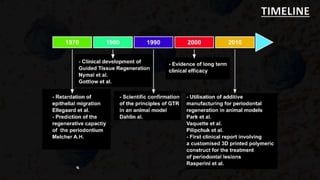
TIMELINE
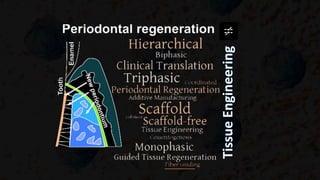
PERIODONTAL REGENERATION
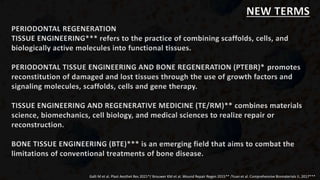
TISSUE ENGINEERING*** refers to the practice of combining scaffolds, cells, and
biologically active molecules into functional tissues.
PERIODONTAL TISSUE ENGINEERING AND BONE REGENERATION (PTEBR)* promotes
reconstitution of damaged and lost tissues through the use of growth factors and
signaling molecules, scaffolds, cells and gene therapy.
TISSUE ENGINEERING AND REGENERATIVE MEDICINE (TE/RM)** combines materials
science, biomechanics, cell biology, and medical sciences to realize repair or
reconstruction.
BONE TISSUE ENGINEERING (BTE)*** is an emerging field that aims to combat the
limitations of conventional treatments of bone disease.
Galli M et al. Plast Aesthet Res 2021*/ Brouwer KM et al. Wound Repair Regen 2015** /Yuan et al. Comprehensive Biomaterials II, 2017***
NEW TERMS
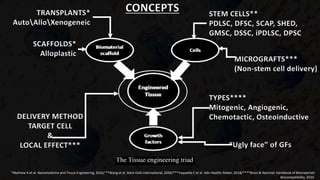
CONCEPTS
*Mathew A et al. Nanomedicine and Tissue Engineering, 2016/ **Wang et al. Stem Cells International, 2020/***Vaquette C et al. Adv Healthc Mater, 2018/****Brion & Rammal. Handbook of Biomaterials
Biocompatibility, 2020.
TRANSPLANTS*
AutoAlloXenogeneic
SCAFFOLDS*
Alloplastic
STEM CELLS**
PDLSC, DFSC, SCAP, SHED,
GMSC, DSSC, iPDLSC, DPSC
MICROGRAFTS***
(Non-stem cell delivery)
TYPES****
Mitogenic, Angiogenic,
Chemotactic, Osteoinductive
“Ugly face” of GFs
DELIVERY METHOD
TARGET CELL
&
LOCAL EFFECT***
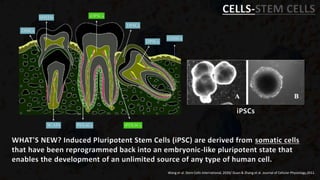
CELLS-STEM CELLS
Wang et al. Stem Cells International, 2020/ Duan & Zhang et al. Journal of Cellular Physiology,2011.
WHAT'S NEW? Induced Pluripotent Stem Cells (iPSC) are derived from somatic cells
that have been reprogrammed back into an embryonic-like pluripotent state that
enables the development of an unlimited source of any type of human cell.
iPSCs
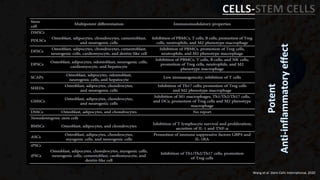
CELLS-STEM CELLS
Wang et al. Stem Cells International, 2020
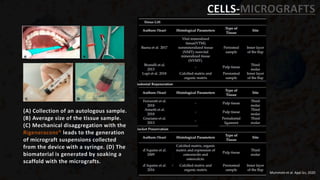
CELLS-MICROGRAFTS
Mummolo et al. Appl Sci, 2020
(A) Collection of an autologous sample.
(B) Average size of the tissue sample.
(C) Mechanical disaggregation with the
Rigeneracons® leads to the generation
of micrograft suspensions collected
from the device with a syringe. (D) The
biomaterial is generated by soaking a
scaffold with the micrografts.
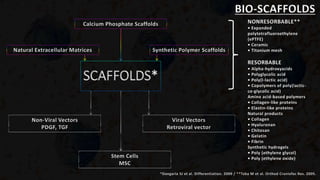
BIO-SCAFFOLDS
SCAFFOLDS*
Natural Extracellular Matrices
Calcium Phosphate Scaffolds
Synthetic Polymer Scaffolds
Viral Vectors
Retroviral vector
Stem Cells
MSC
Non-Viral Vectors
PDGF, TGF
*Dangaria SJ et al. Differentiation. 2009 / **Taba M et al. Orthod Craniofac Res. 2005.
NONRESORBABLE**
• Expanded
polytetrafluoroethylene
(ePTFE)
• Ceramic
• Titanium mesh
RESORBABLE
• Alpha-hydroxyacids
• Polyglycolic acid
• Poly(l-lactic acid)
• Copolymers of poly(lactic-
co-glycolic acid)
Amino acid-based polymers
• Collagen-like proteins
• Elastin-like proteins
Natural products
• Collagen
• Hyaluronan
• Chitosan
• Gelatin
• Fibrin
Synthetic hydrogels
• Poly (ethylene glycol)
• Poly (ethylene oxide)
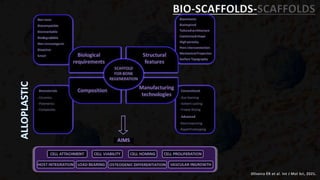
BIO-SCAFFOLDS-SCAFFOLDS
Oliveira ÉR et al. Int J Mol Sci, 2021.
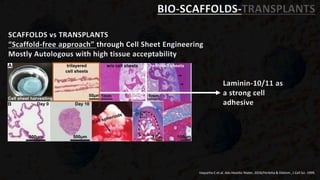
BIO-SCAFFOLDS-TRANSPLANTS
SCAFFOLDS vs TRANSPLANTS
“Scaffold-free approach” through Cell Sheet Engineering
Mostly Autologous with high tissue acceptability
Laminin-10/11 as
a strong cell
adhesive
Vaquette C et al. Adv Healthc Mater, 2018/Ferletta & Ekblom , J Cell Sci. 1999.
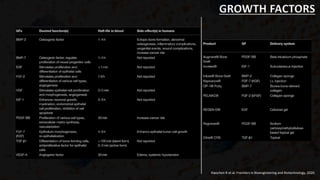
GROWTH FACTORS
Xiaochen R et al. Frontiers in Bioengineering and Biotechnology, 2020.
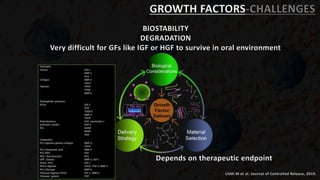
GROWTH FACTORS-CHALLENGES
BIOSTABILITY
DEGRADATION
Very difficult for GFs like IGF or HGF to survive in oral environment
Depends on therapeutic endpoint
Lilith M et al. Journal of Controlled Release, 2019.
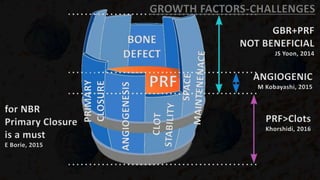
ANGIOGENESIS
PRIMARY
CLOSURE
PRF
BONE
DEFECT
PRF>Clots
Khorshidi, 2016
ANGIOGENIC
M Kobayashi, 2015
GBR+PRF
NOT BENEFICIAL
JS Yoon, 2014
for NBR
Primary Closure
is a must
E Borie, 2015
GROWTH FACTORS-CHALLENGES
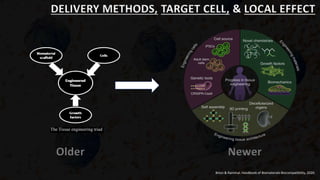
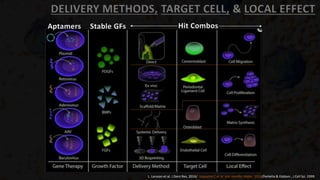
DELIVERY METHODS, TARGET CELL, & LOCAL EFFECT
Brion & Rammal. Handbook of Biomaterials Biocompatibility, 2020.
Older Newer
DELIVERY METHODS, TARGET CELL, & LOCAL EFFECT
L. Larsson et al. J Dent Res, 2016/ Vaquette C et al. Adv Healthc Mater, 2018/Ferletta & Ekblom , J Cell Sci. 1999.
Aptamers Stable GFs Hit Combos
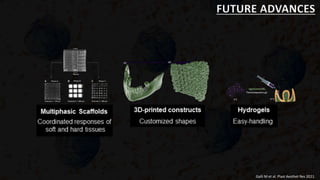
FUTURE ADVANCES
Galli M et al. Plast Aesthet Res 2021.
THANK YOU

Tissue engineering

  • 1.
    TISSUE ENGINEERING and itsapplication in PERIODONTAL REGENERATION
  • 3.
  • 4.
    PERIODONTAL REGENERATION TISSUE ENGINEERING***refers to the practice of combining scaffolds, cells, and biologically active molecules into functional tissues. PERIODONTAL TISSUE ENGINEERING AND BONE REGENERATION (PTEBR)* promotes reconstitution of damaged and lost tissues through the use of growth factors and signaling molecules, scaffolds, cells and gene therapy. TISSUE ENGINEERING AND REGENERATIVE MEDICINE (TE/RM)** combines materials science, biomechanics, cell biology, and medical sciences to realize repair or reconstruction. BONE TISSUE ENGINEERING (BTE)*** is an emerging field that aims to combat the limitations of conventional treatments of bone disease. Galli M et al. Plast Aesthet Res 2021*/ Brouwer KM et al. Wound Repair Regen 2015** /Yuan et al. Comprehensive Biomaterials II, 2017*** NEW TERMS
  • 5.
    CONCEPTS *Mathew A etal. Nanomedicine and Tissue Engineering, 2016/ **Wang et al. Stem Cells International, 2020/***Vaquette C et al. Adv Healthc Mater, 2018/****Brion & Rammal. Handbook of Biomaterials Biocompatibility, 2020. TRANSPLANTS* AutoAlloXenogeneic SCAFFOLDS* Alloplastic STEM CELLS** PDLSC, DFSC, SCAP, SHED, GMSC, DSSC, iPDLSC, DPSC MICROGRAFTS*** (Non-stem cell delivery) TYPES**** Mitogenic, Angiogenic, Chemotactic, Osteoinductive “Ugly face” of GFs DELIVERY METHOD TARGET CELL & LOCAL EFFECT***
  • 6.
    CELLS-STEM CELLS Wang etal. Stem Cells International, 2020/ Duan & Zhang et al. Journal of Cellular Physiology,2011. WHAT'S NEW? Induced Pluripotent Stem Cells (iPSC) are derived from somatic cells that have been reprogrammed back into an embryonic-like pluripotent state that enables the development of an unlimited source of any type of human cell. iPSCs
  • 7.
    CELLS-STEM CELLS Wang etal. Stem Cells International, 2020
  • 8.
    CELLS-MICROGRAFTS Mummolo et al.Appl Sci, 2020 (A) Collection of an autologous sample. (B) Average size of the tissue sample. (C) Mechanical disaggregation with the Rigeneracons® leads to the generation of micrograft suspensions collected from the device with a syringe. (D) The biomaterial is generated by soaking a scaffold with the micrografts.
  • 9.
    BIO-SCAFFOLDS SCAFFOLDS* Natural Extracellular Matrices CalciumPhosphate Scaffolds Synthetic Polymer Scaffolds Viral Vectors Retroviral vector Stem Cells MSC Non-Viral Vectors PDGF, TGF *Dangaria SJ et al. Differentiation. 2009 / **Taba M et al. Orthod Craniofac Res. 2005. NONRESORBABLE** • Expanded polytetrafluoroethylene (ePTFE) • Ceramic • Titanium mesh RESORBABLE • Alpha-hydroxyacids • Polyglycolic acid • Poly(l-lactic acid) • Copolymers of poly(lactic- co-glycolic acid) Amino acid-based polymers • Collagen-like proteins • Elastin-like proteins Natural products • Collagen • Hyaluronan • Chitosan • Gelatin • Fibrin Synthetic hydrogels • Poly (ethylene glycol) • Poly (ethylene oxide)
  • 10.
  • 11.
    BIO-SCAFFOLDS-TRANSPLANTS SCAFFOLDS vs TRANSPLANTS “Scaffold-freeapproach” through Cell Sheet Engineering Mostly Autologous with high tissue acceptability Laminin-10/11 as a strong cell adhesive Vaquette C et al. Adv Healthc Mater, 2018/Ferletta & Ekblom , J Cell Sci. 1999.
  • 12.
    GROWTH FACTORS Xiaochen Ret al. Frontiers in Bioengineering and Biotechnology, 2020.
  • 13.
    GROWTH FACTORS-CHALLENGES BIOSTABILITY DEGRADATION Very difficultfor GFs like IGF or HGF to survive in oral environment Depends on therapeutic endpoint Lilith M et al. Journal of Controlled Release, 2019.
  • 14.
    ANGIOGENESIS PRIMARY CLOSURE PRF BONE DEFECT PRF>Clots Khorshidi, 2016 ANGIOGENIC M Kobayashi,2015 GBR+PRF NOT BENEFICIAL JS Yoon, 2014 for NBR Primary Closure is a must E Borie, 2015 GROWTH FACTORS-CHALLENGES
  • 15.
    DELIVERY METHODS, TARGETCELL, & LOCAL EFFECT Brion & Rammal. Handbook of Biomaterials Biocompatibility, 2020. Older Newer
  • 16.
    DELIVERY METHODS, TARGETCELL, & LOCAL EFFECT L. Larsson et al. J Dent Res, 2016/ Vaquette C et al. Adv Healthc Mater, 2018/Ferletta & Ekblom , J Cell Sci. 1999. Aptamers Stable GFs Hit Combos
  • 17.
    FUTURE ADVANCES Galli Met al. Plast Aesthet Res 2021.
  • 18.

Editor's Notes

  • #3 biphasic scaffold means two diff materials. Fiber-Based Scaffolds Fibrous scaffold structures may be developed by electrospinning of polymers to generate continuous micro- or nanoscale diameter fibers. Additionally, the orientation of fibers can be controlled during electrospinning to develop random or aligned fibers. 
  • #4 istorical timeline of the development of barrier/membrane and scaffold based periodontal regeneration approaches aimed to exert temporo-spatial co-ordination of the periodontal wound healing process: From the initial concept involving a free palatal graft for impeding epithelial migration, via the clinical implementation of the GTR concept utilizing occlusive membranes, to the most recent clinical advancements involving additively manufactured polymeric multiphasic scaffolds for periodontal tissue engineering
  • #5 Periodontal regeneration is defined as the restoration of lost periodontium or supporting tissues and includes formation of new alveolar bone, new cementum, and new periodontal ligament.
  • #6 A transplant can be classified or defined in many ways; for example, it can be based on the relationship between the recipient and the donor, its location in a recipient, and so on. Different types of transplants include autograft (from one part of the body to other within one individual), isograft (within genetically identical species like identical twins), allograft (from different individuals of same species), and xenograft (from members of different species). The different populations of dental mesenchymal stem cells and their distribution. PDLSCs: periodontal ligament stem cells; DFSCs: dental follicle stem cells; DPSCs: dental pulp-derived stem cells; SCAPs: stem cells from apical papilla; SHEDs: stem cells from exfoliated deciduous teeth; GMSCs: gingival mesenchymal stem cells; DSSCs: dental socket-derived stem cells; iPDLSCs: PDLSCs derived from infected tissue; iDPSCs: DPSCs derived from infected tissue. The micrografting technique was conceived by Cicero Parker Meek at the University of South Carolina Aiken in 1958.34 Micrografting is based on the concept that by increasing the superficial area of a skin graft by cutting the graft into smaller “micrografts,” it is possible to cover a wound larger than the original donor site. Micrografting was first applied to the treatment of burns because of a lack of available donor sites for skin grafting.
  • #7 PDLSCs: periodontal ligament stem cells; DFSCs: dental follicle stem cells; DPSCs: dental pulp-derived stem cells; SCAPs: stem cells from apical papilla; SHEDs: stem cells from exfoliated deciduous teeth; GMSCs: gingival mesenchymal stem cells; DSSCs: dental socket-derived stem cells; iPDLSCs: PDLSCs derived from infected tissue; iDPSCs: DPSCs derived from infected tissue.  which were reprogrammed from male human foreskin fibroblasts by four transfected transcript factors. The essential transcription factors to maintain a “stem cell state” or stemness in ESCs. NON-BLASTOCYSTIC ORIGIN. NANOG, OCT4, NESTIN, and SRY
  • #8 Th17 cells are characterized by production of IL-17 and may have evolved for host protection against microbes that Th1 or Th2 immunity are not well suited for, such as extracellular bacteria and some fungi. M1 macrophages are classically activated, typically by IFN-γ or lipopolysaccharide (LPS), and produce proinflammatory cytokines, phagocytize microbes, and initiate an immune response. M1 macrophages produce nitric oxide (NO) or reactive oxygen intermediates (ROI) to protect against bacteria and viruses. M2 macrophages are alternatively activated by exposure to certain cytokines such as IL-4, IL-10, or IL-13. M2 macrophages will produce either polyamines to induce proliferation or proline to induce collagen production. These macrophages are associated with wound healing and tissue repair.
  • #9 Schematic representation of Rigenera® technology use. (A) Collection of an autologous sample. (B) Average size of the tissue sample. (C) Mechanical disaggregation with the Rigeneracons® leads to the generation of micrograft suspensions collected from the device with a syringe. (D) The biomaterial is generated by soaking a scaffold with the micrografts.
  • #11 The main biological and structural properties, common compositions, and manufacturing technologies of bone tissue engineering scaffolds
  • #12 The predominant cell surface receptor in epithelial cells for both laminin-10.
  • #14 examples of thermosensitive hydrogels are collagen, agarose, hyaluronic acid, poly(organophosphazenes), and chitosan
  • #15 Liebig Law of Minimum
  • #16 From hard to soft, tissue-engineered materials are to meet essential characteristics: (1) provide a platform for cell attachment and 111 Handbook of Biomaterials Biocompatibility DOI: https://doi.org/10.1016/B978-0-08-102967-1.00008-6 © 2020 Elsevier Ltd. All rights reserved.growth; (2) orchestrate cell differentiation or tissue formation through customized biophysical/chemical cues and/or multiple tissue specific growth factors (GFs) delivery over a therapeutic timespan; (3) be biocompatible with controllable degradation and resorption rate; and (4) matching or narrowing mechanical properties of tissues at the implantation site [8,9]. Aiming to enhance the regeneration process of damaged tissues and organs, modern strategies involve the use of tissue-engineered materials in combination with living cells of interest and/or bioactive molecules (Fig. 7.1). Aptamers are short, single-stranded DNA or RNA (ssDNA or ssRNA) molecules that can selectively bind to a specific target, including proteins, peptides, carbohydrates, small molecules, toxins, and even live cells.
  • #17 A variety of viral [i.e., adenovirus, retrovirus, adeno-associated virus (AAV)] and nonviral (i.e., plasmid) vectors have been used for the delivery of various growth factors [i.e., platelet-derived growth factor (PDGF), bone morphogenetic protein (BMP), fibroblast growth factor (FGF)] to elicit a local effect (i.e. cell differentiation, proliferation, etc.) that can promote periodontal regeneration. Cells can be transduced (using viral vector) or transfected (using a non-viral vector) and the cells and/or growth factors can be delivered using a variety of methods, including via a scaffolding matrix that can be implanted at the defect site.
  • #18 Multiphasic scaffolds proposed for periodontal regeneration are largely characterized by the presence of bone and periodontal attachment compartments. A hydrogel is a three-dimensional (3D) network of hydrophilic polymers that can swell in water and hold a large amount of water while maintaining the structure due to chemical or physical cross-linking of individual polymer chains.