



Dr. Thaslim Fathima
2nd YEAR POST-GRADUATE
CONTENTS
• INTRODUCTION
• HISTORICAL PERSPECTIVE
• NEED FOR TISSUE ENGINEERING
• CURRENTLY AVAILABLE STRATEGIES
EMPLOYED TO ENGINEER TISSUE
• SCAFFOLD OR SUPPORTING MATRICES
• SOURCES OF CELLS IN TISSUE ENGINEERING
• SIGNALING MOLECULES IN TISSUE
ENGINEERING
• FUTURE DIRECTIONS/ CONSIDERATIONS
• CONCLUSION
• REFERENCES
INTRODUCTION
Regeneration of the periodontal tissues
is a complex phenomenon requiring
interplay between various processes in
a timely manner.
Langer and collegues 1993
3 ADD A FOOTER MM.DD.20XX
Tissue engineering is an interdisciplinary field that
applies principles and methods of engineering and the
life sciences towards the development of biological
substitutes that restore, maintain, and improve the
function of damaged tissues and organs.
Term ―tissue engineering was coined at a
National Science Foundation (N.S.F.)
bioengineering meeting in Washington D.C
Periodontal regeneration
In the past few decades, many attempts have been made to unravel the
“magic filler” material that could result in new clinical and histological
attachment, but have only culminated in healing by repair.
Periodontal repair refers to healing that does not allow the original
morphological nor functional restoration of the tissue, considered as
non-functional scarring.
Tissue engineering was proposed as a possible technique for
regenerating lost periodontal tissues by Langer and colleagues in 1993.
4 ADD A FOOTER MM.DD.20XX
DEFINITION
Defined as the reconstruction of living tissues, to be used for replacement
of damaged or lost tissue/organs of living organisms; and is founded on
the principles of cell biology, development biology and biomaterial
sciences.
(Nerem R, Sambanis A, 1995)
DEFINITION
As the application of principles and methods of engineering and life sciences
towards the fundamental understanding of structure-function relationships, in
normal and pathological mammalian tissues and the development of biological
substitutes that restore, maintain, or improve tissue function.
(National Science Foundation workshop)
Historical perspective
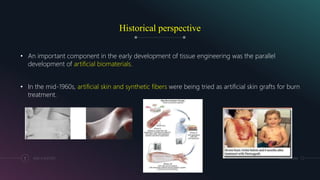
• An important component in the early development of tissue engineering was the parallel
development of artificial biomaterials.
• In the mid-1960s, artificial skin and synthetic fibers were being tried as artificial skin grafts for burn
treatment.
MM.DD.20XXADD A FOOTER7
Historical perspective
MM.DD.20XXADD A FOOTER8
• In the early 1970s, there were concerted efforts to treat artificial surfaces to be used in implants in
ways that would enable them to avoid causing blood coagulation, by applying special heparin
complex coatings.
• One year later, in 1985, Y.C. Fung proposed that the NSF establish a new research center to be known
as the “Center for the Engineering of Living Tissues”.
• In 1988, Joseph Vacanti and Robert Langer published what would be the first of many tissue
engineering papers together — a study of cell transplantation using bioresorbable scaffold carriers.
GOAL OF TISSUE ENGINEERING
Availability
of cell types
needed
Presence or
absence of
cues or
signals
necessary
to recruit
and
stimulate
these cells
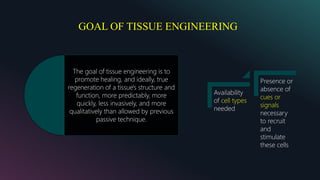
The goal of tissue engineering is to
promote healing, and ideally, true
regeneration of a tissue's structure and
function, more predictably, more
quickly, less invasively, and more
qualitatively than allowed by previous
passive technique.
STRATEGIES TO TISSUE
ENGINEER
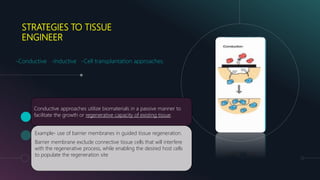
Conductive approaches utilize biomaterials in a passive manner to
facilitate the growth or regenerative capacity of existing tissue.
Example- use of barrier membranes in guided tissue regeneration.
Barrier membrane exclude connective tissue cells that will interfere
with the regenerative process, while enabling the desired host cells
to populate the regeneration site
-Conductive -Inductive -Cell transplantation approaches.
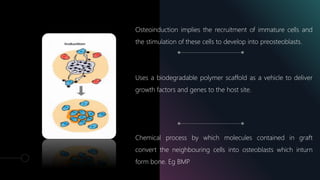
Osteoinduction implies the recruitment of immature cells and
the stimulation of these cells to develop into preosteoblasts.
Uses a biodegradable polymer scaffold as a vehicle to deliver
growth factors and genes to the host site.
Chemical process by which molecules contained in graft
convert the neighbouring cells into osteoblasts which inturn
form bone. Eg BMP
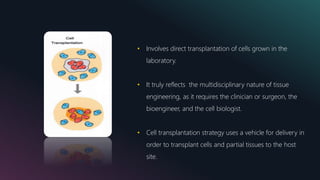
• Involves direct transplantation of cells grown in the
laboratory.
• It truly reflects the multidisciplinary nature of tissue
engineering, as it requires the clinician or surgeon, the
bioengineer, and the cell biologist.
• Cell transplantation strategy uses a vehicle for delivery in
order to transplant cells and partial tissues to the host
site.
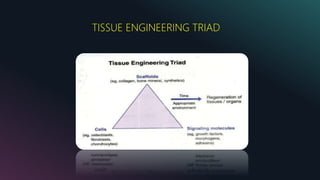
TISSUE ENGINEERING TRIAD
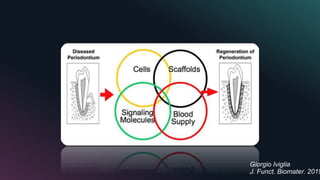
Giorgio Iviglia
J. Funct. Biomater. 2019
MM.DD.20XXADD A FOOTER16
o(I) The stimulation of the growth of the key surrounding tissues by
applying barrier membranes and bone grafting materials and
o(ii) The prevention of the growth and proliferation of undesired cell types
like epithelial cells.
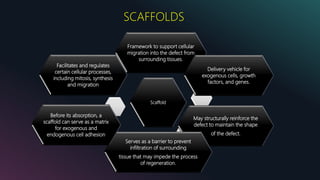
SCAFFOLDS
Scaffold
Framework to support cellular
migration into the defect from
surrounding tissues.
Delivery vehicle for
exogenous cells, growth
factors, and genes.
May structurally reinforce the
defect to maintain the shape
of the defect.
Serves as a barrier to prevent
infiltration of surrounding
tissue that may impede the process
of regeneration.
Before its absorption, a
scaffold can serve as a matrix
for exogenous and
endogenous cell adhesion
Facilitates and regulates
certain cellular processes,
including mitosis, synthesis
and migration
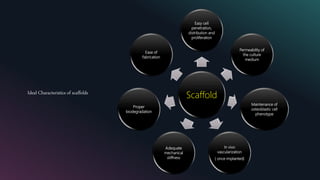
Ideal Characteristics of scaffolds
Scaffold
Easy cell
penetration,
distribution and
proliferation
Permeability of
the culture
medium
Maintenance of
osteoblastic cell
phenotype
In vivo
vascularization
( once implanted)
Adequate
mechanical
stiffness
Proper
biodegradation
Ease of
fabrication
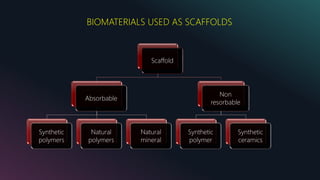
BIOMATERIALS USED AS SCAFFOLDS
Scaffold
Absorbable
Synthetic
polymers
Natural
polymers
Natural
mineral
Non
resorbable
Synthetic
polymer
Synthetic
ceramics
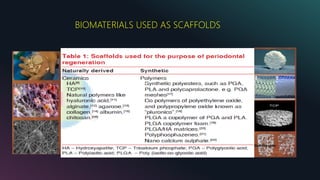
BIOMATERIALS USED AS SCAFFOLDS
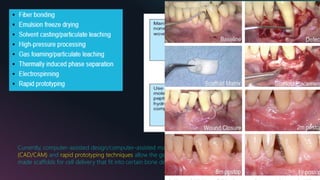
Currently, computer-assisted design/computer-assisted manufacturing
(CAD/CAM) and rapid prototyping techniques allow the generation of custom-
made scaffolds for cell delivery that fit into certain bone defects.
• Liao et al. in a study compared porous beta-tricalcium phosphate/chitosan composite scaffolds
with pure chitosan scaffolds.
Composite scaffolds showed higher proliferation rate of human periodontal ligament cells
(HPLCs) and up-regulated the gene expression of bone sialoprotein and cementum attachment
protein.
In vivo, HPLCs in the composite scaffold not only proliferated, but also recruited vascular tissue
ingrowth; thus, suggesting the benefit of using these composite scaffolds
MM.DD.20XXADD A FOOTER22
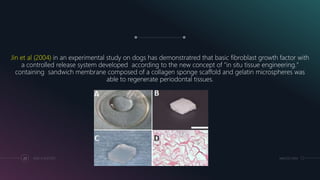
Jin et al (2004) in an experimental study on dogs has demonstratred that basic fibroblast growth factor with
a controlled release system developed according to the new concept of "in situ tissue engineering."
containing sandwich membrane composed of a collagen sponge scaffold and gelatin microspheres was
able to regenerate periodontal tissues.
MM.DD.20XXADD A FOOTER23
CELLS
• Cell source is an important parameter to consider when applying tissue
engineering strategies to restore lost tissues and functions.
CELL
SEEDING
CELL
SUSPENSION
• Cell incorporation into implantable matrices, which ensures their localization at
treatment site – concept being referred to as cell seeding.
• An alternative is to inject a cell suspension into sealed compartment containing
defect.
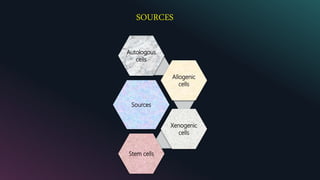
SOURCES
Sources
Autologous
cells
Allogenic
cells
Xenogenic
cells
Stem cells
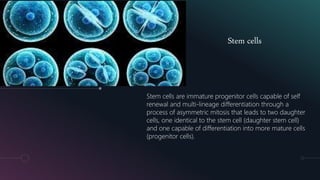
Stem cells
Stem cells are immature progenitor cells capable of self
renewal and multi-lineage differentiation through a
process of asymmetric mitosis that leads to two daughter
cells, one identical to the stem cell (daughter stem cell)
and one capable of differentiation into more mature cells
(progenitor cells).
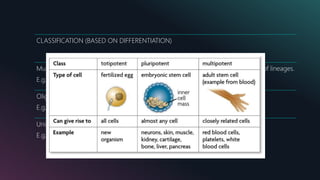
CLASSIFICATION (BASED ON DIFFERENTIATION)
Multipotent: the potential to give rise to cells from multiple, but a limited number of lineages.
E.g.: mesenchymal stem cells
Oligopotent: the capacity to differentiate into a few cell types.
E.g. Myeloid stem cells
Unipotent: the ability to differentiate into only one type of cells.
E.g. Skin.
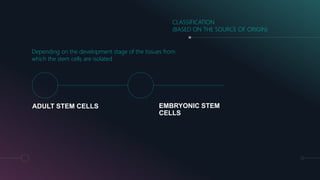
ADULT STEM CELLS EMBRYONIC STEM
CELLS
CLASSIFICATION
(BASED ON THE SOURCE OF ORIGIN)
Depending on the development stage of the tissues from
which the stem cells are isolated
FRIEDENSTEIN AND COLLEGUES
o Embryonic stem cells are derived from
embryos that are 2 – 11 days old called
blastocysts. They are totipotent cells….
o Adult stem cells are multipotent stem
cells, and depending upon their origin,
they can be further classified into
hemopoetic stem cells and mesenchymal
stem cells.
31 ADD A FOOTER MM.DD.20XX
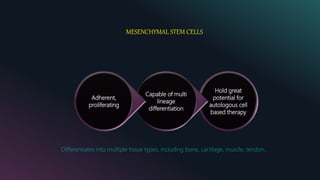
MESENCHYMAL STEM CELLS
Hold great
potential for
autologous cell
based therapy
Capable of multi
lineage
differentiation
Adherent,
proliferating
Differentiates into multiple tissue types, including bone, cartilage, muscle, tendon.
• Another important characteristic of MSCs for regenerative medicine is their potential
allogenic use without immunosuppressive therapy.
• Within the sphere of periodontal tissue engineering, mesenchymal derived cells have
been applied for simultaneous regeneration of the attachment apparatus components.
MM.DD.20XXADD A FOOTER34
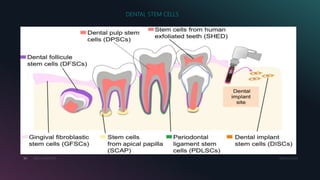
DENTAL STEM CELLS
DENTAL PULP STEM CELLS
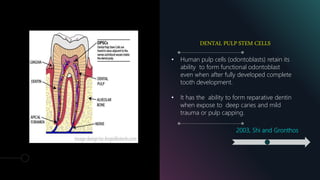
• Human pulp cells (odontoblasts) retain its
ability to form functional odontoblast
even when after fully developed complete
tooth development.
• It has the ability to form reparative dentin
when expose to deep caries and mild
trauma or pulp capping.
2003, Shi and Gronthos
• Easy surgical access to the collection
site and very low morbidity after
extraction of the dental pulp.
DPSCs can generate much more typical
dentin tissues within a short period than
nondental stem cells.
Can be safely cryopreserved and
recombined with many scaffolds.
Possess immuno-privilege and anti-
inflammatory abilities favorable for the
allotransplantation experiments.
MM.DD.20XXADD A FOOTER36
Stem cells from human exfoliated deciduous teeth
MM.DD.20XXADD A FOOTER37
• Dr. Songtao Shi discovered SHED in 2003.
• Miura et al. confirmed that SHED were able to differentiate into a variety of cell types to a
greater extent than DPSCs, including osteoblast-like, odontoblast-like cells, adipocytes, and
neural cells.
• Abbas et al.investigated the possible neural crest origin of SHED.
• The main task of these cells seems to be the formation of mineralized tissue, which can be
used to enhance orofacial bone regeneration
Stem cells from apical papilla (SCAP)
MM.DD.20XXADD A FOOTER38
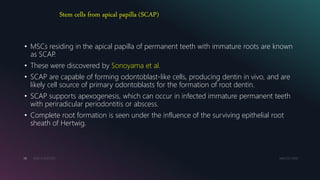
• MSCs residing in the apical papilla of permanent teeth with immature roots are known
as SCAP.
• These were discovered by Sonoyama et al.
• SCAP are capable of forming odontoblast-like cells, producing dentin in vivo, and are
likely cell source of primary odontoblasts for the formation of root dentin.
• SCAP supports apexogenesis, which can occur in infected immature permanent teeth
with periradicular periodontitis or abscess.
• Complete root formation is seen under the influence of the surviving epithelial root
sheath of Hertwig.
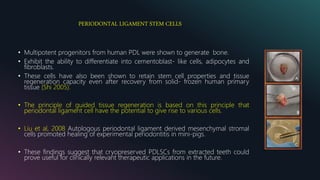
PERIODONTAL LIGAMENT STEM CELLS
• Multipotent progenitors from human PDL were shown to generate bone.
• Exhibit the ability to differentiate into cementoblast- like cells, adipocytes and
fibroblasts.
• These cells have also been shown to retain stem cell properties and tissue
regeneration capacity even after recovery from solid- frozen human primary
tissue (Shi 2005).
• The principle of guided tissue regeneration is based on this principle that
periodontal ligament cell have the potential to give rise to various cells.
• Liu et al, 2008 Autologous periodontal ligament derived mesenchymal stromal
cells promoted healing of experimental periodontitis in mini-pigs.
• These findings suggest that cryopreserved PDLSCs from extracted teeth could
prove useful for clinically relevant therapeutic applications in the future.
WHOLE-TOOTH REGENERATION
• Whole-tooth regeneration efforts largely consist of two approaches:
• One involves in vivo implantation of immature tooth structures grown in vitro from dental
progenitor cells,
• While the other uses in vitro expanded, cultured dental progenitor cell populations seeded
onto polymer scaffolds and implanted in vivo.
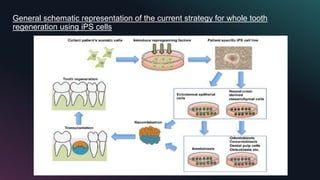
General schematic representation of the current strategy for whole tooth
regeneration using iPS cells
TOOTH STEM CELL BANKING
MM.DD.20XXADD A FOOTER42
• Although tooth banking is currently not very popular the trend is gaining acceptance
mainly in the developed countries.
• The first tooth bank was established in Hiroshima University and the company was
named as “Three Brackets” (Suri Buraketto) in 2005.
• Stemade introduced the concept of dental stem cells banking in India recently by
launching its operations in Mumbai and Delhi.
Signaling molecules
• The two types of signaling molecules that have received the greatest attention are
growth factors and morphogens that act by altering the cell phenotype.
• These have pleotropic effects some of which include:
• Mitogenic
• Chemotactic
• Angiogenic effects
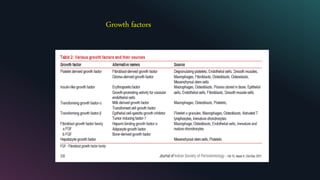
Growth factors
Platelet-derived growth factor
• It was discovered by Lynch and coworkers in the late 1980s.
• Platelet-derived growth factor (PDGF) is the natural wound healing “hormone”.
• PDGF secreted from platelets play an important role in initial wound healing, its
subsequent secretion from macrophages continues the events of wound healing
through up-regulation of other growth factors and cells that ultimately promote
fibroblastic and osteoblastic functions.
• Moon et al. applied PDGF-BB to promote migration and proliferation of periodontal
ligament fibroblasts.
• They demonstrated that PDGF has the capacity to stimulate bone formation and
periodontal regeneration in vivo and indicate that it holds promise as an important
adjuvant to periodontal surgery.
Insulin like growth factor
• Insulin like growth factor-I is found in substantial levels in platelets and is
released during clotting along with the other growth factors.
• Han and Amar demonstrated that in vitro IGF-I substantially enhanced cell survival in
periodontal ligament fibroblast compared to gingival fibroblasts by the up-regulation of
anti-apoptic molecules and down-regulation of pro-apoptotic molecules.
Transforming growth factor
• TGF-β appears to be a major regulator of cell replication and differentiation.
• Three forms of TGF-β have been identified namely TGF-β1, TGF-β2, and
TGF-β3.
• It is chemotactic for fibroblasts and cementoblasts, and promotes fibroblast
accumulation and fibrosis in the healing process
• TGF-β isoforms have multiple regulatory roles in the synthesis, maintenance
and turnover of the extracellular matrix.
Oates et al. compared the
mitogenic activity of TGF-β with
interleukin-1 and PDGF in
fibroblast cells derived from
periodontal ligament explants.
TGF-β was relatively a weak mitogen for
Periodontal (PDL) cells compared to PDGF,
suggesting that TGF-β may indirectly
stimulate DNA synthesis
Fibroblast growth factor
• The two most thoroughly characterized forms are: Basic FGF (bFGF) and
acidic FGF (aFGF).
• Both aFGF and bFGF are single chain proteins that are proteolytically
derived from different precursor molecules to generate biologically active
proteins of 15,000 molecular weight.
• They promote proliferation and attachment of endothelial cells and PDL
cells in wound healing process.
• FGF-2 is known to attract epithelial cells more effectively than FGF-1
Examined the efficiency of topical
application of FGF-2 with
periodontal regeneration in the
bony defects by surgically creating
furcation class II bone defects in
non-human primates and
concluded that a topical
application of FGF-2 can enhance
considerable periodontal
regeneration.
Takayama et
al.
Did a recent randomized clinical trial
trying to evaluate the therapeutic
response to varying doses of FGF-2
(bFGF).
They demonstrated a significant
increase in the alveolar bone height
on using 0.3% FGF-2.
Kitamura et
al.
51 ADD A FOOTER MM.DD.20XX
Hepatocyte growth factor
• Hepatocyte growth factor (HGF) is a
secreted, heparin sulfate
glycosaminoglycan-binding protein.
Yamada et al. cultured fibroblasts in a culture medium
containing HGF and concluded that they produced good cell
proliferation and vascular endothelial growth factor (VEGF)
release.
The results suggest that it may provide a new tool for the
treatment of gingival recession
Bone morphogenetic proteins
• They trigger cellular effects by way of heterotetrameric serine/ theonine
kinase receptors and intracellular signaling proteins.
• They are a group of related proteins that are known to possess the unique
ability to induce cartilage and bone formation.
• BMPs, like PDGF, play a role in the blood vessel formation.
• They play an important role in the angiogenetic activity by up-regulating the
angiogenetic peptides like VEGF, may bind to endothelial cells and stimulate
the migration and promote blood vessel formation.
• The hallmark property of BMP is the differentiation factor.
CLINICAL APPLICATIONS
OF TISSUE ENGINEERING
FOR PERIODONTAL TISSUE
REGENERATION
MM.DD.20XXADD A FOOTER56
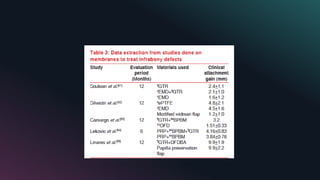
GUIDED TISSUE REGENERATION
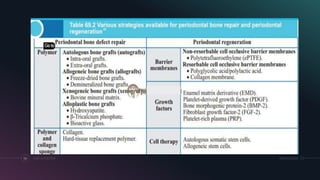
• Nyman and Karring in the 1982 were the first ones to have proposed the use of guided tissue
regeneration for periodontal regeneration, which marked the evolution of periodontal
regeneration technologies using tissue engineering.
• The placement of barrier membranes over the denuded root surface and the debrided
periodontal defect has shown space provision, epithelial cell occlusion, exclusion of gingival
connective tissue from the root surface and selective repopulation of periodontal ligament
cells.
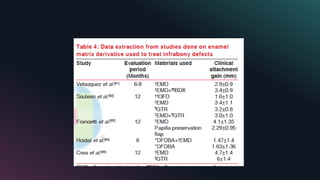
Enamel matrix derivative
Commercially available as Emdogain which have been known to effect
periodontal regeneration
Recent data from a systematic review indicates that biologically EMPs cause an
increase in cell attachment of epithelial cells, gingival fibroblasts, and PDL
fibroblasts.
Stimulation in the synthesis of total protein and extracellular matrix molecules
has also been documented
• The rationale for the clinical use of enamel matrix derivative is the observation that enamel
matrix proteins are deposited onto the surfaces of developing tooth roots before cementum
formation.
They increase the expression of transcription factors that are related to chondroblast and
osteoblasts/cementoblast differentiation
Use of Enamel matrix derivative (EMD) and a demineralized freeze dried bone allograft
(DFDBA) have been demonstrated to be osteopromotive in nature; thus, resulting in an
additional increase in bone formation.
The only concern with the use of EMD has been related to its application and its related
viscous nature, which may not provide sufficient soft tissue/flap support; thus, potentially
limiting the space available for the regeneration process.
Platelet rich plasma
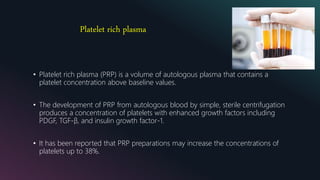
• Platelet rich plasma (PRP) is a volume of autologous plasma that contains a
platelet concentration above baseline values.
• The development of PRP from autologous blood by simple, sterile centrifugation
produces a concentration of platelets with enhanced growth factors including
PDGF, TGF-β, and insulin growth factor-1.
• It has been reported that PRP preparations may increase the concentrations of
platelets up to 38%.
• PRP works through transmembrane receptors and intra cytoplasmic signaling
pathways, as do all other growth factor preparations.
• PRP stimulates the proliferation of human osteogenic cells and periodontal
ligament cells.
• Because of its fibrinogen content, PRP reacts with thrombin and induces fibrin
clot formation, which, in turn, is capable of upregulating collagen synthesis in
the extracellular matrix and provides a favorable scaffold for cellular migration
and adhesion.
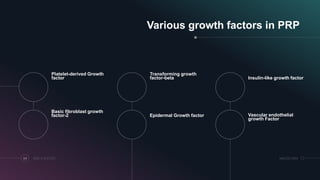
Various growth factors in PRP
Platelet-derived Growth
factor
Transforming growth
factor-beta Insulin-like growth factor
Basic fibroblast growth
factor-2 Epidermal Growth factor Vascular endothelial
growth Factor
64 ADD A FOOTER MM.DD.20XX
MM.DD.20XXADD A FOOTER66
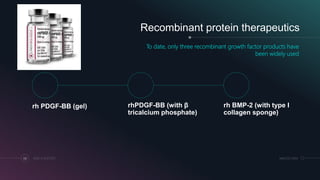
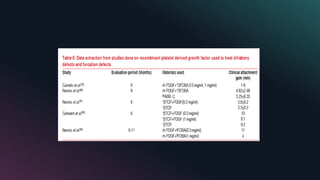
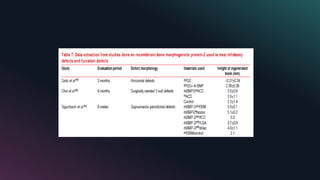
Recombinant protein therapeutics
To date, only three recombinant growth factor products have
been widely used
rh PDGF-BB (gel) rhPDGF-BB (with β
tricalcium phosphate)
rh BMP-2 (with type I
collagen sponge)
• Recombinant platelet derived growth factor (rh PDGF BB) is more than 98% pure
recombinant protein developed using conventional recombinant expression techniques
under highly controlled conditions.
• Use of rh PDGF has been one of the options to regenerate periodontium and has received
FDA clearance for use.
MM.DD.20XXADD A FOOTER68
o The concept of the use of recombinant protein therapeutics
delivered in an allograft matrix has provided significant clinical
results.
o The efficacy of GEM 21S (growth enhanced matrix β
TCP+PDGF), biomimmetic therapeutics were recently
reported by Nevins and co workers
MM.DD.20XXADD A FOOTER69
Studies have also suggested that the use of rh PDGF+ β
TCP and a collagen membrane may represent an acceptable
alternative to connective tissue graft for covering gingival
recession defects.
o Simion M conducted a study using rh PDGF in conjunction
with anorganic bone block for vertical ridge augmentation.
o It resulted in better healing and increased amount of regenerated
Bone.
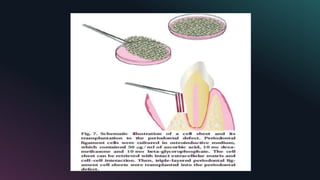
CELL BASED APPROACHES
• Typical cell harvesting methods using enzymatic dispersion might destroy critical cell surface
proteins such as ion channels, while growth factor receptors and cell to cell junctions remain
intact.
• Cell transplantation using autologous cells is expected to play a central clinical role in the
future. Dental cell seeding attempts have attempted to regenerate the periodontal tissues
since 1990s.
• Okano et al. developed temperature responsive culture dishes by grafting a polymer poly N
isopropylacylamide (PIPAAm) onto tissue culture graded polystyrene dishes by irradiation
with an electron beam.
• Cells generally adhere to hydrophobic surfaces, but not to hydrophillic surfaces. At
temperatures lower than 32°C, it is fully hydrated.
• This dish allowed intact cells with preserved extracellular matrix proteins and
normal cell functions to be harvested with just low temperature treatment.
• This has evolved into a novel strategy called “Cell sheet engineering” which
produces tissues without a specific scaffold.
• Transplanted cell sheets can be grafted to the recipient tissues without
suturing.
MM.DD.20XXADD A FOOTER77
Akizuki investigated periodontal healing
after application of PDLcell sheet in
beagle dogs. Results showed that, in
experimental group periodontal tissue
healing with the formation of bone, PDL
and cementum occurred in 3 out of 5
defects.
Flores et al. evaluated whether human PDL
cell sheet could reconstruct periodontal
tissue and found that transplanted PDL cell
sheet cultured with osteogenic differentiation
medium induced periodontal tissue
regeneration containing an obvious
cementum layer and Sharpey’s fiber.
Hasegawa et al. assessed the ability
of periodontal ligament cell sheets to
regenerate the periodontal ligament
tissue and demonstrated its
usefulness in periodontal tissue
Regeneration.
Huang and Zhang have set forward a
hypothesis of transplanting PDL cell obtained
from the periodontium of autogenous
extracted teeth, such as the third molar and
premolar for orthodontic purposes sheets
when cultured using the cell sheet
engineering approach into the implant beds
before inserting the implants.
Gene delivery based approaches
• These techniques involve a gene encoding. A therapeutic protein being introduced
into the cells which can then express the target protein.
• This technique avoids the problems associated with the protein delivery method by
maintaining constant protein levels at the site of the defect.
CHALLENGES AHEAD
MM.DD.20XXADD A FOOTER79
• Structural and functional complexity
of the periodontium.
The fact that more than one tissue
must be reconstructed, namely
alveolar bone, periodontal ligament,
root cementum, and gingiva, makes
it much more difficult to find both the
right combination and the doses of
growth factors.
MM.DD.20XXADD A FOOTER80
To overcome the rapid clearance of growth factors, a carrier system must be
found that stores and releases the growth factors over a longer period of time
so that their resident time is prolonged.
Although many carrier systems have been tested, none of them appears to be
ideal.
MM.DD.20XXADD A FOOTER81
While high developmental and therapeutic costs appear justified
for severe skeletal conditions such as non-unions, open fractures,
spinal fusion, and large bone defects, for example in the
mandible, the same cannot necessarily be said for relatively small
and non-life-threatening periodontal defects where preventive and
maintenance measures are still mandatory.
CONCLUSION
References
o Tissue engineering: A new vista in periodontal regeneration Nymphea Pandit, Rajvir Malik,
Deepa Philips,2017.
o Current overview on dental stem cells applications in regenerative dentistry.Ramta Bansal and
Aditya Jain
o Inside Periodontal Regeneration—A More In-Depth OverviewGiorgio Iviglia
J. Funct. Biomater. 2019
o Tissue engineering. Applications in oral and maxillofacial surgery and periodontics- Samuel E
Lynch, 2nd edition
o Schroeder HE. The periodontium. Handbook of microscopic anatomy. Vol V/5. Berlin: Springer,
1986.
o Newman MG, Takei HH, Kloklevold PR, Carranza FA. Carranza’s clinical periodontology. 10 th
ed. WB Saunders Co; 2006.
o Olive G, Chaumanet G, Genovese MD, Beneduce C, Andrena S. A clinical retrospective
evaluation of 156 consecutive cases. G Dent 2010; 58:126-133.
84 ADD A FOOTER MM.DD.20XX
!

Tissue engineering

  • 1.
    Dr. Thaslim Fathima 2ndYEAR POST-GRADUATE
  • 2.
    CONTENTS • INTRODUCTION • HISTORICALPERSPECTIVE • NEED FOR TISSUE ENGINEERING • CURRENTLY AVAILABLE STRATEGIES EMPLOYED TO ENGINEER TISSUE • SCAFFOLD OR SUPPORTING MATRICES • SOURCES OF CELLS IN TISSUE ENGINEERING • SIGNALING MOLECULES IN TISSUE ENGINEERING • FUTURE DIRECTIONS/ CONSIDERATIONS • CONCLUSION • REFERENCES
  • 3.
    INTRODUCTION Regeneration of theperiodontal tissues is a complex phenomenon requiring interplay between various processes in a timely manner. Langer and collegues 1993 3 ADD A FOOTER MM.DD.20XX Tissue engineering is an interdisciplinary field that applies principles and methods of engineering and the life sciences towards the development of biological substitutes that restore, maintain, and improve the function of damaged tissues and organs. Term ―tissue engineering was coined at a National Science Foundation (N.S.F.) bioengineering meeting in Washington D.C
  • 4.
    Periodontal regeneration In thepast few decades, many attempts have been made to unravel the “magic filler” material that could result in new clinical and histological attachment, but have only culminated in healing by repair. Periodontal repair refers to healing that does not allow the original morphological nor functional restoration of the tissue, considered as non-functional scarring. Tissue engineering was proposed as a possible technique for regenerating lost periodontal tissues by Langer and colleagues in 1993. 4 ADD A FOOTER MM.DD.20XX
  • 5.
    DEFINITION Defined as thereconstruction of living tissues, to be used for replacement of damaged or lost tissue/organs of living organisms; and is founded on the principles of cell biology, development biology and biomaterial sciences. (Nerem R, Sambanis A, 1995)
  • 6.
    DEFINITION As the applicationof principles and methods of engineering and life sciences towards the fundamental understanding of structure-function relationships, in normal and pathological mammalian tissues and the development of biological substitutes that restore, maintain, or improve tissue function. (National Science Foundation workshop)
  • 7.
    Historical perspective • Animportant component in the early development of tissue engineering was the parallel development of artificial biomaterials. • In the mid-1960s, artificial skin and synthetic fibers were being tried as artificial skin grafts for burn treatment. MM.DD.20XXADD A FOOTER7
  • 8.
    Historical perspective MM.DD.20XXADD AFOOTER8 • In the early 1970s, there were concerted efforts to treat artificial surfaces to be used in implants in ways that would enable them to avoid causing blood coagulation, by applying special heparin complex coatings. • One year later, in 1985, Y.C. Fung proposed that the NSF establish a new research center to be known as the “Center for the Engineering of Living Tissues”. • In 1988, Joseph Vacanti and Robert Langer published what would be the first of many tissue engineering papers together — a study of cell transplantation using bioresorbable scaffold carriers.
  • 9.
    GOAL OF TISSUEENGINEERING Availability of cell types needed Presence or absence of cues or signals necessary to recruit and stimulate these cells The goal of tissue engineering is to promote healing, and ideally, true regeneration of a tissue's structure and function, more predictably, more quickly, less invasively, and more qualitatively than allowed by previous passive technique.
  • 10.
    STRATEGIES TO TISSUE ENGINEER Conductiveapproaches utilize biomaterials in a passive manner to facilitate the growth or regenerative capacity of existing tissue. Example- use of barrier membranes in guided tissue regeneration. Barrier membrane exclude connective tissue cells that will interfere with the regenerative process, while enabling the desired host cells to populate the regeneration site -Conductive -Inductive -Cell transplantation approaches.
  • 11.
    Osteoinduction implies therecruitment of immature cells and the stimulation of these cells to develop into preosteoblasts. Uses a biodegradable polymer scaffold as a vehicle to deliver growth factors and genes to the host site. Chemical process by which molecules contained in graft convert the neighbouring cells into osteoblasts which inturn form bone. Eg BMP
  • 12.
    • Involves directtransplantation of cells grown in the laboratory. • It truly reflects the multidisciplinary nature of tissue engineering, as it requires the clinician or surgeon, the bioengineer, and the cell biologist. • Cell transplantation strategy uses a vehicle for delivery in order to transplant cells and partial tissues to the host site.
  • 13.
  • 14.
  • 16.
    MM.DD.20XXADD A FOOTER16 o(I)The stimulation of the growth of the key surrounding tissues by applying barrier membranes and bone grafting materials and o(ii) The prevention of the growth and proliferation of undesired cell types like epithelial cells.
  • 17.
    SCAFFOLDS Scaffold Framework to supportcellular migration into the defect from surrounding tissues. Delivery vehicle for exogenous cells, growth factors, and genes. May structurally reinforce the defect to maintain the shape of the defect. Serves as a barrier to prevent infiltration of surrounding tissue that may impede the process of regeneration. Before its absorption, a scaffold can serve as a matrix for exogenous and endogenous cell adhesion Facilitates and regulates certain cellular processes, including mitosis, synthesis and migration
  • 18.
    Ideal Characteristics ofscaffolds Scaffold Easy cell penetration, distribution and proliferation Permeability of the culture medium Maintenance of osteoblastic cell phenotype In vivo vascularization ( once implanted) Adequate mechanical stiffness Proper biodegradation Ease of fabrication
  • 19.
    BIOMATERIALS USED ASSCAFFOLDS Scaffold Absorbable Synthetic polymers Natural polymers Natural mineral Non resorbable Synthetic polymer Synthetic ceramics
  • 20.
  • 21.
    Currently, computer-assisted design/computer-assistedmanufacturing (CAD/CAM) and rapid prototyping techniques allow the generation of custom- made scaffolds for cell delivery that fit into certain bone defects.
  • 22.
    • Liao etal. in a study compared porous beta-tricalcium phosphate/chitosan composite scaffolds with pure chitosan scaffolds. Composite scaffolds showed higher proliferation rate of human periodontal ligament cells (HPLCs) and up-regulated the gene expression of bone sialoprotein and cementum attachment protein. In vivo, HPLCs in the composite scaffold not only proliferated, but also recruited vascular tissue ingrowth; thus, suggesting the benefit of using these composite scaffolds MM.DD.20XXADD A FOOTER22
  • 23.
    Jin et al(2004) in an experimental study on dogs has demonstratred that basic fibroblast growth factor with a controlled release system developed according to the new concept of "in situ tissue engineering." containing sandwich membrane composed of a collagen sponge scaffold and gelatin microspheres was able to regenerate periodontal tissues. MM.DD.20XXADD A FOOTER23
  • 24.
    CELLS • Cell sourceis an important parameter to consider when applying tissue engineering strategies to restore lost tissues and functions. CELL SEEDING CELL SUSPENSION
  • 25.
    • Cell incorporationinto implantable matrices, which ensures their localization at treatment site – concept being referred to as cell seeding. • An alternative is to inject a cell suspension into sealed compartment containing defect.
  • 26.
  • 27.
    Stem cells Stem cellsare immature progenitor cells capable of self renewal and multi-lineage differentiation through a process of asymmetric mitosis that leads to two daughter cells, one identical to the stem cell (daughter stem cell) and one capable of differentiation into more mature cells (progenitor cells).
  • 28.
    CLASSIFICATION (BASED ONDIFFERENTIATION) Multipotent: the potential to give rise to cells from multiple, but a limited number of lineages. E.g.: mesenchymal stem cells Oligopotent: the capacity to differentiate into a few cell types. E.g. Myeloid stem cells Unipotent: the ability to differentiate into only one type of cells. E.g. Skin.
  • 29.
    ADULT STEM CELLSEMBRYONIC STEM CELLS CLASSIFICATION (BASED ON THE SOURCE OF ORIGIN) Depending on the development stage of the tissues from which the stem cells are isolated
  • 30.
    FRIEDENSTEIN AND COLLEGUES oEmbryonic stem cells are derived from embryos that are 2 – 11 days old called blastocysts. They are totipotent cells…. o Adult stem cells are multipotent stem cells, and depending upon their origin, they can be further classified into hemopoetic stem cells and mesenchymal stem cells. 31 ADD A FOOTER MM.DD.20XX
  • 31.
    MESENCHYMAL STEM CELLS Holdgreat potential for autologous cell based therapy Capable of multi lineage differentiation Adherent, proliferating Differentiates into multiple tissue types, including bone, cartilage, muscle, tendon.
  • 32.
    • Another importantcharacteristic of MSCs for regenerative medicine is their potential allogenic use without immunosuppressive therapy. • Within the sphere of periodontal tissue engineering, mesenchymal derived cells have been applied for simultaneous regeneration of the attachment apparatus components.
  • 33.
  • 34.
    DENTAL PULP STEMCELLS • Human pulp cells (odontoblasts) retain its ability to form functional odontoblast even when after fully developed complete tooth development. • It has the ability to form reparative dentin when expose to deep caries and mild trauma or pulp capping. 2003, Shi and Gronthos
  • 35.
    • Easy surgicalaccess to the collection site and very low morbidity after extraction of the dental pulp. DPSCs can generate much more typical dentin tissues within a short period than nondental stem cells. Can be safely cryopreserved and recombined with many scaffolds. Possess immuno-privilege and anti- inflammatory abilities favorable for the allotransplantation experiments. MM.DD.20XXADD A FOOTER36
  • 36.
    Stem cells fromhuman exfoliated deciduous teeth MM.DD.20XXADD A FOOTER37 • Dr. Songtao Shi discovered SHED in 2003. • Miura et al. confirmed that SHED were able to differentiate into a variety of cell types to a greater extent than DPSCs, including osteoblast-like, odontoblast-like cells, adipocytes, and neural cells. • Abbas et al.investigated the possible neural crest origin of SHED. • The main task of these cells seems to be the formation of mineralized tissue, which can be used to enhance orofacial bone regeneration
  • 37.
    Stem cells fromapical papilla (SCAP) MM.DD.20XXADD A FOOTER38 • MSCs residing in the apical papilla of permanent teeth with immature roots are known as SCAP. • These were discovered by Sonoyama et al. • SCAP are capable of forming odontoblast-like cells, producing dentin in vivo, and are likely cell source of primary odontoblasts for the formation of root dentin. • SCAP supports apexogenesis, which can occur in infected immature permanent teeth with periradicular periodontitis or abscess. • Complete root formation is seen under the influence of the surviving epithelial root sheath of Hertwig.
  • 38.
    PERIODONTAL LIGAMENT STEMCELLS • Multipotent progenitors from human PDL were shown to generate bone. • Exhibit the ability to differentiate into cementoblast- like cells, adipocytes and fibroblasts. • These cells have also been shown to retain stem cell properties and tissue regeneration capacity even after recovery from solid- frozen human primary tissue (Shi 2005). • The principle of guided tissue regeneration is based on this principle that periodontal ligament cell have the potential to give rise to various cells. • Liu et al, 2008 Autologous periodontal ligament derived mesenchymal stromal cells promoted healing of experimental periodontitis in mini-pigs. • These findings suggest that cryopreserved PDLSCs from extracted teeth could prove useful for clinically relevant therapeutic applications in the future.
  • 39.
    WHOLE-TOOTH REGENERATION • Whole-toothregeneration efforts largely consist of two approaches: • One involves in vivo implantation of immature tooth structures grown in vitro from dental progenitor cells, • While the other uses in vitro expanded, cultured dental progenitor cell populations seeded onto polymer scaffolds and implanted in vivo.
  • 40.
    General schematic representationof the current strategy for whole tooth regeneration using iPS cells
  • 41.
    TOOTH STEM CELLBANKING MM.DD.20XXADD A FOOTER42 • Although tooth banking is currently not very popular the trend is gaining acceptance mainly in the developed countries. • The first tooth bank was established in Hiroshima University and the company was named as “Three Brackets” (Suri Buraketto) in 2005. • Stemade introduced the concept of dental stem cells banking in India recently by launching its operations in Mumbai and Delhi.
  • 42.
    Signaling molecules • Thetwo types of signaling molecules that have received the greatest attention are growth factors and morphogens that act by altering the cell phenotype. • These have pleotropic effects some of which include: • Mitogenic • Chemotactic • Angiogenic effects
  • 43.
  • 44.
    Platelet-derived growth factor •It was discovered by Lynch and coworkers in the late 1980s. • Platelet-derived growth factor (PDGF) is the natural wound healing “hormone”. • PDGF secreted from platelets play an important role in initial wound healing, its subsequent secretion from macrophages continues the events of wound healing through up-regulation of other growth factors and cells that ultimately promote fibroblastic and osteoblastic functions.
  • 45.
    • Moon etal. applied PDGF-BB to promote migration and proliferation of periodontal ligament fibroblasts. • They demonstrated that PDGF has the capacity to stimulate bone formation and periodontal regeneration in vivo and indicate that it holds promise as an important adjuvant to periodontal surgery.
  • 46.
    Insulin like growthfactor • Insulin like growth factor-I is found in substantial levels in platelets and is released during clotting along with the other growth factors. • Han and Amar demonstrated that in vitro IGF-I substantially enhanced cell survival in periodontal ligament fibroblast compared to gingival fibroblasts by the up-regulation of anti-apoptic molecules and down-regulation of pro-apoptotic molecules.
  • 47.
    Transforming growth factor •TGF-β appears to be a major regulator of cell replication and differentiation. • Three forms of TGF-β have been identified namely TGF-β1, TGF-β2, and TGF-β3. • It is chemotactic for fibroblasts and cementoblasts, and promotes fibroblast accumulation and fibrosis in the healing process • TGF-β isoforms have multiple regulatory roles in the synthesis, maintenance and turnover of the extracellular matrix.
  • 48.
    Oates et al.compared the mitogenic activity of TGF-β with interleukin-1 and PDGF in fibroblast cells derived from periodontal ligament explants. TGF-β was relatively a weak mitogen for Periodontal (PDL) cells compared to PDGF, suggesting that TGF-β may indirectly stimulate DNA synthesis
  • 49.
    Fibroblast growth factor •The two most thoroughly characterized forms are: Basic FGF (bFGF) and acidic FGF (aFGF). • Both aFGF and bFGF are single chain proteins that are proteolytically derived from different precursor molecules to generate biologically active proteins of 15,000 molecular weight. • They promote proliferation and attachment of endothelial cells and PDL cells in wound healing process. • FGF-2 is known to attract epithelial cells more effectively than FGF-1
  • 50.
    Examined the efficiencyof topical application of FGF-2 with periodontal regeneration in the bony defects by surgically creating furcation class II bone defects in non-human primates and concluded that a topical application of FGF-2 can enhance considerable periodontal regeneration. Takayama et al. Did a recent randomized clinical trial trying to evaluate the therapeutic response to varying doses of FGF-2 (bFGF). They demonstrated a significant increase in the alveolar bone height on using 0.3% FGF-2. Kitamura et al. 51 ADD A FOOTER MM.DD.20XX
  • 51.
    Hepatocyte growth factor •Hepatocyte growth factor (HGF) is a secreted, heparin sulfate glycosaminoglycan-binding protein. Yamada et al. cultured fibroblasts in a culture medium containing HGF and concluded that they produced good cell proliferation and vascular endothelial growth factor (VEGF) release. The results suggest that it may provide a new tool for the treatment of gingival recession
  • 52.
    Bone morphogenetic proteins •They trigger cellular effects by way of heterotetrameric serine/ theonine kinase receptors and intracellular signaling proteins. • They are a group of related proteins that are known to possess the unique ability to induce cartilage and bone formation. • BMPs, like PDGF, play a role in the blood vessel formation.
  • 53.
    • They playan important role in the angiogenetic activity by up-regulating the angiogenetic peptides like VEGF, may bind to endothelial cells and stimulate the migration and promote blood vessel formation. • The hallmark property of BMP is the differentiation factor.
  • 54.
    CLINICAL APPLICATIONS OF TISSUEENGINEERING FOR PERIODONTAL TISSUE REGENERATION
  • 55.
  • 56.
    GUIDED TISSUE REGENERATION •Nyman and Karring in the 1982 were the first ones to have proposed the use of guided tissue regeneration for periodontal regeneration, which marked the evolution of periodontal regeneration technologies using tissue engineering. • The placement of barrier membranes over the denuded root surface and the debrided periodontal defect has shown space provision, epithelial cell occlusion, exclusion of gingival connective tissue from the root surface and selective repopulation of periodontal ligament cells.
  • 58.
    Enamel matrix derivative Commerciallyavailable as Emdogain which have been known to effect periodontal regeneration Recent data from a systematic review indicates that biologically EMPs cause an increase in cell attachment of epithelial cells, gingival fibroblasts, and PDL fibroblasts. Stimulation in the synthesis of total protein and extracellular matrix molecules has also been documented
  • 59.
    • The rationalefor the clinical use of enamel matrix derivative is the observation that enamel matrix proteins are deposited onto the surfaces of developing tooth roots before cementum formation. They increase the expression of transcription factors that are related to chondroblast and osteoblasts/cementoblast differentiation Use of Enamel matrix derivative (EMD) and a demineralized freeze dried bone allograft (DFDBA) have been demonstrated to be osteopromotive in nature; thus, resulting in an additional increase in bone formation. The only concern with the use of EMD has been related to its application and its related viscous nature, which may not provide sufficient soft tissue/flap support; thus, potentially limiting the space available for the regeneration process.
  • 61.
    Platelet rich plasma •Platelet rich plasma (PRP) is a volume of autologous plasma that contains a platelet concentration above baseline values. • The development of PRP from autologous blood by simple, sterile centrifugation produces a concentration of platelets with enhanced growth factors including PDGF, TGF-β, and insulin growth factor-1. • It has been reported that PRP preparations may increase the concentrations of platelets up to 38%.
  • 62.
    • PRP worksthrough transmembrane receptors and intra cytoplasmic signaling pathways, as do all other growth factor preparations. • PRP stimulates the proliferation of human osteogenic cells and periodontal ligament cells. • Because of its fibrinogen content, PRP reacts with thrombin and induces fibrin clot formation, which, in turn, is capable of upregulating collagen synthesis in the extracellular matrix and provides a favorable scaffold for cellular migration and adhesion.
  • 63.
    Various growth factorsin PRP Platelet-derived Growth factor Transforming growth factor-beta Insulin-like growth factor Basic fibroblast growth factor-2 Epidermal Growth factor Vascular endothelial growth Factor 64 ADD A FOOTER MM.DD.20XX
  • 65.
    MM.DD.20XXADD A FOOTER66 Recombinantprotein therapeutics To date, only three recombinant growth factor products have been widely used rh PDGF-BB (gel) rhPDGF-BB (with β tricalcium phosphate) rh BMP-2 (with type I collagen sponge)
  • 66.
    • Recombinant plateletderived growth factor (rh PDGF BB) is more than 98% pure recombinant protein developed using conventional recombinant expression techniques under highly controlled conditions. • Use of rh PDGF has been one of the options to regenerate periodontium and has received FDA clearance for use.
  • 67.
    MM.DD.20XXADD A FOOTER68 oThe concept of the use of recombinant protein therapeutics delivered in an allograft matrix has provided significant clinical results. o The efficacy of GEM 21S (growth enhanced matrix β TCP+PDGF), biomimmetic therapeutics were recently reported by Nevins and co workers
  • 68.
    MM.DD.20XXADD A FOOTER69 Studieshave also suggested that the use of rh PDGF+ β TCP and a collagen membrane may represent an acceptable alternative to connective tissue graft for covering gingival recession defects. o Simion M conducted a study using rh PDGF in conjunction with anorganic bone block for vertical ridge augmentation. o It resulted in better healing and increased amount of regenerated Bone.
  • 71.
    CELL BASED APPROACHES •Typical cell harvesting methods using enzymatic dispersion might destroy critical cell surface proteins such as ion channels, while growth factor receptors and cell to cell junctions remain intact. • Cell transplantation using autologous cells is expected to play a central clinical role in the future. Dental cell seeding attempts have attempted to regenerate the periodontal tissues since 1990s. • Okano et al. developed temperature responsive culture dishes by grafting a polymer poly N isopropylacylamide (PIPAAm) onto tissue culture graded polystyrene dishes by irradiation with an electron beam. • Cells generally adhere to hydrophobic surfaces, but not to hydrophillic surfaces. At temperatures lower than 32°C, it is fully hydrated.
  • 72.
    • This dishallowed intact cells with preserved extracellular matrix proteins and normal cell functions to be harvested with just low temperature treatment. • This has evolved into a novel strategy called “Cell sheet engineering” which produces tissues without a specific scaffold. • Transplanted cell sheets can be grafted to the recipient tissues without suturing.
  • 74.
    MM.DD.20XXADD A FOOTER77 Akizukiinvestigated periodontal healing after application of PDLcell sheet in beagle dogs. Results showed that, in experimental group periodontal tissue healing with the formation of bone, PDL and cementum occurred in 3 out of 5 defects. Flores et al. evaluated whether human PDL cell sheet could reconstruct periodontal tissue and found that transplanted PDL cell sheet cultured with osteogenic differentiation medium induced periodontal tissue regeneration containing an obvious cementum layer and Sharpey’s fiber. Hasegawa et al. assessed the ability of periodontal ligament cell sheets to regenerate the periodontal ligament tissue and demonstrated its usefulness in periodontal tissue Regeneration. Huang and Zhang have set forward a hypothesis of transplanting PDL cell obtained from the periodontium of autogenous extracted teeth, such as the third molar and premolar for orthodontic purposes sheets when cultured using the cell sheet engineering approach into the implant beds before inserting the implants.
  • 75.
    Gene delivery basedapproaches • These techniques involve a gene encoding. A therapeutic protein being introduced into the cells which can then express the target protein. • This technique avoids the problems associated with the protein delivery method by maintaining constant protein levels at the site of the defect.
  • 76.
  • 77.
    • Structural andfunctional complexity of the periodontium. The fact that more than one tissue must be reconstructed, namely alveolar bone, periodontal ligament, root cementum, and gingiva, makes it much more difficult to find both the right combination and the doses of growth factors. MM.DD.20XXADD A FOOTER80
  • 78.
    To overcome therapid clearance of growth factors, a carrier system must be found that stores and releases the growth factors over a longer period of time so that their resident time is prolonged. Although many carrier systems have been tested, none of them appears to be ideal. MM.DD.20XXADD A FOOTER81
  • 79.
    While high developmentaland therapeutic costs appear justified for severe skeletal conditions such as non-unions, open fractures, spinal fusion, and large bone defects, for example in the mandible, the same cannot necessarily be said for relatively small and non-life-threatening periodontal defects where preventive and maintenance measures are still mandatory.
  • 80.
  • 81.
    References o Tissue engineering:A new vista in periodontal regeneration Nymphea Pandit, Rajvir Malik, Deepa Philips,2017. o Current overview on dental stem cells applications in regenerative dentistry.Ramta Bansal and Aditya Jain o Inside Periodontal Regeneration—A More In-Depth OverviewGiorgio Iviglia J. Funct. Biomater. 2019 o Tissue engineering. Applications in oral and maxillofacial surgery and periodontics- Samuel E Lynch, 2nd edition o Schroeder HE. The periodontium. Handbook of microscopic anatomy. Vol V/5. Berlin: Springer, 1986. o Newman MG, Takei HH, Kloklevold PR, Carranza FA. Carranza’s clinical periodontology. 10 th ed. WB Saunders Co; 2006. o Olive G, Chaumanet G, Genovese MD, Beneduce C, Andrena S. A clinical retrospective evaluation of 156 consecutive cases. G Dent 2010; 58:126-133. 84 ADD A FOOTER MM.DD.20XX
  • 82.

Editor's Notes

  • #5 The ultimate goal of periodontal therapy is to completely restore the periodontal attachment including cementum, periodontal ligament, and alveolar bone lost due to periodontal disease or trauma.
  • #10 Whether the damaged tissues heal by regeneration or repair depends upon two crucial factors.
  • #11 Characterised in 3 major classes.. .
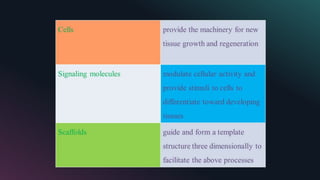
  • #14 The tissue engineering approach to bone and periodontal regeneration combines three key elements to enhance regeneration. 1. Conductive scaffolds/Extracellular matrix. 2. Signalling molecules. 3. Stem/Progenitor cells. This concept is often represented as a triangle, indicating that by combining the three key elements, tissue regeneration can often be accomplished
  • #15 Specifically, periodontal regeneration relies on four basic paradigms [20]: (i) Implanted material (scaffold) acts as a three-dimensional (3D) template supporting new tissue growth; (ii) Cells are the primary building blocks of the reconstructive strategies of periodontal tissue thanks to their proliferation and differentiation; (iii) Bioactive molecules (i.e., growth factors) promote cell activity that results in improved cell proliferation and differentiation; (iv) The blood supply delivers oxygen, nutrients, and essential factors to tissue, and thus promotes the growth of newly formed tissue and helps to maintain homeostasis inside the 3D scaffold
  • #17 OBJECTIVES
  • #18 The scaffold provides a 3D substratum on to which the cells can proliferate and migrate, produce a matrix and form a functional tissue with a desired shape. A suitable bioactive three‑dimensional scaffold for the promotion of cellular proliferation and differentiation is critical in periodontal tissue engineering.
  • #20 S.P- polylactic acid, polyglycolic acid. N.P– collagen(1,2,3,4), fibrin, chitosan. N.M– Anorg bone. --------------- S.P- polytetrafluoroethylene, S.C– Calcium phosphate
  • #21 Biomaterials used as scaffolds in tissue engineering are classified into two broad categories [Table 1]. • Naturally derived. • Synthetic.
  • #22 method of production of the scaffold 3d PRINTED SCAFFOLDS
  • #24 A) Collagen hydrogel. (B) Sponge form of collagen. (C) Collagen hydrogel scaffold. (D) Thin-sliced sections of collagen hydrogel scaffold. Penetration of hydrogel (light-stained area) was observed in the sponge form of collagen.
  • #25 While PDGF-BB is a ligand for the PDGF alpha- and beta-receptor chains, PDGF is a dimeric glycoprotein formed by two A chains (AA), two B chains (BB), or as a heterodimer with an A and a B chain (AB).
  • #26 There are two modes for supplying exogenous cells into defect: Cell seeding, Cell suspension
  • #28 Autologous cells (the host’s own cells). Allogenic cells (cells from a donor).  Xenogenic cells (cells from a different species).  Stem cells: either allogenic (fetal or adult derived) or autologous (adult derived).
  • #30 Totipotent: the ability to differentiate into all type, can form any cell of the embryo as well as the placenta. Eg: morula  Pluripotent: can differentiate into any tissue type except placental tissue. Eg: cells from inner cell mass of the blastocyst.  Multipotent : can differentiate into multiple specialized cells of a closely related family of cells. Eg; haematopoetic stem cell.  Oligopotent : the ability to differentiate into a few cells. Eg; lymphoid  Unipotent : these cells only produce one cell type, but have the property of self renewal which disitinguishes them from the non stem cells. Eg; muscle stem cell, cardiac stem cell.
  • #31 Depending on the development stage of the tissues from which the stem cells are isolated, stem cells can be broadly divided into two categories: Adult stem cells and embryonic stem cells
  • #32 Due to ethical concerns and the risk of tumorogenicity and teratoma formation, it use has been restricted to the research field. Friedenstein and colleagues first identified mesenchymal stem cells in aspirates of adult bone marrow.
  • #33 Among the adults stem cells, bone marrow–derived stem cells or mesenchymal stem cells (MSCs) are imp with characteristics such as. Multi lineage differentiation having the capability of differentiating into multiple tissue types, including bone, cartilage, muscle, tendon, etc.,
  • #35 We can derive stem cells from
  • #36 In 2003, Shi and Gronthos iso­lated dental pulp stem cells through immunoselection.
  • #40 Under defined culture conditions, s are multipotent and exhibit the ability to differentiate into cementoblast- like cells, adipocytes and fibroblasts. The principle of guided tissue regeneration is based on this principle that periodontal ligament cell have the potential to give rise to various cells.
  • #42 Ips-induced pluripotent stem cells…….The patient's somatic cells are harvested. Reprogramming conditions/factors are introduced to induce self-renewal and pluripotency, and patient-specific iPS cells are established. iPS cells are induced to form ectodermal epithelial cells and neural crest-derived mesenchymal cells, and they are further induced to form odontogenic cells in vitro. The two cell populations are combined by direct contact, mimicking the in vivo arrangement. Interaction of these cells leads to formation of an early-stage tooth germ. Once transplanted into the mouth, the recombinants develop and lead to functional recovery from tooth loss.
  • #44 Signaling molecules are proteins that may act locally or systemically to affect the growth and function of cells in various manners… i.e. by causing the differentiation of stem cells into bone forming cells ‑.a process commonly known as osteoinduction. …. (proliferative); (stimulate directed migration of cells); (stimulate new blood vessel formation)
  • #45 Growth factors act on the external cell membrane receptors of a target cell, provide the signal to local mesenchymal and epithelial cells to migrate, divide, and increase matrix synthesis. The growth factor that has received the most attention in hard and soft tissue wound healing is platelet derived growth factor.
  • #46 Platelet-derived growth factor (PDGF) is the natural wound healing “hormone”. It is naturally produced by the body at sites of soft tissue and bone injury…up‑regulation of other growth factors and cells that ultimately promote fibroblastic and osteoblastic functions.
  • #48 is a potent chemotactic agent for vascular endothelial cells resulting in increased neovascularization. It also stimulates mitosis of many cells in vitro such as fibroblasts, osteocytes, and chondrocytes.
  • #49 The 2 best characterized polypeptides from this group of growth factors are (TGF)‑α and TGF‑β. TGF‑β is chemotactic for fibroblasts and cementoblasts, and promotes fibroblast accumulation and fibrosis in the healing process. It can also modulate other growth factors such as PDGF, TGF‑α, and EGF and fibroblast growth factor (FGF) possibly by altering their cellular response or by inducing their expression.
  • #51 Fibroblast growth factors are the members of heparin binding growth factor family. They promote proliferation and attachment of endothelial cells and PDL cells in wound healing process.
  • #53 HGF has been shown to have mitogenic effects on osteoblasts; thus, participating in the bone remodeling process.
  • #54  (BMPs) are the members of transforming growth factor‑β (TGF‑β) superfamily, which play a crucial role in cell growth and differentiation.
  • #55 BMP will differentiate an undifferentiated mesenchymal cell into an osteoblast. In contrast, PDGF is a chemotactic and mitogenic factor for osteoblast like precursors
  • #63 Since physiologic concentrations of growth factors may not be sufficient to stimulate local bone formation, the use of exogenous growth factors to supplement endogenous biological mediators has been explored.
  • #64 whereas epithelial cell proliferation was inhibited The fibrin component of PRP gel works as a hemostatic agent aiding in stabilizing the graft material and the blood clot, It adheres to the root surface and may impede the apical migration of epithelial cells and connective tissue cells from the flap.
  • #67 With advances in recombinant technology, the development and commercialization of pure recombinant human growth factor ‑.matrix combination has been developed
  • #68 They are first produced by removing the specific DNA sequences from a human cell and transfecting it into a bacterial plasmid. The bacterial plasmid is then transfected into the host cells capable of large scale growth. These are essentially protein factories that synthesize and secrete many proteins.
  • #72 The identification and development of recombinant human bone morphogenetic protein‑2 (rhBMP‑2) has lead to the commercial availability for the first time of an osteoinductive autograft replacement (INFUSE® Bone Graft). rhBMP‑2 is a homodimeric protein consisting of two BMP‑2 protein subunits.
  • #74 osteoinductive
  • #84 It is clear that tissue engineering is definitely a novel, and more effective approach to periodontal regeneration and reconstructive therapy and is certainly one that will have a major impact in future health care practice. Continuing efforts should be made to explore means of attaining true regeneration of all periodontal connective tissues (cementum, ligament and bone) and thus restore the original form and function of the dentition in order to improve tooth retention rate.